Manthan
Future Cities: Ensuring World Class
Civic amenities in Urban India
Team Name: Team Underdogs
Institute: Indian institute of Foreign Trade,Kolkata
Member’s Name:
Soumya Bhattacharya (sbh.2110@gmail.com, 9062828681)
Tanmoy Mondal (tanmoy.only4u@gmail.com, 8100234509)
Pankaj Kute (pankajkute83@gmail.com, 9836929564)
Kunal Malhotra (kunal.m42@gmail.com, 9088104819)
Meenakshi Deshpande( meenakshidesh2003@gmail.com,9674463325
Problems of Current cities
Problems with
resources
Water
and
sanitatio
n
Energy
and fuel
Problems with
infrastructure
Congesti
on in
cities
Lack of
space
Problems with administration
and society
Adminis
tration
Social
service
and
commun
ity
Employ
ment
Inclusive
growth
Problems with
environment
Transpor
t issues
Pollutio
n
Energy
guzzling
building
s
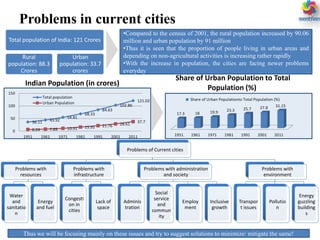
Total population of India: 121 Crores
Rural
population: 88.3
Crores
Urban
population: 33.7
crores
•Compared to the census of 2001, the rural population increased by 90.06
million and urban population by 91 million
•Thus it is seen that the proportion of people living in urban areas and
depending on non-agricultural activities is increasing rather rapidly
•With the increase in population, the cities are facing newer problems
everyday
Problems in current cities
Thus we will be focusing mainly on these issues and try to suggest solutions to minimize/ mitigate the same!
36.11 43.92
54.81
68.33
84.63
102.86
121.02
6.24 7.89 10.91 15.95 21.76 28.61
37.7
0
50
100
150
1951 1961 1971 1981 1991 2001 2011
Indian Population (in crores)
Total population
Urban Population
1951 1961 1971 1981 1991 2001 2011
17.3 18 19.9 23.3 25.7 27.8 31.15
Share of Urban Population to Total
Population (%)
Share of Urban Populationto Total Population (%)
The Compact urban cells concept
 The circle of comfort for
every individual should be a 1
mile radius or a 20 min walk
 Whatever he/she needs
should be made available in his
circle of comfort
 This will make most of the
travelling out of the circle of
comfort redundant
 Cities to consist of multiple
compact urban cells
 These multiple cells to be
interconnected via efficient
transport infrastructure like
highways, metro lines
 This makes it possible to
manage traffic on highways
while reducing the congestion in
the individual cells
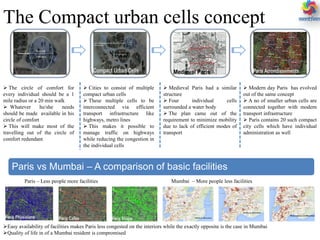
 Medieval Paris had a similar
structure
 Four individual cells
surrounded a water body
 The plan came out of the
requirement to minimize mobility
due to lack of efficient modes of
transport
 Modern day Paris has evolved
out of the same concept
 A no of smaller urban cells are
connected together with modern
transport infrastructure
 Paris contains 20 such compact
city cells which have individual
administration as well
Paris vs Mumbai – A comparison of basic facilities
Paris – Less people more facilities Mumbai – More people less facilities
Easy availability of facilities makes Paris less congested on the interiors while the exactly opposite is the case in Mumbai
Quality of life in of a Mumbai resident is compromised
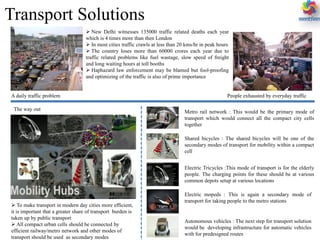
Transport Solutions
 New Delhi witnesses 135000 traffic related deaths each year
which is 4 times more than then London
 In most cities traffic crawls at less than 20 kms/hr in peak hours
 The country loses more than 60000 crores each year due to
traffic related problems like fuel wastage, slow speed of freight
and long waiting hours at toll booths
 Haphazard law enforcement may be blamed but fool-proofing
and optimizing of the traffic is also of prime importance
A daily traffic problem People exhausted by everyday traffic
The way out
 To make transport in modern day cities more efficient,
it is important that a greater share of transport burden is
taken up by public transport
 All compact urban cells should be connected by
efficient railway/metro network and other modes of
transport should be used as secondary modes
Metro rail network : This would be the primary mode of
transport which would connect all the compact city cells
together
Shared bicycles : The shared bicycles will be one of the
secondary modes of transport for mobility within a compact
cell
Electric Tricycles :This mode of transport is for the elderly
people. The charging points for these should be at various
common depots setup at various locations
Electric mopeds : This is again a secondary mode of
transport for taking people to the metro stations
Autonomous vehicles : The next step for transport solution
would be developing infrastructure for automatic vehicles
with for predesigned routes
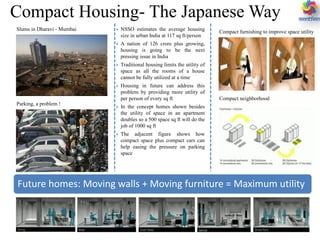
Compact Housing- The Japanese Way
Future homes: Moving walls + Moving furniture = Maximum utility
 NSSO estimates the average housing
size in urban India at 117 sq ft/person
 A nation of 126 crore plus growing,
housing is going to be the next
pressing issue in India
 Traditional housing limits the utility of
space as all the rooms of a house
cannot be fully utilized at a time
 Housing in future can address this
problem by providing more utility of
per person of every sq ft
 In the concept homes shown besides
the utility of space in an apartment
doubles so a 500 space sq ft will do the
job of 1000 sq ft
 The adjacent figure shows how
compact space plus compact cars can
help easing the pressure on parking
space
Slums in Dharavi - Mumbai
Parking, a problem !
Compact furnishing to improve space utility
Compact neighborhood
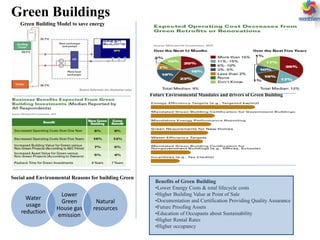
Green Building Model to save energy
Water
usage
reduction
Lower
Green
House gas
emission
Natural
resources
Social and Environmental Reasons for building Green
Future Environmental Mandates and drivers of Green Building
Benefits of Green Building
•Lower Energy Costs & total lifecycle costs
•Higher Building Value at Point of Sale
•Documentation and Certification Providing Quality Assurance
•Future Proofing Assets
•Education of Occupants about Sustainability
•Higher Rental Rates
•Higher occupancy
Green Buildings
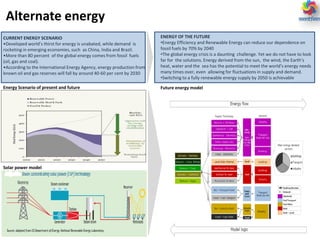
CURRENT ENERGY SCENARIO
•Developed world’s thirst for energy is unabated, while demand is
rocketing in emerging economies, such as China, India and Brazil.
•More than 80 percent of the global energy comes from fossil fuels
(oil, gas and coal).
•According to the International Energy Agency, energy production from
known oil and gas reserves will fall by around 40-60 per cent by 2030
ENERGY OF THE FUTURE
•Energy Efficiency and Renewable Energy can reduce our dependence on
fossil fuels by 70% by 2040
•The global energy crisis is a daunting challenge. Yet we do not have to look
far for the solutions. Energy derived from the sun, the wind, the Earth’s
heat, water and the sea has the potential to meet the world’s energy needs
many times over, even allowing for fluctuations in supply and demand.
•Switching to a fully renewable energy supply by 2050 is achievable
Energy Scenario of present and future
Solar power model
Future energy model
Alternate energy
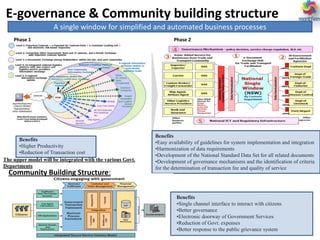
A single window for simplified and automated business processes
Phase 1
Benefits
•Higher Productivity
•Reduction of Transaction cost
The upper model will be integrated with the various Govt.
Departments
Phase 2
Benefits
•Easy availability of guidelines for system implementation and integration
•Harmonization of data requirements
•Development of the National Standard Data Set for all related documents
•Development of governance mechanisms and the identification of criteria
for the determination of transaction fee and quality of service
Community Building Structure:
Benefits
•Single channel interface to interact with citizens
•Better governance
•Electronic doorway of Government Services
•Reduction of Govt. expenses
•Better response to the public grievance system
E-governance & Community building structure
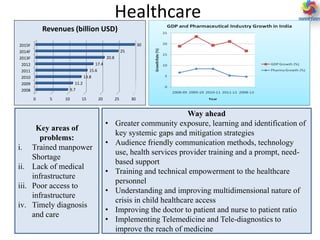
Healthcare
0 5 10 15 20 25 30
2008
2009
2010
2011
2012
2013F
2014F
2015F
9.7
11.2
13.8
15.6
17.4
20.8
25
30
Revenues (billion USD)
Way ahead
• Greater community exposure, learning and identification of
key systemic gaps and mitigation strategies
• Audience friendly communication methods, technology
use, health services provider training and a prompt, need-
based support
• Training and technical empowerment to the healthcare
personnel
• Understanding and improving multidimensional nature of
crisis in child healthcare access
• Improving the doctor to patient and nurse to patient ratio
• Implementing Telemedicine and Tele-diagnostics to
improve the reach of medicine
Key areas of
problems:
i. Trained manpower
Shortage
ii. Lack of medical
infrastructure
iii. Poor access to
infrastructure
iv. Timely diagnosis
and care
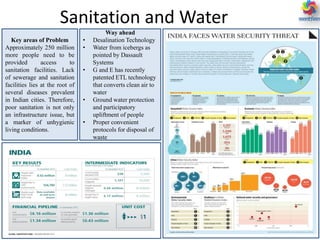
Sanitation and Water
Key areas of Problem
Approximately 250 million
more people need to be
provided access to
sanitation facilities. Lack
of sewerage and sanitation
facilities lies at the root of
several diseases prevalent
in Indian cities. Therefore,
poor sanitation is not only
an infrastructure issue, but
a marker of unhygienic
living conditions.
Way ahead
• Desalination Technology
• Water from icebergs as
pointed by Dassault
Systems
• G and E has recently
patented ETL technology
that converts clean air to
water
• Ground water protection
and participatory
upliftment of people
• Proper convenient
protocols for disposal of
waste
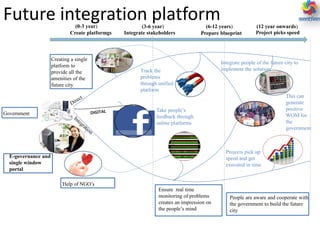
Future integration platform
Government
Creating a single
platform to
provide all the
amenities of the
future city
Create platformgs Integrate stakeholders Prepare blueprint Project picks speed
Track the
problems
through unified
platform
Take people’s
feedback through
online platforms
This can
generate
positive
WOM for
the
government
Projects pick up
speed and get
executed in time
Integrate people of the future city to
implement the solution
Ensure real time
monitoring of problems
creates an impression on
the people’s mind
People are aware and cooperate with
the government to build the future
city
Help of NGO’s
E-governance and
single window
portal
(0-3 year) (3-6 year) (6-12 years) (12 year onwards)
References
Healthcare: http://www.futurehealthsystems.org/india/
http://download.intel.com/design/embedded/medical-solutions/Enabling_Quality_Healthcare_to_All_Case_Study.pdf
Water and sanitation:
http://sitemaker.umich.edu/section9group6/solutions
http://www.entwicklung.at/uploads/media/Brosch%C3%BCre_EcoSanitation_e_August_01.pdf
energy:
http://www.iea.org/publications/freepublications/publication/CoGeneration_RenewablesSolutionsforaLowCarbonEnergyFuture.pdf
http://awsassets.panda.org/downloads/the_energy_report_lowres_111110.pdf
Future transports:
http://www.thepep.org/clearinghouse/docfiles/the.future.of.transport.pdf
http://newsroom.accenture.com/images/20020/transportation.pdf ---------
Green buildings:
http://www.unep.org/gc/gc26/Building-for-the-future.pdf
http://www.swlaw.com/assets/pdf/publications/2010/06/11/Green-Building-Past-Present-Future.pdf -----green rating (LEED)
Pollution:
http://www.umich.edu/~nppcpub/resources/GENp2.pdf
http://www.scottishaffairs.org/backiss/pdfs/sa18/sa18_MacLeod.pdf

IIFTUnderdogs

  • 1.
    Manthan Future Cities: EnsuringWorld Class Civic amenities in Urban India Team Name: Team Underdogs Institute: Indian institute of Foreign Trade,Kolkata Member’s Name: Soumya Bhattacharya (sbh.2110@gmail.com, 9062828681) Tanmoy Mondal (tanmoy.only4u@gmail.com, 8100234509) Pankaj Kute (pankajkute83@gmail.com, 9836929564) Kunal Malhotra (kunal.m42@gmail.com, 9088104819) Meenakshi Deshpande( meenakshidesh2003@gmail.com,9674463325
  • 2.
    Problems of Currentcities Problems with resources Water and sanitatio n Energy and fuel Problems with infrastructure Congesti on in cities Lack of space Problems with administration and society Adminis tration Social service and commun ity Employ ment Inclusive growth Problems with environment Transpor t issues Pollutio n Energy guzzling building s Total population of India: 121 Crores Rural population: 88.3 Crores Urban population: 33.7 crores •Compared to the census of 2001, the rural population increased by 90.06 million and urban population by 91 million •Thus it is seen that the proportion of people living in urban areas and depending on non-agricultural activities is increasing rather rapidly •With the increase in population, the cities are facing newer problems everyday Problems in current cities Thus we will be focusing mainly on these issues and try to suggest solutions to minimize/ mitigate the same! 36.11 43.92 54.81 68.33 84.63 102.86 121.02 6.24 7.89 10.91 15.95 21.76 28.61 37.7 0 50 100 150 1951 1961 1971 1981 1991 2001 2011 Indian Population (in crores) Total population Urban Population 1951 1961 1971 1981 1991 2001 2011 17.3 18 19.9 23.3 25.7 27.8 31.15 Share of Urban Population to Total Population (%) Share of Urban Populationto Total Population (%)
  • 3.
    The Compact urbancells concept  The circle of comfort for every individual should be a 1 mile radius or a 20 min walk  Whatever he/she needs should be made available in his circle of comfort  This will make most of the travelling out of the circle of comfort redundant  Cities to consist of multiple compact urban cells  These multiple cells to be interconnected via efficient transport infrastructure like highways, metro lines  This makes it possible to manage traffic on highways while reducing the congestion in the individual cells  Medieval Paris had a similar structure  Four individual cells surrounded a water body  The plan came out of the requirement to minimize mobility due to lack of efficient modes of transport  Modern day Paris has evolved out of the same concept  A no of smaller urban cells are connected together with modern transport infrastructure  Paris contains 20 such compact city cells which have individual administration as well Paris vs Mumbai – A comparison of basic facilities Paris – Less people more facilities Mumbai – More people less facilities Easy availability of facilities makes Paris less congested on the interiors while the exactly opposite is the case in Mumbai Quality of life in of a Mumbai resident is compromised
  • 4.
    Transport Solutions  NewDelhi witnesses 135000 traffic related deaths each year which is 4 times more than then London  In most cities traffic crawls at less than 20 kms/hr in peak hours  The country loses more than 60000 crores each year due to traffic related problems like fuel wastage, slow speed of freight and long waiting hours at toll booths  Haphazard law enforcement may be blamed but fool-proofing and optimizing of the traffic is also of prime importance A daily traffic problem People exhausted by everyday traffic The way out  To make transport in modern day cities more efficient, it is important that a greater share of transport burden is taken up by public transport  All compact urban cells should be connected by efficient railway/metro network and other modes of transport should be used as secondary modes Metro rail network : This would be the primary mode of transport which would connect all the compact city cells together Shared bicycles : The shared bicycles will be one of the secondary modes of transport for mobility within a compact cell Electric Tricycles :This mode of transport is for the elderly people. The charging points for these should be at various common depots setup at various locations Electric mopeds : This is again a secondary mode of transport for taking people to the metro stations Autonomous vehicles : The next step for transport solution would be developing infrastructure for automatic vehicles with for predesigned routes
  • 5.
    Compact Housing- TheJapanese Way Future homes: Moving walls + Moving furniture = Maximum utility  NSSO estimates the average housing size in urban India at 117 sq ft/person  A nation of 126 crore plus growing, housing is going to be the next pressing issue in India  Traditional housing limits the utility of space as all the rooms of a house cannot be fully utilized at a time  Housing in future can address this problem by providing more utility of per person of every sq ft  In the concept homes shown besides the utility of space in an apartment doubles so a 500 space sq ft will do the job of 1000 sq ft  The adjacent figure shows how compact space plus compact cars can help easing the pressure on parking space Slums in Dharavi - Mumbai Parking, a problem ! Compact furnishing to improve space utility Compact neighborhood
  • 6.
    Green Building Modelto save energy Water usage reduction Lower Green House gas emission Natural resources Social and Environmental Reasons for building Green Future Environmental Mandates and drivers of Green Building Benefits of Green Building •Lower Energy Costs & total lifecycle costs •Higher Building Value at Point of Sale •Documentation and Certification Providing Quality Assurance •Future Proofing Assets •Education of Occupants about Sustainability •Higher Rental Rates •Higher occupancy Green Buildings
  • 7.
    CURRENT ENERGY SCENARIO •Developedworld’s thirst for energy is unabated, while demand is rocketing in emerging economies, such as China, India and Brazil. •More than 80 percent of the global energy comes from fossil fuels (oil, gas and coal). •According to the International Energy Agency, energy production from known oil and gas reserves will fall by around 40-60 per cent by 2030 ENERGY OF THE FUTURE •Energy Efficiency and Renewable Energy can reduce our dependence on fossil fuels by 70% by 2040 •The global energy crisis is a daunting challenge. Yet we do not have to look far for the solutions. Energy derived from the sun, the wind, the Earth’s heat, water and the sea has the potential to meet the world’s energy needs many times over, even allowing for fluctuations in supply and demand. •Switching to a fully renewable energy supply by 2050 is achievable Energy Scenario of present and future Solar power model Future energy model Alternate energy
  • 8.
    A single windowfor simplified and automated business processes Phase 1 Benefits •Higher Productivity •Reduction of Transaction cost The upper model will be integrated with the various Govt. Departments Phase 2 Benefits •Easy availability of guidelines for system implementation and integration •Harmonization of data requirements •Development of the National Standard Data Set for all related documents •Development of governance mechanisms and the identification of criteria for the determination of transaction fee and quality of service Community Building Structure: Benefits •Single channel interface to interact with citizens •Better governance •Electronic doorway of Government Services •Reduction of Govt. expenses •Better response to the public grievance system E-governance & Community building structure
  • 9.
    Healthcare 0 5 1015 20 25 30 2008 2009 2010 2011 2012 2013F 2014F 2015F 9.7 11.2 13.8 15.6 17.4 20.8 25 30 Revenues (billion USD) Way ahead • Greater community exposure, learning and identification of key systemic gaps and mitigation strategies • Audience friendly communication methods, technology use, health services provider training and a prompt, need- based support • Training and technical empowerment to the healthcare personnel • Understanding and improving multidimensional nature of crisis in child healthcare access • Improving the doctor to patient and nurse to patient ratio • Implementing Telemedicine and Tele-diagnostics to improve the reach of medicine Key areas of problems: i. Trained manpower Shortage ii. Lack of medical infrastructure iii. Poor access to infrastructure iv. Timely diagnosis and care
  • 10.
    Sanitation and Water Keyareas of Problem Approximately 250 million more people need to be provided access to sanitation facilities. Lack of sewerage and sanitation facilities lies at the root of several diseases prevalent in Indian cities. Therefore, poor sanitation is not only an infrastructure issue, but a marker of unhygienic living conditions. Way ahead • Desalination Technology • Water from icebergs as pointed by Dassault Systems • G and E has recently patented ETL technology that converts clean air to water • Ground water protection and participatory upliftment of people • Proper convenient protocols for disposal of waste
  • 11.
    Future integration platform Government Creatinga single platform to provide all the amenities of the future city Create platformgs Integrate stakeholders Prepare blueprint Project picks speed Track the problems through unified platform Take people’s feedback through online platforms This can generate positive WOM for the government Projects pick up speed and get executed in time Integrate people of the future city to implement the solution Ensure real time monitoring of problems creates an impression on the people’s mind People are aware and cooperate with the government to build the future city Help of NGO’s E-governance and single window portal (0-3 year) (3-6 year) (6-12 years) (12 year onwards)
  • 12.
    References Healthcare: http://www.futurehealthsystems.org/india/ http://download.intel.com/design/embedded/medical-solutions/Enabling_Quality_Healthcare_to_All_Case_Study.pdf Water andsanitation: http://sitemaker.umich.edu/section9group6/solutions http://www.entwicklung.at/uploads/media/Brosch%C3%BCre_EcoSanitation_e_August_01.pdf energy: http://www.iea.org/publications/freepublications/publication/CoGeneration_RenewablesSolutionsforaLowCarbonEnergyFuture.pdf http://awsassets.panda.org/downloads/the_energy_report_lowres_111110.pdf Future transports: http://www.thepep.org/clearinghouse/docfiles/the.future.of.transport.pdf http://newsroom.accenture.com/images/20020/transportation.pdf --------- Green buildings: http://www.unep.org/gc/gc26/Building-for-the-future.pdf http://www.swlaw.com/assets/pdf/publications/2010/06/11/Green-Building-Past-Present-Future.pdf -----green rating (LEED) Pollution: http://www.umich.edu/~nppcpub/resources/GENp2.pdf http://www.scottishaffairs.org/backiss/pdfs/sa18/sa18_MacLeod.pdf