Practical statistical network analysis 
(with R and igraph) 
G´abor Cs´ardi 
csardi@rmki.kfki.hu 
Department of Biophysics, KFKI Research Institute for Nuclear and Particle Physics of the 
Hungarian Academy of Sciences, Budapest, Hungary 
Currently at 
Department of Medical Genetics, 
University of Lausanne, Lausanne, Switzerland
What is a network (or graph)? 
Practical statistical network analysis – WU Wien 2
What is a network (or graph)? 
Practical statistical network analysis – WU Wien 3
What is a network (or graph)? 
Practical statistical network analysis – WU Wien 4
What is a graph? 
• Binary relation (=edges) between elements of a set (=vertices).
What is a graph? 
• Binary relation (=edges) between elements of a set (=vertices). 
• E.g. 
vertices = {A,B,C,D,E} 
edges = ({A,B}, {A,C}, {B,C}, {C,E}).
What is a graph? 
• Binary relation (=edges) between elements of a set (=vertices). 
• E.g. 
vertices = {A,B,C,D,E} 
edges = ({A,B}, {A,C}, {B,C}, {C,E}). 
• It is“better”to draw it: 
E D 
C 
A B
What is a graph? 
• Binary relation (=edges) between elements of a set (=vertices). 
• E.g. 
vertices = {A,B,C,D,E} 
edges = ({A,B}, {A,C}, {B,C}, {C,E}). 
• It is“better”to draw it: 
E D 
C 
A B 
A 
B 
C 
E 
D 
Practical statistical network analysis – WU Wien 5
Undirected and directed graphs 
• If the pairs are unordered, then the graph is undirected: 
vertices = {A,B,C,D,E} 
edges = ({A,B}, {A,C}, {B,C}, {C,E}). 
A 
B 
C 
E 
D
Undirected and directed graphs 
• If the pairs are unordered, then the graph is undirected: 
vertices = {A,B,C,D,E} 
edges = ({A,B}, {A,C}, {B,C}, {C,E}). 
A 
B 
C 
E 
D 
• Otherwise it is directed: 
vertices = {A,B,C,D,E} 
edges = ((A,B), (A,C), (B,C), (C,E)). 
A 
B 
C 
E 
D 
Practical statistical network analysis – WU Wien 6
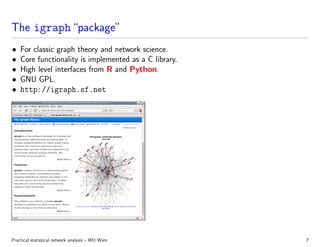
The igraph“package” 
• For classic graph theory and network science. 
• Core functionality is implemented as a C library. 
• High level interfaces from R and Python. 
• GNU GPL. 
• http://igraph.sf.net 
Practical statistical network analysis – WU Wien 7
Vertex and edge ids 
• Vertices are always numbered from zero (!). 
• Numbering is continual, form 0 to |V | − 1.
Vertex and edge ids 
• Vertices are always numbered from zero (!). 
• Numbering is continual, form 0 to |V | − 1. 
• We have to“translate”vertex names to ids: 
V = {A,B,C,D,E} 
E = ((A,B), (A,C), (B,C), (C,E)). 
A = 0,B = 1,C = 2,D = 3,E = 4.
Vertex and edge ids 
• Vertices are always numbered from zero (!). 
• Numbering is continual, form 0 to |V | − 1. 
• We have to“translate”vertex names to ids: 
V = {A,B,C,D,E} 
E = ((A,B), (A,C), (B,C), (C,E)). 
A = 0,B = 1,C = 2,D = 3,E = 4. 
1 > g <- graph( c(0,1, 0,2, 1,2, 2,4), n=5 ) 
Practical statistical network analysis – WU Wien 8
Creating igraph graphs 
• igraph objects
Creating igraph graphs 
• igraph objects 
• print(), summary(), is.igraph()
Creating igraph graphs 
• igraph objects 
• print(), summary(), is.igraph() 
• is.directed(), vcount(), ecount() 
1 > g <- graph( c(0,1, 0,2, 1,2, 2,4), n=5 ) 
2 > g 
3 Vertices: 5 
4 Edges: 4 
5 Directed: TRUE 
6 Edges: 
7 
8 [0] 0 -> 1 
9 [1] 0 -> 2 
10 [2] 1 -> 2 
11 [3] 2 -> 4 
Practical statistical network analysis – WU Wien 9
Visualization 
1 > g <- graph.tree(40, 4) 
2 > plot(g) 
3 > plot(g, layout=layout.circle)
Visualization 
1 > g <- graph.tree(40, 4) 
2 > plot(g) 
3 > plot(g, layout=layout.circle) 
1 # Force directed layouts 
2 > plot(g, layout=layout.fruchterman.reingold) 
3 > plot(g, layout=layout.graphopt) 
4 > plot(g, layout=layout.kamada.kawai)
Visualization 
1 > g <- graph.tree(40, 4) 
2 > plot(g) 
3 > plot(g, layout=layout.circle) 
1 # Force directed layouts 
2 > plot(g, layout=layout.fruchterman.reingold) 
3 > plot(g, layout=layout.graphopt) 
4 > plot(g, layout=layout.kamada.kawai) 
1 # Interactive 
2 > tkplot(g, layout=layout.kamada.kawai) 
3 > l <- layout=layout.kamada.kawai(g)
Visualization 
1 > g <- graph.tree(40, 4) 
2 > plot(g) 
3 > plot(g, layout=layout.circle) 
1 # Force directed layouts 
2 > plot(g, layout=layout.fruchterman.reingold) 
3 > plot(g, layout=layout.graphopt) 
4 > plot(g, layout=layout.kamada.kawai) 
1 # Interactive 
2 > tkplot(g, layout=layout.kamada.kawai) 
3 > l <- layout=layout.kamada.kawai(g) 
1 # 3D 
2 > rglplot(g, layout=l)
Visualization 
1 > g <- graph.tree(40, 4) 
2 > plot(g) 
3 > plot(g, layout=layout.circle) 
1 # Force directed layouts 
2 > plot(g, layout=layout.fruchterman.reingold) 
3 > plot(g, layout=layout.graphopt) 
4 > plot(g, layout=layout.kamada.kawai) 
1 # Interactive 
2 > tkplot(g, layout=layout.kamada.kawai) 
3 > l <- layout=layout.kamada.kawai(g) 
1 # 3D 
2 > rglplot(g, layout=l) 
1 # Visual properties 
2 > plot(g, layout=l, vertex.color="cyan") 
Practical statistical network analysis – WU Wien 10
Simple graphs 
• igraph can handle multi-graphs: 
V = {A,B,C,D,E} 
E = ((AB), (AB), (AC), (BC), (CE)). 
1 > g <- graph( c(0,1,0,1, 0,2, 1,2, 3,4), n=5 ) 
2 > g 
3 Vertices: 5 
4 Edges: 5 
5 Directed: TRUE 
6 Edges: 
7 
8 [0] 0 -> 1 
9 [1] 0 -> 1 
10 [2] 0 -> 2 
11 [3] 1 -> 2 
12 [4] 3 -> 4 
Practical statistical network analysis – WU Wien 11
Simple graphs 
• igraph can handle loop-edges: 
V = {A,B,C,D,E} 
E = ((AA), (AB), (AC), (BC), (CE)). 
1 > g <- graph( c(0,0,0,1, 0,2, 1,2, 3,4), n=5 ) 
2 > g 
3 Vertices: 5 
4 Edges: 5 
5 Directed: TRUE 
6 Edges: 
7 
8 [0] 0 -> 0 
9 [1] 0 -> 1 
10 [2] 0 -> 2 
11 [3] 1 -> 2 
12 [4] 3 -> 4 
Practical statistical network analysis – WU Wien 12
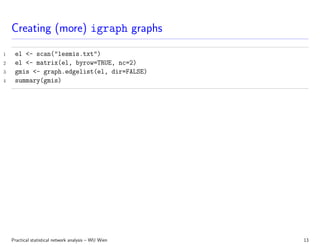
Creating (more) igraph graphs 
1 el <- scan("lesmis.txt") 
2 el <- matrix(el, byrow=TRUE, nc=2) 
3 gmis <- graph.edgelist(el, dir=FALSE) 
4 summary(gmis) 
Practical statistical network analysis – WU Wien 13
Naming vertices 
1 V(gmis)$name 
2 g <- graph.ring(10) 
3 V(g)$name <- sample(letters, vcount(g)) 
Practical statistical network analysis – WU Wien 14
Creating (more) igraph graphs 
1 # A simple undirected graph 
2 > g <- graph.formula( Alice-Bob-Cecil-Alice, 
3 Daniel-Cecil-Eugene, Cecil-Gordon )
Creating (more) igraph graphs 
1 # A simple undirected graph 
2 > g <- graph.formula( Alice-Bob-Cecil-Alice, 
3 Daniel-Cecil-Eugene, Cecil-Gordon ) 
1 # Another undirected graph, ":" notation 
2 > g2 <- graph.formula( Alice-Bob:Cecil:Daniel, 
3 Cecil:Daniel-Eugene:Gordon )
Creating (more) igraph graphs 
1 # A simple undirected graph 
2 > g <- graph.formula( Alice-Bob-Cecil-Alice, 
3 Daniel-Cecil-Eugene, Cecil-Gordon ) 
1 # Another undirected graph, ":" notation 
2 > g2 <- graph.formula( Alice-Bob:Cecil:Daniel, 
3 Cecil:Daniel-Eugene:Gordon ) 
1 # A directed graph 
2 > g3 <- graph.formula( Alice +-+ Bob --+ Cecil 
3 +-- Daniel, Eugene --+ Gordon:Helen )
Creating (more) igraph graphs 
1 # A simple undirected graph 
2 > g <- graph.formula( Alice-Bob-Cecil-Alice, 
3 Daniel-Cecil-Eugene, Cecil-Gordon ) 
1 # Another undirected graph, ":" notation 
2 > g2 <- graph.formula( Alice-Bob:Cecil:Daniel, 
3 Cecil:Daniel-Eugene:Gordon ) 
1 # A directed graph 
2 > g3 <- graph.formula( Alice +-+ Bob --+ Cecil 
3 +-- Daniel, Eugene --+ Gordon:Helen ) 
1 # A graph with isolate vertices 
2 > g4 <- graph.formula( Alice -- Bob -- Daniel, 
3 Cecil:Gordon, Helen )
Creating (more) igraph graphs 
1 # A simple undirected graph 
2 > g <- graph.formula( Alice-Bob-Cecil-Alice, 
3 Daniel-Cecil-Eugene, Cecil-Gordon ) 
1 # Another undirected graph, ":" notation 
2 > g2 <- graph.formula( Alice-Bob:Cecil:Daniel, 
3 Cecil:Daniel-Eugene:Gordon ) 
1 # A directed graph 
2 > g3 <- graph.formula( Alice +-+ Bob --+ Cecil 
3 +-- Daniel, Eugene --+ Gordon:Helen ) 
1 # A graph with isolate vertices 
2 > g4 <- graph.formula( Alice -- Bob -- Daniel, 
3 Cecil:Gordon, Helen ) 
1 # "Arrows" can be arbitrarily long 
2 > g5 <- graph.formula( Alice +---------+ Bob ) 
Practical statistical network analysis – WU Wien 15
Vertex/Edge sets, attributes 
• Assigning attributes: 
set/get.graph/vertex/edge.attribute.
Vertex/Edge sets, attributes 
• Assigning attributes: 
set/get.graph/vertex/edge.attribute. 
• V(g) and E(g).
Vertex/Edge sets, attributes 
• Assigning attributes: 
set/get.graph/vertex/edge.attribute. 
• V(g) and E(g). 
• Smart indexing, e.g. 
V(g)[color=="white"]
Vertex/Edge sets, attributes 
• Assigning attributes: 
set/get.graph/vertex/edge.attribute. 
• V(g) and E(g). 
• Smart indexing, e.g. 
V(g)[color=="white"] 
• Easy access of attributes: 
1 > g <- erdos.renyi.game(100, 1/100) 
2 > V(g)$color <- sample( c("red", "black"), 
3 vcount(g), rep=TRUE) 
4 > E(g)$color <- "grey" 
5 > red <- V(g)[ color == "red" ] 
6 > bl <- V(g)[ color == "black" ] 
7 > E(g)[ red %--% red ]$color <- "red" 
8 > E(g)[ bl %--% bl ]$color <- "black" 
9 > plot(g, vertex.size=5, layout= 
10 layout.fruchterman.reingold) 
Practical statistical network analysis – WU Wien 16
Creating (even) more graphs 
• E.g. from .csv files. 
1 > traits <- read.csv("traits.csv", head=F) 
2 > relations <- read.csv("relations.csv", head=F) 
3 > orgnet <- graph.data.frame(relations) 
4 
5 > traits[,1] <- sapply(strsplit(as.character 
6 (traits[,1]), split=" "), "[[", 1) 
7 > idx <- match(V(orgnet)$name, traits[,1]) 
8 > V(orgnet)$gender <- as.character(traits[,3][idx]) 
9 > V(orgnet)$age <- traits[,2][idx] 
10 
11 > igraph.par("print.vertex.attributes", TRUE) 
12 > orgnet 
Practical statistical network analysis – WU Wien 17
Creating (even) more graphs 
• From the web, e.g. Pajek files. 
1 > karate <- read.graph("http://cneurocvs.rmki.kfki.hu/igraph/karate.net", 
2 format="pajek") 
3 > summary(karate) 
4 Vertices: 34 
5 Edges: 78 
6 Directed: FALSE 
7 No graph attributes. 
8 No vertex attributes. 
9 No edge attributes. 
Practical statistical network analysis – WU Wien 18
Graph representation 
• There is no best format, everything 
depends on what kind of questions 
one wants to ask. 
Alice 
Bob 
Cecil 
Diana 
Esmeralda 
Fabien 
Gigi 
Helen 
Iannis 
Jennifer 
Practical statistical network analysis – WU Wien 19
Graph representation 
• Adjacency matrix. Good for 
questions like: is ’Alice’ connected 
to ’Bob’? 
Alice 
Bob 
Cecil 
Diana 
Esmeralda 
Fabien 
Gigi 
Helen 
Iannis 
Jennifer 
Alice 
Bob 
Cecil 
Diana 
Esmeralda 
Fabien 
Gigi 
Helen 
Iannis 
Jennifer 
0 
1 
0 
0 
1 
0 
0 
1 
0 
1 
1 
0 
0 
1 
0 
0 
1 
1 
0 
0 
0 
0 
0 
1 
0 
1 
1 
0 
0 
0 
0 
1 
1 
0 
1 
0 
1 
1 
1 
0 
1 
0 
0 
1 
0 
1 
0 
1 
1 
0 
0 
0 
1 
0 
1 
0 
0 
1 
0 
0 
0 
1 
1 
1 
0 
0 
0 
1 
0 
0 
1 
1 
0 
1 
1 
1 
1 
0 
0 
1 
0 
0 
0 
1 
1 
0 
0 
0 
0 
0 
1 
0 
0 
0 
0 
0 
0 
1 
0 
0 
Practical statistical network analysis – WU Wien 20
Graph representation 
• Edge list. Not really good for 
anything. 
Alice 
Bob 
Cecil 
Alice 
Diana 
Cecil 
Esmeralda 
Bob 
Cecil 
Diana 
Alice 
Bob 
Diana 
Esmeralda 
Fabien 
Gigi 
Diana 
Esmeralda 
Alice 
Helen 
Bob 
Diana 
Diana 
Esmeralda 
Esmeralda 
Fabien 
Fabien 
Gigi 
Gigi 
Gigi 
Helen 
Helen 
Helen 
Helen 
Helen 
Helen 
Iannis 
Iannis 
Jennifer 
Jennifer 
Practical statistical network analysis – WU Wien 21
Graph representation 
• Adjacency lists. GQ: who are the 
neighbors of ’Alice’? 
Alice 
Bob 
Cecil 
Diana 
Esmeralda 
Fabien 
Gigi 
Helen 
Iannis 
Jennifer 
Bob, Esmeralda, BBBooobbb,,, EEEsssmmmeeerrraaallldddaaa,,, HHHHeeeelllleeeennnn,,,, JJJJeeeennnnnnnniiiiffffeeeerrrr 
AAAAlllliiiicccceeee,,,, DDDDiiiiaaaannnnaaaa,,,, GGGGiiiiggggiiii,,,, HHHHeeeelllleeeennnn 
DDDiiiaaannnaaa,,, FFFaaabbbiiieeennn,,, GGGiiigggiii 
BBBBBBoooooobbbbbb,,,,,, CCCCCCeeeeeecccccciiiiiillllll,,,,,, EEEEEEssssssmmmmmmeeeeeerrrrrraaaaaallllllddddddaaaaaa,,,,,, GGGGGGiiiiiiggggggiiiiii,,,,,, HHHHHHeeeeeelllllleeeeeennnnnn,,,,,, IIIIIIaaaaaannnnnnnnnnnniiiiiissssss 
AAAAAllllliiiiiccccceeeee,,,,, DDDDDiiiiiaaaaannnnnaaaaa,,,,, FFFFFaaaaabbbbbiiiiieeeeennnnn,,,,, HHHHHeeeeellllleeeeennnnn,,,,, IIIIIaaaaannnnnnnnnniiiiisssss 
CCCeeeccciiilll,,, EEEsssmmmeeerrraaallldddaaa,,, HHHeeellleeennn 
BBBBoooobbbb,,,, CCCCeeeecccciiiillll,,,, DDDDiiiiaaaannnnaaaa,,,, HHHHeeeelllleeeennnn 
AAAAAAAllllllliiiiiiiccccccceeeeeee,,,,,,, BBBBBBBooooooobbbbbbb,,,,,,, DDDDDDDiiiiiiiaaaaaaannnnnnnaaaaaaa,,,,,,, EEEEEEEsssssssmmmmmmmeeeeeeerrrrrrraaaaaaallllllldddddddaaaaaaa,,,,,,, FFFFFFFaaaaaaabbbbbbbiiiiiiieeeeeeennnnnnn,,,,,,, GGGGGGGiiiiiiigggggggiiiiiii,,,,,,, JJJJJJJeeeeeeennnnnnnnnnnnnniiiiiiifffffffeeeeeeerrrrrrr 
DDiiaannaa,, EEssmmeerraallddaa 
AAlliiccee,, HHeelleenn 
Practical statistical network analysis – WU Wien 22
Graph representation 
• igraph. Flat data structures, 
indexed edge lists. Easy to handle, 
good for many kind of questions. 
Practical statistical network analysis – WU Wien 23
Centrality in networks 
• degree 
Alice 
4 
Bob 
4 
Cecil 
3 
Diana 
6 
Esmeralda 
5 
Fabien 
3 
Gigi 
4 
Helen 
7 
Iannis 
2 
Jennifer 
2 
Practical statistical network analysis – WU Wien 24
Centrality in networks 
• closeness 
Cv = P|V | − 1 
i6=v dvi 
Alice 
0.6 
Bob 
0.64 
Cecil 
0.53 
Diana 
0.75 
Esmeralda 
0.69 
Fabien 
0.6 
Gigi 
0.64 
Helen 
0.82 
Iannis 
0.53 
Jennifer 
0.5 
Practical statistical network analysis – WU Wien 25
Centrality in networks 
• betweenness 
Bv = 
X 
i6=j,i6=v,j6=v 
givj/gij 
Alice 
1.67 
Bob 
1.12 
Cecil 
0.83 
Diana 
6.76 
Esmeralda 
4.62 
Fabien 
1.45 
Gigi 
1.45 
Helen 
10.1 
Iannis 
0 
Jennifer 
0 
Practical statistical network analysis – WU Wien 26
Centrality in networks 
• eigenvector centrality 
Ev = 
1 
 
X|V | 
i=1 
AivEi, Ax = x 
Alice 
0.63 
Bob 
0.71 
Cecil 
0.46 
Diana 
0.88 
Esmeralda 
0.75 
Fabien 
0.49 
Gigi 
0.68 
Helen 
1 
Iannis 
0.36 
Jennifer 
0.36 
Practical statistical network analysis – WU Wien 27
Centrality in networks 
• page rank 
Ev = 
1 − d 
|V | 
+ d 
X|V | 
i=1 
AivEi 
Alice 
0.61 
Bob 
0.59 
Cecil 
0.47 
Diana 
0.87 
Esmeralda 
0.74 
Fabien 
0.47 
Gigi 
0.59 
Helen 
1 
Iannis 
0.34 
Jennifer 
0.34 
Practical statistical network analysis – WU Wien 28
Community structure in networks 
• Organizing things, clustering items 
to see the structure. 
M. E. J. Newman, PNAS, 103, 8577–8582 
Practical statistical network analysis – WU Wien 29
Community structure in networks 
• How to define what is modular? 
Many proposed definitions, here is 
a popular one: 
Q = 
1 
2|E| 
X 
vw 
[Avw−pvw](cv, cw).
Community structure in networks 
• How to define what is modular? 
Many proposed definitions, here is 
a popular one: 
Q = 
1 
2|E| 
X 
vw 
[Avw−pvw](cv, cw). 
• Random graph null model: 
pvw = p = 
1 
|V |(|V | − 1)
Community structure in networks 
• How to define what is modular? 
Many proposed definitions, here is 
a popular one: 
Q = 
1 
2|E| 
X 
vw 
[Avw−pvw](cv, cw). 
• Random graph null model: 
pvw = p = 
1 
|V |(|V | − 1) 
• Degree sequence based null model: 
pvw = kvkw 
2|E| 
Practical statistical network analysis – WU Wien 30
Cohesive blocks 
(Based on ‘Structural Cohesion and Embeddedness: a Hierarchical Concept of Social 
Groups’ by J.Moody and D.White, Americal Sociological Review, 68, 103–127, 2003) 
Definition 1: A collectivity is structurally cohesive to the extent that the social 
relations of its members hold it together.
Cohesive blocks 
(Based on ‘Structural Cohesion and Embeddedness: a Hierarchical Concept of Social 
Groups’ by J.Moody and D.White, Americal Sociological Review, 68, 103–127, 2003) 
Definition 1: A collectivity is structurally cohesive to the extent that the social 
relations of its members hold it together. 
Definition 2: A group is structurally cohesive to the extent that multiple 
independent relational paths among all pairs of members hold it together.
Cohesive blocks 
(Based on ‘Structural Cohesion and Embeddedness: a Hierarchical Concept of Social 
Groups’ by J.Moody and D.White, Americal Sociological Review, 68, 103–127, 2003) 
Definition 1: A collectivity is structurally cohesive to the extent that the social 
relations of its members hold it together. 
Definition 2: A group is structurally cohesive to the extent that multiple 
independent relational paths among all pairs of members hold it together. 
• Vertex-independent paths and vertex connectivity.
Cohesive blocks 
(Based on ‘Structural Cohesion and Embeddedness: a Hierarchical Concept of Social 
Groups’ by J.Moody and D.White, Americal Sociological Review, 68, 103–127, 2003) 
Definition 1: A collectivity is structurally cohesive to the extent that the social 
relations of its members hold it together. 
Definition 2: A group is structurally cohesive to the extent that multiple 
independent relational paths among all pairs of members hold it together. 
• Vertex-independent paths and vertex connectivity. 
• Vertex connectivity and network flows. 
Practical statistical network analysis – WU Wien 31
Cohesive blocks 
Practical statistical network analysis – WU Wien 32
Cohesive blocks 
Practical statistical network analysis – WU Wien 33
Rapid prototyping 
Weighted transitivity 
c(i) = 
A3 
ii 
(A1A)ii
Rapid prototyping 
Weighted transitivity 
c(i) = 
A3 
ii 
(A1A)ii 
cw(i) = 
W3 
ii 
(WWmaxW)ii
Rapid prototyping 
Weighted transitivity 
c(i) = 
A3 
ii 
(A1A)ii 
cw(i) = 
W3 
ii 
(WWmaxW)ii 
1 wtrans - function(g) { 
2 W - get.adjacency(g, attr=weight) 
3 WM - matrix(max(W), nrow(W), ncol(W)) 
4 diag(WM) - 0 
5 diag( W %*% W %*% W ) / 
6 diag( W %*% WM %*% W) 
7 } 
Practical statistical network analysis – WU Wien 34
Rapid prototyping 
Clique percolation (Palla et 
al., Nature 435, 814, 2005) 
Practical statistical network analysis – WU Wien 35
. . . and the rest 
• Cliques and independent vertex 
sets. 
• Network flows. 
• Motifs, i.e. dyad and triad census. 
• Random graph generators. 
• Graph isomorphism. 
• Vertex similarity measures, 
topological sorting, spanning 
trees, graph components, K-cores, 
transitivity or clustering coefficient. 
• etc. 
• C-level: rich data type library. 
Practical statistical network analysis – WU Wien 36
Acknowledgement 
Tam´as Nepusz 
All the people who contributed code, sent bug reports, suggestions 
The R project 
Hungarian Academy of Sciences 
The OSS community in general 
Practical statistical network analysis – WU Wien 37

Igraph

  • 1.
    Practical statistical networkanalysis (with R and igraph) G´abor Cs´ardi csardi@rmki.kfki.hu Department of Biophysics, KFKI Research Institute for Nuclear and Particle Physics of the Hungarian Academy of Sciences, Budapest, Hungary Currently at Department of Medical Genetics, University of Lausanne, Lausanne, Switzerland
  • 2.
    What is anetwork (or graph)? Practical statistical network analysis – WU Wien 2
  • 3.
    What is anetwork (or graph)? Practical statistical network analysis – WU Wien 3
  • 4.
    What is anetwork (or graph)? Practical statistical network analysis – WU Wien 4
  • 5.
    What is agraph? • Binary relation (=edges) between elements of a set (=vertices).
  • 6.
    What is agraph? • Binary relation (=edges) between elements of a set (=vertices). • E.g. vertices = {A,B,C,D,E} edges = ({A,B}, {A,C}, {B,C}, {C,E}).
  • 7.
    What is agraph? • Binary relation (=edges) between elements of a set (=vertices). • E.g. vertices = {A,B,C,D,E} edges = ({A,B}, {A,C}, {B,C}, {C,E}). • It is“better”to draw it: E D C A B
  • 8.
    What is agraph? • Binary relation (=edges) between elements of a set (=vertices). • E.g. vertices = {A,B,C,D,E} edges = ({A,B}, {A,C}, {B,C}, {C,E}). • It is“better”to draw it: E D C A B A B C E D Practical statistical network analysis – WU Wien 5
  • 9.
    Undirected and directedgraphs • If the pairs are unordered, then the graph is undirected: vertices = {A,B,C,D,E} edges = ({A,B}, {A,C}, {B,C}, {C,E}). A B C E D
  • 10.
    Undirected and directedgraphs • If the pairs are unordered, then the graph is undirected: vertices = {A,B,C,D,E} edges = ({A,B}, {A,C}, {B,C}, {C,E}). A B C E D • Otherwise it is directed: vertices = {A,B,C,D,E} edges = ((A,B), (A,C), (B,C), (C,E)). A B C E D Practical statistical network analysis – WU Wien 6
  • 11.
    The igraph“package” •For classic graph theory and network science. • Core functionality is implemented as a C library. • High level interfaces from R and Python. • GNU GPL. • http://igraph.sf.net Practical statistical network analysis – WU Wien 7
  • 12.
    Vertex and edgeids • Vertices are always numbered from zero (!). • Numbering is continual, form 0 to |V | − 1.
  • 13.
    Vertex and edgeids • Vertices are always numbered from zero (!). • Numbering is continual, form 0 to |V | − 1. • We have to“translate”vertex names to ids: V = {A,B,C,D,E} E = ((A,B), (A,C), (B,C), (C,E)). A = 0,B = 1,C = 2,D = 3,E = 4.
  • 14.
    Vertex and edgeids • Vertices are always numbered from zero (!). • Numbering is continual, form 0 to |V | − 1. • We have to“translate”vertex names to ids: V = {A,B,C,D,E} E = ((A,B), (A,C), (B,C), (C,E)). A = 0,B = 1,C = 2,D = 3,E = 4. 1 > g <- graph( c(0,1, 0,2, 1,2, 2,4), n=5 ) Practical statistical network analysis – WU Wien 8
  • 15.
    Creating igraph graphs • igraph objects
  • 16.
    Creating igraph graphs • igraph objects • print(), summary(), is.igraph()
  • 17.
    Creating igraph graphs • igraph objects • print(), summary(), is.igraph() • is.directed(), vcount(), ecount() 1 > g <- graph( c(0,1, 0,2, 1,2, 2,4), n=5 ) 2 > g 3 Vertices: 5 4 Edges: 4 5 Directed: TRUE 6 Edges: 7 8 [0] 0 -> 1 9 [1] 0 -> 2 10 [2] 1 -> 2 11 [3] 2 -> 4 Practical statistical network analysis – WU Wien 9
  • 18.
    Visualization 1 >g <- graph.tree(40, 4) 2 > plot(g) 3 > plot(g, layout=layout.circle)
  • 19.
    Visualization 1 >g <- graph.tree(40, 4) 2 > plot(g) 3 > plot(g, layout=layout.circle) 1 # Force directed layouts 2 > plot(g, layout=layout.fruchterman.reingold) 3 > plot(g, layout=layout.graphopt) 4 > plot(g, layout=layout.kamada.kawai)
  • 20.
    Visualization 1 >g <- graph.tree(40, 4) 2 > plot(g) 3 > plot(g, layout=layout.circle) 1 # Force directed layouts 2 > plot(g, layout=layout.fruchterman.reingold) 3 > plot(g, layout=layout.graphopt) 4 > plot(g, layout=layout.kamada.kawai) 1 # Interactive 2 > tkplot(g, layout=layout.kamada.kawai) 3 > l <- layout=layout.kamada.kawai(g)
  • 21.
    Visualization 1 >g <- graph.tree(40, 4) 2 > plot(g) 3 > plot(g, layout=layout.circle) 1 # Force directed layouts 2 > plot(g, layout=layout.fruchterman.reingold) 3 > plot(g, layout=layout.graphopt) 4 > plot(g, layout=layout.kamada.kawai) 1 # Interactive 2 > tkplot(g, layout=layout.kamada.kawai) 3 > l <- layout=layout.kamada.kawai(g) 1 # 3D 2 > rglplot(g, layout=l)
  • 22.
    Visualization 1 >g <- graph.tree(40, 4) 2 > plot(g) 3 > plot(g, layout=layout.circle) 1 # Force directed layouts 2 > plot(g, layout=layout.fruchterman.reingold) 3 > plot(g, layout=layout.graphopt) 4 > plot(g, layout=layout.kamada.kawai) 1 # Interactive 2 > tkplot(g, layout=layout.kamada.kawai) 3 > l <- layout=layout.kamada.kawai(g) 1 # 3D 2 > rglplot(g, layout=l) 1 # Visual properties 2 > plot(g, layout=l, vertex.color="cyan") Practical statistical network analysis – WU Wien 10
  • 23.
    Simple graphs •igraph can handle multi-graphs: V = {A,B,C,D,E} E = ((AB), (AB), (AC), (BC), (CE)). 1 > g <- graph( c(0,1,0,1, 0,2, 1,2, 3,4), n=5 ) 2 > g 3 Vertices: 5 4 Edges: 5 5 Directed: TRUE 6 Edges: 7 8 [0] 0 -> 1 9 [1] 0 -> 1 10 [2] 0 -> 2 11 [3] 1 -> 2 12 [4] 3 -> 4 Practical statistical network analysis – WU Wien 11
  • 24.
    Simple graphs •igraph can handle loop-edges: V = {A,B,C,D,E} E = ((AA), (AB), (AC), (BC), (CE)). 1 > g <- graph( c(0,0,0,1, 0,2, 1,2, 3,4), n=5 ) 2 > g 3 Vertices: 5 4 Edges: 5 5 Directed: TRUE 6 Edges: 7 8 [0] 0 -> 0 9 [1] 0 -> 1 10 [2] 0 -> 2 11 [3] 1 -> 2 12 [4] 3 -> 4 Practical statistical network analysis – WU Wien 12
  • 25.
    Creating (more) igraphgraphs 1 el <- scan("lesmis.txt") 2 el <- matrix(el, byrow=TRUE, nc=2) 3 gmis <- graph.edgelist(el, dir=FALSE) 4 summary(gmis) Practical statistical network analysis – WU Wien 13
  • 26.
    Naming vertices 1V(gmis)$name 2 g <- graph.ring(10) 3 V(g)$name <- sample(letters, vcount(g)) Practical statistical network analysis – WU Wien 14
  • 27.
    Creating (more) igraphgraphs 1 # A simple undirected graph 2 > g <- graph.formula( Alice-Bob-Cecil-Alice, 3 Daniel-Cecil-Eugene, Cecil-Gordon )
  • 28.
    Creating (more) igraphgraphs 1 # A simple undirected graph 2 > g <- graph.formula( Alice-Bob-Cecil-Alice, 3 Daniel-Cecil-Eugene, Cecil-Gordon ) 1 # Another undirected graph, ":" notation 2 > g2 <- graph.formula( Alice-Bob:Cecil:Daniel, 3 Cecil:Daniel-Eugene:Gordon )
  • 29.
    Creating (more) igraphgraphs 1 # A simple undirected graph 2 > g <- graph.formula( Alice-Bob-Cecil-Alice, 3 Daniel-Cecil-Eugene, Cecil-Gordon ) 1 # Another undirected graph, ":" notation 2 > g2 <- graph.formula( Alice-Bob:Cecil:Daniel, 3 Cecil:Daniel-Eugene:Gordon ) 1 # A directed graph 2 > g3 <- graph.formula( Alice +-+ Bob --+ Cecil 3 +-- Daniel, Eugene --+ Gordon:Helen )
  • 30.
    Creating (more) igraphgraphs 1 # A simple undirected graph 2 > g <- graph.formula( Alice-Bob-Cecil-Alice, 3 Daniel-Cecil-Eugene, Cecil-Gordon ) 1 # Another undirected graph, ":" notation 2 > g2 <- graph.formula( Alice-Bob:Cecil:Daniel, 3 Cecil:Daniel-Eugene:Gordon ) 1 # A directed graph 2 > g3 <- graph.formula( Alice +-+ Bob --+ Cecil 3 +-- Daniel, Eugene --+ Gordon:Helen ) 1 # A graph with isolate vertices 2 > g4 <- graph.formula( Alice -- Bob -- Daniel, 3 Cecil:Gordon, Helen )
  • 31.
    Creating (more) igraphgraphs 1 # A simple undirected graph 2 > g <- graph.formula( Alice-Bob-Cecil-Alice, 3 Daniel-Cecil-Eugene, Cecil-Gordon ) 1 # Another undirected graph, ":" notation 2 > g2 <- graph.formula( Alice-Bob:Cecil:Daniel, 3 Cecil:Daniel-Eugene:Gordon ) 1 # A directed graph 2 > g3 <- graph.formula( Alice +-+ Bob --+ Cecil 3 +-- Daniel, Eugene --+ Gordon:Helen ) 1 # A graph with isolate vertices 2 > g4 <- graph.formula( Alice -- Bob -- Daniel, 3 Cecil:Gordon, Helen ) 1 # "Arrows" can be arbitrarily long 2 > g5 <- graph.formula( Alice +---------+ Bob ) Practical statistical network analysis – WU Wien 15
  • 32.
    Vertex/Edge sets, attributes • Assigning attributes: set/get.graph/vertex/edge.attribute.
  • 33.
    Vertex/Edge sets, attributes • Assigning attributes: set/get.graph/vertex/edge.attribute. • V(g) and E(g).
  • 34.
    Vertex/Edge sets, attributes • Assigning attributes: set/get.graph/vertex/edge.attribute. • V(g) and E(g). • Smart indexing, e.g. V(g)[color=="white"]
  • 35.
    Vertex/Edge sets, attributes • Assigning attributes: set/get.graph/vertex/edge.attribute. • V(g) and E(g). • Smart indexing, e.g. V(g)[color=="white"] • Easy access of attributes: 1 > g <- erdos.renyi.game(100, 1/100) 2 > V(g)$color <- sample( c("red", "black"), 3 vcount(g), rep=TRUE) 4 > E(g)$color <- "grey" 5 > red <- V(g)[ color == "red" ] 6 > bl <- V(g)[ color == "black" ] 7 > E(g)[ red %--% red ]$color <- "red" 8 > E(g)[ bl %--% bl ]$color <- "black" 9 > plot(g, vertex.size=5, layout= 10 layout.fruchterman.reingold) Practical statistical network analysis – WU Wien 16
  • 36.
    Creating (even) moregraphs • E.g. from .csv files. 1 > traits <- read.csv("traits.csv", head=F) 2 > relations <- read.csv("relations.csv", head=F) 3 > orgnet <- graph.data.frame(relations) 4 5 > traits[,1] <- sapply(strsplit(as.character 6 (traits[,1]), split=" "), "[[", 1) 7 > idx <- match(V(orgnet)$name, traits[,1]) 8 > V(orgnet)$gender <- as.character(traits[,3][idx]) 9 > V(orgnet)$age <- traits[,2][idx] 10 11 > igraph.par("print.vertex.attributes", TRUE) 12 > orgnet Practical statistical network analysis – WU Wien 17
  • 37.
    Creating (even) moregraphs • From the web, e.g. Pajek files. 1 > karate <- read.graph("http://cneurocvs.rmki.kfki.hu/igraph/karate.net", 2 format="pajek") 3 > summary(karate) 4 Vertices: 34 5 Edges: 78 6 Directed: FALSE 7 No graph attributes. 8 No vertex attributes. 9 No edge attributes. Practical statistical network analysis – WU Wien 18
  • 38.
    Graph representation •There is no best format, everything depends on what kind of questions one wants to ask. Alice Bob Cecil Diana Esmeralda Fabien Gigi Helen Iannis Jennifer Practical statistical network analysis – WU Wien 19
  • 39.
    Graph representation •Adjacency matrix. Good for questions like: is ’Alice’ connected to ’Bob’? Alice Bob Cecil Diana Esmeralda Fabien Gigi Helen Iannis Jennifer Alice Bob Cecil Diana Esmeralda Fabien Gigi Helen Iannis Jennifer 0 1 0 0 1 0 0 1 0 1 1 0 0 1 0 0 1 1 0 0 0 0 0 1 0 1 1 0 0 0 0 1 1 0 1 0 1 1 1 0 1 0 0 1 0 1 0 1 1 0 0 0 1 0 1 0 0 1 0 0 0 1 1 1 0 0 0 1 0 0 1 1 0 1 1 1 1 0 0 1 0 0 0 1 1 0 0 0 0 0 1 0 0 0 0 0 0 1 0 0 Practical statistical network analysis – WU Wien 20
  • 40.
    Graph representation •Edge list. Not really good for anything. Alice Bob Cecil Alice Diana Cecil Esmeralda Bob Cecil Diana Alice Bob Diana Esmeralda Fabien Gigi Diana Esmeralda Alice Helen Bob Diana Diana Esmeralda Esmeralda Fabien Fabien Gigi Gigi Gigi Helen Helen Helen Helen Helen Helen Iannis Iannis Jennifer Jennifer Practical statistical network analysis – WU Wien 21
  • 41.
    Graph representation •Adjacency lists. GQ: who are the neighbors of ’Alice’? Alice Bob Cecil Diana Esmeralda Fabien Gigi Helen Iannis Jennifer Bob, Esmeralda, BBBooobbb,,, EEEsssmmmeeerrraaallldddaaa,,, HHHHeeeelllleeeennnn,,,, JJJJeeeennnnnnnniiiiffffeeeerrrr AAAAlllliiiicccceeee,,,, DDDDiiiiaaaannnnaaaa,,,, GGGGiiiiggggiiii,,,, HHHHeeeelllleeeennnn DDDiiiaaannnaaa,,, FFFaaabbbiiieeennn,,, GGGiiigggiii BBBBBBoooooobbbbbb,,,,,, CCCCCCeeeeeecccccciiiiiillllll,,,,,, EEEEEEssssssmmmmmmeeeeeerrrrrraaaaaallllllddddddaaaaaa,,,,,, GGGGGGiiiiiiggggggiiiiii,,,,,, HHHHHHeeeeeelllllleeeeeennnnnn,,,,,, IIIIIIaaaaaannnnnnnnnnnniiiiiissssss AAAAAllllliiiiiccccceeeee,,,,, DDDDDiiiiiaaaaannnnnaaaaa,,,,, FFFFFaaaaabbbbbiiiiieeeeennnnn,,,,, HHHHHeeeeellllleeeeennnnn,,,,, IIIIIaaaaannnnnnnnnniiiiisssss CCCeeeccciiilll,,, EEEsssmmmeeerrraaallldddaaa,,, HHHeeellleeennn BBBBoooobbbb,,,, CCCCeeeecccciiiillll,,,, DDDDiiiiaaaannnnaaaa,,,, HHHHeeeelllleeeennnn AAAAAAAllllllliiiiiiiccccccceeeeeee,,,,,,, BBBBBBBooooooobbbbbbb,,,,,,, DDDDDDDiiiiiiiaaaaaaannnnnnnaaaaaaa,,,,,,, EEEEEEEsssssssmmmmmmmeeeeeeerrrrrrraaaaaaallllllldddddddaaaaaaa,,,,,,, FFFFFFFaaaaaaabbbbbbbiiiiiiieeeeeeennnnnnn,,,,,,, GGGGGGGiiiiiiigggggggiiiiiii,,,,,,, JJJJJJJeeeeeeennnnnnnnnnnnnniiiiiiifffffffeeeeeeerrrrrrr DDiiaannaa,, EEssmmeerraallddaa AAlliiccee,, HHeelleenn Practical statistical network analysis – WU Wien 22
  • 42.
    Graph representation •igraph. Flat data structures, indexed edge lists. Easy to handle, good for many kind of questions. Practical statistical network analysis – WU Wien 23
  • 43.
    Centrality in networks • degree Alice 4 Bob 4 Cecil 3 Diana 6 Esmeralda 5 Fabien 3 Gigi 4 Helen 7 Iannis 2 Jennifer 2 Practical statistical network analysis – WU Wien 24
  • 44.
    Centrality in networks • closeness Cv = P|V | − 1 i6=v dvi Alice 0.6 Bob 0.64 Cecil 0.53 Diana 0.75 Esmeralda 0.69 Fabien 0.6 Gigi 0.64 Helen 0.82 Iannis 0.53 Jennifer 0.5 Practical statistical network analysis – WU Wien 25
  • 45.
    Centrality in networks • betweenness Bv = X i6=j,i6=v,j6=v givj/gij Alice 1.67 Bob 1.12 Cecil 0.83 Diana 6.76 Esmeralda 4.62 Fabien 1.45 Gigi 1.45 Helen 10.1 Iannis 0 Jennifer 0 Practical statistical network analysis – WU Wien 26
  • 46.
    Centrality in networks • eigenvector centrality Ev = 1 X|V | i=1 AivEi, Ax = x Alice 0.63 Bob 0.71 Cecil 0.46 Diana 0.88 Esmeralda 0.75 Fabien 0.49 Gigi 0.68 Helen 1 Iannis 0.36 Jennifer 0.36 Practical statistical network analysis – WU Wien 27
  • 47.
    Centrality in networks • page rank Ev = 1 − d |V | + d X|V | i=1 AivEi Alice 0.61 Bob 0.59 Cecil 0.47 Diana 0.87 Esmeralda 0.74 Fabien 0.47 Gigi 0.59 Helen 1 Iannis 0.34 Jennifer 0.34 Practical statistical network analysis – WU Wien 28
  • 48.
    Community structure innetworks • Organizing things, clustering items to see the structure. M. E. J. Newman, PNAS, 103, 8577–8582 Practical statistical network analysis – WU Wien 29
  • 49.
    Community structure innetworks • How to define what is modular? Many proposed definitions, here is a popular one: Q = 1 2|E| X vw [Avw−pvw](cv, cw).
  • 50.
    Community structure innetworks • How to define what is modular? Many proposed definitions, here is a popular one: Q = 1 2|E| X vw [Avw−pvw](cv, cw). • Random graph null model: pvw = p = 1 |V |(|V | − 1)
  • 51.
    Community structure innetworks • How to define what is modular? Many proposed definitions, here is a popular one: Q = 1 2|E| X vw [Avw−pvw](cv, cw). • Random graph null model: pvw = p = 1 |V |(|V | − 1) • Degree sequence based null model: pvw = kvkw 2|E| Practical statistical network analysis – WU Wien 30
  • 52.
    Cohesive blocks (Basedon ‘Structural Cohesion and Embeddedness: a Hierarchical Concept of Social Groups’ by J.Moody and D.White, Americal Sociological Review, 68, 103–127, 2003) Definition 1: A collectivity is structurally cohesive to the extent that the social relations of its members hold it together.
  • 53.
    Cohesive blocks (Basedon ‘Structural Cohesion and Embeddedness: a Hierarchical Concept of Social Groups’ by J.Moody and D.White, Americal Sociological Review, 68, 103–127, 2003) Definition 1: A collectivity is structurally cohesive to the extent that the social relations of its members hold it together. Definition 2: A group is structurally cohesive to the extent that multiple independent relational paths among all pairs of members hold it together.
  • 54.
    Cohesive blocks (Basedon ‘Structural Cohesion and Embeddedness: a Hierarchical Concept of Social Groups’ by J.Moody and D.White, Americal Sociological Review, 68, 103–127, 2003) Definition 1: A collectivity is structurally cohesive to the extent that the social relations of its members hold it together. Definition 2: A group is structurally cohesive to the extent that multiple independent relational paths among all pairs of members hold it together. • Vertex-independent paths and vertex connectivity.
  • 55.
    Cohesive blocks (Basedon ‘Structural Cohesion and Embeddedness: a Hierarchical Concept of Social Groups’ by J.Moody and D.White, Americal Sociological Review, 68, 103–127, 2003) Definition 1: A collectivity is structurally cohesive to the extent that the social relations of its members hold it together. Definition 2: A group is structurally cohesive to the extent that multiple independent relational paths among all pairs of members hold it together. • Vertex-independent paths and vertex connectivity. • Vertex connectivity and network flows. Practical statistical network analysis – WU Wien 31
  • 56.
    Cohesive blocks Practicalstatistical network analysis – WU Wien 32
  • 57.
    Cohesive blocks Practicalstatistical network analysis – WU Wien 33
  • 58.
    Rapid prototyping Weightedtransitivity c(i) = A3 ii (A1A)ii
  • 59.
    Rapid prototyping Weightedtransitivity c(i) = A3 ii (A1A)ii cw(i) = W3 ii (WWmaxW)ii
  • 60.
    Rapid prototyping Weightedtransitivity c(i) = A3 ii (A1A)ii cw(i) = W3 ii (WWmaxW)ii 1 wtrans - function(g) { 2 W - get.adjacency(g, attr=weight) 3 WM - matrix(max(W), nrow(W), ncol(W)) 4 diag(WM) - 0 5 diag( W %*% W %*% W ) / 6 diag( W %*% WM %*% W) 7 } Practical statistical network analysis – WU Wien 34
  • 61.
    Rapid prototyping Cliquepercolation (Palla et al., Nature 435, 814, 2005) Practical statistical network analysis – WU Wien 35
  • 62.
    . . .and the rest • Cliques and independent vertex sets. • Network flows. • Motifs, i.e. dyad and triad census. • Random graph generators. • Graph isomorphism. • Vertex similarity measures, topological sorting, spanning trees, graph components, K-cores, transitivity or clustering coefficient. • etc. • C-level: rich data type library. Practical statistical network analysis – WU Wien 36
  • 63.
    Acknowledgement Tam´as Nepusz All the people who contributed code, sent bug reports, suggestions The R project Hungarian Academy of Sciences The OSS community in general Practical statistical network analysis – WU Wien 37