Workshop 1A:
Data Collection & Network Analysis with
@Netlytic & the iGraph R Package
Anatoliy Gruzd
gruzd@ryerson.ca
@gruzd
Associate Professor, Ted Rogers School of Management
Director, Social Media Lab
Ryerson University
#SMSociety15
Toronto, July 27, 2015
Outline
• Making Sense of Social Media Data
• Practice Part 1: Netlytic
• Practice Part 2: R + igraph
Anatoliy Gruzd 3
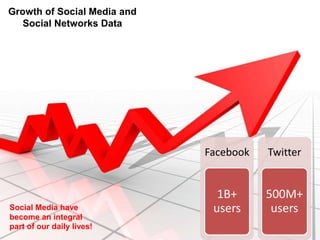
Growth of Social Media and
Social Networks Data
Facebook
1B+
users
Twitter
500M+
usersSocial Media have
become an integral
part of our daily lives!
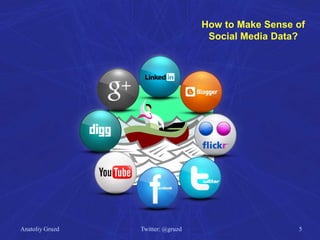
How to Make Sense of
Social Media Data?
Anatoliy Gruzd Twitter: @gruzd 5
Social Big Data -> Visualizations -> Understanding
(Development, Application & Validation)
How to Make Sense of
Social Media Data?
Anatoliy Gruzd Twitter: @gruzd 6
How to Make Sense of
Social Media Data?
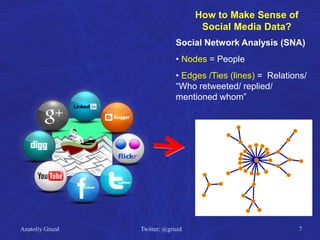
Social Network Analysis (SNA)
• Nodes = People
• Edges /Ties (lines) = Relations/
“Who retweeted/ replied/
mentioned whom”
Anatoliy Gruzd Twitter: @gruzd 7
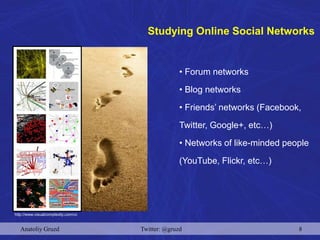
Studying Online Social Networks
http://www.visualcomplexity.com/vc
• Forum networks
• Blog networks
• Friends’ networks (Facebook,
Twitter, Google+, etc…)
• Networks of like-minded people
(YouTube, Flickr, etc…)
Anatoliy Gruzd Twitter: @gruzd 8
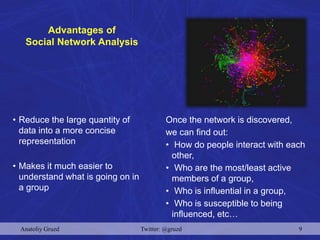
• Reduce the large quantity of
data into a more concise
representation
• Makes it much easier to
understand what is going on in
a group
Advantages of
Social Network Analysis
Once the network is discovered,
we can find out:
• How do people interact with each
other,
• Who are the most/least active
members of a group,
• Who is influential in a group,
• Who is susceptible to being
influenced, etc…
Anatoliy Gruzd Twitter: @gruzd 9
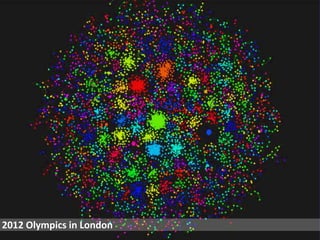
Anatoliy Gruzd Twitter: @dalprof2012 Olympics in London
Anatoliy Gruzd Twitter: @dalprof
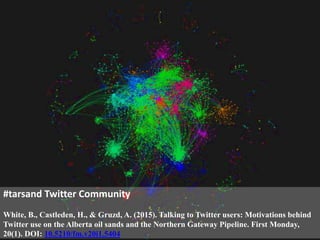
#tarsand Twitter Community
White, B., Castleden, H., & Gruzd, A. (2015). Talking to Twitter users: Motivations behind
Twitter use on the Alberta oil sands and the Northern Gateway Pipeline. First Monday,
20(1). DOI: 10.5210/fm.v20i1.5404
Common approach for collecting social
network data:
• Self-reported social network data
may not be available/accurate
• Surveys or interviews
Problems with surveys or interviews
• Time-consuming
• Questions can be too sensitive
• Answers are subjective or incomplete
• Participant can forget people and
interactions
• Different people perceive events and
relationships differently
How Do We Collect Information About Online Social Networks?
Anatoliy Gruzd Twitter: @gruzd 14
• Common approach: surveys or interviews
• A sample question about students’ perceived social structures
How Do We Collect Information About Social Networks?
Please indicate on a scale from [1] to [5],
YOUR FRIENDSHIP RELATIONSHIP WITH EACH STUDENT IN THE CLASS
[1] - don’t know this person
[2] - just another member of class
[3] - a slight friendship
[4] - a friend
[5] - a close friend
Alice D. [1] [2] [3] [4] [5]
…
Richard S. [1] [2] [3] [4] [5]
Source: C. Haythornthwaite, 1999
Anatoliy Gruzd Twitter: @gruzd 15
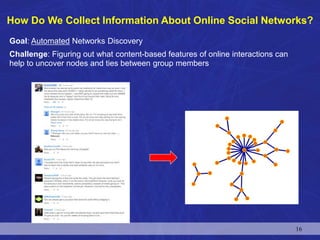
Goal: Automated Networks Discovery
Challenge: Figuring out what content-based features of online interactions can
help to uncover nodes and ties between group members
How Do We Collect Information About Online Social Networks?
16
Automated Discovery of Social Networks
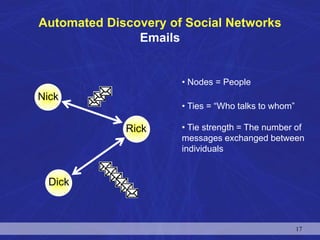
Emails
Nick
Rick
Dick
• Nodes = People
• Ties = “Who talks to whom”
• Tie strength = The number of
messages exchanged between
individuals
17
Automated Discovery of Social Networks
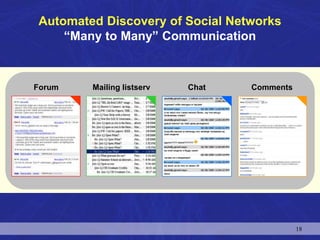
“Many to Many” Communication
ChatMailing listservForum Comments
18
Automated Discovery of Social Networks
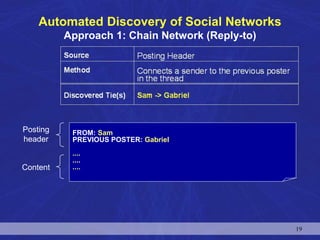
Approach 1: Chain Network (Reply-to)
FROM: Sam
PREVIOUS POSTER: Gabriel
....
....
....
Posting
header
Content
19
Automated Discovery of Social Networks
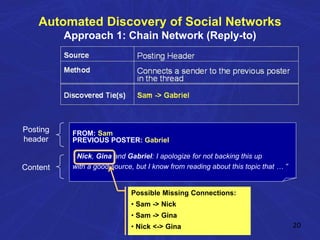
Approach 1: Chain Network (Reply-to)
FROM: Sam
PREVIOUS POSTER: Gabriel
“ Nick, Gina and Gabriel: I apologize for not backing this up
with a good source, but I know from reading about this topic that … ”
Posting
header
Content
Possible Missing Connections:
• Sam -> Nick
• Sam -> Gina
• Nick <-> Gina 20
21
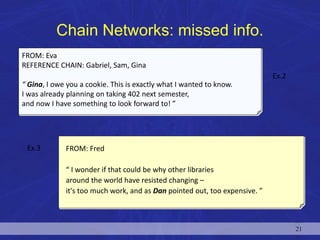
Chain Networks: missed info.
FROM: Eva
REFERENCE CHAIN: Gabriel, Sam, Gina
“ Gina, I owe you a cookie. This is exactly what I wanted to know.
I was already planning on taking 402 next semester,
and now I have something to look forward to! ”
FROM: Fred
“ I wonder if that could be why other libraries
around the world have resisted changing –
it's too much work, and as Dan pointed out, too expensive. ”
Ex.2
Ex.3
21
Automated Discovery of Social Networks
Approach 2: Name Network
FROM: Ann
“Steve and Natasha, I couldn't wait to see your site.
I knew it was going to [be] awesome!”
This approach looks for personal names in the content of the messages to
identify social connections between group members.
22
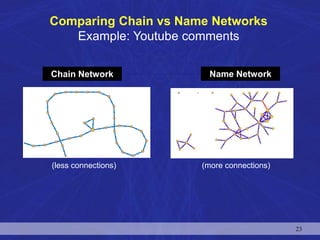
Chain Network
(less connections)
Name Network
(more connections)
Comparing Chain vs Name Networks
Example: Youtube comments
Chain Network Name Network
23
• Main Communicative Functions of Personal Names (Leech, 1999)
– getting attention and identifying addressee
– maintaining and reinforcing social relationships
• Names are “one of the few textual carriers of identity” in discussions
on the web (Doherty, 2004)
• Their use is crucial for the creation and maintenance of a sense of
community (Ubon, 2005)
Automated Discovery of Social Networks
Approach 2: Name Network
24
Automated Discovery of Social Networks
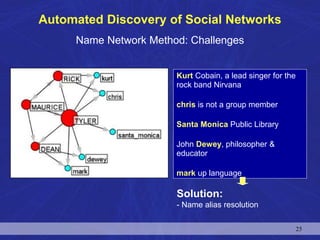
Name Network Method: Challenges
Kurt Cobain, a lead singer for the
rock band Nirvana
chris is not a group member
Santa Monica Public Library
John Dewey, philosopher &
educator
mark up language
Solution:
- Name alias resolution
25
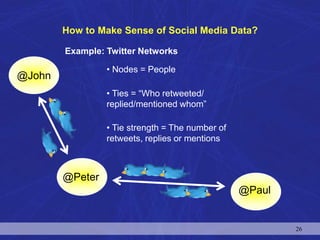
Example: Twitter Networks
@John
@Peter
@Paul
• Nodes = People
• Ties = “Who retweeted/
replied/mentioned whom”
• Tie strength = The number of
retweets, replies or mentions
How to Make Sense of Social Media Data?
26
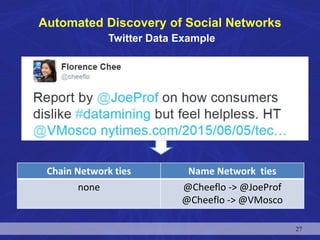
Automated Discovery of Social Networks
Twitter Data Example
27
Chain Network ties Name Network ties
none @Cheeflo -> @JoeProf
@Cheeflo -> @VMosco
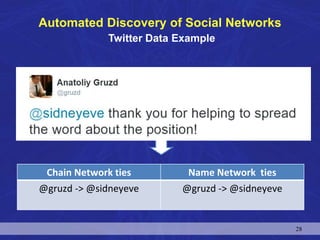
Automated Discovery of Social Networks
Twitter Data Example
28
Chain Network ties Name Network ties
@gruzd -> @sidneyeve @gruzd -> @sidneyeve
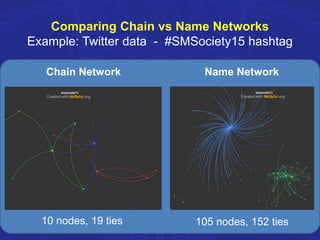
Comparing Chain vs Name Networks
Example: Twitter data - #SMSociety15 hashtag
Chain Network Name Network
10 nodes, 19 ties 105 nodes, 152 ties
Anatoliy Gruzd
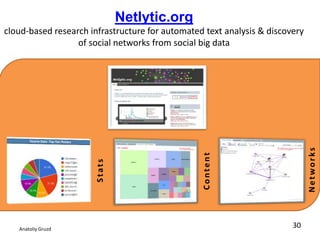
Netlytic.org
cloud-based research infrastructure for automated text analysis & discovery
of social networks from social big data
Networks
Stats
Content
30
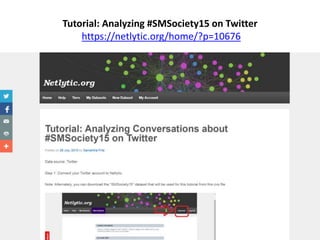
Tutorial: Analyzing #SMSociety15 on Twitter
https://netlytic.org/home/?p=10676
Anatoliy Gruzd 31
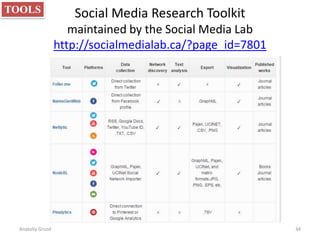
Social Media Research Toolkit
maintained by the Social Media Lab
http://socialmedialab.ca/?page_id=7801
Anatoliy Gruzd 34
TOOLS

Workshop on Data Collection & Network Analysis with @Netlytic & the iGraph R Package

  • 1.
    Workshop 1A: Data Collection& Network Analysis with @Netlytic & the iGraph R Package Anatoliy Gruzd gruzd@ryerson.ca @gruzd Associate Professor, Ted Rogers School of Management Director, Social Media Lab Ryerson University #SMSociety15 Toronto, July 27, 2015
  • 2.
    Outline • Making Senseof Social Media Data • Practice Part 1: Netlytic • Practice Part 2: R + igraph Anatoliy Gruzd 3
  • 3.
    Growth of SocialMedia and Social Networks Data Facebook 1B+ users Twitter 500M+ usersSocial Media have become an integral part of our daily lives!
  • 4.
    How to MakeSense of Social Media Data? Anatoliy Gruzd Twitter: @gruzd 5
  • 5.
    Social Big Data-> Visualizations -> Understanding (Development, Application & Validation) How to Make Sense of Social Media Data? Anatoliy Gruzd Twitter: @gruzd 6
  • 6.
    How to MakeSense of Social Media Data? Social Network Analysis (SNA) • Nodes = People • Edges /Ties (lines) = Relations/ “Who retweeted/ replied/ mentioned whom” Anatoliy Gruzd Twitter: @gruzd 7
  • 7.
    Studying Online SocialNetworks http://www.visualcomplexity.com/vc • Forum networks • Blog networks • Friends’ networks (Facebook, Twitter, Google+, etc…) • Networks of like-minded people (YouTube, Flickr, etc…) Anatoliy Gruzd Twitter: @gruzd 8
  • 8.
    • Reduce thelarge quantity of data into a more concise representation • Makes it much easier to understand what is going on in a group Advantages of Social Network Analysis Once the network is discovered, we can find out: • How do people interact with each other, • Who are the most/least active members of a group, • Who is influential in a group, • Who is susceptible to being influenced, etc… Anatoliy Gruzd Twitter: @gruzd 9
  • 10.
    Anatoliy Gruzd Twitter:@dalprof2012 Olympics in London
  • 11.
    Anatoliy Gruzd Twitter:@dalprof #tarsand Twitter Community White, B., Castleden, H., & Gruzd, A. (2015). Talking to Twitter users: Motivations behind Twitter use on the Alberta oil sands and the Northern Gateway Pipeline. First Monday, 20(1). DOI: 10.5210/fm.v20i1.5404
  • 12.
    Common approach forcollecting social network data: • Self-reported social network data may not be available/accurate • Surveys or interviews Problems with surveys or interviews • Time-consuming • Questions can be too sensitive • Answers are subjective or incomplete • Participant can forget people and interactions • Different people perceive events and relationships differently How Do We Collect Information About Online Social Networks? Anatoliy Gruzd Twitter: @gruzd 14
  • 13.
    • Common approach:surveys or interviews • A sample question about students’ perceived social structures How Do We Collect Information About Social Networks? Please indicate on a scale from [1] to [5], YOUR FRIENDSHIP RELATIONSHIP WITH EACH STUDENT IN THE CLASS [1] - don’t know this person [2] - just another member of class [3] - a slight friendship [4] - a friend [5] - a close friend Alice D. [1] [2] [3] [4] [5] … Richard S. [1] [2] [3] [4] [5] Source: C. Haythornthwaite, 1999 Anatoliy Gruzd Twitter: @gruzd 15
  • 14.
    Goal: Automated NetworksDiscovery Challenge: Figuring out what content-based features of online interactions can help to uncover nodes and ties between group members How Do We Collect Information About Online Social Networks? 16
  • 15.
    Automated Discovery ofSocial Networks Emails Nick Rick Dick • Nodes = People • Ties = “Who talks to whom” • Tie strength = The number of messages exchanged between individuals 17
  • 16.
    Automated Discovery ofSocial Networks “Many to Many” Communication ChatMailing listservForum Comments 18
  • 17.
    Automated Discovery ofSocial Networks Approach 1: Chain Network (Reply-to) FROM: Sam PREVIOUS POSTER: Gabriel .... .... .... Posting header Content 19
  • 18.
    Automated Discovery ofSocial Networks Approach 1: Chain Network (Reply-to) FROM: Sam PREVIOUS POSTER: Gabriel “ Nick, Gina and Gabriel: I apologize for not backing this up with a good source, but I know from reading about this topic that … ” Posting header Content Possible Missing Connections: • Sam -> Nick • Sam -> Gina • Nick <-> Gina 20
  • 19.
    21 Chain Networks: missedinfo. FROM: Eva REFERENCE CHAIN: Gabriel, Sam, Gina “ Gina, I owe you a cookie. This is exactly what I wanted to know. I was already planning on taking 402 next semester, and now I have something to look forward to! ” FROM: Fred “ I wonder if that could be why other libraries around the world have resisted changing – it's too much work, and as Dan pointed out, too expensive. ” Ex.2 Ex.3 21
  • 20.
    Automated Discovery ofSocial Networks Approach 2: Name Network FROM: Ann “Steve and Natasha, I couldn't wait to see your site. I knew it was going to [be] awesome!” This approach looks for personal names in the content of the messages to identify social connections between group members. 22
  • 21.
    Chain Network (less connections) NameNetwork (more connections) Comparing Chain vs Name Networks Example: Youtube comments Chain Network Name Network 23
  • 22.
    • Main CommunicativeFunctions of Personal Names (Leech, 1999) – getting attention and identifying addressee – maintaining and reinforcing social relationships • Names are “one of the few textual carriers of identity” in discussions on the web (Doherty, 2004) • Their use is crucial for the creation and maintenance of a sense of community (Ubon, 2005) Automated Discovery of Social Networks Approach 2: Name Network 24
  • 23.
    Automated Discovery ofSocial Networks Name Network Method: Challenges Kurt Cobain, a lead singer for the rock band Nirvana chris is not a group member Santa Monica Public Library John Dewey, philosopher & educator mark up language Solution: - Name alias resolution 25
  • 24.
    Example: Twitter Networks @John @Peter @Paul •Nodes = People • Ties = “Who retweeted/ replied/mentioned whom” • Tie strength = The number of retweets, replies or mentions How to Make Sense of Social Media Data? 26
  • 25.
    Automated Discovery ofSocial Networks Twitter Data Example 27 Chain Network ties Name Network ties none @Cheeflo -> @JoeProf @Cheeflo -> @VMosco
  • 26.
    Automated Discovery ofSocial Networks Twitter Data Example 28 Chain Network ties Name Network ties @gruzd -> @sidneyeve @gruzd -> @sidneyeve
  • 27.
    Comparing Chain vsName Networks Example: Twitter data - #SMSociety15 hashtag Chain Network Name Network 10 nodes, 19 ties 105 nodes, 152 ties
  • 28.
    Anatoliy Gruzd Netlytic.org cloud-based researchinfrastructure for automated text analysis & discovery of social networks from social big data Networks Stats Content 30
  • 29.
    Tutorial: Analyzing #SMSociety15on Twitter https://netlytic.org/home/?p=10676 Anatoliy Gruzd 31
  • 30.
    Social Media ResearchToolkit maintained by the Social Media Lab http://socialmedialab.ca/?page_id=7801 Anatoliy Gruzd 34 TOOLS