This document contains a preface and introduction to a book on GATE mathematics questions from previous years organized by topic. It provides copyright information and contact details for the author, S K Mondal, an IES officer, GATE top scorer, and experienced teacher. The document then begins to list questions about matrix algebra, with the questions, answers, and solutions provided.
![1. Matrix Algebra
Previous Years GATE Questions
EC All GATE Questions
1. Let, A =
2 0.1
0 3
⎡ − ⎤
⎢ ⎥
⎣ ⎦
and A–1 =
1 a
2
0 b
⎡ ⎤
⎢ ⎥
⎢ ⎥
⎢⎣ ⎥⎦
Then (a + b) = [EC: GATE-20005
(a) 7
20
(b) 3
20
(c) 19
60
(d) 11
20
1.(a)
2 AA− = I
We know 1
2 0.1 1 a 1 2a 0.1b 1 0
0 3 2 0 3b 0 1 0 b
b 1 and a 1
⎛ − ⎞ ⎛ ⎞ ⎛ − ⎞ ⎛ ⎞ ⇒⎜ ⎟ ⎜ ⎟ = ⎜ ⎟ = ⎜ ⎟ ⎝ ⎠ ⎜⎜ ⎟⎟ ⎝ ⎠ ⎝ ⎠ ⎝ ⎠
3 60 ⇒ = =
a b 7
20 ∴ + =
2. Given an orthogonal matrix A =
1 1 1 1
1 1 1 1
1 1 0 0
0 0 1 1
⎡ ⎤
⎢ − − ⎥ ⎢ ⎥
⎢ − ⎥
⎢ ⎥
⎢⎣ − ⎥⎦
[AAT]–1 is [EC: GATE-2005]
(a)
1 0 0 0
4
0 1 0 0
⎡ ⎤
⎢ ⎥
⎢ ⎥
⎢ ⎥
⎢ 4
⎥
⎢ 1 ⎥
⎢ 0 0 0
⎥
⎢ 2
⎥
⎢ 1
⎥
⎢ 0 0 0 ⎥
⎢⎣ ⎥⎦
2
(b)
1 0 0 0
2
0 1 0 0
⎡ ⎤
⎢ ⎥
⎢ ⎥
⎢ ⎥
⎢ 2
⎥
⎢ 1 ⎥
⎢ 0 0 0
⎥
⎢ 2
⎥
⎢ 1
⎥
⎢ 0 0 0 ⎥
⎢⎣ ⎥⎦
2
S K Mondal's
Page 2 of 192](https://image.slidesharecdn.com/gatemathematicsquestionsallbranchbyskmondal-141123081724-conversion-gate01/75/Gate-mathematics-questions-all-branch-by-s-k-mondal-2-2048.jpg)
![S K Mondal's
(c)
1 0 0 0
0 1 0 0
0 0 1 0
0 0 0 1
⎡ ⎤
⎢ ⎥
⎢ ⎥
⎢ ⎥
⎢ ⎥
⎢⎣ ⎥⎦
(d)
1 0 0 0
4
0 1 0 0
⎡ ⎤
⎢ ⎥
⎢ ⎥
⎢ ⎥
⎢ 4
⎥
⎢ 1 ⎥
⎢ 0 0 0
⎥
⎢ 4
⎥
⎢ 1
⎥
⎢ 0 0 0 ⎥
⎢⎣ ⎥⎦
4
2.(c).
We know
AA t =
I
4 T 1 1
4 4 AA I I − − ⎣⎡ ⎦⎤ = ⎡⎣ ⎤⎦ =
3. The rank of the matrix
1 1 1
1 1 0
1 1 1
⎡ ⎤
⎢ − ⎥ ⎢ ⎥
⎢⎣ ⎥⎦
is [EC: GATE-2006]
(a) 0 (b) 1
(c) 2 (d) 3
3. (c)
1 1 1
1 1 0
1 1 1
⎛ ⎞
⎜ − ⎟ ⎜ ⎟
⎜ ⎟
⎝ ⎠
⎯⎯R3 −⎯R1⎯→
1 1 1
1 1 0
0 0 0
⎛ ⎞
⎜ − ⎟ ⎜ ⎟
⎜ ⎟
⎝ ⎠
⎯⎯R1 −⎯R2⎯→
1 2 1
1 1 0 A(say).
0 0 0
⎛ ⎞
⎜ − ⎟ = ⎜ ⎟
⎜ ⎟
⎝ ⎠
1
∴rank(A) = 2.
5. The eigen values of a skew-symmetric matrix are [EC: GATE-2010]
(a) Always zero (b) always pure imaginary
(c) Either zero or pure imaginary (d) always real
5. (c)
ME 20 Years GATE Questions
6.
0 2 2
⎡ ⎤
⎢ ⎥
⎢ ⎥
⎢⎣ ⎥⎦
Rank of the matrix 7 4 8 is 3.
-7 0 -4
[ME: GATE-1994]
6.Ans. False
As.det A = 0 so,rank(A) < 3
Page 3 of 192](https://image.slidesharecdn.com/gatemathematicsquestionsallbranchbyskmondal-141123081724-conversion-gate01/75/Gate-mathematics-questions-all-branch-by-s-k-mondal-3-2048.jpg)
![S K Mondal's
But 0 2 14 0
7 4 = − ≠
∴rank(A) = 2.
7. Rank of the matrix given below is: [ME: GATE-1999]
3 2 -9
-6 -4 18
12 8 -36
⎡ ⎤
⎢ ⎥
⎢ ⎥
⎢⎣ ⎥⎦
(a) 1 (b) 2 (c) 3 (d) 2
7. (a)
3 2 − 9 3 2 −
9
− 6 − 4 18 ⎯⎯⎯⎯→
R 3 −
4R
1
0 0 0
R +
2R
12 8 2 1
−
36 0 0 0
∴rank =1.
8. The rank of a 3×3 matrix C (=AB), found by multiplying a non-zero column matrix A
of size 3×1 and a non-zero row matrix B of size 1×3, is [ME: GATE-2001]
(a) 0 (b) 1 (c) 2 (d) 3
8.(b)
a
1
2 1 2 3
3
LetA = a ,B =
[b b b ]
a
a b a b a b
⎡ ⎤
1 1 1 2 1 3
2 1 2 2 2 3
3 1 3 2 3 3
= = ⎢ ⎥ = ⎢ ⎥
ThenC AB a b a b a b .Thendet (AB) 0.
a b a b a b
⎢⎣ ⎥⎦
Then also every minor
of order 2 is also zero.
∴rank(C) =1.
9. A is a 3 x 4 real matrix and A x = b is an inconsistent system of equations. The
highest possible rank of A is [ME: GATE-2005]
(a) 1 (b) 2 (c) 3 (d) 4
9.(b). Highest possible rank of A= 2 ,as Ax = b is an inconsistent system.
10. Match the items in columns I and II. [ME: GATE-2006]
Page 4 of 192](https://image.slidesharecdn.com/gatemathematicsquestionsallbranchbyskmondal-141123081724-conversion-gate01/75/Gate-mathematics-questions-all-branch-by-s-k-mondal-4-2048.jpg)
![S K Mondal's
Column I Column II
P. Singular matrix 1. Determinant is not defined
Q. Non-square matrix 2. Determinant is always one
R. Real symmetric 3. Determinant is zero
S. Orthogonal matrix 4. Eigenvalues are always real
5. Eigenvalues are not defined
(a) P-3, Q-1, R-4, S-2 (b) P-2, Q-3, R-4, S-1
(c) P-3, Q-2, R-5, S-4 (d) P-3, Q-4, R-2, S-1
10.(a) (P) Singular matrix Æ Determinant is zero
(Q) Non-square matrix Æ Determinant is not defined
(R) Real symmetric Æ Eigen values are always real
(S) Orthogonal Æ Determinant is always one
CE 10 Years GATE Questions
Q1. [A] is a square matrix which is neither symmetric nor skew-symmetric and [ ]T A is its
transpose. The sum and difference of these matrices are defined as [S] = [A] + [A]T and
[ ] [ ] [ ]T D = A − A , respectively. Which of the following statements is TRUE? [CE-2011]
(a) both [S] and [D] are symmetric
(b) both [S] and [D] are skew –symmetric
(c) [S] is skew-symmetric and [D] is symmetric
(d) [S] is symmetric and [D] is skew-symmetric.
Ans. (d)
Exp. Take any matrix and check.
11. Given matrix [A] =
4 2 1 3
6 3 4 7 ,
2 1 0 1
⎡ ⎤
⎢ ⎥
⎢ ⎥
⎢⎣ ⎥⎦
the rank of the matrix is [CE: GATE – 2003]
(a) 4 (b) 3 (c) 2 (d) 1
11.(c)
4 2 1 3 0 0 1 1 0 0 1 1
⎡ ⎤ ⎡ ⎤ ⎡ ⎤
= ⎢ ⎥⎯⎯⎯⎯→⎢ ⎥⎯⎯⎯⎯→⎢ ⎥ ⎢ ⎥ ⎢ ⎥ ⎢ ⎥
⎢⎣ ⎥⎦ ⎢⎣ ⎥⎦ ⎢⎣ ⎥⎦
A 6 3 4 7 0 0 4 4 0 0 0 0
R − 2R R −
4R
R −
3R
1 3 2 1
2 3
2 1 0 1 2 1 0 1 2 1 0 1
∴Rank(A) = 2
12. Real matrices 3 1 3 3 3 5 5 3 5 5 [A] ,[B] ,[C] ,[D] ,[E] × × × × × and 5 1 [F] × are given. Matrices [B] and
[E] are symmetric. [CE: GATE – 2004]
Following statements are made with respect to these matrices.
1. Matrix product [F]T [C]T [B] [C] [F] is a scalar.
2. Matrix product [D]T [F] [D] is always symmetric.
With reference to above statements, which of the following applies?
Page 5 of 192](https://image.slidesharecdn.com/gatemathematicsquestionsallbranchbyskmondal-141123081724-conversion-gate01/75/Gate-mathematics-questions-all-branch-by-s-k-mondal-5-2048.jpg)
![S K Mondal's
(a) Statement 1 is true but 2 is false
(b) Statement 1 is false but 2 is true
(c) Both the statements are true
(d) Both the statements are false
12.(a)
Let ⎡⎣ I ⎤⎦ = ⎡⎣ F ⎤⎦ ⎡⎣ C ⎤⎦ T × 5 3 ⎡⎣ B ⎤⎦ C 3 × 3 ⎡⎣ ⎤⎦ F
× 3 × 5 ⎡⎣ ⎤⎦
5 × 1 = T15 ⎡⎣ I ⎤⎦ =
scalar. 1 × 1 T
3 5 5 1 5 3 Let I' D F D isnot define. × × × ⎡⎣ ⎤⎦ = ⎡⎣ ⎤⎦ ⎡⎣ ⎤⎦ ⎡⎣ ⎤⎦
13. Consider the matrices X (4 × 3), Y (4 × 3) and P (2 × 3). The order or P (XTY)–1PT] T will be
[CE: GATE – 2005]
(a) (2 × 2) (b) (3 × 3)
(c) (4 × 3) (d) (3 × 4)
13.(a)
( ) 1 T T T
⎡ ⎢⎣ P X Y −
P ⎤
2 × 3 3 × 4 4 × 3 3 ×
2 ⎥⎦
1 T T
2 3 3 3 3 2 P Z P TakeZ XY,
= ⎡⎣ −
= × × × ⎤⎦ ⎡⎣ ⎤⎦
T T' T PZ P
T 1 T
2 2 2 2 T
T' T
−
× ×
⎡ = ⎤
= ⎡⎣ ⎤⎦ = ⎡⎣ ⎤⎦ ⎢ ⎥ ⎢⎣ = ⎥⎦
14. The inverse of the 2 × 2 matrix 1 2
⎡ ⎤
⎢ ⎥
⎣ 5 7
⎦
is, [CE: GATE – 2007]
(a) 1 7 2
⎡− ⎤
⎢ − ⎥ ⎣ ⎦
3 5 1
(b) 1 7 2
⎡ ⎤
⎢ ⎥
⎣ ⎦
3 5 1
(c) 1 7 2
⎡ − ⎤
⎢− ⎥ ⎣ ⎦
3 5 1
(d) 1 7 2
⎡− − ⎤
⎢− − ⎥ ⎣ ⎦
3 5 1
14(a).
1 1 2 1 7 2
5 7 3 5 1
− ⎡ ⎤ ⎡− ⎤
⎢ ⎥ = ⎢ ⎥ ⎣ ⎦ ⎣ − ⎦
15. The product of matrices (PQ)–1 P is [CE: GATE – 2008]
(a) P–1 (b) Q–1
(c) P–1 Q–1 P (d) PQ P–1
15.(b)
(PQ) 1 P Q 1P 1P Q 1 − = − − = −
16. A square matrix B is skew-symmetric if [CE: GATE – 2009]
(a) BT = –B (b) BT = B
Page 6 of 192](https://image.slidesharecdn.com/gatemathematicsquestionsallbranchbyskmondal-141123081724-conversion-gate01/75/Gate-mathematics-questions-all-branch-by-s-k-mondal-6-2048.jpg)
![(c) B–1 = B (d) B–1 = BT
16.(a)
BT = −B
17. The inverse of the matrix 3 + 2i i
⎡ ⎤
⎢ ⎣ − i 3 − 2i
⎥ ⎦
is [CE: GATE – 2010]
(a) 1 3 + 2i i
⎡ − ⎤
⎢ − ⎥ ⎣ ⎦
12 i 3 2i
(b) 1 3 2i i
⎡ − − ⎤
⎢ + ⎥ ⎣ ⎦
12 i 3 2i
1 3 2i i
14 i 3 2i
(c) ⎡ + − ⎤
⎢ − ⎥ ⎣ ⎦
1 3 2i i
14 i 3 2i
(d) ⎡ − − ⎤
⎢ + ⎥ ⎣ ⎦
17.(b)
1 3 2i i 1 3 2i i
i 3 2i 12 i 3 2i
− ⎛ + ⎞ ⎡ − − ⎤
⎜ ⎟ = ⎢ ⎥ ⎝ − − ⎠ ⎣ + ⎦
IE All GATE Questions
18. For a given 2 × 2 matrix A, it is observed that [IE: GATE-2006]
A 1
–1
⎡ ⎤
⎢ ⎥
⎣ ⎦
– 1
–1
= ⎡ ⎤
⎢ ⎥
⎣ ⎦
A 1
–2
and ⎡ ⎤
⎢ ⎥
⎣ ⎦
–2 1
= ⎡ ⎤
⎢ ⎣ –2
⎥
⎦
Then matrix A is
(a) A = 2 1 1 0 1 1
⎡ ⎤ ⎡− ⎤ ⎡ ⎤
⎢− ⎣ 1 − 1 ⎥ ⎢ ⎦⎣ 0 − 2 ⎥ ⎦⎣ ⎢− 1 − 2
⎥ ⎦
(b) A = 1 1 1 0 2 1
⎡ ⎤⎡ ⎤⎡ ⎤
⎥ ⎢ ⎣ ⎢− 1 − 2 ⎦⎣ 0 2 ⎥ ⎦⎣ ⎢− 1 − 1
⎥ ⎦
(c) A = 1 1 1 0 2 1
⎡ ⎤ ⎡− ⎤ ⎡ ⎤
⎢− ⎣ 1 − 2 ⎥ ⎢ ⎦⎣ 0 − 2 ⎥ ⎦⎣ ⎢− 1 − 1
⎥ ⎦
(d) A = 0 2
⎡ − ⎤
⎢ ⎣ 1 − 3
⎥ ⎦
18.(c)
From these conditions eigen values are -1 and -2.
Let P 1 1
⎛ ⎞
= ⎜ ⎝− 1 − 2
⎟ ⎠
P 2 1
1 − ⎛ ⎞
⇒ = ⎜ ⎝ − 1 − 1
⎟ ⎠
P 1 A P ⎛ − 1 0 ⎞
− D(say)
∴ = ⎜ ⎟ = ⎝ 0 − 2
⎠
S K Mondal's
Page 7 of 192](https://image.slidesharecdn.com/gatemathematicsquestionsallbranchbyskmondal-141123081724-conversion-gate01/75/Gate-mathematics-questions-all-branch-by-s-k-mondal-7-2048.jpg)
![S K Mondal's
1 A PDP 1 1 1 0 2 1
− ⎛ ⎞ ⎛ − ⎞ ⎛ ⎞
⇒ = = ⎜ ⎝− 1 − 2 ⎟ ⎜ ⎟ ⎜ ⎟ ⎠ ⎝ 0 − 2 ⎠ ⎝− 1 − 1
⎠
EE
Q27. The matrix [ ] 2 1
A
⎡ ⎤
= ⎢ ⎥ ⎣ 4 − 1
⎦
is decomposed into a product of a lower triangular matrix [L]and
an upper triangular matrix [U]. The properly decomposed [L] and [U] matrices
respectively are
(a) 1 0
⎡ ⎤
⎢ ⎣ 4 − 1
⎥ ⎦
and 1 0
⎡ ⎤
⎢ ⎣ 4 − 1
⎥ ⎦
(b) 2 0
⎡ ⎤
⎢ ⎣ 4 − 1
⎥ ⎦
and 1 1
⎡ ⎤
⎢ ⎥
⎣ 0 1
⎦
(c) 1 0
⎡ ⎤
⎢ ⎥
⎣ 4 1
⎦
and 2 1
⎡ ⎤
⎢ ⎣ 0 − 1
⎥ ⎦
(d) 2 0
⎡ ⎤
⎢ ⎣ 4 − 3
⎥ ⎦
and 1 0.5
⎡ ⎤
⎢ ⎥
⎣ 0 1
⎦
[EE-2011]
Ans. (d)
Page 8 of 192](https://image.slidesharecdn.com/gatemathematicsquestionsallbranchbyskmondal-141123081724-conversion-gate01/75/Gate-mathematics-questions-all-branch-by-s-k-mondal-8-2048.jpg)
![S K Mondal's
2. Systems of Linear Equations
Previous Years GATE Question
EC All GATE Questions
1. The system of linear equations [EC: GATE-2008]
4x + 2y = 7
2x + y = 6
has
(a) A unique solution (b) no solution
(c) An infinite number of solutions (d) exactly two distinct solutions
1.(b)
This can be written as AX B Where A 4 2
⎛ ⎞
= =⎜ ⎟
2 1
⎝ ⎠
Angemented matrix A 4 2 7
⎡ ⎤
=⎢ ⎥
⎣ 2 1 6
⎦
A R1 2R2 0 0 5
− ⎡ − ⎤
⎯⎯⎯⎯→ =⎢ ⎥
2 1 6
⎣ ⎦
rank(A) ≠ rank(A). The system is inconsistant .So system has no solution.
ME 20 Years GATE Questions
2. Using Cramer’s rule, solve the following set of equations [ME: GATE-1995]
2x + 3y + z = 9
4x + y = 7
x – 3y – 7z = 6
2. Ans.
Given equations are
2x + 3y + 1z = 9
4x + 1y + 0z = 7
1x – 3y – 7z = 6
By Cramer’s Rule
Page 9 of 192](https://image.slidesharecdn.com/gatemathematicsquestionsallbranchbyskmondal-141123081724-conversion-gate01/75/Gate-mathematics-questions-all-branch-by-s-k-mondal-9-2048.jpg)
![S K Mondal's
x y z 1
= = =
9 3 1 2 9 1 2 3 9 2 3 1
7 1 0 4 7 0 4 1 7 4 1 0
6 -3 -7 1 6 -7 1 -3 6 1 -3 -7
= z 1
or x y
9 3 1 2 9 1
7 1 0 4
69 18 -7
10 0 -12 2 3 1
-7 0 4 1 7 4 1 0
15 69 0 13 0 27 15 18 0
or x y z 1 Hence x=1; y=3; z=-2
57 171 114 57
= =
−
= = =
−
4. For the following set of simultaneous equations: [ME: GATE-1997]
1.5x – 0.5y = 2
4x + 2y + 3z = 9
7x + y + 5z = 10
(a) The solution is unique (b) Infinitely many solutions exist
(c) The equations are incompatible (d) Finite number of multiple solutions exist
4. (a)
3 1 0 2 1 2 2 3 / 2 2 0 2
⎡ − ⎤ − ⎢ ⎥ ⎡ ⎤
⎢ ⎥ ⎢ ⎥
= ⎢ ⎥⎯⎯⎯⎯→⎢ ⎥
⎢ ⎥ ⎢ ⎥
⎢ ⎥ ⎢⎣ ⎥⎦
⎣ ⎦
A 4 2 3 9 1 3 3 5
R −
2R
R −
4R
2 1
3 1
7 1 5 10 1 3 5 2
R3 −
R2
3 / 2 1 0 2 2
1 3 3 5
0 0 2 3
⎡ − ⎤
⎢ ⎥
⎯⎯⎯⎯→⎢ ⎥
⎢ ⎥
⎢ − ⎥ ⎣ ⎦
_
A A
rankof( ) rankof( ) 3
The system hasunique solution.
∴ = =
∴
5. Consider the system of equations given below: [ME: GATE-2001]
Page 10 of 192](https://image.slidesharecdn.com/gatemathematicsquestionsallbranchbyskmondal-141123081724-conversion-gate01/75/Gate-mathematics-questions-all-branch-by-s-k-mondal-10-2048.jpg)
![x + y =
2
2x + 2y =
5
S K Mondal's
This system has
(a) One solution (b) No solution (c) Infinite solution (d) Four solution
5. (b)
Same as Q.1
6. The following set of equations has [ME: GATE-2002]
3 x + 2 y + z = 4 x – y + z = 2 -2 x + 2 z = 5
(a) No solution (b) A unique solution (c) Multiple solution (d) An inconsistency
6.(b)
3 2 14 0 5 2 2
⎡ ⎤ ⎡ − − ⎤
= ⎢ − ⎥⎯⎯⎯⎯→⎢ − ⎥ ⎢ ⎥ ⎢ ⎥
⎢⎣− ⎥⎦ ⎢⎣ − ⎥⎦
A 1 1 12 1 1 1 2
R −
3R
R +
2R
1 2
3 2
2 0 25 0 2 4 9
⎡ ⎤ ⎡ ⎤ ⎢ 0 5 2 2 ⎥ ⎢ 0 5 2 − 2
⎥ − − − −
1R ⎢ 1 1 1 2 ⎥ ⎢ ⎥ ⎯⎯⎯→⎢ 2
3 5
− ⎥⎯⎯⎯⎯→⎢ R 2 +
R 3
⎢ 1 0 − 1 − ⎥ ⎢ ⎥ 0 − 1 ⎢ − 2 − 9 ⎥ ⎢ 0 1 − 2 29
⎥ ⎥ ⎣ ⎦ ⎢ − ⎥ ⎢⎣ ⎥⎦
2 2
∴rank(A) = rank(A) = 3
∴The system has unique solution
7. Consider the system of simultaneous equations [ME: GATE-2003]
x + 2y + z =
6
2x + y + 2z =
6
x + y + z =
5
This system has
(a) Unique solution (b) Infinite number of solutions
(c) No solution (d) Exactly two solution
7. (c )
1 2 16 0 1 0 1
⎡ ⎤ ⎡ ⎤
= ⎢ ⎥⎯⎯⎯⎯→⎢ − − ⎥ ⎢ ⎥ ⎢ ⎥
⎢⎣ ⎥⎦ ⎢⎣ ⎥⎦
A 2 1 26 0 1 0 4
R −
R
R −
2R
1 3
2 3
1 1 15 1 1 1 5
+
−
⎡ ⎤
⎯⎯⎯⎯→⎢ ⎢ 0 3
⎥ ⎥
2 1 −
3 1
⎢⎣ ⎥⎦
R R
R R
0 1 0 1
0 0
4
1 0 1
∴rank(A) = 2 ≠ 3 = rank(A) .
Page 11 of 192](https://image.slidesharecdn.com/gatemathematicsquestionsallbranchbyskmondal-141123081724-conversion-gate01/75/Gate-mathematics-questions-all-branch-by-s-k-mondal-11-2048.jpg)
![∴The system is inconsistent and has no solution.
8. Multiplication of matrices E and F is G. Matrices E and G are [ME: GATE-2006]
cos -sin 0 1 0 0
sin cos 0 and G= 0 1 0 . What is the matrix F?
0 0 1 0 0 1
E
θ θ
θ θ
⎡ ⎤ ⎡ ⎤
= ⎢ ⎥ ⎢ ⎥ ⎢ ⎥ ⎢ ⎥
⎢⎣ ⎥⎦ ⎢⎣ ⎥⎦
cos -sin 0 cos cos 0 cos sin 0
(a) sin cos 0 (b) -cos sin 0 (c) -sin cos 0
θ θ θ θ θ θ
θ θ θ θ θ θ
⎡ ⎤ ⎡ ⎤
⎢ ⎥ ⎢ ⎥
⎢ ⎥ ⎢ ⎥
⎢⎣ ⎥⎦ ⎢⎣ ⎥⎦
⎡ ⎤ ⎡ ⎤
⎢ ⎥ ⎢ ⎥
⎢ ⎥ ⎢ ⎥
⎢⎣ ⎥⎦ ⎢⎣ ⎥⎦
0 0 1 0 0 1 0 0
sin -cos 0
θ θ
θ θ
(d) cos sin 0
1 0 0 1
8.(c)
3 Given EF = G = I
3 ⇒F = E− G = E− I = E−
1 1 1
9. For what value of a, if any, will the following system of equations in x, y and z have a
solution? [ME: GATE-2008]
2x + 3y = 4
x+y+z = 4
x + 2y - z = a
(a) Any real number (b) 0
(c) 1 (d) There is no such value
9. (b)
2 3 0 4 0 1 2 4
⎡ ⎤ ⎡ − − ⎤
= ⎢ ⎥⎯⎯⎯⎯→⎢ − ⎥ ⎢ ⎥ ⎢ ⎥
⎢⎣ − ⎥⎦ ⎢⎣ − − ⎥⎦
A 1 1 1 4 0 1 1 4
R −
2R
R −
R
1 2
3 2
1 2 1a 0 1 2a 4
R3 R1
0 1 2 4
0 1 1 4
0 0 0 a
−
⎡ − − ⎤
⎯⎯⎯⎯→⎢ ⎥ ⎢ ⎥
⎢⎣ ⎥⎦
If a = 0 then rank (A) = rank(A) = 2. Therefore the
system is consistant
∴ The system has soln .
CE 10 Years GATE Questions
S K Mondal's
Page 12 of 192](https://image.slidesharecdn.com/gatemathematicsquestionsallbranchbyskmondal-141123081724-conversion-gate01/75/Gate-mathematics-questions-all-branch-by-s-k-mondal-12-2048.jpg)
![S K Mondal's
33. Solution for the system defined by the set of equations 4y + 3z = 8; 2x – z = 2 and 3x + 2y =
5 is [CE: GATE – 2006]
(a) x = 0; y = 1; z = 4
3
(b) x = 0; y = 1
2
; z = 2
(c) x = 1; y = 1
2
; z = 2 (d) non-existent
33. Ans.(d)
⎡ ⎤
= ⎢ − ⎥ = ⎢ ⎥
⎢⎣ ⎥⎦
Consider the matrix A Now A
′
0 4 3
2 0 1 , det( ) 0
3 2 0
, , .
So byCramer sRule the systemhasno solution
10. Consider a non-homogeneous system of linear equations representing mathematically an
over-determined system. Such a system will be [CE: GATE – 2005]
(a) consistent having a unique solution
(b) consistent having many solutions
(c) inconsistent having a unique solution
(d) Inconsistent having no solution
10. Ans.(b)
In an over determined system having more equations than variables, it is necessary to have
consistent having many solutions .
11. For what values of α and β the following simultaneous equations have an infinite number
of solutions? [CE: GATE – 2007]
x + y + z = 5; x + 3y + 3z = 9; x + 2y + αz = β
(a) 2, 7 (b) 3, 8 (c) 8, 3 (d) 7, 2
11.(d)
1 1 1 5 1 1 1 5
⎡ ⎤ ⎡ ⎤
= ⎢ ⎥⎯⎯⎯⎯→⎢ ⎥ ⎢ ⎥ ⎢ ⎥
⎢⎣ α β⎥⎦ ⎣⎢ α − − ⎥⎦
A 1 3 39 0 2 2 4
R −
R
R −
R
3 1
2 1
1 2 0 1 1 5
2
1R
2
1 1 1 5
0 1 1 2
0 1 1 5
⎡ ⎤
⎯⎯⎯→⎢ ⎥ ⎢ ⎥
⎢⎣ α − β − ⎥⎦
R −
R
R −
R
⎡ ⎤
⎯⎯⎯⎯→⎢ ⎥ ⎢ ⎥
⎢⎣ α − β − ⎥⎦
3 2
1 2
1 0 0 3
0 1 1 2
0 0 2 7
For infinite solution of the system
α − 2 = 0 andβ − 7 = 0
⇒α = 2 andβ − 7.
Page 13 of 192](https://image.slidesharecdn.com/gatemathematicsquestionsallbranchbyskmondal-141123081724-conversion-gate01/75/Gate-mathematics-questions-all-branch-by-s-k-mondal-13-2048.jpg)
![S K Mondal's
12. The following system of equations [CE: GATE – 2008]
x + y + z = 3
x + 2y + 3z = 4
x + 4y + kz = 6
Will NOT have a unique solution for k equal to
(a) 0 (b) 5
(c) 6 (d) 7
12. (d)
1 1 1 3 1 1 1 3
⎡ ⎤ ⎡ ⎤
= ⎢ ⎥⎯⎯⎯⎯→⎢ ⎥ ⎢ ⎥ ⎢ ⎥
⎢⎣ ⎥⎦ ⎢⎣ − ⎥⎦
A 1 2 34 0 1 2 1
R −
R
R −
R
3 1
2 1
1 4 k6 0 3 k 1 3
−
⎡ ⎤
⎯⎯⎯⎯→⎢ ⎥ ⎢ ⎥
⎢⎣ − ⎥⎦
R3 3R2
1 1 1 3
0 1 2 1
0 0 k 7 0
For not unique solution k − 7 − 0
⇒k = 7.
EE All GATE Questions
14. For the set of equations [EE: GATE-2010]
x x x x
x x x x
2 4 2
+ + + =
1 3 4
3 + 6 + 3 + 12 =
6
1 2 3 4
(a) Only the trivial solution x = x = x = x = 0 exists.
1 2 3 4 (b) There are no solutions.
(c) A unique non-trivial solution exists.
(d) Multiple non-trivial solutions exist
14.(d)
Because number of unknowns more them no. of equation.
IE All GATE Questions
15. Let A be a 3 × 3 matrix with rank 2. Then AX = 0 has [IE: GATE-2005]
(a) Only the trivial solution X = 0
(b) One independent solution
(c) Two independent solutions
(d) Three independent solutions
15. (b)
We know , rank (A) + Solution space X(A) = no. of unknowns.
⇒2 + X(A) = 3 . [Solution space X(A)= No. of linearly independent vectors]
⇒ X(A) =1.
Page 14 of 192](https://image.slidesharecdn.com/gatemathematicsquestionsallbranchbyskmondal-141123081724-conversion-gate01/75/Gate-mathematics-questions-all-branch-by-s-k-mondal-14-2048.jpg)
![S K Mondal's
17. Let P ≠ 0 be a 3 × 3 real matrix. There exist linearly independent vectors x and y such that
Px = 0 and Py = 0. The dimension of the range space of P is
[IE: GATE-2009]
(a) 0 (b) 1 (c) 2 (d) 3
17. (b)
Page 15 of 192](https://image.slidesharecdn.com/gatemathematicsquestionsallbranchbyskmondal-141123081724-conversion-gate01/75/Gate-mathematics-questions-all-branch-by-s-k-mondal-15-2048.jpg)
![S K Mondal's
3. Eigen Values and Eigen
Vectors
EC All GATE Questions
1. Given the matrix
4 2 ,
4 3
⎡− ⎤
⎢ ⎥
⎣ ⎦
the eigenvector is [EC: GATE-2005]
(a) 3
⎡ ⎤
⎢ ⎣ 2
⎥
⎦
(b) 4
⎡ ⎤
⎢ ⎣ 3
⎥
⎦
(c) 2
⎡ ⎤
⎣ ⎢− 1
⎥ ⎦
(d) 2
⎡− ⎤
⎢ ⎣ 1
⎥
⎦
1. (c)
Characteristic equation
2 A − λI = 0
4 2 0
4 3
− − λ
⇒ =
− λ
⇒λ = −5,4
Take λ = −5, then AX = λX becomes
⎡− 4 2 ⎤ ⎡ x ⎤ ⎡− 5x
⎤
⎢ 4 3 ⎥ ⎢ 1 ⎥ = ⎢ 1
⎥ ⎣ ⎦ ⎣ x 5x
2 ⎦ ⎣− 2
⎦
4x 2x 5x
4x 3x 5x
⎡− + ⎤ = ⎡− ⎤
1 2 1
1 2 2
⇒ ⎢ ⎥ ⎢ ⎥ ⎣ + ⎦ = ⎣− ⎦
4x 2x 5x x 2x
4x 3x 5x
− + =− ⎫
1 2 1
∴ ⎬⇒ = − − + =− ⎭
1 2
1 2 2
2 1 ∴if x = −1 then x = 2
2 is eigen vector corrosponding to 5.
⎡ ⎤
∴⎢ ⎣− 1
⎥ λ = − ⎦
2. The eigen values and the corresponding eigen vectors of a 2 × 2 matrix are given by
[EC: GATE-2006]
Eigenvalue Eigenvector
λ1 = 8 1 v =
11
⎡ ⎤
⎢ ⎥
⎣ ⎦
λ2 = 4 2 v =
11
⎡ ⎤
⎢− ⎥ ⎣ ⎦
The matrix is
Page 16 of 192](https://image.slidesharecdn.com/gatemathematicsquestionsallbranchbyskmondal-141123081724-conversion-gate01/75/Gate-mathematics-questions-all-branch-by-s-k-mondal-16-2048.jpg)
![S K Mondal's
(a)
6 2
2 6
⎡ ⎤
⎢ ⎥
⎣ ⎦
(b)
4 6
6 4
⎡ ⎤
⎢ ⎥
⎣ ⎦
(c) 2 4
⎡ ⎤
⎢ ⎥
⎣ 4 2
⎦
(d)
4 8
8 4
⎡ ⎤
⎢ ⎥
⎣ ⎦
2. (a)
We know, sum of eigen values = trace (A). = Sum of diagonal element of A.
Therefore λ1 + λ 2 = 8 + 4 =12
Option (a)gives, trace(A) = 6 + 6 =12.
3. For the matrix
4 2 ,
2 4
⎡ ⎤
⎢ ⎥
⎣ ⎦
the eigen value corresponding to the eigenvector
101
101
⎡ ⎤
⎢ ⎥
⎣ ⎦
is
[EC: GATE-2006]
(a) 2 (b) 4
(c) 6 (d) 8
3. (c)
4 2 101 101
2 4 101 101
⎡ ⎤ ⎡ ⎤ ⎡ ⎤
⎢ ⎥ ⎢ ⎥ = λ ⎢ ⎥
⎣ ⎦⎣ ⎦ ⎣ ⎦
606 101 101 606
606 101 6
⎡ ⎤ ⎡ λ⎤⇒ λ =
= ⎢ ⎥ = ⎢ ⎥ ⎣ ⎦ ⎣ λ⎦ ⇒λ =
p p
p p
⎡ ⎤
⎢ ⎥
⎣ ⎦
6. All the four entries of the 2 × 2 matrix P = 11 12
21 22
are nonzero, and one of its eigen
values is zero. Which of the following statements is true? [EC: GATE-2008]
(a) P11P22 – P12P21 = 1 (b) P11P22 – P12P21 = –1
(c) P11P22 – P12P21 = 0 (d) P11P22 + 12P21 = 0
6.(c) One eigen value is zero
⇒detP = 0
11 22 12 21 ⇒P P − P P = 0
7. The eigen values of the following matrix are [EC: GATE-2009]
1 3 5
3 1 6
0 0 3
⎡− ⎤
⎢− − ⎥ ⎢ ⎥
⎢⎣ ⎥⎦
(a) 3, 3 + 5j, –6 – j (b) –6 + 5j, 3 + j, 3 – j
Page 17 of 192](https://image.slidesharecdn.com/gatemathematicsquestionsallbranchbyskmondal-141123081724-conversion-gate01/75/Gate-mathematics-questions-all-branch-by-s-k-mondal-17-2048.jpg)
![S K Mondal's
(c) 3+ j, 3 – j, 5 + j (d) 3, –1 + 3j, –1 – 3j
7. (d)
Let the matrix be A.
We know, Trace (A)=sum of eigen values.
ME 20 Years GATE Questions
8. Find the eigen value of the matrix
1 0 0
⎡ ⎤
= ⎢ ⎥ ⎢ ⎥
⎢⎣ ⎥⎦
A 2 3 1
0 2 4
for any one of the eigen values, find out
the corresponding eigenvector. [ME: GATE-1994]
8.
Same as Q.1
9. The eigen values of the matrix [ME: GATE-1999]
5 3
3 -3
⎡ ⎤
⎢ ⎥
⎣ ⎦
(a) 6 (b) 5 (c) -3 (d) -4
9. (a), (d).
10. The three characteristic roots of the following matrix A [ME: GATE-2000]
are
1 2 3
A 0 2 3
0 0 2
=
(a) 2,3 (b) 1,2,2 (c) 1,0,0 (d) 0,2,3
10.(b)
A is lower triangular matrix. So eigen values are only the diagonal elements.
Page 18 of 192](https://image.slidesharecdn.com/gatemathematicsquestionsallbranchbyskmondal-141123081724-conversion-gate01/75/Gate-mathematics-questions-all-branch-by-s-k-mondal-18-2048.jpg)
![S K Mondal's
11.For the matrix 4 1 the eigen value are
⎡ ⎤
⎢ ⎥
⎣ 1 4
⎦
[ME: GATE-2003]
(a) 3 and -3 (b) –3 and -5 (c) 3 and 5 (d) 5 and 0
11. (c)
12. The sum of the eigen values of the matrix given below is [ME: GATE-2004]
1 2 3
1 5 1
3 1 1
⎡ ⎤
⎢ ⎥
⎢ ⎥
⎢⎣ ⎥⎦
(a) 5 (b) 7 (c) 9 (d) 18
12.(b)
Sum of eigen values of A= trace (A)
13. For which value of x will the matrix given below become singular?
[ME:GATE-2004]
8 x 0
4 0 2
12 6 0
⎡ ⎤
⎢ ⎥
⎢ ⎥
⎢⎣ ⎥⎦
(a) 4 (b) 6 (c) 8 (d) 12
13. (a)
Let the given matrix be A.
A is singular.
⇒det A = 0
8 x 0
4 0 2 0
12 6 0
⎡ ⎤
⇒ ⎢ ⎥ = ⎢ ⎥
⎢⎣ ⎥⎦
⇒x = 4.
14. Which one of the following is an eigenvector of the matrix [ME: GATE-2005]
Page 19 of 192](https://image.slidesharecdn.com/gatemathematicsquestionsallbranchbyskmondal-141123081724-conversion-gate01/75/Gate-mathematics-questions-all-branch-by-s-k-mondal-19-2048.jpg)
![5 0 0 0
0 5 5 0
0 0 2 1
0 0 3 1
⎡ ⎤
⎢ ⎥
⎢ ⎥
⎢ ⎥
⎢ ⎥
⎣ ⎦
S K Mondal's
1 0 1 1
-2 0 0 -1
⎡ ⎤ ⎡ ⎤ ⎡ ⎤ ⎡ ⎤
⎢ ⎥ ⎢ ⎥ ⎢ ⎥ ⎢ ⎥
⎢ ⎥ ⎢ ⎥ ⎢ ⎥ ⎢ ⎥
⎢ ⎥ ⎢ ⎥ ⎢ ⎥ ⎢ ⎥
⎢ ⎥ ⎢ ⎥ ⎢ ⎥ ⎢ ⎥
⎣ ⎦ ⎣ ⎦ ⎣ ⎦ ⎣ ⎦
(a) (b) (c) (d)
0 1 0 2
0 0 -2 1
14. (a)
Let the given matrix be A.
Eigen values of A are. 5, 5,
Take λ = 5, then AX = λX gives.
⎡ ⎤ ⎡ ⎤ ⎡ ⎤
⎢ ⎥ ⎢ ⎥ ⎢ ⎥
⎢ ⎥ ⎢ ⎥ = ⎢ ⎥ ⎢ ⎥ ⎢ ⎥ ⎢ ⎥
⎢ ⎥ ⎢ ⎥ ⎢ ⎥
⎣ ⎦ ⎢⎣ ⎥⎦ ⎢⎣ ⎥⎦
5 0 0 0 x 5x
0 5 5 0 x 5x
0 0 2 1 x 5x
0 0 3 1 x 5x
1 = 1 5x 5x
1 1
2 2
3 3
4 4
2 3 2 3 5x + 5x = 5x ⇒x = 0
3 4 3 4 3 2x x 5x x 0 x 0 + = ⇒ = ∴ = ⎡⎣
3 4 4 3x + x = 5x
Thus the system of four equation has solution in the form ( ) 1 2 K ,K ,0,0 where 1 2 K ,K any real
numbers. If we take 1 2 K = K = −2 than (a) is ture.
15. Eigen values of a matrix 3 2
2 3
S
⎡ ⎤
=⎢ ⎥
⎣ ⎦
are 5 and 1. What are the eigen values of the matrix S2
= SS?
[ME: GATE-2006]
(a) 1 and 25 (b) 6 and 4 (c) 5 and 1 (d) 2 and 10
15. (a)
We know If λ be the eigen value of A
⇒λ2 is an eigen value of A2.
16. If a square matrix A is real and symmetric, then the eigenvaluesn [ME: GATE-2007]
(a) Are always real (b) Are always real and positive
(c) Are always real and non-negative (d) Occur in complex conjugate pairs
Page 20 of 192](https://image.slidesharecdn.com/gatemathematicsquestionsallbranchbyskmondal-141123081724-conversion-gate01/75/Gate-mathematics-questions-all-branch-by-s-k-mondal-20-2048.jpg)
![S K Mondal's
16. (a)
17. The number of linearly independent eigenvectors of 2 1
⎡ ⎤
⎢ ⎥
⎣ 0 2
⎦
is [ME: GATE-2007]
(a) 0 (b) 1 (c) 2 (d) Infinite
17. (d)
Here λ = 2,2
For λ = 2, AX = λX gives,
2 1 x 2x
0 2 x 2x
⎡ ⎤ ⎡ ⎢ 1 ⎤ ⎡ ⎤
⎢ ⎥ ⎥ = ⎢ 1
⎥
⎣ ⎦⎣ 2 ⎦ ⎣ 2
⎦
2x x 2x
+ = ⎫
1 2 1
⇒ ⎬⇒ =
2
2 2
x 0
2x 2x
= ⎭
k is the form of eigen vector corrosponding to =2. where
0
⎡ ⎤
∴⎢ ⎥ λ
⎣ ⎦
k∈R.
18. The matrix
1 2 4
3 0 6
1 1 p
⎡ ⎤
⎢ ⎥
⎢ ⎥
⎢⎣ ⎥⎦
has one eigenvalue equal to 3. The sum of the other two eigenvalues
is [ME: GATE-2008]
(a) p (b) p-1 (c) p-2 (d) p-3
18.(c) Let the given matrix be A.
we knowwe know Σλi = trace(A).
λ1 = = + + = + Here 3 and trace(A) 1 0 P P 1
2 3 ∴λ + λ = P +1 − 3 = P − 2
19. The eigenvectors of the matrix 1 2
⎡ ⎤
⎢ ⎥
⎣ 0 2
⎦
are written in the form 1 1
⎡ ⎤ ⎡ ⎤
⎢ and
⎣ a ⎥ ⎢ ⎦ ⎣ b
⎥
⎦
. What is a + b?
[ME: GATE-2008]
(a) 0 (b) ½ (c) 1 (d) 2
Here 1, 2, GivenX 1 and X 1
⎡ ⎤ ⎡ ⎤
19.(b) 1 2 1 2
λ = λ = = ⎢ ⎥ = ⎢ ⎥
a b
⎣ ⎦ ⎣ ⎦
1 1 1 1 For λ =1, AX = λ X gives
Page 21 of 192](https://image.slidesharecdn.com/gatemathematicsquestionsallbranchbyskmondal-141123081724-conversion-gate01/75/Gate-mathematics-questions-all-branch-by-s-k-mondal-21-2048.jpg)
![S K Mondal's
1 2 1 1
0 2 a a
⎡ ⎤ ⎡ ⎤ ⎡ ⎤
⎢ ⎥ ⎢ ⎥ = ⎢ ⎥
⎣ ⎦ ⎣ ⎦ ⎣ ⎦
1 + 2a =
1 a 0
⇒ ⇒ =
2a a
=
2 2 2 For λ = 2, AX = λX gives
1 2 1 2
0 2 b 2b
⎡ ⎤ ⎡ ⎤ ⎡ ⎤
⎢ ⎥ ⎢ ⎥ = ⎢ ⎥
⎣ ⎦⎣ ⎦ ⎣ ⎦
1 + 2b =
2 b 12
⇒ ⇒ =
2b =
2b
a b 1∴ + = 2
20. For a matrix
3 4
[ ] 5 5 ,
3
5
M
x
=
⎡ ⎤
⎢ ⎥
⎢ ⎥
⎢ ⎥
⎢⎣ ⎥⎦
the transpose of the matrix is equal to the inverse of the
matrix, [M]T = [M]-1. The value of x is given by [ME: GATE-2009]
4 3 3 4
(a) - (b) - (c) (d)
5 5 5 5
20. (a)
T 1 Given M M − ⎡⎣ ⎤⎦ = ⎡⎣ ⎤⎦
⇒ M is orthogonal matrix
⇒ MM T
= I
2 ⎡ ⎤ ⎡ ⎤ ⎡ + ⎤ ⎢ ⎥⎢ ⎥ ⎢ ⎥
= ⎢ ⎥ ⎢ ⎥ = ⎢ ⎥
⎢ ⎥ ⎢ ⎥ ⎢ + + ⎥ ⎢⎣ ⎥⎦ ⎢⎣ ⎥⎦ ⎢⎣ ⎥⎦
Now, MM T
5 5 5 5 25
3 4 3 x 1 3x 12
x 3 4 3 3x 12 x 2
9
5 5 5 5 25 25
2 MM I
∴ T =
1 3x 12 5 25 x 12 5 4
3x 12 x 9 25 3 5
5 25 25
⎡ + ⎤ ⎢ ⎥
⇒ ⎢ ⎥ = = − × = −
⎢ + 2
+ ⎥ ⎢⎣ ⎥⎦
21. One of the Eigen vectors of the matrix A =
2 1
1 3
⎡ ⎤
⎢ ⎥
⎣ ⎦
is [ME: GATE-2010]
2 2 4 1
⎧ ⎫ ⎧ ⎫ ⎧ ⎫ ⎧ ⎫
⎨− ⎬ ⎨ ⎬ ⎨ ⎬ ⎨− ⎬ ⎩ ⎭ ⎩ ⎭ ⎩ ⎭ ⎩ ⎭
(a) (b) (c) (d)
1 1 1 1
Page 22 of 192](https://image.slidesharecdn.com/gatemathematicsquestionsallbranchbyskmondal-141123081724-conversion-gate01/75/Gate-mathematics-questions-all-branch-by-s-k-mondal-22-2048.jpg)
![S K Mondal's
21. (a)
The eigen vectors of A are given by AX=λ X
So we can check by multiplication.
2 2 2 2 1 2
1 3 1 1 1
⎡ ⎤ ⎡ ⎤ ⎡ ⎤ ⎡ ⎤
⎢ ⎥ ⎢ ⎥ = ⎢ ⎥ = ⎢ ⎥ ⎣ ⎦ ⎣− ⎦ ⎣− ⎦ ⎣− ⎦
⎡ ⎤
⇒ ⎢ ⎥ λ = ⎣− ⎦
2 is an eigen vactor of A. corrosponding to 1
1
CE 10 Years GATE Questions
22. The eigen values of the matrix
4 2
2 1
⎡ − ⎤
⎢− ⎥ ⎣ ⎦
[CE: GATE – 2004]
(a) are 1 and 4 (b) are –1 and 2
(c) are 0 and 5 (d) cannot be determined
22. (c)
23. Consider the system of equations (n n) (n t) A x × × = × λ(n l) where, λ is a scalar. Let i i (λ , x ) be an eigen-pair
of an eigen value and its corresponding eigen vector for real matrix A. Let l be a (n × n) unit matrix.
Which one of the following statement is NOT correct?
(a) For a homogeneous n × n system of linear equations, (A – λΙ) x = 0 having a nontrivial solution, the
rank of (A – λΙ) is less than n. [CE: GATE – 2005]
i i (λ , x ) will be the eigen-pair for all i.
(b) For matrix Am, m being a positive integer, m m
(c) If AT = A–1, then i |λ | = 1 for all i.
(d) If AT = A, hen λi is real for all i.
23. (b)
If λ be the eigen value of A. then λm be the eigen value of Am.Xm is no the eigen
vector of Am
24. For a given matrix A =
2 2 3
2 1 6 ,
1 2 0
⎡ − ⎤
⎢− − ⎥ ⎢ ⎥
⎢⎣ ⎥⎦
one of the eigenvalues is 3. [CE: GATE – 2006]
The other two eigenvalues are
(a) 2, –5 (b) 3, –5
(c) 2, 5 (d) 3, 5
24(b).
Page 23 of 192](https://image.slidesharecdn.com/gatemathematicsquestionsallbranchbyskmondal-141123081724-conversion-gate01/75/Gate-mathematics-questions-all-branch-by-s-k-mondal-23-2048.jpg)
![S K Mondal's
we know λ1 + λ2 + λ3 = trace(A).
2 3 ⇒3 + λ + λ = 2 −1 + 0 = 1
2 3 ⇒λ + λ = −2
Only choice (b) is possible.
25. The minimum and the maximum eigen values of the matrix
1 1 3
1 5 1
3 1 1
⎡ ⎤
⎢ ⎥
⎢ ⎥
⎢⎣ ⎥⎦
are –2 and 6, respectively. What
is the other eigen value? [CE: GATE – 2007]
(a) 5 (b) 3
(c) 1 (d) –1
25. (b)
1 2 3 We know λ + λ + λ = trace(A)
− + + λ3 = by the condition, 2 6 7
3 ⇒λ = 3
26. The Eigen values of the matrix [P] =
4 5
2 5
⎡ ⎤
⎢ − ⎥ ⎣ ⎦
are [CE: GATE – 2008]
(a) – 7 and 8 (b) –6 and 5
(c) 3 and 4 (d) 1 and 2
26. (b).
EE All GATE Questions
29. The state variable description of a linear autonomous system is, X= AX,
0 2
2 0
Where X is the two dimensional state vector and A is the system matrix given by A ⎡ ⎤
= ⎢ ⎥
⎣ ⎦
The roots of the characteristic equation are [EE: GATE-2004]
(a) -2 and +2 (b)-j2 and +j2
(c)-2 and -2 (d) +2 and +2
29. (a)
Page 24 of 192](https://image.slidesharecdn.com/gatemathematicsquestionsallbranchbyskmondal-141123081724-conversion-gate01/75/Gate-mathematics-questions-all-branch-by-s-k-mondal-24-2048.jpg)
![S K Mondal's
30. In the matrix equation Px = q which of the following is a necessary condition for the
existence of at least one solution for the unknown vector x: [EE: GATE-2005]
(a) Augmented matrix [Pq] must have the same rank as matrix P
(b) Vector q must have only non-zero elements
(c) Matrix P must be singular
(d) Matrix P must be square
30. (a).
31. For the matrix P=
3 2 2
0 2 1,
0 0 1
s
⎡ − ⎤
⎢ − ⎥ ⎢ ⎥
⎢⎣ ⎥⎦
one of the eigen values is equal to -2. Which of the following
is an eigen vector?
(a)
3
2
1
⎡ ⎤
⎢− ⎥ ⎢ ⎥
⎢⎣ ⎥⎦
(b)
3
2
1
⎡− ⎤
⎢ ⎥
⎢ ⎥
⎢⎣− ⎥⎦
(c)
1
2
3
⎡ ⎤
⎢− ⎥ ⎢ ⎥
⎢⎣ ⎥⎦
(d)
2
5
0
⎡ ⎤
⎢ ⎥
⎢ ⎥
⎢⎣ ⎥⎦
31.(d).
AX = −2X
3 2 2 x 2x
0 2 1 x 2x
0 0 1 x 2x
⎡ − ⎤ ⎡ ⎤ ⎡− ⎤
1 1
2 2
3 3
⇒ ⎢ − ⎥ ⎢ ⎥ ⎢− ⎥ ⎢ ⎥ ⎢ ⎥ ⎢ ⎥
⎢⎣ ⎥⎦ ⎢⎣ ⎥⎦ ⎢⎣− ⎥⎦
3x − 2x + 2x =− 2x −
(i)
1 2 3 1
2x x 2x (ii)
⇒ − + =− −
2 3 2
x = − 2x −
(iii)
3 3
From (ii)and (iii) we get
2 3 x = 0 and x = 0
1 2 3 From(i)5x = 2x − 2x −(iv)
only choice (d) satisfies equation (iv).
32. If
1 0 1
2 1 1 ,
2 3 2
R
⎡ − ⎤
= ⎢ − ⎥ ⎢ ⎥
⎢⎣ ⎥⎦
then top row of R-1 is [EE: GATE-2005]
(a) [5 6 4] (b) [5 − 3 1]
(c) [2 0 -1] (d) [2 −1 1/ 2]
32(b).
Page 25 of 192](https://image.slidesharecdn.com/gatemathematicsquestionsallbranchbyskmondal-141123081724-conversion-gate01/75/Gate-mathematics-questions-all-branch-by-s-k-mondal-25-2048.jpg)
![S K Mondal's
R 1 1 adj R
− =
detR
Now, det R = 1
t 5 6 4 5 3 1
⎡ − ⎤ ⎡ − ⎤
= ⎢− − ⎥ = ⎢− − ⎥ ⎢ ⎥ ⎢ ⎥
⎣⎢ − ⎦⎥ ⎣⎢ − ⎦⎥
adj R 3 4 3 6 4 1
1 1 1 4 3 1
top row of R 1
5 3 1 as detR 1.
. ∴ − = ⎡⎣ − ⎤⎦ =
35. x=[x1x2…..xn]T is an n-tuple nonzero vector. The n×n matrix V=xxT [EE: GATE-2007]
(a) has rank zero (b) has rank l
(c) is orthogonal (d) has rank n
35 (b).
As every minor of order 2 is zero.
Statement for Linked Answer Questions 37 & 38
Cayley - Hamiltion Theorem states that square matrix satisfies its own characteristic
equation, Consider a matrix
3 2
1 0
A
⎡− ⎤
= ⎢ ⎥ ⎣− ⎦
37. A satisfies the relation [EE: GATE-2007]
(a) A +3I + 2A -2 =0 (b) A2+2A+2I=0
(c) (A+I)(A+2I)=0 (d) exp(A)=0
37. (c)
Characteristic equation of A is
2 A − λI = 0
⇒λ2 + 3λ + 2 = 0
⇒(λ + 3)(λ + 2) = 0
( + 2 )( + 2 ) = By Cayley theorem A 3I A 2I 0
38. A9 equals [EE: GATE-2007]
(a) 511 A +510I (b) 309A +104I
(c) 154A +155I (d) exp (9A)
Page 26 of 192](https://image.slidesharecdn.com/gatemathematicsquestionsallbranchbyskmondal-141123081724-conversion-gate01/75/Gate-mathematics-questions-all-branch-by-s-k-mondal-26-2048.jpg)
![S K Mondal's
38.(a)
From Q.37. we get A2 + 3A + 2I = 0
⇒ A2 = −(3A + 2I). −(i)
∴ = = − −
A A.A (3A 2I).(3A 2I)
9A 12A 4I
15A 14I
= + +
= − −
= =− −
= = +
4 2 2
2
Similarly,A A .A 225A 254I(by calculatoin)
8 4 4
9 8
and A A.A 511A 510I
39. The characteristic equation of a (3×3) matrix P is defined as
α (λ ) = λI − P = λ 3 + λ 2 + 2λ + 1= 0
If I denote identity matrix, then the inverse of matrix P will be [EE: GATE-2008]
(a) (P2+P+2I) (b) (P2+P+I)
(c) – (P2+P+I) (c) – (P2+P+2I)
39. (d)
Given ch. equnof A is
λ3 + λ2 + 2λ +1 = 0
⇒P3 + P2 + 2P + I = 0 (By Cayley theorem).
⇒P(P2 + P + 2I) = −I
⇒P−1 = −(P2 + P + 2I).
40. If the rank of a (5×6) matrix Q is 4, then which one of the following statements is correct?
[EE: GATE-2008]
(a) Q will have four linearly independent rows and four linearly independent columns
(b) Q will have four lineally independent rows and five lineally independent columns
(c) QQT will be invertible
(d) QTQ will be invertible
40. (a).
Rank of a matrix is equal to the No. of linearly independent row or no. of
linearly independent column vector.
Page 27 of 192](https://image.slidesharecdn.com/gatemathematicsquestionsallbranchbyskmondal-141123081724-conversion-gate01/75/Gate-mathematics-questions-all-branch-by-s-k-mondal-27-2048.jpg)
![42. Let P be a 2×2 real orthogonal matrix and x G
is a real vector [x1, x2]T with length
x G
=( )1
2 2 2
x1 + x2 .Then which one of the following statements is correct?
[EE: GATE-2008]
(a) PxG ≤ xG where at least one vector statisfies PxG < xG
(b) PxG = xG for all vector xG
(c) PxG ≥ xG where at least one vector satisfies PxG > xG
(d) No relationship can be established between xG and PxG
42. (b)
Let P cos sin
⎛ θ − θ⎞
= ⎜ ⎝ sin θ cos
θ ⎟ ⎠
∴PP' = I
cos sin x Now, PX
⎛ θ − θ⎞ ⎛ ⎞
= ⎜ ⎟ ⎜ 1
⎟ ⎝ sin θ cos θ ⎠ ⎝ x
2
⎠
x cos x sin
x sin x cos
⎡ = ⎢ 1 θ − 2
θ⎤
⎥ ⎣ 1 θ + 2
θ⎦
∴ = ( θ − θ) + ( θ + θ) 2 2
1 2 1 2 PX x cos x sin x sin x cos
2 2
1 2 ∴ PX = x + x
∴ PX = X for all vector x.
43. The trace and determinate of a 2× 2matrix are known to be – 2 and – 35 respectively. Its
eigenvalues are [EE: GATE-2009]
(a) -30 and – 5 (b) – 35 and – 1
(c) – 7 and 5 (d) 17.5 and - 2
43. (c)
Given 2 (i)
λ + λ = − −
λ λ = −
1 2
1 2
35
( )2 ( )2
1 2 1 2 1 2 ∴ λ − λ = λ + λ − 4λ λ = 4 +140 = 144
1 2 ⇒λ − λ = ±12
1 2 take λ − λ = −12 −(ii)
Solving (i) and (ii) we get
1 2 λ = −7 and λ = 5
44. An eigenvector of
1 1 0
0 2 2
0 0 3
P
⎛ ⎞
= ⎜ ⎟ ⎜ ⎟
⎜ ⎟
⎝ ⎠
is
S K Mondal's
Page 28 of 192](https://image.slidesharecdn.com/gatemathematicsquestionsallbranchbyskmondal-141123081724-conversion-gate01/75/Gate-mathematics-questions-all-branch-by-s-k-mondal-28-2048.jpg)
![S K Mondal's
(a) [-1 1 1] T (b) [1 2 1]T (c) [1 -1 2]T (d) [2 1 -1]T
44.(b)
Eigen values of P are 1,2,3
Take λ =
3
AX = λ
X
1 1 0 x 3x
0 2 2 x 3x
0 0 3 x 3x
⎡ ⎤ ⎡ ⎤ ⎡ ⎤
1 1
2 2
3 3
⇒ ⎢ ⎥ ⎢ ⎥ = ⎢ ⎥ ⎢ ⎥ ⎢ ⎥ ⎢ ⎥
⎢⎣ ⎥⎦ ⎢⎣ ⎥⎦ ⎢⎣ ⎥⎦
x x 3x
2x 2x 3x
⇒ + =
1 2 1
1 + 3 =
2
3x = 3x ⇒ x =
1
3 3 3
x 2and x 1
∴ = =
⎡ ⎤
∴ λ = = ⎢ ⎥ ⎢ ⎥
⎢⎣ ⎥⎦
2 1
1
For 3, X 2
1
IE All GATE Questions
16. Identify which one of the following is an eigenvector of the matrix
1 0
−1 −2
A = ⎡ ⎤
⎢ ⎥
⎣ ⎦
[IE: GATE-2005]
(a) [–1 1] T (b) [3 –1] T
(c) [1 –1] T (d) [–2 1] T
16. (b)
Eigen Value (λ) are 1, − 2.
Take 1and if x be the eigen of A.
⎡ ⎤ veefor Corresponding
λ = ⎢ ⎥
y
⎣ ⎦
To λ then.
Page 29 of 192](https://image.slidesharecdn.com/gatemathematicsquestionsallbranchbyskmondal-141123081724-conversion-gate01/75/Gate-mathematics-questions-all-branch-by-s-k-mondal-29-2048.jpg)
![S K Mondal's
1 0 x x
1 2 y y
⎡ ⎤ ⎡ ⎤ ⎡ ⎤
⎢ ⎥ = ⎢ ⎥ = ⎢ ⎥ ⎣− − ⎦ ⎣ ⎦ ⎣ ⎦
x x
x 2y y
⎡ ⎤ ⎡ ⎤
⇒ ⎢ ⎥ = ⎢ ⎥ ⎣− − ⎦ ⎣ ⎦
⇒ −x = 3y
when y = −1 then x = 3
3 be the eigen vector corrosponding to 1
⎡ ⎤
∴⎢ ⎣− 1
⎥ λ = ⎦
47. Let A be an n × n real matrix such that A2 = I and y = be an n – dimensional vector.
Then the linear system of equations Ax = y has [IE: GATE-2007]
(a) No solution
(b) a unique solution
(c) More than one but finitely many independent solutions
(d) Infinitely many independent solutions
47. (b)
A2 = I
⇒ AA = I
⇒det(AA) =1
⇒det A.det A =1
⇒det A = ±1 ≠ 0
By Cramer’s rule AX = y has unique solution.
48. Let A = ij [a ],1 ≤ i, j ≤ n, with n ≥ 3 and ij a = i.j. Then the rank of A is
[IE: GATE-2007]
(a) 0 (b) 1
(c) n – 1 (d) n
48.(b)
1 2 3
⎡ ⎤
= ⎢ ⎥ ⎢ ⎥
⎢⎣ ⎥⎦
A 2 4 6 , by the given condition
3 6 9
R 2R
R 3R
2 1
3 1
1 2 3
Now,A 0 0 0
0 0 0
−
−
⎡ ⎤
⎯⎯⎯⎯→⎢ ⎥ ⎢ ⎥
⎢⎣ ⎥⎦
∴ Rank (A) =1
Page 30 of 192](https://image.slidesharecdn.com/gatemathematicsquestionsallbranchbyskmondal-141123081724-conversion-gate01/75/Gate-mathematics-questions-all-branch-by-s-k-mondal-30-2048.jpg)
![S K Mondal's
51. A real n × n matrix A = ij {a } is defined as follows:
ij a = i = 0, if
i = j, otherwise
The summation of all n eigen values of A is [IE: GATE-2010]
(a) n(n 1)
+ (b) n(n 1)
2
−
2
(c) n(n 1) (2n 1)
+ + (d) n2
6
51.(a) It’s a diagonal marix diagonal contain’s n elements 1,2,----,n.
∴1 + 2 + ...... + n n (n +
1)
= 2
As diagonal elements are eigen valves.
Σλi n(n +
1)
∴= 2
CS All GATE Questions
Q40. Consider the matrix as given below.
1 2 3
0 4 7
0 0 3
⎡ ⎤
⎢ ⎥
⎢ ⎥
⎢⎣ ⎥⎦
What one sof the following options provides the CORRECT values of the eigenvalues of the
matrix?
(a) 1, 4, 3 (b) 3, 7, 3 (c) 7, 3, 2 (d) 1, 2, 3 [CS-2011]
Ans. (a)
Exp. it’s an upper triangular matrix.
52. F is an n × n real matrix. b is an n × 1 real vector. Suppose there are two n × 1 vectors, u
and v such that u ≠ v, and Fu = b, Fv = b.
Which one of the following statements is false? [CS: GATE-2006]
(a) Determinant of F is zero
(b) There are an infinite number of solutions to Fx = b
Page 31 of 192](https://image.slidesharecdn.com/gatemathematicsquestionsallbranchbyskmondal-141123081724-conversion-gate01/75/Gate-mathematics-questions-all-branch-by-s-k-mondal-31-2048.jpg)
![S K Mondal's
(c) There is an x ≠ 0 such that Fx = 0
(d) F must have two identical rows
52(d).
If F is non singular, then it has a unique inverse.
Now, u = F–1 b and v = F–1 b
Since F–1 is unique u = v but it is given that u v. This is a contradiction. So F must be
singular. This means that
(a) Determinate of F is zero is true. Also
(b) There are infinite number of solution to Fx = b is true since |F| = 0.
Given that Fu = b and Fv = b
(c) There is an X ≠ 0 such that F X = 0 is also true, since X has infinite number of solutions,
including the X = 0 solution.
(d) F must have 2 identical rows is false, since a determinant may become zero, even if two
identical columns are present. It is not necessary that 2 identical rows must be present for |F| to
become zero
53. Consider the set of (column) vectors defined ty X = {x ∈ R3| x1 + x2 + x3 = 0, where xT =
[x , x , x ] T
}. [CS: GATE-2007]
1 2 3 which of the following is TRUE? (a) {[1, –1, 0]T, [1, 0, –1]T} is a basis for the subspace X.
(b) {[1, –1, 0]T, [1, 0, –1]T} is linearly independent set, but it does not span X and therefore is
not a basis of X
(c) X is not a subspace for R3
(d) None of the above
53.(b)
54. The following system of equations [CS: GATE-2008]
1 2 3 x + x + 2x = 1
1 3 3 x + 2x + 3x = 2
1 2 3 x + 4x + ax = 4
has a unique solution. The only possible value(s) for a is/are
(a) 0 (b) either 0 or 1
(c) one of 0, 1 or –1 (d) any real number other than 5
54. (d)
1 1 2 1 1 1 2 1
⎡ ⎤ ⎤ ⎡ ⎤ ⎤
= ⎢ ⎥ ⎥⎯⎯⎯⎯→⎢ ⎥ ⎥ ⎢ ⎥ ⎥ ⎢ ⎥ ⎥
⎢⎣ ⎥⎦ ⎥⎦ ⎢⎣ − ⎥⎦ ⎥⎦
A 1 2 3 2 0 1 1 1
R −
R
R −
R
2 1
3 1
1 4 a 3 0 3 a 2 3
Page 32 of 192](https://image.slidesharecdn.com/gatemathematicsquestionsallbranchbyskmondal-141123081724-conversion-gate01/75/Gate-mathematics-questions-all-branch-by-s-k-mondal-32-2048.jpg)
![S K Mondal's
R3 3R2
1 1 2 1
0 1 1 1
0 0 a 5 0
−
⎡ ⎤
⎯⎯⎯⎯→⎢ ⎥ ⎢ ⎥
⎢⎣ − ⎥⎦
System has unique Soln if rank (A) = rank (A) = 3 . It is possible if a ≠ 5.
55. How many of the following matrics have an eigenvalue 1? [CS: GATE-2008]
1 0 0 1 1 1
0 0 0 0 1 1
⎡ ⎤ ⎡ ⎤ ⎡ − ⎤
⎢ ⎥ ⋅ ⎢ ⎥ ⋅ ⎢ ⎥
⎣ ⎦ ⎣ ⎦ ⎣ ⎦
and 1 0
⎡− ⎤
⎢ ⎣ 1 − 1
⎥ ⎦
(a) One (b) two
(c) Three (d) four
55. (a)
Eigen valves of
1 1 are 1 i,1 i
1 1
⎡ − ⎤
⎢ ⎥ + −
⎣ ⎦
Rest given matrix are triangular matrix. so diagonal elements are the eigen values.
1 0 has one eigen value 1.
0 0
⎡ ⎤
∴⎢ ⎥
⎣ ⎦
56. Consider the following matrix. [CS: GATE-2010]
A = 2 3
⎡ ⎤
⎢ ⎥
⎣ x y
⎦
If the eigen values of A are 4 and 8, then
(a) x = 4, y = 10 (b) x = 5, y = 8
(c) x = –3, y = 9 (d) x = –4, y = 10
56.(d)
We know,
λ1 + λ2 = 2 + y and λ1λ2 = detA = 2y − 3x
⇒2 + y = 8 + 4 =12 ⇒2y − 3x = 8.4 = 32
⇒ y = 10 x 2.10 −
32 ⇒ = = −
4
3
57. Consider the following system of linear equations [CS: GATE-2003]
2 1 4 x
4 3 12 y
1 2 8 z
⎡ − ⎤ ⎡ ⎤
⎢ − ⎥ ⎢ ⎥ ⎢ ⎥⎢ ⎥
⎢⎣ − ⎥⎦ ⎢⎣ ⎥⎦
⎡α⎤
⎢ ⎥
⎢ ⎥
⎢⎣ ⎥⎦
= 5
7
Notice that the second and the third columns of the coefficient matrix are linearly dependent. For how
many values of α, does this system of equations have infinitely many solutions?
(a) 0 (b) 1
(c) 2 (d) infinitely many
Page 33 of 192](https://image.slidesharecdn.com/gatemathematicsquestionsallbranchbyskmondal-141123081724-conversion-gate01/75/Gate-mathematics-questions-all-branch-by-s-k-mondal-33-2048.jpg)
![S K Mondal's
57. (b)
⎥= ⎡ ⎤⎢ 2 1 − 4 ⎤ α ⎤ ⎡ ⎢ 2 1 − 4
⎤ ⎥ α ⎢ ⎥⎢ − ⎥ ⎥ ⎥ ⎥⎯⎯⎯⎯→⎢ − ⎥ − α ⎣ − ⎥ ⎢ ⎥ ⎥ ⎦ ⎦ ⎥ ⎢ ⎣ − ⎦ ⎥ − α ⎦
⎥ A 4 3 12 5 0 1 4 5 2
R −
2R
R −
1R
2 1
3 1
1 2 8 14 2
0 3 2 6 7 2
2 1 4 2 1 4
0 1 4 5 2 0 1 4 5 2
0 3 12 14 0 0 0 1 5
⎡ − ⎤ α ⎤ ⎡ − ⎤ α ⎤
⎯⎯⎯→⎢ 2R3 − ⎥ − α⎥⎯⎯⎯⎯→⎢ R3 −
3R2
− ⎥ ⎥ ⎢ ⎥ ⎥ ⎢ ⎥ − α ⎥
⎢⎣ − ⎥⎦ − α⎥⎦ ⎢⎣ ⎥⎦ − + α⎥⎦
The system has infinitely many solution
if 1 5 0 1 . − + α = ⇒α = 5
∴ for only one value of α.
58. The number of different n × n symmetric matrices with each element being either 0 or 1 is:
(Note : power (2, x) is same as 2x) [CS: GATE-2004]
(a) Power (2, n) (b) power (2, n2)
(c) Power (2, (n2 + n)/2 (d) power (2, (n2 – n)/2)
58. Ans.(c)
In a symmetric matrix, the lower triangle must be the minor image of upper triangle using
the diagonal as mirror. Diagonal elements may be anything. Therefore, when we are
counting symmetric matrices we count how many ways are there to fill the upper triangle
and diagonal elements. Since the first row has n elements, second (n – 1) elements, third
row (n – 2) elements and so on upto last row, one element.
Total number of elements in diagonal + upper triangle
= n + (n – 1) + (n – 2) + … + 1
= n(n + 1)
2
Now, each one of these elements can be either 0 or 1. So that number of ways we can fill
these elements is
(n2 n) power 2,
n(n + 1)
2 2 = ⎛ + ⎞
⎜ ⎟
⎝ ⎠
2
(n2 n) 2,
Since there is no choice for lower triangle elements the answer is power ⎛ + ⎞
⎜ ⎟
⎝ ⎠
2
which
is choice (c).
59. Let A, B, C, D be n × n matrices, each with non-zero determinant, If ABCD = 1, then B–1 is
[CS: GATE-2004]
(a) D–1 C–1 A–1 (b) CDA
(c) ADC (d) does not necessarily exist
Page 34 of 192](https://image.slidesharecdn.com/gatemathematicsquestionsallbranchbyskmondal-141123081724-conversion-gate01/75/Gate-mathematics-questions-all-branch-by-s-k-mondal-34-2048.jpg)
![S K Mondal's
59. (b).
ABCD = 1.
⇒ ABCDD−1C−1 = D−1C−1
⇒ AB = D−1C−1
⇒ A−1AB = A−1D−1C−1
⇒B = (CDA)−1
⇒B−1 = CDA.
60. In an M × N matrix such that all non-zero entries are covered in a rows and b column. Then
the maximum number of non-zero entries, such that no two are on the same row or column,
is [CS: GATE-2004]
(a) ≤ a + b (b) ≤ max (a, b)
(c) ≤ min[M–a, N–b] (d) ≤ min {a, b}
60. (d)
61. How many solutions does the following system of linear equations have
[CS: GATE-2004]
–x + 5y = – 1
x – y = 2
x + 3y = 3
(a) Infinitely many (b) two distinct solution
(c) Unique (d) none
61. (c)
1 5 1 1 5 1
⎡− ⎤ − ⎤ ⎡− ⎤ − ⎤
= ⎢ − ⎥ ⎥⎯⎯⎯⎯→⎢ ⎥ ⎥ ⎢ ⎥ ⎥ ⎢ ⎥ ⎥
⎢⎣ ⎥⎦ ⎥⎦ ⎢⎣ ⎥⎦ ⎥⎦
A 1 12 0 4 1
R +
R
R +
R
2 1
3 1
1 .3 3 0 8 2
R3 2R2
1 5 1
0 4 1 rank(A) rank(A) 2
0 0 0
−
⎡− ⎤ − ⎤
⎯⎯⎯⎯→⎢ ⎥ ⎥∴ = = ⎢ ⎥ ⎥
⎢⎣ ⎥⎦ ⎦⎥
63. Consider the following system of equation in three real variables 1 2 3 x ,x and x
1 2 3 2x − x + 3x = 1
1 2 3 3x − 2x + 5x = 2
Page 35 of 192](https://image.slidesharecdn.com/gatemathematicsquestionsallbranchbyskmondal-141123081724-conversion-gate01/75/Gate-mathematics-questions-all-branch-by-s-k-mondal-35-2048.jpg)
![S K Mondal's
−x1 − 4x2 + x3 = 3
This system of equations has [CS: GATE-2005]
(a) No solution
(b) A unique solution
(c) More than one but a finite number of solutions
(d) An infinite number of solutions
63. Ans. (b)
2 1 3 1 2 1 3 1
3R
A 3 2 5 2 R 3 1
0 1 1 1
2
R 1R
1 4 1 3 3 2 2 2 2
1
0 9 5 7
2 2 2
−
+
⎡ ⎤ ⎤
⎢ − ⎥ ⎥
⎡ − ⎤ ⎤ ⎢ ⎥ ⎥ ⎢ ⎥ ⎥ ⎢ − ⎥ ⎥ = ⎢ − ⎥ ⎥⎯⎯⎯⎯→ ⎢ ⎥ ⎥
⎢⎣− − ⎥⎦ ⎥⎦ ⎢ ⎥ ⎥ ⎢ − ⎥ ⎥
⎣ ⎦ ⎦
−
⎡ − ⎤ ⎤
⎢ − ⎥ ⎥⎯⎯⎯⎯→⎢ ⎥ ⎥
⎢ ⎥ ⎥
⎢ − ⎥ − ⎥ ⎣ ⎦ ⎦
R3 9R2
2 1 3 1
0 1 1 1
2 2 2
0 0 2 1
∴ Rank (A) = Rank (A) = 3
64. What are the eigen values of the following 2 × 2 matrix? [CS: GATE-2005]
2 1
4 5
⎡ − ⎤
⎢− ⎥ ⎣ ⎦
(a) –1 and 1 (b) 1 and 6
(c) 2 and 5 (d) 4 and –1
64. (b).
Page 36 of 192](https://image.slidesharecdn.com/gatemathematicsquestionsallbranchbyskmondal-141123081724-conversion-gate01/75/Gate-mathematics-questions-all-branch-by-s-k-mondal-36-2048.jpg)
![S K Mondal's
4. Determinants
Previous Years GATE Questions
EE All GATE Questions
1. The determinant of the matrix [EE: GATE-2002]
1 0 0 0
100 1 0 0
100 200 1 0
100 200 300 1
⎡ ⎤
⎢ ⎥
⎢ ⎥
⎢ ⎥
⎢ ⎥
⎣ ⎦
is
(a) 100 (b) 200 (c)1 (d) 300
1.Ans(c)
Page 37 of 192](https://image.slidesharecdn.com/gatemathematicsquestionsallbranchbyskmondal-141123081724-conversion-gate01/75/Gate-mathematics-questions-all-branch-by-s-k-mondal-37-2048.jpg)
![S K Mondal's
5. Calculus
EC All GATE Questions
2. As x is increased from – ∞ to ∞ , the function [EC: GATE-2006]
f(x) =
e
1 + e
x
x
(a) Monotonically increases
(b) Monotonically decreases
(c) Increases to a maximum value and then decreases
(d) Decreases to a minimum value and then increases
2. (a)
f (x) e 0, x ( , )
x
x 2
′ = ∀ ∈ −∞ ∞
(1 +
e )
3. A function is given by f(t) = sin2 t + cos 2t. Which of the following is true?
[EC: GATE-2009]
(a) f has frequency components at 0 and 1 Hz.
2π
(b) f has frequency components at 0 and 1 Hz.
π
(c) f has frequency components at 1
2π
and 1 Hz.
π
(d) f has frequency components at 0,1
2π
and 1 Hz.
π
3. Ans.(a)
f(t) = sin2t + cos2t
(i) f(t) = sin2t + 1 – 2 sin2t
= 1 – sin 2t
= cos2 t
Hence have 1
2π
frequency components
(ii) f(t) = 1 cos2t cos 2t
2
−
+
= 1 cos2t
2
+
Page 38 of 192](https://image.slidesharecdn.com/gatemathematicsquestionsallbranchbyskmondal-141123081724-conversion-gate01/75/Gate-mathematics-questions-all-branch-by-s-k-mondal-38-2048.jpg)
![= cos2t
4.
S K Mondal's
0
⎛ θ ⎞
⎜ ⎟
⎝ ⎠
θ
sin
lim 2
θ→
is [EC: GATE-2007]
(a) 0.5 (b) 1 (c) 2 (d) not defined
4. (a)
limsin( θ / 2) θ
/ 2) 1
= limsin( .1 =
θ→ 0 θ θ→ 0
θ
/ 2 2 2
ME 20 Years GATE Questions
5 Following are the values of a function y(x) : y(-1) = 5, y(0), y(1) = 8 dy
dx
at x = 0 as per Newton’s central
difference scheme is: [ME: GATE-1999]
(a) 0 (b) 1.5 (c) 2.0 (d) 3.0
5. Ans.(b)
dy y y y(1) y( 1) 8 5 1.5
dx x x 1 ( 1) 2
⎛ ⎞ − − − − ⎜ ⎟ = 2 1
= = = ⎝ ⎠ − − −
at x=0 2 1
6. If , y= x+ x + x + x + ...∞, then y (2)= [ME: GATE-2007]
(a) 4 or 1 (b) 4 only (c) 1 only (d) Undefined
6. Ans. (b)
Given y=x+ x x x ... or, (y-x)= x x x ...
Square both side, we get
+ + + ∞ + + + ∞
2 2
(y-x) = x + y=x+ x + x + ... ∞ (y-x) =
y
2 2
y − 2x + 1)y + x =
0 put x = 2
y 2
5y 4 0 (y-4)(y-1)=0 ∴y=1 or 4
But is always greater than x. Hence y = 4 only
∴ − + =
7.
The value of Limsinx is
⎡ ⎤
⎢⎣ x
→∞ x
⎥⎦
[ME: GATE-1994]
(a) ∞ (b) 2 (c) 1 (d) 0
7.(c)
Page 39 of 192](https://image.slidesharecdn.com/gatemathematicsquestionsallbranchbyskmondal-141123081724-conversion-gate01/75/Gate-mathematics-questions-all-branch-by-s-k-mondal-39-2048.jpg)
![S K Mondal's
Put x 1 . Thenlimsinx limsin1 / y = = =
1
z x →∞ x y0
→ 1 / y
8.
⎡ ⎛ ⎞⎤ ⎢ ⎜ − ⎟⎥ ⎣ ⎝ ⎠⎦
The value of Lim 1 1 is
x
→∞ sinx tanx
[ME: GATE-1994]
(a) 0 (b) 2 (c) 1 (d) ∞
8.(d)
lim 1 1
x
→∞ sin x tan x
⎛ − ⎞ ⎜ ⎟
⎝ ⎠
2sin 2
x lim 1 cosx lim 2 limtan x sinx 2sin x cos x 2
⎛ − ⎞ = ⎜ ⎟ = =
x x x
→∞ →∞ →∞
2 2
⎝ ⎠
= ∞
9. The function f(x) = |x+1| on the interval [-2, 0] [ME: GATE-1995]
(a) Continuous and differentiable
(b) Continuous on the integral but not differentiable at all points
(c) Neither continuous nor differentiable
(d) Differentiable but not continuous
9. (b)
f(x) = x +1
f is continuous in [−2,0]
but not differentiable at
x = −1 because we can draw
infinite number of tangents at x = −1
-2 -1 0 1 2
10.
3
−
lim x cos x equal
→∞ x +
(sin x)
x 2 2
[ME: GATE-1995]
(a) ∞ (b) 0 (c) 2 (d) Does not exist
10. Ans. (a)
Page 40 of 192](https://image.slidesharecdn.com/gatemathematicsquestionsallbranchbyskmondal-141123081724-conversion-gate01/75/Gate-mathematics-questions-all-branch-by-s-k-mondal-40-2048.jpg)
![S K Mondal's
cos x and sin x are finite whatever x may be
3 3
−
lim x cos x = lim x .
→∞ x (sinx) →∞ x
∴ =∞
x 2 2 x 2
+
11. If y=|x| for x0 and y=x for x ≥ 0, then [ME: GATE-1997]
(a) dy
dx
is discontinuous at x = 0 (b) y is discontinuous at x = 0
(c) y is not defend at x = 0 (d) Both y and dy
dx
are discontinuous at x = 0
11. (b)
12. 2
Lt (x -1)/(x-1) is
→
x 1
[ME: GATE-2000]
(a) ∞ (b) 0 (c) 2 (d) 1
12. (c)
limx 2
−
1 = lim( x + 1) =
2
x → 1 x −
1 x →
1
13. What is the derivative of f(x) = |x| at x = 0? [ME: GATE-2001]
(a) 1 (b) -1 (c) 0 (d) Does not exist
13. (d)
f(x) = x .
y
(0,0)
x
y = x
At x = 0, we can draw infinitely many tangents at x=0.So limit does not exists.
14. Which of the following functions is not differentiable in the domain [-1,1]?
[ME: GATE-2002]
(a) f(x) = x2 (b) f(x) = x-1 (c) f(x) = 2 (d) f(x) = Maximum (x,-x)
14. Ans.(a)
Page 41 of 192](https://image.slidesharecdn.com/gatemathematicsquestionsallbranchbyskmondal-141123081724-conversion-gate01/75/Gate-mathematics-questions-all-branch-by-s-k-mondal-41-2048.jpg)
![15.
S K Mondal's
Lt Sin x is equal to
→
2
x 0
x
[ME: GATE-2003]
(a) 0 (b) ∞ (c) 1 (d) -1
15. (c)
2 2 2
limsin x sin x x x = lim ⎛ ⎞ .x = ⎛ limsin ⎞ .limx
x → 0 x 0 ⎜ x ⎟ ⎜ ⎟
→ x → 0 x x →
0
⎝ ⎠ ⎝ ⎠
=1.0 =1
16.
2
2 3
x x
x x →
If f(x)= 2 7 3 , then lim f(x) will be
− +
− −
5 12 9 x
[ME: GATE-2006]
(a) – 1/3 (b) 5/18 (c) 0 (d) 2/5
16. (b)
2
lim 2x 7x 3 0 form
x → 3 5x 2
12x 9 0
− + ⎡ ⎤
− − ⎢⎣ ⎥⎦
lim 4x −
7 use L' Hospital rule
x → 3
10x 12
⎡⎣ ⎤⎦ −
4.3 −
7
10.3 −
12
=5
18
17.
⎛ 2
⎞
− ⎜ 1
+ + ⎟
⎝ ⎠ = [ME: GATE-2007]
0 3
2
lim
x
x
e x x
→ x
(a) 0 (b) 1/6 (c) 1/3 (d) 1
17. (b)
2
e x
1 x x
⎛ ⎞
− ⎜ + + ⎟
⎝ ⎠ =
lim 2 lim
x → 0 x 3 x →
0
1 x x x x ........... 1 x x
2 3 4 2
2! 3! 4! 2
3
x
⎛ ⎞
+ + + + + − ⎜ + + ⎟
⎝ ⎠
= x o
1 x
lim 3! 4! (negelecting higher order term)
1
→
16
+
=
18. The Value of
1/3
lim 2
x 8
( 8)
x
→ x
−
−
[ME: GATE-2008]
(a) 1 (b) 1 (c) 1 (d) 1
16 12 8 4
Page 42 of 192](https://image.slidesharecdn.com/gatemathematicsquestionsallbranchbyskmondal-141123081724-conversion-gate01/75/Gate-mathematics-questions-all-branch-by-s-k-mondal-42-2048.jpg)
![S K Mondal's
18.(d)
1 1
3 3
lim x − 2 lim x −
2 lim 1 1
= = =
x 8 (x 2)(x 2x 4) x 2x 4 4 → → →
x 8 x 8 1 x 8 2/3 1/3 3 2/3 1/3
− + +
− + +
19. The function Y=| 2-3x | [ME: GATE-2010]
(a) is continuous ∀x∈R and differentiable ∀x∈R
(b) is continuous ∀x∈R and differentiable ∀x∈R except at x = 3/2
(c) is continuous ∀x∈R and differentiable ∀x∈R except at x = 2/3
(d) is continuous ∀x∈R except at x = 3 and differentiable ∀x∈R
19 (c)
same as 9.
CE 10 Years GATE Questions
Q27. What should be the value of λ such that the function defined below is continuous at x =
π/22?
( )
cosx if x 2
x
2
1 ifx2
⎧λ π ⎪ ≠ ⎪ π − ⎨⎪
π = ⎪⎩
f x
(a) 0 (b) 2 / π (c) 1 (d) π / 2 [CE-2011]
Ans. (c)
Exp. By the given condition
( ) = ( π
) x 2
limπ f x f 2 →
lim cos x 1
x 2 ( )
2 x
→π
λ
⇒ =
π −
… (1)
Now,
lim cos x 0 form
x 2
2 x 0
→π
λ ⎡ ⎤
π − ⎢⎣ ⎥⎦
… (2)
lim sinx
→π 1
=
x 2
−λ
−
[use L’Hospital Rule]
= λ
From (1), λ = 1
20. Given that one root of the equation x3 – 10x2 + 31x – 30 = 0 is 5, the other two roots are
(a) 2 and 3 (b) 2 and 4
(c) 3 and 4 (d) – 2 and –3 [CE: GATE – 2007]
20. (a)
Given x3 −10x2 + 31x − 30 = 0......(i) and x = 5 is one root of (i)
Page 43 of 192](https://image.slidesharecdn.com/gatemathematicsquestionsallbranchbyskmondal-141123081724-conversion-gate01/75/Gate-mathematics-questions-all-branch-by-s-k-mondal-43-2048.jpg)
![S K Mondal's
∴(x − 5)is a factor of (i)
∴x3 −10x2 + 31x − 30 = 0
⇒x3 − 5x2 − 5x2 + 25x + 6x − 30 = 0
⇒x2 (x − 5) − 5x(x − 5) + 6(x − 5) = 0
⇒(x − 5)(x2 − 5x + 6) = 0
⇒ x = 5,3,2.
21. The value of the function f(x) =
x 3 +
x
2
lim → 2x −
7 x
x 0 3 2
is [CE: GATE – 2004]
(a) 0 (b) 1
7 −
(c) 1
7 (d) ∞
21. (b)
3 2
lim x + x = lim x +
1 1
x → 0 2x =−
3 − 7x 2 x → 0
2x −
7 7
22. The
x 0
sin 2 x
⎡ ⎤
⎢⎣ ⎥⎦ [CE: GATE – 2010]
lim 3 is
→ x
(a) 2
3 (b) 1 (c) 3
2 (d) ∞
22. (a)
Hint s : limsin x − =
1
→ x
x 0
IE All GATE Questions
24. If , y= x+ x + x + x + ...∞, then y (2)= [ME: GATE-2007]
(a) 4 or 1 (b) 4 only (c) 1 only (d) Undefined
24. Ans. (b)
Page 44 of 192](https://image.slidesharecdn.com/gatemathematicsquestionsallbranchbyskmondal-141123081724-conversion-gate01/75/Gate-mathematics-questions-all-branch-by-s-k-mondal-44-2048.jpg)
![Given y=x+ x x x ... or, (y-x)= x x x ...
Square both side, we get
+ + + ∞ + + + ∞
2 2
(y-x) = x + y=x+ x + x + ... ∞ (y-x) =
y
2 2
y − 2x + 1)y + x =
0 put x = 2
y 2
5y 4 0 (y-4)(y-1)=0 ∴y=1 or 4
But is always greater than x. Hence y = 4 only
∴ − + =
26. Consider the function f(x) = |x|3, where x is real. Then the function f(x) at x = 0 is
[IE: GATE-2007]
(a) Continuous but not differentiable
(b) Once differentiable but not twice
(c) Twice differentiable but not thrice
(d) Thrice differentiable
26. (a)
same as 13.
27.
lim sin x
x → 0
x
is [IE: GATE-2008]
(a) Indeterminate (b) 0 (c) 1 (d) 2
27. Ans. (c)
28. The expression e–ln x for x 0 is equal to [IE: GATE-2008]
(a) –x (b) x (c) x–1 (d) –x–1
28. (c)
In1 Inx x e e 1
x
− = =
29. At t = 0, the function
f (t) sint
= has
t
(a) a minimum (b) a discontinuity
(c) a point of inflection (d) a maximum
29. (d)
limsin t 1
t → 0
t
=
CS All GATE Questions
S K Mondal's
Page 45 of 192](https://image.slidesharecdn.com/gatemathematicsquestionsallbranchbyskmondal-141123081724-conversion-gate01/75/Gate-mathematics-questions-all-branch-by-s-k-mondal-45-2048.jpg)
![S K Mondal's
30. Consider the following two statements about the function f(x) = |x|
P: f(x) is continuous for all real values of x
Q: f(x) is differentiable for all real values of x
Which of the following is TRUE? [CS: GATE-2007]
(a) P is true and Q is false (b) P is false and Q is true
(c) Both P and Q are true (d) Both P and Q are false
30. Ans. (a)
f(x) = |x|
or f(x) =
x x 0
x x 0
≥ ⎧⎨
⎩−
The graph of f(x) is
y
x′ o x
f(x) is continuous for all real values of x
Lim |x| = Lim |x| = 0
x →0– x → 0+
as can be seen from graph of |x|.
Lim f(x) = –1
x → 0–
and Lim f(x) = +1 as can be seen from graph of |x|
x → 0+
Left derivative ≠ Right derivative
So |x| is continuous but not differentiable at x = 0.
31.
lim x sin x
→ ∞ x cosx
x
−
+
equals [CS: GATE-2008]
(a) 1 (b) –1
(c) ∞ (d) – ∞
31(a).
1 sin x 1 limsin x lim x sin x lim x x
x x x cosx x
1 cosx 1 lim cosx
x x
x
→∞
→∞ →∞
→∞
− − −
= =
+ + +
put x 1 Asx y 0
y = →∞ ⇒ →
Page 46 of 192](https://image.slidesharecdn.com/gatemathematicsquestionsallbranchbyskmondal-141123081724-conversion-gate01/75/Gate-mathematics-questions-all-branch-by-s-k-mondal-46-2048.jpg)
![S K Mondal's
1 limysin 1
sy
x →
0
y
1 limy co1 y →
0
−
=
+
1 limysin 1 y 0
y 1 0 1 1 limy cos 1 1 0
y 0
y
→
→
−
−
= = =
+ +
32. What is the value of
2n
lim 1 1 ?
n
− ∞ n
⎛ − ⎞ ⎜ ⎟
⎝ ⎠
[CS: GATE-2010]
(a) 0 (b) e–2
(c) e–1/2 (d) 1
32. (b)
2n n 2 n 2
⎛ ⎞ ⎡⎛ ⎞ ⎤ ⎡ ⎛ ⎞ ⎤ ⎜ − ⎟ = ⎢⎜ − ⎟ ⎥ = ⎢ ⎜ − ⎟ ⎥
⎝ ⎠ ⎢⎣⎝ ⎠ ⎥⎦ ⎢⎣ ⎝ ⎠ ⎥⎦
( )e−1 2 e−2 = =
lim 1 1 lim 1 1 lim 1 1
n →∞ n n →∞ n n
→∞ n
Page 47 of 192](https://image.slidesharecdn.com/gatemathematicsquestionsallbranchbyskmondal-141123081724-conversion-gate01/75/Gate-mathematics-questions-all-branch-by-s-k-mondal-47-2048.jpg)
![6. Mean Value Theorems
Previous Years GATE Questions
ME 20 Years GATE Questions
1. The value of ξ in the mean value of theorem of f(b) – f(a) = (b-a) f’ ( ξ ) for
f(x) = Ax2 + Bx + C in (a, b) is [ME: GATE-1994]
(a) b + a (b) b – a (c) (b + a)
(d) (b a)
2
−
2
CE 10 Years GATE Questions
2. A rail engine accelerates from its stationary position for 8 seconds and travels a distance of
280 m. According to the Mean Value Theorem, the speedometer at a certain time during
acceleration must read exactly [CE: GATE – 2005]
(a) 0 (b) 8 kmph
(c) 75 kmph (d) 126 kmph
Answer with Explanation
1. Ans. (c)
2
f'(x) = 2Ax +B
f(b) - f(a) (Ab 2 +Bb +C) - (Aa 2
and = f'(ξ), or 2Aξ +B = +Ba +C)
Exp. - Given f(x) = Ax +Bx +C
b - a b - a
2 2
= A(b + a ) +B(b - a) = A (b + a) + B Hence ξ = b + a
b - a 2
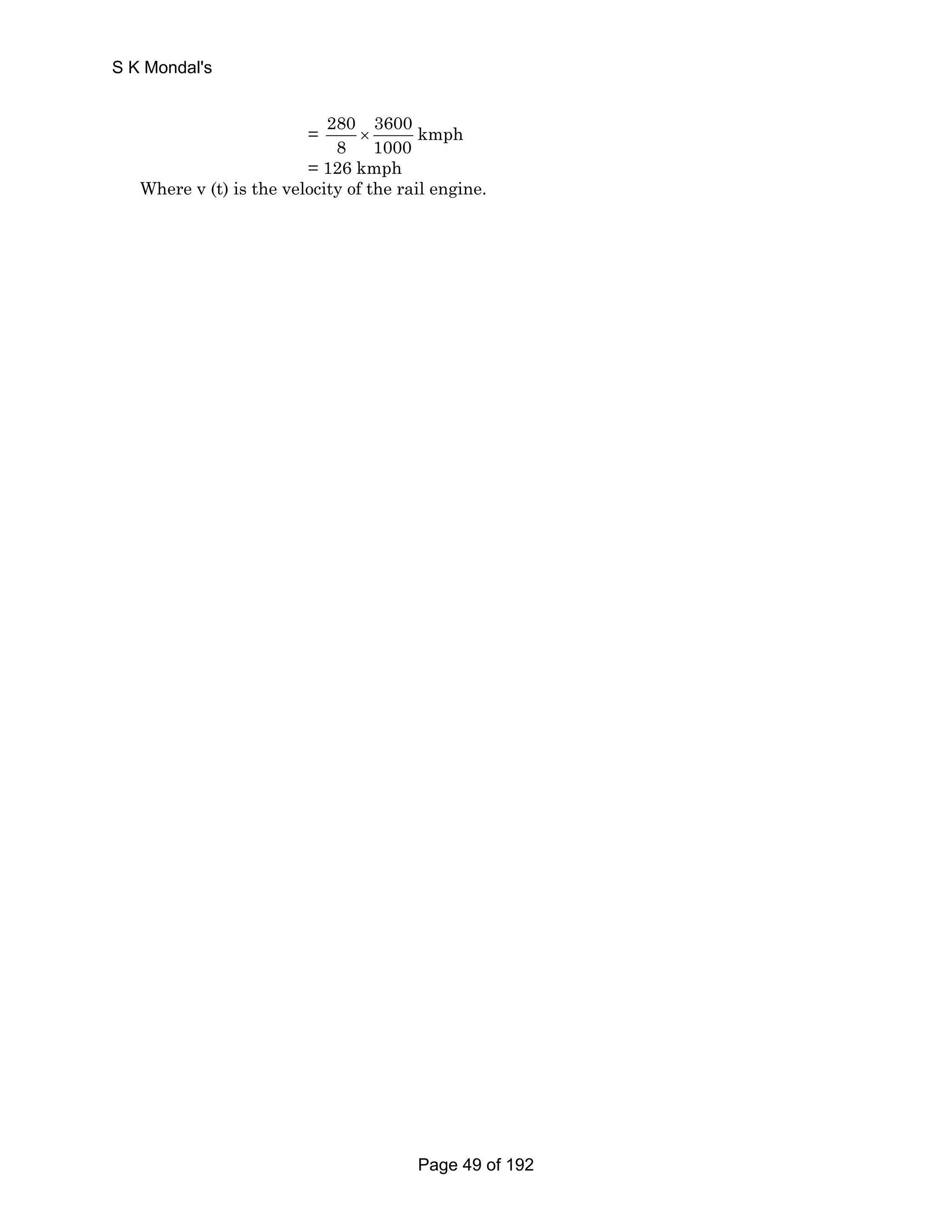
2. Ans. (d)
Since the position of rail engine S(t) is continuous and differentiable function, according to
Lagranges mean value theorem
∃t Where 0 ≤ t ≤ 8 such that
S′ (t) = v (t) = S(8) S(0)
−
−
8 0
= (280 0) m/sec
−
−
(8 0)
= 280 m/sec
8
S K Mondal's
Page 48 of 192](https://image.slidesharecdn.com/gatemathematicsquestionsallbranchbyskmondal-141123081724-conversion-gate01/75/Gate-mathematics-questions-all-branch-by-s-k-mondal-48-2048.jpg)
![S K Mondal's
7. Theorems of Integral
Calculus
EC All GATE Questions
1. The value of the integral I =
1 exp x
2 8
2
∞ ⎛ ⎞
⎜ − ⎟ π ⎝ ⎠ ∫ dx is [EC: GATE-2005]
0
(a) 1 (b) π
(c) 2 (d) 2π
1.(a)
∞ 2
I 1 exp ⎛ − x ⎞
dx
π ⎝ ⎠ ∫
=
= ⎜ ⎟
2 8
0
x2 put z
8
dz xdx
⇒ =
4 dx 4dz 2dz
⇒ = =
8z z
1 ∞
e z
. 2 dz
2 ∫
π z
= −
0
1 ∞
e z z 1/2
dz
π ∫
= − −
0
1 1 e z z 1 2 dz (n) e z z n 1
dz,n 0
− − − − − ⎡ ⎤
∞ ∞
∫ ∫
= ∴⎢Γ = ⎥
π 0 ⎣ 0
⎦
1 1 / 2 (1 / 2)
= Γ( ) ⎡⎣∴Γ = π⎤⎦ π
= 1 π =1
π
π
∫ θ θ is given by [EC: GATE-2006]
2. The integral 3
0
sin d
(a) 1
2 (b) 2
3
Page 50 of 192](https://image.slidesharecdn.com/gatemathematicsquestionsallbranchbyskmondal-141123081724-conversion-gate01/75/Gate-mathematics-questions-all-branch-by-s-k-mondal-50-2048.jpg)
![S K Mondal's
(c) 4
3 (d) 83
2. (c)
( )
π π
sin3 d 1 cos2 sin d . putz cos
θ θ = − θ θ θ = θ
=− θ θ
∫ ∫
0 0
dz sin d .
( ) ( ) 1 1
1 z dz 1 z dz
= − ∫ − 2 = ∫ −
2
( ) ( )
−
1 −
1
1 1
2 1 z dz 2 z z3 2 1 1 / 3 3
= ∫
− 2
= ⎡ ⎢⎣ − ⎤ ⎥⎦ = − = 3 4
1 0
3. The following plot shows a function y which varies linearly with x. The value of the integral I =
2
∫ ydx is [EC: GATE-2007]
1
3
2
1
– 1 0 1 2 3
x
y
(a) 1.0 (b) 2.5
(c) 4.0 (d) 5.0
3(b).
Here the points (0,1) and (-1,0) are on the time
∴The equn of the line is
y 1 0 −
1 − = (x −
0)
1 0
− −
⇒ y −1 = x
⇒ y = x +1
2 2 2
ydx x 1 dx x2 x 2.5
∴ ∫ = ∫
( + )
= ⎡ ⎤ ⎢⎣ 2
+ ⎥⎦ = 1 1 1
4. Which one of the following function is strictly bounded? [EC: GATE-2007]
Page 51 of 192](https://image.slidesharecdn.com/gatemathematicsquestionsallbranchbyskmondal-141123081724-conversion-gate01/75/Gate-mathematics-questions-all-branch-by-s-k-mondal-51-2048.jpg)
![S K Mondal's
1
x (b) ex
(a) 2
(c) x2 (d) e−x2
4. (d)
For a strictly bounded function f(x), limit should be finite
Here lim e −
(finite).
→∞
→ = x2
x
ME 20 Years GATE Questions
1
2 y
∞
− ∫ [ME: GATE-1994]
6. The 3
The value of y e dx is .......
0
6. Ans.
∞
1/2 −
y3 3
−
−
y .e dy put y z
∞ −
−
∞ − −
∞ − −
=
⇒
⇒
⇒ =
∫
=
=
= Γ
= π
π
=
∫
∫
∫
0
2
2
2
3
1
6 2
z 3
0
1
z 2
0
1 1 z 2
0
3y dy=dz
dy= 1 y dz
3
dy 1 z dz
3
= 1 z .e .z dz
3
1 e z dz
3
1 e z dz
3
1 (1)
3 2
1.
3
3
Page 52 of 192](https://image.slidesharecdn.com/gatemathematicsquestionsallbranchbyskmondal-141123081724-conversion-gate01/75/Gate-mathematics-questions-all-branch-by-s-k-mondal-52-2048.jpg)
![S K Mondal's
a
8. (sin6 sin7 ) is equal to
∫ + [ME: GATE-2005]
a
x xdx
−
a a a
∫ 6 xdx ∫ 7 xdx ∫ 6 x + 7
x dx
(a) 2 sin (b) 2 sin (c) 2 (sin sin ) (d) Zero
0 0 0
8. (a)
( ) a
∫ +
6 7
a
sin x sin x dx
−
a
= 2∫sin 6
xdx.
0
sin x is odd function
⇒sin6 x is even and sin7x is odd function.
a a
sin x 2 sin xdx
∫ 6
= ∫
a 0
−
a
and sin x 0.
∫ 7
=
a
−
dx
x
∞
−∞ ∫ + is [ME: GATE-2010]
9. The value of the integral 1 2
(a)−π (b)−π / 2 (c)π / 2 (d)π
9. (d)
∞ ∞
dx tan 1 x / 2 ( / 2 ) .
1 x
2
∫
= ⎡⎣ −
⎤⎦ = ⎡⎣π − π ⎤⎦ = π + −∞ −∞
10. Which of the following integrals is unbounded? [ME: GATE-2008]
/4 1
π ∞ ∞
(a) tan dx (b) 1 dx (c) dx (d) 1 dx
∫ x ∫ ∫ xe −
x
2
∫
+ − x x
1 1
0 0 0 0
10. (d)
At x 1, 1
=
1 −
x is unbounded.
21. The length of the curve 2 3/2
y = x between x = 0 and x = 1 is [ME: GATE-2008]
3
(a) 0.27 (b) 0.67 (c) 1 (d) 1.22
Page 53 of 192](https://image.slidesharecdn.com/gatemathematicsquestionsallbranchbyskmondal-141123081724-conversion-gate01/75/Gate-mathematics-questions-all-branch-by-s-k-mondal-53-2048.jpg)
![S K Mondal's
21.(d)
Length of the wire = ⎛⎜ ⎞⎟ +
⎝ ⎠ ∫
2
1
0
dy 1 dx
dx
1
0 = ∫ x +1dx
=1.22.
CE 10 Years GATE Questions
EE All GATE Questions
Q28. What is the value of the definite integral, a
0
x
x + a − x ∫ dx ?
(a) 0 (b) a/2 (c) a (d) 2a [CE-2011]
Ans. (b)
Exp. Let ( ) a
f x x I
+ − ∫ dx (say)
= =
0 1
x a x
f a x a x I
( ) a
−
− + ∫ dx (say)
− = =
0 2
a x x
We know
( ) ( ) a a
0 0 ∫ f x dx = ∫ f a − x dx
1 2 ⇒ I = I = I (say)
I I a x + a −
x a
dx a
− + ∫ dx =∫
∴ = = =
1 2 0 0
a x x
1 ⇒2I = a
⇒2I = a
I a
2
⇒ =
∞
= ∫ − then S has the value [EE: GATE-2005]
11. If 3
S x dx,
1
(a) 1
− (b) 1
3
4
(c) 1
2
(d) 1
11. (c)
Page 54 of 192](https://image.slidesharecdn.com/gatemathematicsquestionsallbranchbyskmondal-141123081724-conversion-gate01/75/Gate-mathematics-questions-all-branch-by-s-k-mondal-54-2048.jpg)
![S K Mondal's
∞ − ∞
S x dx ⎡ x 2
⎤
1
− = ∫
3
= ⎢ = ⎣ − ⎥ ⎦ 2 2
1 1
16 The value of the quantity P, where
1
P = ∫ xexdx , is equal to [EE: GATE-2010]
0
(a) 0 (b) 1 (c) e (d) 1/e
16. (b)
1 1 x x x
P = ∫ xe dx = ⎡⎣xe − e ⎤⎦ =1
0
0
17. A continuous-time system is described by ( ) − ( ) = x t y t e where y (t) is the output and x (t) is the
input. y(t) is bounded. [EE: GATE-2006]
(a) only when x(t) is bounded
(b) only when x(t) is non-negative
(c) only or t ≥ 0 if x (t) is bounded for t ≥ 0
(d) even when x(t) is not bounded
17. (d)
As e−∞ →0(finite)
∴y(t)is bounded even if x(t) is not bounded.
IE All GATE Questions
17. The value of the integral
∫ 1
−
2
1
1 dx
x
is [IE: GATE-2005]
(a) 2 (b) does not exist (c) –2 (d) ∞
17. (b)
1
∫ 1 dx does not exists because at x 1 =
0, is not bounded.
x 2 x 2
−
1
Page 55 of 192](https://image.slidesharecdn.com/gatemathematicsquestionsallbranchbyskmondal-141123081724-conversion-gate01/75/Gate-mathematics-questions-all-branch-by-s-k-mondal-55-2048.jpg)
![CS All GATE Questions
20.
4
0
(1 tan x) dx
(1 tan x)
π
−
+ ∫ evaluates to [CS: GATE-2009]
(a) 0 (b) 1 (c) ln 2 (d) 1 ln 2
2
20. Ans.(d)
Since
a
∫0 f(x) dx = a
0 ∫ f(a − x) dx
∴ 1 = 4
0
1 tanx dx
1 tanx
π −
+ ∫
= 4
0
1 tan x dx
4
1 tan x
4
π
⎛ π ⎞ − ⎜ − ⎟
⎝ ⎠
⎛ π ⎞ + ⎜ − ⎟
⎝ ⎠
∫
Since tan (A – B) = tan A −
tanB
1 +
tan A tanB
∴ I = 4
0
tan tan x
4
1 tan tanx
4 dx
tan tan x
4
1 tan tanx
4
π
⎡ π ⎤ ⎢ − ⎥
⎢ π ⎥ ⎢ + ⎥ ⎢⎣ ⎥⎦
⎡ π ⎤ ⎢ − ⎥
⎢ π ⎥ ⎢ + ⎥ ⎢⎣ ⎥⎦
∫
= 4
0
1 1 tan x
1 tanx dx
1 1 tan x
1 tanx
π
⎡ − ⎤
− ⎢ ⎥ ⎣ + ⎦
⎡ − ⎤
+ ⎢ ⎥ ⎣ + ⎦
∫
= 4
0
2tanx dx
2
π
∫
= 4
π
∫
tan x dx
0 = 4
π
0 [log(sec x)]
⎛ π ⎞ ⎜ ⎟ −
⎝ ⎠
= ln sec ln(sec0)
4
S K Mondal's
Page 56 of 192](https://image.slidesharecdn.com/gatemathematicsquestionsallbranchbyskmondal-141123081724-conversion-gate01/75/Gate-mathematics-questions-all-branch-by-s-k-mondal-56-2048.jpg)
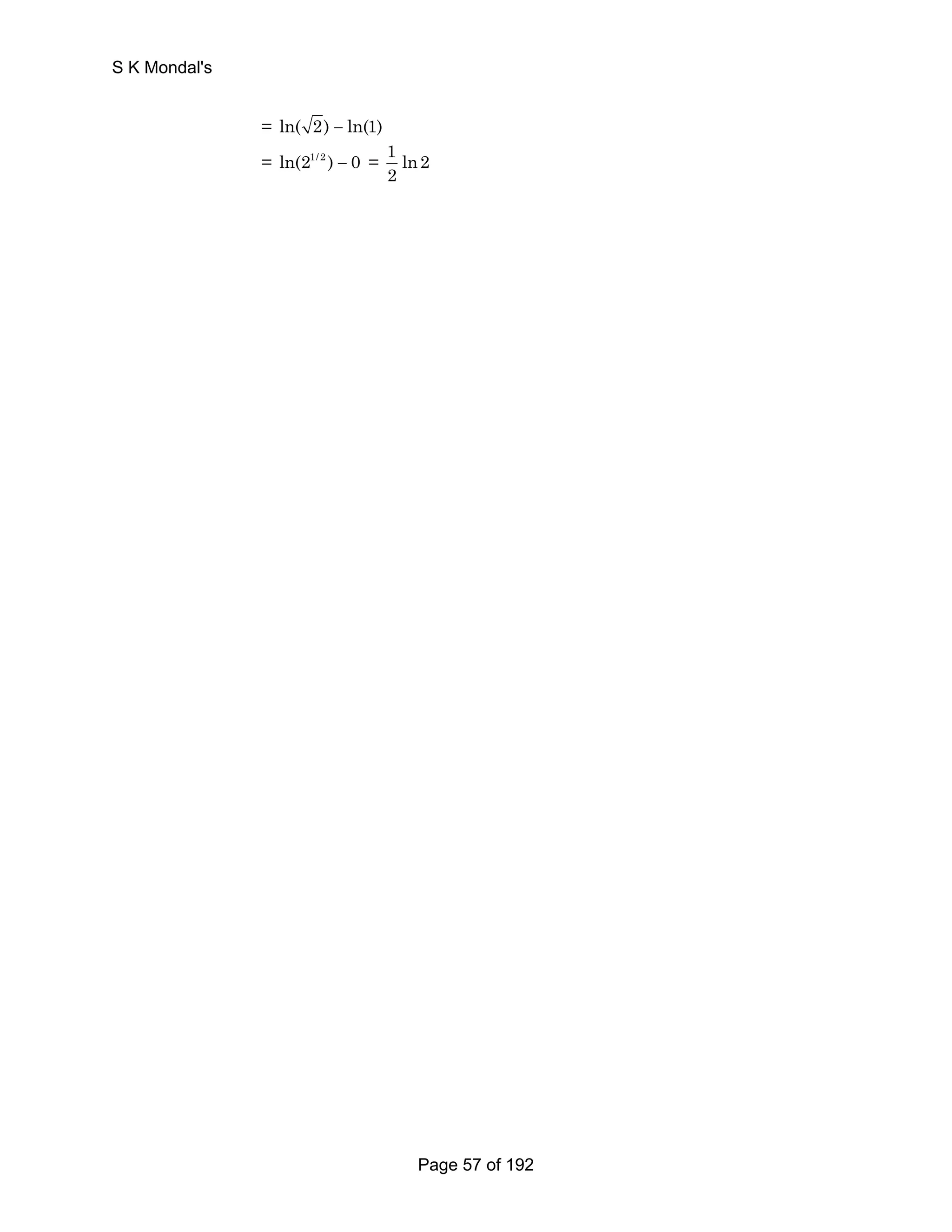
![S K Mondal's
8. Partial Derivatives
EC All GATE Questions
1. Consider the function f(x) = x2 – x – 2. The maximum value of f(x) in the closed interval [–4, 4]
is [EC: GATE-2007]
(a) 18 (b) 10
(c) –2.25 (d) indeterminate
1.(a)
f(x) = x2 − x − 2
∴f '(x) = 2x −1
f1(x) 0 x 1 4,4
2 = ⇒ = ∈⎡⎣− ⎤⎦
Nowf (x) = 2 0
∴f(x)has minimum at x =1 / 2
It Shows that a maximum value that will be at x = 4 or x = - 4
At x = 4, f(x) =10
∴At x = −4, f(x) =18
∴At x = −4, f(x) has a maximum.
2. For real values of x, the minimum value of the function f(x) = exp (x) + exp (–x) is
[EC: GATE-2008]
(a) 2 (b) 1
(c) 0.5 (d) 0
2. (a)
f(x) = ex + e−x
For extrema,
f '(x) = 0⇒ex − e−x = 0
⇒x = 0.
f (x) = ex − e−x
x 0 f (x) 2 0 = =
Heve minimum at x = 0, f10) = 2.
3. If
1
ey = x x then y has a [EC: GATE-2010]
(a) Maximum at x = e (b) minimum at x = e
(c) Maximum at x = e-1 (d) minimum at x = e-1
Page 58 of 192](https://image.slidesharecdn.com/gatemathematicsquestionsallbranchbyskmondal-141123081724-conversion-gate01/75/Gate-mathematics-questions-all-branch-by-s-k-mondal-58-2048.jpg)
![3. (a)
ey x 1
x =
Take log both side
y 1 log x
x =
For extrema,
dy 1 1 = 0 ⇒ − log x 0
dx x 2 x =
2
Now
2
d y 1 0
dx 2 x =
= e e 3
∴Max at x = e.
ME 20 Years GATE Questions
5. Let f =yx. What is
2 f
x y
∂
∂ ∂
at x = 2, y = 1? [ME: GATE-2008]
(a) 0 (b) In 2 (c) 1 (d) 1/In 2
5(c).
f = yx
Take log both side
log f = x log y
Differentiate
1 ∂ f x ∂ f y x ⎛ x ⎞
y x1
−
.x
f y y y y
= ⇒ = ⎜ ⎟ = ∂ ∂ ⎝ ⎠
∂ ∂
⇒ = = +
2
f ( y .x) xy lny y
x y x
x − 1 x − 1 x −
1
∂ ∂ ∂
2
(2,1)
f
xdy
∂
∴
∂
=1
6. If II (x,y) is a homogeneous function of degree n, then ∂ N ∂
x + y N =
nH.
x y
∂ ∂
[ME: GATE-1994]
6. Euler’s Theorem for homogeneous function
x2
7.
If (x)= t dt, then d is
φ ∫ [ME: GATE-1998]
0
(a) 2x2 (b) x (c) 0 (d) 1
φ
dx
S K Mondal's
Page 59 of 192](https://image.slidesharecdn.com/gatemathematicsquestionsallbranchbyskmondal-141123081724-conversion-gate01/75/Gate-mathematics-questions-all-branch-by-s-k-mondal-59-2048.jpg)
![.
S K Mondal's
7. (a)
x2
3
(x) t dt 2 x
Φ = ∫ =
3 0
d Φ
2 3x2 2x2
dx 3
∴ = =
8. If z = f(x,y), dz is equal to [ME: GATE-2000]
(a) ( ∂ f/ ∂ x)dx + ( ∂ f/ ∂ y)dy (b) ( ∂ f/ ∂ y)dx + ( ∂ f/ ∂
x)dy
(c) ( ∂ f/ ∂ x)dx - ( ∂ f/ ∂ y)dy (b) ( ∂ f/ ∂ y)dx - ( ∂ f/ ∂
x)dy
8. (a)
9. The function f(x) = x3- 6x2+ 9x+25 has [ME: GATE-1995]
(a) A maxima at x = 1 and a minima at x = 3
(b) A maxima at x = 3 and a minima at x = 1
(c) No maxima, but a minima at x = 3
(d) A maxima at x = 1, but not minima
9.(a)
f(x) = x3 − 6x2 + 9x + 25
For extrema, f1(x) = 0⇒3x2 −12x + 9 = 0⇒x =1,3.
For extrema, f 1 (x) 0 3x 2
12x 9 0 x 1,3.
Now,f (x) 6x 12
f (x) 6 0. f(x)has mix.value at x 1 =
x 1
= ⇒ − + = ⇒ =
= −
∴ =− =
x 3 f (x) 6 0. f(x)has min.value at x 3 = = =
10. The minimum point of the function f(x) = (x2/3) – x is at [ME: GATE-2001]
(a) x = 1 (b) x = -1 (c) x = 0 (d) x 1
3
=
10. (a)
For extrema, f1(x) = 0
⇒x2 −1 = 0
⇒x = ±1
Page 60 of 192](https://image.slidesharecdn.com/gatemathematicsquestionsallbranchbyskmondal-141123081724-conversion-gate01/75/Gate-mathematics-questions-all-branch-by-s-k-mondal-60-2048.jpg)
![S K Mondal's
f (x) = 2x
f (1) = 2 0 andf ′′ ( − 1) = − 2
0
f has min value at x 1
⇒ =
11. The function f(x,y) = 2x2 +2xy – y3 has [ME: GATE-2002]
(a) Only one stationary point at (0,0)
(b) Two stationary points at (0,0) and (1/6, -1/3)
(c) Two stationary points at (0,0) and (1,-1)
(d) No stationary point
11. Ans.(b)
See theory.
12. If x=a(θ + sinθ) and y=a(1-cosθ), then dy/dx will be equal [ME: GATE-2004]
⎛ θ ⎞ ⎛ θ ⎞ ⎛ θ ⎞ ⎛ θ ⎞
⎜ ⎟ ⎜ ⎟ ⎜ ⎟ ⎜ ⎟
⎝ ⎠ ⎝ ⎠ ⎝ ⎠ ⎝ ⎠
(a) sin (b) cos (c) tan (d) cot
2 2 2 2
12. (c)
dx a(1 cos ) dy asin
dy = + θ d = θ
θ
θ θ
dy 2sin 2 cos 2 tan 2 dx 2cos 2
∴ = = θ
2 θ
13. Equation of the line normal to function f(x) = (x-8)2/3+1 at P(0,5) is
[ME: GATE-2006]
(a) y = 3x -5 (b) y = 3x +5 (c) 3y = x+15 (d) 3y = x -15
13.(b)
m dy 1 mm 1
= dx =− 3 ∴ 1
=−
(0,5)
1 1 ⇒m = 3, where m = slope of thenormal.
∴ Equation of normal at (0,5) is
y − 5 = 3(x −1)
⇒ y = 3x + 5
14. The minimum value of function y = x2 in the interval [1, 5] is [ME: GATE-2007]
(a) 0 (b) 1 (c) 25 (d) Undefined
14. (b)
Page 61 of 192](https://image.slidesharecdn.com/gatemathematicsquestionsallbranchbyskmondal-141123081724-conversion-gate01/75/Gate-mathematics-questions-all-branch-by-s-k-mondal-61-2048.jpg)
![S K Mondal's
y = x2 is strictly increasing function on [1,5]
∴y = x2 has minimum value at x = 1 is 1.
23. The distance between the origin and the point nearest to it on the surface z2 = 1 + xy is
[ME: GATE=2009]
(a) 1 (b) 3 (c) 3 (d) 2
2
−
23. Ans(a)
CE 10 Years GATE Questions
15. The function f(x) = 2x3 – 3x2 – 36x + 2 has its maxima at [CE: GATE – 2004]
(a) x = – 2 only (b) x = 0 only
(c) x = 3 only (d) both x = –2 and x = 3
15. (a)
f(x) = 2x3 − 3x2 − 36x + 2
f (x) = 6x2 − 6x − 36
For extrema, f1(x) = 0
⇒x2 − x − 6 = 0
⇒x = 3,−2
f (x) =12x − 6
x 3 f (x) 30 0 f has minimum at x 3 = = ⇒ =
x 2 f (x) 30 0 f has maximum at x 2 =− = − ⇒ = −
16. Given a function [CE: GATE – 2010]
f(x, y) = 4x2 + 6y2 – 8x – 4y + 8
The optimal value of f(x, y)
(a) is a minimum equal to 10
3
(b) is a maximum equal to 10
3
(c) is a minimum equal to 8
3
(a) is a maximum equal to 8
3
16. (a)
f(x,y) = 4x2 + 6y2 − 8x − 4y + 8
Page 62 of 192](https://image.slidesharecdn.com/gatemathematicsquestionsallbranchbyskmondal-141123081724-conversion-gate01/75/Gate-mathematics-questions-all-branch-by-s-k-mondal-62-2048.jpg)
![S K Mondal's
f 8x 8. f 12y 4.
x y
∂ ∂
= − = −
∂ ∂
∂ f = 0 gives x = 1 and only ∂
f = gives y 1 / 3
x y
=
∂ ∂
∴(1,1 / 3) is only stationary point.
Now r f 8 0
⎡ ∂ ⎤
= ⎢ ⎥ = ⎣∂ ⎦
( )
2
2
1,1/3
x
t f 12 0
⎡ ∂ ⎤
= ⎢ ⎥ = ⎣∂ ⎦
( )
2
2
1,1/3
y
and s f 0
⎡ ∂ ⎤
= ⎢ ⎥ = ⎣∂ ⎦
( )
2
1,1/3
xdy
∴ rt − s2 = 96 6.
∴ (1,1 / 3) is a pointof minima.
f 1,1 / 3 4 1 6 1 8.1 4.1 / 3 8
( ) 2
∴ = × + × 3 − − +
2
10 =
.
3 EE All GATE Questions
Q27. What should be the value of λ such that the function defined below is continuous at x =
π/22?
( )
cosx if x 2
x
2
1 ifx2
⎧λ π ⎪ ≠ ⎪ π − ⎨⎪
π = ⎪⎩
f x
(a) 0 (b) 2 / π (c) 1 (d) π / 2 [CE-2011]
Ans. (c)
Exp. By the given condition
( ) = ( π
) x 2
limπ f x f 2 →
lim cos x 1
x 2 ( )
2 x
→π
λ
⇒ =
π −
… (1)
lim cos x 0 form
x 2
2 x 0
→π
λ ⎡ ⎤
π − ⎢⎣ ⎥⎦
… (2)
lim sinx
→π 1
x 2
−λ
−
[use L’Hospital Rule]
= λ
From (1), λ = 1
Page 63 of 192](https://image.slidesharecdn.com/gatemathematicsquestionsallbranchbyskmondal-141123081724-conversion-gate01/75/Gate-mathematics-questions-all-branch-by-s-k-mondal-63-2048.jpg)
![S K Mondal's
17. For the function f(x) = x2e-x, the maximum occurs when x is equal to [EE: GATE-2005]
(a) 2 (b) 1 (c) 0 (d) -1
17. (a)
f '(x) = 2xe−2 − x2e−x
For extrema f '(x) = 0
⇒2xe−x − x2e−x = 0
⇒ x = 0,2
Now
f (x) = 2e−x − 2xe−x − 2xe−x + x2e−x
= 2e−x − 4xe−x + x2e−x
f (x) 2 0 and f (x) 2e− 2
0
x 0 x 2 = = ⎡⎣ ⎤⎦ = ⎡⎣ ⎤⎦ = −
∴ at x = 2,f(x) has a maximum value.
18. Consider function f(x) =(x2-4)2 where x is a real number. Then the function has
[EE: GATE-2008]
(a) Only one minimum
(b) Only two minima
(c) Three minima
(d) Three maxima
18.(b)
f(x) = (x2 − 4)2
f '(x) = 2(x2 − 4).2x = 4x(x2 − 4).
For extrema,f '(x) = 0
⇒x = 0,−2,2.
f (x) = 4(x2 − 4) + 8x2
=12x2 −16
x 0 f (x) 16 0 = ⎡⎣ ⎤⎦ = −
x 2 f (x) 32 0 =− ⎡⎣ ⎤⎦ =
x 2 and f (x) 32 0 = ⎡⎣ ⎤⎦ =
∴At x = 0,f(x)has maxima.
At x = −2,2,f(x)has minima.
19. A cubic polynomial with real coefficients [EE: GATE-2009]
(a) Can possibly no extrema and no zero crossings
(b) May have up to three extrema and up to 2 zero crossings
(c) Cannot have more than two extrema and more than three zero crossings
(d) Will always have an equal number of extrema and zero crossings
19. Ans. (c)
F(x) = Ax3 + Bx2 +Cx + D
Page 64 of 192](https://image.slidesharecdn.com/gatemathematicsquestionsallbranchbyskmondal-141123081724-conversion-gate01/75/Gate-mathematics-questions-all-branch-by-s-k-mondal-64-2048.jpg)
![S K Mondal's
∴
F (x) = 3Ax2 + 2Bx +C
First max: F '(x) = 6Ax + 2B
Second max: F ''(x) = 6A
F '''(x) = 0
So maximum two extrema and three zero crossing
IE All GATE Questions
0 1 n 1 n a x + a x y + ...... + a xy + a y , where i a (i = 0 to n) are constants, then
20. If f = −
n n- 1 n 1 n
−
x ∂ f + y ∂
f
∂ x ∂
y
is [IE: GATE-2005]
(a) fn
(b) nf
(c) nf (d) n f
20. (e)
x ∂ f y ∂
f xf
x y
+ = −
∂ ∂
Euler’s theorem for homogeneous function
21. Given y = x2 + 2x + 10, the value of
x =1
dy
dx
is equal to [IE: GATE-2008]
(a) 0 (b) 4
(c) 12 (d) 13
21. (b)
Given, y = x2 + 2x + 10
∴ dy
dx = 2x + 2
⇒
dy
dx =
x 1
= 4
22. For real x, the maximum value of
e
e
sin x
cos x
is [IE: GATE-2007]
(a) 1 (b) e
(c) e 2 (d) ∞
22(c).
y = esinx−cosx
Page 65 of 192](https://image.slidesharecdn.com/gatemathematicsquestionsallbranchbyskmondal-141123081724-conversion-gate01/75/Gate-mathematics-questions-all-branch-by-s-k-mondal-65-2048.jpg)
![S K Mondal's
Take log both side
log y = cosx − sin x
1 dy cosx sin x
y dx ∴ = +
dy y(cos x sin x) esinx cosx (cos x sin x)
dx
⇒ = + = − +
For extrema dy 0gives.
dx =
tan x 1 tan( 4) tan 34
π π = − = π − =
x 3
π
4
⇒ =
2
d y = e (sin x − cosx) .(cosx + sinx) 2 + e (sinx − cosx)
(sinx dx
− +
cosx)
2
d2y 2e 0.
dx2
so ,y hasmax at x 3
⎡ ⎤ = − 2
⎢⎣ ⎥⎦
x 3
4
4
π
=
π
=
At that point , y=e 2
23. Consider the function y = x2 – 6x + 9. The maximum value of y obtained when x varies over
the interval 2 to 5 is [IE: GATE-2008]
(a) 1 (b) 3
(c) 4 (d) 9
23. (b)
y' = 0 gives 2x − 6 = 0
⇒x = 3
y(x) = 2
CS All GATE Questions
24. A point on a curve is said to be an extremum if it is a local minimum or a local maximum.
The number of distinct exterma for the curve 3x4 – 16x3 – 24x2 + 37 is
[CS: GATE-2008]
(a) 0 (b) 1
(c) 2 (d) 3
24.(d)
Let f(x) = 3x4 −16x3 − 24x2 + 37
Page 66 of 192](https://image.slidesharecdn.com/gatemathematicsquestionsallbranchbyskmondal-141123081724-conversion-gate01/75/Gate-mathematics-questions-all-branch-by-s-k-mondal-66-2048.jpg)
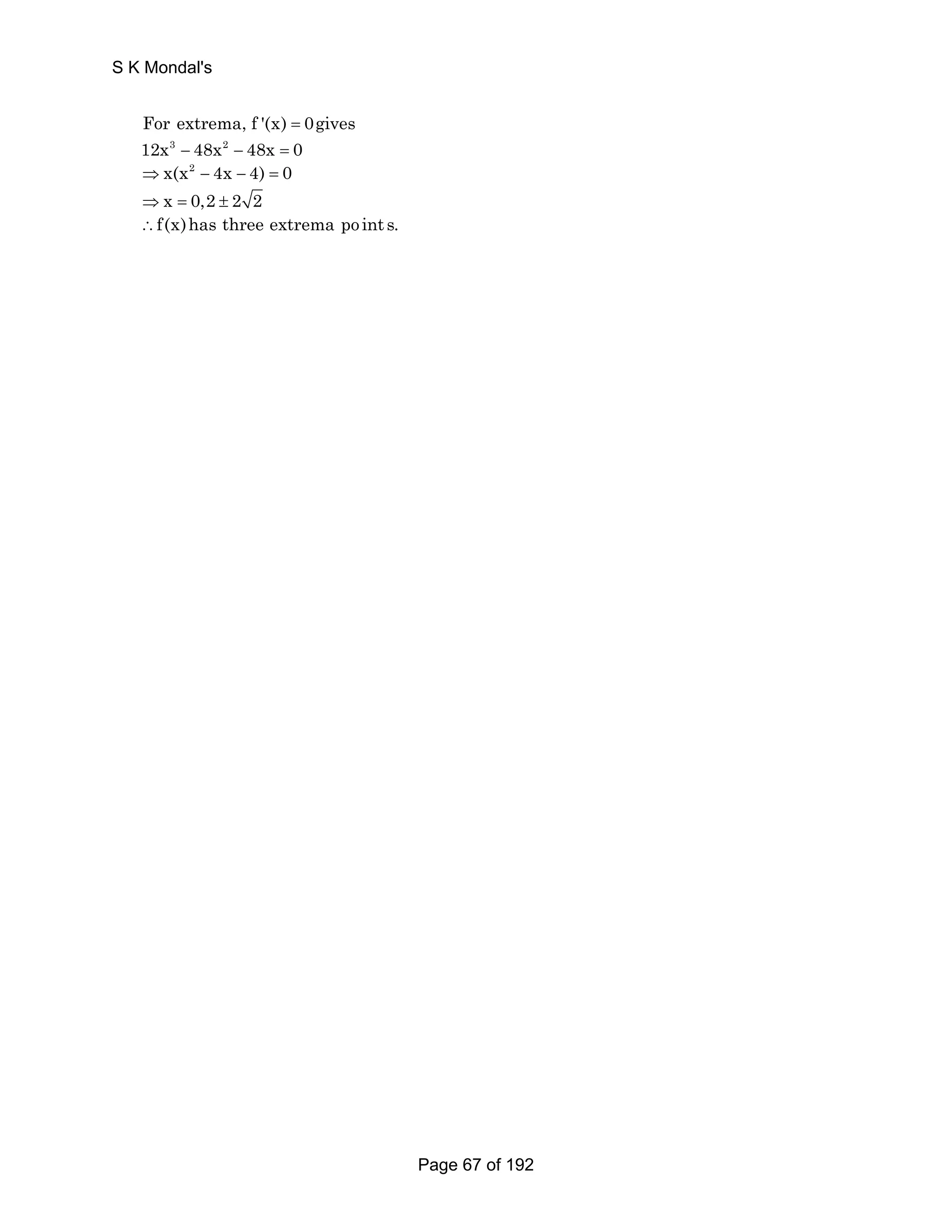
![9. Gradient
EC All GATE Questions
1. ∇ × ∇ × P, where P is a vector, is equal to [EC: GATE-2006]
(a) P × ∇ × P – ∇ 2 P (b) ∇ 2 P + ∇ (∇ • P)
(c) ∇ 2 P + ∇ × P (d) ∇ (∇ • P) – ∇ 2 P
1. (d) (formula)
2. ∫∫(∇ × P) • ds, where P is a vector, is equal to [EC: GATE-2006]
(a) v∫ P • dl (b) v∫ ∇ × ∇ × P • dl
(c) v∫ ∇ × P • dl (d) ∫∫∫∇ • P dv
2. (a) Hints (Stokes Theorem).
1. Consider points P and Q in the x-plane, with P= (1, 0) and Q = (0, 1). The line integral
Q
2 ∫(xdx + ydy) along the semicircle with the line segment PQ as its diameter [EC: GATE-2008]
P
(a) Is –1 (b) is 0 (c) Is 1
d) depends on the direction (clockwise or anti-clockwise) of the semicircle
1.Ans. (b)
The straight line equation is x + y = 1
P
(1, 0)
(0, 1) Q
2∫(1 − y) . (−dy) + 2∫ y dy
=
Then, I =
1 1
0 0
2 1 1
2 y y 2 y
2 2
⎡ ⎤ ⎡ ⎤
⎢ − ⎥ + ⎢ ⎥
⎣ ⎦ ⎣ ⎦
∫ ∫ = 0
0 0
S K Mondal's
Page 68 of 192](https://image.slidesharecdn.com/gatemathematicsquestionsallbranchbyskmondal-141123081724-conversion-gate01/75/Gate-mathematics-questions-all-branch-by-s-k-mondal-68-2048.jpg)
![S K Mondal's
5. The value of the integral of the function g(x, y) = 4x3 + 10y4 along the straight line segment from
the point (0, 0) to the point (1, 2) in the x-y plane is [EC: GATE-2008]
(a) 33 (b) 35
(c) 40 (d) 56
5(a).
The equation of the line passing through (0,0) and (1,2)
is y = 2x
Given y(x,y) = 4x3 +10y4 = 4x3 +10(2x)4 = 4x3 +160xy
( ) 1
∴I = ∫ 4x 3 +160x 4
dx = 33.
0
ME 20 Years GATE Questions
3. The magnitude of the gradient of the function f = xyz3 at (1,0,2) is [ME:GATE-1998]
(a) 0 (b) 3 (c) 8 (d) ∞
3. (c)
⎛ ∂ ∂ ∂ ⎞
.f iˆ ˆj kˆ .xyz3
∇ = ⎜ + + ⎝ ∂ x ∂ y ∂ z
⎟ ⎠
JK
= yz3iˆ + xz3ˆj + 3xyz2kˆ
JK
∇ =
(1,0,2) .f 8ˆj
∴ ∇.f = 8ˆj = 8.
(1,0,2)
JK
JG
is a differentiable vector function and f is a sufficient differentiable scalar function,
then curl ((fV)
4. If V
JG
is equal to [ME: GATE-1995]
G G JG G G
(a) (grad f)×(v)+(f curl v) (b) O (c) f curl (v) (d) (grade f)×(v)
4.(a)
JK ( ) ( JK ) v)
−
f v f v f( = (gradf ) × v + f(curl v)
∇ × = ∇ × + ∇ ×
5. The expression curl (grad f), where f is a scalar function, is [ME: GATE-1996]
(a) Equal to ∇2f (b) Equal to div (grad f)
(c) A scalar of zero magnitude (d) A vector of zero magnitude
5. (d)
Page 69 of 192](https://image.slidesharecdn.com/gatemathematicsquestionsallbranchbyskmondal-141123081724-conversion-gate01/75/Gate-mathematics-questions-all-branch-by-s-k-mondal-69-2048.jpg)
![( )
⎡ ⎤
⎢ iˆ ˆj kˆ
⎥
⎢ ⎥
⎢ ∂ ∂ ∂ ⎥
.f
∇× ∇ = ⎢ ⎥ ⎢∂ ∂ ∂ ⎥
x y z
f f f
x y z
⎢ ∂ ∂ ∂ ⎥
⎢∂ ∂ ∂ ⎥ ⎣ ⎦
JK JK
f 2f ˆ ˆ 2f 2f ˆ ˆ 2f 2f i j j k
y z y z x z x z x y x y
⎛ ∂ ∂ ⎞ ⎛ ∂ ∂ ⎞ ⎛ ∂ ∂ ⎞
= ⎜ − ⎟ − ⎜ − ⎟ + ⎜ − ⎟ ⎝ ∂ ∂ ∂ ∂ ⎠ ⎝ ∂ ∂ ∂ ∂ ⎠ ⎝ ∂ ∂ ∂ ∂ ⎠
= 0
6. The temperature field in a body varies according to the equation T(x,y) = x3+4xy. The
direction of fastest variation in temperature at the point (1,0) is given by
(a) 3i + 8j (b) i (c) 0.6i + 0.8j (d) 0.5i + 0.866j [ME: GATE-1997]
6. Ans. (c)
Given T=x +4xy
T 3x 4y
x
∂
= +
∂
⎛ ∂ ⎞ ⎜ ⎟ = ⎝ ∂ ⎠
T 3
x
∂
T =
4x
∂
y
T 4
y
⎛ ∂ ⎞
⎜ ⎟ = ⎝ ∂ ⎠
∴
3
2
(1,0)
(1,0)
Direction of fastest variation in temperat
+ +
ure at (1,0) is given by
(3i 4j) or 0.6i 0.8j
G G G
7. If the velocity vector in a two – dimensional flow field is given by v = 2xyi + (2y2 − x2)j,
the
vorticity vector, curl v G
will be [ME: GATE-1999]
G G G
(a) 2y2 j (b) 6yj (c) zero (d) -4xk
7. (d)
iˆ ˆj kˆ
⎛ ⎞
⎜ ⎟
⎜ ∂ ∂ ⎟ = − − ∇× = ⎜ ⎟ ∂ ∂ = − ⎜ ⎟
V 0 ( 2x 4x )
kˆ x y 4xk
ˆ ⎜ − ⎟ ⎝ ⎠
JK JJK
2xy 2y 2 x 2
0
G G G G
8. The divergence of vector r = xi + yj + zk is
[ME: GATE-2001]
S K Mondal's
Page 70 of 192](https://image.slidesharecdn.com/gatemathematicsquestionsallbranchbyskmondal-141123081724-conversion-gate01/75/Gate-mathematics-questions-all-branch-by-s-k-mondal-70-2048.jpg)
![S K Mondal's
G G G
(a) i + j + k
(b) 3 (c) 0 (d) 1
8. (b)
JK JK
F ⎛ ∂ iˆ ∂ ∂ kˆ ⎞
.(xiˆ yˆj zkˆ )
∇× = ⎜ + + + + ⎝ ∂ x ∂ y ∂ z
⎟ ⎠
= + + =
1 1 1 3
G [ME: GATE-2003]
9. The cector field F = xi − yj (where i and j are unit vector) is
(a) Divergence free, but not irrotational is
(b) Irrotational, but not divergence free
(c) Divergence free and irrotational
(d) Neither divergence free nor irrotational
9. (c).
JK FJK iˆ j kˆ . xiˆ yˆj
( ) ⎛ ∂ ∂ − ∂ ⎞
∇× = ⎜ + + ⎟ − ⎝ ∂ x ∂ y ∂ z
⎠
JK
=1 −1 = 0 ⇒F is devergence free
i j k
JK JK K
∂ ∂ ∂
F 0
∇ × = =
x y z
x y 0
∂ ∂ ∂
−
⇒Fis irrotational vector.
10. The divergence of the vector (x − y)i + ( y − x)j + (x + y + z)k is
(a) 0 (b) 1 (c) 2 (d) 3
10.(d)
11. The divergence of the vector field 3xzi + 2xy j − yz2 k at a point (1 ,1,1) is equal to
(a) 7 (b) 4 (c) 3 (d) 0 [ME: GATE-2009]
11. (c)
JK JK
∇× F = 3z + 2x − 2yz
(1,1,1) F 3.1 2.1 2.1.1
∇× ⎤⎦ = + −
3.
=
JK JK
JG
12. Velocity vector of a flow field is given asV = 2xyiˆ − x2zˆj
. The vorticity vector at
(1, 1, 1) is [ME: GATE-2010]
Page 71 of 192](https://image.slidesharecdn.com/gatemathematicsquestionsallbranchbyskmondal-141123081724-conversion-gate01/75/Gate-mathematics-questions-all-branch-by-s-k-mondal-71-2048.jpg)
![(a)4iˆ − ˆj (b) 4iˆ − kˆ (c)iˆ − 4 ˆj (d)iˆ − 4kˆ
12. (d) JJK curl V is called vorticity vector.
iˆ ˆj kˆ
x iˆ 0 kˆ 2xz 2x Now, curl V V
= ∇× = ∂ ∂ ∂ = + + (− − )
JJK JK JJK 2
∂ x ∂ y ∂
z 0
2xy −
2x 2
z 0
iˆ kˆ 2 2 curlV ˆ ˆi 4k
JJK
∴⎡ = + (− − ) ⎣ ⎦ ⎤ (1,1,1)
= −
13. Among the following, the pair of vectors orthogonal to each other is [ME: GATE-1995]
(a) [3,4,7], [3,4,7] (b) [0,0,0], [1,1,0] (c) [1,0,2], [0,5,0] (d) [1,1,1], [-1,-1,-1]
13. (c)
K K K K a,b be two vector st a.b 0. Then we say that they are orthogonal.
Let − =
Choice (c) is correct.
14. The angle between two unit-magnitude co-planar vectors P (0.866, 0.500, 0) and Q (0.259,
0.966, 0) will be [ME: GATE-2004]
(a) 00 (b) 300 (c) 450 (d) 600
14. (c)
JK JK
JK JK 2 2 2 2 2 2
( ) ( )
( ) ( ) ( ) ( )
P.Q 0.866 0.259 0.5 0.966 0 cos
× + × +
θ = =
P Q .866 + .5 + 0 .259 + .966 +
0
= 0.707.
⇒θ = 45º
15.The area of a triangle formed by the tips of vectors a, b, and c is [ME: GATE-2007]
(a) 1 ( a − b ).( a − c ) (b) 1 ( a − b ) × ( a −
c
)
2 2
(c) 1 ) (d) 1 ( ).
a × b × c a ×
b c
2 2
15.(b)
16. In a flow field in x, y-plane, the variation of velocity with time t is given by v v = (x2 + yt)i
G
G G
v = (x2 + y2 )i
[ME: GATE-1999]
S K Mondal's
Page 72 of 192](https://image.slidesharecdn.com/gatemathematicsquestionsallbranchbyskmondal-141123081724-conversion-gate01/75/Gate-mathematics-questions-all-branch-by-s-k-mondal-72-2048.jpg)
![S K Mondal's
The G acceleration of the G particle in this G field, occupying G
point (1,1) at time t = 1 will be
(a) i (b) 2i (c) 3i (d) 5i
16. Ans.(d)
2
2
v = (x +
yt)i
v=x yt,
at t=1, v (1,1)
=1+1×1=2
u 2x 2 1 2,
x
u y 1, u t 1
t y
a u u v u w u u =(2×2+0+0+1)i=5i
x
x y z t
+
∂
= = × =
∂
∂ ∂
= = = =
∂ ∂
∂ ∂ ∂ ∂
= + + +
∂ ∂ ∂ ∂
G
17. The maximum value of the directional derivative of the function φ = 2x2 + 3y2 + 5z2 at a point
(1,1,-1) is [ME:GATE-2000]
(a) 10 (b) -4 (c) 152 (d) 152
17. (c)
JK
∇Φ = 4xiˆ + 6yˆj +10zkˆ
∇Φ⎤⎦ = + −
(1,1, 1)
4iˆ 6ˆj 10kˆ
−
JK
JK 2 2 2
( ) −
∴ ∇Φ = + + − =
(1,1 1)
4 6 10 152
18. The directional derivative of the scalar function f(x, y, z) = x2 + 2y2 + z at the point P = (1,1,
G [ME: GATE-2008]
2) in the direction of the vector a = 3i − 4j is
(a) – 4 (b) -2 (c) -1 (d) 1
18.(b)
Required directional derivatives at P(1,1,-1)
JK ∧
K
.nˆ , where n is the unit vector in the direction of a
( ) ( )
∴ ∇Φ
(1,1,2)
K K K K K
K 2 2
2iˆ 4ˆj kˆ .1 3iˆ 4ˆj a 3i 4j 1 3i 4j .
− ( )
= + + − = = = −
5 a 3 4 5
( )
+ −
= ( − ) 1 6 16
5
Page 73 of 192](https://image.slidesharecdn.com/gatemathematicsquestionsallbranchbyskmondal-141123081724-conversion-gate01/75/Gate-mathematics-questions-all-branch-by-s-k-mondal-73-2048.jpg)
![S K Mondal's
= −2.
JG
A xyax x ay then ∫ •
19. If = + 2
JG G
vc
A dl over the path shown in the figure is
(a) 0 (b) 2
3
(c) 1 (d) 2 3
19. (a)
JJK v ∫ A.dl K
=
0 is the curve is closed.
JG G JG G from the origin to the point
20. The line integral ∫V.d r of the vector V.(r) = 2xyzi + x2 z j + x2 yk
P (1, 1, 1) [ME: GATE-2005]
(a) Is 1 (b) Is zero
(c) Is -1 (d) Cannot be determined without specifying the path
20.Ans(a)
JG G
2 2
V dr xyzi x z j x yk dxi dy j dzk
. = [2 + + ].( + +
)
2 2
xyzdx x zdy x ydz
(2 )
= + +
Along theline joining tothe po is given
by the parametric formby
x t y t z t
1
Then V dr t t tdt t 2 tdt t 2
tdt
0
1
3
0
(0,0,0) int (1,1,1)
, ,
. (2.. . . )
t dt
4 4.
= = =
= + +
= =
∫ ∫
∫
∫ ∫
∫
JG G
1 =
1
4
24. The area enclosed between the curves y2 = 4x and X2= 4y is [ME: GATE-2009]
(a) 16 (b) 8 (c) 32 (d) 16
3 3
Page 74 of 192](https://image.slidesharecdn.com/gatemathematicsquestionsallbranchbyskmondal-141123081724-conversion-gate01/75/Gate-mathematics-questions-all-branch-by-s-k-mondal-74-2048.jpg)
![S K Mondal's
24. (a)
Let y 4x be curve (i) =y (sa y)
=
=
2
1
x 2
4y be curve (ii) =y (sa y)
2
( ) 4
0 1 2 ∴Area = ∫ y − y dx
4x x dx 16
4 2
0
⎛ ⎞
⎝ ⎠ ∫
= ⎜ − ⎟ =
4 3
x2 = 4y
(4,4)
(4,0)
y2 = 4x
25. Stokes theorem connects [ME: GATE-2005]
(a) A line integral and a surface integral
(b) A surface integral and a volume integral
(c) A line integral and a volume integral
(d) Gradient of a function and its surface integral
25. (a)
27. The Gauss divergence theorem relates certain [ME: GATE-2001]
(a) Surface integrals to volume integrals
(b) Surface integrals to line integrals
(c) Vector quantities to other vector quantities
(d) Line integrals to volume integrals
27. (a)
Page 75 of 192](https://image.slidesharecdn.com/gatemathematicsquestionsallbranchbyskmondal-141123081724-conversion-gate01/75/Gate-mathematics-questions-all-branch-by-s-k-mondal-75-2048.jpg)
![S K Mondal's
4. For the function φ = ax2y - y3 to represent the velocity potential of an ideal fluid ∇2φ should
be equal to zero. In that case, the value of ‘a’ has to be: [ME: GATE-1999]
(a) -1 (b) 1 (c) -3 (d) 3
4. (d)
Φ = ax2y − y3
2 2
∂ Φ ∂ Φ
= 2ay and =−
6y
x 2 y
2 ∂ ∂
2 2
2
∂ Φ ∂ Φ
2 2 2ay 6y
x y
∴∇ Φ = + = −
∂ ∂
∴∇2Φ = 0⇒a = 3.
CE 10 Years GATE Questions
JG JG will be
Q29. If a and b are two arbitrary vectors with magnitudes a and b, respectively 2 a × b
equal to
(a) ( )a2b2 a.b 2 −
JG JG (c) ( )a2b2 a.b 2 +
JG JG (b) ab − a.b
JG JG [CE-2011]
JG JG (d) ab + a.b
Ans. (a)
Exp. a b a bsin n ∧
JG JG JG JG
× = θ
ab sin n ∧
JG ]
= θ [Taking p = P
JG JG JG JG
( )2 2 ∴ a × b = a × b
2
2 2 a b sin n ∧
= θ
⎡ ∧ ⎤
a2b2 (1 cos2 ) n 1
= − θ ⎢ ∵
= ⎣ ⎥ ⎦
= a2b2 − a2b2 cos2 θ
= a2b2 − (abcos θ)2
JG JG
( )a2b2 a.b 2 = −
( )2
= a2b2 − a b cos θ
JG JG
28. For a scalar function f(x, y, z) = x2 + 3y2 + 2z2, the gradient at the point P (1, 2, –1) is
(a) 2 i 6 j 4k → → →
+ + (b) 2 i 12 j 4k → → →
+ − [CE: GATE – 2009]
(c) 2 i 12 j 4k → → →
+ + (d) 56
Page 76 of 192](https://image.slidesharecdn.com/gatemathematicsquestionsallbranchbyskmondal-141123081724-conversion-gate01/75/Gate-mathematics-questions-all-branch-by-s-k-mondal-76-2048.jpg)
![S K Mondal's
28. (b)
f 2iˆ 12ˆj 4kˆ − ∇ = + −
(1,2, 1)
JK
29. The inner (dot) product of two vectors P andQ → → is zero. The angle (degrees) between the two
vectors is [CE: GATE – 2008]
(a) 0 (b) 30
(c) 90 (d) 120
29. (c)
30. If P, Q and R are three points having coordinates (3, –2, –1), (1, 3, 4), (2, 1, –2) in XYZ
space, then the distance from point P to plane OQR (O being the origin of the coordinate
system) is given by [CE: GATE – 2003]
(a) 3 (b) 5
(c) 7 (d) 9
30. (a)
The equation of the plane OQR is (O being origin).
x x y y z z
x x y y z z 0
x x y y z z
− 1 − 1 −
1
− − − =
− − −
x 0 y 0 z 0
1 3 4 0
2 1 2
2 1 2 1 2 1
3 1 3 1 3 1
− − −
⇒ =
−
⇒2x − 2y + z = 0 −(i)
Now 1 distance from P to plane (1) is
2.3 − 2.( − 2) + ( −
1) =
3.
2 2 + ( − 2) 2 + (1)
2
31. For a scalar function f(x, y, z) = x2 + 3y2 + 2z2, the directional derivative at the point P(1, 2,
–1) in the direction of a vector i j 2k → → →
− + is [CE: GATE – 2009]
(a) –18 (b) −3 6
(c) 3 6 (d) 18
31. (b)
Same as Q.18.
Page 77 of 192](https://image.slidesharecdn.com/gatemathematicsquestionsallbranchbyskmondal-141123081724-conversion-gate01/75/Gate-mathematics-questions-all-branch-by-s-k-mondal-77-2048.jpg)
![32. Value of the integral 2
v∫ (xydy − y dx), where, c is the square cut from the first quadrant by
c
the lines x = 1 and y = 1 will be (Use Green’s theorem to change the line integral into
double integral) [CE: GATE – 2005]
(a) 1
2
(b) 1
(c) 3
2
(d) 53
32. (c) Green’s theorem say,
Mdx Ndy N M dxdy
( ) ⎛ ∂ ∂ ⎞
v∫ + = ∫∫ ⎜ x − xy
⎝ ∂ ∂ y
⎟ ⎠ Here v∫ (xydy − y2dx)
= (− + ) = ⎛⎜ ∂ − ∂ (− ) ⎞⎟
(xy) y y dx xydy dxdy
⎜ ∂ ∂ ⎟ ⎝ ⎠
v∫ ∫∫
2
2
xy
x y
( )
= ∫∫ +
x 0y 0
=∫ ∫
y 2y dxdy
= =
1 1
dx 3ydy
0 0
3
=
2 EE All GATE Questions
34. For the scalar field u=
2 2
2 3
x + y , magnitude of the gradient at the point(1,3) is
[EE: GATE-2005]
(a) 13
9
(b) 9
2
(c) 5 (d) - 9
2
34. (c)
⎛ ∂ ∂ ⎞
u iˆ ˆj u
∇ = ⎜ + ⎟ ⎝ ∂ x ∂ y
⎠
JK
xiˆ 2 yˆj u iˆ 2ˆj
= + 3 ∴∇ (1,3)
= +
JK
S K Mondal's
Page 78 of 192](https://image.slidesharecdn.com/gatemathematicsquestionsallbranchbyskmondal-141123081724-conversion-gate01/75/Gate-mathematics-questions-all-branch-by-s-k-mondal-78-2048.jpg)
![S K Mondal's
∴ ∇u = 1 + 2
2 2
(1,3)
JK
= 5
35. Let x and y be two vectors in a 3 dimensional space and x, y denote their dot product.
Then the determinant det x,x x,y
⎡ ⎤
⎢ ⎣ y,x y,y
⎥ ⎦
[EE: GATE-2007]
(a) is zero when x and y are linearly independent
(b) is positive when x and y are linearly independent
(c) is non-zero for all non-zero x and y
(d) is zero only when either x or y is zero
35. Ans (d)
. . . .
det
x x x y x x x y
y x y y y x y y
. . . .
zero only when either x or y is zero.
is
⎡ ⎤
⎢ ⎥ =
⎣ ⎦
46. A sphere of unit radius is centered at the origin. The unit normal at a point (x, y,
z) on the surface of the sphere is the vector [IE: GATE-2009]
(a) (x, y, z) (b) 1 , 1 , 1
⎛ ⎞
⎜ ⎟
⎝ 3 3 3
⎠
(b) x , y , z
⎛ ⎞
⎜ ⎟
⎝ 3 3 3
⎠
(d) x , y , z
⎛ ⎞
⎜ ⎟
⎝ ⎠
2 2 2
46. (b)
→
47. If a vector R(t)
has a constant magnitude, then [IE: GATE-2005]
→
(a) R dR = 0
→
→
• (b) R dR = 0
dt
dt
→
×
→
(c) R R dR
→
→ →
• − (d) R R dR
dt
dt
→ →
× =
47. (a)
Let R(t) →
= ^ ^ ^ x(t)i + y(t) j + z(t) k
|R(t)| →
= k (constant)
i.e., x2(t) + y2 (t) + z2 (t) = constant.
Page 79 of 192](https://image.slidesharecdn.com/gatemathematicsquestionsallbranchbyskmondal-141123081724-conversion-gate01/75/Gate-mathematics-questions-all-branch-by-s-k-mondal-79-2048.jpg)
![→
S K Mondal's
On analysing the given (a) option, we find that R(t) . dR(t)
dt
→
will give constant magnitude, so first
differentiation of the integration will be zero.
15. ( , ) ( 2 ) ( 2 ) x y F x y = x + xy a + y + xy a . It’s line integral over the straight line from (x,y) = (0,2) to
(x, y) = (2,0) evaluates to [EE: GATE-2009]
(a) – 8 (b) 4 (c ) 8 (d) 0
15. (d)
The equation of the line passing through (0,2) and (2,0) is x + y = 2
( ) 2 0
∴∫F(x,y)dxdy = ∫ x 2 + xy dx + ∫ ⎡⎣y 2
+ y(2 − y)⎤⎦ dy
0 2
2 0
∴∫ ⎡⎣x 2 + x(2 − x)⎤⎦ dx + ∫ ⎡⎣y 2
+ y(2 − y)⎤⎦ dy
0 2
= 0.
Page 80 of 192](https://image.slidesharecdn.com/gatemathematicsquestionsallbranchbyskmondal-141123081724-conversion-gate01/75/Gate-mathematics-questions-all-branch-by-s-k-mondal-80-2048.jpg)
![10. Multiple Integrals
EC All GATE Questions
ME 20 Years GATE Questions
2. A triangle ABC consists of vertex points A (0,0) B(1,0) and C(0,1). The value of the integral
∫ ∫ 2x dxdy over the triangle is
(a) 1 (b) 1 (c) 1 (d) 1
3 8 9
[ME: GATE-1997]
2. (b)
The equation of the line
AB is
y 0 1 0 x 1 .
− ( )
− = −
0 −
1
⇒ y + x =1
{ } 1 1 x
2xdxdy 2 xdy dx −
∴∫∫ = ∫ ∫
y 0
x 0
=
=
1 1
( ) ( )
2 x.1 x dx 2 x x dx
2 1 1 1
2 3 3
= ∫ − = ∫ −
=
2
x 0 0
= ⎛ − ⎞ = ⎜ ⎟
⎝ ⎠
A(1,0)
B(0,1)
0
S K Mondal's
Page 81 of 192](https://image.slidesharecdn.com/gatemathematicsquestionsallbranchbyskmondal-141123081724-conversion-gate01/75/Gate-mathematics-questions-all-branch-by-s-k-mondal-81-2048.jpg)
![3.
S K Mondal's
/2 /2
π π
∫ ∫ [ME: GATE-2000]
0 0
sin(x+y) dx dy is
(a) 0 (b) (c) π π/2 (d) 2
3. (d)
2 2
0 0 sin(x y)dxdy π π
∫ ∫ +
2 2 2 2
0 0 0 0 sin xdx. cos ydy cosxdx sin ydy π π π π
= ∫ ∫ +∫ ∫
2 2 2 2
0 0 0 0 cosx sin y sin x cos y π π π π
= ⎡⎣− ⎤⎦ ⎡⎣ ⎤⎦ + ⎡⎣ ⎤⎦ ⎡⎣− ⎤⎦
=1.1 + 1.1 = 2
4. The area enclosed between the parabala y = x2 and the straight line y = x is
[ME: GATE-2003]
(a) 1/8 (b) 1/6 (c) 1/3 (d) ½
4. (b)
( ) 1 2
0 ∴Area = ∫ x − x dx
1 1 1units.
3 2 6 = − =
y = x2
(1,1)
y = x
5. The volume of an object expressed in spherical co-ordinates is given by
2π π/3 1 2
0 0 0
V=∫ ∫ ∫ r sinφ dr dφ dθ The value of the integral is
[ME: GATE-2004]
(a) (b) (c) 2 (d)
π π π π
3 6 3 4
5. (a)
2 3 1 2
0 0 0 V rsin drd .d . π π = ∫ ∫ ∫ φ φ θ
Page 82 of 192](https://image.slidesharecdn.com/gatemathematicsquestionsallbranchbyskmondal-141123081724-conversion-gate01/75/Gate-mathematics-questions-all-branch-by-s-k-mondal-82-2048.jpg)
![0 0 0 r d d sin d π π ∫ θ∫ θ∫ φ φ
= 1 2 2 3
1 π
= π⎡⎣− θ⎤⎦
13 .2 .12 = π
3. = π
3
0 .2 cos
3
5. Ans. (a)
2 π π /31 2 π π
/31
∫ ∫ ∫ 2
∫ ∫ ∫
∫ ∫
V = r sin φ .dr.d φ .d θ , = sin φ .d φ .d θ
,
0 0 0 0 0 2
2 π 2
π
= 1 [1 cos ] π
/3
0
d , = 1 1 d 1 2
2 32 6 3
0 0
π
− φ θ θ= × π=
6. Changing the order of the integration in the double integral [ME: GATE-2005]
8 2
I = ∫ ∫ f x y dydx I = ∫ ∫ f x y dxdy
0 /4
(a) 4 y (b) 16 y2 (c) x (d) 8
s q
( , ) leads to ( , ) . What is q?
x rxp
6. Ans. (a)
8 2
When I = ∫ ∫ f(x.y)dx dy
0 x/4
S K Mondal's
Page 83 of 192](https://image.slidesharecdn.com/gatemathematicsquestionsallbranchbyskmondal-141123081724-conversion-gate01/75/Gate-mathematics-questions-all-branch-by-s-k-mondal-83-2048.jpg)
![Figure
2 4Y
I = ∫ ∫ f(x.y)dx dy
0 0
7. By a change of variable x (u, y) = uv, y (u, v) = v/u is double integral, the integrand f(x, y)
changes to f(uv, v/u) φ (u,v). Then, φ (u, v) is [ME: GATE-2005]
(a) 2 u/v (b) 2 uv (c) v2 (d) 1
7. Ans. (a)
2
2
x v
u
x u
v
and y v y 1
u u v u
x x v u
and (u,v)= u v = = v v 2v y y v 1 u u u
u v u u
∂
=
∂
∂
=
∂
∂ ∂
= − =
∂ ∂
∂ ∂
φ ∂ ∂ + =
∂ ∂ −
∂ ∂
8. The right circular cone of largest volume that can be enclosed by a sphere of 1 m radius has a
height of [ME: GATE-2005]
(a) 1/3 m (b) 2/3 m (c)2 2m
3
(d) 4/3 m
8. Ans. (c)
9. Consider the shaded triangular region P shown in the figure. What is ?
∫ ∫ xydxdy
P
S K Mondal's
Page 84 of 192](https://image.slidesharecdn.com/gatemathematicsquestionsallbranchbyskmondal-141123081724-conversion-gate01/75/Gate-mathematics-questions-all-branch-by-s-k-mondal-84-2048.jpg)
![0
P
2
1
X
Y
Figure
(a) 1 (b) 2 (c) 7 (d) 1
6 9 16
[ME: GATE-2008]
9. (a)
The equation of the line AB is
x y 1
2 1 + =
⇒x + 2y = 2 ∞
2 2 x
⎧⎪ −
⎪⎫ ∴ = ⎨ ⎬
x 0 y 0 Area xydy dx
∫ ∫
2
= ⎩⎪ =
⎪⎭ x y dx 1 x 4 4x x dx
2 8
⎡ ⎤
⎢ ⎥ = − +
⎣ ⎦ ∫ ∫
( )
2 x
2 2 2 2 2
x 0 0
0
−
=
4 2
3 2
0
1 x 4x 2x
8 4 3
⎡ ⎤
= ⎢ − + ⎥
⎣ ⎦
1 4 4 .8 8
8 3
= ⎡ − + ⎤ ⎢⎣ ⎥⎦
1
6 =
A(2,0)
(0,1)
11. the parabolic arc y = x,1≤ x ≤ 2 is revolved around the x-axis. The volume of
[ME: GATE-2010]
S K Mondal's
Page 85 of 192](https://image.slidesharecdn.com/gatemathematicsquestionsallbranchbyskmondal-141123081724-conversion-gate01/75/Gate-mathematics-questions-all-branch-by-s-k-mondal-85-2048.jpg)
![S K Mondal's
(a)π / 4 (b)π / 2 (c)3π / 4 (d)3π / 2
11. Ans. (d)
Differential volume
dv = π
y 2
dy
Volume from x = 1 to x = 2
v = 2 ∫
π
y 2
dy
y 1 = x, y 2
=
x
2 2 2
⎛ ⎞
⎝ ⎠ ∫ π
v xdx x
= = ⎜ ⎟ =
π π
1 1
3
2 2
22. A path AB in the form of one quarter of a circle of unit radius is shown in the figure.
Integration of (x + y)2 on path AB traversed in a counterclockwise sense is
[ME: GATE-2009]
B
A X
Y
Figure
π π π
(a) -1 (b) +1 (c) (d) 1
2 2 2
22. (b)
( )2 ∫∫ x + y dxdy
Path AB
π
= θ + θ 2
∫ 2
θ = 0
(r cos r sin ) .rd ,here r 1
( ) π
0 1 sin2 d
2 1.
= ∫ + θ θ 2
= π +
Page 86 of 192](https://image.slidesharecdn.com/gatemathematicsquestionsallbranchbyskmondal-141123081724-conversion-gate01/75/Gate-mathematics-questions-all-branch-by-s-k-mondal-86-2048.jpg)
![Y
O
X
r.
Q
S K Mondal's
7. Using definite integrals find the area of the region bounded by the curves
y = x2 + 2 [ME: GATE-1995]
y = x
x = 0
and x = 3
Also sketch the region bounded by these curves.
7.
OABC be the region.
y=x 2
+2
B
0
(3,0)
y = x
A
CE 10 Years GATE Questions
12. What is the area common to the circles r = a and r = 2a cos θ?
(a) 0.524 a2 (b) 0.614 a2 [CE: GATE – 2006]
Page 87 of 192](https://image.slidesharecdn.com/gatemathematicsquestionsallbranchbyskmondal-141123081724-conversion-gate01/75/Gate-mathematics-questions-all-branch-by-s-k-mondal-87-2048.jpg)
![(c) 1.047 a2 (d) 1.228 a2
12. Ans. (d)
Area common to circles r = a
And r = 2a cos θ is 1.228 a2
13. The value of
3 x
∫ ∫(6 − x − y) dx dy = 0 [CE: GATE – 2008]
0 0
(a) 13.5 (b) 27.0
(c) 40.5 (d) 54.0
13.(a)
( ) 3 x
0 0 ∫ ∫ 6 − x − y dxdy
3 { x ( ) }
x 0 y 0 6 x y dy dx
= ∫ ∫ − −
= =
6y xy y dx
3 2
0
⎛ ⎞
⎝ ⎠ ∫
3 2
0
= ⎜ − − ⎟
2
6x 3x dx
⎛ ⎞
⎝ ⎠ ∫
= ⎜ − ⎟
2
3 3
3x x 27 27 27 13.5
⎡ ⎤
= ⎢ 2
− 2 ⎥ = − 2 = =
⎣ ⎦
2
0
14. A parabolic cable is held between two supports at the same level. The horizontal span between
the supports is L. The sag at the mid-span is h. The equation of the parabola is y =
4h x ,
2
2
L where
x is the horizontal coordinate and y is the vertical coordinate with the origin at the centre of the
cable. The expression for the total length of the cable is
L 2 2
(a)
4
0
1 64 h x dx
L ∫ + (b)
L
2 3 2
2 1 64 h x dx
L ∫ +
4
0
[CE: GATE – 2010]
(c)
L
2 2 2
4
0
1 64 h x dx
L ∫ + (d)
L
2 2 2
2 1 64 h x dx
L ∫ +
4
0
14(d). We know length of the curve f(x) between x = a and x = b given by
2
∫
b
+ ⎛ ⎞ a
⎜ ⎟
⎝ ⎠ 1 dy dx
dx
2
2
Given 4h x
L λ =
dy 8h x
dx =
L 2
Since,y = 0. at x = 0
S K Mondal's
Page 88 of 192](https://image.slidesharecdn.com/gatemathematicsquestionsallbranchbyskmondal-141123081724-conversion-gate01/75/Gate-mathematics-questions-all-branch-by-s-k-mondal-88-2048.jpg)
![and y h at x L
2 = =
∴ ( )
= + ⎛ ⎞ ⎜ ⎟
2 L2
0 2
Length of cable 1 8hx dx
∫
⎝ L
⎠ Length of cable
2 1 64 h x dx
L 2 2
2
o 4
= ∫ +
L
EE All GATE Questions
(1 / ) H V = ∫ π R − h H dh for the volume of a cone is equal to[EE: GATE-2006]
15. The expression 2 2
0
(1 / ) R ∫ π R − h H dr (b) 2 2
(a) 2 2
0
(1 / ) R ∫ π R − h H dh
0
(c)
2 (1 / ) H ∫ π r H − r R dh (d)
0
2
2 1 R r H r dr
∫
0
⎝ ⎠ π ⎛⎜ − ⎞⎟
R
15. Ans. (d)
( )
( )
Choices a can
2
( ) and d be correct becouse
variable is r in these two.
By integrating d , we
get
1 π r H
, which is volume of cone.
3
16. A surface S(x,y)=2x+5y-3 is integrated once over a path consisting of the points that satisfy
(x + 1)2 + (y −1)2 = 2 . The integral evaluates to [EE: GATE-2006]
(a) 17 2 (b) 17 / 2
(c) 2 /17 (d) 0
16. Ans. (d)
18. f (x, y) is a continuous defined over (x, y)∈[0,1]×[0,1]. Given two constrains,
x y2 and
y x2 , the volume under f (x, y) is [EE: GATE-2009]
S K Mondal's
Page 89 of 192](https://image.slidesharecdn.com/gatemathematicsquestionsallbranchbyskmondal-141123081724-conversion-gate01/75/Gate-mathematics-questions-all-branch-by-s-k-mondal-89-2048.jpg)
![y x y
(a) ( )
2
1
∫ ∫
y 0
x y
,
= =
= =
f x y dxdy (b)
( )
1 1
∫ ∫
2 2
,
y x
y x x y
f x y dxdy
= =
= =
(c)
( )
1 1
∫ ∫
0 0
,
y x
y x
f x y dxdy
= =
= =
(d)
( )
∫ ∫
0 0
,
y x x y
y x
f x y dxdy
= =
= =
18. (a)
∴volume
1 y
∫ ∫ =
2
=
x y
y 0
f(x,y)dxdy
y2 = 4x
x2 y
y2 x
IE All GATE Questions
19. The value of integral
∞ ∞
∫ ∫ –x2 –y2
0 0
e e dx dy is [IE: GATE-2007]
π (b) π
(a) 2
π
(c) π (d) 4
19. (d)
∞ ∞ ∞ ∞
= ∫ ∫ − − = ∫ − ∫ − x2 y2 x2 y2
0 0 0 0
I e e dxdy e dx e dy
put z = x2 ,dz = 2xdx
e dx 1 e z dz 1 e z dz 1 (1)
∞ − ∞ − − ∞ − − π
∫ = ∫ = ∫ = Γ = x2 z 12 z 12 1
0 0 0
2 2 2 2 2
S K Mondal's
Page 90 of 192](https://image.slidesharecdn.com/gatemathematicsquestionsallbranchbyskmondal-141123081724-conversion-gate01/75/Gate-mathematics-questions-all-branch-by-s-k-mondal-90-2048.jpg)
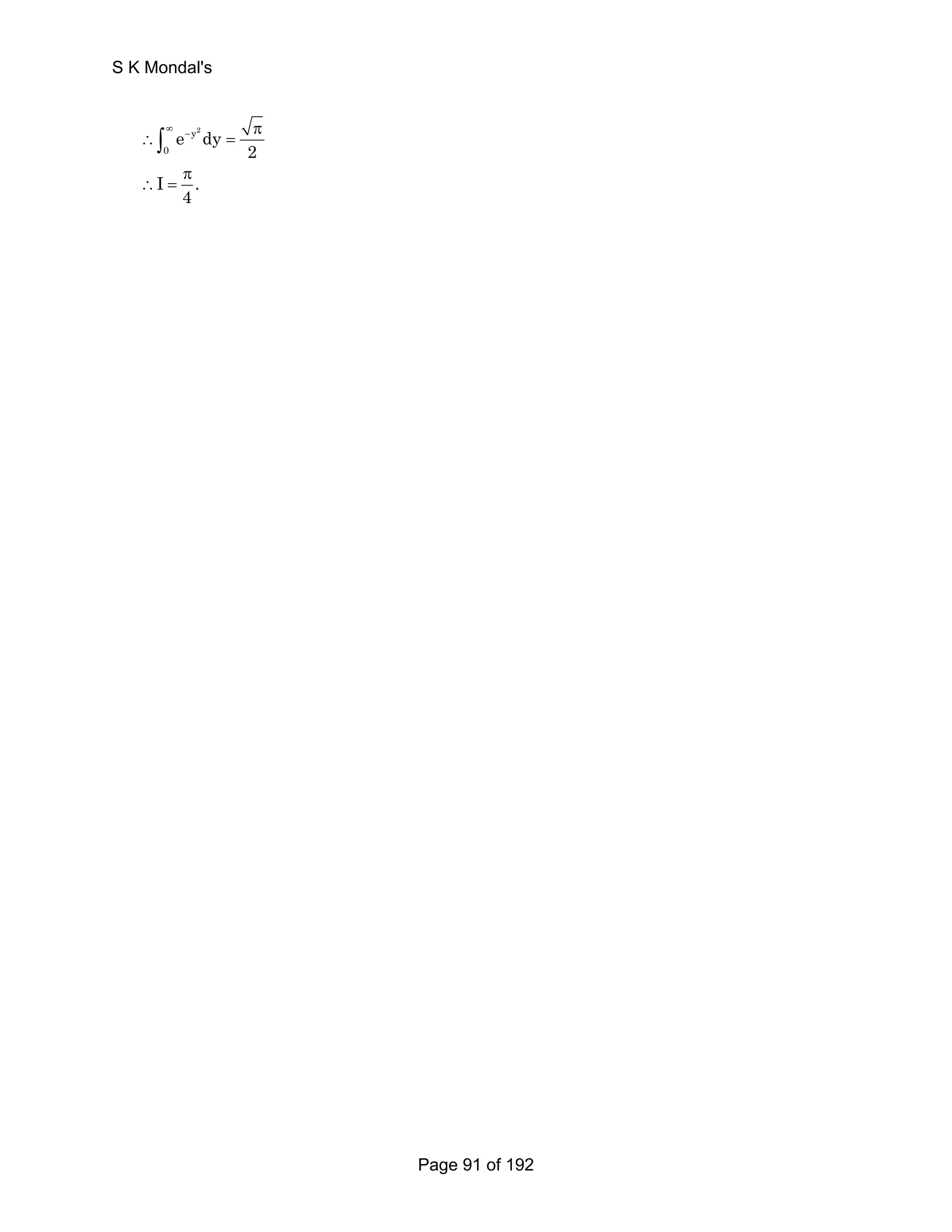
![S K Mondal's
11. Fourier Series
EC All GATE Questions
1. Choose the function f(t); –∞ t ∞, for which a Fourier series cannot be defined.
[EC: GATE-2005]
(a) 3 sin (25 t) (b) 4 cos (20 t + 3) + 2 sin (710 t)
(c) exp (–|t|) sin (25 t) (d) 1
1.(c)
2. The Fourier series of a real periodic function has only [EC: GATE-2009]
P. cosine terms if it is even
Q. sine terms if it is even
R. cosine terms if it is odd
S. sine terms if it is odd
Which of the above statements are correct?
(a) P and S (b) P and R
(c) Q and S (d) Q and R
2. (a) Because sine function is odd and cosine is even function.
3. The trigonometric Fourier series for the waveform f(t) shown below contains
[EC: GATE-2010]
(a) Only cosine terms and zero value for the dc component
(b) Only cosine terms and a positive value for the dc component
(c) Only cosine terms and a negative value for the dc component
(d) Only sine terms and a negative for the dc component
3. (c) From figure it’s an even function. so only cosine terms are present in the series and for DC
value,
Page 92 of 192](https://image.slidesharecdn.com/gatemathematicsquestionsallbranchbyskmondal-141123081724-conversion-gate01/75/Gate-mathematics-questions-all-branch-by-s-k-mondal-92-2048.jpg)
![So 1 f(t)dt
T
2
T
2
T − = ∫
T
⎡ ⎤
1 '2Adt Adt 2Adt
T
T T 2
4 4
T T
2 4 T
∫ ∫ ∫
4
1 2A T T A T T 2A T T
T 4 2 4 4 2 4
−
− −
= ⎢ − + + − ⎥
⎢ ⎥
⎣ ⎦
⎡ ⎛ ⎞ ⎛ ⎞ ⎛ ⎞⎤ = ⎢− ⎜ + ⎟ + ⎜ + ⎟ − ⎜ − ⎟⎥
⎣ ⎝ ⎠ ⎝ ⎠ ⎝ ⎠⎦
1 2A. T AT 2AT
T 4 2 4
= ⎡− + − ⎤ ⎢⎣ ⎥⎦
1 AT
T 2
⎡− ⎤ = ⎢ ⎥ ⎣ ⎦
= −⎜⎛ ⎟⎞
A2
⎝ ⎠
So DC take negative value.
5. For the function e–x, the linear approximation around x = 2 is [EC: GATE-2007]
(a) (3 – x) e–2 (b) 1 – x
(c) [3 + 2 2 − (1 + 2) x]e−2 (d) e–2
5. Ans.(a)
f(x) =
f(x ) (x − x ) f ′ (x ) (x − x ) 2
f ′′
(x ) 0 0 0 0
.......
0
+ + +
1 2
e 2 (x 2) ( e 2 ) (x 2) 2
( e 2 ) ........
= − − + − − − + +
−
2
=
e 2 x (x 2) 2
e ........
⎛ − ⎞
+ ⎜ − + ⎟ +
⎝ ⎠
2 2
− −
2
2
(3 )e
−
= −x
(neglecting higher power of x)
6. Which of the following functions would have only odd powers of x in its Taylor series
expansion about the point x = 0? [EC: GATE-2008]
(a) sin (x3) (b) sin (x2)
(c) cos (x3) (d) cos (x2)
6. (a)
We know, sinx x x3 x5 x7 = − + − +
....
3! 5! 7!
S K Mondal's
Page 93 of 192](https://image.slidesharecdn.com/gatemathematicsquestionsallbranchbyskmondal-141123081724-conversion-gate01/75/Gate-mathematics-questions-all-branch-by-s-k-mondal-93-2048.jpg)
![x 9 sin x3 x3 x 15 x 21
.....
∴ = − + − +
3! 5! 7!
7. In the Taylor series expansion of exp(x) + sin(x) about the point x = π, the coefficient of (x –
π)2 is [EC: GATE-2008]
(a) exp (π) (b) 0.5 exp(π)
(c) exp (π) + 1 (d) exp(π) – 1
7. (b)
Let f(x) = ex + sin x
Taylor 's series is
( f(x) f(a) (x a)f '(a) x − a )
2 = + − +
f (a)
2!
where a = π
x 2
( ) ( ) ( ) ( ) ( ) − π
f(x) = f π + x − π f ' π + f π
.
2!
cofficient of (x )2 ( )
is f π
2
∴ −π
( ) x
Now,f π = e − sin x =
eπ
x =π ∴cofficient of (x − π)2 = 0.5exp(π).
8. The Taylor series expansion of sin x
x − π
at x = π is given by [EC: GATE-2009]
(a)
1 (x − π
)2 ...
+ + (b)
3!
1 (x − π
)2 ...
− − +
3!
(c)
1 (x − π
)2 ...
− + (d)
3!
1 (x − π
)2 ...
− + +
3!
8. (d)
We know.
sin x x3 x5 x7 = x − + − +
......
3! 5! 7!
x 3 x 5 x 7
( ) ( ) ( − π) ( − π) ( − π)
sin x x .......
∴ − π = − π − + − +
3! 5! 7!
sin x x 2 x 4 x 6 1 .......
x 3! 5! 7!
− ( − π) ( − π) ( − π)
⇒ = − + − +
− π
S K Mondal's
Page 94 of 192](https://image.slidesharecdn.com/gatemathematicsquestionsallbranchbyskmondal-141123081724-conversion-gate01/75/Gate-mathematics-questions-all-branch-by-s-k-mondal-94-2048.jpg)
![sin x ( x − π) 2 ( x − π) 4 ( x − π)
6 1 ........
x 3! 5! 7!
⇒ = − + − + −
− π
1. The function x(t) is shown in the figure. Even and odd parts of a unit-step function u(t) are
respectively, [EC: GATE-2005]
0 t
– 1
x(t)
1
(a) 1 , 1 x(t)
2 2
(b) 1 , 1 x(t)
2 2 − (c) 1 , 1 x(t)
2 2 − (d) 1 , 1 x(t)
2 2 − −
1. Ans.(a)
Even part = u(t) + u( −
t)
2
Now u(t) = 0; t 0
= 1, t ≥ 0
∴ u(–t) = 0, –t 0
= 1, – t ≥ 0
i.e., u(–t) = 1, t ≤ 0
= 0, t 0
∴ u(t) u( t)
+ − = 1 ;
2
2 t ≤ 0
= 1
2 t 0
∴ Even [u(t)] = 1
2
Odd (u(t)) = u(t) + u( −
t)
2
1, t 0
2
1, t 0
2
⎡− ≤ ⎤ ⎢ ⎥
⎢ ⎥
⎢ ⎥ ⎢⎣ ⎥⎦
= x(t)
2 from given figure
ME 20 Years GATE Questions
S K Mondal's
Page 95 of 192](https://image.slidesharecdn.com/gatemathematicsquestionsallbranchbyskmondal-141123081724-conversion-gate01/75/Gate-mathematics-questions-all-branch-by-s-k-mondal-95-2048.jpg)
![S K Mondal's
π ∞
= Σ = + +
9. 2n 2 4
For x , the sum of the series (cos x) cos x cos x ........is
1
6
(a) π (b) 3 (c) ∞ (d) 1 [ME: GATE-1998]
9. Ans. (b)
( ) ∞
=
Σ = + + 2n 2 4
n 0
cosx cos x cos x ......
( ) ∞
=
π π π π
= Σ = + + + 2n
At x , cosx cos 2 cos 4 cos 6
6 ...... 6 6 6 6
n 0
3 9 27 ......
4 16 64 = + + +
3
4 3 4 3. 1 3 4 1
= = × =
4
−
11. In the Taylor series expansion of ex about x = 2, the coefficient of (x - 2)4 is
(a) 1/4! (b) 24/4! (c) e2/4! (d) e4/4! [ME: GATE-2008]
11. (d)
Taylor series of
f(x) in the neighborhood of a,
( )n
n
∞
=Σ − =
f(x) b x a ,herea 2.
n =
0
( ) = ∴ = =
where b f (a) b f 2 e
n 4 4
n 4
n! 4! 4!
12. The sum of the infinite series, 1 1 1 1 ... is
+ + + + [ME: GATE-1997]
2 3 4
π
π
2
(a) (b) infinity (c) 4 (d)
4
12. Ans. ()
CE 10 Years GATE Questions
14. The Fourier series expansion of a symmetric and even function, f(x) where
Page 96 of 192](https://image.slidesharecdn.com/gatemathematicsquestionsallbranchbyskmondal-141123081724-conversion-gate01/75/Gate-mathematics-questions-all-branch-by-s-k-mondal-96-2048.jpg)
![f(x) = 1 + ⎛⎜ 2x ⎞⎟ , ⎝ π ⎠
– π ≤ x ≤ 0 [CE: GATE – 2003]
And = 1 − ⎛⎜ 2x ⎞⎟ ,
⎝ π ⎠
0 ≤ x ≤ π
Will be
(a) 2 2
π Σ (b) 2 2
n 1
4 (1 cos n )
n
∞
=
+ π
n 1
4 (1 cos n )
n
∞
=
− π
π Σ
π Σ (d) 2 2
(c) 2 2
n 1
4 (1 sin n )
n
∞
=
− π
n 1
4 (1 sin n )
n
∞
=
+ π
π Σ
14. (b)
f(x) is symmetric and even, it’s Fourier series contain only cosine term.
Now.
an 2 = ∫
π ⎛ 1 2x − ⎞ cosnxdx π 0
⎜ π ⎟ ⎝ ⎠ 2 ⎡ sinnx ⎤π 4 ⎧⎪⎡ .xsinnx = − ⎤π cosnx
π ⎪⎫ − π ⎨⎢ ⎢− ⎡ ⎤⎬ ⎣ ⎢ n ⎦ ⎥ 0 π 2 ⎩⎪⎣ n ⎥ ⎦ ⎣ n
2
⎦ ⎥ 0 0
⎪⎭
4 cosn 1
n = − π −
( ) 2 2
π
4 = 1 − cosn
π
2 n 2
⎡⎣ π⎤⎦ 2 5 8 11 ..........
15. The summation of series S = 2 3
2 2 2 + + + + ∞ is [CE: GATE – 2004]
(a) 4.50 (b) 6.0
(c) 6.75 (d) 10.0
15. (d)
Let S = 2 + x.
were x 5 8 11 ....... (i)
= + + + ∞ − 2 3
2 2 2
1 x 5 8 11 ....... (ii)
2 2 2 2
Apply(i) − (ii)we get.
⇒ = + + + ∞ − 2 3 4
x 1 x 5 8 − 5 11 − 8 14 −
11 .....
− = + + + + 2 3 4
2 2 2 2 2
x 5 3 3 3 ....
2 2 2 2 2
⇒ = + ⎛ + + + ⎞ ⎜ ⎟
⎝ ⎠ 2 3 4
S K Mondal's
Page 97 of 192](https://image.slidesharecdn.com/gatemathematicsquestionsallbranchbyskmondal-141123081724-conversion-gate01/75/Gate-mathematics-questions-all-branch-by-s-k-mondal-97-2048.jpg)
![∞
= +Σ ω + ω of the periodic signal
f t a a cosn t b sinn t
F(t)
1
0
-1 1 2 3
-1
2
⎡ ⎤
⎢ ⎥
S K Mondal's
x 5 2 2
5 3 2 2 1 1 4 2 2
⇒ = + ⎢ ⎥ = + =
⎢ − ⎥ ⎢⎣ ⎥⎦
2
∴x = 8 ∴S = 2 + 8 =10.
EE All GATE Questions
Q16. The Fourier series expansion ( ) 0 n n
n =
1
shown below will contain the following nonzero terms
(a) 0 a and n b ,n = 1,3,5...∞ (b) 0 a , n and a ,n = 1,2,3...∞
(c) 0 a and n a ,n = 1,2,3...∞ (d) 0 a and n a ,n = 1,3,5...∞ [EE-2011]
Ans. (b)
Exp. from the figure, we can say that
f(t) is an symmetric and even function of t.
as cost is even function so choice (b) is correct.
16. Fourier series for the waveform, f (t) shown in fig. is [EE: GATE-2002]
8 sin( ) 1 sin(3 ) 1 sin(5 ) .........
(a) 2
π t π t π t
9 25
π
⎡ + + + ⎤ ⎢⎣ ⎥⎦
8 sin( ) 1 cos(3 ) 1 sin(5 ) .........
(b) 2
π t π t π t
9 25
π
⎡ − + + ⎤ ⎢⎣ ⎥⎦
8 cos( ) 1 cos(3 ) 1 cos(5 ) .........
(c) 2
π t π t π t
9 25
π
⎡ − + + ⎤ ⎢⎣ ⎥⎦
8 cos( ) 1 sin(3 ) 1 sin(5 ) .........
(d) 2
π t π t π t
9 25
π
⎡ − + + ⎤ ⎢⎣ ⎥⎦
16.(c)
From the figure, we say f (x) is even functions. so choice (c) is correct.
17. The Fourier series for the function f(x)=sin2x is [EE: GATE-2005]
(a) sinx+sin2x
(b) 1-cos2x
Page 98 of 192](https://image.slidesharecdn.com/gatemathematicsquestionsallbranchbyskmondal-141123081724-conversion-gate01/75/Gate-mathematics-questions-all-branch-by-s-k-mondal-98-2048.jpg)
![(c) sin2x+cos2x
(d) 0.5-0.5cos2x
17. (d)
Here f(x) = sin2 x is even function, hence f(x) has no sine term.
Now, a 2 = π sin 2 xdx. = π ( 1 − cos2x )
dx =
1. we know π∫ ∫
∞
0 0 0
f(x) a a cosnx.
= 0 +Σ
=
n
n 1
2
= 0.5 + term contain cos ine
18. X(t) is a real valued function of a real variable with period T. Its trigonometric Fourier
Series expansion contains no terms of frequency ω = 2π (2k) / T;k = 1, 2,....Also, no sine
terms are present. Then x(t) satisfies the equation [EE: GATE-2006]
(a) x (t ) = −x(t −T )
(b) x (t ) = −x(T − t ) = −x (−t ) (c) x (t ) = x(T − t ) = −x (t −T / 2)
(d) x (t ) = x(t −T ) = x (t −T / 2)
18. (d)
No sine terms are present.
∴x(t) is even function.
19. The Fourier Series coefficients, of a periodic signal x (t), expressed as
∞
= −∞ = Σ are given by
( ) a e j 2 kt /T k k x t π
2 1 0 1 2 1; 0.5 0.2; 2; 0.5 0.2; 2 1; 0; 2. k a j a j a j a j a j and a for k − − = − = + = = − = + =
Witch of the following is true? [EE: GATE-2009]
(a) x(t) has finite energy because only finitely many coefficients are non- zero
(b) x(t) has zero average value because it is periodic
(c) The imaginary part of x(t) is constant
(d) The real part of x(t) is even
19. (a)
IE All GATE Questions
S K Mondal's
Page 99 of 192](https://image.slidesharecdn.com/gatemathematicsquestionsallbranchbyskmondal-141123081724-conversion-gate01/75/Gate-mathematics-questions-all-branch-by-s-k-mondal-99-2048.jpg)
![∞
S K Mondal's
20. f(x), shown in the figure is represented by f(x) = 0 Σ n
a + {a cos(nx)
n =1
n + b sin(nx)}. The
value of 0 a is [IE: GATE-2010]
x
f(x)
1.5
1.0
–2π –π 0 π 2π 3π
–1.0
–1.5
(a) 0 (b)
π (c) π (d) 2π
2
20. (a).
From the figure, we say that , f(x) is odd function.
T
2
a f(x)dx0.
∴ = ∫ =
0 0
T
0
21. Given the discrete-time sequence x[n] =[2,0, -1, –3,4,1, –1]
↑
, X (ejπ) is
(a) 8 (b) 6π (c) 8π (d) 6[IE: GATE-2005]
21. Ans.(c)
25. The infinite series f(x) =
x3 x5 x7 x – + – .......
3! 5! 7!
∞ converges to [IE: GATE-2010]
(a) cos (x) (b) sin (x)
(c) sin h (x) (d) ex
25. (b).
We know Taylor series at
Page 100 of 192](https://image.slidesharecdn.com/gatemathematicsquestionsallbranchbyskmondal-141123081724-conversion-gate01/75/Gate-mathematics-questions-all-branch-by-s-k-mondal-100-2048.jpg)
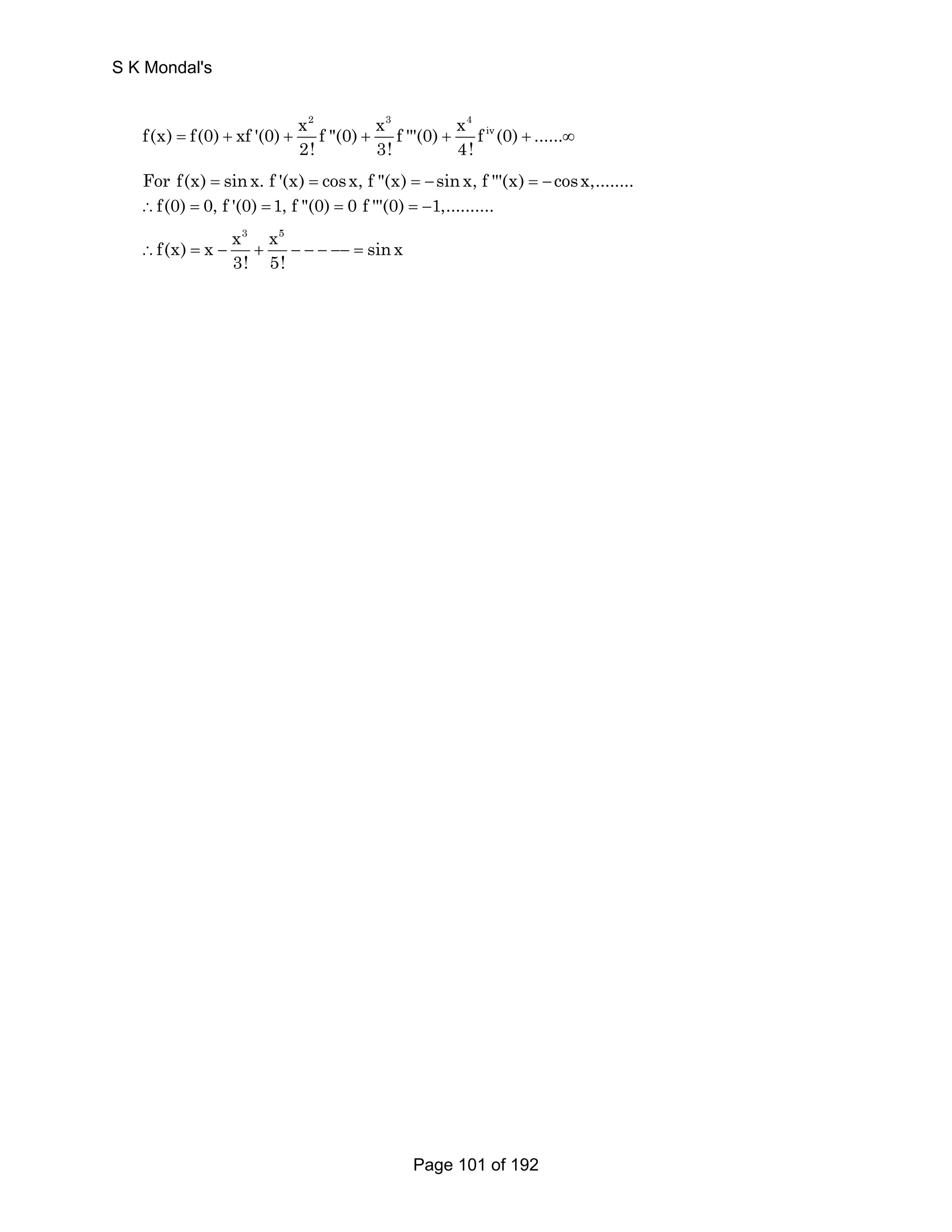
![S K Mondal's
12. Differential Equations
Previous Years GATE Questions
EC All GATE Questions
1. The following differential equation has [EC: GATE-2005]
2 3
3 d y 4 ⎛ dy ⎞ y 2
2
dt + + + 2
⎜ dt
⎟
⎝ ⎠
= x
(a) degree = 2, order = 1 (b) degree = 3, order = 2
(c) degree = 4, order = 3 (d) degree = 2, order = 3
2. The order of the differential equation [EC: GATE-2009]
2 3
4
d y dy dt + ⎛ ⎞ ⎜ dt
⎟
+ y
2
⎝ ⎠
= e–t is
(a) 1 (b) 2 (c) 3 (d) 4
3. A solution of the following differential equation is given by [EC: GATE-2005]
d 2
y 5 dy + 6 y
= 0
dx − 2
dx (a) y = e2x + e–3x (b) y = e2x + e3x
(c) y = e–2x + e3x (d) y = e–2x + e–3x
4. For the differential equation
d 2
y + k 2
y
dx
2
= 0, the boundary conditions are
(i) y = 0 for x = 0, and
(ii) y = 0 for x = a [EC: GATE-2006]
The form of non-zero solutions of y (where m varies over all integers) are
m x
(a) y =
a
m
m
A sin
π
Σ (b) y =
m x
a
m
m
A cos
π
Σ
(c) y =
m
a
m
m
A x
π
Σ (d) y =
m x
a
m
m
A e
π
− Σ
5. The solution of the differential equation
2
k 2
d y
dx
2
= 2 y − y under the boundary conditions
[EC: GATE-2007]
(i) 1 y = y At x = 0 and
(ii) 2 y = y At x = ∞,
Page 102 of 192](https://image.slidesharecdn.com/gatemathematicsquestionsallbranchbyskmondal-141123081724-conversion-gate01/75/Gate-mathematics-questions-all-branch-by-s-k-mondal-102-2048.jpg)
![S K Mondal's
2 Where k, y and y are constants, is
1 2 (a) y = (y − y ) exp ⎛ − ⎞ ⎜ ⎟
+ y
1 2 2 x
k
⎝ ⎠
(y y ) exp x + y
⎛ − ⎞ − ⎜ ⎟
(b) y = 2 1 1
k
⎝ ⎠
(y y ) sin h x + y
− ⎛ ⎞ ⎜ ⎟
(c) y = 1 2 1
k
⎝ ⎠
Ans(d)
(y y ) exp x + y
⎛ − ⎞ − ⎜ ⎟
(d) y = 1 2 2
k
⎝ ⎠
6. Which of the following is a solution to the differential equation dx(t) 3x(t)
dt + = 0?
[EC: GATE-2008]
(a) x(t) = 3e–1 (b) x(t) = 2e–3t
(c) x(t) = 3 t2
2 − (d) x(t) = 3t2
7. A function n(x) satisfies the differential equation
2
d n(x) − n(x) = 0
dx 2 L
2
where L is a constant. The
boundary conditions are: n(0)=K and n(∞)= 0. The solution to this equation is
[EC: GATE-2010]
(a) n(x) = K exp(x/L) (b) n(x) = K exp( x / L )
(c) n(x) = K2 exp(-x/L) (d) n(x) = K exp(-x/L)
ME 20 Years GATE Questions
8. For the differential equation dy 5y 0 with y(0)=1,
dt
+ = the general solution is
(a) e5t (b) e-5t (c) 5e-5t (d) e −5t
[ME: GATE-1994]
9. A differential equation of form dy y(x,y)
dx
= is homogeneous if the function f(x,y) depends only on
the ratio y or x .
x y
[ME: GATE-1995]
10. The solution of the differential equation dy y2 0 is
dx
+ = [ME: GATE-2003]
−
(a) y = 1 (b) y= x2 +
c
x +
c 3
(c) cex (d) Unsolvable as equation is non-linear
Page 103 of 192](https://image.slidesharecdn.com/gatemathematicsquestionsallbranchbyskmondal-141123081724-conversion-gate01/75/Gate-mathematics-questions-all-branch-by-s-k-mondal-103-2048.jpg)
![S K Mondal's
11. If x2 dy 2xy 2 nx , and y(1)=0, then what is y(e)?
+ = A [ME: GATE-2005]
dx x
(a) e (b) 1 (c) 1/e (d) 1/e2
12. The solution of the differential equation 2 dy 2xy e x with y(0) = 1 is
dx
+ = −
2 2 2 2 (a) (1+x)e+ x (b) (1+x)e−x (c) (1-x)e+ x (d) (1-x)e−x [ME: GATE-2006]
13. The solution of dy/dx = y2 with initial value y (0) = 1 bounded in the interval
x x
(a) − ∞ ≤ ≤ ∞ (b) − ∞ ≤ ≤
1
(c) x 1, x1 (d) − 2 ≤ x
≤
2
[ME: GATE-2007]
14. The solution of 4 with the condition y(1)= 6 is
5
x dy y x
dx
+ = [ME: GATE-2009]
(a) y= x 4 + 1 4 x 4 4 5 (b) y= + 4 (c) y= x +1 (d) y= x
+1
x x
5 5 5 5 5
15.
2
2
Solve for y, if d y 2 dy y 0; with y(0) = 1 and y (0)= - 2
+ + = ω [ME:GATE-1994]
dt dt
16. The solution to the differential equation f’’(x)+4f’(x)+4f(x)=0 is [ME: GATE-1995]
(a) f1(x) = e-2x (b) f1(x) = e2x, f2(x) = e-2x
(c) f1(x) = e-2x, f2(x) = xe-2x (d) f1(x) = e-2x, f2(x) = e-x
17. The general solution of the differential equation
2
x 2
= d y − x dy + y =
0 is
2
dx dx
(a) Ax + Bx2 (A, B are constants) [ME: GATE-1998]
(b) Ax + B log x (A, B are constants)
(c) Ax + Bx2 log x (A, B are constants)
(d) Ax + Bx log x (A, B are constants)
18.
2
d y (x 4x) dy y x 8
dx dx
+ 2 + + = 8
− [ME: GATE-1999]
2
The above equation is a
(a) Partial differential equation (b) Nonlinear differential equation
(c) Non-homogeneous differential equation (d) Ordinary differential equation
19. The solution of the differential equation d2y/dx2+dy/dx+y=0 is [ME: GATE-2000]
Statement for Linked Answer Questions 20 21:
20. The complete solution of the ordinary differential equation
2
2 1 2 d y p dy qy 0 is y = c e x c e x
dx dx
+ + = − + − [ME: GATE-2005]
Page 104 of 192](https://image.slidesharecdn.com/gatemathematicsquestionsallbranchbyskmondal-141123081724-conversion-gate01/75/Gate-mathematics-questions-all-branch-by-s-k-mondal-104-2048.jpg)
![S K Mondal's
Then, p and q are
(a) p = 3, q = 3 (b) p = 3, q = 4 (c) p=4,q=3 (d) p = 4, q = 4
21. Which of the following is a solution of the differential equation
2
2 d y p dy (q 1) 0?
dx dx
+ + + = [ME: GATE-2005]
(a) e-3x (b) x e-x (c) x e-2x (d) x2e-2x
22.
2
2 For d 4 dy 3y 3e x , the particular integrals is
+ + = 2
[ME: GATE-2006]
dx dy
(a) 1 (b) 1 (c) 3 (d) C
e 2 x e 2 x e 2 x e−x +C e− 3
x
1 2
15 5
23. Given that
.. .
x+ 3x = 0, and x(0)=1, x(0) = 0 what is x(1)? [ME: GATE-2008]
(a) -0.99 (b) -0.16 (c) 0.16 (d) 0.99
24. It is given that y + 2y' + y = 0, y(0) = 0, y(1)=0. What is y (0.5)? [ME: GATE-2008]
(a) 0 (b) 0.37 (c) 0.62 (d) 1.13
25. The Blasius equation,
3 2
3 2 0
d f f d f
dη dη
+ = , is a [ME: GATE-2010]
2
(a) Second order nonlinear ordinary differential equation
(b) Third order nonlinear ordinary differential equation
(c) Third order linear ordinary differential equation
(d) Mixed order nonlinear ordinary differential equation
26. The partial differential equation [ME: GATE-2007]
2 2
2 2 0 has
x y x y
∂ φ ∂ φ ⎛ ∂φ ⎞ ⎛ ∂φ ⎞ + + ⎜ ⎟ + ⎜ ⎟ = ∂ ∂ ⎝ ∂ ⎠ ⎝ ∂ ⎠
(a) Degree 1 order 2 (b) Degree 1 order 1
(c) Degree 2 order 1 (d) Degree 2 order 2
CE 10 Years GATE Questions
27. The degree of the differential equation
d 2
x + 2x
3
= 0 is dt [CE: GATE –2007]
2
(a) 0 (b) 1 (c) 2 (d) 3
29. The order and degree of the differential equation [CE: GATE – 2010]
3 3
2
d y dy dx + 4 ⎛ ⎞ ⎜ ⎟
+ y
3
⎝ dx
⎠
= 0 are respectively
(a) 3 and 2 (b) 2 and 3 (c) 3 and 3 (d) 3 and 1
Page 105 of 192](https://image.slidesharecdn.com/gatemathematicsquestionsallbranchbyskmondal-141123081724-conversion-gate01/75/Gate-mathematics-questions-all-branch-by-s-k-mondal-105-2048.jpg)
![S K Mondal's
30. The solution for the differential equation dy
dx
= x2y with the condition that y = 1 at x = 0 is
(a) =
1
y e2x (b)
x3 ln (y) 4
3 = + [CE: GATE – 2007]
(c) ln (y) =
x2
2
(d) =
x3
y e 3
31. Biotransformation of an organic compound having concentration (x) can be modelled using an
ordinary differential equation dx kx2 0,
dt + = where k is the reaction rate constant. If x = a at
t = 0, the solution of the equation is [CE: GATE – 2004]
(a) x = ae–kt (b) 1 1 kt
x a = + (c) x = a (1 – e–kt) (d) x = a + kt
32. The solution of the differential equation, x2 dy 2xy x 1
dx + − + = 0, given that at x = 1, y = 0 is
[CE: GATE – 2006]
1 1 1
2 x 2x − + (b) 2
(a) 2
1 1 1
2 x 2x − −
1 1 1
2 x 2x + + (d) 2
(c) 2
1 1 1
2 x 2x − + +
33. Transformation to linear form by substituting v = y1 – n of the equation dy p(t) y
dt + = q (t)yn ; n
0 will be [CE: GATE – 2005]
(a) dv (1 n) pv (1 n)q
dt + − = − (b) dv (1 n) pv (1 n)q
dt + − = +
(c) dv (1 n) pv (1 n)q
dt + + = − (d) dv (1 n) pv (1 n)q
dt + + = +
34. A spherical naphthalene ball exposed to the atmosphere loses volume at a rate proportional to
its instantaneous surface area due to evaporation. If the initial diameter of the ball is 2 cm
and the diameter reduces to 1 cm after 3 months, the ball completely evaporates in
[CE: GATE – 2006]
(a) 6 months (b) 9 months
(c) 12 months (d) infinite time
35. A body originally at 60ºC cools down to 40ºC in 15 minutes when kept in air at a temperature
of 25ºC. What will be the temperature of the body at the end of 30 minutes?
[CE: GATE – 2007]
(a) 35.2º C (b) 31.5º C
(c) 28.7º C (d) 15º C
36. Solution of dy
dx
= x
y − at x = 1 and y = 3 is [CE: GATE – 2008]
(a) x – y2 = –2 (b) x + y2 = 4
Page 106 of 192](https://image.slidesharecdn.com/gatemathematicsquestionsallbranchbyskmondal-141123081724-conversion-gate01/75/Gate-mathematics-questions-all-branch-by-s-k-mondal-106-2048.jpg)
![(c) x2 – y2 = –2 (d) x2 + y2 = 4
37. Solution of the differential equation 3y dy 2x
dx + = 0 represents a family of
(a) Ellipses (b) circles [CE: GATE – 2009]
(c) Parabolas (d) hyperbolas
39. Match each differential equation in Group I to its family of solution curves from Group II.
[CE: GATE-2009]
Group I Group II
P. dy y
dx x = 1. Circles
Q. dy y
dx x = − 2. Straight lines
R. dy x
dx y = 3. Hyperbolas
S. dy x
dx y = −
Codes:
P Q R S P Q R S
(a) 2 3 3 1 (b) 1 3 2 1
(c) 2 1 3 3 (d) 3 2 1 2
40. The solution of
d 2
y dy + 2 + 17 y
= 0; y (0) = 1, dy x
dx 2
dx ⎛ ⎞
⎜ ⎟
⎝ ⎠
dx 4
= 0 in the range 0 x
π
is given by
4
[CE: GATE – 2005]
e x cos4 x 1 sin 4 x
(a) − ⎜⎛ + ⎟⎞
4
⎝ ⎠
ex cos4 x 1 sin 4 x
(b) ⎛⎜ − ⎞⎟
4
⎝ ⎠
e 4x cosx 1 sin x
(c) − ⎛⎜ − ⎞⎟
4
⎝ ⎠
e 4x cos4 x 1 sin 4 x
(d) − ⎛⎜ − ⎞⎟
4
⎝ ⎠
41. The general solution of
d 2
y + y = 0
is dx [CE: GATE – 2008]
2
(a) y = P cos x + Q sin x (b) y = P cos x
(c) y = P sin x (d) y = P sin2 x
2 2
k h k h
42. The equation ∂ ∂
+
x 2 z 2
x z
∂ ∂
= 0 can be transformed to
h h
x z
2 2
2 2
1
∂ ∂
+
∂ ∂
= 0 by substituting
[CE: GATE – 2008]
(a) z
t
x
x = x k
k
(b) x
t
z
x = x k
k
S K Mondal's
Page 107 of 192](https://image.slidesharecdn.com/gatemathematicsquestionsallbranchbyskmondal-141123081724-conversion-gate01/75/Gate-mathematics-questions-all-branch-by-s-k-mondal-107-2048.jpg)
![S K Mondal's
(c) x
t
z
x = x k
k
(d) z
t
x
x = x k
k
43. The solution to the ordinary differential equation
d 2
y dy dx + − 6y
= 0 is
2
dx [CE: GATE – 2010]
(a) 3x 2x
1 2 y = c e + c e− (b) 3x 2x
1 2 y = c e + c e
1 2 y = c e− + c e (d) 3x 2x
1 2 y = c e− + c e−
(c) 3x 2x
45. The partial differential equation that can be formed from z = ax + by + ab has the form
with p z and q z
⎛ ∂ ∂ ⎞ ⎜ = ⎝ ∂ x = ∂ y
⎟ ⎠
[CE: GATE – 2010]
(a) z = px + qy (b) z = px + pq
(c) z = px + qy + pq (d) z = qy + pq
Q30. The solution of the differential equation dy + y = x,
dx x
with the condition that y = 1 at x = 1, is
y = + (b) 2 1
2 x
3x 3
(a) 2
y = + (c) 2 x
2 2x
y = + (d)
3 3
2 x2
3x 3
y = + [CE-
2011]
Ans. (d)
Exp, dy + y = x
dx x
It’s a linear differential equation
1dx log x ∴I.E. = e∫ x = e = x
Solution is xy = ∫ x2dx + C
x3 xy C
⇒ = + … (1)
3
Given y (1) = 1,
∴ from (1): c 2
3
=
x3 2 xy
∴ = +
3 3
2 x3 y
⇒ = +
3x 3
EE All GATE Questions
46. The solution of the first order differential equation ( ) ( ) 0 x(t ) = −3x t , x 0 = x is
Page 108 of 192](https://image.slidesharecdn.com/gatemathematicsquestionsallbranchbyskmondal-141123081724-conversion-gate01/75/Gate-mathematics-questions-all-branch-by-s-k-mondal-108-2048.jpg)
![[EE: GATE-2005]
S K Mondal's
(a) ( ) 3
X t = x e− t (b) ( ) 3
0
0 X t = x e− (c) ( ) 1/3
0 X t = x e−
(d) ( ) 1
0 X t = x e−
48. For the differential equation
2
2 d x 6 dx 8x 0
dt dt
+ + = with initial conditions x (0) = 1
and
0
0
dx
dt =
t
= , the solution is [EE: GATE-2010]
(a) x (t) = 2e-6t –e-2t (b) x (t) = 2e-2t –e-4t
(c) x (t) = -e-6t +2e-4t (d) x (t) = e--2t –e-4t
Q13. With K as constant, the possible solution for the first order differential equation dy e 3x
dx
= −
is
(a) 1 e 3x K
− − + (b) 1 e3x K
3
− + (c) −3e−3x + K (d) −3e−x + K [EE-2011]
3
Ans. (a)
Exp. dy e 3x
dx
= −
⇒ dy = e−3xdx
y e −
3x K
= +
−
3
IE All GATE Questions
51. Consider the differential equation dy
dx
= 1 + y2. Which one of the following can be a
particular solution of this differential equation? [IE: GATE-2008]
(a) y = tan (x + 3) (b) y = tan x + 3
(c) x = tan (y + 3) (d) x = tan y + 3
Page 109 of 192](https://image.slidesharecdn.com/gatemathematicsquestionsallbranchbyskmondal-141123081724-conversion-gate01/75/Gate-mathematics-questions-all-branch-by-s-k-mondal-109-2048.jpg)
![S K Mondal's
22. The boundary-value problem yn + λy = 0, y(0) = y(λ) = 0 will have non-zero solutions if and only
if the values of λ are [IE: GATE-2007]
(a) 0, ±1, ±2, ……….. (b) 1, 2, 3, ……..
(c) 1, 4, 9, ……… (d) 1, 9, 25, ………
22 Ans. (c)
Differential Equation
1. Ans. (b)
2 3
3 d y + 4 ⎛ dy ⎞
+ y 2
+ 2
dt 2
⎜ dt
⎟
⎝ ⎠
= x
Order of highest derivative = 2
Hence, most appropriate answer is (b)
2. Ans. (b) The order of a differential equation is the order of the highest derivative involving in
equation, so answer is 2.
3. (b)
Let y = mx be the trial soln of the given differental equation
∴The corrosponding auxiliary equation is
m2 − 5m+ 6 = 0
⇒m = 2,3
2x 3x
1 2 ∴ y = c e + c e
4. (a)
Here 1 2 y = c coskx + c sinkx ........... (1) be the solution of the given differential equation.
Now use boundary conditions
For 1 x = 0,y = 0 gives c = 0. Equation − (1) becomes
Page 110 of 192](https://image.slidesharecdn.com/gatemathematicsquestionsallbranchbyskmondal-141123081724-conversion-gate01/75/Gate-mathematics-questions-all-branch-by-s-k-mondal-110-2048.jpg)
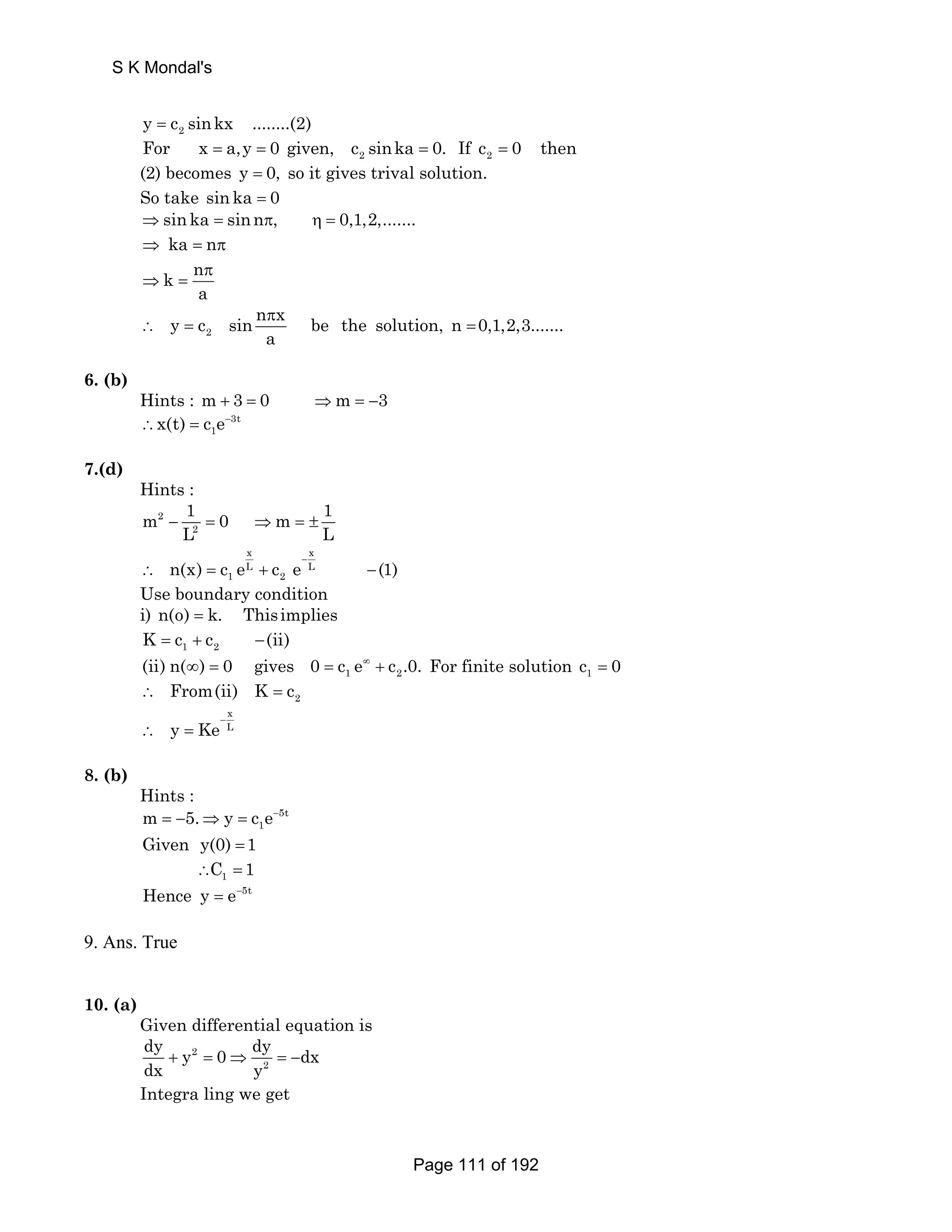
![S K Mondal's
1 x c
y − = − +
1
y 1 1
⇒ = x − c =
x +
c 11. (d)
x2 dy 2xy 2ln x (i)
dx x + = −
dy 2 2ln x ⇒ + y =
.
dx x x 3
It is linear differential equation.
2dx
∫
I.F. e x x2
∴ = =
Multiplying I.F both side of (i) then we get
d(yx2 ) 2ln x
x =
Integrating we get
( )2
2 yx 2 lnx dx c 2 ln x c
x 2 = ∫ + = +
Using boundary condition y(1) = 0 we get
C = 0
( ln x
)2
2
y
x ∴ =
y(e) 1 lne 1
[ ] 2
e ∴ = ∴ =
12 (b)
It is a linear diff. equation
2
2xdx
∫
I.F = e =
ex
∴ Solution is yex2 = ∫ e−x 2ex2dx + c = x + c
At x = 0, y =1, gives c =1
( ) ∴ y = 1 + x e−x2
13 (c)
Given dy y2
dx =
Integrating,
∫ dy ⇒ y = ∫
dx
2
1 x c
y ⇒ − = +
Page 112 of 192](https://image.slidesharecdn.com/gatemathematicsquestionsallbranchbyskmondal-141123081724-conversion-gate01/75/Gate-mathematics-questions-all-branch-by-s-k-mondal-112-2048.jpg)
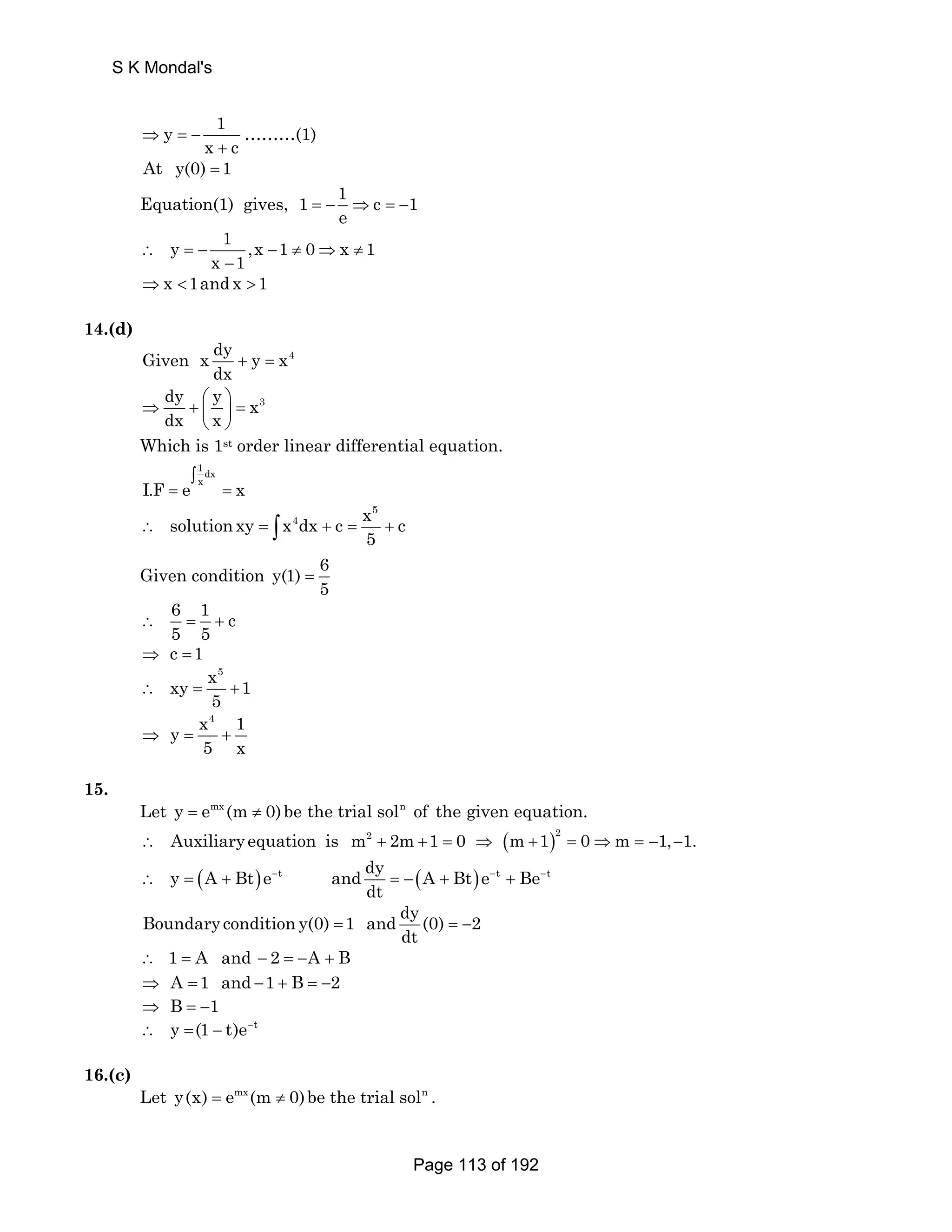
![S K Mondal's
41. (a)
Let y = emx (m ≠ 0) be the trial solution.
Auxiliary equation is m2 +1 = 0
⇒ m = ±i
∴ y = Pcosx + Qsinx
42(d).
Put t x = z
x
x k
k
t x
x
∂
∂
= z
x
k
k
⇒
x
x
t
∂
∂
= z
x
k
k
… (i)
Now given equation is
2 2
k ∂ h k ∂
h
+
x 2 z 2
x z
∂ ∂
= 0 … (ii)
h
x
2
2t
∂
∂
=
h
∂ ⎛ ∂ ⎞
∂ x ⎜ ∂ x
⎟ t ⎝ t
⎠
=
h x
∂ ⎛ ∂ ∂ ⎞ ∂ x ⎜ × ⎟ t ⎝ ∂ x ∂ x
t
⎠
h k
∂ ⎛ ∂ ⎞
⎜⎜ × ⎟⎟ ∂ ⎝ ∂ ⎠
= x
x x k
t z
[from eqn. (i)]
k h
k x x
= x
∂ ⎛ ∂ ⎞ × ⎜ ⎟ ∂ ⎝ ∂ ⎠
z t
k h h
k x x x
= x
z
⎛ ∂ ⎛ ∂ ⎞ ∂ ⎞ × ⎜ ⎜ ⎟ × ⎟ ⎝ ∂ ⎝ ∂ ⎠ ∂ ⎠
=
k h k
k x k
⎛ ∂ 2
⎞
× ⎜⎜ × ⎟⎟ ⎝ ∂ ⎠
x x
2
z z
=
k 2
x
h
k x
2
z
∂
×
∂
∴
2
2 h
x
∂
∂
=
k 2
z
∂
h
k ×
∂
x
2
x t
Now substitute in equation (ii) we get
2 2
k k × z
∂ h ∂
h
× +
k x 2 z 2
k ∂ x ∂
z
x t
= 0
⇒
2 2
k h k h
∂ ∂
× +
∂ ∂
z 2 z 2
x z
t
= 0
⇒
h h
x z
2 2
2 2
t
∂ ∂
+
∂ ∂
= 0
This is the desired form
Page 120 of 192](https://image.slidesharecdn.com/gatemathematicsquestionsallbranchbyskmondal-141123081724-conversion-gate01/75/Gate-mathematics-questions-all-branch-by-s-k-mondal-120-2048.jpg)
![S K Mondal's
13. Complex Variables
QUESTION AND ANSWERE
Complex Analysis:
1. The residue of the function f(z) = 1
2 2
(z + 2) (z − 2)
at z = 2 is [EC: GATE-2008]
(a) 1
32 − (b) 1
16 − (c) 1
16
(d) 1
32
1. (a)
Residue at z 2 is lim d z 2 f(z)
( )2
= ⎡ − ⎤ ⎣ ⎦
→ dz
z 2
2
lim d ⎡⎛ 1
⎞ ⎤ = ⎢⎜ ⎥ z → 2
dz z + 2
⎟ ⎢⎣⎝ ⎠ ⎥⎦
lim −
2
→ z 2
z 2 ( )3
=
+
lim −
2 1
→ z 2 32
= =−
z 2 ( +
)3
2. If f(z) = 1
2 1 c + c z− , than
unit
circle
1 f(z)dz
z
+ v∫ is given by [EC: GATE-2009]
(a) 1 2 πc (b) 0 2 π(1 + c ) (c) 1 2 π jc (d) 0 2 π j (1 + c )
2. (d)
( )0 1
Let g(z) 1 + f(z) 1 + c z +
c
2
= =
z z
∴ g(z) has a pole of order two at z = 0
Res(g,o) lim d z 0 g(z)
( )2
∴ = ⎡ − ⎤ ⎣ ⎦
→ dz
z 0
( ) z 0 0
lim 1 c
→
= +
0 = 1 + c
g(z)dz 2 i(1 c )
0
=
∴ ∫ = π +
z 1
Page 123 of 192](https://image.slidesharecdn.com/gatemathematicsquestionsallbranchbyskmondal-141123081724-conversion-gate01/75/Gate-mathematics-questions-all-branch-by-s-k-mondal-123-2048.jpg)
![3. The residues of a complex function ( ) 1 −
2
X z z
( 1)( 2)
=
− −
z z z
at its poles are [EC: GATE-2010]
(a) 1, 1 and 1
− (b) 1, 1 and 1
2 2
2 2
− (c) 1,1 and 3
− (d) 1, 1 and 3
2 2
−
2 2
3. (c)
x(z)has simple poles at z = 0,1,2.
Res x,0 lim z 0 x z lim 1 −
2z 1
( ) ( ) ( ) ( )( ) z 0 z 0
∴ = ⎡⎣ − ⎤⎦ = = − −
→ → z 1 z 2 2
Res x,1 lim z 1 x z lim 1 −
2z 1
( ) ( ) ( ) ( ) z 1 z 1
= ⎡⎣ − ⎤⎦ = = −
→ → z z 2
Res x,2 lim z 2 x z lim 1 − 2z −
3
( ) ( ) ( ) ( ) z 2 z 2
= ⎡⎣ − ⎤⎦ = = −
→ → z z 1 2
4. For the function of a complex variable W = ln Z (where, W = u + jv and Z = x + jy), the u =
constant lines get mapped in Z-plane as [EC: GATE-2006]
(a) set of radial straight lines
(b) set of concentric circles
(c) set of confocal hyperbolas
(d) set of confocal ellipses
4. Ans. (b)
Given, W = e log z
⇒ u + iv = e log (x + iy) = 1
2
log(x2 + y2) + i tan–1 y
⎛ ⎞
⎜ ⎟
⎝ ⎠
x
Since, u is constant, therefore
1
2
log(x2 + y2) = c
⇒ x2 + y2 = c
Which is represented set of concentric circles.
1 dz
z 4 − = + v∫ in positive sense is [EC: GATE-2006]
5. The value of the contour integral 2
|z j| 2
(a) j
π (b)
2
π
−
2
(c) j
π
− (d)
2
π
2
S K Mondal's
Page 124 of 192](https://image.slidesharecdn.com/gatemathematicsquestionsallbranchbyskmondal-141123081724-conversion-gate01/75/Gate-mathematics-questions-all-branch-by-s-k-mondal-124-2048.jpg)
![S K Mondal's
5. (d)
Let f(z) 1 1
z 4 z 2i z 2i = =
2 + ( + )( −
)
In z − i = 2, z = 2i is a pole of order 1.
Res f,2i lim z 2i f z 1
( ) ( ) ( ) z 2i
∴ = ⎡⎣ − ⎤⎦ =
→ 4i
∴ ∫ = π × =
z i 2
f(z)dz 2 i 1
π
4i 2 − =
(0,3)
(0,i)
(0,-1)
⎢z-i⎜=2
ME 20 Years GATE Questions
7. ii, where i= −1, is given by [ME: GATE-1996]
−π π
(a) 0 (b) e /2 (c) (d) 1
2
7. (b)
Page 125 of 192](https://image.slidesharecdn.com/gatemathematicsquestionsallbranchbyskmondal-141123081724-conversion-gate01/75/Gate-mathematics-questions-all-branch-by-s-k-mondal-125-2048.jpg)
![S K Mondal's
ii = ei log i .
Now, log i log i 2k i, k 0,1,2,.........
⎛ π ⎞ = + ⎜ π + ⎟ =
2
⎝ ⎠
i, fork 0.
2
π
= =
i i. 2 i e i e
2
π
π −
∴ = =
8. The integral v∫ f (z)dz evaluated around the unit circle on the complex plane for
f (z) cos z is
z
[ME: GATE-2008]
(a) 2π i (b) 4π i (c) -2π i (d) 0
8. (a)
f(z) cosz ,
z
=
f(z) has a simple pole at z 0
∴ =
( ) ( ) z 0
Res(f,0) lim z 0 f z 1
∴ = ⎡⎣ − ⎤⎦ =
→
∴ v∫ f(z)dz = 2πi ×1 = 2πi
9. Assuming i = −2 and t is a real number
/3
π
∫ [ME: GATE-2006]
0
eitdt is
⎛ ⎞ ⎛ ⎞
(a) 3 i 1 (b) 3 i 1 (c) 1 i 3 (d) 1 i
1 3
+ − + ⎜⎜ ⎟⎟ + ⎜⎜ + ⎟⎟
2 2 2 2 2 2 2 2
⎝ ⎠ ⎝ ⎠
9.(a)
π π
e dt e l e 1 i cos i sin 1
∫
⎡ ⎤ − ⎢ ⎥ = ( π − )
⎛ π π = − ⎞ ⎜ + − ⎟
⎣ ⎦ ⎝ ⎠ i 1 i 3 1 3 i.1
/3 it /3
it i /3
i i 3 3
0 0
⎛ ⎞
= − ⎜⎜ + − ⎟⎟ = +
2 2 2 2
⎝ ⎠
10. If φ (x,y) and ψ (x,y) are functions with continuous second derivatives, then
φ (x,y) + iψ (x,y) can be expressed as an analytic function of x+ iψ (i= -1),
when [ME: GATE-2007]
Page 126 of 192](https://image.slidesharecdn.com/gatemathematicsquestionsallbranchbyskmondal-141123081724-conversion-gate01/75/Gate-mathematics-questions-all-branch-by-s-k-mondal-126-2048.jpg)
![S K Mondal's
∂ ∂ ∂ ∂ ∂ ∂ ∂ ∂
φ ψ φ ψ φ ψ φ ψ
(a) , (b) ,
= − = = − =
x x y y y x x y
∂ ∂ ∂ ∂ ∂ ∂ ∂ ∂
∂ ∂ ∂ ∂ ∂ ∂ ∂ ∂
2 2 2 2
2 2 2 2
φ φ ψ ψ φ φ ψ ψ
(c) + = + = 1 (d) + = + =
0
x y x y x y x y
∂ ∂ ∂ ∂ ∂ ∂ ∂ ∂
10. (b)
(x,y) i (x,y) is analylic, so Φ + Ψ it satisfies Cauchy-Riemannequation
∂Φ ∂Ψ ∂Φ ∂Ψ
,
= =−
x y y x
∂ ∂ ∂ ∂
11. An analytic function of a complex variable z = x + iy is expressed as f(z) = u (x, y) + i v(x, y)
where i = −1 . If u = xy, the expression for v should be [ME: GATE-2009]
( x + y )2 x 2 − y 2 2 − 2 − 2 (a) +k (b) +k (c) y x +k (d) ( x y
)+k
2 2 2 2
11. (c)
Here u and v are analytic as f(z) is analytic.
∴ u,v satisfy Cauchy-Riemann equation.
x y y x u = v − (i) and u = − v − (ii)
Given u = xy
x ∴ u = y
y ⇒ v = y [by(i)]
Integrating
y2 v c(x) (iii)
2 = + −
Again
x v = c′(x)
y ⇒ −u = c′(x) [by(ii)]
x c(x)
⇒ − = ′
Integreting,
c(x) −
x 2
= +
k
2
From (iii) we get
v y2 −
x2 = +
k
2
i
i
12. The modulus of the complex number 3 4
⎛ + ⎞
⎜ ⎝ 1 − 2
⎟ ⎠
is. [ME: GATE-2010]
(a)5 (b) 5 (c)1/ 5 (d)1/5
12. (b)
Page 127 of 192](https://image.slidesharecdn.com/gatemathematicsquestionsallbranchbyskmondal-141123081724-conversion-gate01/75/Gate-mathematics-questions-all-branch-by-s-k-mondal-127-2048.jpg)
![3 + 4i (3 + 4i)(1 + 2i) − 5 +
10i 1 2i
1 − 2i = (1 − 2i)(1 2i) = 5
= − +
+
3 +
4i 1 2i 5
1 2i
∴ = − + =
−
CE 10 Years GATE Questions
Q26. For an analytic function, f (x + iy) = u(x, y) + iv(x, y) ,u is given by u = 3x2 − 3y2 . The
expression for v, considering K to be constant is
(a) 3y2 − 3x2 + K (b) 6x − 6y + K (c) 6y − 6x + K (d) 6xy + K [CE-2011]
Ans. (d)
Exp. Cauchy Riemann equations for
f (z) = u + iv
x y u = v and y x u = −v … (ii)
Given u = 3x2 − 3y2
x y ⇒ u = 6x⇒ u = 6x [using (i)]
⇒ v = 6xy + φ(x) … (iii)
Differentiating w.r.t.x
( ) x v = 6y + φ' x
( )
( )
y u 6y 'x
6y 6y ' x
⇒ − = + φ
⇒ = +φ
[using (ii)]
⇒ φ'(x) = 0
⇒ φ(x) = K (Constant)
∴ from (iii) we get
v = 6xy + K
z 1
z 1
13. The analytic function f(z) = 2
−
+
has singularities at [CE: GATE – 2009]
(a) 1 and –1 (b) 1 and i
(c) 1 and –i (d) i and –i
13. (d)
f(z) z 1 z 1
z 2
1 (z i)(z i)
− −
= =
+ + −
∴ f(z)has singularities at z = i,−i
14. Using Cauchy’s integral theorem, the value of the integral (integration being taken in counter
clockwise direction)
3
c
z 6dz
3z 1
−
− v∫ is [CE: GATE – 2006]
S K Mondal's
Page 128 of 192](https://image.slidesharecdn.com/gatemathematicsquestionsallbranchbyskmondal-141123081724-conversion-gate01/75/Gate-mathematics-questions-all-branch-by-s-k-mondal-128-2048.jpg)
![(a) 2 4 i
π
− π (c) 4 6 i
π
− π (b) 6 i
81
8
π
− π (d) 1
81
14. (a)
Let f(z) z3 −
6 = . Here f(z) has a singularities atz =
i / 3
3z −
i
3 3
Res(f,1) lim (z i / 3) z 6 1 . i 6
3 z → i/3
3z i 3 27
⎡ − ⎤ ⎛ ⎞
∴ = ⎢ − × ⎥ = ⎜ − ⎟ ⎣ − ⎦ ⎝ ⎠
3
⎛ ⎞ π π
4
⎝ ⎠ ∫
∴ = π × ⎜ − ⎟ = − π = − π
c
f(z)dx 2 i 1 i 6 2 i 4 i 2 4 i
3 27 81 81
15. Consider likely applicability of Cauchy’s Integral Theorem to evaluate the following integral
counter clockwise around the unit circle c. [CE: GATE – 2005]
I =
v∫ sec zdz,
c
z being a complex variable. The value of I will be
(a) I = 0: singularities set = φ
(a) I = 0 : singularities set = { 2n +
1 ± π ; n =
0,1, 2........}
2
(c) I =
π : singularities set = { ± nπ; n = 0, 1, 2 ………}
2
(d) None of above
15. Ans. (a)
∫sec z dz = 1 dz
∫ cos z
n 1
The poles are at 0 z = ⎛⎜ + ⎞⎟ π
2
⎝ ⎠
= ....... − 3 π , −π , π , + 3 π
.......
2 2 2 2
None of these poles lie inside the unit circle |z| = 1
Hence, sum of residues at poles = 0
∴ Singularities set = φ and
I = 2πi [sum of residues of f(z) at the poles]
= 2πi × 0 = 0
16. The value of the integral
C
cos (2 π
z) dz
(2z 1) (z 3)
− − ∫ (where C is a closed curve given by |z| = 1) is
[CE: GATE – 2009]
(a) – πi (b) i
π (c) 2 i
5
π (d) πi
5
S K Mondal's
Page 129 of 192](https://image.slidesharecdn.com/gatemathematicsquestionsallbranchbyskmondal-141123081724-conversion-gate01/75/Gate-mathematics-questions-all-branch-by-s-k-mondal-129-2048.jpg)
![S K Mondal's
16. (c)
Let f(z) cos(2 π
z) = . f(z)has singularity at z =
1 / 2
(2z − 1)(z −
3)
in C (1z1 = 1).
Res(f,1 / 2) lim (z 1 / 2)f(z)
∴ = ⎡⎣ − ⎤⎦
z →
1/2
lim 1 . cos(2 z)
→ 2 z 3
= ⎡ π ⎤ z 1/2
⎣ ⎢ − ⎥ ⎦
1
=
5 c
f(z)dz 2 π
i
5
∴ ∫ =
17. Which one of the following is NOT true for complex number 1 2 Z andZ ?
Z
Z
(a) 1
2
Z Z
|Z |
= 1 2
2
2
(b) 1 2 1 2 |Z + Z |≤|Z |+|Z | [CE: GATE – 2005]
(c) 1 2 1 2 |Z − Z |≤|Z |−|Z | (d) + 2 + − 2 = 2 + 2
1 2 1 2 1 2 |Z Z | |Z Z | 2|Z | 2|Z |
17. Ans. (d)
(a) is true since
Z
Z
1
2
Z Z
Z Z
= 1 2
2 2
Z Z
|Z |
= 1 2
2
2
(b) is true by triangle inequality of complex number.
(c) is not true since 1 − 2 ≥ 1 2 |Z Z | |Z |–|Z |
(d) is true since
+ 2
1 2 |Z Z | = 1 2 1 2 (Z + Z ) (Z + Z )
= 1 2 1 2 (Z + Z ) (Z + Z )
= 1 1 2 2 2 1 1 2 Z Z + Z Z + Z Z + Z Z … (i)
1 2 |Z − Z | = 1 2 1 2 (Z + Z ) (Z − Z )
= 1 2 1 2 (Z − Z ) (Z − Z )
= 1 1 2 2 2 1 1 2 Z Z + Z Z − Z Z − Z Z … (ii)
And 2
Adding (i) and (ii) we get
|Z + Z | 2 +|Z − Z | 2
= 2Z Z 2Z Z
1 2 1 2 1 1 + 2 2 = 2 2
1 2 2|Z | + 2|Z |
EE All GATE Questions
Q14. Roots of the algebraic equation x3 + x2 + x + 1 = 0 are
Page 130 of 192](https://image.slidesharecdn.com/gatemathematicsquestionsallbranchbyskmondal-141123081724-conversion-gate01/75/Gate-mathematics-questions-all-branch-by-s-k-mondal-130-2048.jpg)
![S K Mondal's
(a) (+1, +j, −j) (b) (+1, −1, +1) (c) (0,0,0) (d) (−1, +j, −j) [EE-2011]
Ans. (d)
Exp, x3 + x2 + x + 1 = 0 … (1)
Now f (−1) = 0
So, (x + 1) is a factor of (1)
∴x3 + x2 + x + 1 = 0
⇒ x2 (x + 1) + 0(x + 1) + 1(x + 1) = 0
⇒ (x + 1)(x2 + 1) = 0⇒ x = 1, −j, +j
Q1. A point z has been plotted in the complex plane, as shown in figure below.
The plot of the complex number y 1
= [EE-2011]
z
(a)
(b)
(c)
(d)
Page 131 of 192](https://image.slidesharecdn.com/gatemathematicsquestionsallbranchbyskmondal-141123081724-conversion-gate01/75/Gate-mathematics-questions-all-branch-by-s-k-mondal-131-2048.jpg)
![S K Mondal's
Ans. (d)
18. Given X(z)=
z
z − a
( )2
with z a, the residue of X(z) zn-1 at z=a for n≥ 0 will be
[EE: GATE-2008]
(a) an−1 (b) an (c) nan (d) nan-1
18. Ans. (d)
X z z with z a
( )
( )
( ) ( )
( )
( )
( ) ( )
( )
( )
−
→
→
=
−
= =
−
∴
−
2
1
2
2
Re of F z z=a
= 1 lim [ ]
1!
= lim
F a
n
n
dz a
n
dz a
z a
Let f z X z z z
z a
sidue at
d z a F z
dz
d z
dz
= nan−1
19. For the equation, s3 - 4s2 + s + 6 =0
The number of roots in the left half of s-plane will be [EE: GATE-2004]
(a) zero (b) one (c) two (d) three
19. Ans. (c)
Constructing Routh-array
S3 1 1 0
S2 -4 6 0
S1 2 0
S0 6
Number of sign changes in the first column is two, therefore the number of roots in the left half s-plane
is 2
20. The algebraic equation [EE: GATE-2006]
F(s) = s5 − 3s4 + 5s3 − 7s2 + 4s + 20 is given F(s) = 0 has
(a) a single complex root with the remaining roots being real
(b) one positive real root and four complex roots, all with positive real parts
Page 132 of 192](https://image.slidesharecdn.com/gatemathematicsquestionsallbranchbyskmondal-141123081724-conversion-gate01/75/Gate-mathematics-questions-all-branch-by-s-k-mondal-132-2048.jpg)
![S K Mondal's
(c) one negative real root, two imaginary roots, and two roots with positive real parts
(d) once positive real root, two imaginary roots, and two roots with negative real parts
20. Ans. (c)
( ) 5 2 2
F s =s -3s -7s +4s=20
we can solve it by making Routh Hurwitz array.
5
4
3
2
1
0
1 5 4
3 7 20
8 / 3 20 / 3 0
5 20 0
0 0 0
20 0 0
s
s
s
s
s
s
− −
We can replace 1st element of s1 by 10.
If we observe the 1st column, sign is changing two times.
So we have two poles on right half side of imaginary
Axis and 5s2+20=0
So, s = ±2 j and1 pole on left side of imaginary axis .
dz
+ z ∫ where C is the contour z − i / 2 = 1 is [EE: GATE-2007]
36. The value of vC (1 2 )
(a) 2π i
(b) π
(c) tan−1 z
(d) π i tan−1 z
36. Ans (b)
IE All GATE Questions
21. Consider the circle |z – 5 – 5i| = 2 in the complex plane (x, y) with z = x + iy. The
minimum distance from the origin to the circle is [IE: GATE-2005]
(a) 5 2 − 2 (b) 54
Page 133 of 192](https://image.slidesharecdn.com/gatemathematicsquestionsallbranchbyskmondal-141123081724-conversion-gate01/75/Gate-mathematics-questions-all-branch-by-s-k-mondal-133-2048.jpg)
![S K Mondal's
(c) 34 (d) 5 2
21. (a)
z − 5 − 5i = 2
⇒ z − (5 + 5i) = 2 represents a circle of radius 2. and center (5,5)
From figure,
OP = 52 + 52 = 2 5
(5,5i)
0 (0,0)
P
Q
Y
X
OQ is minimum distance from the origin.
OQ = 2 5 − 2 as PQ = radius = 2.
22. Let z3 = z, where z is a complex number not equal to zero. Then z is a solution of
[IE: GATE-2005]
(a) z2 = 1 (b) z3 = 1
(c) z4 = 1 (d) z9 = 1
22. Ans. (c)
Given, z3 = z
⇒ z4 = |z|2 (on multiplying z both side)
Now by hit and trial method we see the solution being
Z4 = 1
23. The value of the integral of the complex function [IE: GATE-2006]
f(s) = 3s + 4
(s + 1) (s + 2)
Along the path |s| = 3 is
(a) 2πj (b) 4πj
(c) 6πj (d) 8πj
23. (c)
Given f(s) 3s +
4
(s 1)(s 2)
=
+ +
f(s)has singularities at s = −1,−2 which are inside the given circle
Page 134 of 192](https://image.slidesharecdn.com/gatemathematicsquestionsallbranchbyskmondal-141123081724-conversion-gate01/75/Gate-mathematics-questions-all-branch-by-s-k-mondal-134-2048.jpg)
![S K Mondal's
s = 3
Res(f, 1) lim (s 1)f(s) 1.
∴ − = ⎡⎣ + ⎤⎦ =
s →−
1
Res(f, 2) lim (s 2)f(s) 2.
− = ⎡⎣ + ⎤⎦ =
s →−
2
∫ = π × + = π
s =
3
f(s)ds 2 j (1 2) 6 j
24. Let j = –1 . Then one value of jj is [IE: GATE-2007]
(a) j (b) –1 (c)
π (d) e 2
2
π
−
24. (d) same as Q.7
25. The polynomial p(x) = x5 + x + 2 has [IE: GATE-2007]
(a) all real roots (b) 3 real and 2 complex roots
(c) 1 real and 4 complex roots (d) all complex roots
25. (c)
Given f(x) = x5 + x + 2.
P(+x) = + + + (Taking only sign of each term)
⇒P(x)has no +ve real roots.
P(-x)= - - + (Taking only sign of each term)
⇒ P(x)has one − ve real root
As, P(x) of degree 5 .So other four roots are complex.
sin z
z
26. For the function 3
of a complex variable z, the point z = 0 is [IE: GATE-2007]
(a) a pole of order 3 (b) a pole of order 2
(c) a pole of order 1 (d) not a singularity
26. (b)
As.limsinz 1.
→ z
z 0
=
Therefore the function has z = 0 is a pole of order 2.
27. It is known that two roots of the nonlinear equation x3 – 6x2 + 11x – 6 = 0 are 1 and 3.
The third root will be [IE: GATE-2008]
(a) j (b) –j (c) 2 (d) 4
27. (c)
Page 135 of 192](https://image.slidesharecdn.com/gatemathematicsquestionsallbranchbyskmondal-141123081724-conversion-gate01/75/Gate-mathematics-questions-all-branch-by-s-k-mondal-135-2048.jpg)
![Let third root be α. of x3 − 6x2 +11x − 6 = 0
Then1 + 3 + α = 6⇒α = 2
28. If z = x + jy, where x and y are real, the value of |ejz| is [IE: GATE-2009]
(a) 1 (b) e x2 + y2 (c) ey (d) e–y
28. (d)
ejz = ej(x+jy) = e−y+jx = e−yejx = e−y ejx
= e−y ⎡⎣∵e−y 0,for all y∈ℜ and eix = 1 ⎤⎦
29. One of the roots of the equation x3 = j, where j is the positive square root of –1, is
[IE: GATE-2009]
(a) j (b) 3 j1
2 2 + (c) 3 j1
2 2 − (d) 3 j 1
2 2 − −
29. (b)
x3 = j
j
π
x3 e 2
⇒ =
j
π π π
x e 6 cos jsin
⇒ = = +
6 6
3 j.1
2 2 ⇒ +
30. The root mean squared value of x(t) = 3 + 2 sin (t) cos (2t) is [IE: GATE-2008]
(a) 3 (b) 8 (c) 10 (d) 11
30. Ans. (d)
x(t) = 3 + 2 sin t cos 2t
x(t) = 3 + sin 3t – sin t
∴ Root mean square value = 32 + 12 + 12 = 11
31. Contour C in the adjoining figure is described by x2 + y2 = 16.
The value of ∫v
2
C
z +8 dz
0.5z – 1.5j
(Note : j = –1 ) [IE: GATE-2010]
S K Mondal's
Page 136 of 192](https://image.slidesharecdn.com/gatemathematicsquestionsallbranchbyskmondal-141123081724-conversion-gate01/75/Gate-mathematics-questions-all-branch-by-s-k-mondal-136-2048.jpg)
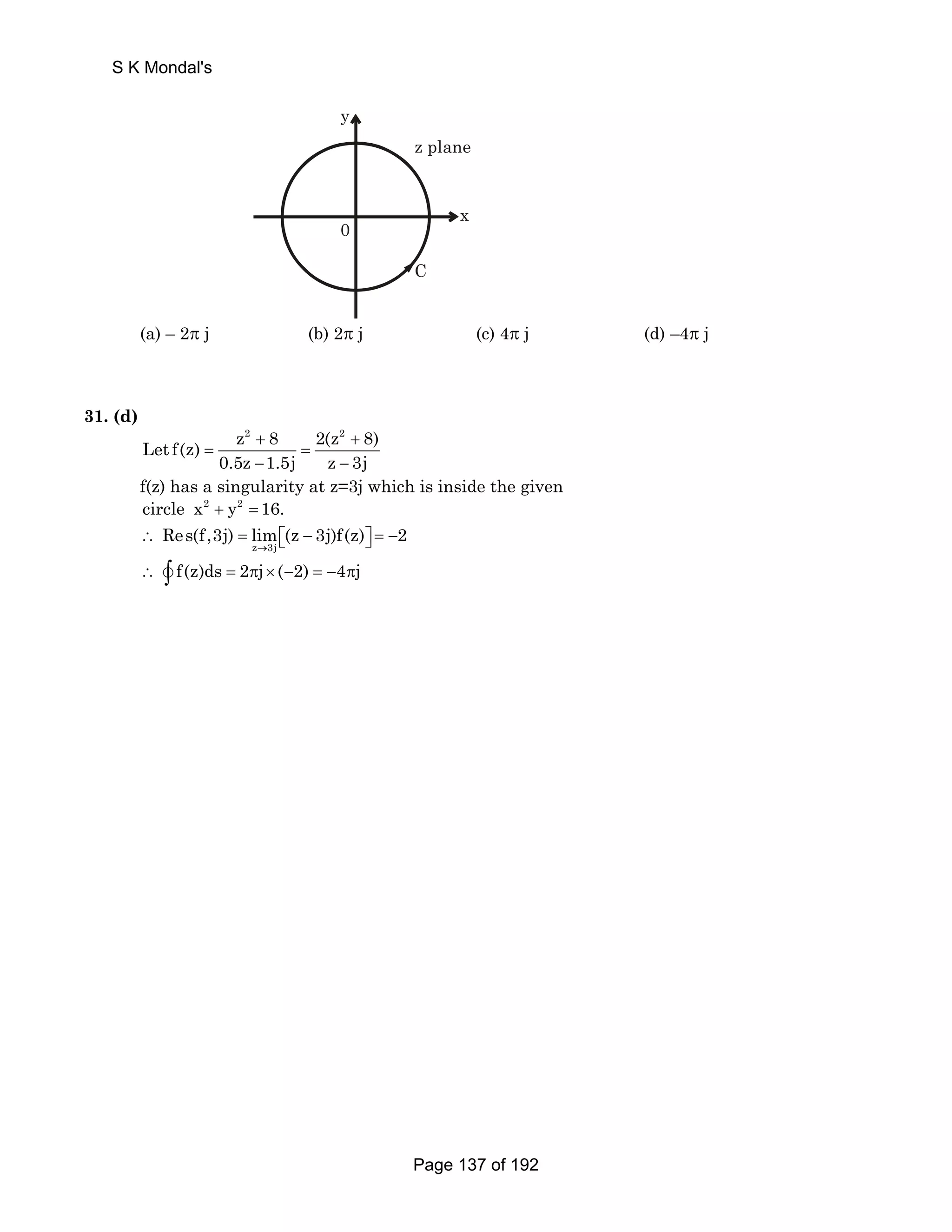
![14. Probability and Statistics
Probability Statistics
1. A fair dice is rolled twice. The probability that an odd number will follow an even number is
[EC: GATE-2005]
(a) 1
2
(b) 1
6
(c) 1
3
(d) 1
4
1. (d) Here the sample space S = 6
Therefore P(oddnumber) 3 1
6 2 = =
and P(evennumber) 3 1
6 2 = =
since events are independent,
therefore, P(odd / even) 1 1 1
2 2 4 = × =
2. A probability density function is of the form [EC: GATE-2006]
p(x) = Ke–α|x|, x ∈ (–∞,∞)
The value of K is
(a) 0.5 (b) 1 (c) 0.5α (d)α
2. (c)
As (x) is a probability density function
p(x)dx 1
∞
∴ ∫ =
−∞
ke xdx 1
∞
⇒ ∫ −α
=
−∞
0
ke dx ke dx 1 x x,for x 0
∫ x ∫ x
∵
0
x,for x 0
∞
α −α
−∞
⎡ = ⎤
⇒ + = ⎢ ⎥
⎣ = − ⎦
⇒ k = 0.5α
3. Three companies X, Y and Z supply computers to a university. The percentage of computers
supplied by them and the probability of those being defective are tabulated below
[EC: GATE-2006]
S K Mondal's
Page 138 of 192](https://image.slidesharecdn.com/gatemathematicsquestionsallbranchbyskmondal-141123081724-conversion-gate01/75/Gate-mathematics-questions-all-branch-by-s-k-mondal-138-2048.jpg)
![S K Mondal's
Company % of computers
supplied
Probability of
being
defective
X 60% 0.01
Y 30% 0.02
Z 10% 0.03
Given that a computer is defective, the probability that it was supplied by Y is
(a) 0.1 (b) 0.2 (c) 0.3 (d) 0.4
3. Ans. (d)
4. If E denotes expectation, the variance of a random variable X is given by [EC: GATE-2007]
(a) E[X2] – E2[X] (b) E[X2] + E2[X]
(c) E[X2] (d) E2[X]
4. ans (a)
Varience of X = E{(X −m)2},m = mean of the distribution
∴Var(X) = E{(X2 − 2mX +m2 )}
= E(X2 ) − 2mE(X) +m2
= E(X2 ) − 2E2(X) + E2(X) [∵m = E(X),bydefinationof mean]
= E(X2 ) − E2(X)
5. An examination consists of two papers, Paper 1 and Paper 2. The probability of failing in Paper
1 is 0.3 and that in Paper 2 is 0.2. Given that a student has failed in Paper 2, the probability of
failing in Paper 1 is 0.6. The probability of a student failing in both the papers is
[EC: GATE-2007]
(a) 0.5 (b) 0.18
(c) 0.12 (d) 0.06
5.Ans(c).
Let A be the event that ‘failed in paper 1’.
B be the event that ‘failed in paper 2’.
Given P(A) = 0.3, P(B) = 0.2.
And also given P A 0.6
⎛ ⎞ ⎜ ⎝ B
⎟
= ⎠
weknowP A P(A B)
⎛ ⎞ ∩ ⎜ ⎟ =
⎝ ⎠
B P(B)
⇒ P(A ∩ B) = 0.6 × 0.2 = 0.12
6. Px(x) = M exp(–2|x|) – N exp(–3 |x|) is the probability density function for the real random
variable X, over the entire x axis. M and N are both positive real numbers. The equation relating
M and N is [EC: GATE-2008]
(a) M 2 N 1
3 − = (b) 2M 1 N 1
3 + =
Page 139 of 192](https://image.slidesharecdn.com/gatemathematicsquestionsallbranchbyskmondal-141123081724-conversion-gate01/75/Gate-mathematics-questions-all-branch-by-s-k-mondal-139-2048.jpg)
![(c) M + N = 1 (d) M + N = 3
6. Ans.(a)
Given x P (x) is the probability density function for the random variable X.
(Me 2 x Ne 3 x )dx 1
∞
⇒ ∫ − − −
=
−∞
0
( ) ∞
( ) Me Ne dx Me Ne dx 1
⇒ ∫ 2x − 3x + ∫ 2x + 3x
=
0
− −
−∞
M N M N 1
2 3 2 3
⇒⎛ − ⎞ + ⎛ − ⎞ = ⎜ ⎟ ⎜ ⎟
⎝ ⎠ ⎝ ⎠
M 2N 1
3 ⇒ − =
7. A fair coin is tossed 10 times. What is the probability that ONLY the first two tosses will yield
heads? [EC: GATE-2009]
(a)
1 2
2
⎛ ⎞
⎜ ⎟
⎝ ⎠
(b)
3
10
C 1
2
⎛ ⎞
⎜ ⎟
⎝ ⎠
2
(c)
1 10
2
⎛ ⎞
⎜ ⎟
⎝ ⎠
(d)
10
10
C 1
2
⎛ ⎞
⎜ ⎟
⎝ ⎠
2
7. (c)
Let A be the event that first toss is head
And B be the event that second toss is head.
P(A) 1 , P(B) 1
2 2 ∴ = =
By the given condition rest all 8 tosses should be tail
∴ The probability of getting head in first two cases
2 8 10 1 . 1 1 .
2 2 2
= ⎛ ⎞ ⎛ ⎞ = ⎛ ⎞ ⎜ ⎟ ⎜ ⎟ ⎜ ⎟
⎝ ⎠ ⎝ ⎠ ⎝ ⎠
8. A fair coin is tossed independently four times. The probability of the event “the number of time
heads shown up is more than the number of times tails shown up” is [EC: GATE-2010]
(a) 1
16
(b) 1
8
(c) 1
4
(d) 5
16
8. Ans (d)
Here we have to find
P(H,H,H,T) + P(H,H,H,H)
3 4 0
4c 1 . 1 4c 1 . 1
= ⎛ ⎞ ⎛ ⎞ ⎛ ⎞ ⎛ ⎞ 3 ⎜ ⎟ ⎜ ⎟ + 4
⎜ ⎟ ⎜ ⎟
2 2 2 2
⎝ ⎠ ⎝ ⎠ ⎝ ⎠ ⎝ ⎠
4 4 4. 1 1
2 2
= ⎛ ⎞ + ⎛ ⎞ ⎜ ⎟ ⎜ ⎟
⎝ ⎠ ⎝ ⎠
5
16 =
ME 20 Years GATE Questions
S K Mondal's
Page 140 of 192](https://image.slidesharecdn.com/gatemathematicsquestionsallbranchbyskmondal-141123081724-conversion-gate01/75/Gate-mathematics-questions-all-branch-by-s-k-mondal-140-2048.jpg)
![S K Mondal's
9 In a manufacturing plant, the probability of making a defective bolt is 0.1. The mean and
standard deviation of defective bolts in a total of 900 bolts are respectively
[ME: GATE-2000]
(a) 90 and 9 (b) 9 and 90
9. Ans (a)
It’s a poission distribution. Here n = 900,p = 0.1
∴ mean(m) = np = 900 × 0.1 = 90
Standard deviation (σ) = npq = 90 ×.9,Hereq = 1 − p.
= 81 = 9 (∵σ 0).,
10. Consider the continuous random variable with probability density function
f t = + t ≤ ≤
( ) 1 for -1 t 0
=1 - t for 0 ≤ t ≤
1
[ME: GATE-2006]
The standard deviation of the random variables is
(a) 1 (b) 1 (c) 1 (d) 1
3 6 3 6
10. Ans. (b)
∞
2 2
t Var(T) t f(t)dt,
= σ = ∫ T being the random variable of f(t).
−∞
0 1
t (1+t)dt+ t (1 t)dt
= ∫ 2 ∫ 2
−
−
1 0
1
=
6 1 0
6
∴ σ t ⎡⎣∵σ t
⎤⎦
11. The standard deviation of a uniformly distributed random variable between 0 and 1 is
[ME: GATE-2009]
(a) 1 (b) 1 (c) 5 (d) 7
12 3 12 12
11. (a)
Herep.d.f.is f(x) 1 1, 0 x 1.
1 0 = =
−
1 1
mean(m) E(x) xf(x)dx xdx 1
2 ∴ = = ∫ = ∫ =
0 0
1 2 1
(x) x 1 .1.dx x x 1 dx
⎝ ⎠ ⎝ ⎠ ∫ ∫ 1 1 1 1
∴ Va = σ 2 ⎛⎜ − = ⎞⎟ = ⎛⎜ 2
− + ⎞⎟
2
0 0
r
4
3 2 4 12 = − + =
1 [ 0]
12
∴σ = ∵σ
Page 141 of 192](https://image.slidesharecdn.com/gatemathematicsquestionsallbranchbyskmondal-141123081724-conversion-gate01/75/Gate-mathematics-questions-all-branch-by-s-k-mondal-141-2048.jpg)
![S K Mondal's
12 The probability that two friends share the same birth-month is [ME: GATE-1998]
(a) 1 (b) 1 (c) 1 (d) 1
6 12 144 24
12. (b)
Let A = the event that the birth month of first friend
And B= that of second friend.
∴ P(A) = 1,as 1st friend can born in any month
andP(B) 1 ,by the condition.
12 =
∴ Probability of two friends share same birth-month
is 1 1 1
12 12 × =
13. The probability of a defective piece being produced in a manufacturing process is 0.01. The
probability that out of 5 successive pieces, only one is defective, is
(a) (0.99)2 (0.01) (b) (0.99)(0.01)4 [ME: GATE-1996]
(c) 5×(0.99)(0.01)4 (d) 5×(0.99)4(0.01)
13. (d)
The required probability 5 1 4 4
1 = c (.01) ×(.99) = 5 × (0.99) ×(.01).
14. A box contains 5 block balls and 3 red balls. A total of three balls are picked from the box one
after another, without replacing them back. The probability of getting two black balls and one
red ball is [ME: GATE-1997]
(a) 3/8 (b) 2/15 (c) 15/28 (d) ½
14. (c)
Here the possible combination of picking up three balls without replacement is
BBR, BRB, RBB.
(B = Black ball, R = Red balls)
P(BBR) 5 4 3 5
8 7 6 28 ∴ = × × =
P(BRB) 5 3 4 5
8 7 6 28 = × × =
P(RBB) 3 5 4 5
8 7 6 28 = × × =
∴ Probability of getting two black balls and one red ball is 15
28
.
15. An unbiased coin is tossed three times. The probability that the head turns up in exactly two
cases is [ME: GATE-2001]
Page 142 of 192](https://image.slidesharecdn.com/gatemathematicsquestionsallbranchbyskmondal-141123081724-conversion-gate01/75/Gate-mathematics-questions-all-branch-by-s-k-mondal-142-2048.jpg)
![S K Mondal's
(a) 1/9 (b) 1/8 (c) 2/3 (d) 3/8
15. (d)
Required probability
2
= 3
× ⎛ ⎞ ⎛ ⎞ ⎜ ⎟ × ⎜ ⎟
= c 1 1 3
2
2 2 8
⎝ ⎠ ⎝ ⎠
16. Two dice are thrown. What is the probability that is the sum of the numbers on the two dice is
eight? [ME: GATE-2002]
(a) 5/36 (b) 5/18 (c) ¼ (d) 1/3
16. (a)
Here sample space = 6 × 6 = 36
Here, there are five such points whose sum is 8. They are (2,6), (3,5), (4,4),
(5,3), (6,2).
Requireprobability 5
36 ∴ =
17. Manish has to travel from A to D changing buses at stops B and C enroute. The maximum
waiting time at either stop can be 8 minutes each, but any time of waiting up to 8 minutes is
equally likely at both places. He can afford up to 13 minutes of total waiting time if he is to
arrive at D on time. What is the probability that Manish will arrive late at D?
[ME: GATE-2002]
(a) 8/13 (b) 13/64 (c) 119/128 (d) 9/128
17.Ans(a)
18. Arrivals at a telephone booth are considered to be poison, with an average time of 10 minutes
between successive arrivals. The length of a phone call is distributes exponentially with mean
3 minutes. The probability that an arrival does not have to wait before service is
[ME: GATE-2002]
(a) 0.3 (b) 0.5 (c) 0.7 (d) 0.9
18.Ans(a)
19. A box contains 5 black and 5 red balls. Two balls are randomly picked one after another from
the box, without replacement. The probability for both balls being red is
[ME: GATE-2003]
(a) 1 (b) 1 (c) 19 (d) 2
90 2 90 9
19. (d)
The probability of drawing two red balls without replacement
5 4 2
10 9 9 = × =
20. From a pack of regular from a playing cards, two cards are drawn at random. What is the
probability that both cards will be Kings, if first card in NOT replaced
Page 143 of 192](https://image.slidesharecdn.com/gatemathematicsquestionsallbranchbyskmondal-141123081724-conversion-gate01/75/Gate-mathematics-questions-all-branch-by-s-k-mondal-143-2048.jpg)
![S K Mondal's
(a) 1 (b) 1 (c) 1 (d) 1
26 52 169 221
[ME: GATE-2004]
20. (d)
Here sample space S = 52
∴The probability of drawing both cards are king without replacement
4 3
1 1 c c 1
52 51 221 = × =
21. A lot has 10% defective items. Ten items are chosen randomly from this lot. The probability
that exactly 2 of the chosen items are defective is [ME: GATE-2005]
(a) 0.0036 (b) 0.1937 (c) 0.2234 (d) 0.3874
21.(b)
Let A be the event that items are defective and B be the event that items are non- defective.
∴P(A) = 0.1 and P(B) = 0.9
∴ Probability that exactly two of those items are defective
= 10 c (.1) 2 (.9) 8
= 0.1937
2 22. A single die is thrown twice. What is the probability that the sum is neither 8 nor 9?
[ME: GATE-2005]
(a) 1/9 (b) 5/36 (c) 1/4 (d) 3/4
22. (d)
Here sample space = 36
Total No. of way in which sum is either 8 or 9 are
(2,6), (3,5),(3,6), (4,4), (4,5), (5,3), (5,4), (6,2), (6,3)
So probability of getting sum 8 or 9 9 1
36 4 = =
So the probability of not getting sum 8 or 9 =1 1 3
− = .
4 4
24. A box contains 20 defective items and 80 non-defective items. If two items are selected at
random without replacement, what will be the probability that both items are defective?
[ME: GATE-2006]
(a) 1/5 (b) 1/25 (c) 20/99 (d) 11/495
24(d)
The probability of defective items 20
= .
100
Therefore the probability of first two defective items
without replacement
20 19 19 .
100 99 495
= × =
Page 144 of 192](https://image.slidesharecdn.com/gatemathematicsquestionsallbranchbyskmondal-141123081724-conversion-gate01/75/Gate-mathematics-questions-all-branch-by-s-k-mondal-144-2048.jpg)
![25. A coin is tossed 4 times. What is the probability of getting heads exactly 3 times?
(a) 1 (b) 3 (c) 1 (d) 3
4 8 2 4
[ME: GATE-
2008
25. (a)
Probability of getting exactly three heads
3
= 4
× ⎛ ⎞ ⎜ ⎟ × ⎛ ⎞ ⎜ ⎟
= × = c 1 1 4 1 1
3 4
2 2 2 4
⎝ ⎠ ⎝ ⎠
26. If three coins are tossed simultaneously, the probability of getting at least one head is
[ME: GATE-2009]
(a) 1/8 (b) 3/8 (c) 1/2 (d) 7/8
26. (d)
Here the sample space S = 23 = 8.
No. of ways to get all tails =1.
probability toget all tails 1
8 ∴ =
Probability to get at least one head is =1- 1 7
8 8 ∴ =
27. A box contains 2 washers, 3 nuts and 4 bolts. Items are drawn from the box at random one at a
time without replacement. The probability of drawing 2 washers first followed by 3 nuts and
subsequently the 4 bolts is [ME: GATE-2010]
(a) 2/315 (b) 1/630 (c) 1/1260 (d) 1/2520
27. (c)
Here sample space = 9
The required probability of drawing 2 washers, 3 nuts and 4 bolts respectively
without replacement
2 1 3 2 1 4 3 2 1
9 8 7 6 5 4 3 2 1 = × × × × × × × ×
1
1260 =
28. If 20 per cent managers are technocrats, the probability that a random committee of 5
managers consists of exactly 2 technocrats is [ME: GATE-1993]
(a) 0.2048 (b) 0.4000 (c) 0.4096 (d) 0.9421
28. (a)
The probability of technocrats manager 20 1
100 5 = =
S K Mondal's
Page 145 of 192](https://image.slidesharecdn.com/gatemathematicsquestionsallbranchbyskmondal-141123081724-conversion-gate01/75/Gate-mathematics-questions-all-branch-by-s-k-mondal-145-2048.jpg)
![S K Mondal's
∴ Probability of non technocrats manager 4
5 =
Now the require probability
2 2 3
= 5
× ⎛ ⎞ ⎛ ⎞ ⎛ ⎞ ⎜ ⎟ × ⎜ ⎟ × ⎜ ⎟
= c 1 1 4 0.2048
2
5 5 5
⎝ ⎠ ⎝ ⎠ ⎝ ⎠
29. Analysis of variance is concerned with: [ME: GATE-1999]
(a) Determining change in a dependent variable per unit change in an independent variable
(b) Determining whether a qualitative factor affects the mean of an output variable
(c) Determining whether significant correlation exists between an output variable and an
input variable.
(d) Determining whether variance in two or more populations are significantly different.
29. Ans.(d)
Analysis of variance is used in comparing two or more populations, e.g. Different types of
manures for yelding a single crop.
30. Four arbitrary point (x1,y1), (x2,y2), (x3,y3), (x4,y4), are given in the x, y – plane Using the
method of least squares, if, regressing y upon x gives the fitted line y = ax + b; and regressing y
upon x given the fitted line y = ax + b; and regressing x upon y gives the fitted line x = cy + d
then [ME: GATE-1999]
(a) The two fitted lines must coincide (b) The two fitted lines need not coincide
(c) It is possible that ac = 0 (d) A must be 1/c
30. (d)
y = ax + b − (i) and x = cy + d − (ii)
From(ii)we get x d cy y 1 x d (iii)
c c − = ⇒ = − −
comparing(i) and(ii),a 1 = and b −
d
=
c c
31. A regression model is used to express a variable Y as a function of another variable X. This
implies that [ME: GATE-2002]
(a) There is a causal relationship between Y and X
(b) A value of X may be used to estimate a value of Y
(c) Values of X exactly determine values of Y
(d) There is no causal relationship between Y and X
31. (b)
32. Let X and Y be two independent random variables. Which one of the relations between
expectation (E), variance (Var) and covariance (Cov) given below is FALSE?
[ME: GATE-2007]
(a) E (XY) = E (X) E (Y) (b) Cov (X, Y) = 0
(c) Var (X + Y) = Var (X) + Var (Y) (d) E (X2 y2) = (E (X))2 (E (y))2
Page 146 of 192](https://image.slidesharecdn.com/gatemathematicsquestionsallbranchbyskmondal-141123081724-conversion-gate01/75/Gate-mathematics-questions-all-branch-by-s-k-mondal-146-2048.jpg)
![32. (b).
CE 10 Years GATE Questions
33. A class of first year B. Tech. Students is composed of four batches A, B, C and D, each
consisting of 30 students. It is found that the sessional marks of students in Engineering
Drawing in batch C have a mean of 6.6 and standard deviation of 2.3. The mean and
standard deviation of the marks for the entire class are 5.5 and 4.2, respectively. It is decided
by the course instructor to normalize the marks of the students of all batches to have the
same mean and standard deviation as that of the entire class. Due to this, the marks of a
student in batch C are changed from 8.5 to
(a) 6.0 (b) 7.0 [CE: GATE – 2006]
(c) 8.0 (d) 9.0
33.Ans(d). Let mean and stander deviation of batch C be μc and σc respectively and mean
and standard deviation of entire class of 1st year students be μ and σ respectively.
Givenμ = 6.6 and σ = 2.3
c c and μ = 5.5 and σ = 4.2
In order to normalize batch C to entire class, the normalized score must be equated
Since Z x − μ
=
σ
c c
Z x 8.5 6.6
c
− μ −
c
2.3
= =
σ
Now Z x − μ x −
5.5
4.2
= =
σ
Z Z x 5.5 8.5 6.6
∴ = ⇒ =
c
− −
4.2 2.3
⇒ x = 8.969 ≅ 9.0
34. Three values of x and y are to be fitted in a straight line in the form y = a + bx by the method
of least squares. GivenΣx = 6, Σy = 21, Σx2 = 14 and Σxy = 46, the values of a and b are
respectively. [CE: GATE – 2008]
(a) 2 and 3 (b) 1 and 2
(c) 2 and 1 (d) 3 and 2
34.Ans(d)
y = a + bx
Given
n = 3, Σx = 6, Σy = 21, Σx2 = 14
And Σxy = 46
n Σ xy −Σ x Σ
y
n Σ x − ( Σ
x)
b = 2 2
a = y − bx
S K Mondal's
Page 147 of 192](https://image.slidesharecdn.com/gatemathematicsquestionsallbranchbyskmondal-141123081724-conversion-gate01/75/Gate-mathematics-questions-all-branch-by-s-k-mondal-147-2048.jpg)
![= Σ y b Σ
x
n −
n
S K Mondal's
Substituting, we get
(3 × 46) − (6 ×
21)
(3 × 14) −
(6)
b = 2
= 2
a = 21 2 6
− × ⎛ ⎞ ⎜ ⎟
3 3
⎝ ⎠
= 3
∴ a = 3 and b = 2
35. A box contains 10 screws, 3 of which are defective. Two screws are drawn at random with
replacement. The probability that none of the two screws is defective will be
(a) 100% (b) 50% [CE: GATE – 2003]
(c) 49% (d) None of these
35. (d)
Non defective screws =7
∴Probability of the two screws are non defective
c c 100%
c
3 7
0 2
10
2
×
= ×
7 100% 46.6 47%
15 = × =
36. A hydraulic structure has four gates which operate independently. The probability of failure
off each gate is 0.2. Given that gate 1 has failed, the probability that both gates 2 and 3 will
fail is [CE: GATE – 2004]
(a) 0.240 (b) 0.200
(c) 0.040 (d) 0.008
36.(c)
P(gate to and gate 3/gate 1 failed)
P(gate2 and gate 3)
=
= P(gate2) ×P(gate 3)
= 0.2 × 0.2 =
0.04
all three gates are
⎡∴
independent corrosponding
to each other
⎢⎢⎢
⎤⎦
⎣
37. Which one of the following statements is NOT true?
(a) The measure of skewness is dependent upon the amount of dispersion
(b) In a symmetric distribution, the values of mean, mode and median are the same
(c) In a positively skewed distribution; mean median mode
(d) In a negatively skewed distribution; mode mean median [CE: GATE – 2005
37. (d)
(d) is not true since in a negatively skewed distribution, mode median mean
Page 148 of 192](https://image.slidesharecdn.com/gatemathematicsquestionsallbranchbyskmondal-141123081724-conversion-gate01/75/Gate-mathematics-questions-all-branch-by-s-k-mondal-148-2048.jpg)
![S K Mondal's
38. There are 25 calculators in a box. Two of them are defective. Suppose 5 calculators are
randomly picked for inspection (i.e., each has the same chance of being selected), what is the
probability that only one of the defective calculators will be included in the inspection?
[CE: GATE – 2006]
(a) 1
2
(b) 1
3
(c) 1
4
(d) 1
5
38. (b)
Probability of only one is defective out of 5 calculators
c c 1
c 3
2 23
1 4
25
5
×
= =
39. If the standard deviation of the spot speed of vehicles in a highway is 8.8 kmph and the mean
speed of the vehicles is 33 kmph, the coefficient of variation in speed is
[CE: GATE – 2007]
(a) 0.1517 (b) 0.1867 (c) 0.2666 (d)0.3645
39. (c)
C 8.8 0.2666
33
σ
ν = = =
μ
40. If probability density functions of a random variable X is
f(x) = x2 for –1 ≤ x ≤ 1, and [CE: GATE – 2008]
= 0 for any other value of x
Then, the percentage probability P 1 x 1
⎛ − ≤ ≤ ⎞ ⎜ ⎟
⎝ ⎠
3 3
is
(a) 0.247 (b) 2.47 (c) 24.7 (d) 247
40. (b)
1 1
3 3 3
P 1 x 1 x dx x 2
⎛ − ⎞ 2
⎡ ⎤ ⎜ ⎝ 3 ≤ ≤ 3 ⎟ = ∫
= ⎢ ⎥ =
⎠ 1 ⎣ 3 ⎦ 1
81 − −
3 3
Percentage probability 2 100 2.47%
81 ∴ = ×
41. A person on a trip has a choice between private car and public transport. The probability of
using a private car is 0.45. While using the public transport, further choices available are bus
and metro, out of which the probability of commuting by a bus is 0.55. In such a situation, the
probability (rounded up to two decimals) of using a car, bus and metro, respectively would be
[CE: GATE – 2008]
(a) 0.45, 0.30 and 0.25 (b) 0.45, 0.25 and 0.30
(c) 0.45, 0.55 and 0.00 (d) 0.45, 0.35 and
41. (a)
Given
Page 149 of 192](https://image.slidesharecdn.com/gatemathematicsquestionsallbranchbyskmondal-141123081724-conversion-gate01/75/Gate-mathematics-questions-all-branch-by-s-k-mondal-149-2048.jpg)
![S K Mondal's
p(private car) = 0.45
p(bus / public transport) = 0.55
Since a person has a choice between private car and public transport
p (public transport)= 1 – p(private car)
= 1 – 0.45 = 0.55
p (bus) = p(bus ∩ public transport)
= p(bus| public transport)
× p(public transport)
= 0.55 × 0.55
= 0.3025 0.30
Now p (metro) = 1 – [p(private car) + p(bus)]
= 1 – (0.45 + 0.30) = 0.25
∴ p (private car) = 0.45
p (bus) = 0.30
and p(metro) = 0.25
42. The standard normal probability function can be approximated as
N F(x ) = 0.12
n n
1
1 + exp(−1.7255 x |x | )
[CE: GATE – 2009]
Where N x = standard normal deviate. If mean and standard deviation of annual
precipitation are 102 cm and 27 cm respectively, the probability that the annual
precipitation will be between 90 cm and 102 cm is
(a) 66.7% (b) 50.0% (c) 33.3% (d) 16.7%
42. (d)
Here μ =102cm and σ = 27cm
P(90 ≤ x ≤102) P 90 102 x 102 102
⎛ − − ⎞ = ⎜ ≤ ≤ ⎟
27 27
⎝ ⎠
= P(−0.44 ≤ x ≤ 0)
This area is shown below
-0.44
The shaded area in above figure is given by F(0) − F(−0.44)
0.12
1 1
= 1 + exp(0) −
1 + exp( − 1.7255 × ( − 0.44) ×
(0.44) ) = 0.5 − 0.3345
= 0.1655 16.55%
Page 150 of 192](https://image.slidesharecdn.com/gatemathematicsquestionsallbranchbyskmondal-141123081724-conversion-gate01/75/Gate-mathematics-questions-all-branch-by-s-k-mondal-150-2048.jpg)
![S K Mondal's
43. Two coins are simultaneously tossed. The probability of two heads simultaneously appearing
is [CE: GATE – 2010]
(a) 1
8
(b) 1
6
(c) 1
4
(d) 1
2
43.(c)
Probability of two head 1 1 1
2 2 4 = × =
Q3. There are two containers, with one containing 4 Red and 3 Green balls and the other
containing Blue and 4 Green balls. One bal is drawn at random form each container. The
probability that one of the ball is Red and the other is Blue will be
(a) 1/7 (b) 9/49 (c) 12/49 (d) 3/7 [CE-2011]
Ans. (c)
EE All GATE Questions
45. A fair coin is tossed three times in succession. If the first toss produces a head, then the
probability of getting exactly two heads in three tosses is [EE: GATE-2005]
(a) 1
8
(b) 1
2
(c) 3
8
(d) 3
4
45.(d)
After first head in first toss, probability of tails in 2nd and 3rd toss 1 .1 1
2 2 4 = =
∴ Probability of exactly two heads 1 1 3
4 4 = − =
46. Two fair dice are rolled and the sum r of the numbers turned up is considered
[EE: GATE-2006]
(a) Pr ( 6) 1
r = (b) Pr(r/3 is an integer)= 5
6
6
(c) Pr(r=8|r/4 is an integer) = 5
9
(d) Pr(r=6|r/5 is an integer)= 1
18
46. (c)
Page 151 of 192](https://image.slidesharecdn.com/gatemathematicsquestionsallbranchbyskmondal-141123081724-conversion-gate01/75/Gate-mathematics-questions-all-branch-by-s-k-mondal-151-2048.jpg)
![S K Mondal's
47. A box contains 4 white balls and 3 red balls. In succession, two balls are randomly selected and
removed from the box. Given that the first removed ball is white, the probability that the
second removed ball is red is [EE: GATE-2010]
(a) 1/3 (a) 3/7
(a) 1/2 (a) 4/7
47. (c)
After first ball is drawn white then sample space has 4 + 3 – 1 = 6 balls.
Probability of second ball is red without replacement
0 1 c c 1
6 2
3 3
×
= =
14. X is a uniformly distributed random variable that takes values between 0 and 1. The value
of E{X3} will be [EE: GATE-2008]
(a) 0 (b) 1
8
(c) 1
4
(d) 1
2
14. Ans. (c)
( )
( ) ∞
⎧
= ⎨⎩
1 4 1
= = =
−∞
= − =
∫ ∫
3 3 3
0 0
1,0 1
0, wise
( )
4
1 0 1
4 4
x
x
x
f x
other
E X x f x dx x dx x
IE All GATE Questions
48. Consider a Gaussian distributed radom variable with zero mean and standard
deviation σ. The value of its cumulative distribution function at the origin will be
[IE: GATE-2008]
(a) 0 (b) 0.5 (c) 1 (d) 10σ
48 Ans. (b)
49. A random variable is uniformly distributed over the interval 2 to 10. Its variance will
be [IE: GATE-2008]
(a) 16
3
(b) 6 (c) 256
9
(d) 36
49. (a)
Page 152 of 192](https://image.slidesharecdn.com/gatemathematicsquestionsallbranchbyskmondal-141123081724-conversion-gate01/75/Gate-mathematics-questions-all-branch-by-s-k-mondal-152-2048.jpg)
![S K Mondal's
Thep.d.f f(x) 1 1 , x (2,10)
= 10 = ∈
−
2 8 2 10 10
2
⎣ ⎦ ∫ 1 .96 6.
2
mean of x E(x) 1 x dx 1 x
⎡ ⎤
= = =⎢
⎥
8 8 2
16 = =
2 ( )2
x Varience of x =(σ ) = E⎡⎣ x − 6 ⎤⎦
x 6 1 dx 1 x 12x 36x
10 3 2 ( )
2
2
⎡ ⎤
⎣ ⎦ ∫
16
3 =
= − = ⎢ − + ⎥
8 8 3 2
50. The probability that there are 53 Sundays in a randomly chosen leap year is
(a) 1
7
(b) 1
14
(c) 1
28
(d) 2
7
[IE: GATE-2005]
50. (d)
No. of days in a leap year are 366 days. In which there are 52 complete weeks and 2 days
extra.
This 2 days may be of following combination.
1. Sunday Monday
2. Monday Tuesday
3. Tuesday Wednesday
4. Wednesday Thursday
5. Thursday Friday
6. Friday Saturday
7. Saturday Sunday
There are two combination of Sunday in (1.) and (7).
∴ Required probability
2
7 =
51. You have gone to a cyber-café with a friend. You found that the cyber-café has only
three terminals. All terminals are unoccupied. You and your friend have to make a
random choice of selecting a terminal. What is the probability that both of you will
NOT select the same terminal? [IE: GATE-2006]
(a) 1
9
(b) 1
3
(c) 2
3
(d) 1
51.(c)
Out of three terminals probability of selecting terminals of two friends is 1
3 =
Probability of not selecting same terminal 1 1 2
3 3 ∴ =− =
Page 153 of 192](https://image.slidesharecdn.com/gatemathematicsquestionsallbranchbyskmondal-141123081724-conversion-gate01/75/Gate-mathematics-questions-all-branch-by-s-k-mondal-153-2048.jpg)
![S K Mondal's
52. Probability density function p(x) of a random variable x is as shown below. The
1c
value of 2c
α is [IE: GATE-2006]
(a) (b) (c) 2
(b + c)
(d) 1
(b + c)
p(x)
α
0 a a +b a +c X
∞
52.(a) p(x)is p.d.f. p(x)dx 1
⇒ ∫ =
−∞
From figure, area of traiangle = 1 .c. α
c
α =
2 2
c 1 2
2 c
α
∴ = ⇒α=
53. Two dices are rolled simultaneously. The probability that the sum of digits on the
top surface of the two dices is even, is [IE: GATE-2006]
(a) 0.5 (b) 0.25 (c) 0.167 (d) 0.125
53. (a)
Here sample space S= 6 × 6 = 36
Total no. of way in which sum of digits on the top surface of the two dice is is even
is 18.
The require probability 18 0.5 .
36 ∴ = =
55. Poisson’s ratio for a metal is 0.35. Neglecting piezo-resistance effect, the gage factor
of a strain gage made of this metal is [IE: GATE-2010]
(a) 0.65 (b) 1 (c) 1.35 (d) 1.70
55. (d)
Poission’s ratio σ = 0.36
Gage factor, Gr =1 + 2σ =1 + 2× 0.35 =1.70
Page 154 of 192](https://image.slidesharecdn.com/gatemathematicsquestionsallbranchbyskmondal-141123081724-conversion-gate01/75/Gate-mathematics-questions-all-branch-by-s-k-mondal-154-2048.jpg)
![S K Mondal's
56. Assume that the duration in minutes of a telephone conversation follows the
exponential distribution f(x) =
–x
5 1e ,x 0.
5
≥ The probability that the conversation will
exceed five minutes is [IE: GATE-2007]
(a) 1
e
(b) 1 1
1
e
e − (c) 2
1 1
(d) 2
e −
56. (a)
Required probability
x
5
5
1 e dx 1
5 e
∞
− = ∫ =
22. Using the given data points tabulated below, a straight line passing through the origin is
fitted using least squares method. The slope of the line is
x 1.0 2.0 3.0
y 1.5 2.2 2.7
[IE: GATE-2005]
(a) 0.9 (b) 1.0
(c) 1.1 (d) 1.5
22. Ans.(c)
Suppose the line being, y = mx
Since, it has been fit by least square method, therefore
Σy = μΣx, andΣx y = 2 μΣx
∴ m = 1.1
23. The function y = sin φ, (φ 0) is approximated as y = φ, where φ is in radian. The maximum
value of φ for which the error due to the approximation is with in ±2% is
[IE: GATE-2006]
(a) 0.1 rad (b) 0.2 rad
(c) 0.3 rad (d) 0.4 rad
23. Ans.(c)
CS All GATE Questions
Q3. If two fair coins are flipped and at least one of the outcome is know to be a head, what is the
probability that both outcomes are heads?
(a) 1/3 (b) ¼ (c) ½ (d) 2/3 [CS-2011]
Ans. (c)
Page 155 of 192](https://image.slidesharecdn.com/gatemathematicsquestionsallbranchbyskmondal-141123081724-conversion-gate01/75/Gate-mathematics-questions-all-branch-by-s-k-mondal-155-2048.jpg)
![S K Mondal's
Q18. If the difference between the expectation of the square of a random variable ( [ ])2 E X is
denoted by R, then
R = 0 (b) R 0 (c) R ≥ 0 (d) R 0 [CS-2011]
(a)
Ans. (c)
Exp. We know,
The second control momnt,
{( )}2
2 μ = E X − m [m = mean of the distribution of X]
= E(X2 ) − 2m× E(X) + m2
( ) ( ) ( ) = E X2 − 2 ⎡E X ⎤2 + E X ⎣ ⎦ ⎡⎣∵m = E(X)⎤⎦
( ) ( ) E X2 − ⎡E X ⎤2 ⎣ ⎦
2 μ ≥ 0
( ) ( ) ∴E X2 − ⎡E X ⎤2 ≥ 0 ⎣ ⎦
Q34. A deck of 5 cards (each carrying a distinct number from 1 to 5) is shuffled thoroughly. Two
cards are then removed one at a time from the deck. What is the probability that the two
cards are selected with the number on the first card being one higher than the number on
the second card?
(a) 1/5 (b) 4/25 (c) ¼ (d) 2/5 [CS-2011]
Ans. *
57. For each element is a set of size 2n, an unbiased coin is tossed. The 2n coin tossed are
independent. An element is chosen if the corresponding coin toss were head. The probability
that exactly n elements are chosen is [CS: GATE-2006]
2n
n
4
⎛ ⎞
⎜ ⎟
⎝ ⎠ (b) n
(a) n
2n
n
2
⎛ ⎞
⎜ ⎟
⎝ ⎠ (c) 1
2n
n
⎛ ⎞
⎜ ⎟
⎝ ⎠
(d) 1
2
57.(a)
The probability that exactly n elements are chosen
= the probability of getting n heads out of 2n tosses
n 2n n
− = 2n
c ⎛ 1 ⎞ ⎛ 1
⎞ n
⎜ ⎟ × ⎜ ⎟
2 2
⎝ ⎠ ⎝ ⎠
2n
c
=
2 n
2n
2n
n
n c 4 =
Page 156 of 192](https://image.slidesharecdn.com/gatemathematicsquestionsallbranchbyskmondal-141123081724-conversion-gate01/75/Gate-mathematics-questions-all-branch-by-s-k-mondal-156-2048.jpg)
![S K Mondal's
59. Suppose we uniformly and randomly select a permutation from the 20! permutations of 1, 2, 3
….., 20. What is the probability that 2 appears at an earlier position that any other even number
in the selected permutation? [CS: GATE-2007]
(a) 1
2
(b) 1
10
(c) 9!
20!
(d) None of these
59. (d)
Number of permutations with ‘2’ in the first position = 19!
Number of permutations with ‘2’ in the second position = 10 × 18!
(fill the first space with any of the 10 odd numbers and the 18 spaces after the 2 with 18 of
the remaining numbers in 18! ways)
Number of permutations with ‘2’ in 3rd position = 10 × 9 × 17!
(fill the first 2 places with 2 of the 10 odd numbers and then the remaining 17 places with
remaining 17 numbers)
and so on until ‘2’ is in 11th place. After that it is not possible to satisfy the given condition,
since there are only 10 odd numbers available to fill before the ‘2’. So the desired number of
permutations which satisfies the given condition is
19! + 10 × 18! + 10 × 9 × 17! + 10 × 9 × 8 × 16! + … + 10! × 9!
Now the probability of this happening is given by
19! + 10 ×18! + 10 × 9 ×17! ... + 10! × 9!
20!
Which is clearly not choices (a), (b) or (c)
Thus, Answer is (d) none of these.
60. Aishwarya studies either computer science or mathematics everyday. if the studies computer
science on a day, then the probability that she studies mathematics the next day is 0.6. If she
studies mathematics on a day, then the probability that she studies computer science the next
day is 0.4. Given that Aishwarya studies computer science on Monday, what is the probability
that she studies computer science on Wednesday? [CS: GATE-2008]
(a) 0.24 (b) 0.36 (c) 0.4 (d) 0.6
60. (c)
Let C denote computes science study and M denotes maths study.
P(C on monday and C on wednesday)
= p(C on monday, M on tuesday and C on wednesday)
+ p(C on monday, C on tuesday and C on wednesday)
= 1 × 0.6 × 0.4 + 1 × 0.4 × 0.4
= 0.24 + 0.16
= 0.40
61. Let X be a randon variable following normal distribution with mean +1 and variance 4. Let Y be
another normal variable with mean –1 and variance unknown. If P(X ≤ –1) = P(Y ≥ 2) the
standard deviation of Y is [CS: GATE-2008]
(a) 3 (b) 2 (c) 2 (d) 1
Page 157 of 192](https://image.slidesharecdn.com/gatemathematicsquestionsallbranchbyskmondal-141123081724-conversion-gate01/75/Gate-mathematics-questions-all-branch-by-s-k-mondal-157-2048.jpg)
![61. Ans. (a) Given Ψx = 1, 2
σx = 4 ⇒ σx = 2 and μY = –1, σY is unknown
given, p(X ≤ –1) = p(Y ≥ 2)
Converting into standard normal variates,
p ⎛ − 1 − μ ⎞
⎜ z ≤ x
⎝ σ ⎟ x
⎠
⎛ − μ ⎞
⎜⎜ ≥ ⎟⎟ ⎝ σ ⎠
= y
y
2
p z
p z 1 1
⎛ − − ⎜ ≤ ⎞ ⎟
⎝ 2
⎠
=
p z 2 ( 1)
⎛ − − ⎞
⎜⎜ ≥ σ ⎟⎟ ⎝ y
⎠
P(z ≤ –1) =
p z 3
⎛ ⎞
⎜⎜ ≥ σ ⎟⎟ ⎝ y
⎠
… (i)
Now since us know that in standard normal distribution,
P(z ≤ –1) = p(z ≥ 1) … (ii)
Comparing (i) and (ii) we can say that
3
σ
y
= 1 ⇒ σy = 3
62. An unbalanced dice (with 6 faces, numbered from 1 to 6) is thrown. The probability that the face
value is odd is 90% of the probability that the face value is even. The probability of getting any
even numbered face is the same.
If the probability that the face is even given that it is greater than 3 is 0.75, which one of the
following options is closed to the probability that the face value exceeds 3?
[CS: GATE-2009]
(a) 0.453 (b) 0.468 (c) 0.485 (d) 0.492
62. (b)
It is given that
P(odd) = 0.9 p(even)
Now since Σp(x) = 1
∴ p(odd) + p (even) = 1
⇒ 0.9 p(even) + p (even) = 1
⇒ p(even) = 1
1.9
= 0.5263
Now, it is given that p (any even face) is same
i.e p(2) = p(4) = p(6)
Now since,
p(even) = p(2) or p(4) or p(6)
= p(2) + p(4) + p(6)
∴ p(2) = p(4) = p(6) = 1 p(even)
3
= 1 (0.5263)
3
S K Mondal's
Page 158 of 192](https://image.slidesharecdn.com/gatemathematicsquestionsallbranchbyskmondal-141123081724-conversion-gate01/75/Gate-mathematics-questions-all-branch-by-s-k-mondal-158-2048.jpg)
![= 0.1754
S K Mondal's
It is given that
p(even|face 3) = 0.75
p(even face
3)
∴ ∩ = 0.75
p(face
3)
⇒ p(face 4, 6)
=
p(face 3)
= 0.75
⇒ p(face 3) = p(face 4, 6)
= = p(4) p(6)
0.75
+
0.75
= 0.1754 +
0.1754
0.75
= 0.4677 0.468
63. Consider a company that assembles computers. The probability of a faulty assembly of any
computer is p. The company therefore subjects each computer to a testing process. This testing
process gives the correct result for any computer with a probability of q.
What is the probability of a computer being declared faulty? [CS: GATE-2010]
(a) pq + (1 – p) (1 – q) (b) (1 – q)p (c) (1 – p)q (d) pq
63.(a)
(declared faulty)
(declared not faulty)
(declared faulty)
(declared not faulty)
faulty
not faulty
p
1-p
q
1-q
1-q
q
From the diagram,
P(declared faulty) = pq + (1 − p)(1 − q)
64. What is the probability that a divisor of 1099 is a multiple of 1096? [CS: GATE-2010]
(a) 1
625
(b) 4
625
(c) 12
625
(d) 16
625
64. Ans. (a)
p(multiple of 10% |divisor of 1099)
Page 159 of 192](https://image.slidesharecdn.com/gatemathematicsquestionsallbranchbyskmondal-141123081724-conversion-gate01/75/Gate-mathematics-questions-all-branch-by-s-k-mondal-159-2048.jpg)
![S K Mondal's
=
n(multiple of 10 and divisor of 10
96 99)
n(divisor of 10 99
)
Since 10 = 2.5
1099 = 299 . 599
Any divisor of 1099 is of the form 2a . 5b where 0 ≤ a ≤ 99 and 0 ≤ b ≤ 99.
The number of such possibilities is combination of 100 values of a and 100 values of b = 100
× 100 each of which is a divisor of 1099.
So, no. of divisors of 1099 = 100 × 100.
Any number which is a multiple of 1096 as well as divisor of 1099 is of the form 2a . 5b where
96 ≤ a ≤ 99 and 96 ≤ b ≤ 99. The number of such combinations of 4 values of a and 4 values
of b is 4 × 4 combinations, each of which will be a multiple of 1096 as well as a divisor of 1099.
∴ p(multiple of 1096|divisor of 1099)
= 4 ×
4
100 ×
100
= 1
625
65. Let P(E) denote the probability of the even E. Given P(A) = 1, P(B) = 1 ,
2
P A
B
the values of ⎛ ⎞
⎜ ⎟
⎝ ⎠
P B
A
and ⎛ ⎞
⎜ ⎟
⎝ ⎠
respectively are [CS: GATE-2003]
(a) 1 , 1
4 2
(b) 1 , 1
2 4
(c) 1 ,1
2
(d) 1, 1
2
65.(d)
Here, P(A) 1,P(B) 1
2 = =
Since A, B are independent events,
∴ P(AB) = P(A)P(B)
P A P(AB) P(A)P(B) P(A) 1
⎛ ⎞ ⎜ ⎝ B ⎟
= ⎠
P(B) = P(B)
= = P B P(A)P(B) P(B) 1
A P(A) 2
⎛ ⎞ = = = ⎜ ⎟
⎝ ⎠
66. A program consists of two modules executed sequentially. Let 1 f (t) and f2 (t) respectively
denote the probability density functions of time taken to execute the two modules. The
probability density function of the overall time taken to execute the program is given by
[CS: GATE-2003]
(a) 1 2 f (t) + f (t) (b)
t
1 2
0
∫ f (x)f (x)dx
(c)
t
1 2
0
∫ f (x)f (t − x)dx (d) 1 2 max {f (t), f (t)}
Page 160 of 192](https://image.slidesharecdn.com/gatemathematicsquestionsallbranchbyskmondal-141123081724-conversion-gate01/75/Gate-mathematics-questions-all-branch-by-s-k-mondal-160-2048.jpg)
![S K Mondal's
66.(c)
Let the time taken for first and second modules be represented by x and y and
total time = t.
and y and total time = t.
∴t = x + y is a random variable
Now the joint density function
g(t) = ∫ t
0
f(x, y) dx
= − ∫ t
0
f(x, t x) dx
= − ∫ t
f (x) f (t x)dx
1 2
0
which is also called as convolution of 1 f and 2 f ,abbreviated as 1 2 f *f .
Correct answer is therefore, choice (c).
67. If a fair coin is tossed four times. What is the probability that two heads and two tails will
result? [CS: GATE-2004]
(a) 3
8
(b) 1
2
(c) 58
(d) 3
4
67. (a)
Here P(H) P(T) 1
2 = =
It’s a Bernoulli’s trials.
∴ Required probability
2 2
= 4
⎛ ⎞ ⎛ ⎞ ⎜ ⎟ ⎜ ⎟
c . 1 . 1
2
2 2
⎝ ⎠ ⎝ ⎠
4
c 3
= 2
2 =
4
8 68. An examination paper has 150 multiple-choice questions of one mark each, with each question
having four choices. Each incorrect answer fetches – 0.25 mark. Suppose 1000 students choose
all their answers randomly with uniform probability. The sum total of the expected marks
obtained all these students is [CS: GATE-2004]
(a) 0 (b) 2550 (c) 7525 (d) 9375
68. (d)
Let the marks obtained per question be a random variable X. It’s probability distribution
table is given below:
Page 161 of 192](https://image.slidesharecdn.com/gatemathematicsquestionsallbranchbyskmondal-141123081724-conversion-gate01/75/Gate-mathematics-questions-all-branch-by-s-k-mondal-161-2048.jpg)
![S K Mondal's
X
P (X)
1
14
-0.25
34
Expected mark per question = E(x) =Σx p(x)
1 1 ( 0.25) 3 1 marks
4 4 16 = × + − × =
Total marks expected for 150 questions
1 150 75 marks per student.
16 8 = × =
Total expected marks of 1000 students
75 1000 9375 marks
8 = × = .
69. Two n bit binary strings, S1 and S2 are chosen randomly with uniform probability. The
probability that the Hamming distance between these strings (the number of bit positions
where the two strings differ) is equal to d is [CS: GATE-2004]
n
(a)
n C
d
2
(b)
n
d C
d
2
d
2
(c) n
1
2
(d) d
69.(a)
It’s a binomial distribution
d nd
( )
− = = ⎛ ⎞ ⎛ ⎞ ⎜ ⎟ ⎜ ⎟
P x d n
c 1 1
d
2 2
⎝ ⎠ ⎝ ⎠
n
c
=
2 d
n
70. A point is randomly selected with uniform probability in the X-Y. plane within the rectangle
with corners at (0, 0), (1, 0), (1, 2) and (0, 2). If p is the length of the position vector of the
point, the expected value of p2 is [CS: GATE-2004]
(a) 2
3
(b) 1 (c) 4
3
(d) 53
70. (d)
Page 162 of 192](https://image.slidesharecdn.com/gatemathematicsquestionsallbranchbyskmondal-141123081724-conversion-gate01/75/Gate-mathematics-questions-all-branch-by-s-k-mondal-162-2048.jpg)
![(1,2)
P(x,j)
(0,2)
y
O (0,0) (1,0)
X
p
S K Mondal's
∴ p = x2 + y2 ⇒ p2 = x2 + y2
∴E(p2 ) = E(x2 + y2 ) = E(x2 ) + E(y2 )
Since x and y are uniformly distributed
inthe int erval 0 ≤ x ≤ 1 and 0 ≤ y ≤ 2 respectively.
∴Pr obability density function of x,
p(x) 1 1
= 1 0 =
−
and probability density function of y,
p(y) 1 1
2 0 2 = =
−
1 1
E(x ) x p(x)dx x dx 1
∴ 2 = ∫ 2 = ∫ 2
=
3 0 0
2 2 2
And E(y ) y p(y)dy y dy 4
2 3 = ∫ = ∫ =
2 2
0 0
E(p2 ) E(x2 ) E(y2 ) 1 4 5
3 3 3 ∴ = + = + =
71. Let f(x) be the continuous probability density function of a random variable X. The probability
that a X ≤ b, is [CS: GATE-2005]
b
(a) f (b –a) (b) f(b) – f(a) (c)
∫ f(x)dx (d)
a
b
∫ xf(x)dx
a
71.(c)
For continuous cases,
( ) b
a P a × ≤ b = ∫ f(x)dx
Page 163 of 192](https://image.slidesharecdn.com/gatemathematicsquestionsallbranchbyskmondal-141123081724-conversion-gate01/75/Gate-mathematics-questions-all-branch-by-s-k-mondal-163-2048.jpg)
![S K Mondal's
15. Numerical Methods
1. The equation x3 – x2 + 4x – 4 = 0 is to be solved using the Newton-Raphson method. If x = 2 is
taken as the initial approximation of the solution, then the next approximation using this
method will be [EC: GATE-2007]
(a) 2
3
(b) 4
3
(c) 1 (d) 3
2
1.(a)
Newton-Raphson iteration scheme is
x x f(x ) n
,n 0,1,2......
n + 1 = n
− f ' ( x )
=
n
Here x = 2,
0 x 2 f(2) 8 2 .
∴ 1
= − f '(2) = 12 =
3 2. The recursion relation to solve x = e–x using Newton-Raphson method is [EC: GATE-2008]
(a) xn
+ = (b) xn
n 1 X e−
X X e−
n 1 = + n −
X (1 X ) e
−
(c) n
n
x
+ − = +
n 1 n x
1 +
e
2 −
x
X X e (1 x ) 1
n − + n
−
(d) n
n
n 1 x
x e
+ −
n
=
−
2. (c)
Newton-Raphson iteration scheme is
x x f(x ) n ,f(x) x e x
.
( )
n 1 n
n
f ' x
−
+ = − = −
n
x
n
x x e
n
−
n x
1 e−
= −
+
( 1 + e − x n ) x − ( x −
e
−
x
n )
n n
n
x
1 e
−
=
+
( ) n
1 x e
1 e
n
x
n
x
−
−
+
=
+
4. We wish to solve x2 – 2 = 0 by Netwon Raphson technique. Let the initial guess b x0 = 1.0
Subsequent estimate of x(i.e.x1) will be: [ME: GATE-1999]
(a) 1.414 (b) 1.5 (c) 2.0 (d) None of the above
4.(b).
Page 164 of 192](https://image.slidesharecdn.com/gatemathematicsquestionsallbranchbyskmondal-141123081724-conversion-gate01/75/Gate-mathematics-questions-all-branch-by-s-k-mondal-164-2048.jpg)
![x x f x here f x x
( 0 ), () 2
2
( )
= − = −
1 0
0
1 1
2
3
2
1.5
′
f x
−
= −
=
=
5. The values of a function f(x) are tabulated below [ME: GATE-2004]
x f(x)
0 1
1 2
2 1
3 10
Using Newton's forward difference formula, the cubic polynomial that can be fitted to the
above data, is
3 2 3 2
(a) 2x +7x -6x+2 (b) 2x -7x +6x-2
(c) x 3 -7x 2 -6x 2 +1 (d) 2x 3 -7x 2
+6x+1
5. Ans. (d)
x f(x) ∇f (x) ∇2f (x) ∇2f (x)
0
1
1
2
1
2
2
1
-1
10
1
3
10
9
2
Using Newton’s forward interpolation formula we get
f (x) = f (0) + x − ∇ f (0) + x(x 1) ∇ 2 − f (0) + x(x 1)(x −
2) ∇
3
f (0)
1 x(1) x(x 1) ( 2) x(x 1)(x 2) (12), =1+x+(x-x 2 )+2x(x 2
-3x+2)
1 1.2 1.2.3
− − −
= + + − +
2 6
2 3 2 3 2
=1+x+x-x + 2x − 6x + 4x, =2x − 7x + 6x +
1
6. Starting from X0 = 1, one step of Newton-Raphson method in solving the equation x3 + 3x-7 =
0 gives the next value (x1) as [ME: GATE-2005]
(a) x1= 0.5 (b) x1= 1.406 (c) x1= 1.5 (d) x1 = 2
6. (c)
Newton-Raphson iteration scheme is
x x f(x ) n
,n 0,1,2......
+ f ' x = − =
( )
n 1 n
n
0 Given x =1
( )
x 1 f 1 1 3 3 1.5
∴ = − = − = =
1 ( )
−
f ' 1 6 2
S K Mondal's
Page 165 of 192](https://image.slidesharecdn.com/gatemathematicsquestionsallbranchbyskmondal-141123081724-conversion-gate01/75/Gate-mathematics-questions-all-branch-by-s-k-mondal-165-2048.jpg)
![S K Mondal's
7. The order of error is the Simpson’s rule for numerical integration with a step size h is
[ME: GATE-1997]
(a) h (b) h2 (c) h3 (d) h4
7. Ans. (b)
8. The accuracy of Simpson's rule quadrature for a step size h is [ME: GATE-2003]
(a) O(h2) (b) O(h3) (c) O(h4) (d) O(h2)
8. Ans. (d)
9. With a 1 unit change in b, what is the change in x in the solution of the system of equations x
+ y = 2, 1.01 x + 0.99 y = b? [ME: GATE-2005]
(a) Zero (b) 2 units (c) 50 units (d) 100 units
9.. Ans. (c)
Given x + y = 2 …………….. (i)
1.01 x + 0.99 y = b …………….. (ii)
Multiply 0.99 is equation (i), and subtract from equation (ii), we get
(1.01-0.99) x = b -2×0.99 0.02x = b-1.98 ∴ 0.02 Δ x= Δ b ∴Δ x= 1 =
50 unit
0.02
10. Match the items in columns I and II. [ME: GATE-2006]
Column I Column II
P. Gauss-Seidel method 1. Interpolation
Q. Forward Newton-Gauss method 2. Non-linear differential equations
R. Runge-Kutta method 3. Numerical integration
S. Trapezoidal Rule 4. Linear algebraic equations
(a) P-1, Q-4, R-3, S-2 (b) P-1, Q-4, R-2, S-3
(c) P-1, Q-3, R-2, S-4 (d) P-4, Q-1, R-2, S-3
10. (d)
(P) Gauss – Seidal method Æ Linear algebraic equation
(Q) Forward Newton – Gauss method Æ Interpolation
(R) Runge – Kutta method Æ Non-linear differential equations
(S) Trapezoidal Rule Æ Numerical integration
11. A calculator has accuracy up to 8 digits after decimal place. The value of
2
π
∫ when
0
sin x dx
evaluated using this calculator by trapezoidal method with 8 equal intervals, to 5
significant digits is [ME: GATE-2007]
(a) 0.00000 (b) 1.0000 (c) 0.00500 (d) 0.00025
11. Ans. (a)
Page 166 of 192](https://image.slidesharecdn.com/gatemathematicsquestionsallbranchbyskmondal-141123081724-conversion-gate01/75/Gate-mathematics-questions-all-branch-by-s-k-mondal-166-2048.jpg)
![h 2 0
π − π
= =
= =
⎛ π ⎞ = ⎜ ⎟ =
⎝ ⎠
⎛ π ⎞ = ⎜ ⎟ =
⎝ ⎠
⎛ π ⎞ = ⎜ ⎟ =
⎝ ⎠
( )
= π =
⎛ π ⎞ = ⎜ ⎟ = −
⎝ ⎠
⎛ π ⎞ = ⎜ ⎟ = −
⎝ ⎠
⎛ π =
⎝
0
1
2
3
4
5
6
7
8 4
y sin(0) 0
y sin 0.70710
4
y sin 1
2
y sin 3 0.7010
4
y sin 0
y sin 5 0.70710
4
y sin 6 1
4
7 y sin4
8
x +
nh
−
π
⎞ = − ⎜ ⎟
⎠
⎛ π ⎞ = ⎜ ⎟ =
⎝ ⎠
= + + + + +
=
+ + + + + − −
0
∫
∫
0
0 n 1 2 n1
x
2
0
0.70710
y sin 8 0
4
Trapezoidal rule
f(x).dx h [(y y ) 2(y y ... y )]
2
sin x.dx h
8
[(0 0) 2(0.70710 1 0.70710 0 0.70710 0.70710)] = 0.00000
13. In the solution of the following set of linear equations by Gauss elimination using partial
pivoting 5x + y + 2z = 34; 4y – 3z = 12; and 10x – 2y + z = –4; the pivots for elimination
of x and y are [CE: GATE – 2009]
(a) 10 and 4 (b) 10 and 2
(c) 5 and 4 (d) 5 and –4
13. Ans.(a)
The equations are
5x + y + 2z = 34
0x + 4y – 3z = 12
and 10x – 2y + z = –4
The augmented matrix for gauss-elimination is
5 1 2 34
0 4 3 12
10 2 1 4
⎡ ⎤
⎢ − ⎥ ⎢ ⎥
⎢⎣ − − ⎥⎦
Since in the first column maximum element in absolute value is 10, we need to
exchange row 1 with row 3.
S K Mondal's
Page 167 of 192](https://image.slidesharecdn.com/gatemathematicsquestionsallbranchbyskmondal-141123081724-conversion-gate01/75/Gate-mathematics-questions-all-branch-by-s-k-mondal-167-2048.jpg)
![5 1 2 34
0 4 3 12
10 2 1 4
⎡ ⎤
⎢ − ⎥ ⎢ ⎥
⎢⎣ − − ⎥⎦
⎯⎯R(1,⎯3)⎯→
10 2 1 4
0 4 3 12
5 1 2 34
⎡ − − ⎤
⎢ − ⎥ ⎢ ⎥
⎢⎣ ⎥⎦
S K Mondal's
So the pivot for eliminating x is 11 a = 10
Now to eliminate y, we need to compass the eliminate in second column at and below
the diagonal.
Since 22 a = 4 is already larger in absolute value compares to 32 a = 1
∴ The pivot element for eliminating y is 22 a = 4 itself.
∴ The pivots for eliminating x and y are respectively 10 and 4.
CE 10 Years GATE Questions
Q2. The square root of a number N is to be obtained by applying the Newton Raphson
iterations to the equation x2 − N = 0. If i denotes the iteration index, the correct
iterative scheme will be
(a) x 1 ⎛ N
⎞
= i 1 ⎜ x + i
⎟
i
+ 2 x
⎝ ⎠
x 1 x N
⎛ ⎞
(b) 2
= ⎜ + ⎟
i 1 i 2
i
+ 2 x
⎝ ⎠
(b) (c)
2
x 1 x N
⎛ ⎞
= ⎜ + ⎟
i 1 i
i
+ 2 x
⎝ ⎠
x 1 x N
⎛ ⎞
(d) i 1 i
= ⎜ − ⎟
i
+ 2 x
⎝ ⎠
[CE-2011]
Ans. (a)
( )
Exp. i
( )
i 1 i
i
f x
x x ,i 0,1,2...
+ f ' x = − =
x x N f x x N
− = − ∨ ⎣ ⎡ ( )
= − ⎦
⎤ 2
i
i
i
2x
1 2x 2 x 2
N
i i
2 x
⎡ − + ⎤
= ⎢ ⎥
⎣ i
⎦
1 x 2
N
i
2 x
⎡ + ⎤
= ⎢ ⎥
⎣ i
⎦
1 x N
2 x
⎡ ⎤
= ⎢ + ⎥
i
⎣ i
⎦
Statement for Linked Answer Questions 12 and 13:
Give a 0, we wish to calculate its reciprocal value 1
a
by using Newton Raphson Method for
f(x) = 0.
12. The Newton Raphson algorithm for the function will be [CE: GATE – 2005]
x 1 x a
= ⎛ + ⎞ ⎜ ⎟
(a) k 1 k
k
+ 2 x
⎝ ⎠
x x a x
= ⎛ + ⎞ ⎜ ⎟
⎝ ⎠
(b) 2
k 1 k k
+ 2
x x a x
k 1 k k x 2x ax + = − (d) 2
(c) 2
+ 2 = −
k 1 k k
12. (c)
Page 168 of 192](https://image.slidesharecdn.com/gatemathematicsquestionsallbranchbyskmondal-141123081724-conversion-gate01/75/Gate-mathematics-questions-all-branch-by-s-k-mondal-168-2048.jpg)
![x 1 1 a 0
a x = ⇒ − =
Let f(x) 1 a
x = −
Newton Rapshon iteration scheme
x x f(x )
n
( )
n 1 n
n
+ f ' x = −
1 −
a
x x n
n
1
2
n
x
= −
−
x x 2
1 a
= + ⎜ − ⎟
n n
⎛ ⎞
n
x
⎝ ⎠
n n 2x ax
= − 2
13. For a = 7 and starting with X0 = 0.2, the first two iterations will be
(a) 0.11, 0.1299 (b) 0.12, 0.1392
(c) 0.12, 0.1416 (d) 0.13, 0.1428
13.(b)
2
1 0 0 x = 2x − ax
= 2× 0.2 − 7 × 0.04
= 0.12
= −
= × − ×
= −
=
2 1 1 x 2x ax
2
2 .12 7 0.0144
0.24 0.1008
0.1392
14. The following equation needs to be numerically solved using the Newton-Raphson method.
x3 + 4x – 9 = 0
The iterative equation for this purpose is (k indicates the iteration level)
[CE: GATE – 2007]
(a)
2x 3
x 9
k
k 1 2
+ 3x 4
k
+
=
+
(b)
3x 2
x 4
k
k 1 2
+ 2x 9
k
+
=
+
(c) 2
k 1 k k x x 3x 4 + = − + (d)
4 x 2
x 3
k
k 1 2
+ 9x 2
k
+
=
+
14.(a)
Newton –Rapshon iteration scheme is
( )
n
( )
n 1 n
n
f x
x x
+ f ' x = −
3
x x 4x 9
n + n
−
n 2
3x 4
n
= −
+
S K Mondal's
Page 169 of 192](https://image.slidesharecdn.com/gatemathematicsquestionsallbranchbyskmondal-141123081724-conversion-gate01/75/Gate-mathematics-questions-all-branch-by-s-k-mondal-169-2048.jpg)
![S K Mondal's
2x 9
3x 4
3
n
2
n
+
=
+
15. A 2nd degree polynomial, f(x) has values of 1, 4 and 15 at x = 0, 1 and 2, respectively. The
integral
2
∫ f(x) dx is to be estimated by applying the trapezoidal rule to this data. What is
0
the error (defined as “true value – approximate value”) in the estimate?
(a) 4
3 − (b) 2
3 − [CE: GATE – 2006]
(c) 0 (d) 2
3
15. (a)
Given
(x)
f(x)
0
1
1
4
2
15
( )( )
( )( )
( )( )
f(x) x − 1 x − 2 f ( 0 ) x − 0 x − 2 f ( 1 ) x − 0 x −
1 ( )( ) ( )( ) ( )( ) .f ( 2
) ∴ = + +
0 − 1 0 − 2 1 − 0 1 − 2 2 − 0 2 −
1
x2 − 3x + 2 .1 x2 − 2x 4 x2 −
x :15
= + +
2 −
1 2
= 4x2 − x +1
Error f x dx b y y 2y
= ∫ ( ) − ⎡⎣ + + ⎤⎦ 2
0 0 2 1
2
= ( 2
− + ) − ⎡ ⎣ ∫ + + ⎦ ⎤ 2
0
4x x 1 dx 1 1 15 2.4
2
32 12
3 = −
4
3 = −
16. The table below gives values of a function F(x) obtained for values of x at intervals of 0.25.
x 0 0.25 0.5 0.75 1.0
F(x) 1 0.9412 0.8 0.64 0.50
[CE: GATE – 2010]
The value of the integral of the function between the limits 0 to 1 using Simpson’s rule is
(a) 0.7854 (b) 2.3562
(c) 3.1416 (d) 7.5000
16. (a)
( ) = ⎣ ⎡ ( 0 + ) 4 + ( 1 + ) 3 + 2
⎦ ∫ 1
⎤ 0
f x dx h y y 4 y y 2y
3
0.25 1 0.5 4(0.9412 0.64) 2 0.8
3
= ⎡⎣ + + + + × ⎤⎦
Page 170 of 192](https://image.slidesharecdn.com/gatemathematicsquestionsallbranchbyskmondal-141123081724-conversion-gate01/75/Gate-mathematics-questions-all-branch-by-s-k-mondal-170-2048.jpg)
![S K Mondal's
= 0.7854
EE All GATE Questions
17. Equation ex-1=0 is required to be solved using Newton’s method with an initial guess x0=-1
Then after one step of Newton’s method, estimate x1 of the solution will be given by
(a) 0.71828 (b) 0.36784 (c) 0.20587 (d) 0.00000
[EE: GATE-2008]
17. (a)
f(x) = ex −1
Newton iteration scheme
( )
n
( )
n 1 n
n
f x
x x
+ f ' x = −
x e n
1
n
x
n x
e
−
= −
1 1 x x e 1 1. e . 1 1 e 1
( ) 0
0
x
1 0 x
e
e
− −
∴ = − = − − = − − −
= e − 2
= .71828
18. (a)
Let f(x) = x2 −117
Newton iteration scheme is
( )
n
( )
n 1 n
n
f x
x x
+ f ' x = −
x 2
x 117
n
n
n
−
2x
= −
x 2
117
n
2x
n
+
=
1 x 117
2 x
⎛ ⎞
= ⎜ + ⎟
n
⎝ n
⎠
19. A differential equation dx e 2tu (t )
dt
= − has to be solved using trapezoidal rule of integration
with a step size h=0.01s. Function u(t) indicates a unit step function. If x(0-)=0, then value
of x at t=0.01s will be given by
[EE: GATE-2008]
(a) 0.00099 (b) 0.00495 (c) 0.0099 (d) 0.0198
19. Ans. (c)
Page 171 of 192](https://image.slidesharecdn.com/gatemathematicsquestionsallbranchbyskmondal-141123081724-conversion-gate01/75/Gate-mathematics-questions-all-branch-by-s-k-mondal-171-2048.jpg)
![S K Mondal's
49. The differential equation dx 1 −
x
= is discretised using Euler’s numerical integration
dt τ
method with a time step ΔT 0 .What is the maximum permissible value of ΔT to ensure
stability of the solution of the corresponding discrete time equation?
[EE: GATE-2007]
(a) 1 (b) τ / 2 (c) τ (d) 2τ
49. Ans. (d)
IE All GATE Questions
20. For k = 0, 1, 2, …… the steps of Newton-Raphson method for solving a non-linear equation
is given as [IE: GATE-2006]
2 x + 5 x
3 3
x = -2
k + 1 k k
Starting from a suitable initial choice as k tends to ∞, the iterate xk tends to
(a) 1.7099 (b) 2.2361
(c) 3.1251 (d) 5.0000
20. (a)
2
x 2 x 5 x
k 1 k k
3 3
−
+ = +
2
x 1 x 5 x
= − + −
k k k
3 3
2
x x 1 x 5 x 3 3
−
+ ⇒ − =− +
k 1 k k k
( )
( )
f x 1 5 x 3
k x x − 2 5 3 k
−
f ' x 3 3x
⇒ = − =
k k 2
k k
∴f(x) = x3 − 5 (by newton-Rapshon medhod)
f(x) = 0
⇒x3 = 5
⇒x =1.7099
21. Identify the Newton-Raphson iteration scheme for finding the square root of 2.
x = 1 x + 2
⎛ ⎞
⎜ ⎟
⎝ ⎠
(a) n +1 n
n
2 x
x = 1 x 2
⎛ − ⎞ ⎜ ⎟
⎝ ⎠
(b) n +1 n
n
2 x
x = 2
(c) n +1
n
x
(d) n +1 n x = 2+x [IE: GATE-2007]
21.(a)
x = 2
∴f(x) = x2 − 2
N − R scheme is
Page 172 of 192](https://image.slidesharecdn.com/gatemathematicsquestionsallbranchbyskmondal-141123081724-conversion-gate01/75/Gate-mathematics-questions-all-branch-by-s-k-mondal-172-2048.jpg)
![( )
n
( )
S K Mondal's
n 1 n
n
x x f x
+ f ' x = −
x 2
x 2
n
n
−
n
2x
= =
x 2
n
+
2
2x
n
=
1 x 2
2 x
⎛ ⎞
= ⎜ + ⎟
n
⎝ n
⎠
CS All GATE Questions
x 9 ,
2 8x + 0 x = 0.5 obtained from the Newton-Raphson method.
23. Consider the series n 1 x + = n
n
The series converges to [CS: GATE-2007]
(a) 1.5 (b) 2 (c) 1.6 (d) 1.4
23. (a)
x x n
9 ; x 0.5
+ 2 8x = + =
n 1 0
n
n 1 n The series converges when x x + = = α
9 4 2 9
α α +
∴α = + =
2 8 8
α α
⇒4α2 = 9
3 1.5
2 ⇒ α = =
1 x R
2 x
⎛ ⎞
⎜ + ⎟
⎝ ⎠
24. The Newton-Raphson iteration x = n + 1 n
−
n
can be used to compute the
[CS: GATE-2008]
(a) square of R (b) reciprocal of R
(c) square root of R (d) logarithm of R
24.(c)
25. Newton-Raphson method is used to compute a root of the equation x2 – 13 = 0 with 3.5 as
the initial value. The approximation after one iteration is [CS: GATE-2010]
(a) 3.575 (b) 3.677 (c) 3.667 (d) 3.607
25. (d) N-R iteration scheme is
( )
n
( )
n 1 n
n
x x f x
+ f ' x = −
Page 173 of 192](https://image.slidesharecdn.com/gatemathematicsquestionsallbranchbyskmondal-141123081724-conversion-gate01/75/Gate-mathematics-questions-all-branch-by-s-k-mondal-173-2048.jpg)
![( )
( )
( )2
f x 3.5 13
x x 0
3.5
1 0
f ' x 2 3.5
0
3.607.
−
∴ = − = −
×
=
26. A piecewise linear function f(x) is plotted using thick solid lines in the figure below (the plot
is drawn to scale). [CS: GATE-2003]
f (x)
1.0
a d (2.05, 1.0)
(1.55, 0.5)
(0.5, 0.5)
x1
1.3
x0 x2
0.6 1.55 2.05
b c
(0.8, –1.0)
If we use the Newton-Raphson method to find the roots of f(x) = 0 using x0, x1 and x2
respectively as initial guesses, the roots obtained would be
(a) 1.3, 0.6 and 0.6 respectively (b) 0.6, 0.6 and 1.3 respectively
(c) 1.3, 1.3 and 0.6 respectively (d) 1.3, 0.6 and 1.3 respectively
26. Ans. (d)
Starting from 0 x ,
slope of line a = 1 0.5
−
−
0 0.5
= –1
y-intercept = 1
Eqn, of a is y = mx + c = –1x + 1
This line will cut x axis (i.e., y = 0), at x = 1
Since x = 1 is than x = 0.8, a perpendicular at x = 1 will cut the line c and not line b.
∴ root will be 1.3
Starting from 1 x ,
the perpendicular at 1 x is cutting line b and root will be 0.6.
Starting from 2 x ,
Slope of line d = 1 0.5
−
−
2.05 1.55
= 1
Equation of d is y – 0.5 = 1(x – 1.55)
i.e. y = x – 1.05
This line will cut x axis at x = 1.05
Since x = 1.05 is than x = 0.8, the perpendicular at x = 1.05 will cut the line c and not
line b. the root will be therefore equal to 1.3. So starting from 0 x , 1 x and 2 x the roots
will be respectively 1.3, 0.6 and 1.3.
27. The minimum Number of equal lenth subintervals needed to approximater
2
∫ xe x
dx to an
1
S K Mondal's
Page 174 of 192](https://image.slidesharecdn.com/gatemathematicsquestionsallbranchbyskmondal-141123081724-conversion-gate01/75/Gate-mathematics-questions-all-branch-by-s-k-mondal-174-2048.jpg)
![accuracy of at least 1 10 6
3
× − using the trapezoidal rule is [CS: GATE-2008]
(a) 1000e (b) 1000 (c) 100e (d) 100
27 Ans. (a)
Here, the function being integrated is
f(x) = xex
f(x) = xex + ex = ex (x + 1)
f ′ (x) = xex + ex + ex = ex(x + 2)
Truncation Error for trapezoidal rule
= TE (bound)
3
= ′′ ξ
i
h max|f ( )|.N
12
Where Ni is number of subintervals
Ni = b a
h −
h3 b a max|f ( )|.
12 h
= − ′′ ξ ≤ ξ ≤
⇒ T = −
E ′′ ξ
h2 (b a)max|f ( )|1 2
12
=
2
h (2 1) [e2 (2 2)]
12 − +
=
2
h e2
3
= 1 10 6
3
× −
⇒ h2 =
10
e
−
6
2
⇒ h =
10 −
3
e
Ni = b a
h −
2 −
1
10
e
= 3
⎛ −
⎞
⎜ ⎟
⎝ ⎠
= 1000 e
S K Mondal's
Page 175 of 192](https://image.slidesharecdn.com/gatemathematicsquestionsallbranchbyskmondal-141123081724-conversion-gate01/75/Gate-mathematics-questions-all-branch-by-s-k-mondal-175-2048.jpg)
![16. Transform Theory
Previous years GATE Questions
EC All GATE Questions
1. Let x(n) =
1 n u(n),
2
⎛ ⎞
⎜ ⎟
⎝ ⎠
y(n) = x2(n) and Y(ejw) be the Fourier transform of y(n). Then Y(ej0) is
[EC: GATE-2005]
(a) 1
4 (b) 2 (c) 4 (d) 4
3
1. Ans. (a)
x(n) =
1 n u(n)
2
⎛ ⎞
⎜ ⎟
⎝ ⎠
∴ y(n) =
2n
1 u2 (n)
2
⎛ ⎞
⎜ ⎟
⎝ ⎠
y(n) =
1 2n u(n)
2
⎛ ⎞
⎜ ⎟
⎝ ⎠
=
1 2 n u(n)
2
⎛ ⎛ ⎞ ⎞
⎜ ⎜ ⎟ ⎟
⎝ ⎝ ⎠ ⎠
∴ y(n) =
1 n u(n)
4
⎛ ⎞
⎜ ⎟
⎝ ⎠
∴ y(e10) = 1
4
2. The signal x(t) • is described by [EC: GATE-2008]
x(:) = 1 for t 1
− ≤ ≤ + ⎧⎨⎩
0 otherwise
Two of the angular frequencies at which its Fourier transform becomes zero are
(a) π , 2π (b) 0.5 π, 1.5 π
(c) 0, π (d) 2π, 2.5 π
2. Ans. (a)
Given : x(t) = 1 1 1
− + ⎡⎢⎣
0 otherwise
Fourier transform is
1
1 [e ]
i
∫ i st
= i st 1
1
e− dt
−
−
− −
s 1
S K Mondal's
Page 176 of 192](https://image.slidesharecdn.com/gatemathematicsquestionsallbranchbyskmondal-141123081724-conversion-gate01/75/Gate-mathematics-questions-all-branch-by-s-k-mondal-176-2048.jpg)
![1 [e e ]
i
= i st i st
s
− − = 2 [sin st]
s
= 0 for s = π and 2π
S K Mondal's
3. Consider the function f(t) having Laplace transform
F(s) = 0
2 2
0
Re[s] 0
s
ω
+ ω
The final value of f(t) would be [EC: GATE-2006]
(a) 0 (b) 1
(c) –1 ≤ f(∞)≤ 1 (d) ∞
3. Ans. (c)
f(t) = L–1 f(x)
= sin w0 t
As –1 ≤ sin θ ≤ 1
Thus, –1 ≤ f(∞) ≤ 1
T
T =
1
0
– 1
f(t)
ωt
2π
ω0
4. Given that F(s) is the one-sided Laplace transform of f(t), the Laplace transform of
t
∫ f(τ) d τ
0
is [EC: GATE-2009]
(a) sF(s) – f(0) (b) 1 F(s)
2
(c)
s
∫F(τ) d τ (d) 1 [F(s) f(0)]
0
2 −
4. Ans. (b)
4
∫ f(τ) d τ = 1 f(s)
0
s
……(Lapalace formule)
5. Given f(t) = L–1
⎡ + ⎤
⎢ ⎥ =
⎢⎣ + + − ⎥⎦ t
3 s 1 . If lim f ( t
) 1,
4 3 →∞
3 2 ( )
s s K s
then the value of K is [EC: GATE-2010]
(a) 1 (b) 2 (c) 3 (d) 4
5. Ans. (d)
Page 177 of 192](https://image.slidesharecdn.com/gatemathematicsquestionsallbranchbyskmondal-141123081724-conversion-gate01/75/Gate-mathematics-questions-all-branch-by-s-k-mondal-177-2048.jpg)
![S K Mondal's
⎧⎪ + ⎪⎫ = ⎨ ⎬
f t L s
( ) ( )
( )
( )
( )
−
( ) ( )
( )
( )
1
3 2
3 2
0
→∞ →
t s
0 2
3 1
4 3
( )
3 1
4 3
lim lim 1
3 1
lim 1
4 3
3 1 4
s
s s K s
F s L f t
s
s s K s
f t SF s
s
s s K s
K K
→
⎩⎪ + + − ⎪⎭
= ⎡⎣ ⎤⎦
+
=
+ + −
= =
+
⇒ =
+ + −
⇒ − = ⇒ =
(a) |z| 5
6 (b) |z| 6
5 (c) 5 |z| 6
6 5 (d)
6 |z|
5 ∞
6. The region of convergence of Z-transform of the sequence
5 n 6 n u(n) u( n 1)
6 5
⎛ ⎞ − ⎛ ⎞ − − ⎜ ⎟ ⎜ ⎟
⎝ ⎠ ⎝ ⎠
must be
6. Ans. (c)
f(n) =
5 n 6 n u(n) u( n 1)
6 5
⎛ ⎞ − ⎛ ⎞ − − ⎜ ⎟ ⎜ ⎟
⎝ ⎠ ⎝ ⎠
Now,
6 n
5
⎛ ⎞
⎜ ⎟
⎝ ⎠
=
n 56
− ⎛ ⎞
⎜ ⎟
⎝ ⎠
∴
5 ⎛ 6 ⎞
n
6 ⎜ 5
⎟
⎝ ⎠
=
5 ⎛ 5 ⎞
− n .
6 ⎜ ⎝ 6
⎟
⎠
or
6 n
5
⎛ ⎞
⎜ ⎟
⎝ ⎠
=
5 5 n 1
6 6
− − ⎛ ⎞ ⎛ ⎞
⎜ ⎟ ⎜ ⎟
⎝ ⎠ ⎝ ⎠
∴ f(n) =
5 n 5 5 n 1 u(n) u( n 1)
6 66
− − ⎛ ⎞ − ⎛ ⎞ − − ⎜ ⎟ ⎜ ⎟
⎝ ⎠ ⎝ ⎠
∴ F(z) =
1
1 5 z 1 5 1 5 z 1 .z 1
6 6 6
−
⎛⎜ − − ⎞⎟ − ⎛⎜ − − ⎞⎟ −
⎝ ⎠ ⎝ ⎠
Hence, region of convergence, |z| 6
5 and |z| 5
6 .
For two terms 5 |z| 6
6 5
[EC: GATE-2005]
7. Consider the z-transform X(z) = 5z2 + 4z-1 + 3; 0 |z| ∝. The inverse z-transform x[n] is
[EC: GATE-2010]
(a) 5 δ[n + 2] + 3 δ[n] + 4 δ[n – 1] (b) 5 δ[n – 2] + 3 δ[n] + 4 δ[n + 1]
Page 178 of 192](https://image.slidesharecdn.com/gatemathematicsquestionsallbranchbyskmondal-141123081724-conversion-gate01/75/Gate-mathematics-questions-all-branch-by-s-k-mondal-178-2048.jpg)
![(c) 5 u[n + 2] + 3 u[n] + 4 u[n – 1] (d) 5 u[n – 2] + 3 u[n] + 4 u[n + 1]
7. Ans. (a)
x(z) = 5z2 + 4z-1 + 3
0IZl ∞
x[n] = 5 δ[n + 2] + 4 δ[n – 1] + 3 δ[n]
ME 20 Years GATE Questions
8. If f(t) is a finite and continuous function for t, the Laplace transformation is given by
∞
= ∫ − st
For f(t) = cos h mt, the Laplace transformation is…..[ME: GATE-1994]
F e f(t) dt.
0
s
8. Ans. 2 2
s −m
cos ωt is w .
9. The Laplace transform of 2 2
δ + ω
[ME: GATE-1995]
(a) True (b)False
9. Ans. (b)False
cos ωt is w .
Laplace transform of 2 2
δ − ω
10. (s+1)-2 is the Laplace transform of [ME: GATE-1998]
(a) t2 (b) t3 (c) e-2t (d) te-t
10. Ans.(d)
2
t
2
L(t) 1
s
By first shifting theorem
L(e .t)= 1
(s 2)
−
=
+
11. Laplace transform of (a + bt)2 where ‘a’ and ‘b’ are constants is given by:
[ME: GATE-1999]
2 2 2 2
(a) (a+bs) 2
(b) 1 (c) a + 2ab + 2b (d) a + 2ab + b
2 2 3 2 3
(a+bs) s s s s s s
11. Ans.(c)
2 2 22
(a + bt) = a + b t +
2abt.
Laplace transform of 1= 1 Laplace transform of t =
Ln
s s +
1
L (a+bt) a 2b 2ab
∴ = + +
n
n
2 2
2
3 2
s s s
S K Mondal's
Page 179 of 192](https://image.slidesharecdn.com/gatemathematicsquestionsallbranchbyskmondal-141123081724-conversion-gate01/75/Gate-mathematics-questions-all-branch-by-s-k-mondal-179-2048.jpg)
![S K Mondal's
12. The Laplace transform of the function sin2 2t is [ME: GATE-2000]
(a) (1/2s)-s/[2(s2+16)] (b) s/(s2+16)
(c) (1/s)-s/(s2+4) (d) s/(s2+4)
12. Ans.(a)
−
⎧ − ⎫ ⎧ ⎫ ⎧ ⎫ ∴ ⎨ ⎬ ⎨ − ⎬ = ⎨ − ⎬
⎩ ⎭ ⎩ + ⎭ ⎩ + ⎭
2
2 2
sin 2t=1 cos4t
2
L. 1 cos4t = 1 1 s 1 s
2 2 s s 16 2s (s 16)
13. Laplace transform of the function sin ωt [ME: GATE-2003]
(a) s (b) (c) s (d)
ω ω
2 2 2 2 2 2 2 2
s s s s
+ ω + ω − ω − ω
13. Ans. (b)
2 2 L[sin t]
s
ω
ω =
+ ω
14. A delayed unit step function is defined as 0, for ta
u(t-a)=
⎧⎨
1, for t a
⎩ ≥
. Its Laplace transform is
-es es as
(a) a.e-as (b) e (c) e (d) e
s s s
14. Ans. (d)
∞ ∞ ∞ − ∞ −
a st as
− − − − ⎡ ⎤
L[U(t a)] e U(t a)dt, e .0.dt+ e .1.dt, =0. e dt, = e e
− = ∫ st − = ∫ st ∫ st ∫
st
⎢ ⎥ = ⎣ − ⎦ s s
0 0 0 a a
15. If F(s) is the Laplace transform of function f (t), then Laplace transform
t
∫ f τ dτ [ME: GATE-2007]
(a) 1 F(s) (b) 1 F(s) - f(0) (c) sF(s) f (0) (d) F(s) ds
of
0
( ) is
s s
− ∫
15. Ans. (a)
⎡ ⎤
⎢ ⎥ =
⎢⎣ ⎥⎦
∫ t
L f(t) dt 1 F(s)
0
s
16. The Inverse Laplace transform of 2
1 is
(S + S)
[ME: GATE-2009]
(a) 1 + et (b) 1-et (b) 1- e-t (d) 1 + e-t
16. Ans. (c)
Page 180 of 192](https://image.slidesharecdn.com/gatemathematicsquestionsallbranchbyskmondal-141123081724-conversion-gate01/75/Gate-mathematics-questions-all-branch-by-s-k-mondal-180-2048.jpg)
![L −
1
1 ?
⎛ ⎞ ⎜ ⎟ = ⎝ + ⎠
s s
1 = 1 = 1 −
1
s s s(s 1) s s 1
L 1 =L 1 L 1 =1-e
2
2
+ + +
⎛ ⎞ ⎛ ⎞ − − ⎛ ⎞ ⎜ + ⎟ ⎜ ⎟ ⎜ + ⎟ ⎝ ⎠ ⎝ ⎠ ⎝ ⎠
1 1 1 t
− − − −
2
s s s s 1
[ ]
Using standard formulae Standard formula:
L 1 1 L 1 e
⎛ ⎞ = ⇒ ⎛ ⎞ = ⇒ ⎜ ⎟ ⎜ + ⎟ ⎝ ⎠ ⎝ ⎠
1 1 at
− − −
s sa
L 1 1 eat
− ⎛⎜ ⎞⎟ = ⎝ s − a
⎠
17. The Laplace transform of a function f(t) is 2
1
s (s +1)
. The function f(t) is
(a) t-1+e-t (b) t+1+e-t (c) -1+e-t (d) 2t+et
[ME: GATE-2010]
17. Ans. (a)
[ ( )] 1
2
=
L f t
S S
( ) 1
1
( 1)
2
( 1)
−
+
⎧ ⎫
f t L
= ⎨ ⎩ S S
+ ⎬ ⎭
1 1
− ⎧⎨ ⎫⎬= − ⎩ + ⎭
L e t
1
S
− − − ⎧ ⎫
⎨ ⎬= = − ⎩ + ⎭ ∫
L 1
e t dt e t
t
1 1
( 1)
0
S S
− − − ⎧ ⎫
⎨ ⎬= − = − + ⎩ + ⎭ ∫
L 1
e t t e t
2
t
1 1 1
( 1)
0
S S
CE 10 Years GATE Questions
18. If L defines the Laplace Transform of a function, L [sin (at)] will be equal to
a
s − a
(a) 2 2
a
s + a
(b) 2 2
[CE: GATE – 2003]
s
s + a
(c) 2 2
s
s − a
(d) 2 2
18. Ans. (b)
L [f (t)] = st
0
e f(t)dt
∞
− ∫
⇒ L [sin (at)] = st
0
e sin(at)dt
∞
− ∫
a
s + a
= 2 2
S K Mondal's
Page 181 of 192](https://image.slidesharecdn.com/gatemathematicsquestionsallbranchbyskmondal-141123081724-conversion-gate01/75/Gate-mathematics-questions-all-branch-by-s-k-mondal-181-2048.jpg)
![S K Mondal's
19. Laplace transform for the function f(x) = cosh (ax) is [CE: GATE – 2009]
a
s − a
(a) 2 2
s
s − a
(b) 2 2
a
s + a
(c) 2 2
s
s + a
(d) 2 2
19. Ans. (b)
It is a standard result that
L (cosh at) = 2 2
s .
s − a
Q3. There are two containers, with one containing 4 Red and 3 Green balls and the other
containing Blue and 4 Green balls. One bal is drawn at random form each container.
The probability that one of the ball is Red and the other is Blue will be
(a) 1/7 (b) 9/49 (c) 12/49 (d) 3/7 [CE-
2011]
Ans. (c)
EE All GATE Questions
Statement for Linked Answer Question (20) and (21)
A state variable system X(t)= 0 1 ( ) 1 ( )
,
⎡ ⎤ ⎡ ⎤
⎢ ⎥ + ⎢ ⎥ ⎣ − ⎦ ⎣ ⎦
Xt ut
0 3 0
with the initial condition X(0)[-1 3]T and
the unit step input u(t) has
20. The state transition equation [EE: GATE-2005]
(a)
1 1 (1 )
⎡ − e
−
3
t
⎤ ⎢ ⎥
⎢ 3
⎥
⎢⎣ 0
e
−
3
t
⎥⎦
(b)
1 1 ( 3 )
⎡ e − t − e
−
t
⎤ ⎢ ⎥
⎢ 3
⎥
⎢⎣ 0
e
−
t
⎥⎦
(c)
1 1 ( )
⎡ e − t − e
−
3
t
⎤ ⎢ 3
⎥
⎢ ⎥
⎢⎣ 0
e
−
3
t
⎥⎦
(d) 1 (1 )
⎡ − e
−
t
⎤
⎢ ⎥
⎢⎣ 0
e
−
t
⎥⎦
20. Ans. (a)
Page 182 of 192](https://image.slidesharecdn.com/gatemathematicsquestionsallbranchbyskmondal-141123081724-conversion-gate01/75/Gate-mathematics-questions-all-branch-by-s-k-mondal-182-2048.jpg)
![s Adj sI A sI A
( )
( ) ( )
1
1
1 1
3
3
1 ( )
0 3
3 0 3 1
1 0
.
1 ( 3)
0 3
1 1
( 3)
0 1
3
1 1 (1 )
3
0
t
t
s sI A
s s
s s
s s s
s
s ss
s
t L sI A
e
e
φ
−
−
− −
−
−
⎡ ⎤ −
− = ⎢ ⎥ = ⎣ + ⎦ −
⎡ + ⎤ ⎡ + − ⎤
⎢ − ⎥ ⎢ ⎥ = ⎣ ⎦ = ⎣ ⎦
⎡ ⎤ +
⎢ + ⎥ ⎣ ⎦
⎡ − ⎤
⎢ + ⎥ = ⎢ ⎥
⎢ ⎥
⎢⎣ + ⎥⎦
∴ = −
⎡ − ⎤ = ⎢ ⎥
⎢ ⎥
⎣ ⎦
21. The state transition equation [EE: GATE-2005]
(a) ( )
⎡ − t
⎤
=⎢ ⎣ t
⎥
⎦
X t t e
e
−
−
⎡ − ⎤
= ⎢ ⎥
⎣ ⎦
(b) ( ) 3 3
t
t
X t t e
e
−
−
(c) ( )
⎡ − 3
t
⎤
=⎢ ⎣ 3 3
t
⎥
⎦
X t t e
e
−
−
(d) ( )
⎡ − 3t
⎤
= ⎢ ⎣ t
⎥
⎦
X t t e
e
−
−
21. Ans. (c)
( ) ( )
state response =L
1 1
zero s BU S
⎡ − ⎤
⎢ + ⎥ ⎡ ⎤ = ⎢ ⎥ ⎢ ⎥ ⎢ ⎥⎣ ⎦
( 3) 1 1
1 0 0
L s s s
⎢⎣ + ⎥⎦
⎡ ⎤ ⎡ ⎤ = ⎢ ⎥ = ⎢ ⎥ ⎢ ⎥ ⎣ ⎦ ⎢⎣ ⎥⎦
( ) ( ) ( )
1
1
1 2
∴ = +
⎡− + − 3
⎤ ⎡
= ⎢ + ⎣ + 3
⎥ ⎦
3
1
0 0
transition equation
=zero input response+zero state response.
X t 0
t
t
⎤ ⎡ − ⎤
⎢ ⎥ = ⎢ ⎥
⎣ ⎦ ⎣ ⎦
1 1
0 3 0
s
s
t
L s
State
X X t
e t
e
φ
φ
−
−
−
−
−
3
3 3
t
t
t e
e
−
−
22. Let x(t)= rect 1
⎛ ⎜ t − ⎞ ⎟
⎝ 2
⎠
(where rect (x) =1 for 1 1
− ≤ x ≤ and zero otherwise). Then if since
2 2
(x)= sin( x)
π
π
x
, the Fourier Transform of x(t)+x(-t) will be given by [EE: GATE-2008]
(a) sinc
ω
π
⎛ ⎞
⎜ ⎝ 2
⎟
⎠
ω
π
⎛ ⎞
⎜ ⎟
⎝ ⎠
(b) 2sinc2
S K Mondal's
Page 183 of 192](https://image.slidesharecdn.com/gatemathematicsquestionsallbranchbyskmondal-141123081724-conversion-gate01/75/Gate-mathematics-questions-all-branch-by-s-k-mondal-183-2048.jpg)
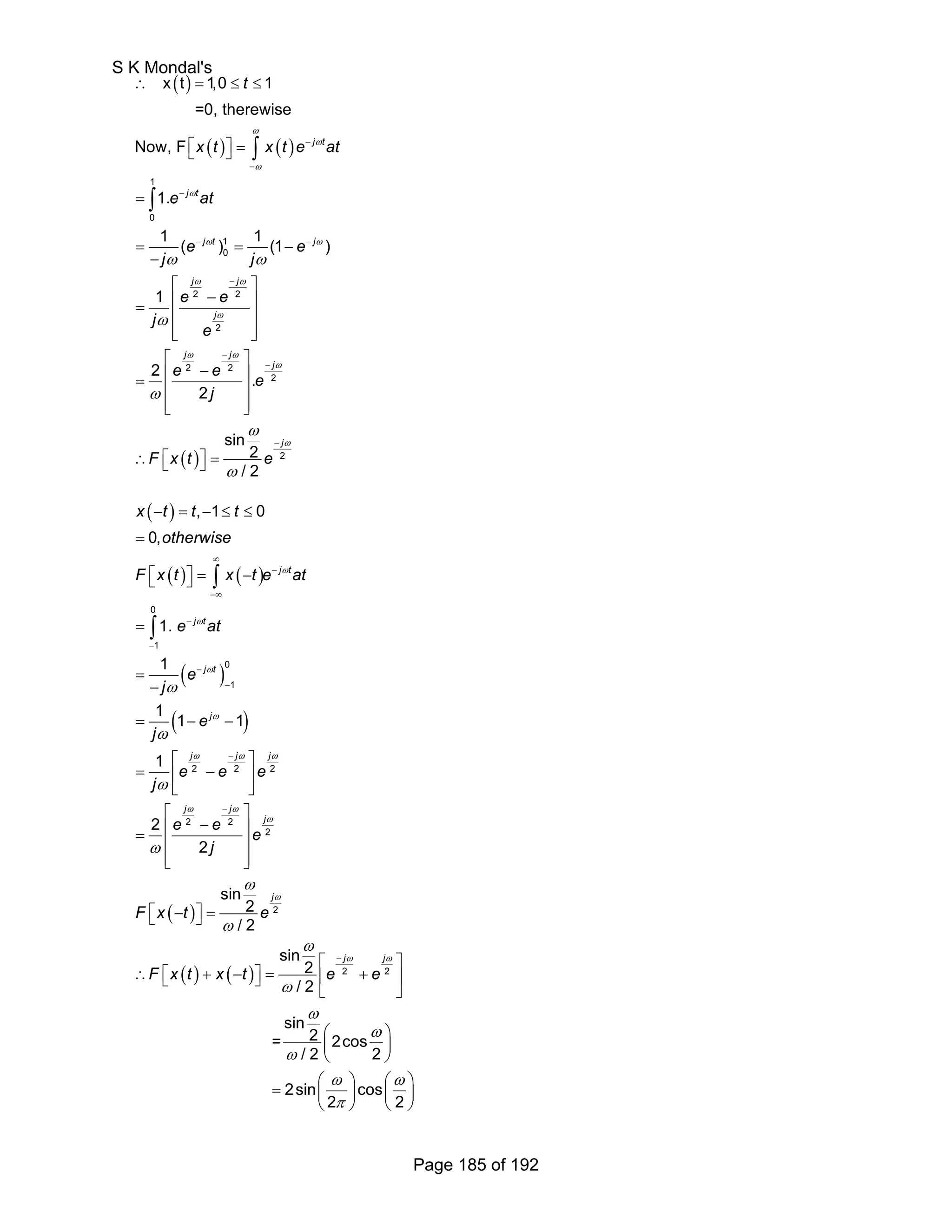
![23. Let s(t) be the step response of a linear system with zero initial conditions; then
the response of this system to an input u(t) is [EE: GATE-2002]
t
s t u d τ τ τ − ∫0
(a) ( ) ( )
⎡ ⎤
⎢ − ⎥
⎣ ⎦
d t s t u d
dt
(b) ( ) ( )
τ τ τ
∫0
⎡ ⎤
t t
s t τ u τ dτ dτ
(c) ( ) ( )
∫ ∫ 1 1
0 0
− ⎢ ⎥
⎣ ⎦
t
∫s t −τ 2u τ dτ
0
(d) ( ) ( )
23. Ans. (b)
24. Let Y(s) be the Laplace transformation of the function y (t), then final value of the function is
[EE: GATE-2002]
(a) ( )
LimY s
s
→0
(b) ( )
LimY s
→∞
s
(c) ( )
LimsY s
s
→0
(d) ( )
LimsY s
→∞
s
24. Ans. (c)
25. Consider the function, F(s) = 2
5
s(s + 3s + 2)
where F(s) is the Laplace transform of the
function f(t).The initial value of f(t) is equal to [EE: GATE-2004]
(a) 5 (b) 5
2
(c) 5
3
(d) 0
25. Ans. (d)
Initial value=
( ) = 5 =
0
LimF s Lim
→∞ →∞
2 + +
S S s 3 s
2
26. The Laplace transform of a function f(t) is F(s)=
2
2
+ +
+ +
5 23 6
( 2 2)
s s
s s s
. As t →∞, f(t) approaches
(a) 3 (b) 5 (c) 17
2
(d) ∞ [EE: GATE-2005]
26. Ans. (a) ( ) ( )
2
2
+ +
5 23 63 2 2 t t t
Lt f t Lt sF s Lt s s
→∞ →∞ →∞ s s
= = =
+ +
27. If u(t), r(t) denote the unit step an unit ramp functions respectively and u(t)* r(t) their
convolution, then the function u(t+1)* r(t-2) is given by [EE: GATE-2007]
(a) (1/2)(t-1) (t-2)
(b) (1/2)(t-1)(t-2)
(c) (1/2)(t-1)2u(t-1)
(d) None of these
27. Ans. (c)
⎡ ⎢⎣ ( + ) = ( )
⎤ ⎥⎦
⎡⎣ ( − )
⎤⎦ =
⎡ ∴ L ⎡ e e ⎤ = L e
⎤ ⎢ ⎥ ⎢ ⎥ ⎣ ⎦ ⎣ ⎦
( ) ( )
2
L u t e
L r t e
2
s
s
1 2 1
2 3
2
1 1
2 1
1 1
= 1 1 1
2
s
se
s
s s
s s s
t ut
−
−
− − −
− −
28. A function y(t) satisfies the following differential equation dy (t ) yt ( ) ( t
)
dt
+ =δ
S K Mondal's
Page 186 of 192](https://image.slidesharecdn.com/gatemathematicsquestionsallbranchbyskmondal-141123081724-conversion-gate01/75/Gate-mathematics-questions-all-branch-by-s-k-mondal-186-2048.jpg)
![Where δ (t ) is the delta function. Assuming zero initial condition, and denoting the unit
step function by u (t ),y (t ) can be of the form [EE: GATE-2008]
(a) et (b) e-t (c) etu(t) (d) e-tu(t)
28. Ans. (d)
( ) ( )
dy t
y t t
dt
Laplace transfrom of both sides, we have
sy(s) -y(o)+y(0)=1
( 1) 0 1
( )
( )
1
1
inverse Laplace transform, we get
Taking
s y s
y s
s
Taking
+ =δ
⇒ + − =
⇒ =
+
y(t)=e-tu (t )
29. The Laplace transform of g(t) is [EE: GATE-2010]
(a) 1 ( 3 s 5 s ) (b) 1 ( − 5 s −
3
s
)
e − e e −
e
s s
e 3
e e e
s s
(c) (1 2 ) (d) 1 ( 5 3
)
s
s s s
−
−
− −
29. Ans. (c)
Common Data for Questions 30 and 31:
Given f(t) and g(t) as shown below:
30. g (t) can be expressed as [EE: GATE-2010]
g t f t g t f t
= − = ⎛ − ⎞ ⎜ ⎟
(a) ( ) (2 3) (b) ( ) 3
2
⎝ ⎠
g t f t g t f t
(c) ( ) 2 3 (d) ( ) 3
= ⎛ − ⎞ = ⎛ − ⎞ ⎜ ⎟ ⎜ ⎟
2 22
⎝ ⎠ ⎝ ⎠
30. Ans. (d)
31. The Laplace transform of g(t) is [EE: GATE-2010]
(a) 1 ( 3 s 5 s ) (b) 1 ( − 5 s −
3
s
)
e − e e −
e
s s
e 3
e e e
s s
(c) (1 2 ) (d) 1 ( 5 3
)
s
s s s
−
−
− −
31. Ans. (c)
32. If u(t) is the unit step and δ (t) is the unit impulse function, the inverse z-transform of
F(z)= 1
z + 1
for k0 is [EE: GATE-2005]
S K Mondal's
Page 187 of 192](https://image.slidesharecdn.com/gatemathematicsquestionsallbranchbyskmondal-141123081724-conversion-gate01/75/Gate-mathematics-questions-all-branch-by-s-k-mondal-187-2048.jpg)
![k
(a) 1( − 1) k δ ( k ) (b) δ ( k ) − ( −
1)k (c) ( − 1) k u ( k ) (d) u ( k ) − ( −
) 32. Ans. (b)
F z z z
( )
( )
( ) ( ) ( )
∵
1
1
1 1
1 1
=1 - .
1
n
8 1
n
z z
z
z
z F z t
z z a
z a
−
−
+ −
= =
+ +
− −
∴ ⎡⎣ ⎤⎦ = − −
⎡ ⎛ ⎞ ⎤ ⎢ ⎜ ⎟ = ⎥ ⎣ ⎝ − ⎠ ⎦
12. The running integrator, given by [EE: GATE-2006]
( ) ( ') ' t y t x t dt −∞ ∫
(a) has no finite singularities in its double sided Laplace Transfrom Y(s)
(b) Produces a bounded output for every causal bounded input
(c) Produces a bounded output for every anticausal bounded input
(d) has no finite zeroes in its double sided Laplace Transfrom Y(s)
12. Ans. (b)
27. The state transition matrix for the system X
= AX with initial state X(0) is
[EE: GATE-2002]
(a) (sI-A)-1
(b) eA tX(0)
(c) Laplace inverse of [(s I-A)-1]
(d) Laplace inverse of [(sI-A)-1X (0)]
27. Ans. (c)
4. Consider the matrix P =
0 1 .
2 3
⎡ ⎤
⎢− − ⎥ ⎣ ⎦
The value of ep is [EC: GATE-2008]
(a)
2e 3e e e
2e 2e 5e e
2 1 1 2
2 1 2 1
⎡ − − − − − −
⎤
⎢ ⎣ − − − − − −
⎥ ⎦
(b)
e e 2e e
2e 4e 3e 2e
1 2 2 1
1 2 1 2
⎡ − + − − − −
⎤
⎢ ⎣ − − − − + −
⎥ ⎦
(c)
5e e 3e e
2e 6e 4e e
2 1 1 2
2 1 2 1
⎡ − + − − − −
⎤
⎢ ⎣ − − − − + −
⎥ ⎦
(d)
2e e e e
2e 2e e 2e
1 2 1 2
1 2 1 2
⎡ − + − − − −
⎤
⎥ ⎣ ⎢− − − − − − + −
⎦
4. Ans. (d) eP = L–1[(sI – P)–1]
and P = 0 1
⎡ ⎤
⎢− ⎣ 2 − 3
⎥ ⎦
where (sI – P)–1 =
s 1 1
2 s 3
− ⎡ ⎤
⎢ + ⎥ ⎣ ⎦
S K Mondal's
Page 188 of 192](https://image.slidesharecdn.com/gatemathematicsquestionsallbranchbyskmondal-141123081724-conversion-gate01/75/Gate-mathematics-questions-all-branch-by-s-k-mondal-188-2048.jpg)
![= 1 s 3 1
(s 1) (s 2) 2 s
⎡ + ⎤
+ + ⎢ − ⎥ ⎣ ⎦
=
s 3 1
⎡ + ⎤
⎢ ⎢ (s + 1) (s + 2) (s + 1) (s + 2)
⎥ ⎥
⎢ − 2 s
⎥
⎢ ⎣ (s + 1) (s + 2) (s + 1) (s + 2)
⎥ ⎦
∴ eP = 1
2 1 1 1
L s 1 s 2 s 1 s 2
2 2 2 1
s 1 s 2 s 2 s 1
−
⎧⎡ ⎤⎫ ⎪⎢ − − ⎥⎪ ⎪⎢ + + + + ⎥⎪ ⎨⎢ ⎥⎬ ⎪ − ⎪ ⎢ + − ⎥ ⎩⎪⎣ + + + + ⎦⎭⎪
=
2e e e e
2e 2e 2e e
1 2 1 2
1 2 2 1
⎡ − + − − − −
⎤
⎣ ⎢− − + − − − −
⎥ ⎦
Q40. Let the Laplace transform of a function f (t) which exists for t 0 be ( ) 1 F s and the
Laplace transform of its delayed version f (t - τ) be F ( s ) . Let F * ( s ) be the complex
2 1 ( ) ( )
conjugate F ( s ) with the Laplace variable set as s = σ + jω . If ( ) s s
2 2
1 ( )
2
1
G s
s
=
F .F*
F
,
then the inverse Laplace transform of G(s) is
(a) An ideal impulse δ (t) (b) an ideal delayed impulse δ (t - τ)
(c) An ideal step function u(t) (d) an ideal delayed step functionu(t - τ)
[EE-2011]
Ans. (b)
IE All GATE Questions
33. If the Fourier transform of x[n] is X(ejω), then the Fourier transform of (–1)n x[n] is
[IE: GATE-2004]
(a) (–j) ω X(ejω) (b) (–1) ω X(ejω)
(c) X(ej(ω – π)) (d) d (X(ej ))
d
ω
ω
33. Ans. (c)
34. If the waveform, shown in the following figure, corresponds to the second
derivative of a given function f (t), then the Fourier transform of f (t) is
(a) 1 + sin ω (b) 1 + cos ω
(c) 2(1 − cosω)
2
ω
2(1 + cosω)
(d) 2
ω
[IE: GATE-2006]
S K Mondal's
Page 189 of 192](https://image.slidesharecdn.com/gatemathematicsquestionsallbranchbyskmondal-141123081724-conversion-gate01/75/Gate-mathematics-questions-all-branch-by-s-k-mondal-189-2048.jpg)
![S K Mondal's
2
2
d f(t)
dt
1
– 1 + 1 t
– 2
34. Ans. (c)
d 2
f(t)
dt
2
= δ (t – 1) + δ (t + 1) – 2δ (t)
Taking Laplace transform of both sides, we get
s2 F(s) = e–s + es – 2
⇒ (jω) 2 F (jω) = e–jω + ejω – 2
⇒ F (jω) = 2(1 − cosω)
2
ω
35. The Fourier transform of a function g (t) is given as
G(ω) =
2
2
+ 21
+ 9
ω
ω
Then the function g (t) is given as [IE: GATE-2006]
(a) δ (t) + 2 exp (–3|t|) (b) cos 3ωt + 21 exp (–3t)
(c) sin 3ωt + 7 cos ωt (d) sin 3ωt + 21 exp (3t)
35. Ans. (a)
g(t) = (t) + 2 exp. (–3|t|)
Taking Laplace transform both sides,
G (ω) =
0
∞
1 2 exp (3t) exp ( j t) . dt 2 exp ( 3t) . exp ( j t) .dt
+ ∫ − ω + ∫ − − ω
0
−∞
=
0
∞
1 2 exp (3 j ) t . dt 2 exp ( 3 j ) t . dt
+ ∫ − ω + ∫ − − ω
0
−∞
= 1 2 2
3 j 3 j + +
− ω + ω
G (ω) =
2
2
21
9
ω +
ω +
36. The Fourier transform of x(t) = e–at u(–t), where u(t) is the unit step function,
[IE: GATE-2008]
(a) Exists for any real value of a
(b) Does not exist for any real value of a
(c) Exists if the real value of a is strictly negative
(d) Exists if the real value of a is strictly positive
36. Ans. (d)
Page 190 of 192](https://image.slidesharecdn.com/gatemathematicsquestionsallbranchbyskmondal-141123081724-conversion-gate01/75/Gate-mathematics-questions-all-branch-by-s-k-mondal-190-2048.jpg)
![37. The fundamental period of x(t) = 2 sin πt + 3 sin 3πt, with t expressed in seconds, is
[IE: GATE-2009]
(a) 1 s (b) 0.67 s
(c) 2 s (d) 3s
37. Ans. (d)
H.C.F. of 2π and 3π is 6π.
Then, fundamental frequency = 6π
∴ Period, T = 6
2
π
π
= 3 sec
38. u(t) represents the unit step function. The Laplace transform of u(t – τ) is
[IE: GATE-2010]
(a) 1
s τ
(b) 1
s – τ
(c)
e s
s
− τ
(d) e–s τ
38. Ans. (c)
f(t) = u(t – τ)
L{f(t)} = L{u(t – τ)}
F(s) =
e s
s
− τ
39. A measurement system with input x(t) and output y(t) is described by the different
equation 3 dy + 5y
dt
= 8x. The static sensitivity of the system is [IE: GATE-2010]
(a) 0.60 (b) 1.60 (c) 1.67 (d) 2.67
39. Ans. (d)
3dy 5y
dt + = 8x
Taking Laplace transform, we have
3sy(s) + 5y(s) = 8X(s)
y(s) [3s + 5] = 8X(s)
y(s)
x(s)
= 8
3s + 5
For static sensitivity, s → 0
∴ Y(s)
X(s)
= 8 1
3 0 5
3
×
+
= 85 = 1.6
40. The fundamental period of the discrete-time signal x[n] =
j ⎛ 5 π
⎞
e ⎜ ⎟
n
⎝ 6
⎠
is
[IE: GATE-2008]
(a) 6
5π
(b) 12
5
(c) 6 (d) 12
40. Ans. (b)
ω = 5
π
6
or 2
π = 5
T
π
6
or T = 12
5
S K Mondal's
Page 191 of 192](https://image.slidesharecdn.com/gatemathematicsquestionsallbranchbyskmondal-141123081724-conversion-gate01/75/Gate-mathematics-questions-all-branch-by-s-k-mondal-191-2048.jpg)
![41. A plant with a transfer function 2
s(s + 3)
is controlled by a PI controller with Kp = 1 and Ki
≥ 0 in a unity feedback configuration. The lowest value of Ki that ensures zero steady state
error for a step change in the reference input is
[IE: GATE-2009]
(a) 0 (b) 1
3
(c) 1
2
(d) 1
41. Ans. (b)
k k 2
⎡ + ⎤ ⎡ ⎤ ⎢⎣ ⎥⎦ ⎢ + ⎥ ⎣ ⎦
G’(s) = i
p
s s(s 3)
ss e =
lim sR(s)
s → 0
1 + G′(s)
R(s) 1
⎡ = ⎤ ⎢⎣ ⎥⎦
s
=
lim 1 1 k k 2
→ ⎡ ⎤ ⎡ ⎤ + ⎢ + ⎥ ⎢ ⎥ ⎣ ⎦ ⎣ + ⎦
s 0 i
p
s s(s 3)
lim s(s + 3)
→ s(s + 3) (k s + k )
= s 0 2
p i
Lowest value of ki = 1
3
for Gs to be zero.
S K Mondal's
Page 192 of 192](https://image.slidesharecdn.com/gatemathematicsquestionsallbranchbyskmondal-141123081724-conversion-gate01/75/Gate-mathematics-questions-all-branch-by-s-k-mondal-192-2048.jpg)


