How to Develop an Effective
      Business Plan
Why a Business Plan?

      The preparation of a business plan is a
      systematic approach to timely identify
      strengths and weaknesses of a business
      opportunity and to pinpoint (further)
      opportunities and risks to allow for
      maximum identification of risk mitigation


Often emphasized reasons of entrepreneurs to write a business plan:
• Clarifying the direction of the company both internally as well as externally
• Put the company “down to paper”
• Requirement to acquire capital, bank-financing
• Identifying what the company can and wants to achieve with the specific business
  opportunity
Goals to make a business plan can be internal
as well as external


                 INTERNAL                      EXTERNAL
                 - To provide clarity on the   - Potential investors
                 goals and prioritization of   - Bank-financing – credit team
                 a business opportunity to     - Suppliers
PLAN             all personnel involved        - Customers
                                               - Steakholders
                                               - Subsidy providers
                 - To change attitudes of      - PR (Public Relations)
                 certain key figures within    - Effective way to introduce the business
                 the company                   opportunity to potential partners and
PROCESS                                        candidates for key roles/jobs

   This presentation will mainly take the internal, planning perspective
Business Plan – 10 Key Components

 1.  Executive Summary
 2.  General Company Description
 3.  Products and Services
 4.  Marketing Plan
 5.  Operational Plan
 6.  Management and Organization
 7.  Financial Plan
 8.  Capitalization
 9.  Further opportunities, threats and the
     mitigation of risks
 10. Appendices
1. Executive Summary: Pointers
The Executive Summary aims to explain the fundamentals of the
proposed business
 • Write this section last
 • Make it two pages or fewer. Include everything that you would cover in
   a five-minute interview
 • Make it enthusiastic, professional, complete, and concise
 • If applying for a loan, state clearly how much you want, precisely how
   you are going to use it, and how the money will make your business
   more profitable, thereby ensuring repayment.

           Include key numbers in the executive summary to
           summarize the opportunity as tangible as possible
2. Company and Industry Description
1. What business will you enter / expand?
2. Where do you plan to make money? What will you do?
3. How can profits be raised quickly?
4. How to build long term value?
5. Is it a good industry to be in?
6. What do / would customers think?
7. How strong are your competitive positions?
8. What about the competitors?


Describe your company’s core strengths and competencies,
    key success factors. Quantify objectives and goals
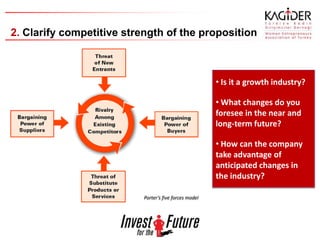
2. Clarify competitive strength of the proposition


                                                        • Is it a growth industry?

                                                        • What changes do you
                                                        foresee in the near and
                                                        long-term future?

                                                        • How can the company
                                                        take advantage of
                                                        anticipated changes in
                                                        the industry?

                           Porter’s five forces model
3. Products and Services
Describe in depth your products or services in terms of what it is that you will offer to
(each) of the (different) target customer(s).

•    Explain what needs of the target customer are
     fullfilled by the product / services.
•    Describe the benefits of the product / services.
     What is special about it?
•    What factors will give you competitive advantages
     or disadvantages?
•    Include level of quality, unique or proprietary features.
•    Explain (potential) substitutes of the products and services.
•    Technical specifications, drawings, photos, sales brochures, and other bulky
     items belong in Appendices
4. Marketing Plan
Describe the market that you will act in.
    After you have described your targeted product / market combinations, it’s important to
    put the marketing plan into its perspective:
    •   What is the total size of your market?
    •   What percent share of the market do you target?
    •   Detail the current demand in the target market.
    •   Trends in target market—growth trends, trends in consumer preferences, and trends
        in product development.
    •   Growth potential and opportunity for a business of your size.
    •   What barriers to entry do you face in entering this market with your new company?
    •   And of course, how will you overcome the barriers?

    Also detail the target customers here in terms of their characteristics,
            geographic locations, other demographic factors etc.
4. Marketing Plan: 5 P’s
In light of your niche, the unique corner of the market that you intend to occupy; define the different
components of your marketing strategy in addition to the product / services you plan to offer:

•   Pricing Strategy
      -   What prices do you plan to set?
      -   How does it compare in the market?
      -   Differentiation of pricing for different customers
      -   Fee structure, commissions, e.g. leasing structure of your products and services.

•   Proposed Location and Distribution Channel Strategy
      -   If your locations are a key component of your market strategy, explain/define the profile of the
          (sought) locations.
      -   Direct / indirect sales (internet, agents, own stores, other stores)
      -   How to approach the customer

•   Promotion Strategy
      -   Explain how you plan to launch and further support the product / services into the market.
      -   Promotional budget

•   Packaging and quality control
4. Marketing Plan: Research to support your
     marketing strategy

    • Market research – Why?
    You need to do market research to make sure you’re on track. Use the business planning
    process as your opportunity to uncover data and to question your marketing efforts.


    • Market research – How?
    There are two kinds of market research: primary and secondary.

         Secondary research means using published information such as industry profiles,
         trade journals, newspapers, magazines, census data, and demographic profiles.

         Primary research means gathering your own data.

   In most of the markets represented relatively little quantitative research is being
conducted to support business. Governments and banks are usually the most complete.
4. Marketing Plan: Sales forecast

 The forecast should be based on your historical sales, the marketing strategies
 that you have just described, your market research, and industry data, where
 available.

 You will want to prepare at least two forecasts:

          1) a "best guess", which is what you
          really expect,
          2) a "worst case" low estimate that you
          are confident you can reach no matter what happens.


       The sales forecast encompasses a period of at least three years
        with a high degree of detail for the first year, while addressing
            the different targeted product / market combinations.
4. Marketing Plan: Analyse your competition

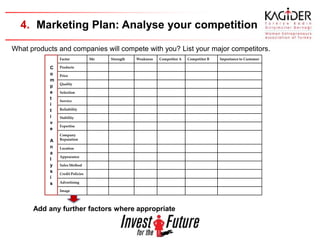
What products and companies will compete with you? List your major competitors.
               Factor            Me   Strength   Weakness   Competitor A   Competitor B   Importance to Customer

           C   Products
           o   Price
           m
               Quality
           p
           e   Selection
           t   Service
           i
           t   Reliability

           i   Stability
           v
               Expertise
           e
               Company
           A   Reputation

           n   Location
           a
               Appearance
           l
           y   Sales Method
           s   Credit Policies
           i
           s   Advertising

               Image


      Add any further factors where appropriate
5. Operational Plan

Explain the daily operation of the business, its location, equipment, people,
processes, and surrounding environment.
• Production: How and where are your products or services produced?
• Suppliers
• Sales or Distribution / Location: What qualities do you need in a location?
 Describe the type of location(s) you’ll have.
• Inventory
• Legal Requirements
    - Licenses permits
    - Trademarks
• Number of employees as Full Time Equivalent
• Credit Policies
    - Managing Your Accounts Receivable
    - Managing Your Accounts Payable
• What is your foreign currency exposure?
5. Operational / Delivery Principles
Delivery principles define where you will put emphasis and focus for each of the key
processes in your company. They tie into your overall and into you marketing
strategy; for example:

• Product Delivery; Supply Chain
     • this maybe only ‘make’, only ‘buy’ or both, describe conditions for potential
       change over time
     • e.g. Leveraging your other business(es)

• Sales and distribution process
     • through wholesalers, partners, agents, stores, internet. Explain why and how
     and the conditions how to divide up the business
     • Discount policy, which discounts in which situations
     • the use of internet, social media

       In delivery principles the entrepreneur (s) can demonstrate their well-
          understanding of the market, the business they want to enter in
Proposed Organization of the Business
Opportunity
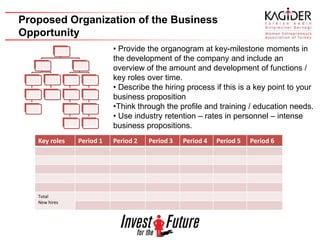
                          • Provide the organogram at key-milestone moments in
                          the development of the company and include an
                          overview of the amount and development of functions /
                          key roles over time.
                          • Describe the hiring process if this is a key point to your
                          business proposition
                          •Think through the profile and training / education needs.
                          • Use industry retention – rates in personnel – intense
                          business propositions.
   Key roles   Period 1   Period 2   Period 3   Period 4   Period 5   Period 6


   Total
   New hires
6. Management and Organization: The
   Entrepreneur(s)

Who will manage the business on a day-to-day basis? What experience do that
key-person(s) bring to the business? What special or distinctive competencies? Is
there a plan for continuation of the business if this person is lost or incapacitated?

                                 List the following professional and advisory support:
                            •             * Board of directors
                            •             * Management advisory board
                            •             * Attorney
                            •             * Accountant
                            •             * Insurance agent
                            •             * Banker
                            •             * Consultant or consultants
                            •             * Mentors and key advisors
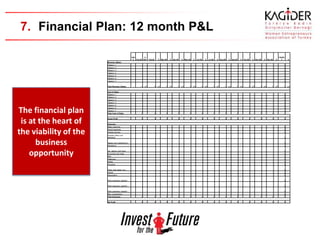
7. Financial Plan: 12 month P&L

                                                   IND.       %                                                                                                                                                                 YEARL
                                                    % Oca.08 B/A       Feb-08       % Mar-08   %       Apr-08   % May-08   % Jun-08   %       Jul-08       % Aug-08   % Sep-08   %       Oct-08   % Nov-08   % Dec-08   %         Y     %
                       Revenue (Sales)
                       Category 1                                  -                  -            -              -          -            -                  -          -            -              -          -            -       0       -
                       Category 2                                  -                  -            -              -          -            -                  -          -            -              -          -            -       0       -
                       Category 3                                  -                  -            -              -          -            -                  -          -            -              -          -            -       0       -
                       Category 4                                  -                  -            -              -          -            -                  -          -            -              -          -            -       0       -
                       Category 5                                  -                  -            -              -          -            -                  -          -            -              -          -            -       0       -
                       Category 6                                  -                  -            -              -          -            -                  -          -            -              -          -            -       0       -
                       Category 7                                  -                  -            -              -          -            -                  -          -            -              -          -            -       0       -


                       Total Revenue (Sales)               0   0,0              0   0,0    0   0,0          0   0,0    0   0,0    0   0,0              0   0,0    0   0,0    0   0,0          0   0,0    0   0,0    0   0,0         0   0,0


                       Cost of Sales
                       Category 1                                  -                  -            -              -          -            -                  -          -            -              -          -            -       0       -
                       Category 2                                  -                  -            -              -          -            -                  -          -            -              -          -            -       0       -
                       Category 3                                  -                  -            -              -          -            -                  -          -            -              -          -            -       0       -
                       Category 4                                  -                  -            -              -          -            -                  -          -            -              -          -            -       0       -


The financial plan
                       Category 5                                  -                  -            -              -          -            -                  -          -            -              -          -            -       0       -
                       Category 6                                  -                  -            -              -          -            -                  -          -            -              -          -            -       0       -
                       Category 7                                  -                  -            -              -          -            -                  -          -            -              -          -            -       0       -
                       Total Cost of Sales                 0       -            0     -    0       -        0     -    0     -    0       -            0     -    0     -    0       -        0     -    0     -    0       -       0       -


 is at the heart of    Gross Profit


                       Expenses
                                                           0       -            0     -    0       -        0     -    0     -    0       -            0     -    0     -    0       -        0     -    0     -    0       -       0       -


the viability of the
                       Salary expenses                             -                  -            -              -          -            -                  -          -            -              -          -            -       0       -
                       Payroll expenses                            -                  -            -              -          -            -                  -          -            -              -          -            -       0       -
                       Outside services                            -                  -            -              -          -            -                  -          -            -              -          -            -       0       -
                       Supplies (office and


      business
                       operating)                                  -                  -            -              -          -            -                  -          -            -              -          -            -       0       -


                       Repairs and maintenance                     -                  -            -              -          -            -                  -          -            -              -          -            -       0       -
                       Advertising                                 -                  -            -              -          -            -                  -          -            -              -          -            -       0       -


    opportunity        Car, delivery and travel
                       Accounting and legal
                       Rent
                       Telephone
                                                                   -
                                                                   -
                                                                   -
                                                                   -
                                                                                      -
                                                                                      -
                                                                                      -
                                                                                      -
                                                                                                   -
                                                                                                   -
                                                                                                   -
                                                                                                   -
                                                                                                                  -
                                                                                                                  -
                                                                                                                  -
                                                                                                                  -
                                                                                                                             -
                                                                                                                             -
                                                                                                                             -
                                                                                                                             -
                                                                                                                                          -
                                                                                                                                          -
                                                                                                                                          -
                                                                                                                                          -
                                                                                                                                                             -
                                                                                                                                                             -
                                                                                                                                                             -
                                                                                                                                                             -
                                                                                                                                                                        -
                                                                                                                                                                        -
                                                                                                                                                                        -
                                                                                                                                                                        -
                                                                                                                                                                                     -
                                                                                                                                                                                     -
                                                                                                                                                                                     -
                                                                                                                                                                                     -
                                                                                                                                                                                                    -
                                                                                                                                                                                                    -
                                                                                                                                                                                                    -
                                                                                                                                                                                                    -
                                                                                                                                                                                                               -
                                                                                                                                                                                                               -
                                                                                                                                                                                                               -
                                                                                                                                                                                                               -
                                                                                                                                                                                                                            -
                                                                                                                                                                                                                            -
                                                                                                                                                                                                                            -
                                                                                                                                                                                                                            -
                                                                                                                                                                                                                                    0
                                                                                                                                                                                                                                    0
                                                                                                                                                                                                                                    0
                                                                                                                                                                                                                                    0
                                                                                                                                                                                                                                            -
                                                                                                                                                                                                                                            -
                                                                                                                                                                                                                                            -
                                                                                                                                                                                                                                            -
                       Utilities                                   -                  -            -              -          -            -                  -          -            -              -          -            -       0       -
                       Insurance                                   -                  -            -              -          -            -                  -          -            -              -          -            -       0       -


                       Taxes (real estate, etc.)                   -                  -            -              -          -            -                  -          -            -              -          -            -       0       -
                       Interest                                    -                  -            -              -          -            -                  -          -            -              -          -            -       0       -
                       Depreciation                                -                  -            -              -          -            -                  -          -            -              -          -            -       0       -


                       Other expenses (specify)                    -                  -            -              -          -            -                  -          -            -              -          -            -       0       -


                       Other expenses (specify)                    -                  -            -              -          -            -                  -          -            -              -          -            -       0       -


                       Other expenses (specify)                    -                  -            -              -          -            -                  -          -            -              -          -            -       0       -
                       Misc. (unspecified)                                            -            -              -          -            -                  -          -            -              -          -            -       0       -
                       Total Expenses                      0       -            0     -    0       -        0     -    0     -    0       -            0     -    0     -    0       -        0     -    0     -    0       -       0       -


                       Net Profit                          0       -            0     -    0       -        0     -    0     -    0       -            0     -    0     -    0       -        0     -    0     -    0       -       0       -
7. P & L, Cash Flow, Balance Sheet!

•   Three-Year Profit Projection
    The 12-month projection is the heart of your financial plan. External investors demand a
    longer time horizon and it provides for good business and planning practise to project at the
    least 3 years.

•   Projected Cash Flow
    If the profit projection is the heart of your business plan, cash flow is the blood. Businesses
    fail because they cannot pay their bills. Suppliers may demand extra guarantees that lock
    up capital, customers may demand certain privileges at startup and the like.

•   Opening Day Balance Sheet and Following Annual Balance Sheets
    A balance sheet shows what items of value are held by the company (assets), and what its
    debts are (liabilities). The balance sheet development process forces to check the internal
    consistency and integrity of the projections and by ways of ratio comparison identifies
    potential opportunities and threats.
7. Financial Plan: Break Even Analysis for
   Start up Business

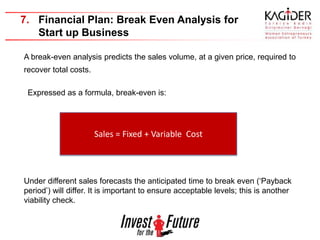
A break-even analysis predicts the sales volume, at a given price, required to
recover total costs.

 Expressed as a formula, break-even is:


                       Sales = Fixed + Variable Cost


Under different sales forecasts the anticipated time to break even (‘Payback
period’) will differ. It is important to ensure acceptable levels; this is another
viability check.
8. Capitalization of your business proposition

 In case of a startup business, you will have many expenses before you even
 begin operating your business. It’s important to estimate these expenses
 accurately and then to plan where you will get sufficient capital. This is a
 research project, and the more thorough your research efforts, the less chance
 that you will leave out important expenses or underestimate them.


 Explain your research and how you arrived at your forecasts of expenses. Give
 sources, amounts, and terms of proposed loans. Also explain in detail how much
 will be contributed by each investor and what percent ownership each will have.


       Provide a start up cash-injection overview, over time and run
     scenario’s if sufficient capital is key to the start up of the business.
8. Capitalization: Personal Financial
   Statement

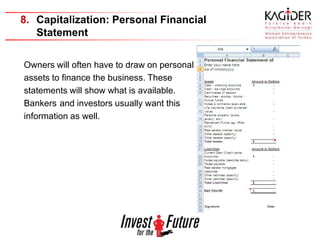
Owners will often have to draw on personal
assets to finance the business. These
statements will show what is available.
Bankers and investors usually want this
information as well.
9. Sensitivity Analysis

    Play around with your financial excels to understand which differences have the
    largest impact. Then go back to the earlier chapters in your plan to address these
    potential opportunities and threats.

-   Check on different sales outcomes (lower realized price, less customers, smaller
    basketsize per customer).
-   Possible actions of other players
-   Changes in enviroment (legal, technology, ..)

    Create a negative scenario set of financials and check capitalization and return
    on capital versus your opportunity cost.


          Put your money in the bank or in this business opportunity?
10. Appendices

Include details and studies used in your business plan; for example:
   Brochures and advertising materials
   Industry studies
   Blueprints and plans
   Maps and photos of location
   Magazine or other articles
   Detailed lists of equipment owned or to be purchased
   Copies of leases and contracts
   Letters of support from future customers
   Any other materials needed to support the assumptions in this plan
   Market research studies
   List of assets available as collateral for a loan
11. Refining The Plan: Manufacturing
     business

• Planned production levels
• Anticipated levels of direct production costs and indirect (overhead) costs-how do
  these compare to industry averages (if available)?
• Prices per product line
• Gross profit margin, overall and for each product line
• Production/capacity limits of planned physical plant
• Production/capacity limits of equipment
• Purchasing and inventory management procedures
• New products under development or anticipated to come online after startup
11. Refining The Plan: Service business


• Service businesses sell intangible products. They are usually more flexible than
  other types of businesses, but they also have higher labor costs and generally very
  little in fixed assets.
• What are the key competitive factors in this industry?
• Your prices
• Methods used to set prices
• System of production management
• Quality control procedures. Standard or accepted industry quality standards.
• How will you measure labor productivity?
• Percent of work subcontracted to other firms. Will you make a profit on
  subcontracting?
• Credit, payment, and collections policies and procedures
• Strategy for keeping client base
11. Refining The Plan (Continued)

 • High Technology Companies
 High-tech companies sometimes have to operate for a long time without profits and
 sometimes even without sales. If this fits your situation, a banker probably will not want to
 lend to you. Venture capitalists may invest, but your story must be very good. You must do
 longer-term financial forecasts to show when profit take-off is expected to occur. And your
 assumptions must be well documented and well argued.

 • Retail Business (Retail = Detail)

      oLocation
      oCompany image
      oPricing
      oInventory
      oCustomer service policies
      oPromotion
      oCredit
Next Steps: Seek Mentoring


    Please send in your business plan
      per latest 20 February 2011 to
  receive mentoring and guidance from
     your Invest for the Future team
THANK YOU
Suggested Reference Material
Adams. Rhonda, Successful Business Plan:Secrets and Strategies, Running Media, 2010.

Adams. Rhonda, Successful Business Research:Straight to the Numbers you need Fast, Planning Shop,
2006.

David H. Bangs, Jr, The Business planning guide : creating a plan for success in your own business /. -- 8th
ed. ---- Chicago, Ill. : Upstart Pub. Co. ; distributed by Dearborn Trade, 1998/

Barringer, Bruce R, Preparing Effective Business Plans: An Entrepreneurial Approach Ireland: Entrepreneurs
association, 2008.

 Bunderson, Gaye. "Have Your Business Plan in Hand Before Seeking $$$." Idaho Business Review, 31
January 2005.

Business Plans Handbook. Farmington Hills, MI: Gale Group, Inc., 2004.

Costin, Harry. Readings in Strategy and Strategic Planning. Fort Worth, TX: The Dryden Press, 1998.

David, R. Fred. Strategic Management: Concepts and Cases. Upper Saddle River, NJ: Prentice Hall, 2003.

DeThomas Arthur and Stephanie Derammelaere, Writing a Convincing Business Plan (Barron's Business
Library, New York: Barron Educational series, 2008.
Suggested Reference Material
Delmar, F. and Shane, S. "Does Business Planning Facilitate the Development of New Ventures?" Strategic
Management Journal 24 (December 2004): 1165–1185.

Florini, A. "Business and Global Governance." Brookings Review, Spring 2003, 5–8.

Gome, A. "Plan Not to Plan." BRW 27 (February 2005): 72–73.

Gupta, A.K., and V. Gorindarajan. Global Strategy and the Organization. John Wiley & Sons Publishers,
2003.

Houlden, Brian. Understanding Company Strategy: An Introduction to Analysis and Implementation.
Cambridge, MA: Blackwell Publishers, Inc., 1996.

Hunger, J. David, and Thomas L. Wheelen. Essentials of Strategic Management. Reading, MA: Addison
Wesley, 1997.

Lasher, William. The Perfect Business Plan Made Simple. New York, NY: Broadway Books, 2005.

Mason, Colin and Matthew Stark. "What Do Investors Look for in a Business Plan?" International Small
Business Journal 22 (June 2005): 227–248.

McKeever, Mike P. How to Write a Business Plan. Berkeley, CA: Nolo, 2005.
Suggested Reference Material
Office of Small Business Development Centers. U.S. Small Business Administration. Available from
http://www.sba.gov/sbdc/aboutus.html.

Peterson, Steven et al, Business Plans Kit for Dummies, Noboken: Wiley Press, 2010.

Pinson, Linda. Anatomy of a Business Plan: A Step-By-Step Guide to Building a Business and Securing Your
Company's Future. Chicago, IL: Dearborn Trade Publishing, 2008.

Porter, Michael E. Competitive Strategy. New York, NY: The Free Press, 1980.

——. Competitive Strategy of Nations. New York, NY: The Free Press, 1990.

Punnett, B.J. International Perspectives on Organizational Behavior and Human Resource Management.
Armonk, N.Y.: MESharpe Inc., 2004.

Stahl, J. Michael, and David W. Grigsby. Strategic Management for Decision Making. Massachusetts: PWS-
KENT Publishing, 1992.

Timmons, Jeffrey et al, Business Plans that work: A Guide to Small Business, New York: McGraw Hill, 2004.
Suggested Reference Material

U.S. Small Business Administration. "Elements of a Business Plan." Available from
http://www.sba.gov/starting_business/planning/writingplan.h...

"Global Entrepreneurship Monitor." Available from http://www.gemconsortium.org.

Zimmerer, T.W., and N.M. Scarborough. Essentials of Entrepreneurship ond Small Business Management.
Upper Saddle River, NJ: Prentice-Hall, 2002.

Wheelen, L. Thomas, and David J. Hunger. Strategic Management and Business Policy: Entering 21st
Century Global Society. Reading, MA: Addison Wesley, 1998.

IFTF Conference - How to Develop an Effective Business Plan

  • 1.
    How to Developan Effective Business Plan
  • 2.
    Why a BusinessPlan? The preparation of a business plan is a systematic approach to timely identify strengths and weaknesses of a business opportunity and to pinpoint (further) opportunities and risks to allow for maximum identification of risk mitigation Often emphasized reasons of entrepreneurs to write a business plan: • Clarifying the direction of the company both internally as well as externally • Put the company “down to paper” • Requirement to acquire capital, bank-financing • Identifying what the company can and wants to achieve with the specific business opportunity
  • 3.
    Goals to makea business plan can be internal as well as external INTERNAL EXTERNAL - To provide clarity on the - Potential investors goals and prioritization of - Bank-financing – credit team a business opportunity to - Suppliers PLAN all personnel involved - Customers - Steakholders - Subsidy providers - To change attitudes of - PR (Public Relations) certain key figures within - Effective way to introduce the business the company opportunity to potential partners and PROCESS candidates for key roles/jobs This presentation will mainly take the internal, planning perspective
  • 4.
    Business Plan –10 Key Components 1. Executive Summary 2. General Company Description 3. Products and Services 4. Marketing Plan 5. Operational Plan 6. Management and Organization 7. Financial Plan 8. Capitalization 9. Further opportunities, threats and the mitigation of risks 10. Appendices
  • 5.
    1. Executive Summary:Pointers The Executive Summary aims to explain the fundamentals of the proposed business • Write this section last • Make it two pages or fewer. Include everything that you would cover in a five-minute interview • Make it enthusiastic, professional, complete, and concise • If applying for a loan, state clearly how much you want, precisely how you are going to use it, and how the money will make your business more profitable, thereby ensuring repayment. Include key numbers in the executive summary to summarize the opportunity as tangible as possible
  • 6.
    2. Company andIndustry Description 1. What business will you enter / expand? 2. Where do you plan to make money? What will you do? 3. How can profits be raised quickly? 4. How to build long term value? 5. Is it a good industry to be in? 6. What do / would customers think? 7. How strong are your competitive positions? 8. What about the competitors? Describe your company’s core strengths and competencies, key success factors. Quantify objectives and goals
  • 7.
    2. Clarify competitivestrength of the proposition • Is it a growth industry? • What changes do you foresee in the near and long-term future? • How can the company take advantage of anticipated changes in the industry? Porter’s five forces model
  • 8.
    3. Products andServices Describe in depth your products or services in terms of what it is that you will offer to (each) of the (different) target customer(s). • Explain what needs of the target customer are fullfilled by the product / services. • Describe the benefits of the product / services. What is special about it? • What factors will give you competitive advantages or disadvantages? • Include level of quality, unique or proprietary features. • Explain (potential) substitutes of the products and services. • Technical specifications, drawings, photos, sales brochures, and other bulky items belong in Appendices
  • 9.
    4. Marketing Plan Describethe market that you will act in. After you have described your targeted product / market combinations, it’s important to put the marketing plan into its perspective: • What is the total size of your market? • What percent share of the market do you target? • Detail the current demand in the target market. • Trends in target market—growth trends, trends in consumer preferences, and trends in product development. • Growth potential and opportunity for a business of your size. • What barriers to entry do you face in entering this market with your new company? • And of course, how will you overcome the barriers? Also detail the target customers here in terms of their characteristics, geographic locations, other demographic factors etc.
  • 10.
    4. Marketing Plan:5 P’s In light of your niche, the unique corner of the market that you intend to occupy; define the different components of your marketing strategy in addition to the product / services you plan to offer: • Pricing Strategy - What prices do you plan to set? - How does it compare in the market? - Differentiation of pricing for different customers - Fee structure, commissions, e.g. leasing structure of your products and services. • Proposed Location and Distribution Channel Strategy - If your locations are a key component of your market strategy, explain/define the profile of the (sought) locations. - Direct / indirect sales (internet, agents, own stores, other stores) - How to approach the customer • Promotion Strategy - Explain how you plan to launch and further support the product / services into the market. - Promotional budget • Packaging and quality control
  • 11.
    4. Marketing Plan:Research to support your marketing strategy • Market research – Why? You need to do market research to make sure you’re on track. Use the business planning process as your opportunity to uncover data and to question your marketing efforts. • Market research – How? There are two kinds of market research: primary and secondary. Secondary research means using published information such as industry profiles, trade journals, newspapers, magazines, census data, and demographic profiles. Primary research means gathering your own data. In most of the markets represented relatively little quantitative research is being conducted to support business. Governments and banks are usually the most complete.
  • 12.
    4. Marketing Plan:Sales forecast The forecast should be based on your historical sales, the marketing strategies that you have just described, your market research, and industry data, where available. You will want to prepare at least two forecasts: 1) a "best guess", which is what you really expect, 2) a "worst case" low estimate that you are confident you can reach no matter what happens. The sales forecast encompasses a period of at least three years with a high degree of detail for the first year, while addressing the different targeted product / market combinations.
  • 13.
    4. Marketing Plan:Analyse your competition What products and companies will compete with you? List your major competitors. Factor Me Strength Weakness Competitor A Competitor B Importance to Customer C Products o Price m Quality p e Selection t Service i t Reliability i Stability v Expertise e Company A Reputation n Location a Appearance l y Sales Method s Credit Policies i s Advertising Image Add any further factors where appropriate
  • 14.
    5. Operational Plan Explainthe daily operation of the business, its location, equipment, people, processes, and surrounding environment. • Production: How and where are your products or services produced? • Suppliers • Sales or Distribution / Location: What qualities do you need in a location? Describe the type of location(s) you’ll have. • Inventory • Legal Requirements - Licenses permits - Trademarks • Number of employees as Full Time Equivalent • Credit Policies - Managing Your Accounts Receivable - Managing Your Accounts Payable • What is your foreign currency exposure?
  • 15.
    5. Operational /Delivery Principles Delivery principles define where you will put emphasis and focus for each of the key processes in your company. They tie into your overall and into you marketing strategy; for example: • Product Delivery; Supply Chain • this maybe only ‘make’, only ‘buy’ or both, describe conditions for potential change over time • e.g. Leveraging your other business(es) • Sales and distribution process • through wholesalers, partners, agents, stores, internet. Explain why and how and the conditions how to divide up the business • Discount policy, which discounts in which situations • the use of internet, social media In delivery principles the entrepreneur (s) can demonstrate their well- understanding of the market, the business they want to enter in
  • 16.
    Proposed Organization ofthe Business Opportunity • Provide the organogram at key-milestone moments in the development of the company and include an overview of the amount and development of functions / key roles over time. • Describe the hiring process if this is a key point to your business proposition •Think through the profile and training / education needs. • Use industry retention – rates in personnel – intense business propositions. Key roles Period 1 Period 2 Period 3 Period 4 Period 5 Period 6 Total New hires
  • 17.
    6. Management andOrganization: The Entrepreneur(s) Who will manage the business on a day-to-day basis? What experience do that key-person(s) bring to the business? What special or distinctive competencies? Is there a plan for continuation of the business if this person is lost or incapacitated? List the following professional and advisory support: • * Board of directors • * Management advisory board • * Attorney • * Accountant • * Insurance agent • * Banker • * Consultant or consultants • * Mentors and key advisors
  • 18.
    7. Financial Plan:12 month P&L IND. % YEARL % Oca.08 B/A Feb-08 % Mar-08 % Apr-08 % May-08 % Jun-08 % Jul-08 % Aug-08 % Sep-08 % Oct-08 % Nov-08 % Dec-08 % Y % Revenue (Sales) Category 1 - - - - - - - - - - - - 0 - Category 2 - - - - - - - - - - - - 0 - Category 3 - - - - - - - - - - - - 0 - Category 4 - - - - - - - - - - - - 0 - Category 5 - - - - - - - - - - - - 0 - Category 6 - - - - - - - - - - - - 0 - Category 7 - - - - - - - - - - - - 0 - Total Revenue (Sales) 0 0,0 0 0,0 0 0,0 0 0,0 0 0,0 0 0,0 0 0,0 0 0,0 0 0,0 0 0,0 0 0,0 0 0,0 0 0,0 Cost of Sales Category 1 - - - - - - - - - - - - 0 - Category 2 - - - - - - - - - - - - 0 - Category 3 - - - - - - - - - - - - 0 - Category 4 - - - - - - - - - - - - 0 - The financial plan Category 5 - - - - - - - - - - - - 0 - Category 6 - - - - - - - - - - - - 0 - Category 7 - - - - - - - - - - - - 0 - Total Cost of Sales 0 - 0 - 0 - 0 - 0 - 0 - 0 - 0 - 0 - 0 - 0 - 0 - 0 - is at the heart of Gross Profit Expenses 0 - 0 - 0 - 0 - 0 - 0 - 0 - 0 - 0 - 0 - 0 - 0 - 0 - the viability of the Salary expenses - - - - - - - - - - - - 0 - Payroll expenses - - - - - - - - - - - - 0 - Outside services - - - - - - - - - - - - 0 - Supplies (office and business operating) - - - - - - - - - - - - 0 - Repairs and maintenance - - - - - - - - - - - - 0 - Advertising - - - - - - - - - - - - 0 - opportunity Car, delivery and travel Accounting and legal Rent Telephone - - - - - - - - - - - - - - - - - - - - - - - - - - - - - - - - - - - - - - - - - - - - - - - - 0 0 0 0 - - - - Utilities - - - - - - - - - - - - 0 - Insurance - - - - - - - - - - - - 0 - Taxes (real estate, etc.) - - - - - - - - - - - - 0 - Interest - - - - - - - - - - - - 0 - Depreciation - - - - - - - - - - - - 0 - Other expenses (specify) - - - - - - - - - - - - 0 - Other expenses (specify) - - - - - - - - - - - - 0 - Other expenses (specify) - - - - - - - - - - - - 0 - Misc. (unspecified) - - - - - - - - - - - 0 - Total Expenses 0 - 0 - 0 - 0 - 0 - 0 - 0 - 0 - 0 - 0 - 0 - 0 - 0 - Net Profit 0 - 0 - 0 - 0 - 0 - 0 - 0 - 0 - 0 - 0 - 0 - 0 - 0 -
  • 19.
    7. P &L, Cash Flow, Balance Sheet! • Three-Year Profit Projection The 12-month projection is the heart of your financial plan. External investors demand a longer time horizon and it provides for good business and planning practise to project at the least 3 years. • Projected Cash Flow If the profit projection is the heart of your business plan, cash flow is the blood. Businesses fail because they cannot pay their bills. Suppliers may demand extra guarantees that lock up capital, customers may demand certain privileges at startup and the like. • Opening Day Balance Sheet and Following Annual Balance Sheets A balance sheet shows what items of value are held by the company (assets), and what its debts are (liabilities). The balance sheet development process forces to check the internal consistency and integrity of the projections and by ways of ratio comparison identifies potential opportunities and threats.
  • 20.
    7. Financial Plan:Break Even Analysis for Start up Business A break-even analysis predicts the sales volume, at a given price, required to recover total costs. Expressed as a formula, break-even is: Sales = Fixed + Variable Cost Under different sales forecasts the anticipated time to break even (‘Payback period’) will differ. It is important to ensure acceptable levels; this is another viability check.
  • 21.
    8. Capitalization ofyour business proposition In case of a startup business, you will have many expenses before you even begin operating your business. It’s important to estimate these expenses accurately and then to plan where you will get sufficient capital. This is a research project, and the more thorough your research efforts, the less chance that you will leave out important expenses or underestimate them. Explain your research and how you arrived at your forecasts of expenses. Give sources, amounts, and terms of proposed loans. Also explain in detail how much will be contributed by each investor and what percent ownership each will have. Provide a start up cash-injection overview, over time and run scenario’s if sufficient capital is key to the start up of the business.
  • 22.
    8. Capitalization: PersonalFinancial Statement Owners will often have to draw on personal assets to finance the business. These statements will show what is available. Bankers and investors usually want this information as well.
  • 23.
    9. Sensitivity Analysis Play around with your financial excels to understand which differences have the largest impact. Then go back to the earlier chapters in your plan to address these potential opportunities and threats. - Check on different sales outcomes (lower realized price, less customers, smaller basketsize per customer). - Possible actions of other players - Changes in enviroment (legal, technology, ..) Create a negative scenario set of financials and check capitalization and return on capital versus your opportunity cost. Put your money in the bank or in this business opportunity?
  • 24.
    10. Appendices Include detailsand studies used in your business plan; for example:  Brochures and advertising materials  Industry studies  Blueprints and plans  Maps and photos of location  Magazine or other articles  Detailed lists of equipment owned or to be purchased  Copies of leases and contracts  Letters of support from future customers  Any other materials needed to support the assumptions in this plan  Market research studies  List of assets available as collateral for a loan
  • 25.
    11. Refining ThePlan: Manufacturing business • Planned production levels • Anticipated levels of direct production costs and indirect (overhead) costs-how do these compare to industry averages (if available)? • Prices per product line • Gross profit margin, overall and for each product line • Production/capacity limits of planned physical plant • Production/capacity limits of equipment • Purchasing and inventory management procedures • New products under development or anticipated to come online after startup
  • 26.
    11. Refining ThePlan: Service business • Service businesses sell intangible products. They are usually more flexible than other types of businesses, but they also have higher labor costs and generally very little in fixed assets. • What are the key competitive factors in this industry? • Your prices • Methods used to set prices • System of production management • Quality control procedures. Standard or accepted industry quality standards. • How will you measure labor productivity? • Percent of work subcontracted to other firms. Will you make a profit on subcontracting? • Credit, payment, and collections policies and procedures • Strategy for keeping client base
  • 27.
    11. Refining ThePlan (Continued) • High Technology Companies High-tech companies sometimes have to operate for a long time without profits and sometimes even without sales. If this fits your situation, a banker probably will not want to lend to you. Venture capitalists may invest, but your story must be very good. You must do longer-term financial forecasts to show when profit take-off is expected to occur. And your assumptions must be well documented and well argued. • Retail Business (Retail = Detail) oLocation oCompany image oPricing oInventory oCustomer service policies oPromotion oCredit
  • 28.
    Next Steps: SeekMentoring Please send in your business plan per latest 20 February 2011 to receive mentoring and guidance from your Invest for the Future team
  • 29.
  • 30.
    Suggested Reference Material Adams.Rhonda, Successful Business Plan:Secrets and Strategies, Running Media, 2010. Adams. Rhonda, Successful Business Research:Straight to the Numbers you need Fast, Planning Shop, 2006. David H. Bangs, Jr, The Business planning guide : creating a plan for success in your own business /. -- 8th ed. ---- Chicago, Ill. : Upstart Pub. Co. ; distributed by Dearborn Trade, 1998/ Barringer, Bruce R, Preparing Effective Business Plans: An Entrepreneurial Approach Ireland: Entrepreneurs association, 2008. Bunderson, Gaye. "Have Your Business Plan in Hand Before Seeking $$$." Idaho Business Review, 31 January 2005. Business Plans Handbook. Farmington Hills, MI: Gale Group, Inc., 2004. Costin, Harry. Readings in Strategy and Strategic Planning. Fort Worth, TX: The Dryden Press, 1998. David, R. Fred. Strategic Management: Concepts and Cases. Upper Saddle River, NJ: Prentice Hall, 2003. DeThomas Arthur and Stephanie Derammelaere, Writing a Convincing Business Plan (Barron's Business Library, New York: Barron Educational series, 2008.
  • 31.
    Suggested Reference Material Delmar,F. and Shane, S. "Does Business Planning Facilitate the Development of New Ventures?" Strategic Management Journal 24 (December 2004): 1165–1185. Florini, A. "Business and Global Governance." Brookings Review, Spring 2003, 5–8. Gome, A. "Plan Not to Plan." BRW 27 (February 2005): 72–73. Gupta, A.K., and V. Gorindarajan. Global Strategy and the Organization. John Wiley & Sons Publishers, 2003. Houlden, Brian. Understanding Company Strategy: An Introduction to Analysis and Implementation. Cambridge, MA: Blackwell Publishers, Inc., 1996. Hunger, J. David, and Thomas L. Wheelen. Essentials of Strategic Management. Reading, MA: Addison Wesley, 1997. Lasher, William. The Perfect Business Plan Made Simple. New York, NY: Broadway Books, 2005. Mason, Colin and Matthew Stark. "What Do Investors Look for in a Business Plan?" International Small Business Journal 22 (June 2005): 227–248. McKeever, Mike P. How to Write a Business Plan. Berkeley, CA: Nolo, 2005.
  • 32.
    Suggested Reference Material Officeof Small Business Development Centers. U.S. Small Business Administration. Available from http://www.sba.gov/sbdc/aboutus.html. Peterson, Steven et al, Business Plans Kit for Dummies, Noboken: Wiley Press, 2010. Pinson, Linda. Anatomy of a Business Plan: A Step-By-Step Guide to Building a Business and Securing Your Company's Future. Chicago, IL: Dearborn Trade Publishing, 2008. Porter, Michael E. Competitive Strategy. New York, NY: The Free Press, 1980. ——. Competitive Strategy of Nations. New York, NY: The Free Press, 1990. Punnett, B.J. International Perspectives on Organizational Behavior and Human Resource Management. Armonk, N.Y.: MESharpe Inc., 2004. Stahl, J. Michael, and David W. Grigsby. Strategic Management for Decision Making. Massachusetts: PWS- KENT Publishing, 1992. Timmons, Jeffrey et al, Business Plans that work: A Guide to Small Business, New York: McGraw Hill, 2004.
  • 33.
    Suggested Reference Material U.S.Small Business Administration. "Elements of a Business Plan." Available from http://www.sba.gov/starting_business/planning/writingplan.h... "Global Entrepreneurship Monitor." Available from http://www.gemconsortium.org. Zimmerer, T.W., and N.M. Scarborough. Essentials of Entrepreneurship ond Small Business Management. Upper Saddle River, NJ: Prentice-Hall, 2002. Wheelen, L. Thomas, and David J. Hunger. Strategic Management and Business Policy: Entering 21st Century Global Society. Reading, MA: Addison Wesley, 1998.