

Business Plan
Presented by:


            Rizwan Qamar

                           2
Outline

•   Business Plan
•   Types of Plan
•   Advantages of Plan
•   Business Planning Process
•   Supply Chain
•   Marketing Research
•   Environmental Scanning
•   Product Management
                                3
Outline          (Cont’d)


•   Pricing
•   Promotion and Distribution
•   Channel Management
•   Financial Plan
•   Brake Even Analysis
•   Limitations


                                            4
Business Plan


•   Set of guide line for the new venture
•   Define each and every aspect of business
•   Identifies Product or service and Market
•   Serves as the Firms Resume


                                               5
Types of Business
             Plans


• The Miniplan
• The Working Plan
• The Presentation Plan


                                 6
The Miniplan


•   Also Called SUMMARY Plan
•   Consists on 1-10 pages
•   Include only Key Matters
•   Suitable for Internal Concerns


                                     7
The Working Plan


• A tool to be used to operate the business
• Longer in detail and shorter in
  Presentation


                                              8
The Presentation
              Plan


• More attention is paid to attractive
  formatting
• Formal language, and conciseness
• Suitable for showing to bankers, investors
  and others outside the company
• More Expensive

                                               9
Advantages of
              Business Plan

• Focusing time and energy
• Puts a solid strategy in place to set your
  business apart from the competition
• Ability to communicate the plan to
  employees
• Held them accountable for results
• Results of business efforts can be tracked
  and mid-course corrections made to get
  back on track if necessary
                                               10
Business Planning
                Process


•   Idea Generation
•   Feasibility Analysis
•   Drawing up a Functional Plan
•   Project Report Preparation
•   Evaluation, Control & Review


                                    11
Contents of a Business
               Plan

•   Executive summary
•   Background
•   Background of key personnel
•   Marketing
•   Production and manufacturing
•   Finance
•   Human resources
                                        12
Supply Chain


• Logistics network, or supply network
• Coordinated system of organizations,
  people, activities, information
• Moving a product or service in physical or
  virtual manner from supplier to customer


                                               13
Key Process of Supply
                 Chain

•   Customer relationship management
•   Customer service management
•   Demand management
•   Order fulfillment
•   Manufacturing flow management
•   Supplier relationship management
•   Product development and commercialization
•   Returns management / reverse logistics
                                                14
Marketing
             Research


• Business-to-Business (B2B) Marketing
  Research
• Consumer Marketing Research
• Advertising Research


                                         15
Marketing Research
               Techniques

•   Test marketing
•   Concept testing
•   Mystery shopping
•   Store audit
•   Demand estimation
•   Sales forecasting
•   Customer satisfaction studies
•   Distribution channel audits
                                    16
Marketing Research
              Techniques
              (Cont’d)
•   Price elasticity testing
•   Segmentation research
•   Consumer decision process research
•   Positioning research
•   Brand name testing
•   Brand equity research
•   Advertising and promotion research
                                         17
Marketing Research
             Techniques
             (Cont’d)

• Internet Strategic Intelligence
• Marketing Effectiveness and analytics


                                          18
Marketing Research
          Methods


• A-BASED ON QUESTIONING
• B-BASED ON OBSERVATIONS


                               19
A-based on
                    questioning

• Qualitative marketing research
              -generally used for exploratory purposes
              -small number of respondents
              -not generalizable to the whole population
              -statistical significance and confidence not
 calculated
           -examples include focus groups, in-depth
 interviews, and projective techniques

                                                             20
A-based on
                questioning (Cont’d)


• Qualitative marketing research
          -generally used to draw conclusions
            -tests a specific hypothesis
            -the uses random sampling techniques so
 as to infer from sample to the population
            -involves a large number of respondents
            -examples include surveys and
 questionnaires
                                                      21
B-based on
                observations

• Ethnographic studies
  – by nature qualitative
  – researcher observes social phenomena in
    their natural setting
  – observations can occur cross-sectionally
    (observations made at one time) or
    longitudinally (observations occur over several
    time-periods)
  – examples include product-use analysis and
    computer cookie traces
                                                  22
B-based on
                observations
                (Cont’d)

• Experimental techniques
  – by nature quantitative
  – the researcher creates a quasi-artificial
    environment to try to control spurious factors
  – then manipulates at least one of the variables
  – examples include purchase laboratories and
    test markets
                                                     23
The Macroenvironment

• The Economy
  –   GNP or GDP per capita
  –   Economic growth
  –   Unemployment rate
  –   Inflation rate
  –   Consumer and investor confidence
  –   Inventory levels
  –   Currency exchange rates
  –   Merchandise trade balance
  –   Financial and political health of trading partners
  –   Balance of payments
  –   Future trends
                                                           24
The Macroenvironment
                    (Cont’d)

• Government
  –   Political climate - amount of government activity
  –   Political stability and risk
  –   Government debt
  –   Budget deficit or surplus
  –   Corporate and personal tax rates
  –   Payroll taxes
  –   Import tariffs and quotas
  –   Export restrictions
  –   Restrictions on international financial flows
                                                          25
The Macroenvironment
                   (Cont’d)

• Legal
  –   Minimum wage laws
  –   Environmental protection laws
  –   Worker safety laws
  –   Union laws
  –   Copyright and patent laws
  –   Anti- monopoly laws
  –   Sunday closing laws
  –   Municipal licenses
  –   Laws that favor business investment
                                            26
The Macroenvironment
               (Cont’d)

• Technology
  – Industrial productivity
  – New manufacturing processes
  – New products and services of competitors
  – New products and services of supply chain
    partners
  – Any new technology that could impact the
    company
  – Cost and accessibility of electrical power
                                                 27
The Macroenvironment
                (Cont’d)


• Ecology
  – Ecological concerns that affect the firms
    production processes
  – Ecological concerns that affect customers'
    buying habits
  – Ecological concerns that affect customers'
    perception of the company or product

                                                 28
The Macroenvironment
                (Cont’d)

• Socio-Cultural
  – Demographic factors such as:
  – Population size and distribution
  – Age distribution
  – Education levels
  – Income levels
  – Ethnic origins
  – Religious affiliations
                                       29
The Macroenvironment
                   (Cont’d)
• Attitudes towards
  – Materialism, capitalism, free enterprise
  – Individualism, role of family, role of government,
    collectivism
  – Role of church and religion
  – Consumerism
  – Environmentalism
  – Importance of work, pride of accomplishment
• Cultural structures including
  – Diet and nutrition
  – Housing conditions
                                                         30
The Macroenvironment
                (Cont’d)

• Potential Suppliers
  – Labor supply
  – Quantity of labor available
  – Quality of labor available
  – Stability of labor supply
  – Wage expectations
  – Employee turn-over rate
  – Strikes and labor relations
  – Educational facilities
                                       31
The Macroenvironment
                     (Cont’d)

• Material suppliers
  –   Quality, quantity, price, and stability of material inputs
  –   Delivery delays
  –   Proximity of bulky or heavy material inputs
  –   Level of competition among suppliers
• Service Providers
  – Quantity, quality, price, and stability of service
    facilitators
  – Special requirements

                                                                   32
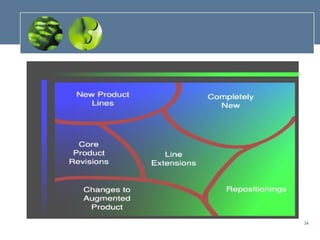
New Product
              Development

•   Idea Generation
•   Idea Screening
•   Concept Development and Testing
•   Business Analysis
•   Beta Testing and Market Testing
•   Technical Implementation
•   Commercialization
                                      33
34
Product
              Management


•   Product planning
•   Product marketing
•   Program management
•   Project management


                           35
Pricing

• Achieve the financial goals of the firm
• Fit the realities of the marketplace (will customers buy at
  that price?)
• Support a product's positioning and be consistent with
  the other variables in the marketing mix
• Price is influenced by the type of distribution channel
  used, the type of promotions used, and the quality of the
  product
• Price will usually need to be relatively high if
  manufacturing is expensive, distribution is exclusive, and
  the product is supported by extensive advertising and
  promotional campaigns
• A low price can be a viable substitute for product quality,
  effective promotions, or an energetic selling effort by
  distributors                                                36
Pricing Types

•   Effective price
•   Price lining
•   Promotional pricing
•   Price/quality relationship
•   Premium pricing
•   Goldilocks pricing
•   Demand-based pricing
                                 37
Promotion

•   Personal selling
•   Non-personal selling
•   Advertising
•   Sales promotion
•   Publicity and public relations
•   Tradeshows
•   Direct selling
•   Product placement
                                     38
Distribution

• Should the product be sold through a retailer?
• Should the product be distributed through wholesale?
• Should multi-level marketing channels be used?
• How long should the channel be (how many members)?
• Where should the product or service be available?
• When should the product or service be available?
• Should distribution be exclusive, selective or extensive?
• Who should control the channel (referred to as the
  channel captain)?
• Should channel relationships be informal or contractual?
• Should channel members share advertising (referred to
  as co-op ads)?                                            39
The distribution
                 channel
• Selling direct, such as via mail order, Internet
  and telephone sales
• Agent, who typically sells direct on behalf of the
  producer
• Distributor (also called wholesaler), who sells to
  retailers
• Retailer (also called dealer), who sells to end
  customers
• Advertisement typically used for consumption
  goods
                                                       40
Financial plan

• Personal financial plan
  – Personal budget
  – Personal investment plan
  – Financing plan
• Business financial plan
  – Financial statements
  – Projection of income and expenses
  – Financing plan
                                        41
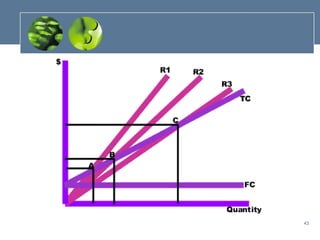
Break Even
                 Analysis
•   Cost=Revenue
•   Cost
•   Variable Cost
•   Fixed Cost
•   Revenue
•   Profit
•   Profit Margin
•   Profit Equation
•   Change in Price and BE
                              42
43
Limitations of BE

• Break-even analysis is only a supply side
• It assumes that fixed costs (FC) are constant
• It assumes average variable costs are constant
  per unit of output, at least in the range of likely
  quantities of sales
• It assumes that the quantity of goods produced is
  equal to the quantity of goods sold
• In multi-product companies, it assumes that the
  relative proportions of each product sold and
  produced are constant
                                                    44
Human Resource
              Management


• It is a Process of acquiring, training,
  appraising and compensating employees
  and attending to their labor relations,
  health and safety and fairness concerns.


                                             45
HRM Activities

•   Requirement and Selection
•   Training and development
•   Performance Appraisals
•   Compensation
•   Incentives and Benefits
•   Equal Employment Opportunities and
    Affirmative Action
                                         46
HRM Activities (Cont’d)


•   Motivating Employees
•   Health and Safety Issues
•   Legal Requirements of Workers
•   Building Employment Commitment


                                         47
Recruitment and
                Selection

•   Job Analysis
•   Job Posting
•   Recruitment
•   Test Conducting
•   Background Investigation
•   Interviews
•   Selection Decision
                                  48
Training and
                 Development


•   Need Analysis
•   Instructional Design
•   Validation
•   Implementation
•   Evaluation


                                49
Training Techniques


•   On the Job Training
•   Off the Job Training
•   Computer Based Training
•   Lectures
•   Programmed Training
•   Audio/Video Visuals based Training
                                         50
Performance Appraisals


• Define Job Means
• Appraising Performance
• Feedback Session


                                  51
Compensation and
              Benefits


• Basic Pay
• Pay on Merit
• Pay for work done


                                 52
Incentives and Benefits

•   Bonuses
•   Commissions
•   Medical Allowance
•   House Rent Allowance
•   Conveyance Allowance
•   Children Education Allowance
•   Free Utilities
                                          53
Incentives and Benefits
                (Cont’d)

•   Pension and Gratuity
•   Vacations/Holidays
•   Sick Leave
•   Insurance Benefits
•   Social Security
•   Family Friendly Benefits


                                          54
Acts and Laws In
             Pakistan

• Industrial Relations Ordinance 2002
• Factory Act 1934
• Industrial and Commercial Employment
  Ordinance 1968
• Payment of wages Act 1936
• Workmen’s Compensation Act 1923
• Provincial Employees Social Security
  Ordinance 1965
                                         55
Recommendations

• The Business Plan should be concise and full of
  relevant information about concerning product or
  service.
• The Business plan should be revised and error
  free.
• The strategies should be well defined and the
  tools to achieve them
• The whole Hierarchy of an organization and their
  concerned work should be clearly defined
                                                 56
Recommendations
                (Cont’d)

• In Business plan the Financial position of
  the company (current) and the Desired
  targets (Future) in terms of profit or return
  should be well defined.
• Business Plan should be result and Goal
  Oriented.


                                                  57
Conclusion

• We conclude that the Business plan is
  having a greater importance for a company
  who desire to enter in Business world.
• The strategies are based on it. It means
  the whole business and its progress
  depends on how well the Business plan of
  the company is being made and clarified.

                                          58
Thanks

         59

Business Plan

  • 1.
  • 2.
    Presented by: Rizwan Qamar 2
  • 3.
    Outline • Business Plan • Types of Plan • Advantages of Plan • Business Planning Process • Supply Chain • Marketing Research • Environmental Scanning • Product Management 3
  • 4.
    Outline (Cont’d) • Pricing • Promotion and Distribution • Channel Management • Financial Plan • Brake Even Analysis • Limitations 4
  • 5.
    Business Plan • Set of guide line for the new venture • Define each and every aspect of business • Identifies Product or service and Market • Serves as the Firms Resume 5
  • 6.
    Types of Business Plans • The Miniplan • The Working Plan • The Presentation Plan 6
  • 7.
    The Miniplan • Also Called SUMMARY Plan • Consists on 1-10 pages • Include only Key Matters • Suitable for Internal Concerns 7
  • 8.
    The Working Plan •A tool to be used to operate the business • Longer in detail and shorter in Presentation 8
  • 9.
    The Presentation Plan • More attention is paid to attractive formatting • Formal language, and conciseness • Suitable for showing to bankers, investors and others outside the company • More Expensive 9
  • 10.
    Advantages of Business Plan • Focusing time and energy • Puts a solid strategy in place to set your business apart from the competition • Ability to communicate the plan to employees • Held them accountable for results • Results of business efforts can be tracked and mid-course corrections made to get back on track if necessary 10
  • 11.
    Business Planning Process • Idea Generation • Feasibility Analysis • Drawing up a Functional Plan • Project Report Preparation • Evaluation, Control & Review 11
  • 12.
    Contents of aBusiness Plan • Executive summary • Background • Background of key personnel • Marketing • Production and manufacturing • Finance • Human resources 12
  • 13.
    Supply Chain • Logisticsnetwork, or supply network • Coordinated system of organizations, people, activities, information • Moving a product or service in physical or virtual manner from supplier to customer 13
  • 14.
    Key Process ofSupply Chain • Customer relationship management • Customer service management • Demand management • Order fulfillment • Manufacturing flow management • Supplier relationship management • Product development and commercialization • Returns management / reverse logistics 14
  • 15.
    Marketing Research • Business-to-Business (B2B) Marketing Research • Consumer Marketing Research • Advertising Research 15
  • 16.
    Marketing Research Techniques • Test marketing • Concept testing • Mystery shopping • Store audit • Demand estimation • Sales forecasting • Customer satisfaction studies • Distribution channel audits 16
  • 17.
    Marketing Research Techniques (Cont’d) • Price elasticity testing • Segmentation research • Consumer decision process research • Positioning research • Brand name testing • Brand equity research • Advertising and promotion research 17
  • 18.
    Marketing Research Techniques (Cont’d) • Internet Strategic Intelligence • Marketing Effectiveness and analytics 18
  • 19.
    Marketing Research Methods • A-BASED ON QUESTIONING • B-BASED ON OBSERVATIONS 19
  • 20.
    A-based on questioning • Qualitative marketing research -generally used for exploratory purposes -small number of respondents -not generalizable to the whole population -statistical significance and confidence not calculated -examples include focus groups, in-depth interviews, and projective techniques 20
  • 21.
    A-based on questioning (Cont’d) • Qualitative marketing research -generally used to draw conclusions -tests a specific hypothesis -the uses random sampling techniques so as to infer from sample to the population -involves a large number of respondents -examples include surveys and questionnaires 21
  • 22.
    B-based on observations • Ethnographic studies – by nature qualitative – researcher observes social phenomena in their natural setting – observations can occur cross-sectionally (observations made at one time) or longitudinally (observations occur over several time-periods) – examples include product-use analysis and computer cookie traces 22
  • 23.
    B-based on observations (Cont’d) • Experimental techniques – by nature quantitative – the researcher creates a quasi-artificial environment to try to control spurious factors – then manipulates at least one of the variables – examples include purchase laboratories and test markets 23
  • 24.
    The Macroenvironment • TheEconomy – GNP or GDP per capita – Economic growth – Unemployment rate – Inflation rate – Consumer and investor confidence – Inventory levels – Currency exchange rates – Merchandise trade balance – Financial and political health of trading partners – Balance of payments – Future trends 24
  • 25.
    The Macroenvironment (Cont’d) • Government – Political climate - amount of government activity – Political stability and risk – Government debt – Budget deficit or surplus – Corporate and personal tax rates – Payroll taxes – Import tariffs and quotas – Export restrictions – Restrictions on international financial flows 25
  • 26.
    The Macroenvironment (Cont’d) • Legal – Minimum wage laws – Environmental protection laws – Worker safety laws – Union laws – Copyright and patent laws – Anti- monopoly laws – Sunday closing laws – Municipal licenses – Laws that favor business investment 26
  • 27.
    The Macroenvironment (Cont’d) • Technology – Industrial productivity – New manufacturing processes – New products and services of competitors – New products and services of supply chain partners – Any new technology that could impact the company – Cost and accessibility of electrical power 27
  • 28.
    The Macroenvironment (Cont’d) • Ecology – Ecological concerns that affect the firms production processes – Ecological concerns that affect customers' buying habits – Ecological concerns that affect customers' perception of the company or product 28
  • 29.
    The Macroenvironment (Cont’d) • Socio-Cultural – Demographic factors such as: – Population size and distribution – Age distribution – Education levels – Income levels – Ethnic origins – Religious affiliations 29
  • 30.
    The Macroenvironment (Cont’d) • Attitudes towards – Materialism, capitalism, free enterprise – Individualism, role of family, role of government, collectivism – Role of church and religion – Consumerism – Environmentalism – Importance of work, pride of accomplishment • Cultural structures including – Diet and nutrition – Housing conditions 30
  • 31.
    The Macroenvironment (Cont’d) • Potential Suppliers – Labor supply – Quantity of labor available – Quality of labor available – Stability of labor supply – Wage expectations – Employee turn-over rate – Strikes and labor relations – Educational facilities 31
  • 32.
    The Macroenvironment (Cont’d) • Material suppliers – Quality, quantity, price, and stability of material inputs – Delivery delays – Proximity of bulky or heavy material inputs – Level of competition among suppliers • Service Providers – Quantity, quality, price, and stability of service facilitators – Special requirements 32
  • 33.
    New Product Development • Idea Generation • Idea Screening • Concept Development and Testing • Business Analysis • Beta Testing and Market Testing • Technical Implementation • Commercialization 33
  • 34.
  • 35.
    Product Management • Product planning • Product marketing • Program management • Project management 35
  • 36.
    Pricing • Achieve thefinancial goals of the firm • Fit the realities of the marketplace (will customers buy at that price?) • Support a product's positioning and be consistent with the other variables in the marketing mix • Price is influenced by the type of distribution channel used, the type of promotions used, and the quality of the product • Price will usually need to be relatively high if manufacturing is expensive, distribution is exclusive, and the product is supported by extensive advertising and promotional campaigns • A low price can be a viable substitute for product quality, effective promotions, or an energetic selling effort by distributors 36
  • 37.
    Pricing Types • Effective price • Price lining • Promotional pricing • Price/quality relationship • Premium pricing • Goldilocks pricing • Demand-based pricing 37
  • 38.
    Promotion • Personal selling • Non-personal selling • Advertising • Sales promotion • Publicity and public relations • Tradeshows • Direct selling • Product placement 38
  • 39.
    Distribution • Should theproduct be sold through a retailer? • Should the product be distributed through wholesale? • Should multi-level marketing channels be used? • How long should the channel be (how many members)? • Where should the product or service be available? • When should the product or service be available? • Should distribution be exclusive, selective or extensive? • Who should control the channel (referred to as the channel captain)? • Should channel relationships be informal or contractual? • Should channel members share advertising (referred to as co-op ads)? 39
  • 40.
    The distribution channel • Selling direct, such as via mail order, Internet and telephone sales • Agent, who typically sells direct on behalf of the producer • Distributor (also called wholesaler), who sells to retailers • Retailer (also called dealer), who sells to end customers • Advertisement typically used for consumption goods 40
  • 41.
    Financial plan • Personalfinancial plan – Personal budget – Personal investment plan – Financing plan • Business financial plan – Financial statements – Projection of income and expenses – Financing plan 41
  • 42.
    Break Even Analysis • Cost=Revenue • Cost • Variable Cost • Fixed Cost • Revenue • Profit • Profit Margin • Profit Equation • Change in Price and BE 42
  • 43.
  • 44.
    Limitations of BE •Break-even analysis is only a supply side • It assumes that fixed costs (FC) are constant • It assumes average variable costs are constant per unit of output, at least in the range of likely quantities of sales • It assumes that the quantity of goods produced is equal to the quantity of goods sold • In multi-product companies, it assumes that the relative proportions of each product sold and produced are constant 44
  • 45.
    Human Resource Management • It is a Process of acquiring, training, appraising and compensating employees and attending to their labor relations, health and safety and fairness concerns. 45
  • 46.
    HRM Activities • Requirement and Selection • Training and development • Performance Appraisals • Compensation • Incentives and Benefits • Equal Employment Opportunities and Affirmative Action 46
  • 47.
    HRM Activities (Cont’d) • Motivating Employees • Health and Safety Issues • Legal Requirements of Workers • Building Employment Commitment 47
  • 48.
    Recruitment and Selection • Job Analysis • Job Posting • Recruitment • Test Conducting • Background Investigation • Interviews • Selection Decision 48
  • 49.
    Training and Development • Need Analysis • Instructional Design • Validation • Implementation • Evaluation 49
  • 50.
    Training Techniques • On the Job Training • Off the Job Training • Computer Based Training • Lectures • Programmed Training • Audio/Video Visuals based Training 50
  • 51.
    Performance Appraisals • DefineJob Means • Appraising Performance • Feedback Session 51
  • 52.
    Compensation and Benefits • Basic Pay • Pay on Merit • Pay for work done 52
  • 53.
    Incentives and Benefits • Bonuses • Commissions • Medical Allowance • House Rent Allowance • Conveyance Allowance • Children Education Allowance • Free Utilities 53
  • 54.
    Incentives and Benefits (Cont’d) • Pension and Gratuity • Vacations/Holidays • Sick Leave • Insurance Benefits • Social Security • Family Friendly Benefits 54
  • 55.
    Acts and LawsIn Pakistan • Industrial Relations Ordinance 2002 • Factory Act 1934 • Industrial and Commercial Employment Ordinance 1968 • Payment of wages Act 1936 • Workmen’s Compensation Act 1923 • Provincial Employees Social Security Ordinance 1965 55
  • 56.
    Recommendations • The BusinessPlan should be concise and full of relevant information about concerning product or service. • The Business plan should be revised and error free. • The strategies should be well defined and the tools to achieve them • The whole Hierarchy of an organization and their concerned work should be clearly defined 56
  • 57.
    Recommendations (Cont’d) • In Business plan the Financial position of the company (current) and the Desired targets (Future) in terms of profit or return should be well defined. • Business Plan should be result and Goal Oriented. 57
  • 58.
    Conclusion • We concludethat the Business plan is having a greater importance for a company who desire to enter in Business world. • The strategies are based on it. It means the whole business and its progress depends on how well the Business plan of the company is being made and clarified. 58
  • 59.

Editor's Notes

  • #2 02/07/13 Business Plan