INTERNATIONAL FINANCIAL
MANAGEMENT
COMPONENTS OF
BALANCE OF PAYMENTS
By
V S SARMA ,PROF, MBA VJIT
1
INTERNATIONAL FINANCIAL MANAGEMENT
BALANCE OF PAYMENT (BOP)
 BOP is a statistical record of a country’s international
transactions over a certain time period presented in the
form of double entry book keeping.
 Each country enters into economic transactions the
other countries and hence makes payments and receive
payments.
 BOP is the statement of accounts of these receipts and
payments
2
INTERNATIONAL FINANCIAL MANAGEMENT
BALANCE OF PAYMENT (BOP)
 Characteristics of BOP:
 Systematic record of R & P
 Fixed time period
 Comprehensiveness i.e. include all transactions viz.
Visible
 invisible
Capital
 revenue etc
Double entry system
 Balancing/adjustment of deference between R & P
3
INTERNATIONAL FINANCIAL MANAGEMENT
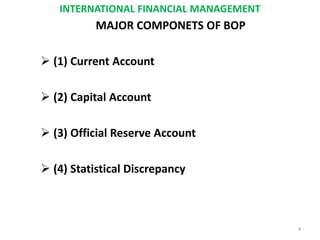
MAJOR COMPONETS OF BOP
 (1) Current Account
 (2) Capital Account
 (3) Official Reserve Account
 (4) Statistical Discrepancy
4
INTERNATIONAL FINANCIAL MANAGEMENT
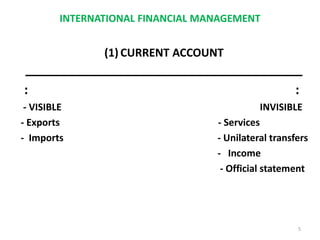
(1) CURRENT ACCOUNT
_______________________________________
: :
- VISIBLE INVISIBLE
- Exports - Services
- Imports - Unilateral transfers
- Income
- Official statement
5
INTERNATIONAL FINANCIAL MANAGEMENT
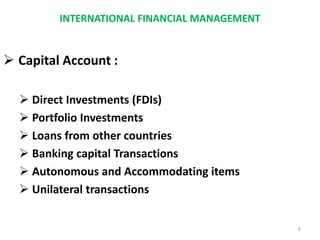
 Capital Account :
 Direct Investments (FDIs)
 Portfolio Investments
 Loans from other countries
 Banking capital Transactions
 Autonomous and Accommodating items
 Unilateral transactions
6
INTERNATIONAL FINANCIAL MANAGEMENT
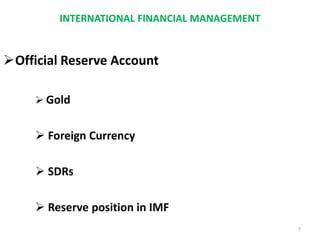
Official Reserve Account
 Gold
 Foreign Currency
 SDRs
 Reserve position in IMF
7
INTERNATIONAL FINANCIAL MANAGEMENT
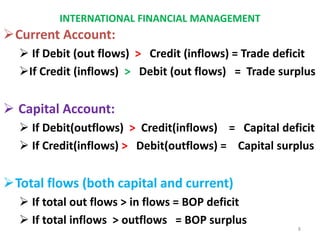
Current Account:
 If Debit (out flows) > Credit (inflows) = Trade deficit
If Credit (inflows) > Debit (out flows) = Trade surplus
 Capital Account:
 If Debit(outflows) > Credit(inflows) = Capital deficit
 If Credit(inflows) > Debit(outflows) = Capital surplus
Total flows (both capital and current)
 If total out flows > in flows = BOP deficit
 If total inflows > outflows = BOP surplus
8
INTERNATIONAL FINANCIAL MANAGEMENT
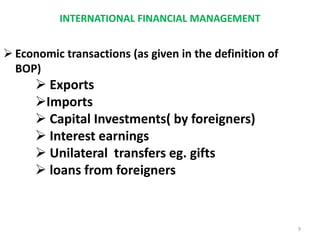
 Economic transactions (as given in the definition of
BOP)
 Exports
Imports
 Capital Investments( by foreigners)
 Interest earnings
 Unilateral transfers eg. gifts
 loans from foreigners
9
INTERNATIONAL FINANCIAL MANAGEMENT
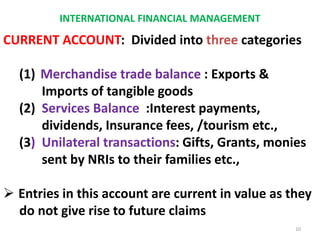
CURRENT ACCOUNT: Divided into three categories
(1) Merchandise trade balance : Exports &
Imports of tangible goods
(2) Services Balance :Interest payments,
dividends, Insurance fees, /tourism etc.,
(3) Unilateral transactions: Gifts, Grants, monies
sent by NRIs to their families etc.,
 Entries in this account are current in value as they
do not give rise to future claims
10
INTERNATIONAL FINANCIAL MANAGEMENT
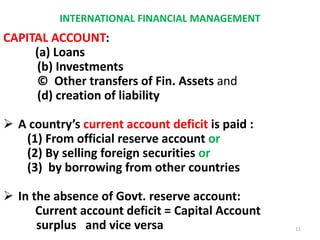
CAPITAL ACCOUNT:
(a) Loans
(b) Investments
© Other transfers of Fin. Assets and
(d) creation of liability
 A country’s current account deficit is paid :
(1) From official reserve account or
(2) By selling foreign securities or
(3) by borrowing from other countries
 In the absence of Govt. reserve account:
Current account deficit = Capital Account
surplus and vice versa 11
INTERNATIONAL FINANCIAL MANAGEMENT
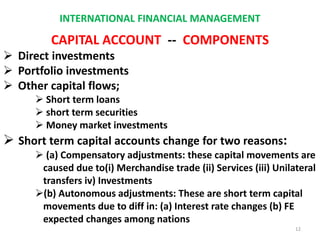
CAPITAL ACCOUNT -- COMPONENTS
 Direct investments
 Portfolio investments
 Other capital flows;
 Short term loans
 short term securities
 Money market investments
 Short term capital accounts change for two reasons:
 (a) Compensatory adjustments: these capital movements are
caused due to(i) Merchandise trade (ii) Services (iii) Unilateral
transfers iv) Investments
(b) Autonomous adjustments: These are short term capital
movements due to diff in: (a) Interest rate changes (b) FE
expected changes among nations
12
INTERNATIONAL FINANCIAL MANAGEMENT
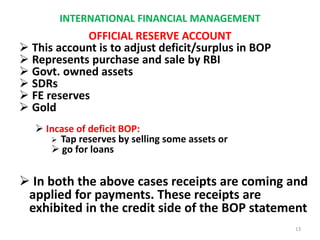
OFFICIAL RESERVE ACCOUNT
 This account is to adjust deficit/surplus in BOP
 Represents purchase and sale by RBI
 Govt. owned assets
 SDRs
 FE reserves
 Gold
 Incase of deficit BOP:
 Tap reserves by selling some assets or
 go for loans
 In both the above cases receipts are coming and
applied for payments. These receipts are
exhibited in the credit side of the BOP statement
13
INTERNATIONAL FINANCIAL MANAGEMENT
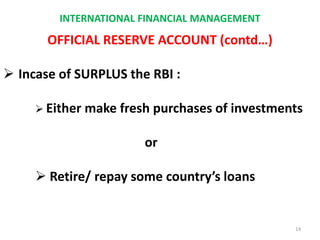
OFFICIAL RESERVE ACCOUNT (contd…)
 Incase of SURPLUS the RBI :
 Either make fresh purchases of investments
or
 Retire/ repay some country’s loans
14
INTERNATIONAL FINANCIAL MANAGEMENT
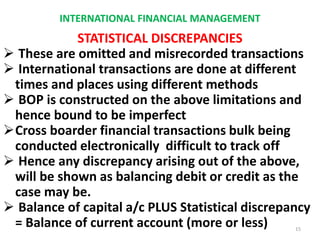
STATISTICAL DISCREPANCIES
 These are omitted and misrecorded transactions
 International transactions are done at different
times and places using different methods
 BOP is constructed on the above limitations and
hence bound to be imperfect
Cross boarder financial transactions bulk being
conducted electronically difficult to track off
 Hence any discrepancy arising out of the above,
will be shown as balancing debit or credit as the
case may be.
 Balance of capital a/c PLUS Statistical discrepancy
= Balance of current account (more or less) 15

Ifm components of bop

  • 1.
    INTERNATIONAL FINANCIAL MANAGEMENT COMPONENTS OF BALANCEOF PAYMENTS By V S SARMA ,PROF, MBA VJIT 1
  • 2.
    INTERNATIONAL FINANCIAL MANAGEMENT BALANCEOF PAYMENT (BOP)  BOP is a statistical record of a country’s international transactions over a certain time period presented in the form of double entry book keeping.  Each country enters into economic transactions the other countries and hence makes payments and receive payments.  BOP is the statement of accounts of these receipts and payments 2
  • 3.
    INTERNATIONAL FINANCIAL MANAGEMENT BALANCEOF PAYMENT (BOP)  Characteristics of BOP:  Systematic record of R & P  Fixed time period  Comprehensiveness i.e. include all transactions viz. Visible  invisible Capital  revenue etc Double entry system  Balancing/adjustment of deference between R & P 3
  • 4.
    INTERNATIONAL FINANCIAL MANAGEMENT MAJORCOMPONETS OF BOP  (1) Current Account  (2) Capital Account  (3) Official Reserve Account  (4) Statistical Discrepancy 4
  • 5.
    INTERNATIONAL FINANCIAL MANAGEMENT (1)CURRENT ACCOUNT _______________________________________ : : - VISIBLE INVISIBLE - Exports - Services - Imports - Unilateral transfers - Income - Official statement 5
  • 6.
    INTERNATIONAL FINANCIAL MANAGEMENT Capital Account :  Direct Investments (FDIs)  Portfolio Investments  Loans from other countries  Banking capital Transactions  Autonomous and Accommodating items  Unilateral transactions 6
  • 7.
    INTERNATIONAL FINANCIAL MANAGEMENT OfficialReserve Account  Gold  Foreign Currency  SDRs  Reserve position in IMF 7
  • 8.
    INTERNATIONAL FINANCIAL MANAGEMENT CurrentAccount:  If Debit (out flows) > Credit (inflows) = Trade deficit If Credit (inflows) > Debit (out flows) = Trade surplus  Capital Account:  If Debit(outflows) > Credit(inflows) = Capital deficit  If Credit(inflows) > Debit(outflows) = Capital surplus Total flows (both capital and current)  If total out flows > in flows = BOP deficit  If total inflows > outflows = BOP surplus 8
  • 9.
    INTERNATIONAL FINANCIAL MANAGEMENT Economic transactions (as given in the definition of BOP)  Exports Imports  Capital Investments( by foreigners)  Interest earnings  Unilateral transfers eg. gifts  loans from foreigners 9
  • 10.
    INTERNATIONAL FINANCIAL MANAGEMENT CURRENTACCOUNT: Divided into three categories (1) Merchandise trade balance : Exports & Imports of tangible goods (2) Services Balance :Interest payments, dividends, Insurance fees, /tourism etc., (3) Unilateral transactions: Gifts, Grants, monies sent by NRIs to their families etc.,  Entries in this account are current in value as they do not give rise to future claims 10
  • 11.
    INTERNATIONAL FINANCIAL MANAGEMENT CAPITALACCOUNT: (a) Loans (b) Investments © Other transfers of Fin. Assets and (d) creation of liability  A country’s current account deficit is paid : (1) From official reserve account or (2) By selling foreign securities or (3) by borrowing from other countries  In the absence of Govt. reserve account: Current account deficit = Capital Account surplus and vice versa 11
  • 12.
    INTERNATIONAL FINANCIAL MANAGEMENT CAPITALACCOUNT -- COMPONENTS  Direct investments  Portfolio investments  Other capital flows;  Short term loans  short term securities  Money market investments  Short term capital accounts change for two reasons:  (a) Compensatory adjustments: these capital movements are caused due to(i) Merchandise trade (ii) Services (iii) Unilateral transfers iv) Investments (b) Autonomous adjustments: These are short term capital movements due to diff in: (a) Interest rate changes (b) FE expected changes among nations 12
  • 13.
    INTERNATIONAL FINANCIAL MANAGEMENT OFFICIALRESERVE ACCOUNT  This account is to adjust deficit/surplus in BOP  Represents purchase and sale by RBI  Govt. owned assets  SDRs  FE reserves  Gold  Incase of deficit BOP:  Tap reserves by selling some assets or  go for loans  In both the above cases receipts are coming and applied for payments. These receipts are exhibited in the credit side of the BOP statement 13
  • 14.
    INTERNATIONAL FINANCIAL MANAGEMENT OFFICIALRESERVE ACCOUNT (contd…)  Incase of SURPLUS the RBI :  Either make fresh purchases of investments or  Retire/ repay some country’s loans 14
  • 15.
    INTERNATIONAL FINANCIAL MANAGEMENT STATISTICALDISCREPANCIES  These are omitted and misrecorded transactions  International transactions are done at different times and places using different methods  BOP is constructed on the above limitations and hence bound to be imperfect Cross boarder financial transactions bulk being conducted electronically difficult to track off  Hence any discrepancy arising out of the above, will be shown as balancing debit or credit as the case may be.  Balance of capital a/c PLUS Statistical discrepancy = Balance of current account (more or less) 15