Presented by
REDDY JANAIAH,
MBA,NCFM,M.Com
 It is a provision of money
 It is a acquisition of funds
 It is a source to run any organization
 It is mainly concerned with how to optimally
make various corporate financial decisions,
such as those pertaining to investment,
financing, dividend policy, and working
capital management, with a view to
achieving a set of given corporate objectives
 Finance which facilitates the smooth conduct
of all these different types of activities, has
also assumed an international finance
 Foreign exchange risk
 Political risk
 Market imperfections
 Expanded opportunity set
 The management of financial resources in
the context of international business
transactions is referred to as International
Financial Management
 Shareholder`s wealth maximization
a. Stakeholders consideration
b.mangement consideration
c.societal consideration
 Profit maximization
 Foreign exchange market
 Exchange rate
 Exchange rate exposure
 International monetary system
 Investment decision
 International financial market
 Assessment and management of interest rate
exposure
 MNC`s working capital management
 International accounting and taxation strategy
 Balance of payments
 International indebtedness and its management
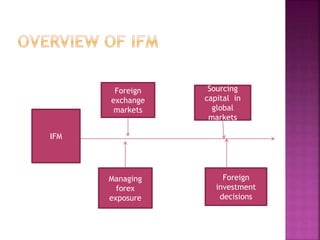
Foreign
exchange
markets
Sourcing
capital in
global
markets
Managing
forex
exposure
Foreign
investment
decisions
IFM
 Licensing
 Franchising
 Joint ventures
 Establishing new foreign subsidiaries
 Manage contracts
 Foreign direct Investment
a. Financial collaborations
b. joint ventures and Technical
collaborations
c. capital markets
d. private placements or preferential rights
 Foreign portfolio investments
 The absolute advantage theory
 The comparative cost theory
 Opportunity cost theory
 The vent for surplus theory
 Trade in agricultural and manufactured goods
 Trade between partners of regional trade
agreements(RTAs)
 Developing countries Trade
 South-south trade
 Containerized cargo
 Air cargo, express cargo
 Global production network
 Intra-firm trade
 E-commerce
 Gross border financial flows
 Global financial market
 Inter relationships between relevant
environmental variables and corporate
responses
 Adopt finance function to firm's own
strategic nature
 To take in stride past failures and mistakes
 To design specific solution
 Knowledge of macro environment
 Culture
 Investment decision
 Working capital management
 Which is a stastical record of a country`s
with rest of the world, is worth studying for
a few reasons.
 It provides detailed information concerning
the demand and supply of a country`s
currency
 E. g., U.S imports more than its exports,
then the supply of dollar is likely to exceed
the demand in the foreign exchange market.
One can thus infer that the US dollar would
be under pressure to depreciate agonist
other currencies
 The BOP can be formally defined as the
stastical record of a country`s international
transactions over a certain period of time
presented in the form of double entry book
keeping
 Cost of production
 Demand and supply
 Cost and availability
 Exchange rate movements
 Domestic business
 Trade agreements
 External pressures
 Price of good
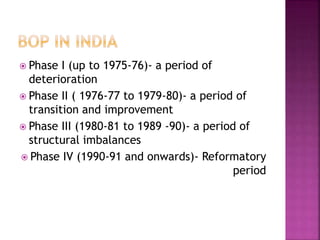
 Phase I (up to 1975-76)- a period of
deterioration
 Phase II ( 1976-77 to 1979-80)- a period of
transition and improvement
 Phase III (1980-81 to 1989 -90)- a period of
structural imbalances
 Phase IV (1990-91 and onwards)- Reformatory
period
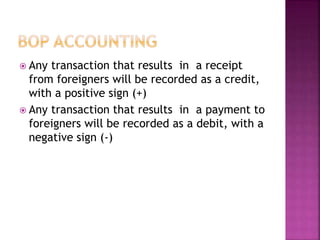
 Any transaction that results in a receipt
from foreigners will be recorded as a credit,
with a positive sign (+)
 Any transaction that results in a payment to
foreigners will be recorded as a debit, with a
negative sign (-)
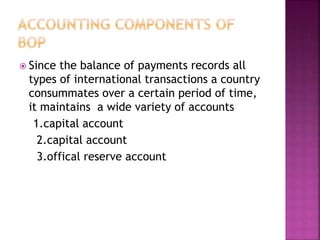
 Since the balance of payments records all
types of international transactions a country
consummates over a certain period of time,
it maintains a wide variety of accounts
1.capital account
2.capital account
3.offical reserve account
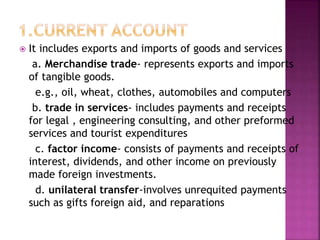
 It includes exports and imports of goods and services
a. Merchandise trade- represents exports and imports
of tangible goods.
e.g., oil, wheat, clothes, automobiles and computers
b. trade in services- includes payments and receipts
for legal , engineering consulting, and other preformed
services and tourist expenditures
c. factor income- consists of payments and receipts of
interest, dividends, and other income on previously
made foreign investments.
d. unilateral transfer-involves unrequited payments
such as gifts foreign aid, and reparations
 It includes all purchases and sales of assets
such as stocks, bonds, bank accounts, real
estate, and business.
a. direct investment – involves acquisitions
of controlling interests in foreign business
b. portfolio investment- investments in
foreign stocks and bonds that do not involve
acquisitions of control
c. other investment- it includes bank
deposits, currency investment, trade credit,
and the like
 Covers all purchases and sales of international
reserve assets such as
a. dollars
b. foreign exchanges
c. gold
d. special drawing rights(SDRs)
 Representing omitted and miss recorded
transactions. Recordings of payments and receipts
arising from international transactions are done
different times and places, possibly using different.
 Cumulative balance of payments including the
current account, capital account, and the stastical
discrepancies
 International money, which is widely acceptable as
means of payment of international transactions,
comprises hard currencies (e.g., U.S dollar, U.K
POUND, Euro and German Mark) which are
convertible into any currency in the world.
 An importing country has to pay the exporting
country in the latter`s currency, which can be
obtained through hard currencies only.
 Trade flows
 Flow of services
 Unilateral transfer
 Direct investment abroad
 Portfolio investment abroad
 Short-term capital flows
 Impact of inflation
 Impact of national income
 Impact of government policies
a. Subsidies for exporters
b. restrictions on imports
c. lack of restriction on piracy
 Impact of exchange rates

introduction to interanational financial management

  • 1.
  • 3.
     It isa provision of money  It is a acquisition of funds  It is a source to run any organization
  • 4.
     It ismainly concerned with how to optimally make various corporate financial decisions, such as those pertaining to investment, financing, dividend policy, and working capital management, with a view to achieving a set of given corporate objectives
  • 5.
     Finance whichfacilitates the smooth conduct of all these different types of activities, has also assumed an international finance
  • 6.
     Foreign exchangerisk  Political risk  Market imperfections  Expanded opportunity set
  • 7.
     The managementof financial resources in the context of international business transactions is referred to as International Financial Management
  • 8.
     Shareholder`s wealthmaximization a. Stakeholders consideration b.mangement consideration c.societal consideration  Profit maximization
  • 9.
     Foreign exchangemarket  Exchange rate  Exchange rate exposure  International monetary system  Investment decision  International financial market  Assessment and management of interest rate exposure  MNC`s working capital management  International accounting and taxation strategy  Balance of payments  International indebtedness and its management
  • 10.
  • 11.
     Licensing  Franchising Joint ventures  Establishing new foreign subsidiaries  Manage contracts
  • 12.
     Foreign directInvestment a. Financial collaborations b. joint ventures and Technical collaborations c. capital markets d. private placements or preferential rights  Foreign portfolio investments
  • 13.
     The absoluteadvantage theory  The comparative cost theory  Opportunity cost theory  The vent for surplus theory
  • 14.
     Trade inagricultural and manufactured goods  Trade between partners of regional trade agreements(RTAs)  Developing countries Trade  South-south trade  Containerized cargo  Air cargo, express cargo  Global production network  Intra-firm trade  E-commerce  Gross border financial flows  Global financial market
  • 15.
     Inter relationshipsbetween relevant environmental variables and corporate responses  Adopt finance function to firm's own strategic nature  To take in stride past failures and mistakes  To design specific solution  Knowledge of macro environment  Culture  Investment decision  Working capital management
  • 17.
     Which isa stastical record of a country`s with rest of the world, is worth studying for a few reasons.  It provides detailed information concerning the demand and supply of a country`s currency  E. g., U.S imports more than its exports, then the supply of dollar is likely to exceed the demand in the foreign exchange market. One can thus infer that the US dollar would be under pressure to depreciate agonist other currencies
  • 18.
     The BOPcan be formally defined as the stastical record of a country`s international transactions over a certain period of time presented in the form of double entry book keeping
  • 19.
     Cost ofproduction  Demand and supply  Cost and availability  Exchange rate movements  Domestic business  Trade agreements  External pressures  Price of good
  • 20.
     Phase I(up to 1975-76)- a period of deterioration  Phase II ( 1976-77 to 1979-80)- a period of transition and improvement  Phase III (1980-81 to 1989 -90)- a period of structural imbalances  Phase IV (1990-91 and onwards)- Reformatory period
  • 21.
     Any transactionthat results in a receipt from foreigners will be recorded as a credit, with a positive sign (+)  Any transaction that results in a payment to foreigners will be recorded as a debit, with a negative sign (-)
  • 22.
     Since thebalance of payments records all types of international transactions a country consummates over a certain period of time, it maintains a wide variety of accounts 1.capital account 2.capital account 3.offical reserve account
  • 23.
     It includesexports and imports of goods and services a. Merchandise trade- represents exports and imports of tangible goods. e.g., oil, wheat, clothes, automobiles and computers b. trade in services- includes payments and receipts for legal , engineering consulting, and other preformed services and tourist expenditures c. factor income- consists of payments and receipts of interest, dividends, and other income on previously made foreign investments. d. unilateral transfer-involves unrequited payments such as gifts foreign aid, and reparations
  • 24.
     It includesall purchases and sales of assets such as stocks, bonds, bank accounts, real estate, and business. a. direct investment – involves acquisitions of controlling interests in foreign business b. portfolio investment- investments in foreign stocks and bonds that do not involve acquisitions of control c. other investment- it includes bank deposits, currency investment, trade credit, and the like
  • 25.
     Covers allpurchases and sales of international reserve assets such as a. dollars b. foreign exchanges c. gold d. special drawing rights(SDRs)
  • 26.
     Representing omittedand miss recorded transactions. Recordings of payments and receipts arising from international transactions are done different times and places, possibly using different.
  • 27.
     Cumulative balanceof payments including the current account, capital account, and the stastical discrepancies
  • 28.
     International money,which is widely acceptable as means of payment of international transactions, comprises hard currencies (e.g., U.S dollar, U.K POUND, Euro and German Mark) which are convertible into any currency in the world.  An importing country has to pay the exporting country in the latter`s currency, which can be obtained through hard currencies only.
  • 29.
     Trade flows Flow of services  Unilateral transfer  Direct investment abroad  Portfolio investment abroad  Short-term capital flows
  • 30.
     Impact ofinflation  Impact of national income  Impact of government policies a. Subsidies for exporters b. restrictions on imports c. lack of restriction on piracy  Impact of exchange rates