


Tutorial on…..
IELTS Reading
Matching information
AccentBLC
18, Sonargaon Janapath
Uttara, Dhaka
Call: 01884886602
M Rahman Nihar
MBA, University of Wales, UK
Contents
What is Matching
Information?
Nature of Matching
Information?
Problem with the Matching
Information.
Tips of Matching
Information.
What is Matching
Information?
• In this kind of question, you are asked to
match statements to paragraphs in the
reading text.
• You do not need to understand what the
whole paragraph is about, just find
specific information in the paragraph
and match it to one of the statements.
Nature of Matching
Information?
The statements could be reasons,
descriptions, summaries, definitions, facts
or explanations.
The answers could be anywhere in the
text and they do not come in order.
Problem with the Matching
Information.
• You need to look at the whole text.
• There are lots of irrelevant information.
• You have to scroll up and down.
Tips of Matching Information.
Do this question last.
Try to find names, place names and numbers
in the questions.
Be aware that there may be synonyms.
For example, you might see ‘34%‘ in the
question but it might say ‘just over a third‘ or
‘about a third‘ in the text.
Techniques of Matching
Information.
Read the questions first.
Skim the reading text to try to understand.
Read the question statements again and
predict which paragraph contains the answer.
Scan the text paragraphs.
Check back with the question statement.
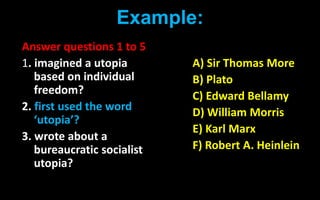
Example:
Answer questions 1 to 5
1. imagined a utopia
based on individual
freedom?
2. first used the word
‘utopia’?
3. wrote about a
bureaucratic socialist
utopia?
A) Sir Thomas More
B) Plato
C) Edward Bellamy
D) William Morris
E) Karl Marx
F) Robert A. Heinlein
Text: Utopia
A utopia is a community or society possessing
highly desirable or perfect qualities. The word
was coined in Greek by Sir Thomas More for his
1516 book Utopia, describing a fictional island
society in the Atlantic Ocean. Chronologically,
the first recorded utopian proposal is Plato's
Republic. It proposes a categorization of citizens
into a rigid class structure of "golden," "silver,"
"bronze" and "iron" socioeconomic classes.
Continue…
• In the early 19th century, several “utopian
socialist” ideas arose, in response to the belief
that social disruption was created by the
development of commercialism and capitalism.
These ideas shared certain characteristics: an
egalitarian distribution of goods, frequently with
the total abolition of money, and citizens only
doing work which they enjoy and which is for
the common good, leaving them with ample
time for the cultivation of the arts and sciences.
Continue…
• One classic example of such a utopia was
Edward Bellamy's Looking Backward. Another
socialist utopia is William Morris' News from
Nowhere, written partially in response to the
top-down (bureaucratic) nature of Bellamy's
utopia, which Morris criticized. However, as the
socialist movement developed it moved away
from utopianism; Karl Marx in particular became
a harsh critic of earlier socialism he described as
utopian.
Continue…
• Utopias have also been imagined by the opposite side
of the political spectrum. For example, Robert A.
Heinlein's The Moon Is a Harsh Mistress portrays an
individualistic and libertarian utopia. Capitalist
utopias of this sort are generally based on free
market economies, in which the presupposition is
that private enterprise and personal initiative without
an institution of coercion, government, provides the
greatest opportunity for achievement and progress of
both the individual and society as a whole.
Next tutorial on…………
Yes/No/Not Given
Keep eyes on it
Thanks

IELTS Reading Matching Information

  • 1.
    Tutorial on….. IELTS Reading Matchinginformation AccentBLC 18, Sonargaon Janapath Uttara, Dhaka Call: 01884886602 M Rahman Nihar MBA, University of Wales, UK
  • 2.
    Contents What is Matching Information? Natureof Matching Information? Problem with the Matching Information. Tips of Matching Information.
  • 3.
    What is Matching Information? •In this kind of question, you are asked to match statements to paragraphs in the reading text. • You do not need to understand what the whole paragraph is about, just find specific information in the paragraph and match it to one of the statements.
  • 4.
    Nature of Matching Information? Thestatements could be reasons, descriptions, summaries, definitions, facts or explanations. The answers could be anywhere in the text and they do not come in order.
  • 5.
    Problem with theMatching Information. • You need to look at the whole text. • There are lots of irrelevant information. • You have to scroll up and down.
  • 6.
    Tips of MatchingInformation. Do this question last. Try to find names, place names and numbers in the questions. Be aware that there may be synonyms. For example, you might see ‘34%‘ in the question but it might say ‘just over a third‘ or ‘about a third‘ in the text.
  • 7.
    Techniques of Matching Information. Readthe questions first. Skim the reading text to try to understand. Read the question statements again and predict which paragraph contains the answer. Scan the text paragraphs. Check back with the question statement.
  • 8.
    Example: Answer questions 1to 5 1. imagined a utopia based on individual freedom? 2. first used the word ‘utopia’? 3. wrote about a bureaucratic socialist utopia? A) Sir Thomas More B) Plato C) Edward Bellamy D) William Morris E) Karl Marx F) Robert A. Heinlein
  • 9.
    Text: Utopia A utopiais a community or society possessing highly desirable or perfect qualities. The word was coined in Greek by Sir Thomas More for his 1516 book Utopia, describing a fictional island society in the Atlantic Ocean. Chronologically, the first recorded utopian proposal is Plato's Republic. It proposes a categorization of citizens into a rigid class structure of "golden," "silver," "bronze" and "iron" socioeconomic classes.
  • 10.
    Continue… • In theearly 19th century, several “utopian socialist” ideas arose, in response to the belief that social disruption was created by the development of commercialism and capitalism. These ideas shared certain characteristics: an egalitarian distribution of goods, frequently with the total abolition of money, and citizens only doing work which they enjoy and which is for the common good, leaving them with ample time for the cultivation of the arts and sciences.
  • 11.
    Continue… • One classicexample of such a utopia was Edward Bellamy's Looking Backward. Another socialist utopia is William Morris' News from Nowhere, written partially in response to the top-down (bureaucratic) nature of Bellamy's utopia, which Morris criticized. However, as the socialist movement developed it moved away from utopianism; Karl Marx in particular became a harsh critic of earlier socialism he described as utopian.
  • 12.
    Continue… • Utopias havealso been imagined by the opposite side of the political spectrum. For example, Robert A. Heinlein's The Moon Is a Harsh Mistress portrays an individualistic and libertarian utopia. Capitalist utopias of this sort are generally based on free market economies, in which the presupposition is that private enterprise and personal initiative without an institution of coercion, government, provides the greatest opportunity for achievement and progress of both the individual and society as a whole.
  • 13.
    Next tutorial on………… Yes/No/NotGiven Keep eyes on it Thanks