IEEE 488
PRESENTED BY
IMRAN TALUKDER
MD. MUKLASUR RAHMAN
MOSA. HAPPY AKTER
Definition - what does IEEE 488 (GPIB) mean?
IEEE-488 refers to the Institute of Electrical & Electronics Engineers (IEEE)
standard number 488. IEEE-488 is a digital communications bus specification
invented by Hewlett Packard and used to connect short range communication
devices. This term is also known as the general purpose interface bus (GPIB)
or the Hewlett Packard interface bus (HP-IB).
Key features or important information about IEEE
488 (GPIB)
-In the 1960s, Hewlett Packard developed IEEE 488 to easily interconnect controllers and instruments. As a
short range communication bus, IEEE 488 was easy to connect and configure.
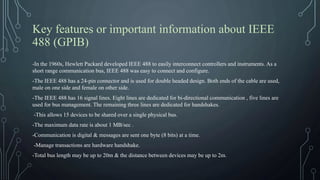
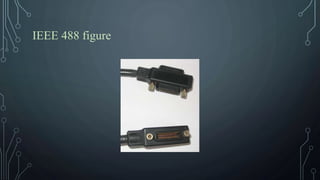
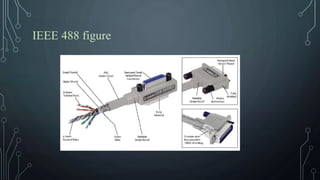
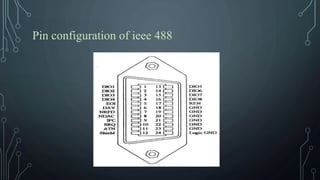
-The IEEE 488 has a 24-pin connector and is used for double headed design. Both ends of the cable are used,
male on one side and female on other side.
-The IEEE 488 has 16 signal lines. Eight lines are dedicated for bi-directional communication , five lines are
used for bus management. The remaining three lines are dedicated for handshakes.
-This allows 15 devices to be shared over a single physical bus.
-The maximum data rate is about 1 MB/sec .
-Communication is digital & messages are sent one byte (8 bits) at a time.
-Manage transactions are hardware handshake.
-Total bus length may be up to 20m & the distance between devices may be up to 2m.
IEEE 488 figure
IEEE 488 figure
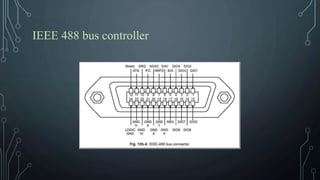
IEEE 488 bus controller
Pin configuration of ieee 488
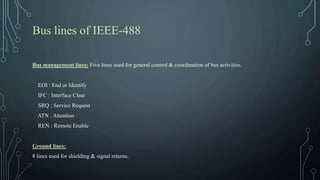
Bus lines of IEEE-488
IEEE-488 bus is a multidrug interface in which all connected devices have access to the bus
lines. The 24 bus lines group into four categories:
Data lines: 8 lines used to transfer information between devices on the bus, one byte at a time.
Handshake lines: Three lines used to handshake the transfer of information across data lines.
DAV : Data valid
NRFD : Not ready for data
NDAC : Not data accepted
Bus lines of IEEE-488
Bus management lines: Five lines used for general control & coordination of bus activities.
EOI : End or Identify
IFC : Interface Clear
SRQ : Service Request
ATN : Attention
REN : Remote Enable
Ground lines:
8 lines used for shielding & signal returns.
GPIB/IEEE-488 operation
GPIB is based around the handshaking protocol. Three lines
• DAV (Data valid)
• NDAC (Not data accepted)
• NRFD (Not ready for data) control this.
Description of the operation of the following pin of
IEEE-488
ATN: Attention is used primarily to differentiate between command mode and data mode.
When ATN is TRUE (I.E. Active high) information on the bus is a command and when ATN is
FALSE (Active LOW) the information on the bus is data.
SRQ: Service Request can be set by a device on the interface to indicate it is in need of
service. SRQ could be set at the completion of a task. E.g. finished doing a measurement, or
when an error as occurred.
DAV: Data Valid is a handshake line indicating that the active talker has placed data on the data
lines.
Description of the operation of the following pin of
IEEE-488
NDAC: Not Data Accepted is a handshake line indicating that one or more active listeners has not accepted the current data
byte. Note the active talker should leave the current byte asserted on the data lines until it has been accepted ot timed out.
NRFD: Not Ready For Data is a handshake line indicating that one or more active listeners is not ready for more data. Note the
active talker should then wait before sending any more data on the bus.
EOI: End Or identify has two uses. EOI is asserted on the last byte of a data transfer. This signals all devices that no more data
should be expected on the transfer.
IFC: Interface Clear is under the exclusive control of the system controller. When it is active high all devices on the bus are
returned to an idle state and the bus is cleared.
Advantages
• Simple hardware interface.
• Ease of connecting multiple devices to a single host.
• Allows mixing of slow & fast devices.
• Well established & mature, widely supported.
• Rugged connectors held in place by screws, means cables can’t easily be
accidentally removed as they can with five wire & USB.
• Rugged cables (usually). In some locations large heavily protected cables are an
advantages.
Disadvantages
• Mechanically bulky connectors & cables.
• Lack of command protocol standards (before SCPI)
• Implementation options can complicate interoperability in pre-IEEE-488.2
devices.
• Non mandatory galvanic isolation between bus & devices.
• High cost.
• Limited availability.

Ieee 488 by imran

  • 1.
    IEEE 488 PRESENTED BY IMRANTALUKDER MD. MUKLASUR RAHMAN MOSA. HAPPY AKTER
  • 2.
    Definition - whatdoes IEEE 488 (GPIB) mean? IEEE-488 refers to the Institute of Electrical & Electronics Engineers (IEEE) standard number 488. IEEE-488 is a digital communications bus specification invented by Hewlett Packard and used to connect short range communication devices. This term is also known as the general purpose interface bus (GPIB) or the Hewlett Packard interface bus (HP-IB).
  • 3.
    Key features orimportant information about IEEE 488 (GPIB) -In the 1960s, Hewlett Packard developed IEEE 488 to easily interconnect controllers and instruments. As a short range communication bus, IEEE 488 was easy to connect and configure. -The IEEE 488 has a 24-pin connector and is used for double headed design. Both ends of the cable are used, male on one side and female on other side. -The IEEE 488 has 16 signal lines. Eight lines are dedicated for bi-directional communication , five lines are used for bus management. The remaining three lines are dedicated for handshakes. -This allows 15 devices to be shared over a single physical bus. -The maximum data rate is about 1 MB/sec . -Communication is digital & messages are sent one byte (8 bits) at a time. -Manage transactions are hardware handshake. -Total bus length may be up to 20m & the distance between devices may be up to 2m.
  • 4.
  • 5.
  • 6.
    IEEE 488 buscontroller
  • 7.
  • 8.
    Bus lines ofIEEE-488 IEEE-488 bus is a multidrug interface in which all connected devices have access to the bus lines. The 24 bus lines group into four categories: Data lines: 8 lines used to transfer information between devices on the bus, one byte at a time. Handshake lines: Three lines used to handshake the transfer of information across data lines. DAV : Data valid NRFD : Not ready for data NDAC : Not data accepted
  • 9.
    Bus lines ofIEEE-488 Bus management lines: Five lines used for general control & coordination of bus activities. EOI : End or Identify IFC : Interface Clear SRQ : Service Request ATN : Attention REN : Remote Enable Ground lines: 8 lines used for shielding & signal returns.
  • 10.
    GPIB/IEEE-488 operation GPIB isbased around the handshaking protocol. Three lines • DAV (Data valid) • NDAC (Not data accepted) • NRFD (Not ready for data) control this.
  • 11.
    Description of theoperation of the following pin of IEEE-488 ATN: Attention is used primarily to differentiate between command mode and data mode. When ATN is TRUE (I.E. Active high) information on the bus is a command and when ATN is FALSE (Active LOW) the information on the bus is data. SRQ: Service Request can be set by a device on the interface to indicate it is in need of service. SRQ could be set at the completion of a task. E.g. finished doing a measurement, or when an error as occurred. DAV: Data Valid is a handshake line indicating that the active talker has placed data on the data lines.
  • 12.
    Description of theoperation of the following pin of IEEE-488 NDAC: Not Data Accepted is a handshake line indicating that one or more active listeners has not accepted the current data byte. Note the active talker should leave the current byte asserted on the data lines until it has been accepted ot timed out. NRFD: Not Ready For Data is a handshake line indicating that one or more active listeners is not ready for more data. Note the active talker should then wait before sending any more data on the bus. EOI: End Or identify has two uses. EOI is asserted on the last byte of a data transfer. This signals all devices that no more data should be expected on the transfer. IFC: Interface Clear is under the exclusive control of the system controller. When it is active high all devices on the bus are returned to an idle state and the bus is cleared.
  • 13.
    Advantages • Simple hardwareinterface. • Ease of connecting multiple devices to a single host. • Allows mixing of slow & fast devices. • Well established & mature, widely supported. • Rugged connectors held in place by screws, means cables can’t easily be accidentally removed as they can with five wire & USB. • Rugged cables (usually). In some locations large heavily protected cables are an advantages.
  • 14.
    Disadvantages • Mechanically bulkyconnectors & cables. • Lack of command protocol standards (before SCPI) • Implementation options can complicate interoperability in pre-IEEE-488.2 devices. • Non mandatory galvanic isolation between bus & devices. • High cost. • Limited availability.