Presented to:
Dr. Subhrajyoti Chatterjee
Assistant Profesor,
Department of
Horticulture
MSSSoA
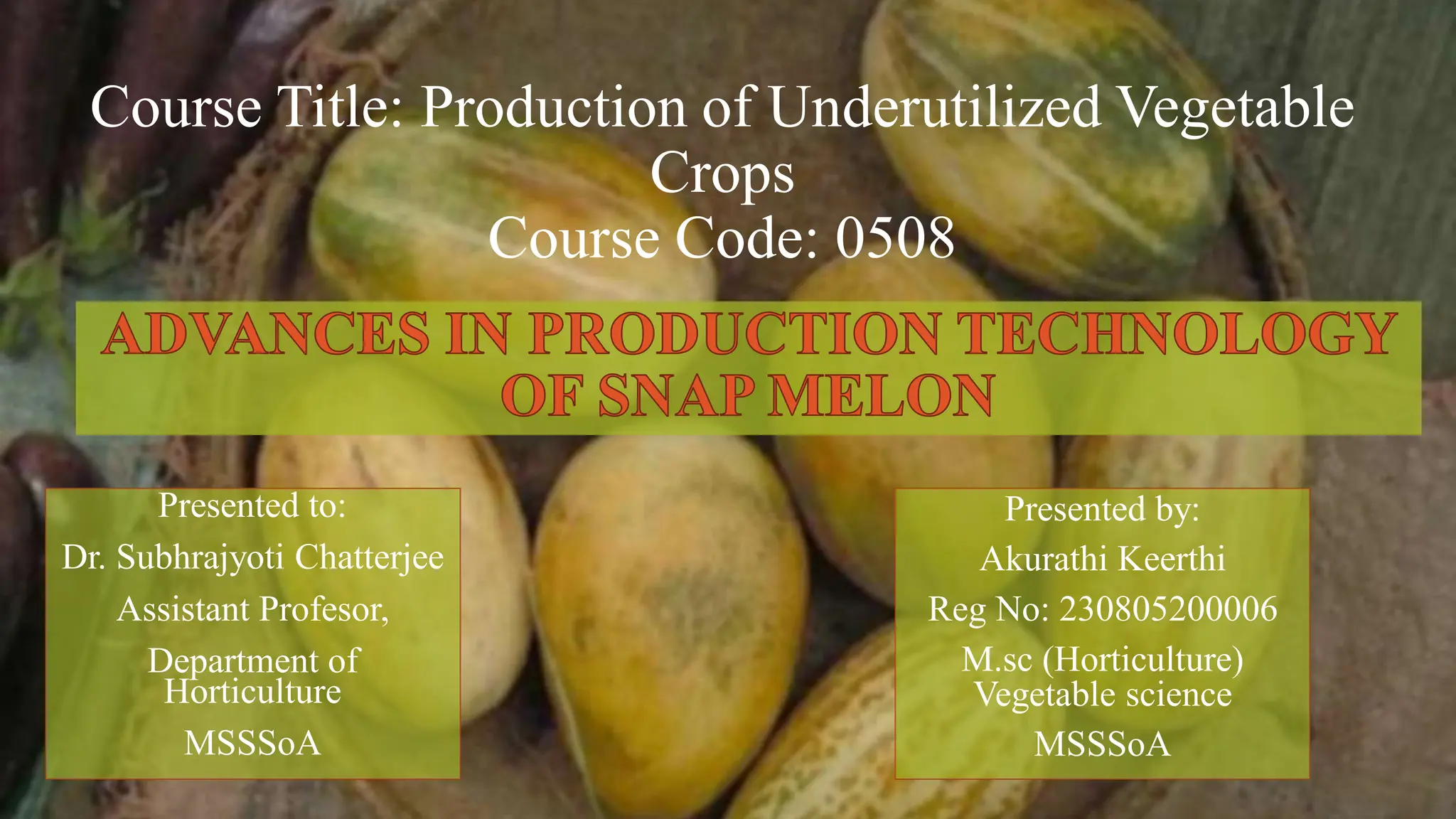
Course Title: Production of Underutilized Vegetable
Crops
Course Code: 0508
Presented by:
Akurathi Keerthi
Reg No: 230805200006
M.sc (Horticulture)
Vegetable science
MSSSoA
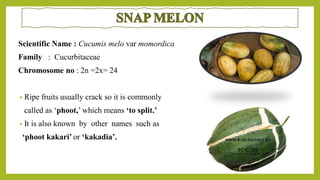
Scientific Name : Cucumis melo var momordica
Family : Cucurbitaceae
Chromosome no : 2n =2x= 24
• Ripe fruits usually crack so it is commonly
called as ‘phoot,’ which means ‘to split.’
• It is also known by other names such as
‘phoot kakari’ or ‘kakadia’.
Origin:
• Snap melon is native to India.
• It was intensively grown in the nineteenth century in northern India (Duthie, 1905).
Distribution:
• India is considered the main centre of diversity, where much diversity is found in
germplasm.
• During domestication, snap melon received wide use and it was distributed from the
place of origin to other parts of the world.
• Under National Field Repository of CIAH, Bikaner (Rajasthan), 65 Accession
number of snap melon germplasm are maintained after massive survey and
collection.
• It is widely cultivated in various Indian states such as Rajasthan, Gujarat, Punjab,
Haryana, Uttar Pradesh, West Bengal and some other northeastern states.
AREA & PRODUTION
• Minor cucurbit- 5.6 % of total
vegetable production.
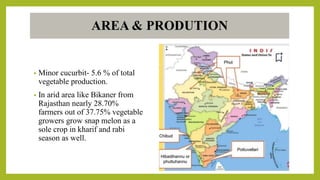
• In arid area like Bikaner from
Rajasthan nearly 28.70%
farmers out of 37.75% vegetable
growers grow snap melon as a
sole crop in kharif and rabi
season as well.
• Snap melon is an important minor cucurbitaceous fruit vegetable of arid region.
• It is a hardy and short duration indigenous crop with much resistance to biotic and
abiotic stresses.
• It is cultivated as an intercrop with sorghum, maize, pearl millet and cotton or as a
sole crop in summer season.
• Snap melon is a source of high fruit acidity, a trait that has been utilized to breed
uniquely flavored melon cultivars.
• Snap melon is resistant to aphids, ZYMV, WMV and downy mildew.
• Punjab Raseela, an improved muskmelon cultivar, was created by crossing snap
melon with a melon variety that is resistant to downy mildew.
• Melon breeders in the USA and some other countries are using snap melon to
evolve disease resistant cultivars.
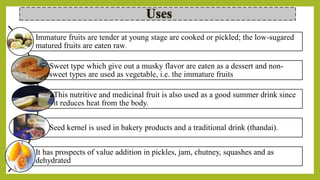
Immature fruits are tender at young stage are cooked or pickled; the low-sugared
matured fruits are eaten raw.
Sweet type which give out a musky flavor are eaten as a dessert and non-
sweet types are used as vegetable, i.e. the immature fruits
This nutritive and medicinal fruit is also used as a good summer drink since
it reduces heat from the body.
Seed kernel is used in bakery products and a traditional drink (thandai).
It has prospects of value addition in pickles, jam, chutney, squashes and as
dehydrated
Medicinal uses
Fruit can be used as Cooling and intense cleaner and also as a natural moisturizer
for skin.
Treatment for burns and abrasions.
Improve appetite and cure stomach pain.
Help in relieving constipation and vomiting.
The seeds are antitussive, digestive, febrifuge and vermifuge and roots are diuretic
and emetic.
As they are rich in minerals, vitamins, and dietary fibres useful for lowering blood
sugar level.
Botany
Snap melon is an annual climber, which is able to climb with the
help of tendrils but more commonly sprawl along the ground.
Vines are monoecious in nature and can grow up to 1.5
meters in length.
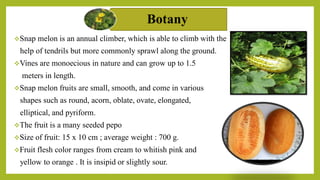
Snap melon fruits are small, smooth, and come in various
shapes such as round, acorn, oblate, ovate, elongated,
elliptical, and pyriform.
The fruit is a many seeded pepo
Size of fruit: 15 x 10 cm ; average weight : 700 g.
Fruit flesh color ranges from cream to whitish pink and
yellow to orange . It is insipid or slightly sour.
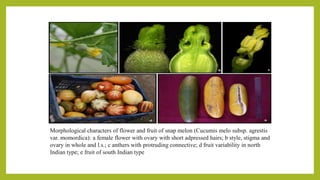
Morphological characters of flower and fruit of snap melon (Cucumis melo subsp. agrestis
var. momordica): a female flower with ovary with short adpressed hairs; b style, stigma and
ovary in whole and l.s.; c anthers with protruding connective; d fruit variability in north
Indian type; e fruit of south Indian type
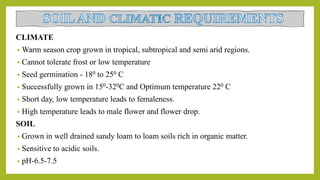
CLIMATE
• Warm season crop grown in tropical, subtropical and semi arid regions.
• Cannot tolerate frost or low temperature
• Seed germination - 180 to 250 C
• Successfully grown in 150-320C and Optimum temperature 220 C
• Short day, low temperature leads to femaleness.
• High temperature leads to male flower and flower drop.
SOIL
• Grown in well drained sandy loam to loam soils rich in organic matter.
• Sensitive to acidic soils.
• pH-6.5-7.5
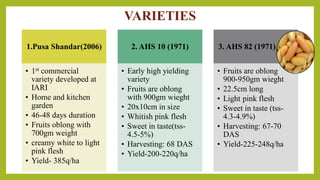
VARIETIES
1.Pusa Shandar(2006)
• 1st commercial
variety developed at
IARI
• Home and kitchen
garden
• 46-48 days duration
• Fruits oblong with
700gm weight
• creamy white to light
pink flesh
• Yield- 385q/ha
2. AHS 10 (1971)
• Early high yielding
variety
• Fruits are oblong
with 900gm wieght
• 20x10cm in size
• Whitish pink flesh
• Sweet in taste(tss-
4.5-5%)
• Harvesting: 68 DAS
• Yield-200-220q/ha
3. AHS 82 (1971)
• Fruits are oblong
900-950gm wieght
• 22.5cm long
• Light pink flesh
• Sweet in taste (tss-
4.3-4.9%)
• Harvesting: 67-70
DAS
• Yield-225-248q/ha
4.Shantiniketan SM-1
• Land race variety for the red and lateritic belt of west Bengal.
• Fruits are Less sweet in taste (tss-4.52%)
• Yeild-106.52q/ha
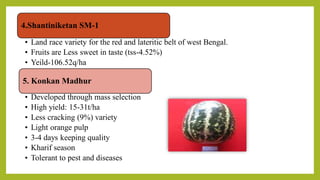
5. Konkan Madhur
• Developed through mass selection
• High yield: 15-31t/ha
• Less cracking (9%) variety
• Light orange pulp
• 3-4 days keeping quality
• Kharif season
• Tolerant to pest and diseases
SOWING TIME :
 Goa, Konkan areas of Maharashtra, Karnataka: June-July
 Rajasthan and West Bengal: January to March
 Kerala, Tamilnadu : Feb-May
SEED RATE : 2-3kg/ha
PLANTING METHOD
1. Ridge method.
o Ridge and furrow- 2.5m distance, furrow width-40-45cm, depth-15- 20cm
o Seeds are sown at a distance of 75-100cm
2. Flat bed method.
o Shallow pits of 30cm length, 30cm width and 30cm depth at a distance of 150cm between rows
and 75-100cm between plants.
o Sowing depth-1.5-2cm
Well decomposed FYM-20-25t/ha
Nitrogen- 40kg/ha
N is applied in two split doses: 1) As a basal dose at the time of last ploughing
2) At the time of flowering.
IRRIGATION:
oDepending on the soil moisture and climatic conditions, irrigation is given at a 5-7day
interval.
oIn arid and semi-arid regions, drip irrigation is most suitable for cucurbit crops.
oIn CIAH, Bikaner, use of drip and micro-sprinkler system increase fruit yield by 25-
30%
INTERCULTURAL OPERATIONS
Hoeing and Weeding:
Snap melon crops are sensitive to weeds during their initial growth stages, so
frequent weeding and hoeing are necessary to control weed growth.
The vines suppress weed growth later
Pre-plant application of fluchloralin @1.2 kg/ha effectively controls weeds and
increases snap melon yield.
Mulching :
Mulching improves soil quality by reducing water
evaporation, drying time, and solid thermal regime.
It also controls weed population and enhances microbial
activity, resulting in 58% higher fruit yield.
HARVESTING
• Snap melon is ready for harvesting : 80–90 DAS
• Early varieties mature at 46–50 DAS.
Maturity Indices
For vegetable and salad purposes: light green to dark green immature fruits are
harvested.
For table purpose: half to fully ripe fruits are
harvested.
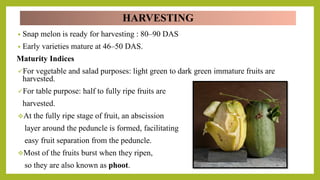
At the fully ripe stage of fruit, an abscission
layer around the peduncle is formed, facilitating
easy fruit separation from the peduncle.
Most of the fruits burst when they ripen,
so they are also known as phoot.
 Fruit yield - 150-200q/ha
 Seed yield - 1-3q/ha
 Snap melon fruits are perishable and can be stored for 2-4 days at room
temperature
 The fruits can be stored for 2-3 weeks in cold storage at 2-4°C temperature and
85-90% RH.
YIELD
STORAGE
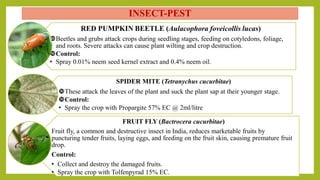
INSECT-PEST
RED PUMPKIN BEETLE (Aulacophora foveicollis lucas)
Beetles and grubs attack crops during seedling stages, feeding on cotyledons, foliage,
and roots. Severe attacks can cause plant wilting and crop destruction.
Control:
• Spray 0.01% neem seed kernel extract and 0.4% neem oil.
SPIDER MITE (Tetranychus cucurbitae)
These attack the leaves of the plant and suck the plant sap at their younger stage.
Control:
• Spray the crop with Propargite 57% EC @ 2ml/litre
FRUIT FLY (Bactrocera cucurbitae)
Fruit fly, a common and destructive insect in India, reduces marketable fruits by
puncturing tender fruits, laying eggs, and feeding on the fruit skin, causing premature fruit
drop.
Control:
• Collect and destroy the damaged fruits.
• Spray the crop with Tolfenpyrad 15% EC.
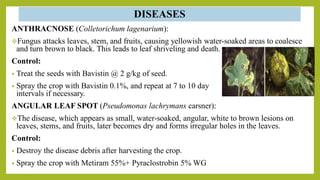
DISEASES
ANTHRACNOSE (Colletorichum lagenarium):
Fungus attacks leaves, stem, and fruits, causing yellowish water-soaked areas to coalesce
and turn brown to black. This leads to leaf shriveling and death.
Control:
• Treat the seeds with Bavistin @ 2 g/kg of seed.
• Spray the crop with Bavistin 0.1%, and repeat at 7 to 10 day
intervals if necessary.
ANGULAR LEAF SPOT (Pseudomonas lachrymans carsner):
The disease, which appears as small, water-soaked, angular, white to brown lesions on
leaves, stems, and fruits, later becomes dry and forms irregular holes in the leaves.
Control:
• Destroy the disease debris after harvesting the crop.
• Spray the crop with Metiram 55%+ Pyraclostrobin 5% WG
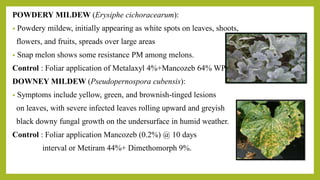
POWDERY MILDEW (Erysiphe cichoracearum):
• Powdery mildew, initially appearing as white spots on leaves, shoots,
flowers, and fruits, spreads over large areas
• Snap melon shows some resistance PM among melons.
Control : Foliar application of Metalaxyl 4%+Mancozeb 64% WP
DOWNEY MILDEW (Pseudopernospora cubensis):
• Symptoms include yellow, green, and brownish-tinged lesions
on leaves, with severe infected leaves rolling upward and greyish
black downy fungal growth on the undersurface in humid weather.
Control : Foliar application Mancozeb (0.2%) @ 10 days
interval or Metiram 44%+ Dimethomorph 9%.
Snapmelon by A.Keerthi underutilized cucurbit.pdf

Snapmelon by A.Keerthi underutilized cucurbit.pdf

  • 1.
    Presented to: Dr. SubhrajyotiChatterjee Assistant Profesor, Department of Horticulture MSSSoA Course Title: Production of Underutilized Vegetable Crops Course Code: 0508 Presented by: Akurathi Keerthi Reg No: 230805200006 M.sc (Horticulture) Vegetable science MSSSoA
  • 2.
    Scientific Name :Cucumis melo var momordica Family : Cucurbitaceae Chromosome no : 2n =2x= 24 • Ripe fruits usually crack so it is commonly called as ‘phoot,’ which means ‘to split.’ • It is also known by other names such as ‘phoot kakari’ or ‘kakadia’.
  • 3.
    Origin: • Snap melonis native to India. • It was intensively grown in the nineteenth century in northern India (Duthie, 1905). Distribution: • India is considered the main centre of diversity, where much diversity is found in germplasm. • During domestication, snap melon received wide use and it was distributed from the place of origin to other parts of the world. • Under National Field Repository of CIAH, Bikaner (Rajasthan), 65 Accession number of snap melon germplasm are maintained after massive survey and collection. • It is widely cultivated in various Indian states such as Rajasthan, Gujarat, Punjab, Haryana, Uttar Pradesh, West Bengal and some other northeastern states.
  • 4.
    AREA & PRODUTION •Minor cucurbit- 5.6 % of total vegetable production. • In arid area like Bikaner from Rajasthan nearly 28.70% farmers out of 37.75% vegetable growers grow snap melon as a sole crop in kharif and rabi season as well.
  • 5.
    • Snap melonis an important minor cucurbitaceous fruit vegetable of arid region. • It is a hardy and short duration indigenous crop with much resistance to biotic and abiotic stresses. • It is cultivated as an intercrop with sorghum, maize, pearl millet and cotton or as a sole crop in summer season. • Snap melon is a source of high fruit acidity, a trait that has been utilized to breed uniquely flavored melon cultivars. • Snap melon is resistant to aphids, ZYMV, WMV and downy mildew. • Punjab Raseela, an improved muskmelon cultivar, was created by crossing snap melon with a melon variety that is resistant to downy mildew. • Melon breeders in the USA and some other countries are using snap melon to evolve disease resistant cultivars.
  • 6.
    Immature fruits aretender at young stage are cooked or pickled; the low-sugared matured fruits are eaten raw. Sweet type which give out a musky flavor are eaten as a dessert and non- sweet types are used as vegetable, i.e. the immature fruits This nutritive and medicinal fruit is also used as a good summer drink since it reduces heat from the body. Seed kernel is used in bakery products and a traditional drink (thandai). It has prospects of value addition in pickles, jam, chutney, squashes and as dehydrated
  • 7.
    Medicinal uses Fruit canbe used as Cooling and intense cleaner and also as a natural moisturizer for skin. Treatment for burns and abrasions. Improve appetite and cure stomach pain. Help in relieving constipation and vomiting. The seeds are antitussive, digestive, febrifuge and vermifuge and roots are diuretic and emetic. As they are rich in minerals, vitamins, and dietary fibres useful for lowering blood sugar level.
  • 8.
    Botany Snap melon isan annual climber, which is able to climb with the help of tendrils but more commonly sprawl along the ground. Vines are monoecious in nature and can grow up to 1.5 meters in length. Snap melon fruits are small, smooth, and come in various shapes such as round, acorn, oblate, ovate, elongated, elliptical, and pyriform. The fruit is a many seeded pepo Size of fruit: 15 x 10 cm ; average weight : 700 g. Fruit flesh color ranges from cream to whitish pink and yellow to orange . It is insipid or slightly sour.
  • 9.
    Morphological characters offlower and fruit of snap melon (Cucumis melo subsp. agrestis var. momordica): a female flower with ovary with short adpressed hairs; b style, stigma and ovary in whole and l.s.; c anthers with protruding connective; d fruit variability in north Indian type; e fruit of south Indian type
  • 10.
    CLIMATE • Warm seasoncrop grown in tropical, subtropical and semi arid regions. • Cannot tolerate frost or low temperature • Seed germination - 180 to 250 C • Successfully grown in 150-320C and Optimum temperature 220 C • Short day, low temperature leads to femaleness. • High temperature leads to male flower and flower drop. SOIL • Grown in well drained sandy loam to loam soils rich in organic matter. • Sensitive to acidic soils. • pH-6.5-7.5
  • 11.
    VARIETIES 1.Pusa Shandar(2006) • 1stcommercial variety developed at IARI • Home and kitchen garden • 46-48 days duration • Fruits oblong with 700gm weight • creamy white to light pink flesh • Yield- 385q/ha 2. AHS 10 (1971) • Early high yielding variety • Fruits are oblong with 900gm wieght • 20x10cm in size • Whitish pink flesh • Sweet in taste(tss- 4.5-5%) • Harvesting: 68 DAS • Yield-200-220q/ha 3. AHS 82 (1971) • Fruits are oblong 900-950gm wieght • 22.5cm long • Light pink flesh • Sweet in taste (tss- 4.3-4.9%) • Harvesting: 67-70 DAS • Yield-225-248q/ha
  • 12.
    4.Shantiniketan SM-1 • Landrace variety for the red and lateritic belt of west Bengal. • Fruits are Less sweet in taste (tss-4.52%) • Yeild-106.52q/ha 5. Konkan Madhur • Developed through mass selection • High yield: 15-31t/ha • Less cracking (9%) variety • Light orange pulp • 3-4 days keeping quality • Kharif season • Tolerant to pest and diseases
  • 13.
    SOWING TIME : Goa, Konkan areas of Maharashtra, Karnataka: June-July  Rajasthan and West Bengal: January to March  Kerala, Tamilnadu : Feb-May SEED RATE : 2-3kg/ha PLANTING METHOD 1. Ridge method. o Ridge and furrow- 2.5m distance, furrow width-40-45cm, depth-15- 20cm o Seeds are sown at a distance of 75-100cm 2. Flat bed method. o Shallow pits of 30cm length, 30cm width and 30cm depth at a distance of 150cm between rows and 75-100cm between plants. o Sowing depth-1.5-2cm
  • 14.
    Well decomposed FYM-20-25t/ha Nitrogen-40kg/ha N is applied in two split doses: 1) As a basal dose at the time of last ploughing 2) At the time of flowering. IRRIGATION: oDepending on the soil moisture and climatic conditions, irrigation is given at a 5-7day interval. oIn arid and semi-arid regions, drip irrigation is most suitable for cucurbit crops. oIn CIAH, Bikaner, use of drip and micro-sprinkler system increase fruit yield by 25- 30%
  • 15.
    INTERCULTURAL OPERATIONS Hoeing andWeeding: Snap melon crops are sensitive to weeds during their initial growth stages, so frequent weeding and hoeing are necessary to control weed growth. The vines suppress weed growth later Pre-plant application of fluchloralin @1.2 kg/ha effectively controls weeds and increases snap melon yield. Mulching : Mulching improves soil quality by reducing water evaporation, drying time, and solid thermal regime. It also controls weed population and enhances microbial activity, resulting in 58% higher fruit yield.
  • 16.
    HARVESTING • Snap melonis ready for harvesting : 80–90 DAS • Early varieties mature at 46–50 DAS. Maturity Indices For vegetable and salad purposes: light green to dark green immature fruits are harvested. For table purpose: half to fully ripe fruits are harvested. At the fully ripe stage of fruit, an abscission layer around the peduncle is formed, facilitating easy fruit separation from the peduncle. Most of the fruits burst when they ripen, so they are also known as phoot.
  • 17.
     Fruit yield- 150-200q/ha  Seed yield - 1-3q/ha  Snap melon fruits are perishable and can be stored for 2-4 days at room temperature  The fruits can be stored for 2-3 weeks in cold storage at 2-4°C temperature and 85-90% RH. YIELD STORAGE
  • 18.
    INSECT-PEST RED PUMPKIN BEETLE(Aulacophora foveicollis lucas) Beetles and grubs attack crops during seedling stages, feeding on cotyledons, foliage, and roots. Severe attacks can cause plant wilting and crop destruction. Control: • Spray 0.01% neem seed kernel extract and 0.4% neem oil. SPIDER MITE (Tetranychus cucurbitae) These attack the leaves of the plant and suck the plant sap at their younger stage. Control: • Spray the crop with Propargite 57% EC @ 2ml/litre FRUIT FLY (Bactrocera cucurbitae) Fruit fly, a common and destructive insect in India, reduces marketable fruits by puncturing tender fruits, laying eggs, and feeding on the fruit skin, causing premature fruit drop. Control: • Collect and destroy the damaged fruits. • Spray the crop with Tolfenpyrad 15% EC.
  • 19.
    DISEASES ANTHRACNOSE (Colletorichum lagenarium): Fungusattacks leaves, stem, and fruits, causing yellowish water-soaked areas to coalesce and turn brown to black. This leads to leaf shriveling and death. Control: • Treat the seeds with Bavistin @ 2 g/kg of seed. • Spray the crop with Bavistin 0.1%, and repeat at 7 to 10 day intervals if necessary. ANGULAR LEAF SPOT (Pseudomonas lachrymans carsner): The disease, which appears as small, water-soaked, angular, white to brown lesions on leaves, stems, and fruits, later becomes dry and forms irregular holes in the leaves. Control: • Destroy the disease debris after harvesting the crop. • Spray the crop with Metiram 55%+ Pyraclostrobin 5% WG
  • 20.
    POWDERY MILDEW (Erysiphecichoracearum): • Powdery mildew, initially appearing as white spots on leaves, shoots, flowers, and fruits, spreads over large areas • Snap melon shows some resistance PM among melons. Control : Foliar application of Metalaxyl 4%+Mancozeb 64% WP DOWNEY MILDEW (Pseudopernospora cubensis): • Symptoms include yellow, green, and brownish-tinged lesions on leaves, with severe infected leaves rolling upward and greyish black downy fungal growth on the undersurface in humid weather. Control : Foliar application Mancozeb (0.2%) @ 10 days interval or Metiram 44%+ Dimethomorph 9%.