Identity Theft, Credit Cards &
Other Important Information for
College Students
Presented by: Tri-State Better Business Bureau
3101 N. Green River Rd., Suite 410
Evansville, IN 47715
Phone: 812-473-0202, 800-359-0979
Email: info@evansville.bbb.org
Web Address: www.evansville.bbb.org
1
∗ 501(c)(6) nonprofit organization
∗ Information source
∗ Objective, unbiased information
∗BBB Business Reviews
∗BBB Wise Giving Reports
∗Dispute Resolution
∗Advertising Review
About Your BBB
2
∗Identity Theft
∗College Students & Credit
∗How to Be a Savvy Consumer
What are we going to discuss?
3
∗ 12.6 million victims in 2012
∗ $20.9 BILLION in losses in 2012
∗ $365-Average cost to a consumer
∗ YOU DON’T KNOW UNTIL IT’S ALREADY
HAPPENED!!
Identity Theft
4
∗It occurs when someone steals your
personal information like credit
cards or your social security number
and uses it fraudulently
∗It can cost you time and money
∗It can destroy your credit and ruin
your good name
What is Identity Theft?
5
∗Your Social Security card
∗Your driver’s license
∗Your account numbers
∗Other personal information:
∗Address
∗Mother’s maiden name
∗DOB
What does the thief want?
6
What steps can you take to deter
identity thieves?
∗ Safeguard Your Information
∗ Don’t use obvious passwords
∗ Avoid carrying your Social
Security number and driver’s
license together.
∗ Request that your Social
Security number not be used
to publicly post grades.
∗ If the school uses your Social
Security number for your
student I.D., request an
assigned number.
∗ Don’t give out personal
information unless you are
sure who you are dealing with.
∗ Send sensitive information to
your home address.
∗ Avoid putting outgoing mail in
unsecured campus mailboxes.
∗ Don’t shop online or pay a bill on
a public computer or public wi-fi
connection.
∗ Shred any pre-approved credit
card offers and bills before
disposing of them.
∗ Limit the amount of personal
information you place online.
This includes “time and place”
data i.e. “At the movies” or “On
Spring Break”.
7
Most Frequently Used
Passwords
8
1.password
2.123456
3.12345678
4.abc123
5.qwerty
6.monkey
7.letmein
8.dragon
9.111111
10. baseball
11. iloveyou
12. trustno1
13. 1234567
14. sunshine
15. master
16. 123123
17. welcome
18. shadow
19. ashley
20. football
21. jesus
22. michael
23. ninja
24. mustang
25. password1
∗ Data on your Smartphone can compromise your identity
∗ How to protect your data:
∗ Password protect your phone with a complex and
unique password and set your phone to auto-lock
∗ Enable a service with remote tracking
∗ Turn Bluetooth off if you’re not using it. Thieves can
pair their Bluetooth device with yours and hack personal
information
∗ Be careful on Wi-Fi networks
∗ Before downloading any apps to your phone, always do
a quick search to make sure it comes from a legitimate
site or publisher and read the “permissions” (what the
app is allowed to do).
Tips for Smartphone Users
9
How do you detect and defend
against identity theft?
∗ DETECT
∗ Routinely monitor bills
and be alert if one
doesn’t arrive
∗ Inspect your Credit
Report
∗ www.annualcreditreport.com
or 877-322-8228
∗ Inspect your bank
statements and credit
card bills for unusual
charges
∗ DEFEND
∗ As soon as you detect a problem:
∗ Place a “Fraud Alert” on your credit reports by
calling any one of the three nationwide credit
reporting companies
∗ Close accounts that have been tampered with or
opened fraudulently
∗ File a police report
∗ Contact the Federal Trade Commission
∗ 1-877-438-4338 or
www.consumer.ftc.gov/features/feature-0014-iden
∗ Contact your Attorney General
∗ Indiana ID Theft Unit: 1-800-382-5516 or
http://www.in.gov/attorneygeneral/2853.htm
∗ Kentucky: 1-502-696-5389 or
http://ag.ky.gov/civil/consumerprotection/idtheft/
∗ Illinois: 1-866-999-5630
http://illinoisattorneygeneral.gov/consumers/Id
entity_Theft_Resource_Guide.pdf
∗ Contact creditors, banks, utility companies, etc.
∗ Keep detailed record of actions you take and all
correspondence
10
Credit Cards & Students
11
∗ Credit Card-You can use this card to buy things and
pay over time; however, it is considered a loan and
must be paid back. If you don’t pay the card off, you
will be charged a finance charge. The dollar amount
you pay depends on how much you owe and the APR
on the account.
∗ Debit Card-This type of card typically allows you real-
time access to your money through savings or
checking account. Keep in mind that if you don’t
watch your balance closely, you could be charged
overdraft fees.
∗ Charge Card-With this type of card, you must pay the
balance in full each time you receive the bill.
Plastic 101
12
If you choose to get a credit card,
read the fine print.
∗ Annual percentage rate (APR)-
the measure of the cost of credit
expressed as a yearly interest
rate. This percentage must be
disclosed before you open the
account and your account
statement.
∗ Watch out for “intro” rates that
may only be in effect for a set
number of months then increase
after that time expires.
∗ Annual fees-Some cards charge a
membership or participation fee.
(This can be charged annually or
monthly)
∗ Transaction fees and other
charges-Some issuers charge a
fee if you use the card to get a
cash advance, make a late
payment or exceed your credit
limit. Some may charge a fee if
you use the card or if you
don’t.
∗ Customer Service-You may
take this for granted until
something goes wrong. Keep
an eye out for issuers with a 24-
hour toll-free telephone
number.
13
14
www.betterloanchoice.com
Bad Credit Loan Matching
Better Loan Choice will analyze the information you provide in your application and match you to a lender for either good credit loans or bad credit loans. Finding loans for borrowers with bad credit
can be challenging, but through our network of lenders, we have been successful. Although we are always able to match an applicant with a lender, this does not guarantee that you will receive a
loan offer. If you are matched with a payday lender, we recommend that you review all of the information on our website that explains the disadvantages of payday/cash advance loans and all fee
and rate information from any payday/cash advance lender pertaining to any loan being offered to you before you agree to the terms of the loan.
Traditional Lenders
When you are matched with one of our traditional lenders, you can expect your APR to range from 6.50% to 36.00%.
Personal Loan Information and Security
We know that entrusting your personal information to others can be stressful, especially online! We want to ensure you that we take our obligations to protect your personal information seriously.
We use the latest web security best practices to protect your data including providing 256 bit encryption on all of the pages on which you provide your personal loans application data. Please see our
Privacy Policy and the disclaimer entitled “Important Information About the Services Offered by BetterLoanChoice.com and How the Information You Provide to Us Will Be Used,” which appears at
the bottom of every page of our website, for information about the use and disclosure of your personal information.
Peer to Peer Lenders
When you are matched with one of our Peer to Peer Lenders, you can expect your APR to range from 6.59% to 35.84%.
If you are matched to a short-term lender please read the following important information:
Consumer Notice: A cash advance, also referred to as a payday loan or payday advance, is a small, short-term loan that is intended to cover a borrower’s expenses until the following payday. Cash
advances are intended for short-term financial relief and do not constitute long-term financial solutions. Consumers facing debt and credit difficulties should seek out debt and credit advisory help.
Consumers are encouraged to consult the federal, state, and local governments to learn more about the risks involved with cash advances, local laws and regulations governing cash advances,
possible loan alternatives and recent developments in their state. Consumers with credit difficulties should seek credit counseling.
Payday Lenders
When you are matched with one of our payday lenders, you can expect your APR to range from 353.23% to 2,737.50%.
Short-Term Lenders
When you are matched with one of our short-term lenders, you can expect your APR to range from 199.44% to 448.76%.
Financial Implications
The following is a representative of our network of participating lenders: If you are unable to repay your loan in a timely manner, you may be assessed one or all of the following - late fees,
administrative fees, non-payment fees, insufficient fund fees, court costs, and legal fees. In addition, unpaid fees may accumulate interest. The lender you are matched to will disclose all potential
fees. Fees may range from $25 to $2,000 based on applicable state law maximums.
Collection Practices
If you are unable to repay your loan, collections efforts will begin immediately by the lender you provides you a loan. Collections practices vary by lender, and all lenders are subject to the Fair Debt
Collection Practices Act. Debt collection efforts may include the following: telephone calls to your home or place of employment between the hours of 8:00 a.m. and 9:00 p.m., voicemail messages,
notices by mail, and door to door. Debt collectors may not harass you, make false statements, threaten arrest, or engage in any other unfair practices.
Credit Score Implications
If you fail to pay your loan on a timely basis, your lender may report your delinquency to a credit reporting agency. If the lender reports your delinquency, you can expect your credit score to
decrease. If your credit score decreases this will make your cost to borrow become more expensive and, depending your level of debt and other factors, you may be unable to borrow money from
any lender in the future. Be aware of the implications of failing to make timely payments.
∗ Shop around for a carrier.
∗ Look for APR that is 15% or lower.
∗ Look for carriers that offer no annual fees.
∗ Be sure to know if the rate is going to increase, and what the
increase percentage is.
∗ Read the fine print in the Terms and Conditions.
∗ Stick with one card and use it sparingly. Only charge what you are
capable of paying back at the end of the month.
∗ Pay off your balance each month.
∗ Make your payment as early as possible in the month to avoid late
charges.
∗ Periodically call and ask for a lower interest rate.
Tips to Avoid Credit Card Debt
15
Credit Card Accountability,
Responsibility and Disclosure Act of
2009 aka Credit  CARD Act of 2009
Provides the following protections for college students:
•To open a credit card account if under 21, you will need to show
that you have the income to make required payments or get a co-
signer 21 or older who has the ability to do so.
•Once you have a card with a co-signer, if you want a higher credit
card limit, the co-signer must agree in writing to the increase.
•Credit card companies are prohibited from marketing credit cards
and from offering pizza, T-shirts, hats, and other freebies within
1,000 feet of a college campus.
•Colleges and universities, as well as alumni organizations, will have
to annually disclose the terms of any marketing or promotional
agreements they make with credit card companies.16
∗BBB has partnered with the
following organizations to help
consumers make wise financial
decisions:
BBB Financial Resources
for Consumers
17
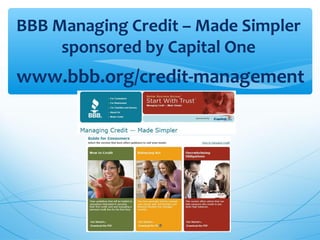
BBB Managing Credit – Made Simpler
sponsored by Capital One
www.bbb.org/credit-management
18
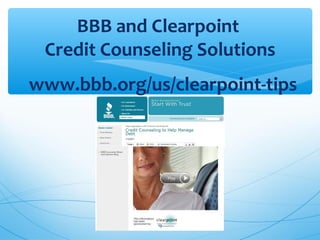
BBB and Clearpoint
Credit Counseling Solutions
www.bbb.org/us/clearpoint-tips
19
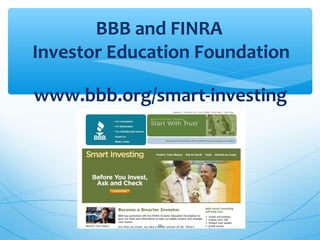
BBB and FINRA
Investor Education Foundation
www.bbb.org/smart-investing
20
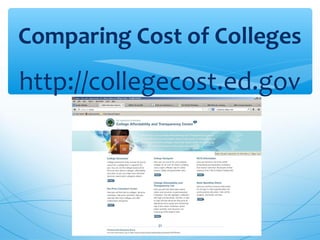
Comparing Cost of Colleges
http://collegecost.ed.gov
21
How to Be a Savvy Consumer
1.Look for the BBB
seal and always
check out a
business with your
BBB before you
buy.
22
2) Sign up for the BBB Smart Tips for
Consumers eNewsletter.
There are 5 different
eNewsletters you can sign up
for:
Smart Tips for Consumers,
Scam Alerts, The Trusted
Scout, Smart Investing, and
Wise Giving.
https://cbbb.wufoo.com/forms/email-sign-up/
23
3) Beware of job offers to make
easy money.
Beware of any job offer, work-at-home
scheme or business opportunity that
promises big money for little work
and no experience.
24
4) Always read the fine print
especially for free trial offers.
Thousands of consumers complained to the
BBB after signing up for a free trial offer
online that resulted in repeated charges to
their credit or debit cards sometimes
amounting to as much as hundreds of dollars
every month. Read the terms and conditions of
any free trial offer before handing over credit or
debit card numbers.
25
5) Keep your computer safe.
Make sure you use strong passwords
with capital and lowercase letters,
numbers, and characters. Have a good
antivirus and anti-malware program
installed and conduct regular scans.
26
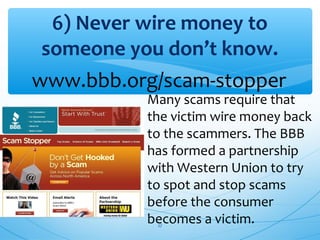
6) Never wire money to
someone you don’t know.
Many scams require that
the victim wire money back
to the scammers. The BBB
has formed a partnership
with Western Union to try
to spot and stop scams
before the consumer
becomes a victim.
www.bbb.org/scam-stopper
27
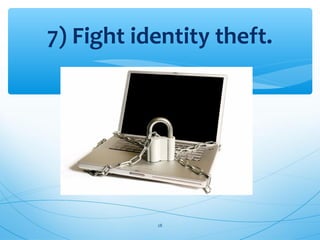
7) Fight identity theft.
28
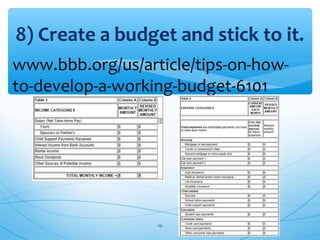
8) Create a budget and stick to it.
www.bbb.org/us/article/tips-on-how-
to-develop-a-working-budget-6101
29
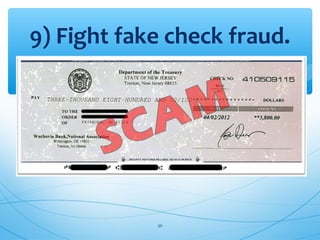
9) Fight fake check fraud.
30
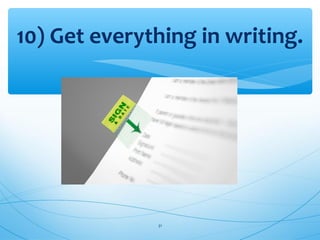
10) Get everything in writing.
31

Identity Theft for College Students

  • 1.
    Identity Theft, CreditCards & Other Important Information for College Students Presented by: Tri-State Better Business Bureau 3101 N. Green River Rd., Suite 410 Evansville, IN 47715 Phone: 812-473-0202, 800-359-0979 Email: info@evansville.bbb.org Web Address: www.evansville.bbb.org 1
  • 2.
    ∗ 501(c)(6) nonprofitorganization ∗ Information source ∗ Objective, unbiased information ∗BBB Business Reviews ∗BBB Wise Giving Reports ∗Dispute Resolution ∗Advertising Review About Your BBB 2
  • 3.
    ∗Identity Theft ∗College Students& Credit ∗How to Be a Savvy Consumer What are we going to discuss? 3
  • 4.
    ∗ 12.6 millionvictims in 2012 ∗ $20.9 BILLION in losses in 2012 ∗ $365-Average cost to a consumer ∗ YOU DON’T KNOW UNTIL IT’S ALREADY HAPPENED!! Identity Theft 4
  • 5.
    ∗It occurs whensomeone steals your personal information like credit cards or your social security number and uses it fraudulently ∗It can cost you time and money ∗It can destroy your credit and ruin your good name What is Identity Theft? 5
  • 6.
    ∗Your Social Securitycard ∗Your driver’s license ∗Your account numbers ∗Other personal information: ∗Address ∗Mother’s maiden name ∗DOB What does the thief want? 6
  • 7.
    What steps canyou take to deter identity thieves? ∗ Safeguard Your Information ∗ Don’t use obvious passwords ∗ Avoid carrying your Social Security number and driver’s license together. ∗ Request that your Social Security number not be used to publicly post grades. ∗ If the school uses your Social Security number for your student I.D., request an assigned number. ∗ Don’t give out personal information unless you are sure who you are dealing with. ∗ Send sensitive information to your home address. ∗ Avoid putting outgoing mail in unsecured campus mailboxes. ∗ Don’t shop online or pay a bill on a public computer or public wi-fi connection. ∗ Shred any pre-approved credit card offers and bills before disposing of them. ∗ Limit the amount of personal information you place online. This includes “time and place” data i.e. “At the movies” or “On Spring Break”. 7
  • 8.
    Most Frequently Used Passwords 8 1.password 2.123456 3.12345678 4.abc123 5.qwerty 6.monkey 7.letmein 8.dragon 9.111111 10.baseball 11. iloveyou 12. trustno1 13. 1234567 14. sunshine 15. master 16. 123123 17. welcome 18. shadow 19. ashley 20. football 21. jesus 22. michael 23. ninja 24. mustang 25. password1
  • 9.
    ∗ Data onyour Smartphone can compromise your identity ∗ How to protect your data: ∗ Password protect your phone with a complex and unique password and set your phone to auto-lock ∗ Enable a service with remote tracking ∗ Turn Bluetooth off if you’re not using it. Thieves can pair their Bluetooth device with yours and hack personal information ∗ Be careful on Wi-Fi networks ∗ Before downloading any apps to your phone, always do a quick search to make sure it comes from a legitimate site or publisher and read the “permissions” (what the app is allowed to do). Tips for Smartphone Users 9
  • 10.
    How do youdetect and defend against identity theft? ∗ DETECT ∗ Routinely monitor bills and be alert if one doesn’t arrive ∗ Inspect your Credit Report ∗ www.annualcreditreport.com or 877-322-8228 ∗ Inspect your bank statements and credit card bills for unusual charges ∗ DEFEND ∗ As soon as you detect a problem: ∗ Place a “Fraud Alert” on your credit reports by calling any one of the three nationwide credit reporting companies ∗ Close accounts that have been tampered with or opened fraudulently ∗ File a police report ∗ Contact the Federal Trade Commission ∗ 1-877-438-4338 or www.consumer.ftc.gov/features/feature-0014-iden ∗ Contact your Attorney General ∗ Indiana ID Theft Unit: 1-800-382-5516 or http://www.in.gov/attorneygeneral/2853.htm ∗ Kentucky: 1-502-696-5389 or http://ag.ky.gov/civil/consumerprotection/idtheft/ ∗ Illinois: 1-866-999-5630 http://illinoisattorneygeneral.gov/consumers/Id entity_Theft_Resource_Guide.pdf ∗ Contact creditors, banks, utility companies, etc. ∗ Keep detailed record of actions you take and all correspondence 10
  • 11.
    Credit Cards &Students 11
  • 12.
    ∗ Credit Card-Youcan use this card to buy things and pay over time; however, it is considered a loan and must be paid back. If you don’t pay the card off, you will be charged a finance charge. The dollar amount you pay depends on how much you owe and the APR on the account. ∗ Debit Card-This type of card typically allows you real- time access to your money through savings or checking account. Keep in mind that if you don’t watch your balance closely, you could be charged overdraft fees. ∗ Charge Card-With this type of card, you must pay the balance in full each time you receive the bill. Plastic 101 12
  • 13.
    If you chooseto get a credit card, read the fine print. ∗ Annual percentage rate (APR)- the measure of the cost of credit expressed as a yearly interest rate. This percentage must be disclosed before you open the account and your account statement. ∗ Watch out for “intro” rates that may only be in effect for a set number of months then increase after that time expires. ∗ Annual fees-Some cards charge a membership or participation fee. (This can be charged annually or monthly) ∗ Transaction fees and other charges-Some issuers charge a fee if you use the card to get a cash advance, make a late payment or exceed your credit limit. Some may charge a fee if you use the card or if you don’t. ∗ Customer Service-You may take this for granted until something goes wrong. Keep an eye out for issuers with a 24- hour toll-free telephone number. 13
  • 14.
    14 www.betterloanchoice.com Bad Credit LoanMatching Better Loan Choice will analyze the information you provide in your application and match you to a lender for either good credit loans or bad credit loans. Finding loans for borrowers with bad credit can be challenging, but through our network of lenders, we have been successful. Although we are always able to match an applicant with a lender, this does not guarantee that you will receive a loan offer. If you are matched with a payday lender, we recommend that you review all of the information on our website that explains the disadvantages of payday/cash advance loans and all fee and rate information from any payday/cash advance lender pertaining to any loan being offered to you before you agree to the terms of the loan. Traditional Lenders When you are matched with one of our traditional lenders, you can expect your APR to range from 6.50% to 36.00%. Personal Loan Information and Security We know that entrusting your personal information to others can be stressful, especially online! We want to ensure you that we take our obligations to protect your personal information seriously. We use the latest web security best practices to protect your data including providing 256 bit encryption on all of the pages on which you provide your personal loans application data. Please see our Privacy Policy and the disclaimer entitled “Important Information About the Services Offered by BetterLoanChoice.com and How the Information You Provide to Us Will Be Used,” which appears at the bottom of every page of our website, for information about the use and disclosure of your personal information. Peer to Peer Lenders When you are matched with one of our Peer to Peer Lenders, you can expect your APR to range from 6.59% to 35.84%. If you are matched to a short-term lender please read the following important information: Consumer Notice: A cash advance, also referred to as a payday loan or payday advance, is a small, short-term loan that is intended to cover a borrower’s expenses until the following payday. Cash advances are intended for short-term financial relief and do not constitute long-term financial solutions. Consumers facing debt and credit difficulties should seek out debt and credit advisory help. Consumers are encouraged to consult the federal, state, and local governments to learn more about the risks involved with cash advances, local laws and regulations governing cash advances, possible loan alternatives and recent developments in their state. Consumers with credit difficulties should seek credit counseling. Payday Lenders When you are matched with one of our payday lenders, you can expect your APR to range from 353.23% to 2,737.50%. Short-Term Lenders When you are matched with one of our short-term lenders, you can expect your APR to range from 199.44% to 448.76%. Financial Implications The following is a representative of our network of participating lenders: If you are unable to repay your loan in a timely manner, you may be assessed one or all of the following - late fees, administrative fees, non-payment fees, insufficient fund fees, court costs, and legal fees. In addition, unpaid fees may accumulate interest. The lender you are matched to will disclose all potential fees. Fees may range from $25 to $2,000 based on applicable state law maximums. Collection Practices If you are unable to repay your loan, collections efforts will begin immediately by the lender you provides you a loan. Collections practices vary by lender, and all lenders are subject to the Fair Debt Collection Practices Act. Debt collection efforts may include the following: telephone calls to your home or place of employment between the hours of 8:00 a.m. and 9:00 p.m., voicemail messages, notices by mail, and door to door. Debt collectors may not harass you, make false statements, threaten arrest, or engage in any other unfair practices. Credit Score Implications If you fail to pay your loan on a timely basis, your lender may report your delinquency to a credit reporting agency. If the lender reports your delinquency, you can expect your credit score to decrease. If your credit score decreases this will make your cost to borrow become more expensive and, depending your level of debt and other factors, you may be unable to borrow money from any lender in the future. Be aware of the implications of failing to make timely payments.
  • 15.
    ∗ Shop aroundfor a carrier. ∗ Look for APR that is 15% or lower. ∗ Look for carriers that offer no annual fees. ∗ Be sure to know if the rate is going to increase, and what the increase percentage is. ∗ Read the fine print in the Terms and Conditions. ∗ Stick with one card and use it sparingly. Only charge what you are capable of paying back at the end of the month. ∗ Pay off your balance each month. ∗ Make your payment as early as possible in the month to avoid late charges. ∗ Periodically call and ask for a lower interest rate. Tips to Avoid Credit Card Debt 15
  • 16.
    Credit Card Accountability, Responsibilityand Disclosure Act of 2009 aka Credit  CARD Act of 2009 Provides the following protections for college students: •To open a credit card account if under 21, you will need to show that you have the income to make required payments or get a co- signer 21 or older who has the ability to do so. •Once you have a card with a co-signer, if you want a higher credit card limit, the co-signer must agree in writing to the increase. •Credit card companies are prohibited from marketing credit cards and from offering pizza, T-shirts, hats, and other freebies within 1,000 feet of a college campus. •Colleges and universities, as well as alumni organizations, will have to annually disclose the terms of any marketing or promotional agreements they make with credit card companies.16
  • 17.
    ∗BBB has partneredwith the following organizations to help consumers make wise financial decisions: BBB Financial Resources for Consumers 17
  • 18.
    BBB Managing Credit– Made Simpler sponsored by Capital One www.bbb.org/credit-management 18
  • 19.
    BBB and Clearpoint CreditCounseling Solutions www.bbb.org/us/clearpoint-tips 19
  • 20.
    BBB and FINRA InvestorEducation Foundation www.bbb.org/smart-investing 20
  • 21.
    Comparing Cost ofColleges http://collegecost.ed.gov 21
  • 22.
    How to Bea Savvy Consumer 1.Look for the BBB seal and always check out a business with your BBB before you buy. 22
  • 23.
    2) Sign upfor the BBB Smart Tips for Consumers eNewsletter. There are 5 different eNewsletters you can sign up for: Smart Tips for Consumers, Scam Alerts, The Trusted Scout, Smart Investing, and Wise Giving. https://cbbb.wufoo.com/forms/email-sign-up/ 23
  • 24.
    3) Beware ofjob offers to make easy money. Beware of any job offer, work-at-home scheme or business opportunity that promises big money for little work and no experience. 24
  • 25.
    4) Always readthe fine print especially for free trial offers. Thousands of consumers complained to the BBB after signing up for a free trial offer online that resulted in repeated charges to their credit or debit cards sometimes amounting to as much as hundreds of dollars every month. Read the terms and conditions of any free trial offer before handing over credit or debit card numbers. 25
  • 26.
    5) Keep yourcomputer safe. Make sure you use strong passwords with capital and lowercase letters, numbers, and characters. Have a good antivirus and anti-malware program installed and conduct regular scans. 26
  • 27.
    6) Never wiremoney to someone you don’t know. Many scams require that the victim wire money back to the scammers. The BBB has formed a partnership with Western Union to try to spot and stop scams before the consumer becomes a victim. www.bbb.org/scam-stopper 27
  • 28.
  • 29.
    8) Create abudget and stick to it. www.bbb.org/us/article/tips-on-how- to-develop-a-working-budget-6101 29
  • 30.
    9) Fight fakecheck fraud. 30
  • 31.
    10) Get everythingin writing. 31

Editor's Notes

  • #3 We are not a government agency or a credit bureau. (Read slide) We cover an 18 county area: 11 in IN, 5 in IL, 2 in KY
  • #5 Stats from Javelin Strategy and Research
  • #7 Also, if you’re on social networking sites, such as FB, avoid revealing info such as names of pets, street you grew up on, where you met your spouse, etc. All these pieces of info ID thieves can use to answer security questions for your various accounts. Next, we’ll take a quick look at the most frequently hacked passwords.
  • #8 Next, we’ll take a quick look at the most frequently used (and hacked) passwords.
  • #9 1. password 2. 123456 3. 12345678 4. abc123 5. qwerty 6. monkey 7. letmein 8. dragon 9. 111111 10. baseball 11. iloveyou 12. trustno1 13. 1234567 14. sunshine 15. master 16. 123123 17. welcome 18. shadow 19. ashley 20. football 21. jesus 22. michael 23. ninja 24. Mustang 25. password1 According to IC3 a password needs to be long but still easy to remember; suggest including song lyrics & point out that this can make a password longer than just a random group of letters and numbers. And since lyrics are easy to remember you can have different passwords for different accounts making things more difficult for hackers and safer for you. Other general tips for password strength include using a variety of capital and lower case letters along with numbers and symbols. Even putting names of pets, children, schools attended on social media sites, can give ID thieves clues to answers to security questions.
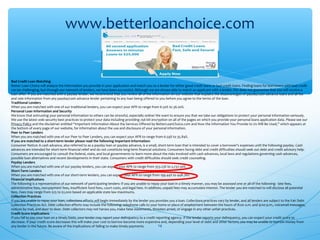
  • #15 Example of fine print. Payday Lenders APR from 353.23% to 2,737.50%. Short Term Lenders APR from 199.44% to 448.76%.
  • #25 Craigslist job scams; if it sounds too good to be true, it probably is
  • #31 Ways to spot a fake check: