Last Updated: Jan. 2014
Tech	
  Lead	
  
Chamath	
  Gunawardana	
  
Iden/ty	
  and	
  En/tlement	
  
Management	
  –	
  Concepts	
  and	
  
Theories	
  
2	
  
About	
  the	
  Presenter(s)	
  
๏  Chamath	
  Gunawardana	
  
Chamath	
  Gunwardana	
  is	
  a	
  technical	
  lead	
  at	
  
WSO2	
  working	
  for	
  the	
  integra/on	
  technology	
  
group.	
  He's	
  engaged	
  in	
  the	
  developments	
  of	
  
the	
  WSO2	
  Iden/ty	
  Server	
  and	
  also	
  a	
  
commiKer	
  of	
  the	
  WSO2	
  Iden/ty	
  Server.	
  
Chamath	
  is	
  also	
  a	
  SUN	
  cer/fied	
  java	
  
programmer.	
  	
  
3	
  
About	
  WSO2	
  
๏  Global	
  enterprise,	
  founded	
  in	
  2005	
  
by	
  acknowledged	
  leaders	
  in	
  XML,	
  
web	
  services	
  	
  technologies,	
  
standards	
  	
  and	
  open	
  source	
  
๏  Provides	
  only	
  open	
  source	
  
plaVorm-­‐as-­‐a-­‐service	
  for	
  private,	
  
public	
  and	
  hybrid	
  cloud	
  
deployments	
  
๏  All	
  WSO2	
  products	
  are	
  100%	
  open	
  
source	
  and	
  released	
  under	
  the	
  
Apache	
  License	
  Version	
  2.0.	
  
๏  Is	
  an	
  Ac/ve	
  Member	
  of	
  OASIS,	
  
Cloud	
  Security	
  Alliance,	
  OSGi	
  
Alliance,	
  AMQP	
  Working	
  Group,	
  
OpenID	
  Founda/on	
  and	
  W3C.	
  
๏  Driven	
  by	
  Innova/on	
  
๏  Launched	
  first	
  open	
  source	
  API	
  
Management	
  solu/on	
  in	
  2012	
  
๏  Launched	
  App	
  Factory	
  in	
  2Q	
  2013	
  
๏  Launched	
  Enterprise	
  Store	
  and	
  
first	
  open	
  source	
  Mobile	
  solu/on	
  
in	
  4Q	
  2013	
  
4	
  
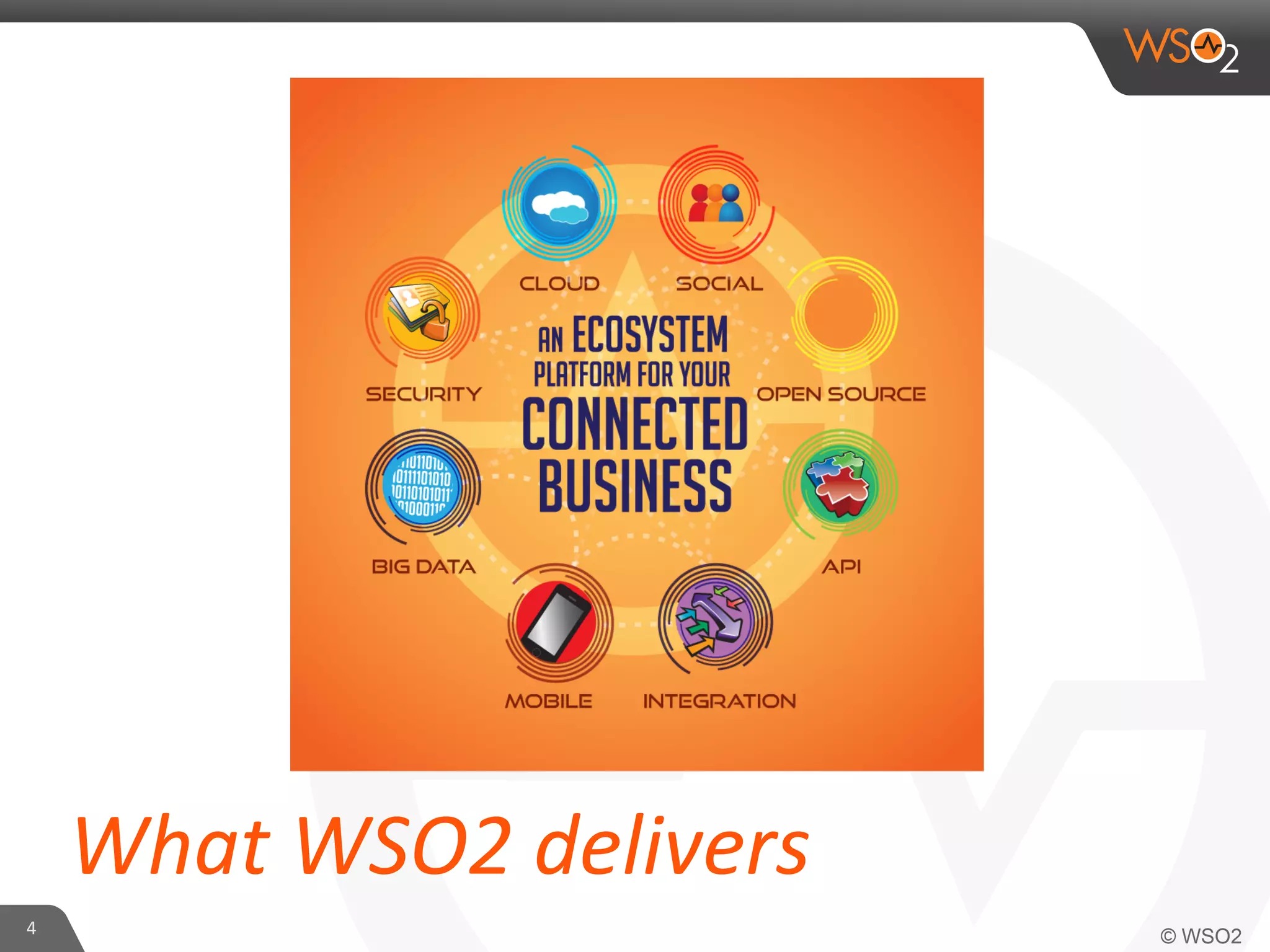
What	
  WSO2	
  delivers	
  
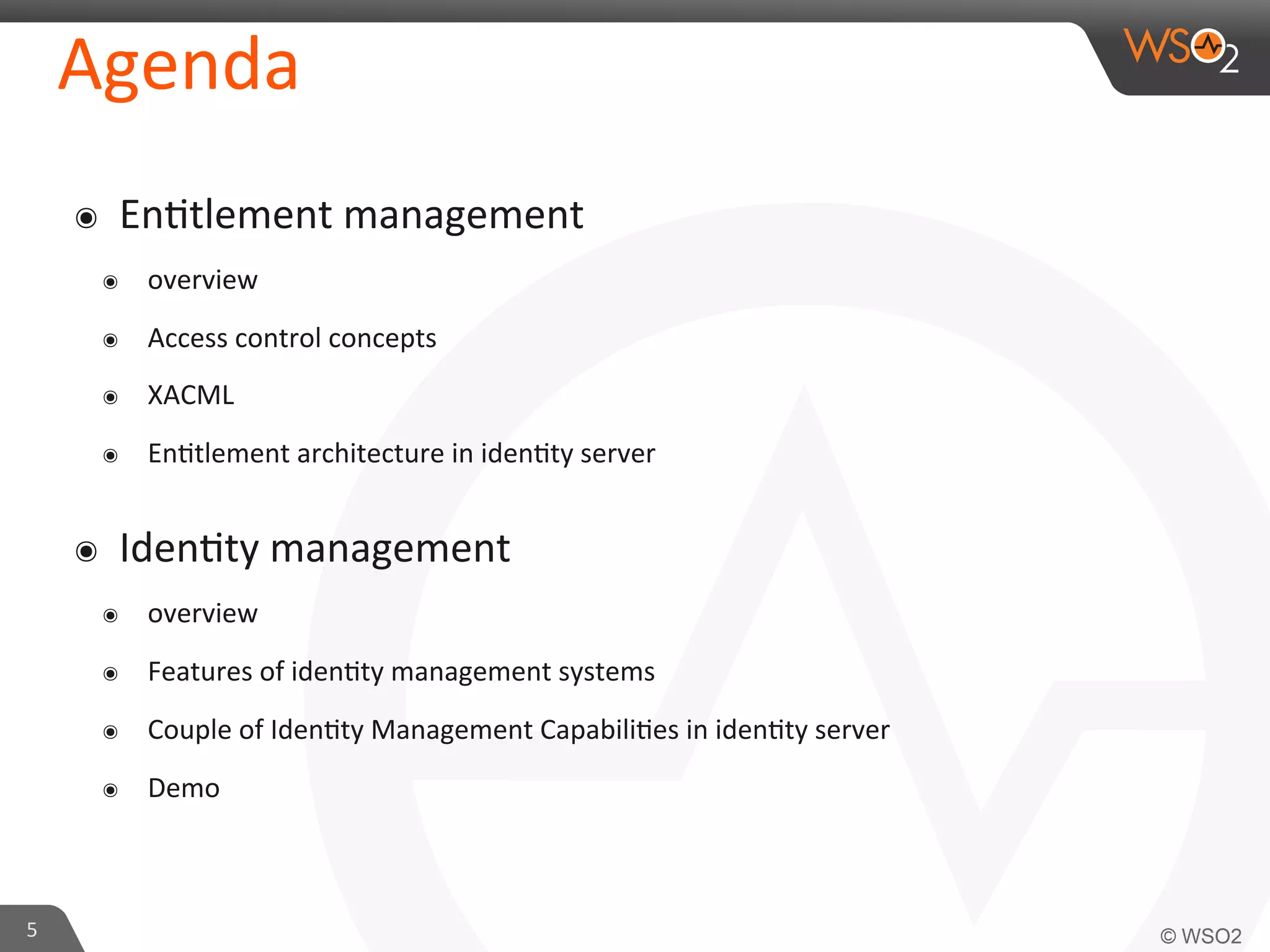
Agenda	
  
๏  En/tlement	
  management	
  
๏  overview	
  
๏  Access	
  control	
  concepts	
  
๏  XACML	
  
๏  En/tlement	
  architecture	
  in	
  iden/ty	
  server	
  
๏  Iden/ty	
  management	
  
๏  overview	
  
๏  Features	
  of	
  iden/ty	
  management	
  systems	
  
๏  Couple	
  of	
  Iden/ty	
  Management	
  Capabili/es	
  in	
  iden/ty	
  server	
  
๏  Demo	
  
5	
  
What	
  is	
  En/tlement	
  Mng..	
  
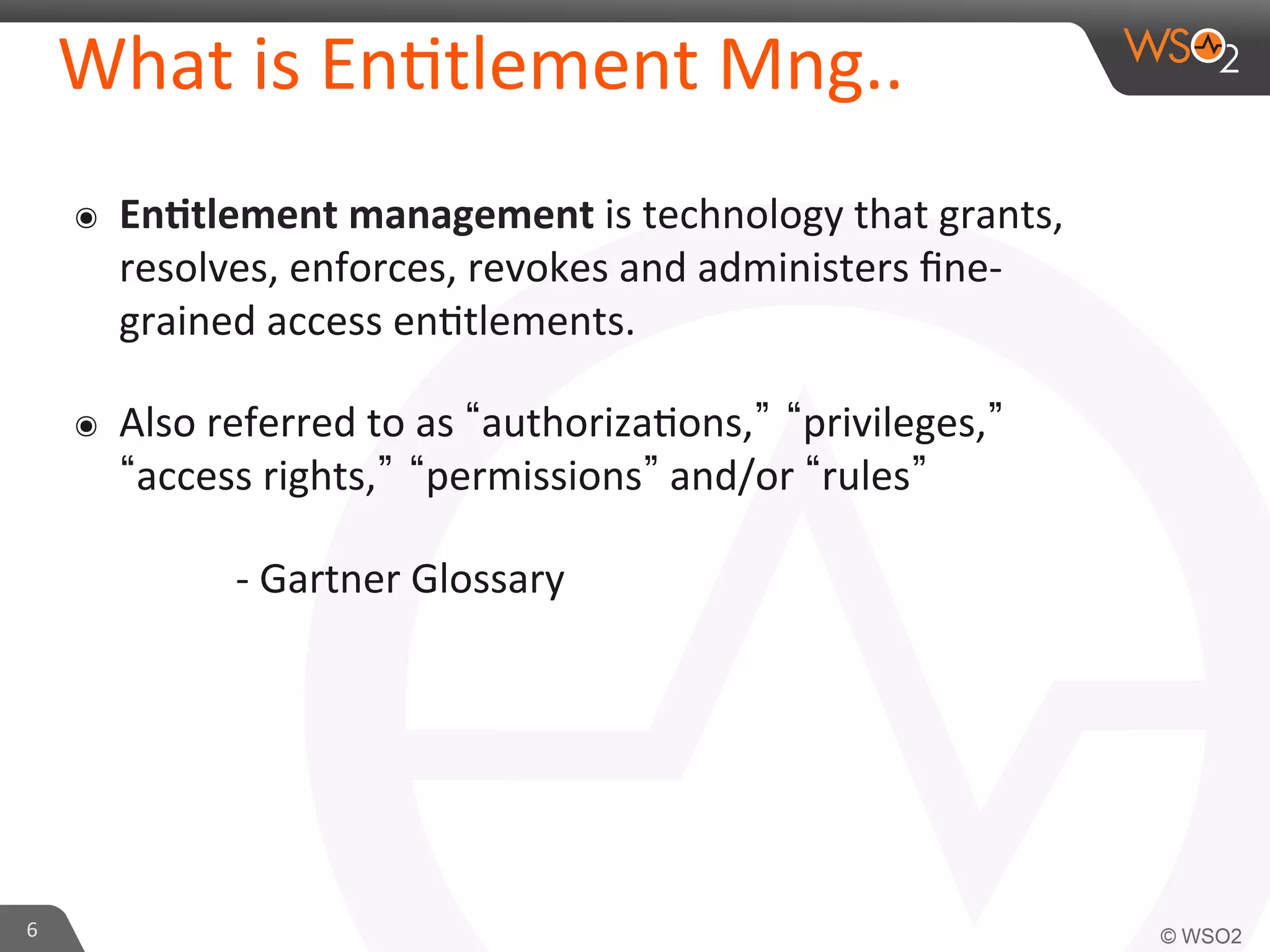
๏  En#tlement	
  management	
  is	
  technology	
  that	
  grants,	
  
resolves,	
  enforces,	
  revokes	
  and	
  administers	
  fine-­‐
grained	
  access	
  en/tlements.	
  
๏  Also	
  referred	
  to	
  as	
   authoriza/ons, privileges,
access	
  rights, permissions 	
  and/or	
   rules 	


  -­‐	
  Gartner	
  Glossary	
  
6	
  
En/tlement	
  Management	
  
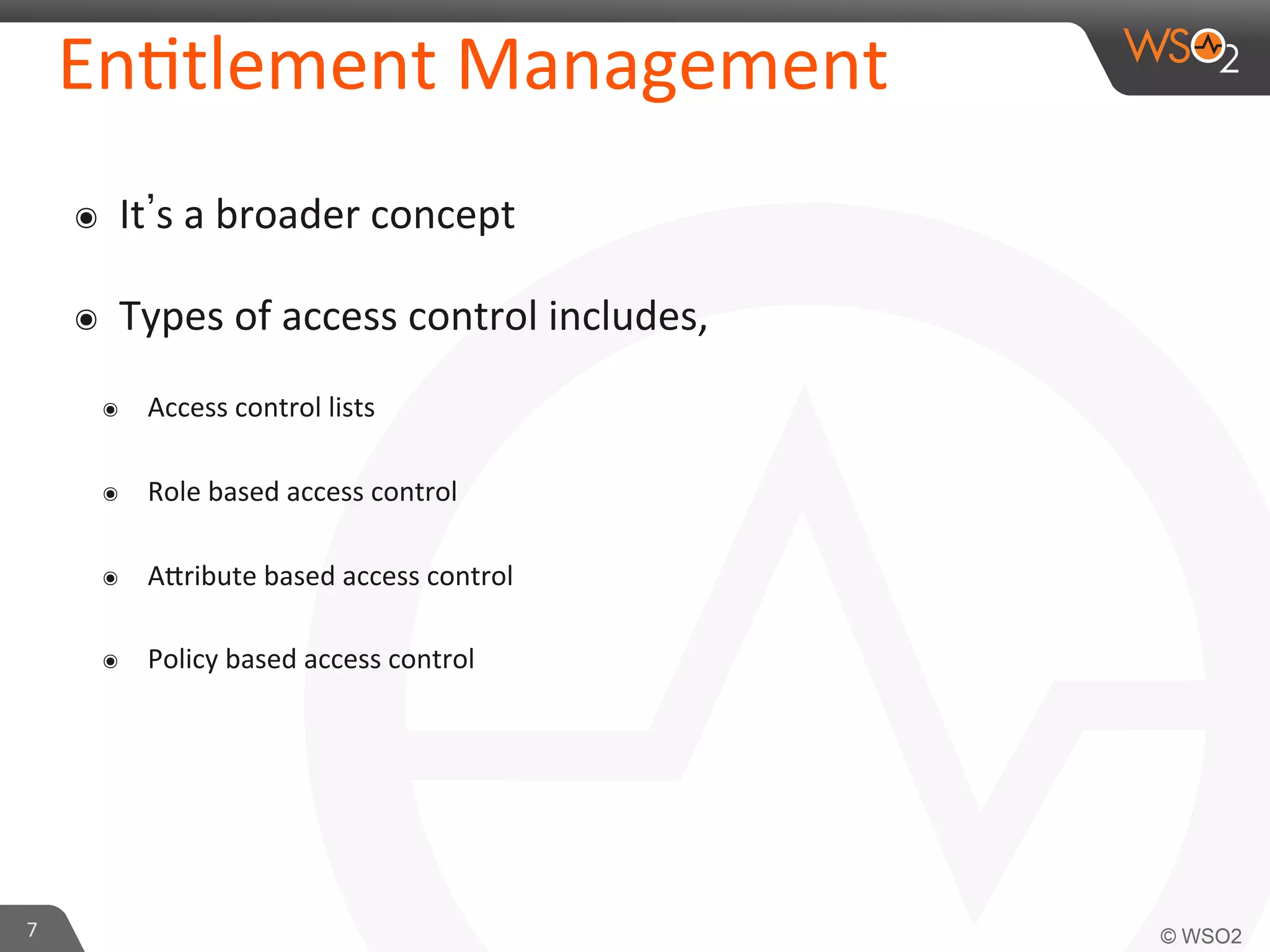
๏  It s	
  a	
  broader	
  concept	
  
๏  Types	
  of	
  access	
  control	
  includes,	
  
๏  Access	
  control	
  lists	
  
๏  Role	
  based	
  access	
  control	
  
๏  AKribute	
  based	
  access	
  control	
  
๏  Policy	
  based	
  access	
  control	
  
7	
  
Access	
  control	
  lists	
  
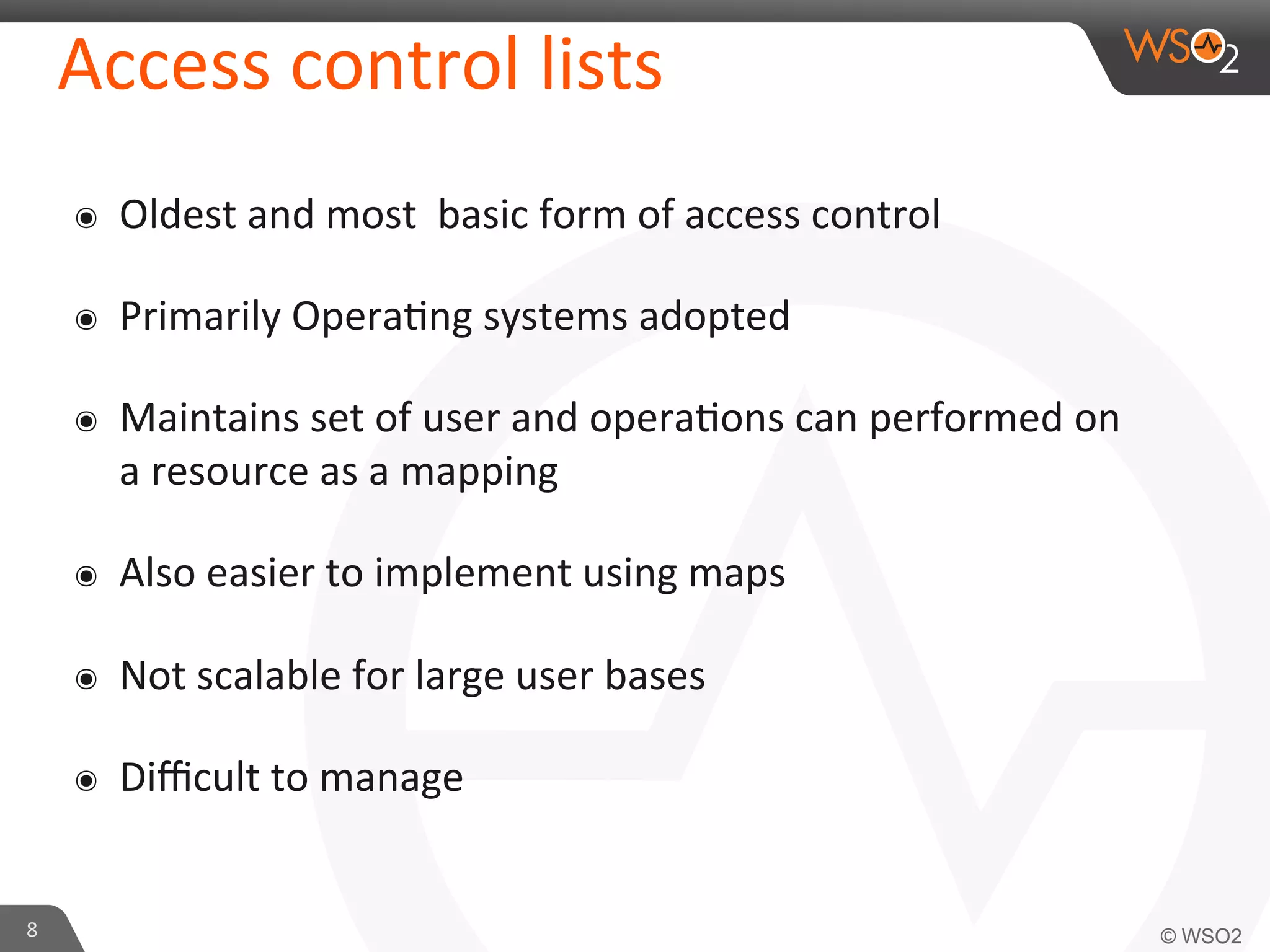
๏  Oldest	
  and	
  most	
  	
  basic	
  form	
  of	
  access	
  control	
  
๏  Primarily	
  Opera/ng	
  systems	
  adopted	
  
๏  Maintains	
  set	
  of	
  user	
  and	
  opera/ons	
  can	
  performed	
  on	
  
a	
  resource	
  as	
  a	
  mapping	
  
๏  Also	
  easier	
  to	
  implement	
  using	
  maps	
  
๏  Not	
  scalable	
  for	
  large	
  user	
  bases	
  
๏  Difficult	
  to	
  manage	
  
8	
  
Role	
  based	
  access	
  control	
  
๏  System	
  having	
  users	
  that	
  belongs	
  to	
  roles	
  
๏  Role	
  defines	
  which	
  resources	
  will	
  be	
  allowed	
  
๏  Reduces	
  the	
  management	
  overhead	
  
๏  Users	
  and	
  roles	
  can	
  be	
  externalized	
  using	
  user	
  stores	
  
๏  Need	
  to	
  manage	
  the	
  roles	
  
๏  User	
  may	
  belong	
  to	
  mul/ple	
  roles	
  
9	
  
AKribute	
  based	
  access	
  control	
  
๏  Authoriza/on	
  based	
  on	
  aKributes	
  
๏  Addresses	
  the	
  limita/on	
  of	
  role	
  based	
  approach	
  to	
  
define	
  fine	
  grain	
  access	
  control	
  
๏  AKributes	
  of	
  user,	
  environment	
  as	
  well	
  as	
  resource	
  it	
  
self	
  
๏  More	
  flexible	
  than	
  role	
  based	
  approach	
  
๏  No	
  need	
  for	
  knowing	
  the	
  user	
  prior	
  to	
  gran/ng	
  access	
  
10	
  
Policy	
  based	
  access	
  control	
  
๏  Address	
  the	
  requirement	
  to	
  have	
  more	
  uniform	
  access	
  
control	
  mechanism	
  
๏  Helps	
  to	
  large	
  enterprises	
  to	
  have	
  uniform	
  access	
  
control	
  amount	
  org	
  units	
  
๏  Helps	
  for	
  security	
  audits	
  to	
  be	
  carried	
  out	
  
๏  Complex	
  than	
  any	
  other	
  access	
  control	
  system	
  
๏  Specify	
  policies	
  unambiguously	
  with	
  XACML	
  
๏  Use	
  of	
  authorized	
  aKribute	
  sources	
  in	
  the	
  enterprise	
  
11	
  
Advantages	
  
๏  Reduce	
  the	
  development	
  /me	
  on	
  cri/cal	
  business	
  
func/ons	
  
๏  Easy	
  management	
  of	
  en/tlements	
  
๏  Based	
  on	
  industry	
  standard	
  specifica/ons	
  
๏  Support	
  for	
  future	
  development	
  with	
  minimum	
  effort	
  
12	
  
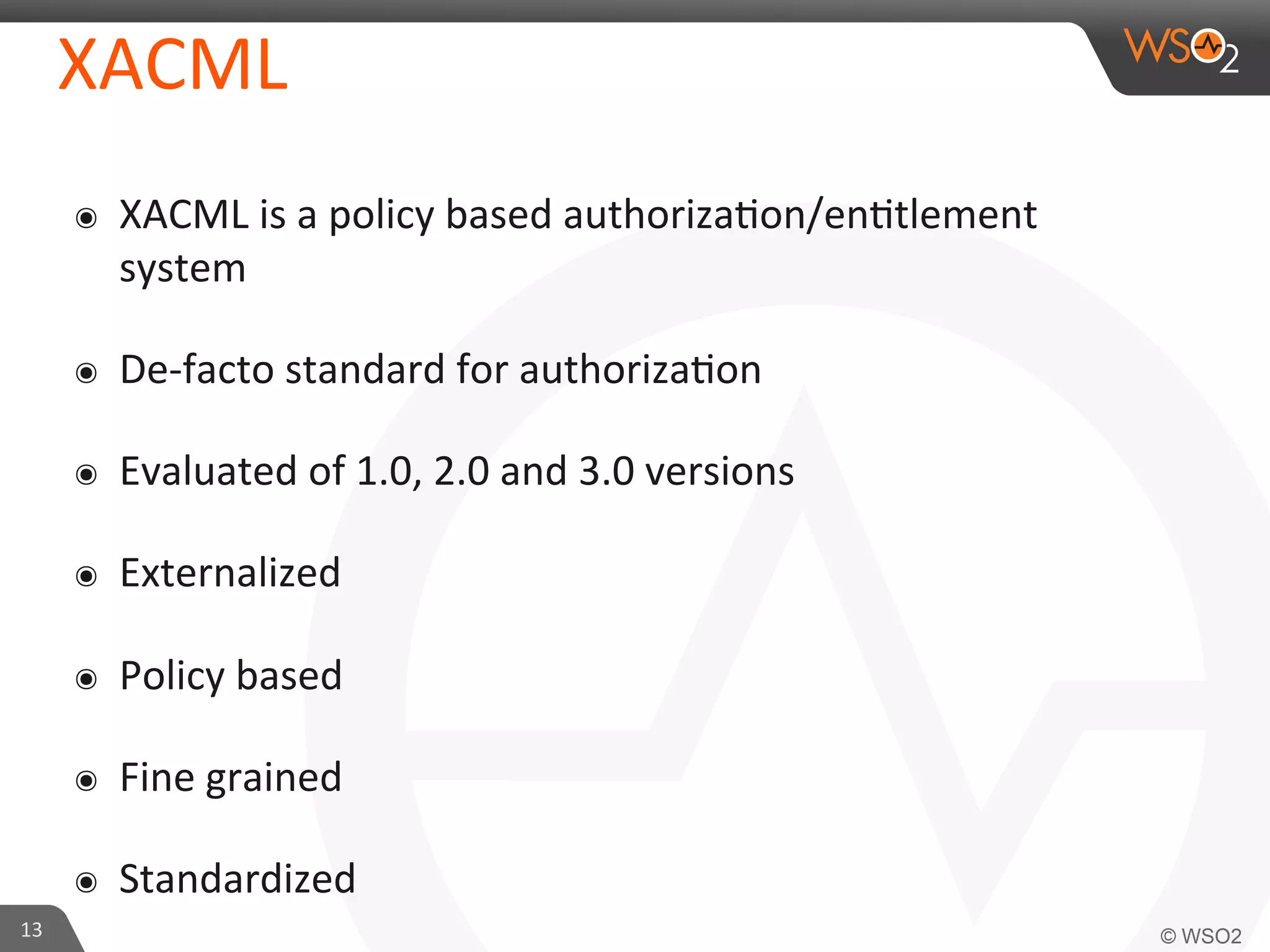
XACML	
  
๏  XACML	
  is	
  a	
  policy	
  based	
  authoriza/on/en/tlement	
  
system	
  
๏  De-­‐facto	
  standard	
  for	
  authoriza/on	
  
๏  Evaluated	
  of	
  1.0,	
  2.0	
  and	
  3.0	
  versions	
  
๏  Externalized	
  
๏  Policy	
  based	
  
๏  Fine	
  grained	
  
๏  Standardized	
  
13	
  
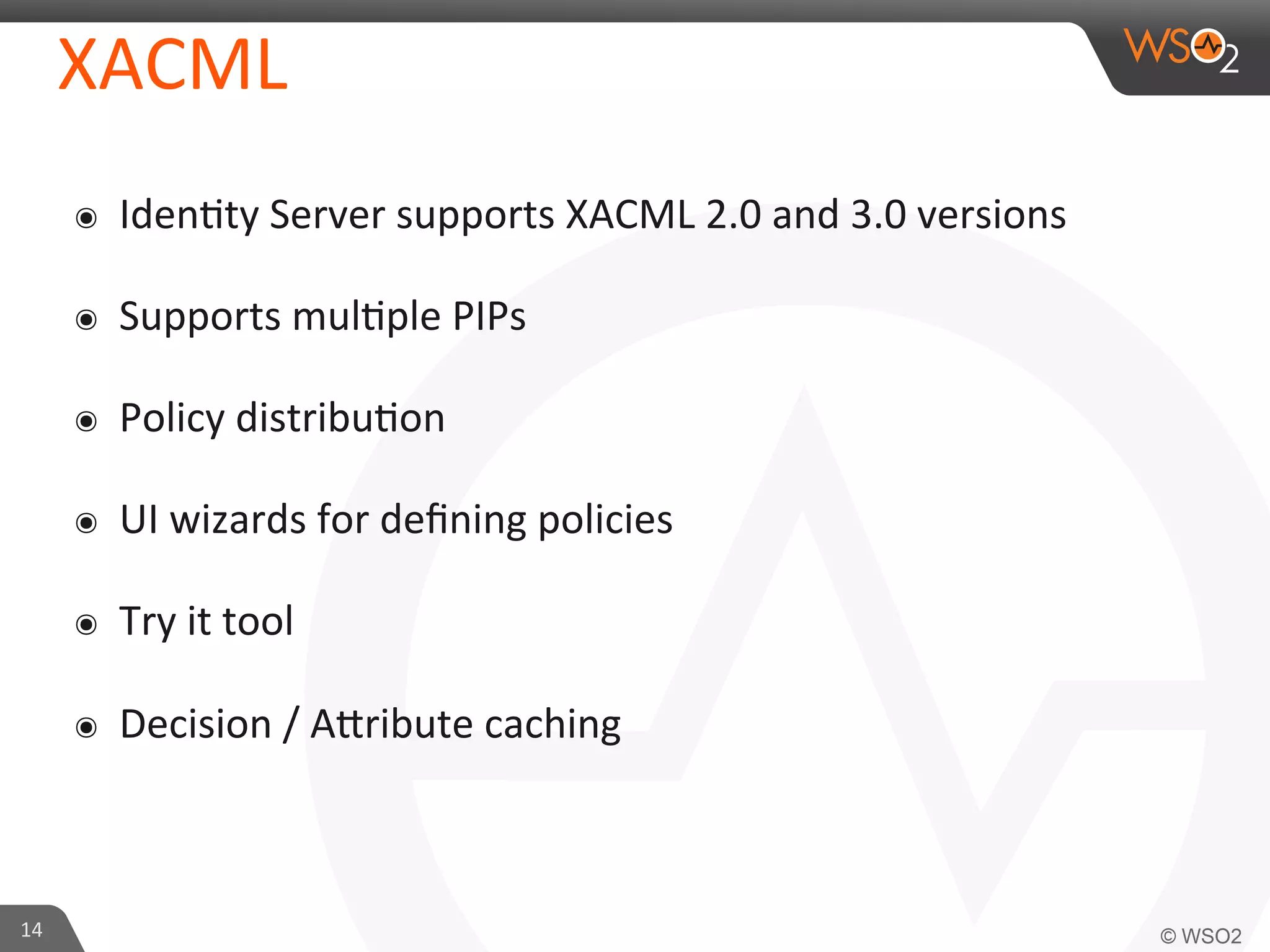
XACML	
  
๏  Iden/ty	
  Server	
  supports	
  XACML	
  2.0	
  and	
  3.0	
  versions	
  
๏  Supports	
  mul/ple	
  PIPs	
  
๏  Policy	
  distribu/on	
  
๏  UI	
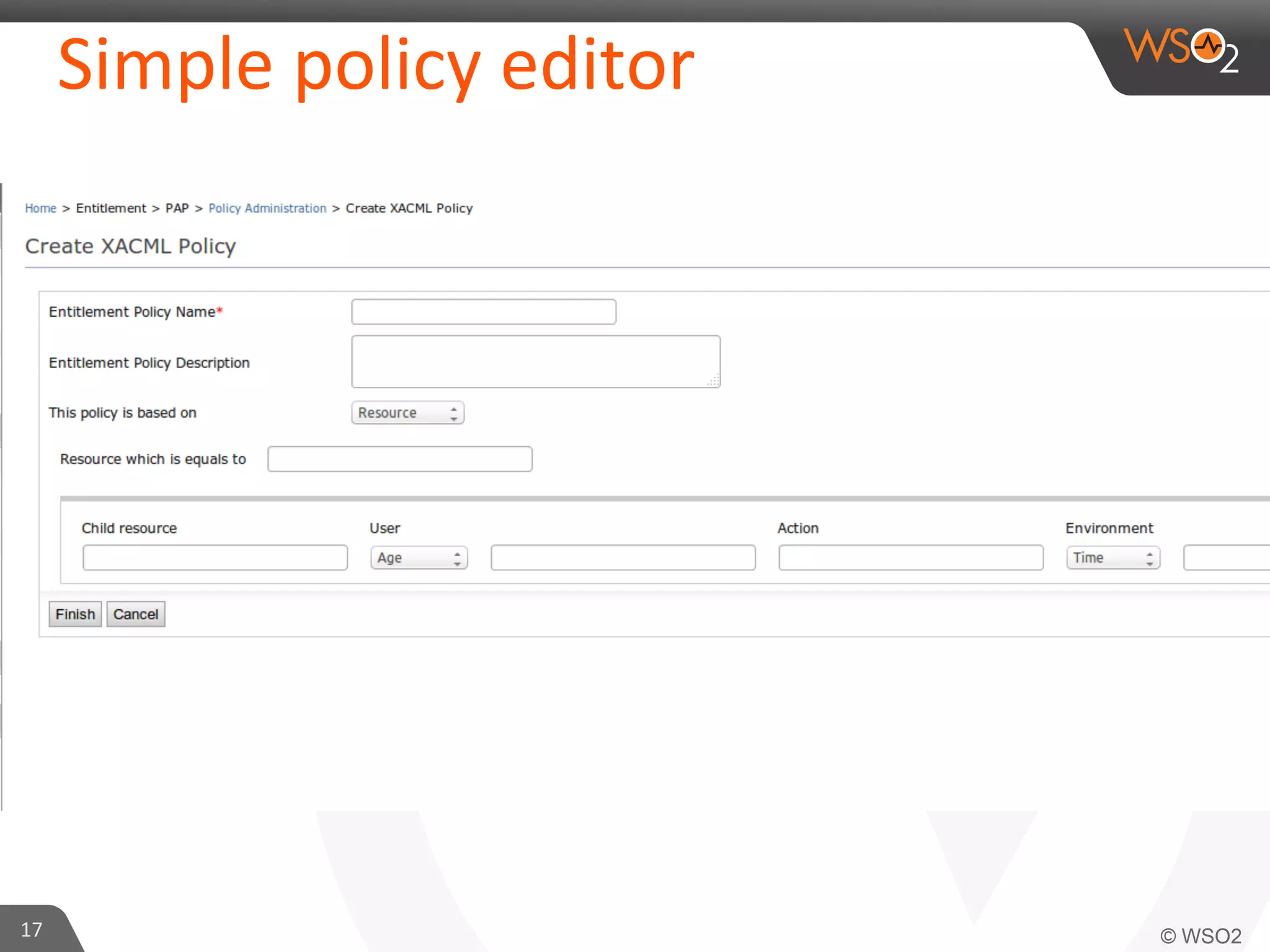
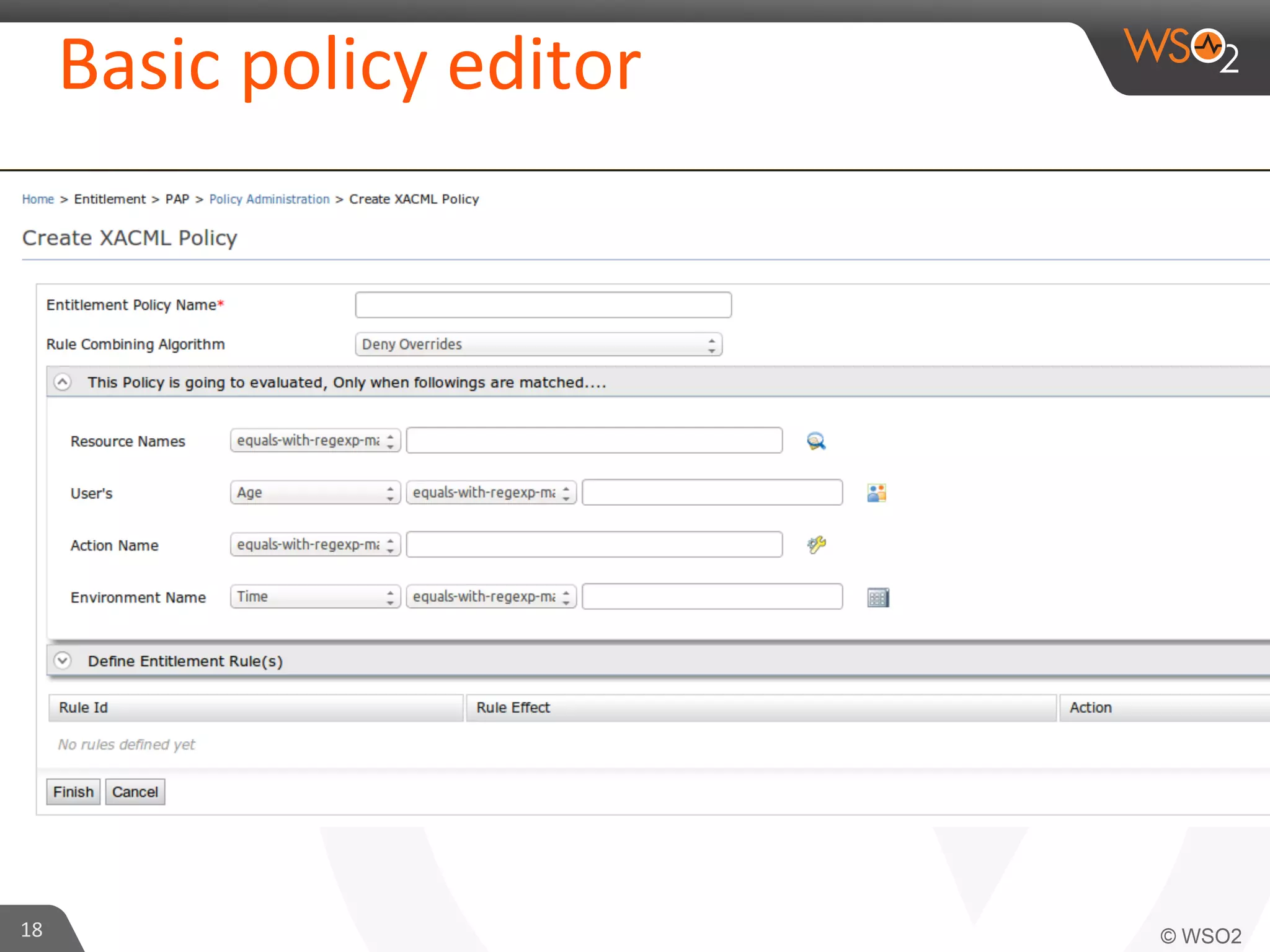
  wizards	
  for	
  defining	
  policies	
  
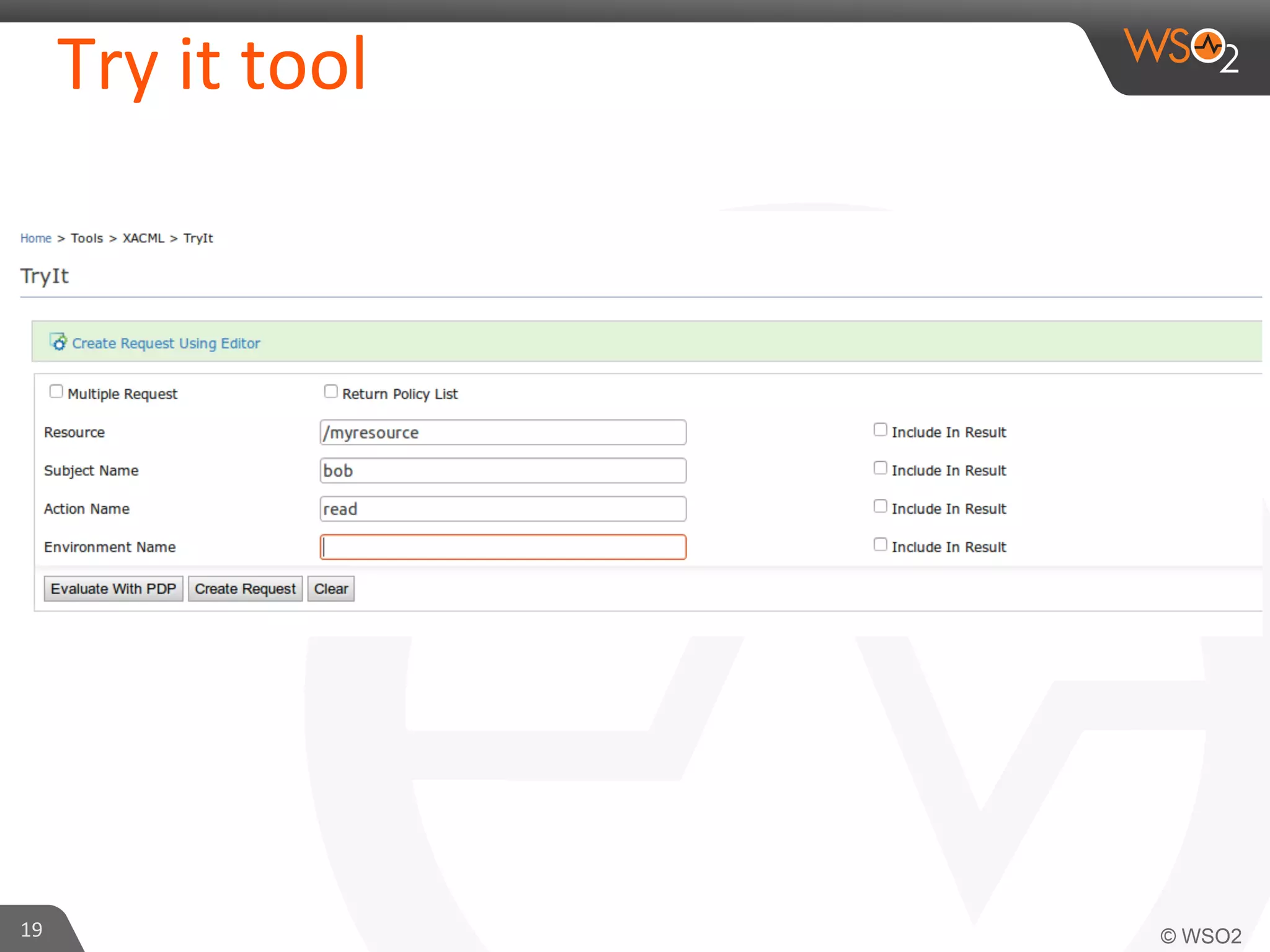
๏  Try	
  it	
  tool	
  
๏  Decision	
  /	
  AKribute	
  caching	
  
14	
  
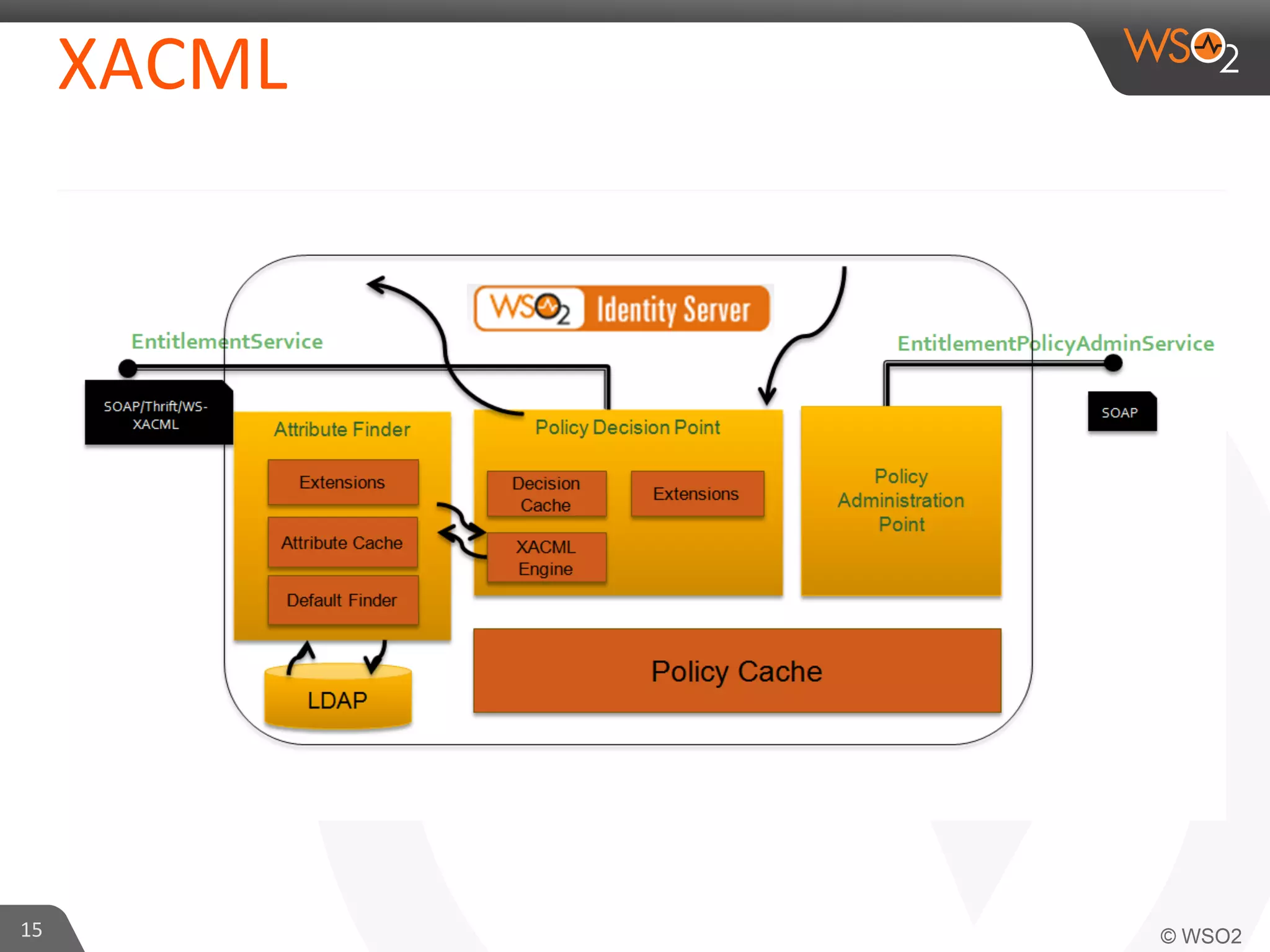
XACML	
  
15	
  
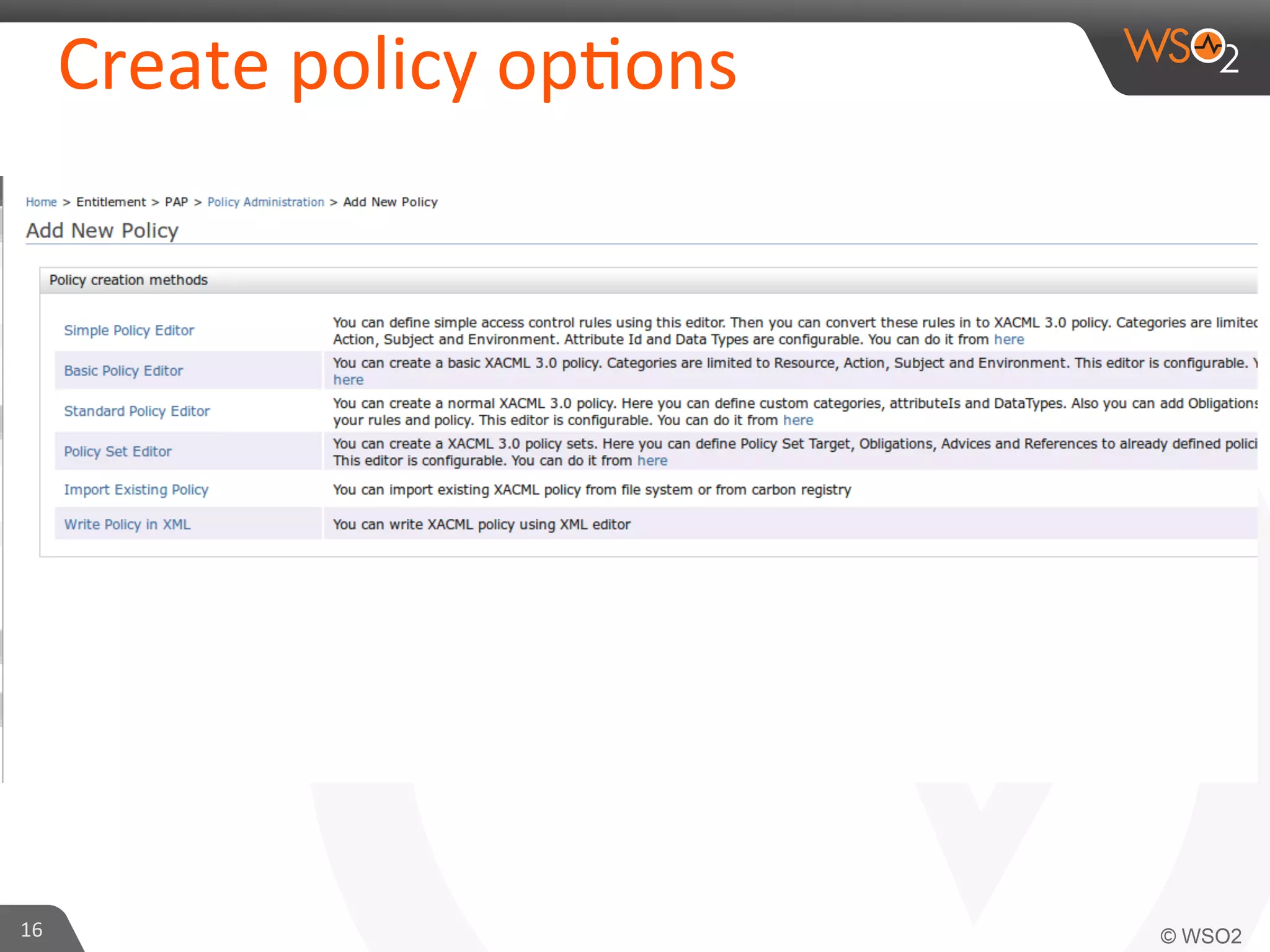
Create	
  policy	
  op/ons	
  
16	
  
Simple	
  policy	
  editor	
  
17	
  
Basic	
  policy	
  editor	
  
18	
  
Try	
  it	
  tool	
  
19	
  
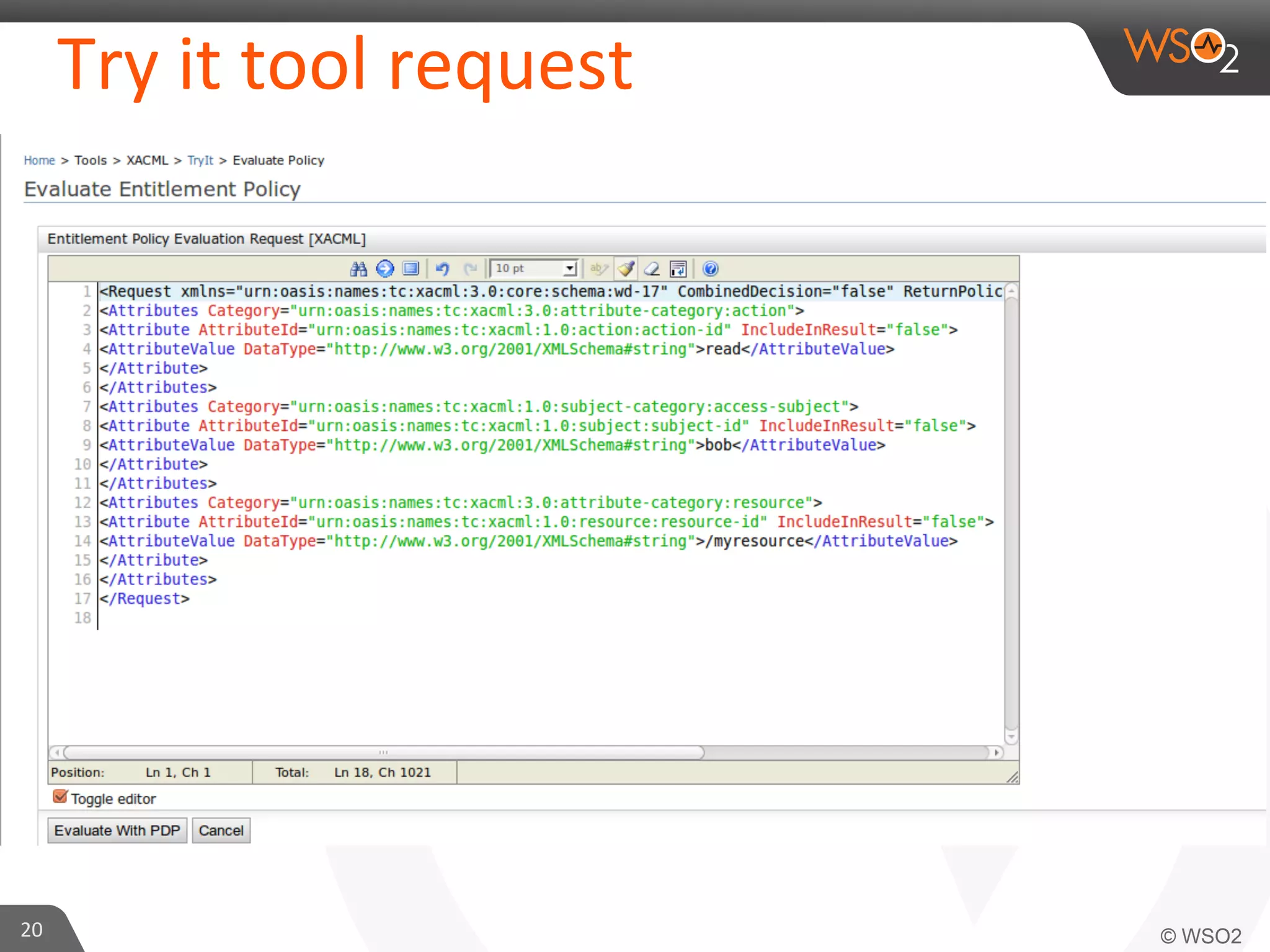
Try	
  it	
  tool	
  request	
  
20	
  
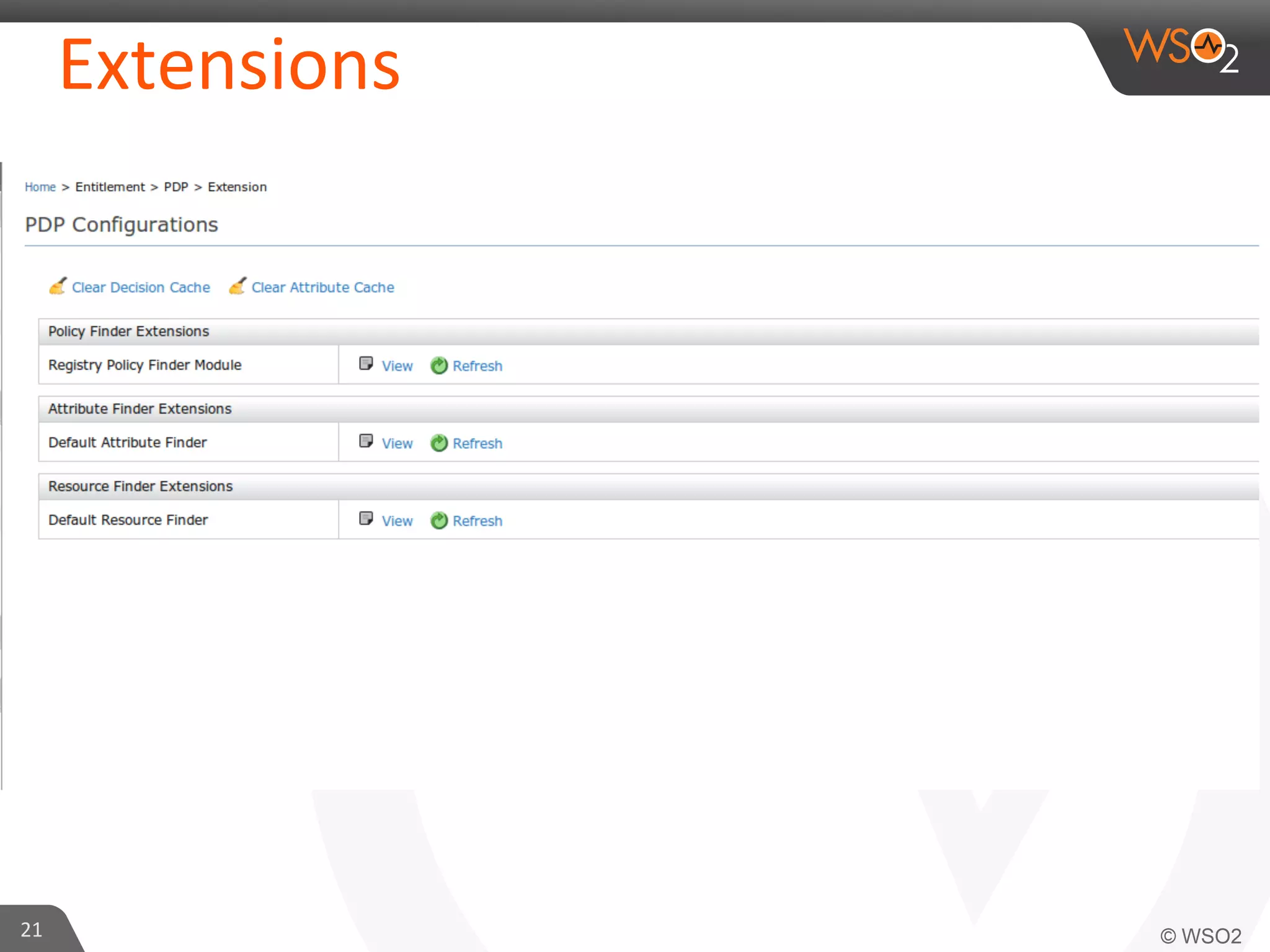
Extensions	
  
21	
  
Iden/ty	
  Management	
  
๏  Managing	
  Iden/ty	
  of	
  users	
  in	
  a	
  system	
  
๏  Control	
  access	
  to	
  resources	
  
๏  Important	
  component	
  in	
  an	
  enterprise	
  
๏  Enterprises	
  depends	
  on	
  the	
  security	
  provided	
  by	
  
iden/ty	
  management	
  systems	
  
22	
  
Why	
  Iden/ty	
  Management	
  
๏  Directly	
  influences	
  the	
  security	
  and	
  produc/vity	
  of	
  an	
  
organiza/on	
  
๏  To	
  enforce	
  consistency	
  in	
  security	
  policies	
  across	
  
organiza/on	
  
๏  To	
  comply	
  with	
  rules	
  and	
  regula/ons	
  enforced	
  in	
  some	
  
cri/cal	
  domains	
  by	
  governments	
  
๏  Provide	
  access	
  to	
  resources	
  to	
  outside	
  par/es	
  without	
  
compromising	
  security	
  
23	
  
Why	
  Iden/ty	
  Management	
  Cont.	
  
๏  Controlled	
  resource	
  access	
  increases	
  organiza/onal	
  
security	
  
๏  Increased	
  audit-­‐ability	
  of	
  the	
  systems	
  
๏  Automated	
  password	
  reset	
  capabili/es	
  
24	
  
Features	
  of	
  IDM	
  System	
  
๏  User	
  Stores	
  /	
  Directories	
  
๏  Authen/ca/on	
  
๏  Authoriza/on	
  
๏  Single	
  Sign	
  On	
  
๏  Provisioning	
  
๏  Delega/on	
  
๏  Password	
  reset	
  
๏  Self	
  registra/on	
  with	
  locking	
  25	
  
User	
  stores	
  /	
  Directories	
  
๏  Grouping	
  of	
  user	
  and	
  roles	
  
๏  Easy	
  management	
  in	
  authoriza/on	
  decisions	
  
๏  Different	
  types	
  of	
  user	
  stores	
  support	
  
26	
  
Authen/ca/on	
  
๏  Iden/fying	
  which	
  en/ty	
  are	
  we	
  communica/ng	
  with	
  
๏  En/ty	
  can	
  be	
  users	
  or	
  systems	
  
๏  Most	
  basic	
  form	
  is	
  user	
  name	
  and	
  password	
  
๏  Authen/ca/on	
  against	
  user	
  store	
  
๏  Concept	
  of	
  mul/	
  factor	
  authen/ca/on	
  
27	
  
Authoriza/on	
  
๏  What	
  an	
  en/ty	
  allowed	
  to	
  access	
  in	
  the	
  system	
  
๏  En/tlement	
  management	
  aspects	
  
๏  Discussed	
  
28	
  
Single	
  Sign	
  On	
  
๏  Having	
  mul/ple	
  applica/ons	
  with	
  login	
  requirements	
  
๏  Once	
  login	
  to	
  the	
  applica/on	
  automa/c	
  login	
  to	
  other	
  
applica/ons	
  
๏  Token	
  usage	
  
๏  Iden/ty	
  Federa/on	
  
๏  Technologies	
  used	
  
๏  OpenID	
  
๏  SAML	
  
๏  Kerboros	
  
๏  WS-­‐Federa/on	
  passive	
  
29	
  
Provisioning	
  
๏  Concept	
  of	
  adding	
  and	
  removing	
  iden//es	
  from	
  user	
  
store	
  
๏  Provisioning	
  to	
  external	
  systems	
  
๏  Technologies	
  
๏  SPML	
  
๏  SCIM	
  
30	
  
Delega/on	
  
๏  Giving	
  responsibility	
  to	
  another	
  en/ty	
  to	
  carry	
  out	
  tasks	
  
on	
  behalf	
  of	
  you	
  
๏  Creden/al	
  sharing	
  systems	
  
๏  Technologies	
  
๏  OAuth	
  
31	
  
Users	
  and	
  roles	
  
๏  Enterprise	
  user	
  stores	
  with	
  users	
  and	
  roles	
  
๏  Managing	
  user	
  stores	
  
๏  Support	
  for	
  mul/ple	
  user	
  stores	
  
๏  Easy	
  configura/on	
  of	
  user	
  stores	
  in	
  UI	
  
๏  Types	
  of	
  user	
  stores	
  	
  
๏  LDAP,	
  Ac/ve	
  Directory,	
  JDBC	
  
๏  Support	
  for	
  mul/-­‐tenancy	
  
32	
  
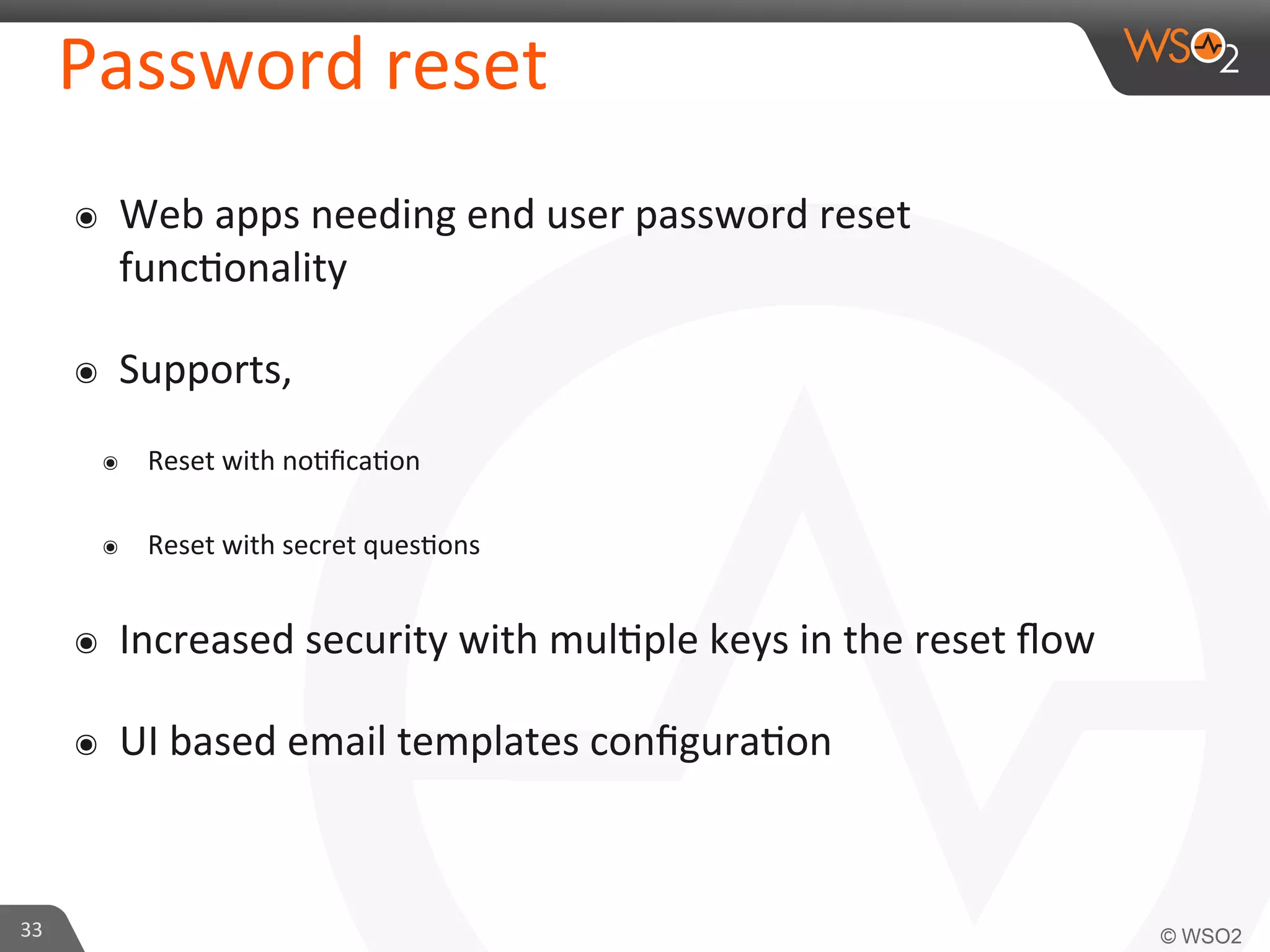
Password	
  reset	
  
๏  Web	
  apps	
  needing	
  end	
  user	
  password	
  reset	
  
func/onality	
  
๏  Supports,	
  
๏  Reset	
  with	
  no/fica/on	
  
๏  Reset	
  with	
  secret	
  ques/ons	
  
๏  Increased	
  security	
  with	
  mul/ple	
  keys	
  in	
  the	
  reset	
  flow	
  
๏  UI	
  based	
  email	
  templates	
  configura/on	
  
33	
  
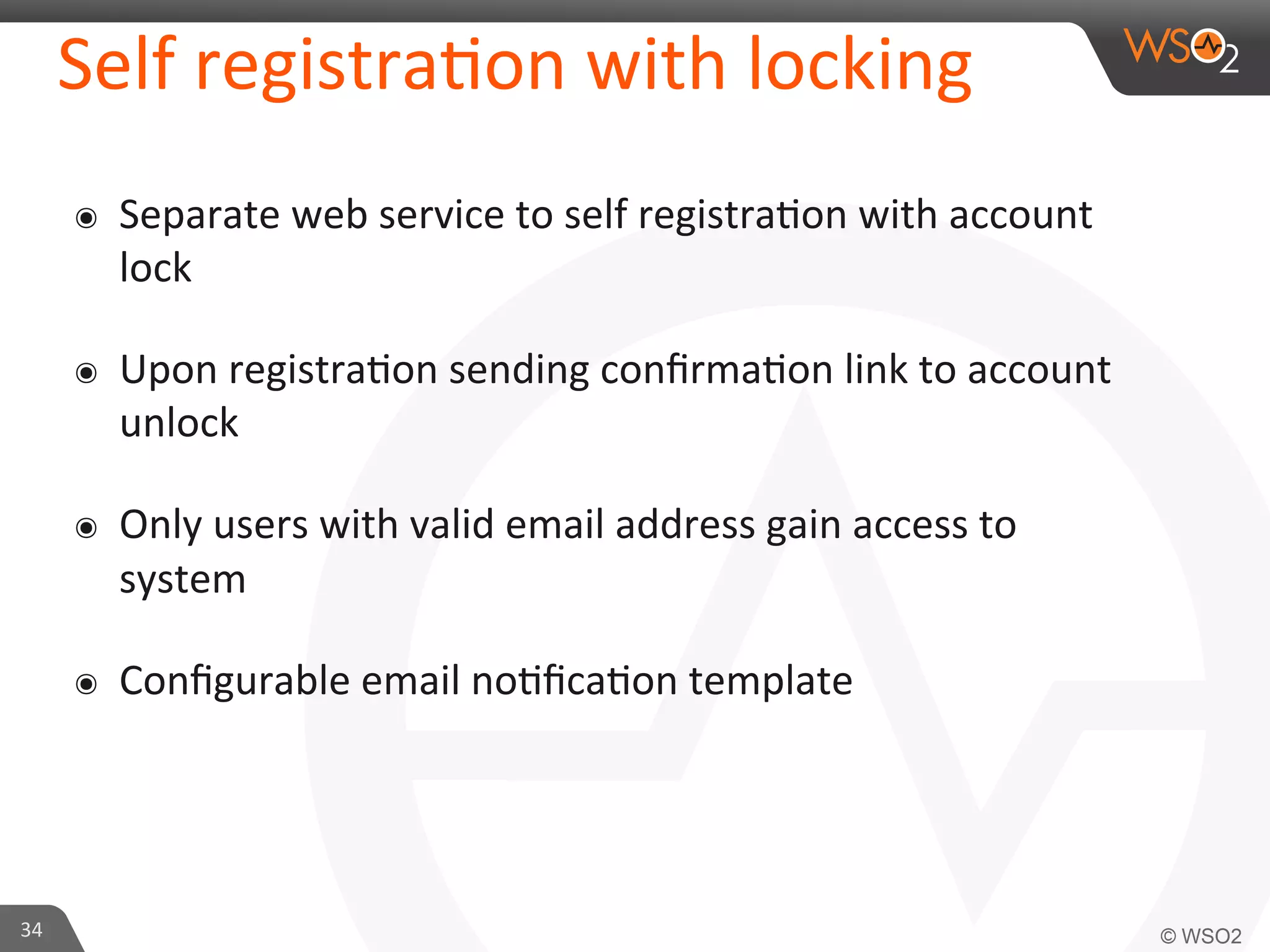
Self	
  registra/on	
  with	
  locking	
  
๏  Separate	
  web	
  service	
  to	
  self	
  registra/on	
  with	
  account	
  
lock	
  
๏  Upon	
  registra/on	
  sending	
  confirma/on	
  link	
  to	
  account	
  
unlock	
  
๏  Only	
  users	
  with	
  valid	
  email	
  address	
  gain	
  access	
  to	
  
system	
  
๏  Configurable	
  email	
  no/fica/on	
  template	
  
34	
  
Demo	
  
35	
  
36	
  
Business	
  Model	
  
37	
  
More	
  Informa/on	
  !	
  
๏  The	
  slides	
  and	
  webinar	
  will	
  be	
  available	
  soon.	
  
๏  Please	
  refer	
  Iden/ty	
  Server	
  documenta/on	
  -­‐	
  hKps://
docs.wso2.org/display/IS500/WSO2+Iden/ty+Server
+Documenta/on	
  
Contact	
  us	
  !	
  

Identity and Entitlement Management Concepts

  • 1.
    Last Updated: Jan.2014 Tech  Lead   Chamath  Gunawardana   Iden/ty  and  En/tlement   Management  –  Concepts  and   Theories  
  • 2.
    2   About  the  Presenter(s)   ๏  Chamath  Gunawardana   Chamath  Gunwardana  is  a  technical  lead  at   WSO2  working  for  the  integra/on  technology   group.  He's  engaged  in  the  developments  of   the  WSO2  Iden/ty  Server  and  also  a   commiKer  of  the  WSO2  Iden/ty  Server.   Chamath  is  also  a  SUN  cer/fied  java   programmer.    
  • 3.
    3   About  WSO2   ๏  Global  enterprise,  founded  in  2005   by  acknowledged  leaders  in  XML,   web  services    technologies,   standards    and  open  source   ๏  Provides  only  open  source   plaVorm-­‐as-­‐a-­‐service  for  private,   public  and  hybrid  cloud   deployments   ๏  All  WSO2  products  are  100%  open   source  and  released  under  the   Apache  License  Version  2.0.   ๏  Is  an  Ac/ve  Member  of  OASIS,   Cloud  Security  Alliance,  OSGi   Alliance,  AMQP  Working  Group,   OpenID  Founda/on  and  W3C.   ๏  Driven  by  Innova/on   ๏  Launched  first  open  source  API   Management  solu/on  in  2012   ๏  Launched  App  Factory  in  2Q  2013   ๏  Launched  Enterprise  Store  and   first  open  source  Mobile  solu/on   in  4Q  2013  
  • 4.
    4   What  WSO2  delivers  
  • 5.
    Agenda   ๏  En/tlement  management   ๏  overview   ๏  Access  control  concepts   ๏  XACML   ๏  En/tlement  architecture  in  iden/ty  server   ๏  Iden/ty  management   ๏  overview   ๏  Features  of  iden/ty  management  systems   ๏  Couple  of  Iden/ty  Management  Capabili/es  in  iden/ty  server   ๏  Demo   5  
  • 6.
    What  is  En/tlement  Mng..   ๏  En#tlement  management  is  technology  that  grants,   resolves,  enforces,  revokes  and  administers  fine-­‐ grained  access  en/tlements.   ๏  Also  referred  to  as   authoriza/ons, privileges, access  rights, permissions  and/or   rules        -­‐  Gartner  Glossary   6  
  • 7.
    En/tlement  Management   ๏ It s  a  broader  concept   ๏  Types  of  access  control  includes,   ๏  Access  control  lists   ๏  Role  based  access  control   ๏  AKribute  based  access  control   ๏  Policy  based  access  control   7  
  • 8.
    Access  control  lists   ๏  Oldest  and  most    basic  form  of  access  control   ๏  Primarily  Opera/ng  systems  adopted   ๏  Maintains  set  of  user  and  opera/ons  can  performed  on   a  resource  as  a  mapping   ๏  Also  easier  to  implement  using  maps   ๏  Not  scalable  for  large  user  bases   ๏  Difficult  to  manage   8  
  • 9.
    Role  based  access  control   ๏  System  having  users  that  belongs  to  roles   ๏  Role  defines  which  resources  will  be  allowed   ๏  Reduces  the  management  overhead   ๏  Users  and  roles  can  be  externalized  using  user  stores   ๏  Need  to  manage  the  roles   ๏  User  may  belong  to  mul/ple  roles   9  
  • 10.
    AKribute  based  access  control   ๏  Authoriza/on  based  on  aKributes   ๏  Addresses  the  limita/on  of  role  based  approach  to   define  fine  grain  access  control   ๏  AKributes  of  user,  environment  as  well  as  resource  it   self   ๏  More  flexible  than  role  based  approach   ๏  No  need  for  knowing  the  user  prior  to  gran/ng  access   10  
  • 11.
    Policy  based  access  control   ๏  Address  the  requirement  to  have  more  uniform  access   control  mechanism   ๏  Helps  to  large  enterprises  to  have  uniform  access   control  amount  org  units   ๏  Helps  for  security  audits  to  be  carried  out   ๏  Complex  than  any  other  access  control  system   ๏  Specify  policies  unambiguously  with  XACML   ๏  Use  of  authorized  aKribute  sources  in  the  enterprise   11  
  • 12.
    Advantages   ๏  Reduce  the  development  /me  on  cri/cal  business   func/ons   ๏  Easy  management  of  en/tlements   ๏  Based  on  industry  standard  specifica/ons   ๏  Support  for  future  development  with  minimum  effort   12  
  • 13.
    XACML   ๏  XACML  is  a  policy  based  authoriza/on/en/tlement   system   ๏  De-­‐facto  standard  for  authoriza/on   ๏  Evaluated  of  1.0,  2.0  and  3.0  versions   ๏  Externalized   ๏  Policy  based   ๏  Fine  grained   ๏  Standardized   13  
  • 14.
    XACML   ๏  Iden/ty  Server  supports  XACML  2.0  and  3.0  versions   ๏  Supports  mul/ple  PIPs   ๏  Policy  distribu/on   ๏  UI  wizards  for  defining  policies   ๏  Try  it  tool   ๏  Decision  /  AKribute  caching   14  
  • 15.
  • 16.
  • 17.
  • 18.
  • 19.
  • 20.
    Try  it  tool  request   20  
  • 21.
  • 22.
    Iden/ty  Management   ๏ Managing  Iden/ty  of  users  in  a  system   ๏  Control  access  to  resources   ๏  Important  component  in  an  enterprise   ๏  Enterprises  depends  on  the  security  provided  by   iden/ty  management  systems   22  
  • 23.
    Why  Iden/ty  Management   ๏  Directly  influences  the  security  and  produc/vity  of  an   organiza/on   ๏  To  enforce  consistency  in  security  policies  across   organiza/on   ๏  To  comply  with  rules  and  regula/ons  enforced  in  some   cri/cal  domains  by  governments   ๏  Provide  access  to  resources  to  outside  par/es  without   compromising  security   23  
  • 24.
    Why  Iden/ty  Management  Cont.   ๏  Controlled  resource  access  increases  organiza/onal   security   ๏  Increased  audit-­‐ability  of  the  systems   ๏  Automated  password  reset  capabili/es   24  
  • 25.
    Features  of  IDM  System   ๏  User  Stores  /  Directories   ๏  Authen/ca/on   ๏  Authoriza/on   ๏  Single  Sign  On   ๏  Provisioning   ๏  Delega/on   ๏  Password  reset   ๏  Self  registra/on  with  locking  25  
  • 26.
    User  stores  /  Directories   ๏  Grouping  of  user  and  roles   ๏  Easy  management  in  authoriza/on  decisions   ๏  Different  types  of  user  stores  support   26  
  • 27.
    Authen/ca/on   ๏  Iden/fying  which  en/ty  are  we  communica/ng  with   ๏  En/ty  can  be  users  or  systems   ๏  Most  basic  form  is  user  name  and  password   ๏  Authen/ca/on  against  user  store   ๏  Concept  of  mul/  factor  authen/ca/on   27  
  • 28.
    Authoriza/on   ๏  What  an  en/ty  allowed  to  access  in  the  system   ๏  En/tlement  management  aspects   ๏  Discussed   28  
  • 29.
    Single  Sign  On   ๏  Having  mul/ple  applica/ons  with  login  requirements   ๏  Once  login  to  the  applica/on  automa/c  login  to  other   applica/ons   ๏  Token  usage   ๏  Iden/ty  Federa/on   ๏  Technologies  used   ๏  OpenID   ๏  SAML   ๏  Kerboros   ๏  WS-­‐Federa/on  passive   29  
  • 30.
    Provisioning   ๏  Concept  of  adding  and  removing  iden//es  from  user   store   ๏  Provisioning  to  external  systems   ๏  Technologies   ๏  SPML   ๏  SCIM   30  
  • 31.
    Delega/on   ๏  Giving  responsibility  to  another  en/ty  to  carry  out  tasks   on  behalf  of  you   ๏  Creden/al  sharing  systems   ๏  Technologies   ๏  OAuth   31  
  • 32.
    Users  and  roles   ๏  Enterprise  user  stores  with  users  and  roles   ๏  Managing  user  stores   ๏  Support  for  mul/ple  user  stores   ๏  Easy  configura/on  of  user  stores  in  UI   ๏  Types  of  user  stores     ๏  LDAP,  Ac/ve  Directory,  JDBC   ๏  Support  for  mul/-­‐tenancy   32  
  • 33.
    Password  reset   ๏ Web  apps  needing  end  user  password  reset   func/onality   ๏  Supports,   ๏  Reset  with  no/fica/on   ๏  Reset  with  secret  ques/ons   ๏  Increased  security  with  mul/ple  keys  in  the  reset  flow   ๏  UI  based  email  templates  configura/on   33  
  • 34.
    Self  registra/on  with  locking   ๏  Separate  web  service  to  self  registra/on  with  account   lock   ๏  Upon  registra/on  sending  confirma/on  link  to  account   unlock   ๏  Only  users  with  valid  email  address  gain  access  to   system   ๏  Configurable  email  no/fica/on  template   34  
  • 35.
  • 36.
  • 37.
    37   More  Informa/on  !   ๏  The  slides  and  webinar  will  be  available  soon.   ๏  Please  refer  Iden/ty  Server  documenta/on  -­‐  hKps:// docs.wso2.org/display/IS500/WSO2+Iden/ty+Server +Documenta/on  
  • 38.