Identify
Construction
Work Hazards
and Select Risk
Control
Part 1
How to Prepare a Job Safety
Analysis (JSA) and a Safe Work
Method Statement (SWMS)
Introduction
In this unit of competency, you will learn the skills and knowledge required
to participate in preparing a job safety analysis (JSA) for general hazards,
and a safe work method statement (SWMS) for high risk work hazards on
construction sites as specified in work health and safety (WHS) legislation.
It includes meeting all relevant requirements of the National Construction
Code (NCC), Australian Standards and Commonwealth and state or territory
legislation.
Completion of the general construction induction training program specified
by the model Code of Practice for Construction Work is required for any
person who is to carry out construction work. Achievement of
CPCCWHS1001 Prepare to work safely in the construction industry meets
this requirement.
No licensing, legislative or certification requirements apply to this unit.
Work Health and Safety Legislation
Work Health and Safety in Construction is governed by National Legislation:
Model Work Health and Safety Act 2011
The main object of the Act is to provide for a balanced and nationally consistent framework to
secure the health and safety of workers and workplaces.
• The Act is law
• Describes how to provide health and safety
in the workplace and the duties for each group that has a role in health and safety in the workplace.
• Sets out Duty of Care requirements for PCBU and worker
Work Health and Safety Legislation
Model Work Health and Safety Regulations 2011
The model WHS Regulations set out detailed requirements to support the duties in the model
WHS Act. They also prescribe procedural or administrative requirements to support the model
WHS Act (for example requiring licences for specific activities and keeping records).
• Are made under the Act
• Provide greater detail on how to comply with the Act
• Tells you what the laws and penalties are
• Prescribe the procedural or administrative requirements (for example requiring licences for
specific activities and keeping records)
Work Health and Safety Legislation
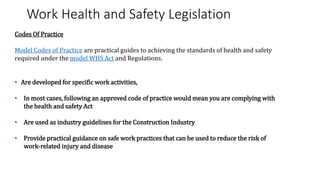
Codes Of Practice
Model Codes of Practice are practical guides to achieving the standards of health and safety
required under the model WHS Act and Regulations.
• Are developed for specific work activities,
• In most cases, following an approved code of practice would mean you are complying with
the health and safety Act
• Are used as industry guidelines for the Construction Industry
• Provide practical guidance on safe work practices that can be used to reduce the risk of
work-related injury and disease
Work Health and Safety Legislation
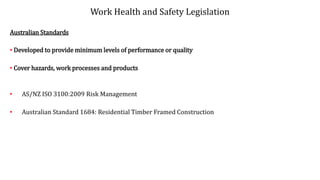
Australian Standards
• Developed to provide minimum levels of performance or quality
• Cover hazards, work processes and products
• AS/NZ ISO 3100:2009 Risk Management
• Australian Standard 1684: Residential Timber Framed Construction
Work Health and Safety Legislation
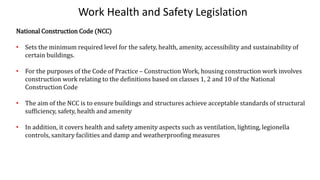
National Construction Code (NCC)
• Sets the minimum required level for the safety, health, amenity, accessibility and sustainability of
certain buildings.
• For the purposes of the Code of Practice – Construction Work, housing construction work involves
construction work relating to the definitions based on classes 1, 2 and 10 of the National
Construction Code
• The aim of the NCC is to ensure buildings and structures achieve acceptable standards of structural
sufficiency, safety, health and amenity
• In addition, it covers health and safety amenity aspects such as ventilation, lighting, legionella
controls, sanitary facilities and damp and weatherproofing measures
Work Health and Safety Legislation
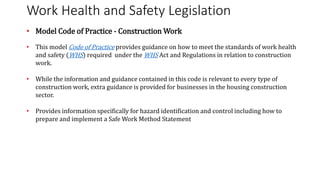
• Model Code of Practice - Construction Work
• This model Code of Practice provides guidance on how to meet the standards of work health
and safety (WHS) required under the WHS Act and Regulations in relation to construction
work.
• While the information and guidance contained in this code is relevant to every type of
construction work, extra guidance is provided for businesses in the housing construction
sector.
• Provides information specifically for hazard identification and control including how to
prepare and implement a Safe Work Method Statement
Work Health and Safety Legislation
• Code of Practice: How to manage work health and safety risks
• Code of Practice: Excavation of Practice: Hazardous manual
• Code of Practice: Managing the Risk of Falls in Housing Construction
• Code of Practice: Hazardous Manual Tasks
Work Health and Safety Legislation
Duty Of Care
Duty of Care requires a person to do everything
reasonably practicable to protect themselves
and others from harm.
This means there are:
• Obligation for employers, employees and contractor to work safely
• A requirement for the person in Control of the Business or Undertaking(PCBU) and workers to work
together to identify and control hazards to enable a safe workplace
• Duty to perform risk management to enable a safe working environment and to document the
process
• Duty to protect yourself and others(including members of the public) from risk or harm
• Must follow Industry Guidelines – Construction industry agrees to adhere to Legislation, Codes Of
Practice and Australian Standards
Job Safety Analysis (JSA)
What is a JSA
• A job safety analysis (JSA) is a written procedure used to review work steps and their associated
hazards in order to put in place correct solutions to eliminate or minimise the risk of those hazards
Typically, JSA’s have 3 main components, these include:
• Tasks – A step by step list of the basic activities of the task
• Hazards – List of potential hazards at each step of the task
• Control measures – Instructions on how to safely carry out the task by controlling each identified
hazard
• .
Other than the employer's general duty of care to ensure workers are trained and competent for their
work, there are no specific legal requirements to have a JSA or any regulations prescribing the format or
content for JSA’s, however, industry guidelines and legislation, Codes and Standards require hazard
identification and control for all construction tasks.
Job Safety Analysis (JSA)
5 Steps to Complete a Job Safety Analysis
1. Document the activity - assemble those involved in the activity and, using a JSA
worksheet, write down the tasks that make up the activity, step by step
2. Identify the hazards - for each task, identify what part of the task may cause injury to
those doing the work or to anyone else nearby
3. Assess the risks involved – for each hazard determine the harm it could do
4. Document the control measures - for each hazard identified, list the measures that
need to be implemented to eliminate or minimise any likely risk of injury to those involved
5. Implement the control measures – put the control measures in place to eliminate or
minimise the risk and monitor the controls to ensure effectiveness
Job Safety Analysis (JSA)
• Identify who is responsible - document the name of the person responsible for
implementing the control measure
• Monitor and review - ensure the activity is supervised to confirm the documented process
is being followed, and review the JSA when
• a documented activity changes
• there is a change of personnel
• after an appropriate length of time.
A Job Safety Analysis is never to be used for a High Risk task or procedure. A high risk as
prescribed by the Regulator is described in the Safe Work Method Statements
Safe Work Method Statement (SWMS)
What is a Safe Work Methos Statement (SWMS)?
• A SWMS is a document that sets out the high risk construction work activities to be carried
out at a workplace, the hazards arising from these activities and the measures to be put in
place to control the risks.
• The Code of Practice: Construction Work, outlines the requirements for SWMS.
The main difference between a JSA and a SWMS is that SWMS are prescribed for all High-Risk
Construction Work (HRCW) under safety regulations in Australia.
A SWMS
Safe Work Method Statement (SWMS)
The 5 basic principles of risk management are
1. Identify hazards (find or see)
2. Assess the risks involved (think about and check)
3. Consult and report ensuring the involvement of relevant people (talk and tell)
4. Control the hazard (stop or prevent it)
5. Review to identify change or improvement
(check and reflect)
Safe Work Method Statement (SWMS)
A SWMS must include
• Identify the work that is high risk construction work
• Specify hazards relating to the high risk construction work and the risks to health and safety
• Describe the measures to be implemented to control the risks
• Describe how the control measures are to be implemented, monitored and reviewed
• A SWMS should be short and focus on describing the specific hazards identified for the high risk
construction work
• A SWMS must be easily understood by workers, including those from non-English speaking
backgrounds
Safe Work Method Statement (SWMS)
A SWMS must include
• the person conducting a business or undertaking's name, address and ABN (if they have one);
• details of the person(s) responsible for ensuring implementation, monitoring and compliance with
the SWMS
• the review date (if any)
• if the work is being carried out at a construction project:
• the name of the principal contractor;
• the address where the high risk construction work will be carried out; and,
• the date the SWMS was prepared and the date it was provided to the principal contractor.
• A SWMS may also include the names of workers that have been consulted on the content of
the SWMS, the date the consultation occurred and the signature of each worker
acknowledging their participation in this consultation and the opportunity to discuss the
• monitored and reviewed
•.
Safe Work Method Statement (SWMS)
• If work is not being carried out in accordance with the SWMS then it must stop immediately or as soon as it is
safe to do so.
• I this happens the SWMS should be reviewed and if necessary revised to reflect the safest way to carry out
the work
A person conducting a business or undertaking must ensure that all workers who will be involved in high risk
construction work are provided with information and instruction so they:
•understand the hazards and the risks arising from the work
•understand and implement the risk controls in a SWMS
•know what to do if the work is not being conducted in accordance with the SWMS
•SWMS should be kept at the workplace where the high risk construction work will be carried out., if this is not
possible, then a SWMS should be kept at a location where it can be delivered to the workplace quickly. A SWMS
can also be kept electronically.

Identify Construction Work Hazards and Select Risk Control Part 1.pptx

  • 1.
    Identify Construction Work Hazards and SelectRisk Control Part 1 How to Prepare a Job Safety Analysis (JSA) and a Safe Work Method Statement (SWMS)
  • 2.
    Introduction In this unitof competency, you will learn the skills and knowledge required to participate in preparing a job safety analysis (JSA) for general hazards, and a safe work method statement (SWMS) for high risk work hazards on construction sites as specified in work health and safety (WHS) legislation. It includes meeting all relevant requirements of the National Construction Code (NCC), Australian Standards and Commonwealth and state or territory legislation. Completion of the general construction induction training program specified by the model Code of Practice for Construction Work is required for any person who is to carry out construction work. Achievement of CPCCWHS1001 Prepare to work safely in the construction industry meets this requirement. No licensing, legislative or certification requirements apply to this unit.
  • 3.
    Work Health andSafety Legislation Work Health and Safety in Construction is governed by National Legislation: Model Work Health and Safety Act 2011 The main object of the Act is to provide for a balanced and nationally consistent framework to secure the health and safety of workers and workplaces. • The Act is law • Describes how to provide health and safety in the workplace and the duties for each group that has a role in health and safety in the workplace. • Sets out Duty of Care requirements for PCBU and worker
  • 4.
    Work Health andSafety Legislation Model Work Health and Safety Regulations 2011 The model WHS Regulations set out detailed requirements to support the duties in the model WHS Act. They also prescribe procedural or administrative requirements to support the model WHS Act (for example requiring licences for specific activities and keeping records). • Are made under the Act • Provide greater detail on how to comply with the Act • Tells you what the laws and penalties are • Prescribe the procedural or administrative requirements (for example requiring licences for specific activities and keeping records)
  • 5.
    Work Health andSafety Legislation Codes Of Practice Model Codes of Practice are practical guides to achieving the standards of health and safety required under the model WHS Act and Regulations. • Are developed for specific work activities, • In most cases, following an approved code of practice would mean you are complying with the health and safety Act • Are used as industry guidelines for the Construction Industry • Provide practical guidance on safe work practices that can be used to reduce the risk of work-related injury and disease
  • 6.
    Work Health andSafety Legislation Australian Standards • Developed to provide minimum levels of performance or quality • Cover hazards, work processes and products • AS/NZ ISO 3100:2009 Risk Management • Australian Standard 1684: Residential Timber Framed Construction
  • 7.
    Work Health andSafety Legislation National Construction Code (NCC) • Sets the minimum required level for the safety, health, amenity, accessibility and sustainability of certain buildings. • For the purposes of the Code of Practice – Construction Work, housing construction work involves construction work relating to the definitions based on classes 1, 2 and 10 of the National Construction Code • The aim of the NCC is to ensure buildings and structures achieve acceptable standards of structural sufficiency, safety, health and amenity • In addition, it covers health and safety amenity aspects such as ventilation, lighting, legionella controls, sanitary facilities and damp and weatherproofing measures
  • 8.
    Work Health andSafety Legislation • Model Code of Practice - Construction Work • This model Code of Practice provides guidance on how to meet the standards of work health and safety (WHS) required under the WHS Act and Regulations in relation to construction work. • While the information and guidance contained in this code is relevant to every type of construction work, extra guidance is provided for businesses in the housing construction sector. • Provides information specifically for hazard identification and control including how to prepare and implement a Safe Work Method Statement
  • 9.
    Work Health andSafety Legislation • Code of Practice: How to manage work health and safety risks • Code of Practice: Excavation of Practice: Hazardous manual • Code of Practice: Managing the Risk of Falls in Housing Construction • Code of Practice: Hazardous Manual Tasks
  • 10.
    Work Health andSafety Legislation Duty Of Care Duty of Care requires a person to do everything reasonably practicable to protect themselves and others from harm. This means there are: • Obligation for employers, employees and contractor to work safely • A requirement for the person in Control of the Business or Undertaking(PCBU) and workers to work together to identify and control hazards to enable a safe workplace • Duty to perform risk management to enable a safe working environment and to document the process • Duty to protect yourself and others(including members of the public) from risk or harm • Must follow Industry Guidelines – Construction industry agrees to adhere to Legislation, Codes Of Practice and Australian Standards
  • 11.
    Job Safety Analysis(JSA) What is a JSA • A job safety analysis (JSA) is a written procedure used to review work steps and their associated hazards in order to put in place correct solutions to eliminate or minimise the risk of those hazards Typically, JSA’s have 3 main components, these include: • Tasks – A step by step list of the basic activities of the task • Hazards – List of potential hazards at each step of the task • Control measures – Instructions on how to safely carry out the task by controlling each identified hazard • . Other than the employer's general duty of care to ensure workers are trained and competent for their work, there are no specific legal requirements to have a JSA or any regulations prescribing the format or content for JSA’s, however, industry guidelines and legislation, Codes and Standards require hazard identification and control for all construction tasks.
  • 12.
    Job Safety Analysis(JSA) 5 Steps to Complete a Job Safety Analysis 1. Document the activity - assemble those involved in the activity and, using a JSA worksheet, write down the tasks that make up the activity, step by step 2. Identify the hazards - for each task, identify what part of the task may cause injury to those doing the work or to anyone else nearby 3. Assess the risks involved – for each hazard determine the harm it could do 4. Document the control measures - for each hazard identified, list the measures that need to be implemented to eliminate or minimise any likely risk of injury to those involved 5. Implement the control measures – put the control measures in place to eliminate or minimise the risk and monitor the controls to ensure effectiveness
  • 13.
    Job Safety Analysis(JSA) • Identify who is responsible - document the name of the person responsible for implementing the control measure • Monitor and review - ensure the activity is supervised to confirm the documented process is being followed, and review the JSA when • a documented activity changes • there is a change of personnel • after an appropriate length of time. A Job Safety Analysis is never to be used for a High Risk task or procedure. A high risk as prescribed by the Regulator is described in the Safe Work Method Statements
  • 14.
    Safe Work MethodStatement (SWMS) What is a Safe Work Methos Statement (SWMS)? • A SWMS is a document that sets out the high risk construction work activities to be carried out at a workplace, the hazards arising from these activities and the measures to be put in place to control the risks. • The Code of Practice: Construction Work, outlines the requirements for SWMS. The main difference between a JSA and a SWMS is that SWMS are prescribed for all High-Risk Construction Work (HRCW) under safety regulations in Australia. A SWMS
  • 15.
    Safe Work MethodStatement (SWMS) The 5 basic principles of risk management are 1. Identify hazards (find or see) 2. Assess the risks involved (think about and check) 3. Consult and report ensuring the involvement of relevant people (talk and tell) 4. Control the hazard (stop or prevent it) 5. Review to identify change or improvement (check and reflect)
  • 16.
    Safe Work MethodStatement (SWMS) A SWMS must include • Identify the work that is high risk construction work • Specify hazards relating to the high risk construction work and the risks to health and safety • Describe the measures to be implemented to control the risks • Describe how the control measures are to be implemented, monitored and reviewed • A SWMS should be short and focus on describing the specific hazards identified for the high risk construction work • A SWMS must be easily understood by workers, including those from non-English speaking backgrounds
  • 17.
    Safe Work MethodStatement (SWMS) A SWMS must include • the person conducting a business or undertaking's name, address and ABN (if they have one); • details of the person(s) responsible for ensuring implementation, monitoring and compliance with the SWMS • the review date (if any) • if the work is being carried out at a construction project: • the name of the principal contractor; • the address where the high risk construction work will be carried out; and, • the date the SWMS was prepared and the date it was provided to the principal contractor. • A SWMS may also include the names of workers that have been consulted on the content of the SWMS, the date the consultation occurred and the signature of each worker acknowledging their participation in this consultation and the opportunity to discuss the • monitored and reviewed •.
  • 18.
    Safe Work MethodStatement (SWMS) • If work is not being carried out in accordance with the SWMS then it must stop immediately or as soon as it is safe to do so. • I this happens the SWMS should be reviewed and if necessary revised to reflect the safest way to carry out the work A person conducting a business or undertaking must ensure that all workers who will be involved in high risk construction work are provided with information and instruction so they: •understand the hazards and the risks arising from the work •understand and implement the risk controls in a SWMS •know what to do if the work is not being conducted in accordance with the SWMS •SWMS should be kept at the workplace where the high risk construction work will be carried out., if this is not possible, then a SWMS should be kept at a location where it can be delivered to the workplace quickly. A SWMS can also be kept electronically.