ENDUROFLOOR™ Floor System
Installation Manual
The smart, simple solution to floor framing.
Get the latest version at enduroframe.com Exported 18/08/2017
1
ENDUROFLOOR™ Installation Manual
Table of Contents
Table of Contents
Table of Figures
1. Overview
2. Scope of Manual
2.1.1. Product performance
2.1.2. General notes to be read before you use
this manual.
2.1.3. Important disclaimer about this
construction manual
3. References
4. Design
5. Required on-site Tools and Equipment
5.1.1. Power Tools
5.1.2. Tool Accessories
5.1.3. Hand Tools
5.1.4. Essential Safety Equipment
6. Material specification
7. Components
7.1. Rollformed Sections
7.2. Lintels
7.3. Fasteners
7.4. Brackets
7.5. Bracing & Blocking
7.6. Beams & Bearers
8. Truss Connections
9. Notes on Vibration
10. Truss Assemblies
10.1. General
10.2. Flush Truss
10.3. Pre Camber
10.4. Manufacturing Crib Allowance
10.5. Floor truss component cribbing for
Independent wall systems
10.6. Floor truss component cribbing
for Integrated wall systems
10.7. Standard Floor Truss
10.8. Design Options
11. Connecting Floors from Upper Wall to Lower Wall
11.1. Connecting non-load bearing internal
bracing wall on upper level to floor
11.1.1. Trimmer construction
11.1.2. Trimmer locations
11.1.3. Bracing wall bottom plate to
trimmer / floor truss top chord uplift
and shear capacity
12. Handling of Endurofloor trusses
13. Floor trusses exposure and storage
14. Truss identification
14.1. Standard Floor truss
14.2. Stepdown Truss
14.3. Cantilever Floor Truss
15. Truss Assembly
15.1. Chord to chord connection identification
15.2. Standard Truss Assembly
15.3. ENDUROFLOOR™ Floor Framing
System stiffening and reinforcement
15.4. Web connection stiffening
15.5. Chord Boxing
16. Points for construction
16.1. Correct direction of ENDUROFLOOR™
chord profile
16.2. Straightness
16.3. Plumb
17. Floor Construction
17.1. General and design
17.2. Prior to construction
17.3. Independent wall to floor system
17.3.1. On-site installation
17.3.2. Prefabrication
17.4. Integrated wall to floor system
Exported 18/08/2017
2
17.5. End wall lintel
17.6. Ceiling battens and plasterboard angles
17.7. Internal wall support and shear transfer
18. Floor Joist Penetrations
18.1. Maximum Hole Penetration Size through
Joists
18.2. 220mm Penetrations with SFS Stiffening
Section
19. Installing beams around stair voids
20. Temporary Construction Bracing and Material
Loads Positioning
Table of Figures
ENDUROFRAME® sections
Detail: Floor truss component cribbing -
Independent wall system
Detail: Floor truss component cribbing -
Integrated wall system
Detail: Typical standard floor truss - all webs at
45 degrees
Detail: Typical standard floor truss - middle
webs at minimum 35 degrees
Detail: Typical standard floor truss - middle
webs greater than 45 degrees
Detail: Typical standard floor truss - Context
and components
Options for tying down walls to floors and floors
to walls
Detail: Typical floor
Detail: Standard floor truss
Detail: Stepdown truss
Detail: Cantilever area truss
Detail: Initial chord placement
Detail: Hole alignment and trusstite installation
Detail: Web separation
Detail: Web placement
Detail: Web fixing
Detail: Check measure
Detail: Reinforcement screw installation
Detail: Screw distances
Chord Boxing Detail
Detail: Typical standard floor truss assembly
sheet
Detail: Straightness
Detail: Plumb
Picture: Packing beams
Detail: Locating joist hanger support
brackets
Detail: Alternatives to using joist
hanger support brackets
Picture: Fixing Secondary support
beams
Inserting 220mm diameter stiffener parts
Stair Void Beam Layout Assembly Diagram
Stair Void Beam connection details
Temporary bracing and material loads positioning
1. Overview
The ENDUROFLOOR™ system has been developed as an add-on intermediate floor system to be manufactured from an
ENDURO® rollformer using standard ENDUROFRAME® components. It shall be able to be manufactured from both a 75 and 90mm
section. A 75mm system shall be able to be made from gauges between 0.55 – 1.2mm thick, and the 90mm system shall be able to
be manufactured from 0.55 to 1.2mm thick steel. Where possible, options shall remain open so the floor system can be manufactured
on a Smartruss rollformer. Due to potentially being manufactured on Smartruss rollformers – and to increase the strength of the
trusses – it will be used in its strong axis.
The ENDUROFLOOR™ system is designed to be used as part of the ENDUROFRAME® system but could also potentially be used
as a standalone floor system to rest on other wall frames, providing the loads are similar to an ENDUROFRAME® building system.
Due to the variable and generally high corrosivity found in subfloor environments, TRUECORE® steel is not recommended for this
application.
Exported 18/08/2017
3
1.
2.
3.
4.
a.
b.
c.
5.
a.
b.
c.
6.
7.
8.
9.
a.
b.
c.
10.
2. Scope of Manual
This manual has been prepared for the construction of steel framed floors within the following parameters:
Only ENDUROFLOOR™ components made from TRUECORE steel and made with the ENDURO rollformer can be used.
® ®
Standard floor truss spacings are at 600mm or 450mm (max) centres dependent on floor truss design limitations. Other
spacings may require additional engineering.
Suitable for particle board sheeting and 75mm autoclaved lightweight concrete panels
2.1.1. Product performance
The ENDUROFLOOR™ system has been designed in accordance with relevant Australian Standards and the requirements of the
Building Code of Australia.
The floor framing system will perform in accordance with ENDUROFLOOR™ design documentation if installed in accordance with
the recommendations and details set down in this manual and related references. This manual contains vital information. Please
read it carefully.
For more information and technical support, contact: www.enduroframe.com
Refer to for locations where ENDUROFRAME can be warranted.
www.truecore.com.au ®
2.1.2. General notes to be read before you use this manual.
This Manual has been prepared for a range of floor framing designs using ENDUROFLOOR™ building components
manufactured from supplied by BlueScope Steel, its licensed manufacturers or dealers.
The ENDUROFRAME® Building System has been designed as a complete framing system.
All erection and connection details must be made in accordance with the relevant standard connection drawing details
contained in this Manual or its supplements, or drawings output from the ENDUROCADD® software.
Before commencement of any fabrication or construction develop a safety management plan to cover key risks. Key risks
include, but are not limited to:-
Working at heights
Electrical safety
Cuts and scratches
Consider and install the appropriate level of safety equipment to manage identified risks. Safety equipment that may be
required includes:-
Personal protective equipment including safety glasses, gloves, hearing protection (when using power tools) and
sunscreen;
Appropriate fall protection equipment including guard rails, scaffolds, ladders, elevated platforms, safety mesh, and
fall restraint harnesses
A temporary earth should be established during the construction of steel frames and, upon completion, the steel
house frames must be permanently earthed in accordance with the requirements of local electricity authorities.
You should check with your local workplace health and safety authority to see what safety measures you need to put in place
prior to and during construction. It is the responsibility of the installer/erector to ensure all local safe work practices are
adhered to and the safety of the whole site is maintained at all times.
For wiring in steel wall frames, nylon grommets shall be installed to run electrical cables through.
Where insufficient detail is included in this manual for your project, seek specialist advice.
Before you commence construction:
You should check with your local government authority to see if any form of prior permission or approval is required;
If you want to build or construct any attached structure, you should seek advice from a suitably qualified engineer to
verify the capacity of your existing structure to withstand any additional load arising from the attached structure. You
should also check with your local government authority to determine any specific requirements for the attachment to
existing structures;
You should check with your local workplace health and safety authority to see what safety measures you need to
put in place prior to and during construction. It is the responsibility of the installer/erector to ensure all local safe
work practices are adhered to and the safety of the whole site is maintained at all times.
To ensure maximum lifespan of your house frame, consult your nearest ENDUROFRAME fabricator for information
®
regarding maintenance, handling, storage and any other technical assistance you may require.
2.1.3. Important disclaimer about this construction manual
Date of Issue
This Manual was issued on April, 2016. BlueScope Steel may make changes to this Manual in its sole discretion. You should check
you are using the current version of the Manual before you start construction. Refer to to check for the latest
www.enduroframe.com
version.
Conditions of Use
If you use this Manual, you acknowledge and agree that your use is subject to the terms and conditions in this Manual. BlueScope
Steel, its agents, officers, employees, subcontractors or consultants make no representations, either expressed or implied, as to the
Exported 18/08/2017
4
suitability of the information and data in this Manual for your particular purposes. It's your responsibility to ensure the design you use
is appropriate for your needs, the products you have purchased, your site and structural limitations and your building and
construction capabilities. It is recommended that you obtain qualified expert advice.
Use of Genuine Materials
Structures in this Manual should only be built or constructed using ENDUROFLOOR™ made from TRUECORE steel and made with
®
the ENDURO rollformer or recommended third party products. Except as otherwise provided in these terms, any warranties only
®
apply to you (if at all) if you use the genuine BlueScope Steel or recommended third party products and method of construction.
Check Delivery
It is important that you check all materials delivered to site against your invoice before you use them in your building or construction
to ensure all components have arrived, are of the appropriate quality and are ready for installation.
Safety
Ensure that all barriers, scaffolding, and fall protection used in order to comply with safe work practices are installed so as not to
damage or overload floor components.
Limitation of Liability
By using this Manual, you accept the risks and responsibility for all losses, damages, costs and other consequences resulting directly
or indirectly from using this Manual. Except to the extent to which liability may not lawfully be excluded or limited, BlueScope Steel
will not be under or incur any liability to any person for any direct or indirect loss or damage (including, without limitation,
consequential loss or damage such as loss of profit or anticipated profit, loss of use, damage to goodwill and loss due to delay)
however caused (including, without limitation, breach of contract, negligence, breach of statute and/or in equity), which may be
suffered or incurred in connection with this Manual.
All rights reserved. No part of this brochure may be reproduced, stored in a retrieval system, or transmitted in any form or by any
means, electronic, mechanical, recording or otherwise, without written permission of BlueScopeSteel Limited. ABN 16 000 011 058
3. References
The following documents have been used in the development of this system:
NASH Standard – Residential and Low-Rise Steel Framing Part 1: Design Criteria (2005)
NASH Handbook – Design of residential & Low-rise Steel Framing (2009)
NASH Technical Note 2 – Six Star Energy Efficiency Measures for Houses (March 2011)
National Construction Code (Building Code of Australia - 2010), Australian Building Codes Board
AS/NZS 1170.0: 2002 - Structural Design Actions - Part 0:General principles
AS/NZS 1170.1: 2002 - Structural Design Actions - Part 1: Permanent, imposed and other actions principles
AS/NZS 1170.2: 2011 - Structural Design Actions - Part 2: Wind actions
AS4055:2012 - Wind loads for Housing
AS/NZS 4600:2005 - Cold-formed steel structures
AS 1684.2-2010 - Residential timber-framed construction – Non-cyclonic areas
ABCB Protocol for Structural Software Draft Version 2010.1
Minister's Specification SA A2.2 'Structural Engineering Software'
NASH standard Residential and Low rise steel framing
4. Design
Components used in the ENDUROFLOOR™ system are specified by an ENDUROCADD® software Trained Software User
referencing loads and span tables contained in the ENDUROFLOOR™ Design Manual. Any floors designed outside the scope of this
Design Manual must be checked and signed off by a suitably qualified engineer. Any supporting beams, and connections required in
the floor structure should are to be specified by others.
5. Required on-site Tools and Equipment
When installing an ENDUROFLOOR™ Floor Framing System, the following tools and safety equipment may be required.
5.1.1. Power Tools
screw gun
metal cutting saw
hand held metal cutting saw
angle grinder
Exported 18/08/2017
5
5.1.2. Tool Accessories
8mm (5/16”) hexagon socket
extension bar (length up to 150mm)
suitable metal cutting blades
8mm (5/16”) spanner or socket and handle
No.2 and No.3 Phillips head driver bits (length up to 100mm)
5.1.3. Hand Tools
double action tin snips (left, right and straight cut)
spirit level
chalk line
step ladder
vice grips
measuring tape
5.1.4. Essential Safety Equipment
eye protection (safety goggles)
High visibility personal protective clothing
hearing protection (when using power tools)
protective gloves
earth leakage circuit breaker for electrical equipment
fall protection harness
scaffolding, ladders, etc.
6. Material specification
ENDUROFLOOR™ sections are roll-formed from TRUECORE steel complying with AS1397:2011. The standard
®
ENDUROFLOOR™ sections are shown in Figure . In the grade shown, the number prefixed with G indicates minimum yield stress
x.x
in MPa; and the number prefixed with AZ or AM indicates minimum coating mass in g/m2.
0.55mm BMT, TRUECORE® G550 AM150 steel
0.75mm BMT, TRUECORE® G550 AM150 steel
1.00mm BMT, TRUECORE® G550 AM150 steel
1.20mm BMT, TRUECORE® G500 AM150 steel
Exported 18/08/2017
6
ENDUROFRAME® sections
7. Components
A full list of components can be seen at this link - .
https://enduroframe.atlassian.net/wiki/x/L4Ms
7.1. Rollformed Sections
CEE section definition Part No. t D B1 B2 L Feed Width mm Section Type Cee Sections
mm mm mm mm mm
C7575ra 0.75 75 40 38 8 163 Ribbed ENDUROTRUSS® & ENDUROWALL®
C7510ra 1.00 75 40 38 8 163 Ribbed
C9075ra 0.75 90 40 38 9 178 Ribbed
C9010ra 1.00 90 40 38 9 178 Ribbed
C9012ra 1.20 90 40 38 9 178 Ribbed
U section definition Part Code t D B1 B2 Feed width mm Usage
mm mm mm mm
U754475G550 0.75 78.5 43 45 163 Dwarf plate
U754410G550 1.00 78.5 43 45 163 Dwarf plate
U904475G550 0.75 93.5 43 45 178 Dwarf plate
U904410G550 1.00 93.5 43 45 178 Dwarf plate
U904412G550 1.20 93.5 43 45 178 Dwarf plate
7.2. Lintels
Picture Size Application Part No.
200 x 35 x 1.5 Single lintel used to resist roll-over of floor trusses at ends.
7.3. Fasteners
Important
Please note equivalent fasteners may be used to those listed below. All fasteners shall be min. AS3566.2 Class 3 with the
exception that class 4 fasteners should be used at less than 400m from high water mark of surf or exposed salt marine
Exported 18/08/2017
7
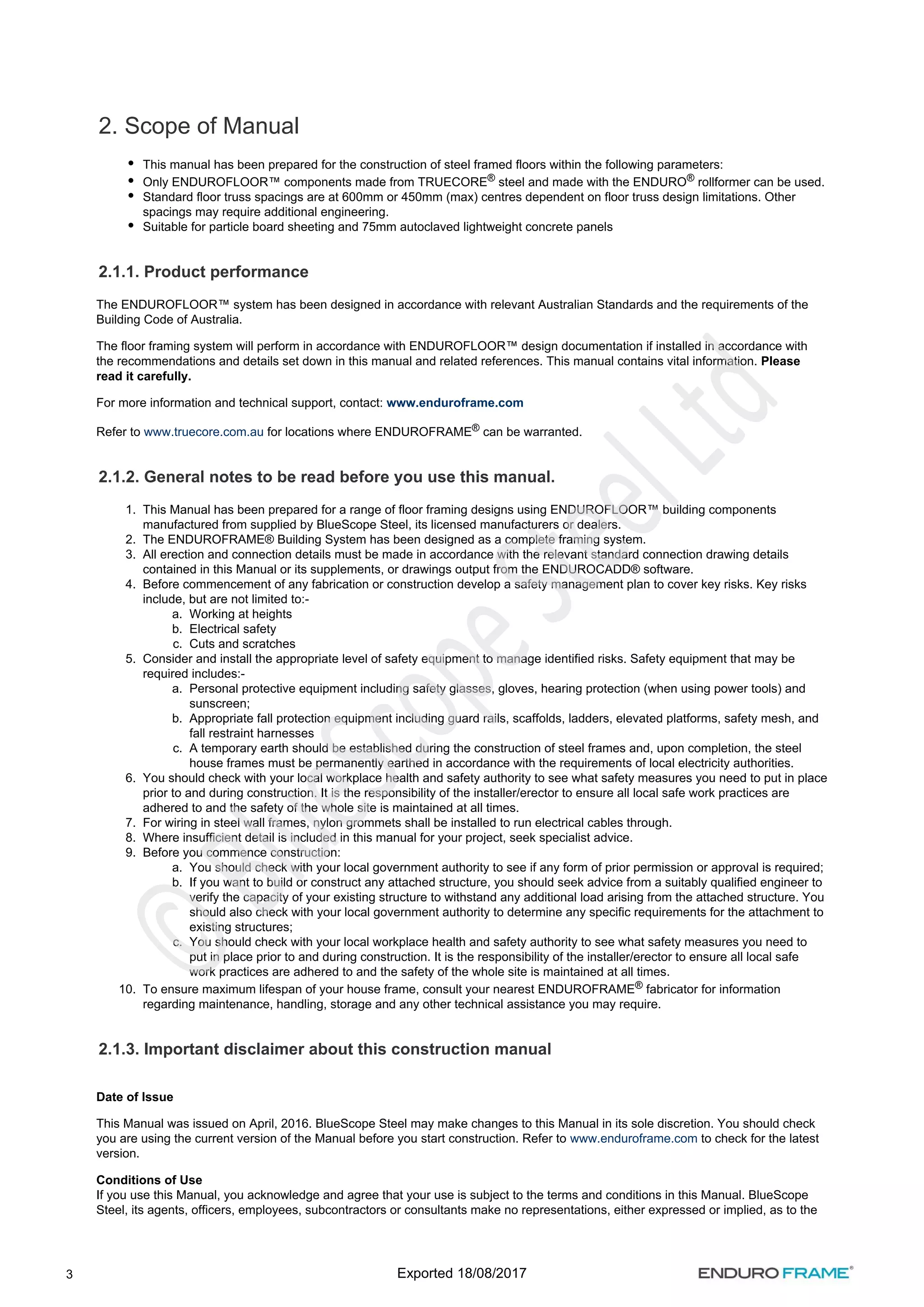
Picture Description Application Suppliers
5/16-12 x 17 Hex
Washer Trusstite
Or
17-15 x 15mm GX screw
Trilobular thread form
Primary connection of truss components through
pre-punched holes.
Both screws listed are suitable for the application.
ITW Buildex,
Bremick, Ideal,
Powers
#10-16x16 hex head self
drilling screw.
Low strength fixing- ceiling batten fix, chord and web
boxing.
Used in all wall systems
ITW Buildex,
Bremick, Ideal,
Powers
Wall fastener – M6 x 1P
x 15mm Smooth Top GX
screw
Wall tite
(Trilobular thread form)
Connecting wall frame components together through
pre-punched holes. Used in ENDUROWALL™
FRAMING SYSTEM,
ITW Buildex,
Bremick, Ideal,
Powers
#12-14x20 hex head self
drilling screws
General Framing Screw- Roof, Wall and Floor frame
installation
Used as reinforcing in truss manufacture.
ITW Buildex,
Bremick, Ideal,
Powers
M6,0 x1P x 18,0 Smooth
Top Gx Teks
Stiffening stud to plate connections and connecting
lintels to plates
ITW Buildex,
Bremick, Ideal,
Powers
The use of the correct fasteners in the quantities shown in the truss fabrication drawings are essential to ensure the design capacity
of the trusses are achieved.
7.4. Brackets
Picture Description Application Supplier Part
No.
influences. Do not use stainless steel fasteners with steel framing made from TRUECORE steel.
®
Where a manufacturer is listed, alternative products may be used providing all corrosion and mechanical properties are the
same as those supplied by the specified manufacturer and in compliance with AS3566.2 Class 3. All screws shall have
shear and pull out values at least equivalent to those shown in the ENDUROFRAME® Design Manual. Product
specifications from fastener suppliers may change from time-to-time so please check the latest technical data sheets from
fastener suppliers to ensure that corrosion and mechanical properties comply with the values required for the
ENDUROFRAME® system.
Exported 18/08/2017
8
CPAH Hold down bracket
1.9 mm B.M.T. Zincform
G450 Z275
Hold down bracket to connect joists to masonry walls Pryda CPAH
Purlin cleats Purlin cleats
100AC - 90x70EA
150AC - 140x70EA
200AAC - 190x70EA
250AAC - 240x70EA
Connecting purlins to purlins Lysaght
General purpose brackets Connecting purlins to purlins Lysaght
ENDURO angle 45 x 45 x
1mm
Trimmer
Ceiling trim
Exported 18/08/2017
9
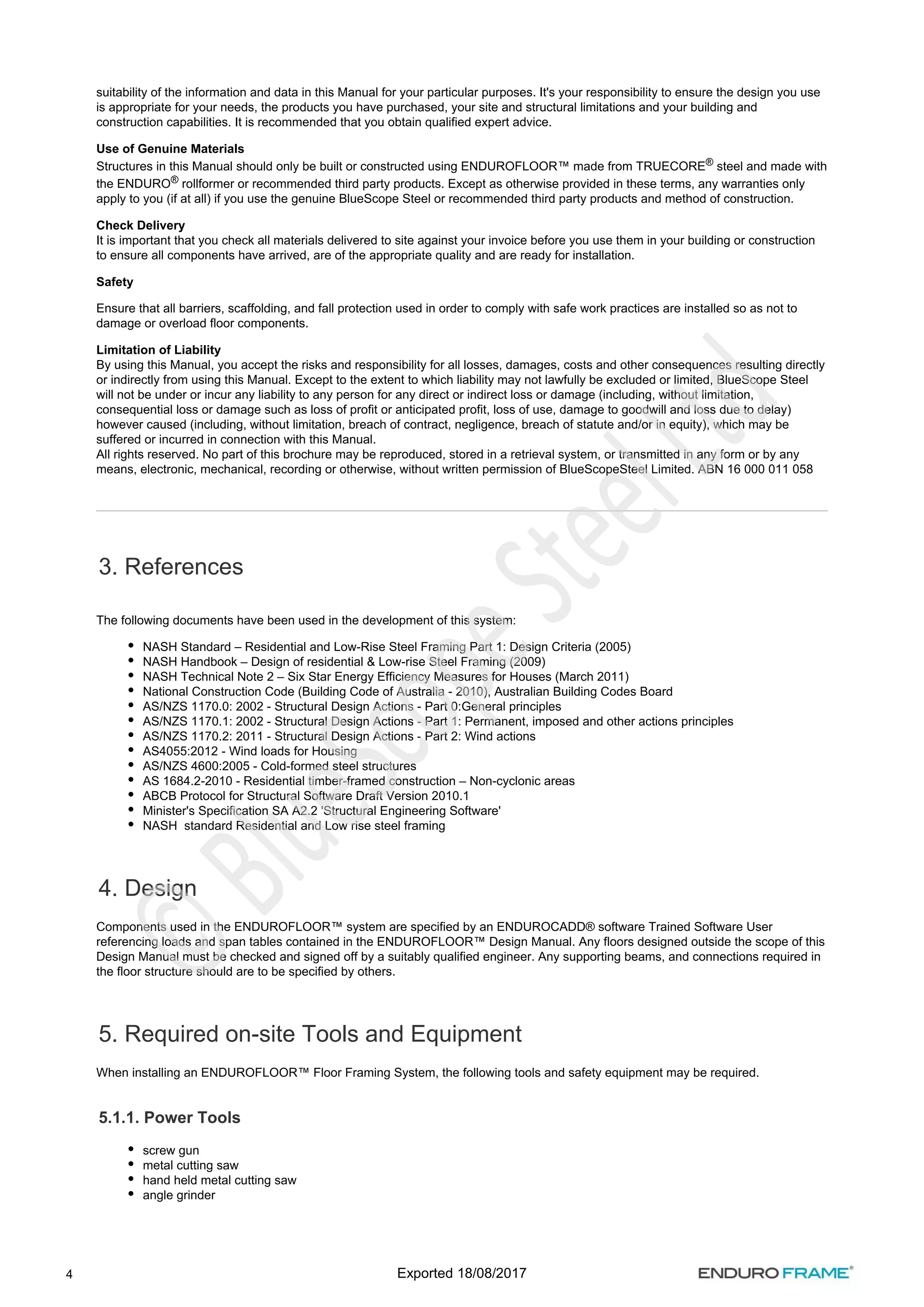
Enduro Floor Truss
Bracket 35 x 35 x 1mm
Connection and support of floor trusses to bearers/beams
SFS stiffening plate Insert an oversized service penetration in a 300mm floor
truss in its vertical axis. Length = 600mm
Can also be used on a 350mm deep floor truss in its vertical
axis. Length = 350mm.
SFS
7.5. Bracing & Blocking
Picture Description Application Supplier Part No.
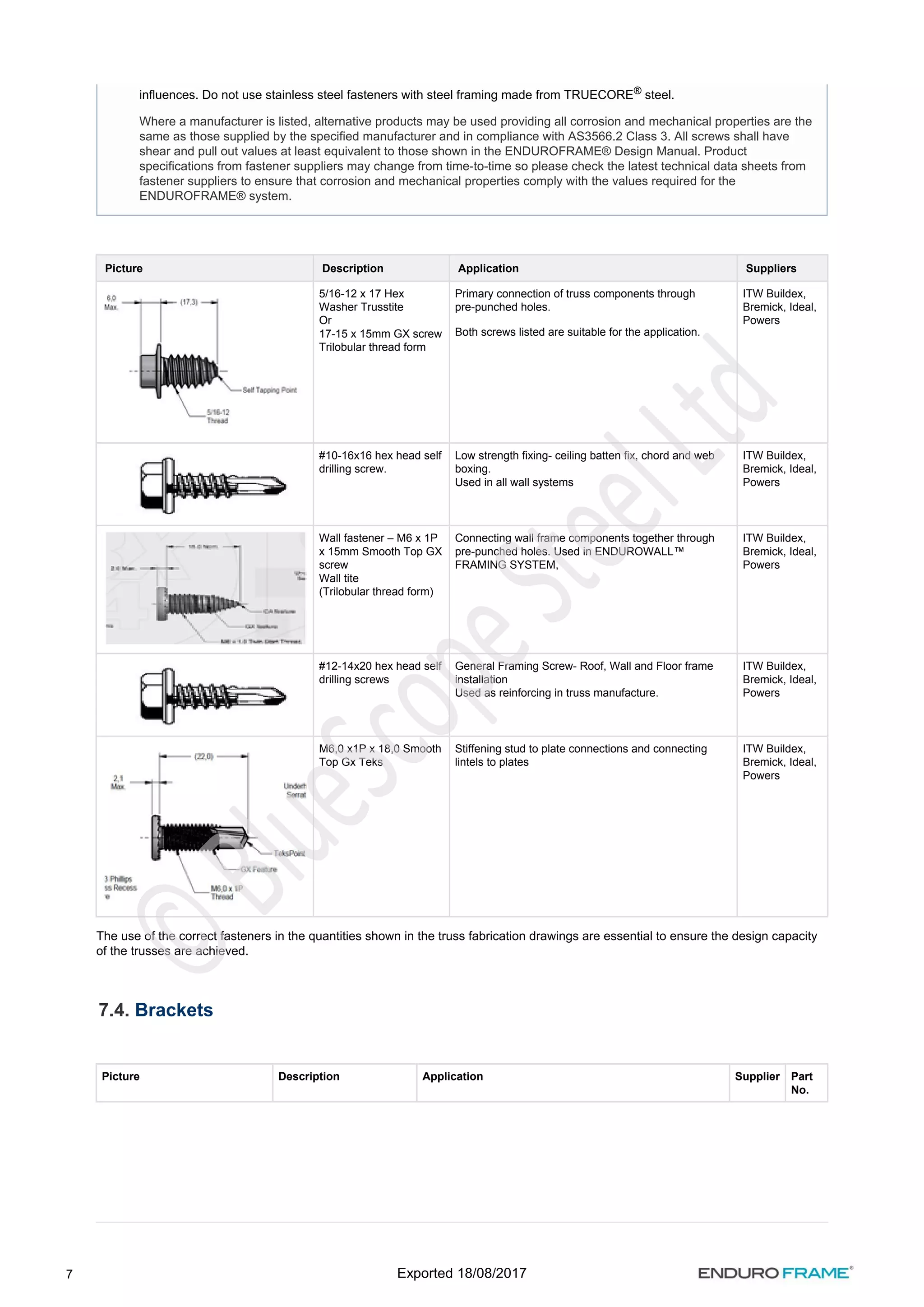
Speedbrace
Z275 ZincForm Steel
®
G300
Rollover resistance brace Pryda SDB
Strap bracing
25 x 1.0, G250
25 x 1.2, G250
32 x 1.0, G250
32 x 1.2, G250
51 x 1.2, G550
70 x 1.0, G250
Rollover resistance brace
Diaphragm bracing
Lysaght
7.6. Beams & Bearers
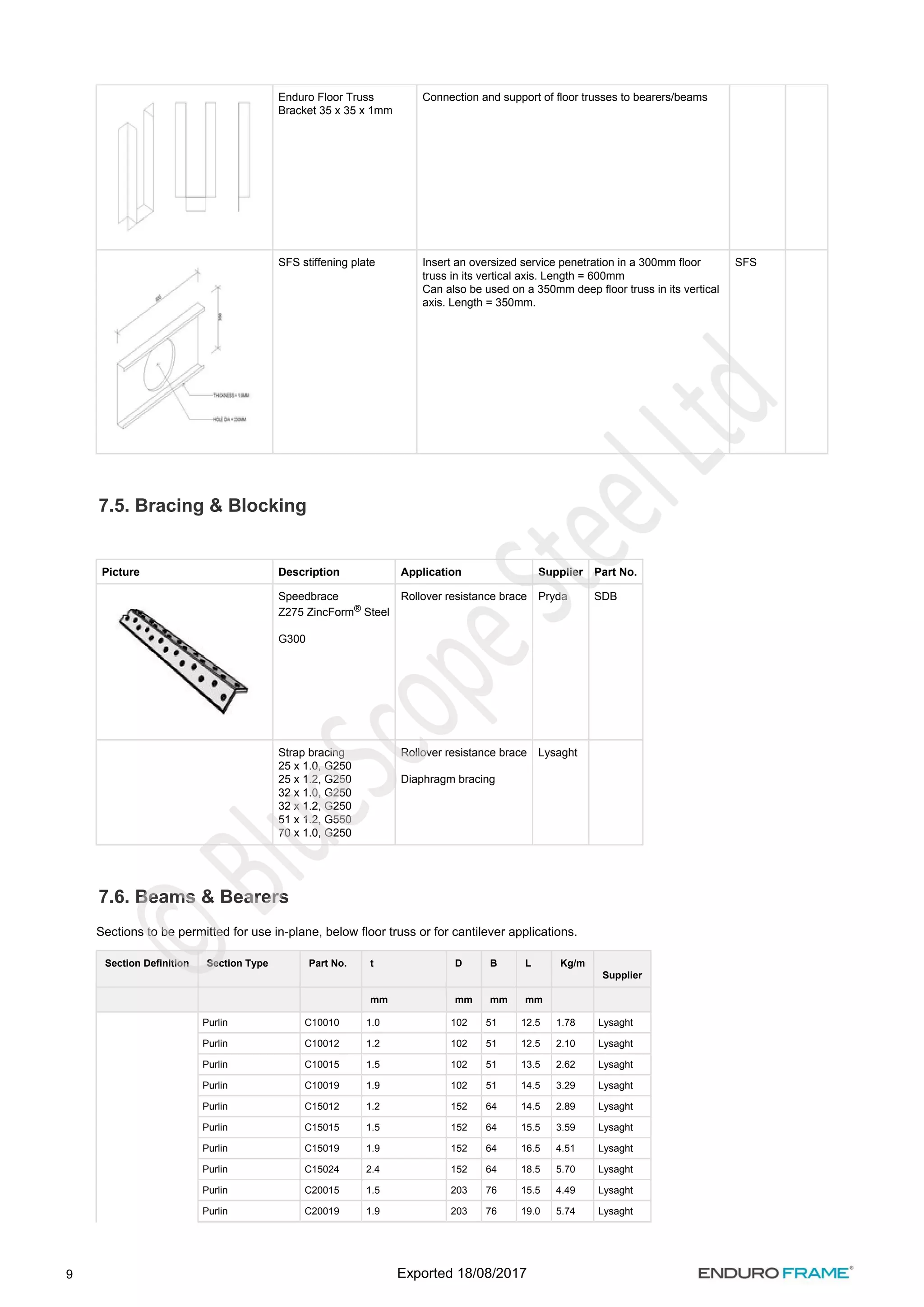
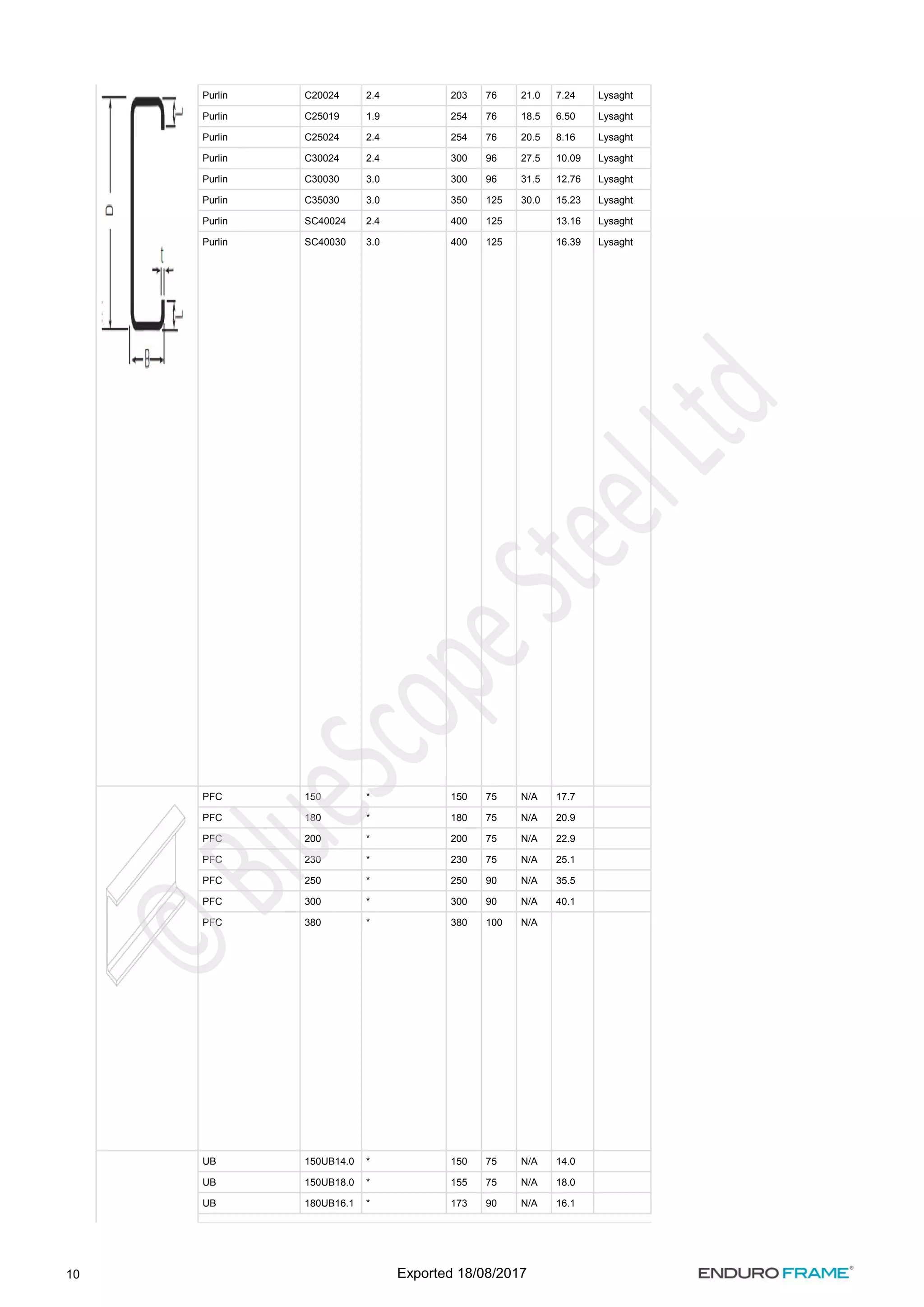
Sections to be permitted for use in-plane, below floor truss or for cantilever applications.
Section Definition Section Type Part No. t D B L Kg/m
Supplier
mm mm mm mm
Purlin C10010 1.0 102 51 12.5 1.78 Lysaght
Purlin C10012 1.2 102 51 12.5 2.10 Lysaght
Purlin C10015 1.5 102 51 13.5 2.62 Lysaght
Purlin C10019 1.9 102 51 14.5 3.29 Lysaght
Purlin C15012 1.2 152 64 14.5 2.89 Lysaght
Purlin C15015 1.5 152 64 15.5 3.59 Lysaght
Purlin C15019 1.9 152 64 16.5 4.51 Lysaght
Purlin C15024 2.4 152 64 18.5 5.70 Lysaght
Purlin C20015 1.5 203 76 15.5 4.49 Lysaght
Purlin C20019 1.9 203 76 19.0 5.74 Lysaght
Exported 18/08/2017
10
Purlin C20024 2.4 203 76 21.0 7.24 Lysaght
Purlin C25019 1.9 254 76 18.5 6.50 Lysaght
Purlin C25024 2.4 254 76 20.5 8.16 Lysaght
Purlin C30024 2.4 300 96 27.5 10.09 Lysaght
Purlin C30030 3.0 300 96 31.5 12.76 Lysaght
Purlin C35030 3.0 350 125 30.0 15.23 Lysaght
Purlin SC40024 2.4 400 125 13.16 Lysaght
Purlin SC40030 3.0 400 125 16.39 Lysaght
PFC 150 * 150 75 N/A 17.7
PFC 180 * 180 75 N/A 20.9
PFC 200 * 200 75 N/A 22.9
PFC 230 * 230 75 N/A 25.1
PFC 250 * 250 90 N/A 35.5
PFC 300 * 300 90 N/A 40.1
PFC 380 * 380 100 N/A
UB 150UB14.0 * 150 75 N/A 14.0
UB 150UB18.0 * 155 75 N/A 18.0
UB 180UB16.1 * 173 90 N/A 16.1
Exported 18/08/2017
11
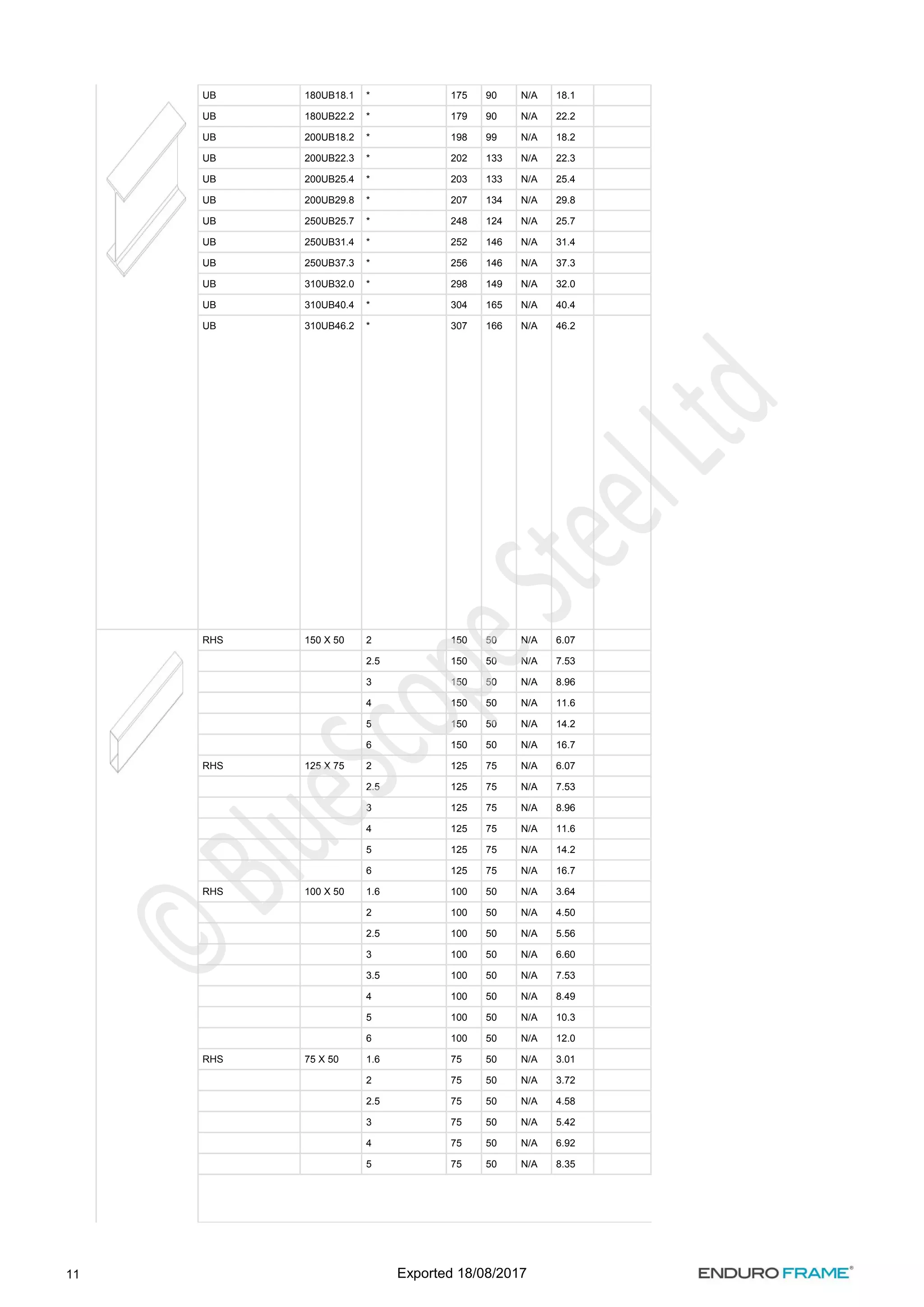
UB 180UB18.1 * 175 90 N/A 18.1
UB 180UB22.2 * 179 90 N/A 22.2
UB 200UB18.2 * 198 99 N/A 18.2
UB 200UB22.3 * 202 133 N/A 22.3
UB 200UB25.4 * 203 133 N/A 25.4
UB 200UB29.8 * 207 134 N/A 29.8
UB 250UB25.7 * 248 124 N/A 25.7
UB 250UB31.4 * 252 146 N/A 31.4
UB 250UB37.3 * 256 146 N/A 37.3
UB 310UB32.0 * 298 149 N/A 32.0
UB 310UB40.4 * 304 165 N/A 40.4
UB 310UB46.2 * 307 166 N/A 46.2
RHS 150 X 50 2 150 50 N/A 6.07
2.5 150 50 N/A 7.53
3 150 50 N/A 8.96
4 150 50 N/A 11.6
5 150 50 N/A 14.2
6 150 50 N/A 16.7
RHS 125 X 75 2 125 75 N/A 6.07
2.5 125 75 N/A 7.53
3 125 75 N/A 8.96
4 125 75 N/A 11.6
5 125 75 N/A 14.2
6 125 75 N/A 16.7
RHS 100 X 50 1.6 100 50 N/A 3.64
2 100 50 N/A 4.50
2.5 100 50 N/A 5.56
3 100 50 N/A 6.60
3.5 100 50 N/A 7.53
4 100 50 N/A 8.49
5 100 50 N/A 10.3
6 100 50 N/A 12.0
RHS 75 X 50 1.6 75 50 N/A 3.01
2 75 50 N/A 3.72
2.5 75 50 N/A 4.58
3 75 50 N/A 5.42
4 75 50 N/A 6.92
5 75 50 N/A 8.35
Exported 18/08/2017
12
6 75 50 N/A 9.67
SHS 100 X 100 2.5 100 100 N/A 7.53
3 100 100 N/A 8.96
4 100 100 N/A 11.6
5 100 100 N/A 14.2
SHS 90 X 90 2 90 90 N/A 5.45
2.5 90 90 N/A 6.74
3.5 90 90 N/A
SHS 75 X 75 2 75 75 N/A 4.5
2.5 75 75 N/A 5.56
3 75 75 N/A 6.60
3.5 75 75 N/A 7.53
4 75 75 N/A 8.49
5 75 75 N/A 10.3
6 75 75 N/A 12.0
Boxspan 100 x 50-12 0.6 100 50 N/A 2.05 Spantec
Boxspan 100 x 50-16 0.8 100 50 N/A 2.71 Spantec
Boxspan 150 x 50-12 0.6 150 50 N/A 2.51 Spantec
Boxspan 150 x 50-16 0.8 150 50 N/A 3.33 Spantec
Boxspan 150 x 50-20 1. 0 150 50 N/A 4.14 Spantec
Boxspan 200 x 50-16 0.8 200 50 N/A 3.94 Spantec
Boxspan 200 x 50-20 1.0 200 50 N/A 4.91 Spantec
Boxspan 250 x 50-20 1.0 250 50 N/A 5.68 Spantec
Exported 18/08/2017
13
SFS Rollformed Joist 1.5, 1.9 & 2.4mm 300 50 N/A SFS
8. Truss Connections
Chord to chord connections do not have any name, and are treated the same as webs. The only information that is recorded in the
connection are the number of fasteners, and these shall be the same for connection at each end of the chord or web.
The only other type of connection is a step down connection which will be referred to as SD-6 which indicates the number of self
tapping fasteners connecting the top chord with the step down chord.
The number of screws indicated is the combined number of Trusstite and reinforcing screws.
When assembling trusses adopt the following rules for screw placement:-
Screws should be placed a minimum of 18mm centre to centre
Screws should be placed a minimum of 10mm from the end of a component
Screws should be placed a minimum of 8mm from the edge of a component
Screws should be placed where shown on the connection drawings within the above spacing constraints
Note
Connections external to the truss - e.g. Bridge truss to Girder Truss, Rafter to truss, truss to support - are covered in the
relevant block assembly sections of this manual.
Connection between extended top chord of floor
truss and dwarf wall stud.
Exported 18/08/2017
14
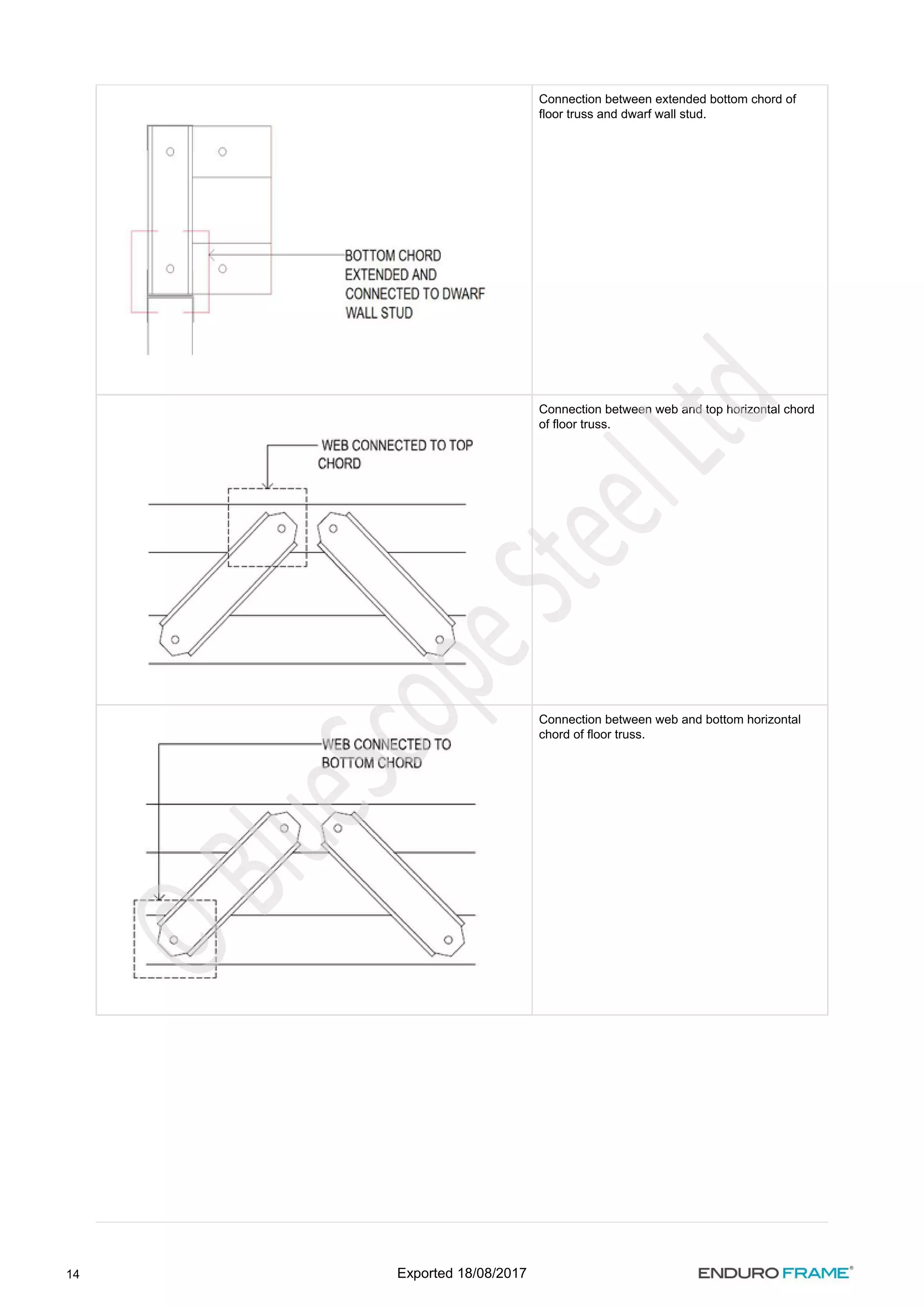
Connection between extended bottom chord of
floor truss and dwarf wall stud.
Connection between web and top horizontal chord
of floor truss.
Connection between web and bottom horizontal
chord of floor truss.
Exported 18/08/2017
15
Compound connection for use in set downs such
as bathroom wet areas and balconies. This
connection compliments the bottom chord
connection (below)
Vertical chords and webs are non-flush only.
Top chord of lower RL area is to be notched along
its length to fit over the top chord of the higher RL
area.
Compound connection for use in set downs such
as bathroom wet areas and balconies. This
connection compliments the top chord connection
(above)
Vertical chords and webs are non-flush only.
Connection between floor joist step down and end
wall.
9. Notes on Vibration
Sound Dampening between chords and webs can be seen at this link - .
https://enduroframe.atlassian.net/wiki/x/J4A3
Floor vibration from general footfall traffic is subjective to each end user. Some people prefer a tight (high frequency) floor whilst
others prefer a floor with more resilience (bounce). Each floor design is affected by multiple circumstances including joist span and
spacing, flooring type and thickness, furniture supported, loads imposed from roof and supporting walls and supported partition
(non-loadbearing) walls.
The ENDUROFLOOR™ system defined in this manual has been tested to have a minimum harmonic frequency of 8 Hz with joists at
a maximum span and centres indicated in the attached span tables, and sheathed with either 22mm or 19mm particleboard flooring
Exported 18/08/2017
16
fixed in accordance to AS1860. This value is considered to be acceptable in most circumstances.
Where a higher frequency (tighter) floor is required, reduced spans, the use of stiffer/thicker flooring or an extra layer of flooring may
be utilised with varied results.
10. Truss Assemblies
10.1. General
For ENDUROTRUSS pre-punched holes are formed in chords and webs during rollforming. The perimeter chords are connected
®
using TRUSSTITE fasteners at changes in direction. The primary shape is formed by aligning pre-punched holes in the adjacent
®
chord members and inserting a TRUSSTITE screw to form a connection. Additional screws, stiffeners or brackets may be required
®
to form the connection. Webs join the chords of a truss forming triangular patterns transmitting tension or compression stresses. The
web to chord connections are formed by aligning the pre-punched holes in the end of the webs with pre-punched holes along the
chord members and inserting a TRUSSTITE fastener. Additional self drilling screws may be required to add strength to the
®
connection. The full geometry of the truss is set by the connection of the pre-punched and notched components. ENDUROTRUSS®
Channels have one flange wider than the other enabling the boxing of the section forming a tubular section with high torsional
strength. To facilitate the boxing of chords after assembly the narrow flange must be placed on the external perimeter of the truss
and on the top of horizontal rails within the truss.
10.2. Flush Truss
Flush truss is not an option with the ENDUROFLOOR™ truss system.
10.3. Pre Camber
There will be no pre-camber in the floors design or manufacture.
10.4. Manufacturing Crib Allowance
Crib lengths are necessary for trusses to fit in between walls and beams. The standard crib length is 2mm of a truss
from each end
but can be adjusted as necessary by the Trained Software User in the ENDUROCADD software. The following crib lengths shall be
assumed:-
Beam lengths - User defined
Length of trusses between 2 walls - 4mm or user defined
Length of trusses between 2 beams - 10mm user defined
or
Length of trusses between a beam and a wall 5mm user defined
or
10.5. Floor truss component cribbing for Independent wall systems
Exported 18/08/2017
17
Detail: Floor truss component cribbing - Independent wall system
10.6. Floor truss component cribbing for Integrated wall systems
Exported 18/08/2017
18
10.6.1.1.1.
Detail: Floor truss component cribbing - Integrated wall system
10.7. Standard Floor Truss
A standard floor truss has the top and bottom chord running parallel (vertical end chords may be used where specified). The end of a
standard floor truss may either sit on top of a load bearing wall or bearer, fit into an integrated wall or butt up against a beam. Vertical
webs are placed directly above, below or between load bearing walls and supporting beams. Common webs will be placed at 45
degrees from the end of the floor truss starting at the top chord, and any non-standard webs are in the middle of the truss span. This
may mean that 2 webs in the centre of the truss are non-standard lengths and can vary between 35 degrees to 90 degrees (vertical).
In order to simplify manufacturing and assembly of trusses, standard lengths are used for webs and vertical chords (where specified).
This will enable standard parts to be pre-made and stored, and will make it easier to find parts during assembly. Only non-standard
length parts will therefore need to be defined on assembly sheets which will greatly de-clutter drawings given these trusses will be
quite dense. Location of standard webs shall be placed from the outside (support locations) working inward toward the middle of the
span. In the majority of cases, this would only require a maximum of 2 webs to be individual.
Detail: Typical standard floor truss - all webs at 45 degrees
Exported 18/08/2017
19
Detail: Typical standard floor truss - middle webs at minimum 35 degrees
Detail: Typical standard floor truss - middle webs greater than 45 degrees
10.8. Design Options
The following options for standard floor trusses include:-
Top chord section (where specified, the 2 vertical chords at the end of the truss shall be the same section)
Single or boxed top chord section
Bottom chord section.
Single or boxed bottom chord section
Web section. This also applies to any vertical sections above a load bearing wall.
Truss depth (this shall be from 250mm, 300mm, 350mm, 400mm and 450mm)
All chords have square end cuts. All floor trusses have the webs back-to-back with the chords. The configurations
for standard floor trusses are shown below.
Exported 18/08/2017
20
Detail: Typical standard floor truss - Context and components
The end connection detail of a standard floor truss is shown in Figure 10 3 Typical standard floor truss end connection detail. The
standard truss fits into and connects with Trusstite screws to the end wall which is manufactured separately to the standard floor
truss. With the Integrated wall type the floor truss is supported by the nogging.
not
10.8.1.1.1. Detail: End connection punch locations
11. Connecting Floors from Upper Wall to Lower Wall
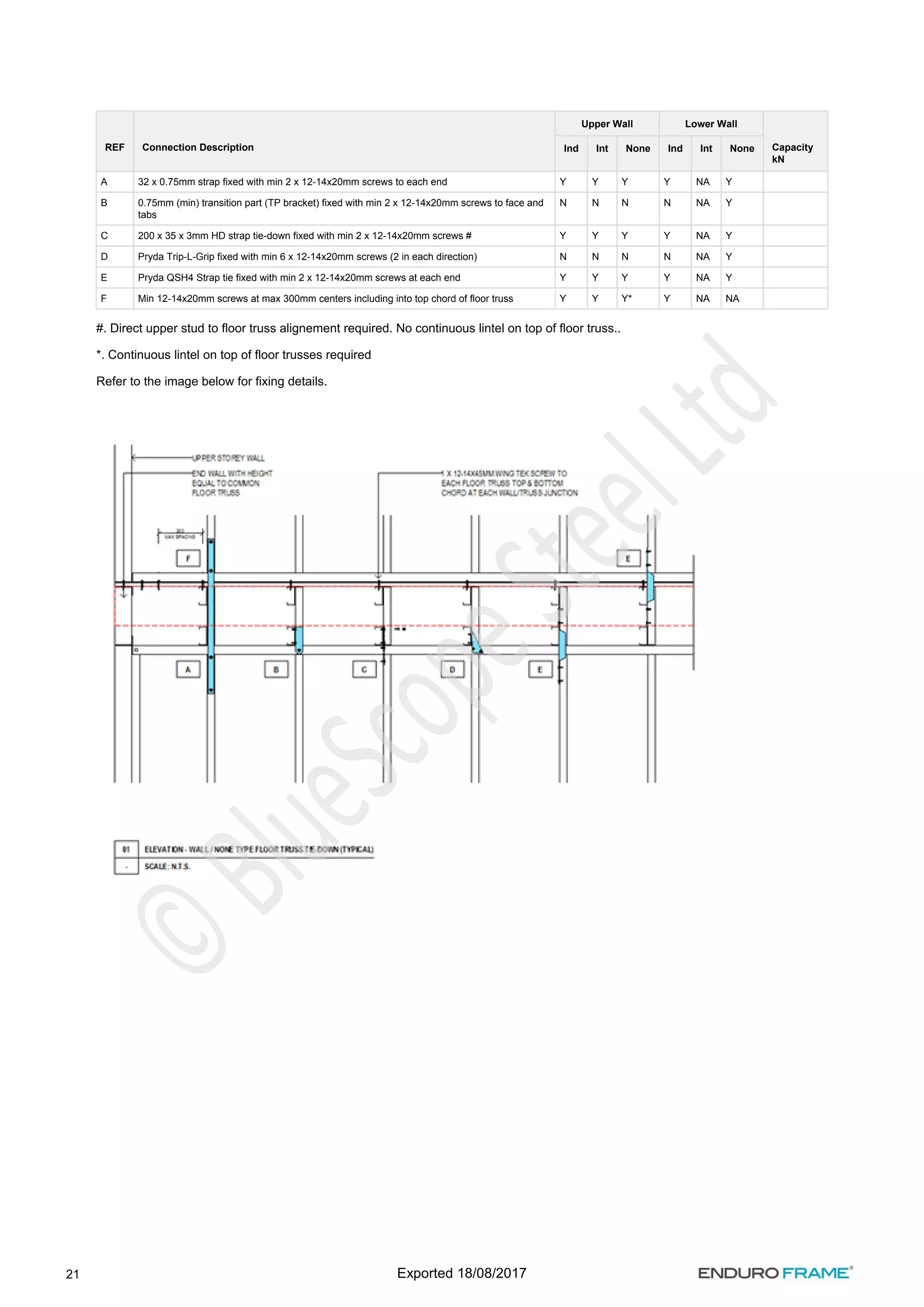
The following options are available to connect upper storey walls to lower storey walls is shown in the table below. This assumes that
the plates used in both the upper and lower walls are minimum 0.75mm BMT.
Exported 18/08/2017
21
REF Connection Description
Upper Wall Lower Wall
Capacity
kN
Ind Int None Ind Int None
A 32 x 0.75mm strap fixed with min 2 x 12-14x20mm screws to each end Y Y Y Y NA Y
B 0.75mm (min) transition part (TP bracket) fixed with min 2 x 12-14x20mm screws to face and
tabs
N N N N NA Y
C 200 x 35 x 3mm HD strap tie-down fixed with min 2 x 12-14x20mm screws # Y Y Y Y NA Y
D Pryda Trip-L-Grip fixed with min 6 x 12-14x20mm screws (2 in each direction) N N N N NA Y
E Pryda QSH4 Strap tie fixed with min 2 x 12-14x20mm screws at each end Y Y Y Y NA Y
F Min 12-14x20mm screws at max 300mm centers including into top chord of floor truss Y Y Y* Y NA NA
#. Direct upper stud to floor truss alignement required. No continuous lintel on top of floor truss..
*. Continuous lintel on top of floor trusses required
Refer to the image below for fixing details.
Exported 18/08/2017
22
1.
2.
1.
2.
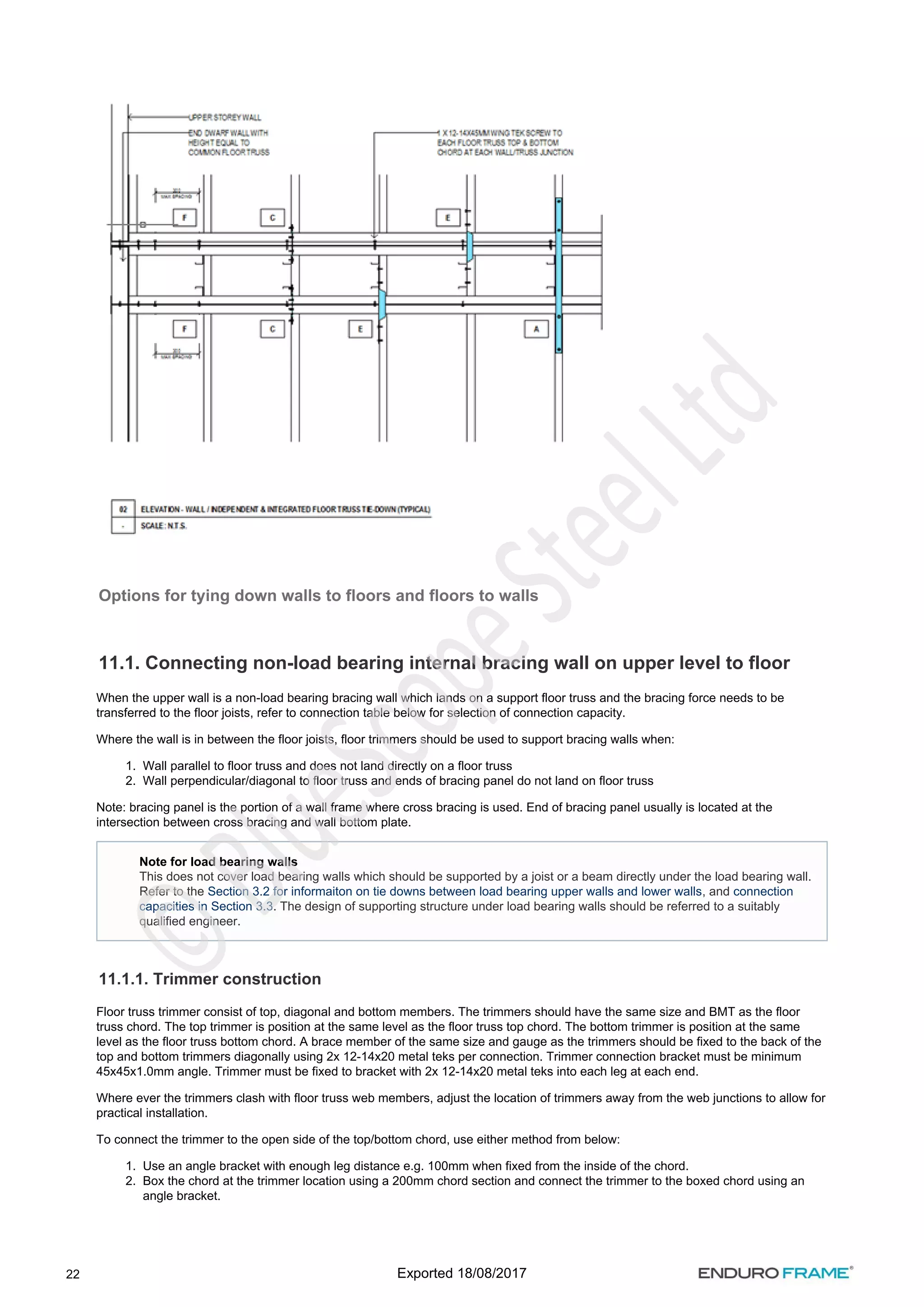
Options for tying down walls to floors and floors to walls
11.1. Connecting non-load bearing internal bracing wall on upper level to floor
When the upper wall is a non-load bearing bracing wall which lands on a support floor truss and the bracing force needs to be
transferred to the floor joists, refer to connection table below for selection of connection capacity.
Where the wall is in between the floor joists, floor trimmers should be used to support bracing walls when:
Wall parallel to floor truss and does not land directly on a floor truss
Wall perpendicular/diagonal to floor truss and ends of bracing panel do not land on floor truss
Note: bracing panel is the portion of a wall frame where cross bracing is used. End of bracing panel usually is located at the
intersection between cross bracing and wall bottom plate.
11.1.1. Trimmer construction
Floor truss trimmer consist of top, diagonal and bottom members. The trimmers should have the same size and BMT as the floor
truss chord. The top trimmer is position at the same level as the floor truss top chord. The bottom trimmer is position at the same
level as the floor truss bottom chord. A brace member of the same size and gauge as the trimmers should be fixed to the back of the
top and bottom trimmers diagonally using 2x 12-14x20 metal teks per connection. Trimmer connection bracket must be minimum
45x45x1.0mm angle. Trimmer must be fixed to bracket with 2x 12-14x20 metal teks into each leg at each end.
Where ever the trimmers clash with floor truss web members, adjust the location of trimmers away from the web junctions to allow for
practical installation.
To connect the trimmer to the open side of the top/bottom chord, use either method from below:
Use an angle bracket with enough leg distance e.g. 100mm when fixed from the inside of the chord.
Box the chord at the trimmer location using a 200mm chord section and connect the trimmer to the boxed chord using an
angle bracket.
Note for load bearing walls
This does not cover load bearing walls which should be supported by a joist or a beam directly under the load bearing wall.
Refer to the , and
Section 3.2 for informaiton on tie downs between load bearing upper walls and lower walls connection
. The design of supporting structure under load bearing walls should be referred to a suitably
capacities in Section 3.3
qualified engineer.
Exported 18/08/2017
23
11.1.2. Trimmer locations
For bracing walls, trimmers are positioned at the end of bracing panels, for a single wall with 2 or more bracing panels, trimmers are
required at the ends of each bracing panel.
11.1.3. Bracing wall bottom plate to trimmer / floor truss top chord uplift and shear capacity
Floor joist top chord / trimmer BMT (mm) Connection capacities (kN)
No. of fastener x fastener size
4x 12-14x20 6x 12-14x20 6x 14g-10
Uplift Shear Uplift Shear Uplift Shear
0.75 3.6 12.3 5.3 18.4 7.2 21.0
1 5 16.3 7.5 24.5 11.3 28.1
1.2 7.9 18.5 11.8 27.8 12.4 31.8
Intermiedate fixing along bottom plate
of bracing panels to floor joist
12g-14 hex head metal teks at 450/600mm standard spacing between studs
Uplift capacities are based on NASH figures, Shear capacities are based on AS4600 hole bearing calculation.
12. Handling of Endurofloor trusses
Trusses must be fully supported in either horizontal or vertical planes when being transported. Care must be taken when tying down
and lifting trusses not to put an excessive pressure on chords, webs or joints. An additional screw may be inserted to provide
additional structural stiffness and ease of transportation.
Most floor trusses work may be lifted by hand, however where cranage is required, use slings. Slings should be located at equal
distances from truss centrelines, and be approximately one-third to one-half the truss length apart.
The angle between the sling legs should be 60 degrees or less and where truss spans are greater than 9000 mm, a spreader bar
with suitable attachments at the web-chord connection should be used.
Note: When maneuvering any materials by hand, take care not to damage components. Components should be inspected on arrival
to site. Damaged components may affect structural integrity and may require replacement.
Exported 18/08/2017
24
1.
2.
3.
13. Floor trusses exposure and storage
Where trusses are stored on site, they should be blocked above firm ground so that they do not come into contact with the soil and to
protect them from ground water:
If the trusses are stored horizontally, as shown in Fig. , the blocking should be at 2.0m to 2.5m centres or as required at
x.x
joints, to prevent bending of the trusses. Avoid using copper, chemically treated timber or EPDM based materials as
blocking.
If the trusses are stored vertically as shown in Fig. , they should be supported at the designed support locations or bottom
x.x
chord panel points, and in a manner that will be prevented from tipping or toppling.
The truss chords should be sloped such that water drains off.
14. Truss identification
A summary of the description of floor trusses is shown in the image below. Wall have been removed in the attached image for clarity.
Exported 18/08/2017
25
Detail: Typical floor
14.1. Standard Floor truss
A standard floor truss consists of parallel top and bottom chords that may be boxed (if necessary), and common webs.
Detail: Standard floor truss
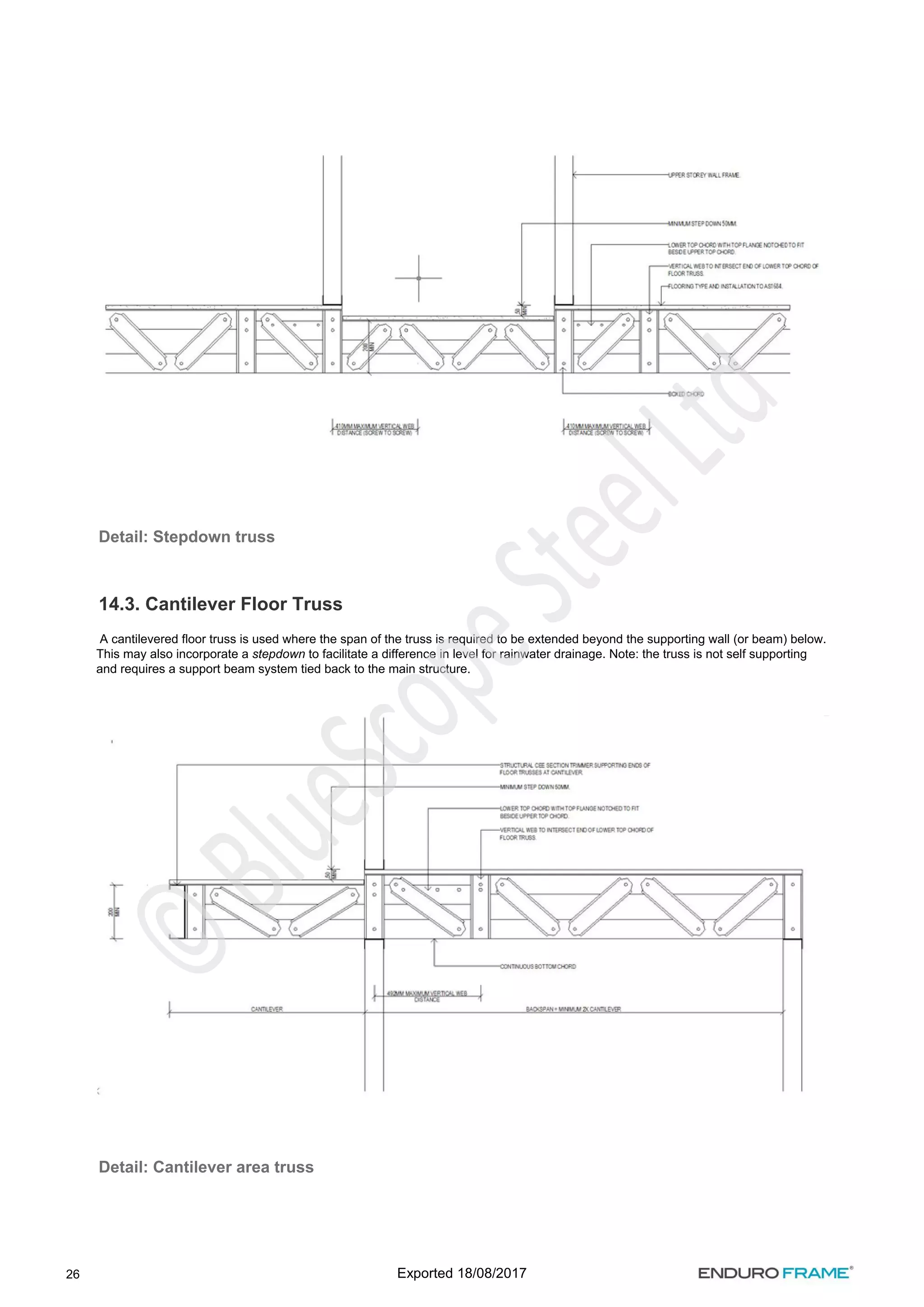
14.2. Stepdown Truss
A stepdown truss is used where a reduced top level is required in a wet area such as a bathroom or laundry. Due consideration
should be given for the possibility of increased floor dead loads from reinforced mortar bed tiling. Stepdown trusses can also be used
on external deck areas or as an architectural feature in alternate floor levels.
Exported 18/08/2017
26
Detail: Stepdown truss
14.3. Cantilever Floor Truss
A cantilevered floor truss is used where the span of the truss is required to be extended beyond the supporting wall (or beam) below.
This may also incorporate a to facilitate a difference in level for rainwater drainage. Note: the truss is not self supporting
stepdown
and requires a support beam system tied back to the main structure.
Detail: Cantilever area truss
Exported 18/08/2017
27
15. Truss Assembly
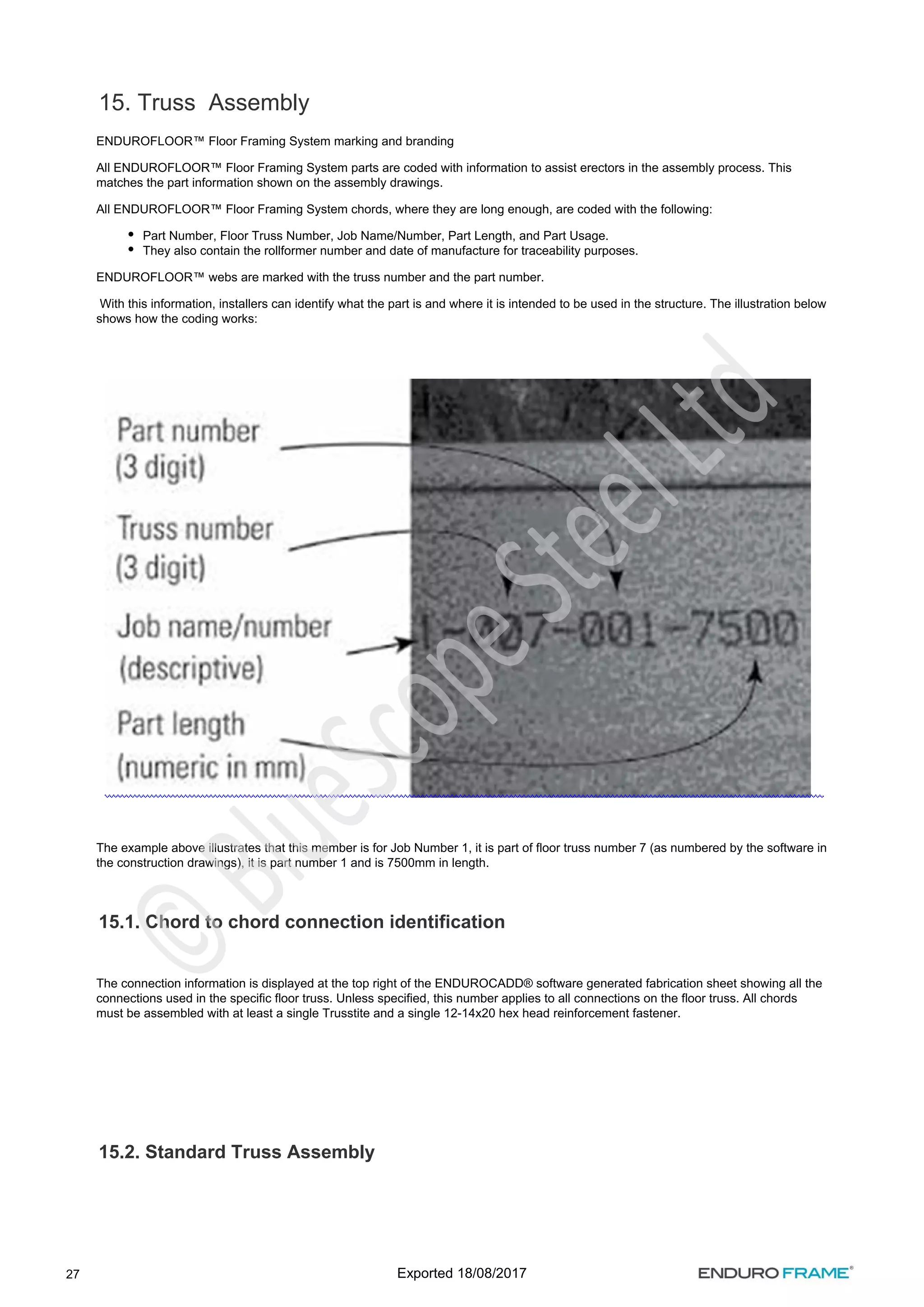
ENDUROFLOOR™ Floor Framing System marking and branding
All ENDUROFLOOR™ Floor Framing System parts are coded with information to assist erectors in the assembly process. This
matches the part information shown on the assembly drawings.
All ENDUROFLOOR™ Floor Framing System chords, where they are long enough, are coded with the following:
Part Number, Floor Truss Number, Job Name/Number, Part Length, and Part Usage.
They also contain the rollformer number and date of manufacture for traceability purposes.
ENDUROFLOOR™ webs are marked with the truss number and the part number.
With this information, installers can identify what the part is and where it is intended to be used in the structure. The illustration below
shows how the coding works:
The example above illustrates that this member is for Job Number 1, it is part of floor truss number 7 (as numbered by the software in
the construction drawings), it is part number 1 and is 7500mm in length.
15.1. Chord to chord connection identification
The connection information is displayed at the top right of the ENDUROCADD® software generated fabrication sheet showing all the
connections used in the specific floor truss. Unless specified, this number applies to all connections on the floor truss. All chords
must be assembled with at least a single Trusstite and a single 12-14x20 hex head reinforcement fastener.
15.2. Standard Truss Assembly
Exported 18/08/2017
28
15.2.1.1. Step 1 - Part Identification
Unpack the trusses and sort into truss lots using the branding as a guide. Identify the chords and webs from the branding information
on the parts. To simplify the assembly process, common webs with a predetermined length are used in the majority of the floor
trusses with individual webs allowing for manufacture of different floor truss lengths. Refer to ENDUROTRUSS® Framing System
for more information on how to identify parts.
marking and branding
15.2.1.2. Step 2 - Truss Layout & Chord Assembly
Identify the chords and lay toes down on a level surface or assembly table and align as per assembly drawing. Vertical chords will lay
back-to-back with horizontal chords. Pre-punched holes are provided for locating truss screw to connect the chords together. All
sections for chords have square cut ends.
Note: Branding is on the side flange which will be on the outside of the truss chords which can aid in assembly and laying out.
Detail: Initial chord placement
15.2.1.3. Step 3 - Align holes and install a locating truss screw
When carrying out the primary assembly of the end webs and chords, align holes as shown and install a locating Trusstite screw in
holes.
Exported 18/08/2017
29
Detail: Hole alignment and trusstite installation
15.2.1.4. Step 4 - Web Installation
If they are linked together, separate linked webs by cutting or snapping pieces apart. If webs are joined they will be attached in the
order required for assembly (Left to right). Snip or snap the webs apart and position each one over the truss chords near their final
location. As this is only a non-flush truss the branding on the webs will face towards the top of the truss and toes of the channel will
face up and no notches are provided at the web ends.
Detail: Web separation
15.2.1.5. Step 5 - Align holes and fix connection with a locating truss screw
Using part identifier numbers layout the webs in accordance with the Assembly Sheet. Line up the 6mm locating holes on the ends
of the webs with the appropriate holes on the floor truss chords. Install a locating Trusstite screw into the aligned holes ensuring
®
that the screw is driven firmly home and does not strip.
Should the locating truss screw strip, reduce the driver torque and place a 12-24x20mm self drilling screw 20mm minimum from the
locating truss screw.
Exported 18/08/2017
30
Detail: Web placement
Detail: Web fixing
Step 6 - Check floor truss dimensions and alignment
Before inserting any reinforcing screws check the overall dimensions of the floor truss against the Assembly Sheet. For a complex
shape truss, lay it on top of a previously assembled one and check they are the same.
Exported 18/08/2017
31
Detail: Check measure
15.2.1.6. Step 7 - Reinforcement screw installation
Once aligned, install 12-24x20mm hex head screws between the Trusstite fastener and the inside flange of the chord as shown in
the detail below.
Detail: Reinforcement screw installation
15.3. ENDUROFLOOR™ Floor Framing System stiffening and reinforcement
Refer to the ENDUROCADD® software generated connection drawing and the assembly drawings to identify reinforcing screws
required to complete truss assembly. Primary fixing screws are self-locating Trusstite screws fastened through pre-punched holes,
®
while reinforcing screws are #12-14 x 20mm hex-head self-drilling fasteners, without washers. Stiffening screws should be installed a
minimum of 21mm from each other and the locating screw and a minimum distance of 10mm from the edge and 17mm from the end.
From the appropriate connection drawing, identify the location and the screws required. Install as shown on the drawing.
Exported 18/08/2017
32
Detail: Screw distances
15.4. Web connection stiffening
Identify webs requiring reinforcing screws by referring to the span tables. For example, all web to chord connections require 2
screws which consists of 1 x Trusstite and 1 x 12/14 x 20mm Hex Head reinforcing screw. This is indicated in the span tables below
®
in white background text. Where grey background is behind the text in the table below, 3 screws are required consisting of 1 x
Trusstite and 2 x 12/14 x 20mm Hex Head reinforcing screw.
®
15.5. Chord Boxing
Where called for in the Assembly Sheet, chords are to be boxed using supplied boxing channel. Boxing is to be fixed to the inside
flanges of chords using either 10-16 x 16mm wafer head self drilling screws, or M6,0 x1P x 18,0 Smooth Top Gx Teks self drilling
screws as per the diagram below. These are fixed 50mm from each end of the boxing and at 600 mm nominal centres along the
boxing. The top flange of the top chord will restrained by screws fixing the flooring fixings, and the bottom flanges of the bottom
chords are restrained by the ceiling batten fixings.
Chord Boxing Detail
16. Points for construction
Floor trusses must be installed plumb and straight
While installing the floor, trusses must be fixed plumb and straight. After fixing, if a bow or tilt is evident, the trusses have not been
installed correctly. In this case, the problem must be rectified before proceeding further.
Warning
Trusses must not be modified on site in any way without first seeking advice from a trained software user (TSU) or a
Exported 18/08/2017
33
16.1. Correct direction of ENDUROFLOOR™ chord profile
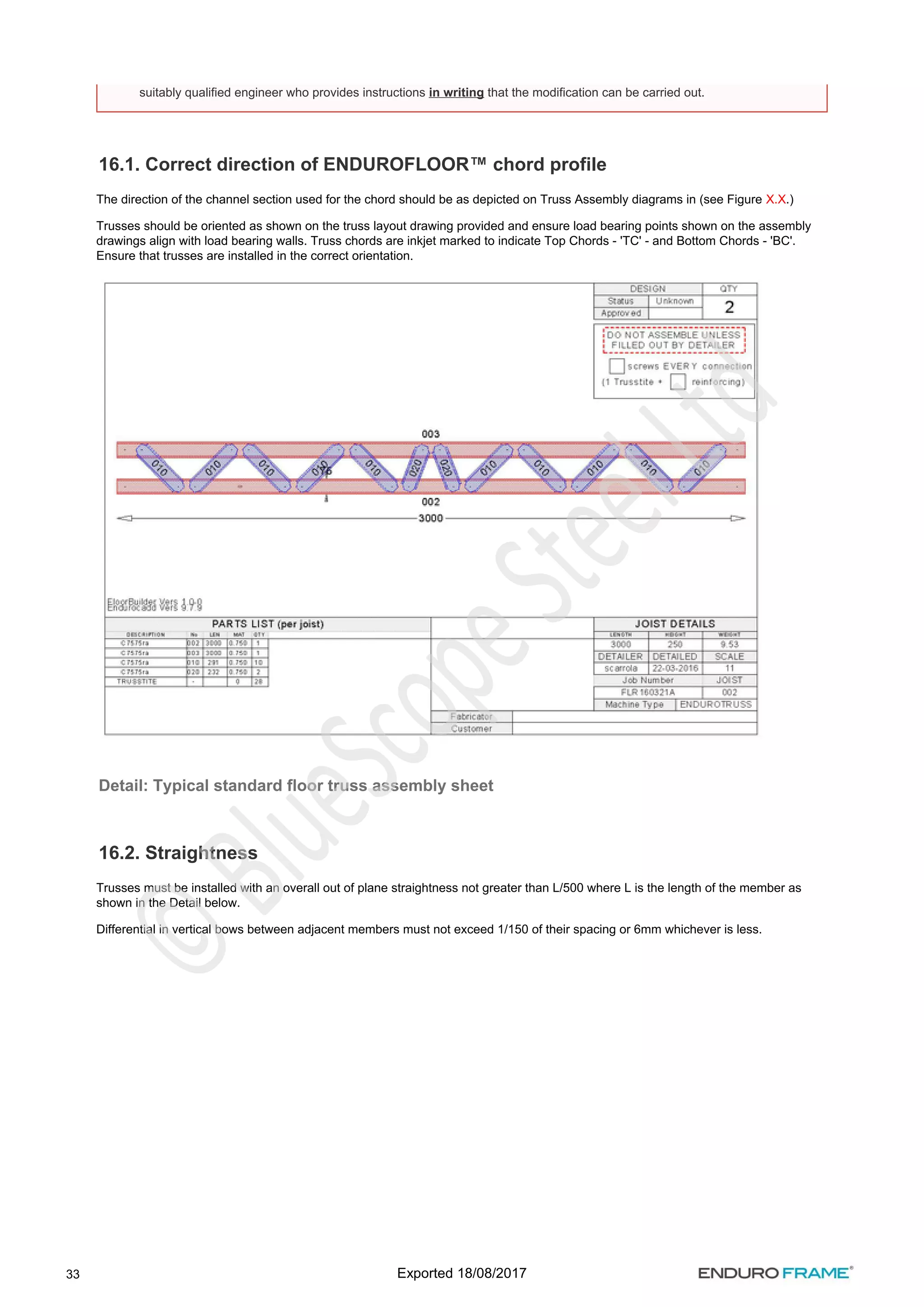
The direction of the channel section used for the chord should be as depicted on Truss Assembly diagrams in (see Figure .)
X.X
Trusses should be oriented as shown on the truss layout drawing provided and ensure load bearing points shown on the assembly
drawings align with load bearing walls. Truss chords are inkjet marked to indicate Top Chords - 'TC' - and Bottom Chords - 'BC'.
Ensure that trusses are installed in the correct orientation.
Detail: Typical standard floor truss assembly sheet
16.2. Straightness
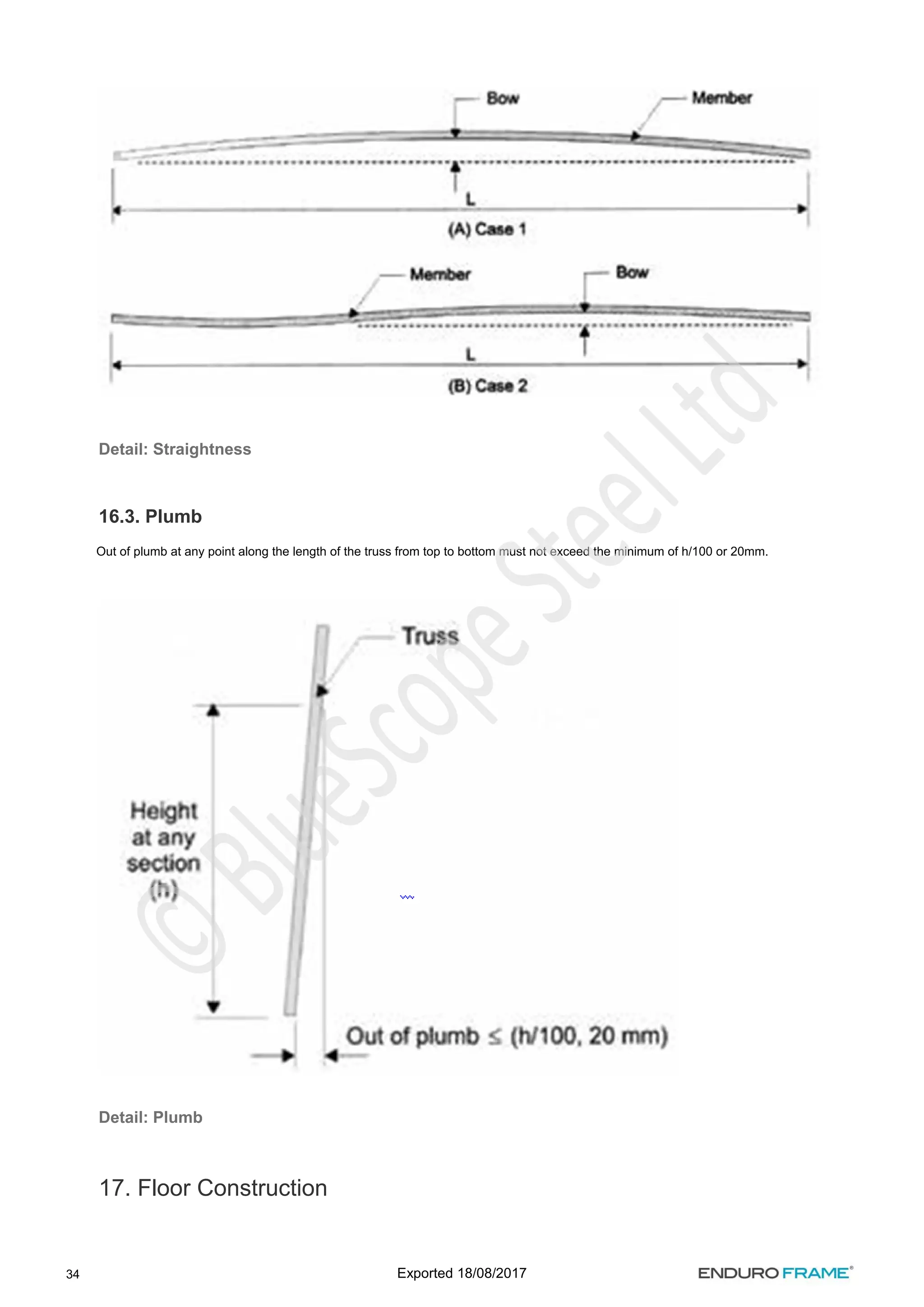
Trusses must be installed with an overall out of plane straightness not greater than L/500 where L is the length of the member as
shown in the Detail below.
Differential in vertical bows between adjacent members must not exceed 1/150 of their spacing or 6mm whichever is less.
suitably qualified engineer who provides instructions that the modification can be carried out.
in writing
Exported 18/08/2017
34
Detail: Straightness
16.3. Plumb
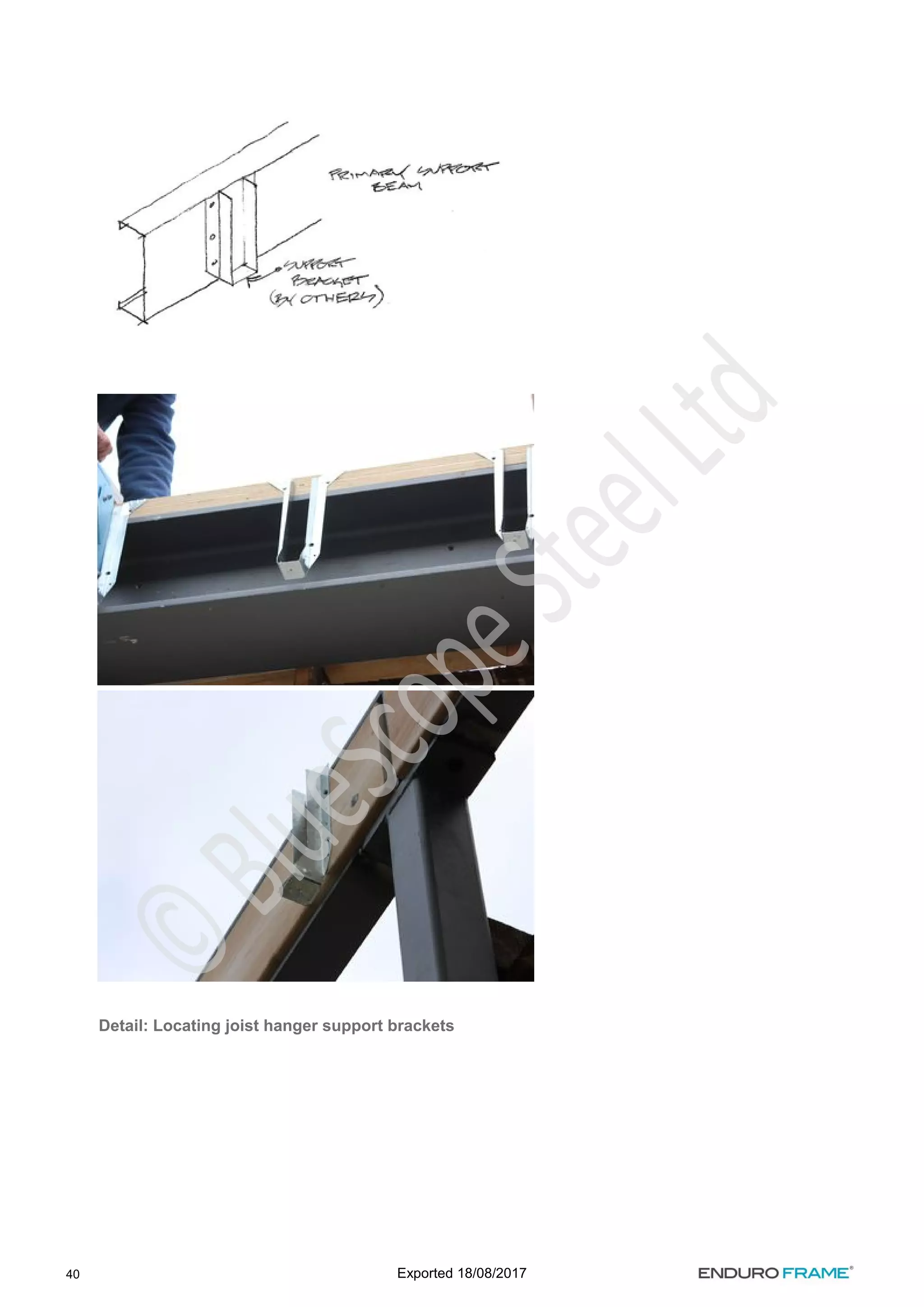
Out of plumb at any point along the length of the truss from top to bottom must not exceed the minimum of h/100 or 20mm.
Detail: Plumb
17. Floor Construction
Exported 18/08/2017
35
17.1. General and design
The trusses are designed by the ENDUROCADD design software to suit the specific floor geometry and loads applicable to the site
®
conditions. Additional loading such as spa baths, billiard tables, heavy fixed cabinetry etc. require special consideration at the time of
design and the placing of these additional loads must be referred back to the designer.
17.2. Prior to construction
Before commencing floor construction:
Check the support structure in particular the plan dimensions, the plumb and level of the support structure, the straightness
of the supporting walls or beams and that the structure is adequately braced, stable and tied down. Rectify support structure
if found deficient prior to proceeding.
Floor trusses must be inspected and any damaged parts must be reported immediately to the manufacturer to ensure correct
rectification. Approval for on site rectification must be obtained from the truss manufacturer prior to installation.
Check that the ENDUROCADD software generated truss layout matches the building and that all truss set-out dimensions
®
and truss identification marks have been provided.
Prior to lifting any floor trusses into place, mark out the support beam and floor truss locations on the top wall plate, using the
supplied Floor Truss Framing Layout as a reference.
It is generally best practice to install support beams before proceeding with the installation of standard floor truss runs.
Whilst installing floor trusses ensure that each floor truss is placed in the correct position, correctly orientated and plumb
(using a spirit level).
If trusses are fixed to the support structure using brackets these are often installed in the marked positions prior to
positioning the trusses.
The floor trusses may be aligned to load bearing studs. In cases where it is not aligned, sufficient capacity shall be provided
for top plate using lintels or stiffeners.
Check that design floor truss spacings have not been exceeded.
NOTE:
Truss orientation and Position
The layout drawings specifies the correct floor truss orientation.
The front of the floor truss is the flat (unlipped) face of the floor truss horizontal chords. Looking at the floor truss from this direction
identifies the Left and Right hand floor truss ends. Ensure floor trusses are orientated as shown on the floor truss layout, and with
chord marked with TC at the top of the truss and BC at the bottom of the truss.
ENDUROFLOOR™ system floor trusses have been designed to engineering standards and it is essential that to perform
as designed, they are handled, erected and braced correctly. The following recommendations apply to floor trusses on
standard domestic buildings.
Exported 18/08/2017
36
Floor Truss Numbering
During the detailing / fabrication process the floor trusses are numbered to accurately identify them. These numbers are shown on
the floor truss layout and form part of the floor truss branding. Floor trusses may have identical shape but may differ in the material
used or number of screws in the connections. Ensure that the correct floor truss is used in its specified location in the floor.
Internal load bearing points
Where floor trusses are supported by internal walls, the floor truss web configuration will be designed to satisfy the load
concentration at the load bearing point. Ensure that the floor truss is installed such that bottom chord to web connections are within
5mm to the support points. The builder should ensure that these loads are accommodated in the footing design.
17.3. Independent wall to floor system
The independent end wall floor system is suitable for either on-site fabrication, or as cassette system in factory pre-fabrication. Both
methods are detailed below.
17.3.1. On-site installation
Exported 18/08/2017
37
Step 1: Place end dwarf wall bottom plates into position on top of lower storey support walls and beams as indicated by the layout
drawings (Ref item: 1 and 2). Note the location of the side flange notches to accommodate for the floor truss and supporting beam
positions. Fix to the top plate of the wall below using 1 x 12-14x20 hex head fasteners on either side of the dwarf stud.
End dwarf walls may be supplied to site pre-fabricated. Where this occurs, remove the dwarf wall top plate and install wall in
the location defined in the Layout.
Step 2: Lift primary support beams into place as indicated on the layout drawing. If necessary, pack to appropriate height or location
as required. Packers may be placed to underside, top or face of the beam to set the correct location and level of the beam for fixing
off the floor trusses.
Exported 18/08/2017
38 Exported 18/08/2017
39
Picture: Packing beams
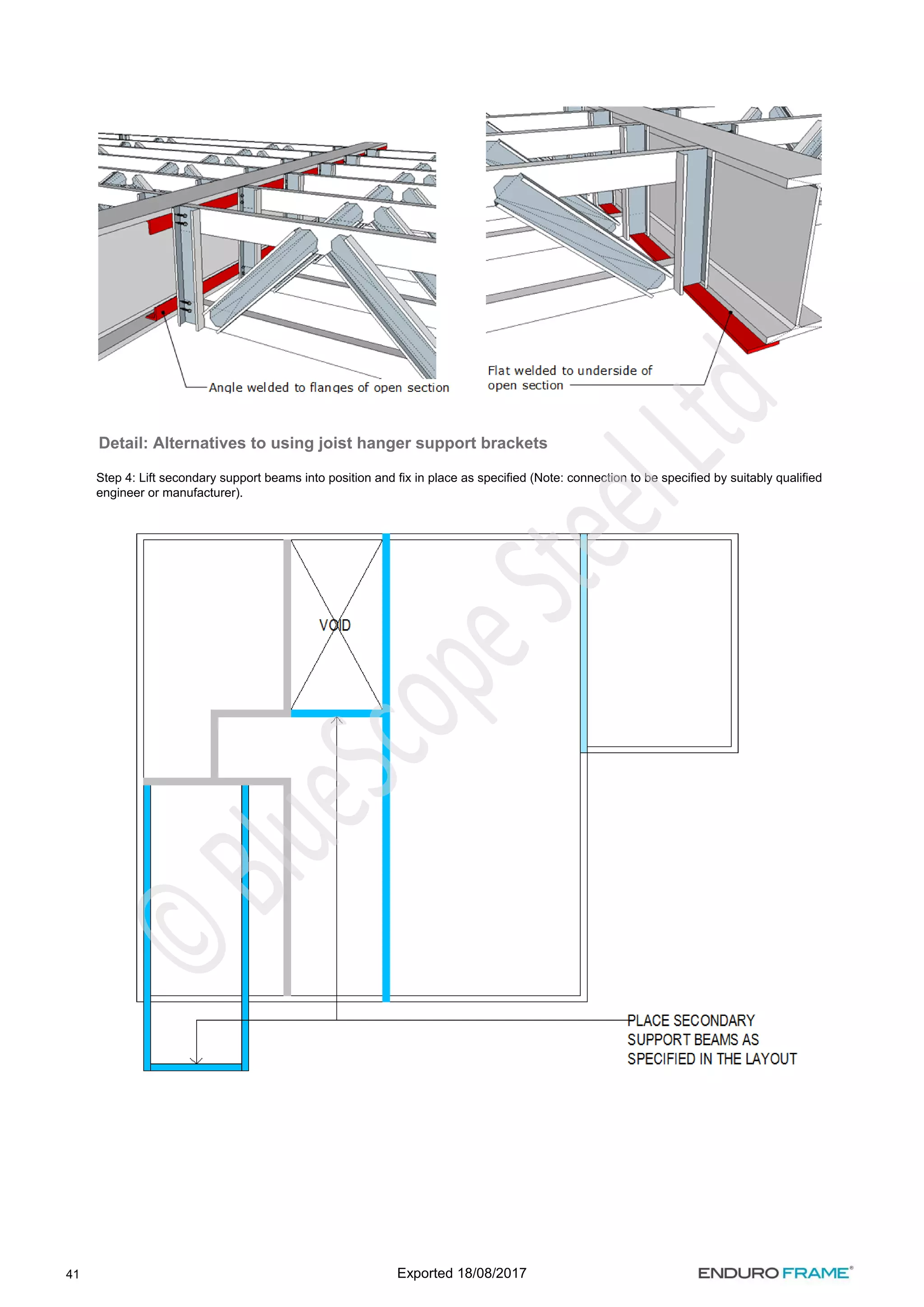
Step 3: Install connection brackets to primary support beams for all secondary support trimming beams and floor trusses (Note:
connection to be specified by suitably qualified engineer or manufacturer). Examples of joist support brackets and their installation is
shown below.
Exported 18/08/2017
40
Detail: Locating joist hanger support brackets
Exported 18/08/2017
41
Detail: Alternatives to using joist hanger support brackets
Step 4: Lift secondary support beams into position and fix in place as specified (Note: connection to be specified by suitably qualified
engineer or manufacturer).
Exported 18/08/2017
42
Picture: Fixing Secondary support beams
Step 5: Install connection brackets to secondary support trimming beams for floor trusses (Note: connection to be specified by
suitably qualified engineer or manufacturer). This is the same as Step 3.
Step 6: Install end dwarf studs into correct location and fix with 1 x Walltite screw to both flanges of the bottom plate. (Ref item: 4)
®
Where the end dwarf wall is pre-fabricated, this step is omitted.
Step 7: Lift floor trusses into place taking note of the direction of the truss in relation to toes left/right and up/down. (Ref item: 3)
Step 8: Fix floor trusses to side of dwarf wall studs at the pre-punched hole location with 1 x Trusstite® into both the top and bottom
chords. Provide reinforcing screws to each chord; the number reinforcing screws will be same as that provided for vertical end
web. At support bracket locations insert 2 x 12-14x20 hex head fasteners into both the top and bottom chords.
Exported 18/08/2017
43
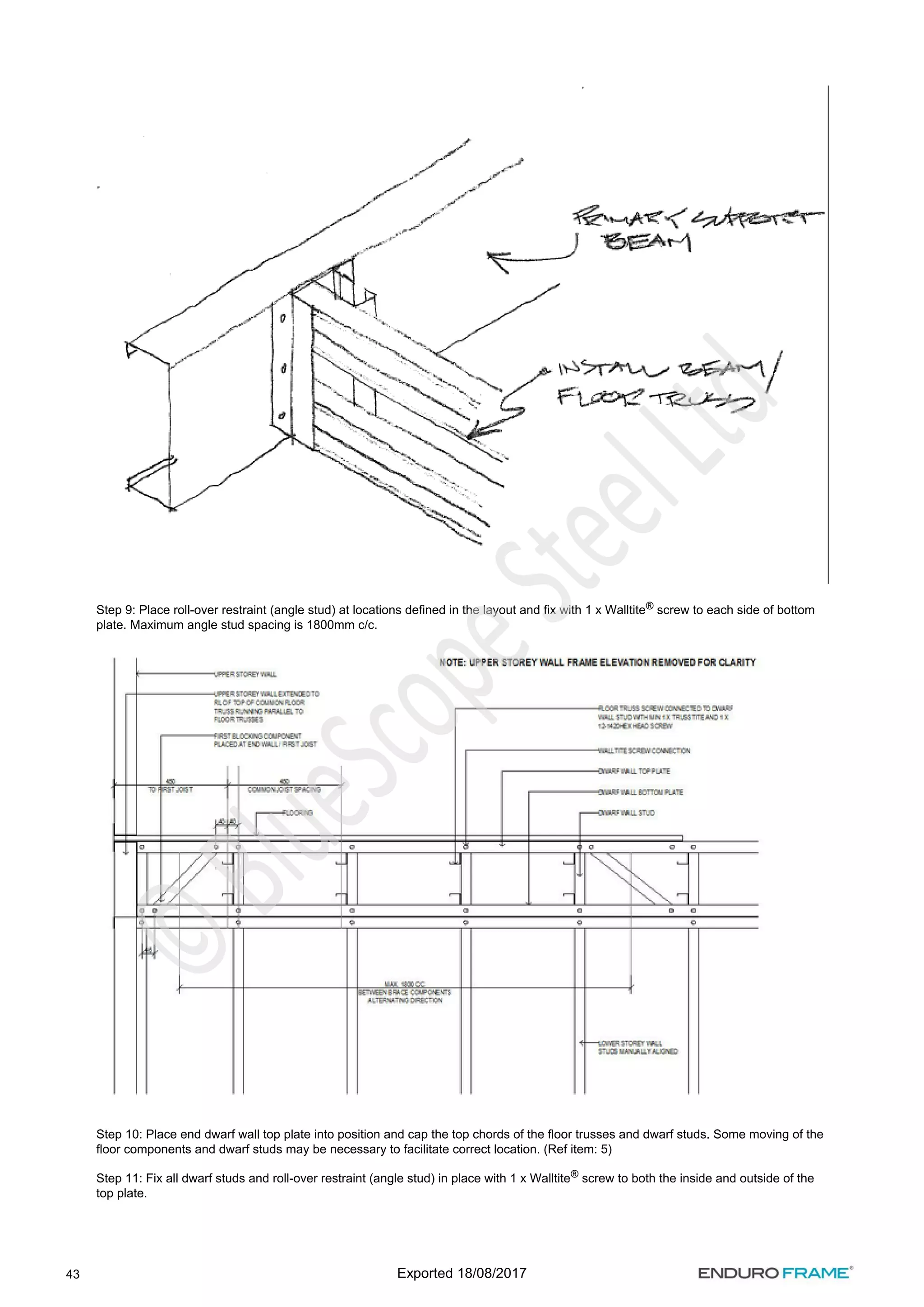
Step 9: Place roll-over restraint (angle stud) at locations defined in the layout and fix with 1 x Walltite screw to each side of bottom
®
plate. Maximum angle stud spacing is 1800mm c/c.
Step 10: Place end dwarf wall top plate into position and cap the top chords of the floor trusses and dwarf studs. Some moving of the
floor components and dwarf studs may be necessary to facilitate correct location. (Ref item: 5)
Step 11: Fix all dwarf studs and roll-over restraint (angle stud) in place with 1 x Walltite screw to both the inside and outside of the
®
top plate.
Exported 18/08/2017
44
Step 12: Install ceiling battens into place as indicated on the layout drawings.
Step 13: Install structural flooring to manufacturers recommendation or AS1860. Ensure the flooring used is suitable for the loading
conditions and truss spacings.
Note: Feature strip flooring is not suitable for fixing directly to the top chords of ENDUROFLOOR™ trusses. It is recommended
that a sheet floor is installed as a structural layer first with strip flooring being installed on the top surface as a decorative layer
to AS1684.
17.3.2. Prefabrication
If the prefabrication method is used, most of the support structure is installed on site. Floors are generally made up of panels
comprising of end dwarf walls with top and bottom plates pre-installed, floor trusses and structural flooring, that are transported to the
worksite and lifted into place making for a more time and cost effective construction solution. The method of fabrication is virtuallly
identical to the on-site method, except for the installation of lifting hardware and a specialist lifting team.
Step 1: Place relevant end dwarf wall bottom plates onto fabrication table. Note the location of the side flange notches to
accommodate for the floor truss and supporting beam positions.
Step 2: If required, place primary support beams into place as indicated on the layout drawing. If necessary, pack to appropriate
height as required.
Step 3: Install connection brackets to primary support beams for all secondary support trimming beams and floor trusses (Note:
connection to be specified by suitably qualified engineer).
Step 4: If required, place secondary support beams into position and fix in place as specified (Note: connection to be specified by
suitably qualified engineer).
Step 5: Install connection brackets to secondary support trimming beams for floor trusses (Note: connection to be specified by
suitably qualified engineer).
Step 6: Install dwarf studs into correct location and fix with 1 x Walltite screw to both the inside and outside of the bottom plate.
®
Step 7: Lift floor trusses into place taking note of the direction of the truss in relation to toes left/right and up/down.
Step 8: Fix floor trusses to side of dwarf wall studs at the pre-punched hole location with 1 x Trusstite® per hole. Provide reinforcing
screws to each chord; the number reinforcing screws will be same as that provided for vertical end web.
Step 9: Place roll-over restraint (angle stud) at locations defined in the layout and fix with 1 x Walltite screw to both the inside and
®
outside of the bottom plate.
Step 10: Place end dwarf wall top plate into position. Some moving of the floor components and dwarf studs may be necessary to
facilitate correct location.
Step 11: Fix all dwarf studs and roll-over restraint (angle stud) in place with 1 x Walltite screw to both the inside and outside of the
®
bottom plate.
Step 12: Install lifting hardware as specified.
Step 13: Install structural flooring to manufacturers recommendations or AS1860.2. Ensure the flooring used is suitable for the
loading conditions and truss spacings.
Note: Feature strip flooring is not suitable for fixing directly to the top chords of ENDUROFLOOR™ trusses. It is recommended
that a sheet floor is installed as a structural layer first with strip flooring being installed on the top surface as a decorative layer
to AS1684.
Step 14: On-site, check dimensions of structural supports for compliance with floor truss layout to enable correct fitting.
Step 15: Check panel size for correct fitting prior to lifting into position.
Step 16: With the assistance of a specialist lifting team, safely lift floor panel into position and fix as specified by a suitably qualified
engineer.
Step 17: Install ceiling battens into place as indicated on the layout drawings (Refer: Ceiling battens and plasterboard angles).
17.4. Integrated wall to floor system
Exported 18/08/2017
45
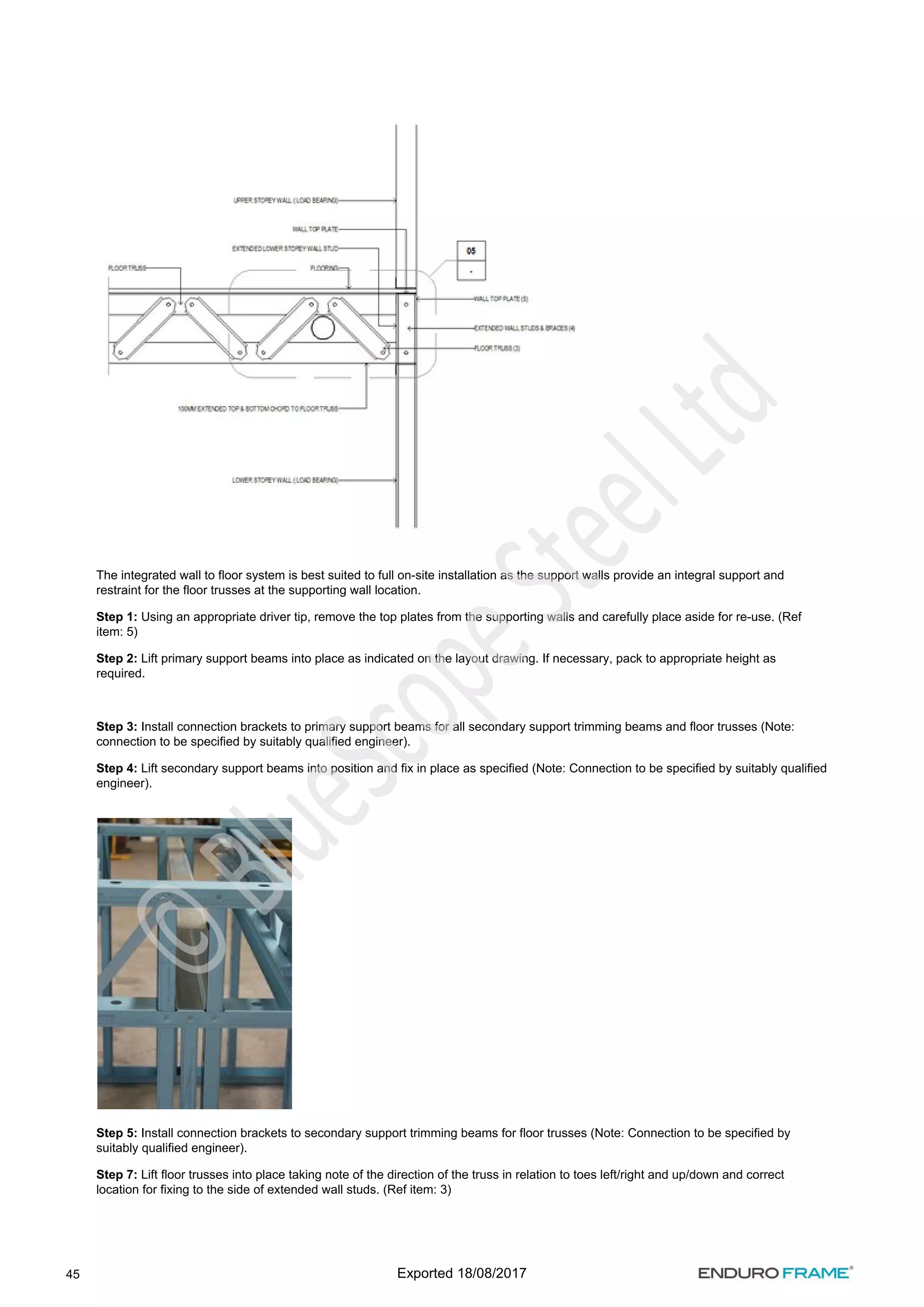
The integrated wall to floor system is best suited to full on-site installation as the support walls provide an integral support and
restraint for the floor trusses at the supporting wall location.
Step 1: Using an appropriate driver tip, remove the top plates from the supporting walls and carefully place aside for re-use. (Ref
item: 5)
Step 2: Lift primary support beams into place as indicated on the layout drawing. If necessary, pack to appropriate height as
required.
Step 3: Install connection brackets to primary support beams for all secondary support trimming beams and floor trusses (Note:
connection to be specified by suitably qualified engineer).
Step 4: Lift secondary support beams into position and fix in place as specified (Note: Connection to be specified by suitably qualified
engineer).
Step 5: Install connection brackets to secondary support trimming beams for floor trusses (Note: Connection to be specified by
suitably qualified engineer).
Step 7: Lift floor trusses into place taking note of the direction of the truss in relation to toes left/right and up/down and correct
location for fixing to the side of extended wall studs. (Ref item: 3)
Exported 18/08/2017
46
Step 8: Fix floor trusses to side of extended wall studs at the pre-punched hole location with 1 x Trusstite per hole.
®
Note: Where a balcony step down is present, the vertical chord on the floor truss is to be removed, with the extended wall
studs being used in this position. The vertical chords have been installed for transportation and installation purposes only.
Exported 18/08/2017
47
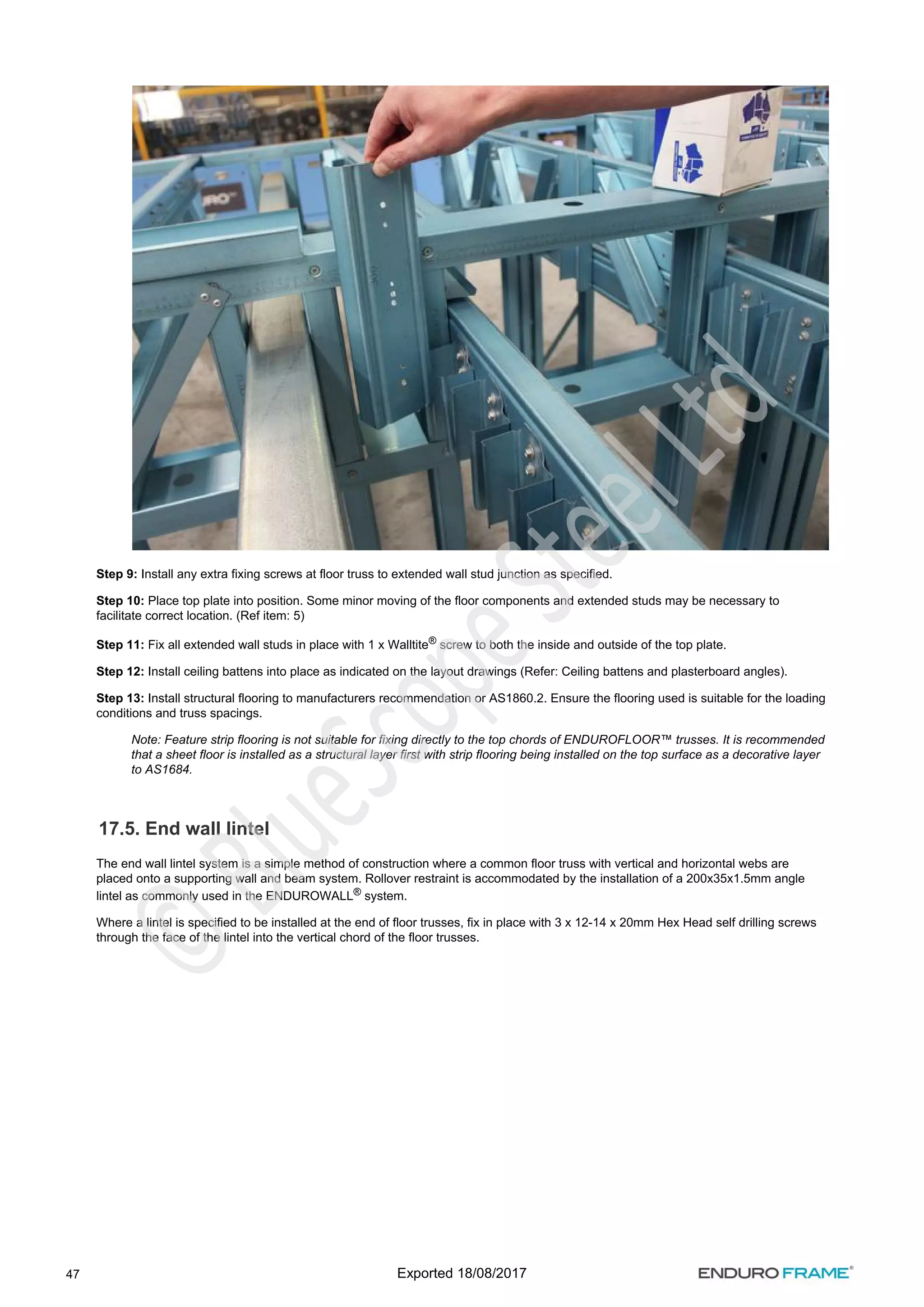
Step 9: Install any extra fixing screws at floor truss to extended wall stud junction as specified.
Step 10: Place top plate into position. Some minor moving of the floor components and extended studs may be necessary to
facilitate correct location. (Ref item: 5)
Step 11: Fix all extended wall studs in place with 1 x Walltite screw to both the inside and outside of the top plate.
®
Step 12: Install ceiling battens into place as indicated on the layout drawings (Refer: Ceiling battens and plasterboard angles).
Step 13: Install structural flooring to manufacturers recommendation or AS1860.2. Ensure the flooring used is suitable for the loading
conditions and truss spacings.
Note: Feature strip flooring is not suitable for fixing directly to the top chords of ENDUROFLOOR™ trusses. It is recommended
that a sheet floor is installed as a structural layer first with strip flooring being installed on the top surface as a decorative layer
to AS1684.
17.5. End wall lintel
The end wall lintel system is a simple method of construction where a common floor truss with vertical and horizontal webs are
placed onto a supporting wall and beam system. Rollover restraint is accommodated by the installation of a 200x35x1.5mm angle
lintel as commonly used in the ENDUROWALL system.
®
Where a lintel is specified to be installed at the end of floor trusses, fix in place with 3 x 12-14 x 20mm Hex Head self drilling screws
through the face of the lintel into the vertical chord of the floor trusses.
Exported 18/08/2017
48
Step 1: Mark position of all floor components as indicated on the layout drawing.
Step 2: Lift primary support beams into place as indicated on the layout drawing. If necessary, pack to appropriate height as
required.
Step 3: Install connection brackets to primary support beams for all secondary support trimming beams and floor trusses (Note:
Connection to be specified by suitably qualified engineer).
Step 4: Lift secondary support beams into position and fix in place as specified (Note: Connection to be specified by suitably qualified
engineer).
Step 5: Install connection brackets to secondary support trimming beams for floor trusses (Note: Connection to be specified by
suitably qualified engineer).
Step 6: Lift floor trusses into place taking note of the direction of the truss in relation to toes left/right and up/down.
Step 7: Fix floor trusses to top plate at the correct locations with 1 x 12-14 x 20mm hex head self drilling screw. Alternative tie down
types may be specified and should also be fixed at this stage.
Step 8: Once floor trusses are in position, place angle lintel into position. Some minor moving of the floor components may be
necessary to facilitate correct location.
Step 9: Check plumb of floor components and once correct, install 3 x 12-14 x 20mm Hex Head self drilling screws through the face
of the lintel into the vertical chord of the floor trusses.
Step 10: Install ceiling battens into place as indicated on the layout drawings (Refer: Ceiling battens and plasterboard angles)
Step 11: Install structural flooring to manufacturers recommendation or AS1860.2. Ensure the flooring used is suitable for the loading
conditions and truss spacings.
Note: Feature strip flooring is not suitable for fixing directly to the top chords of ENDUROFLOOR™ trusses. It is recommended
that a sheet floor is installed as a structural layer first with strip flooring being installed on the top surface as a decorative layer
to AS1684.
Ensure that a screw is located at the cross-over point of the flooring, angle lintel and the floor truss top chord flange.
17.6. Ceiling battens and plasterboard angles
Exported 18/08/2017
49
As indicated in the floor construction steps, ceiling battens must be fitted immediately after the floor trusses have been installed. By
fixing the ceiling battens at this stage the floor trusses will be laterally restrained without the need of bottom chord ties.
Step 1: When all floor trusses are installed, install ceiling battens to the underside of the bottom chords. Ceiling battens can be
spaced at 600mm centres or 450mm centres depending on the type of plasterboard that will be used for the ceiling (check the
plasterboard manufacturers specifications). Ceiling batten sizes shall be selected from batten manufacturer's technical literature and
sized to suit span, spacings and loads.
NOTE: Ceiling battens spacing is dependent on ceiling lining. For suspended ceilings, lateral restraints must be provided at spacings
specified Floor Truss Layout Sheet.
Step 2: Fix the ceiling battens with two #10-16x16mm hex head self drilling screws, one into each flange of the batten into the bottom
chord of the floor truss.
Step 3: Plasterboard angle must be used at the intersection of the ceiling batten/load bearing wall junction to support the ends of the
ceiling battens.
17.7. Internal wall support and shear transfer
Ceiling Battens as Bottom Chord Restraints
Ceiling battens may also be restraining the bottom chord of floor truss and, as such, must be installed at spacings no
further than specified in the floor truss certification sheet. In the event that plasterboard is fixed to the underside of the
joists, battens shall be placed on the top flange of bottom chords, and no further than 2000mm apart.
Exported 18/08/2017
50
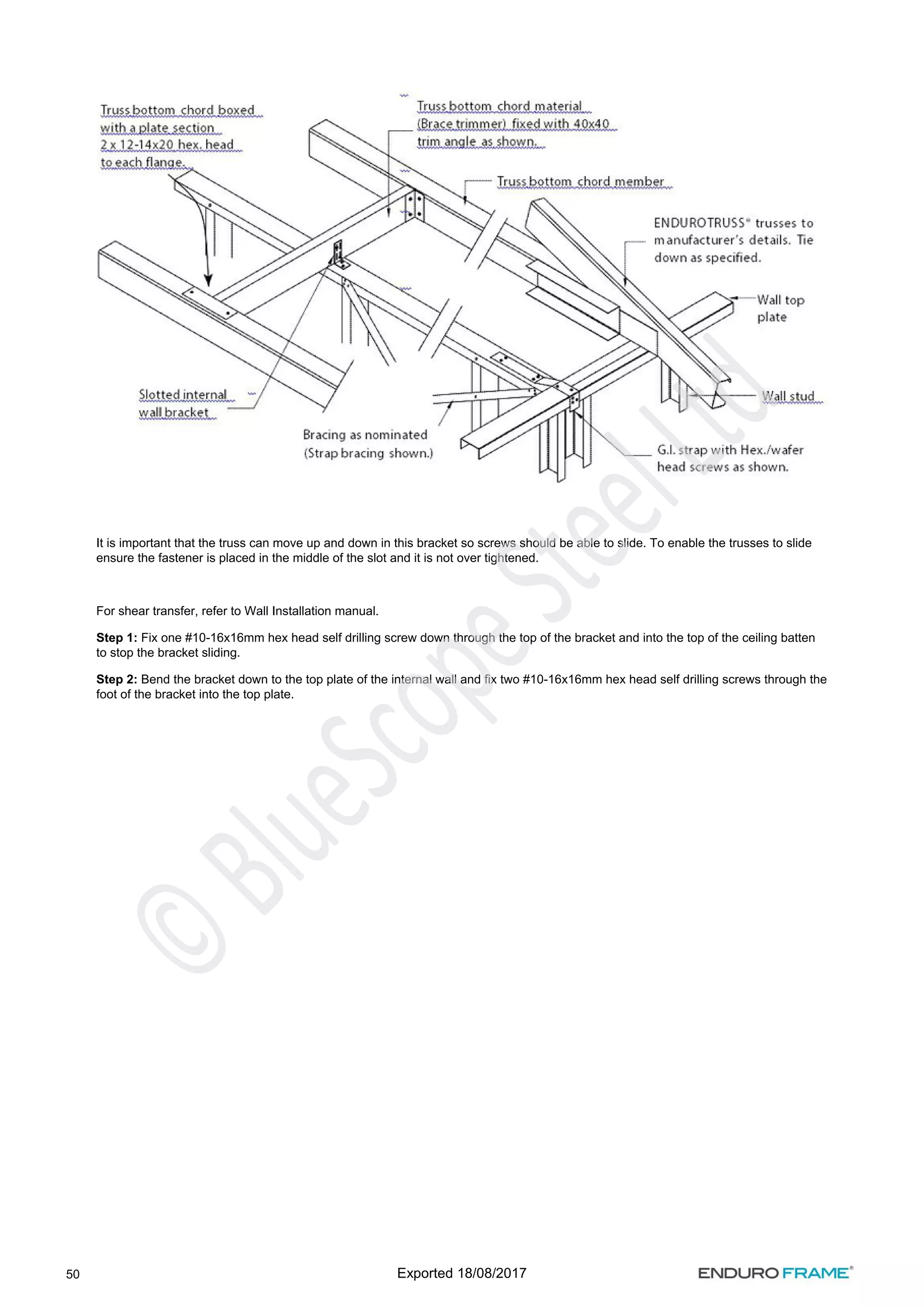
It is important that the truss can move up and down in this bracket so screws should be able to slide. To enable the trusses to slide
ensure the fastener is placed in the middle of the slot and it is not over tightened.
For shear transfer, refer to Wall Installation manual.
Step 1: Fix one #10-16x16mm hex head self drilling screw down through the top of the bracket and into the top of the ceiling batten
to stop the bracket sliding.
Step 2: Bend the bracket down to the top plate of the internal wall and fix two #10-16x16mm hex head self drilling screws through the
foot of the bracket into the top plate.
Exported 18/08/2017
51
Step 3: Install hitch brackets to the bottom chord of floor trusses at a maximum of 1200mm centres. Fix two #10-16x16mm hex
head self drilling screws into the side of the flat face of the bottom chord.
Step 4: Fix two #10-16x16mm hex head self drilling screws through the foot of the bracket into the top plate.
18. Floor Joist Penetrations
18.1. Maximum Hole Penetration Size through Joists
The maximum size of penetrations that can fit through various joist sizes are as follows:-
Floor Truss Depth Chord Section Max. round penetration diameter
250mm C75 100mm
C90 70mm
300mm C75 150mm
C90 120mm
350mm C75 200mm
C90 170mm
Exported 18/08/2017
52
400mm C75 250mm
C90 220mm
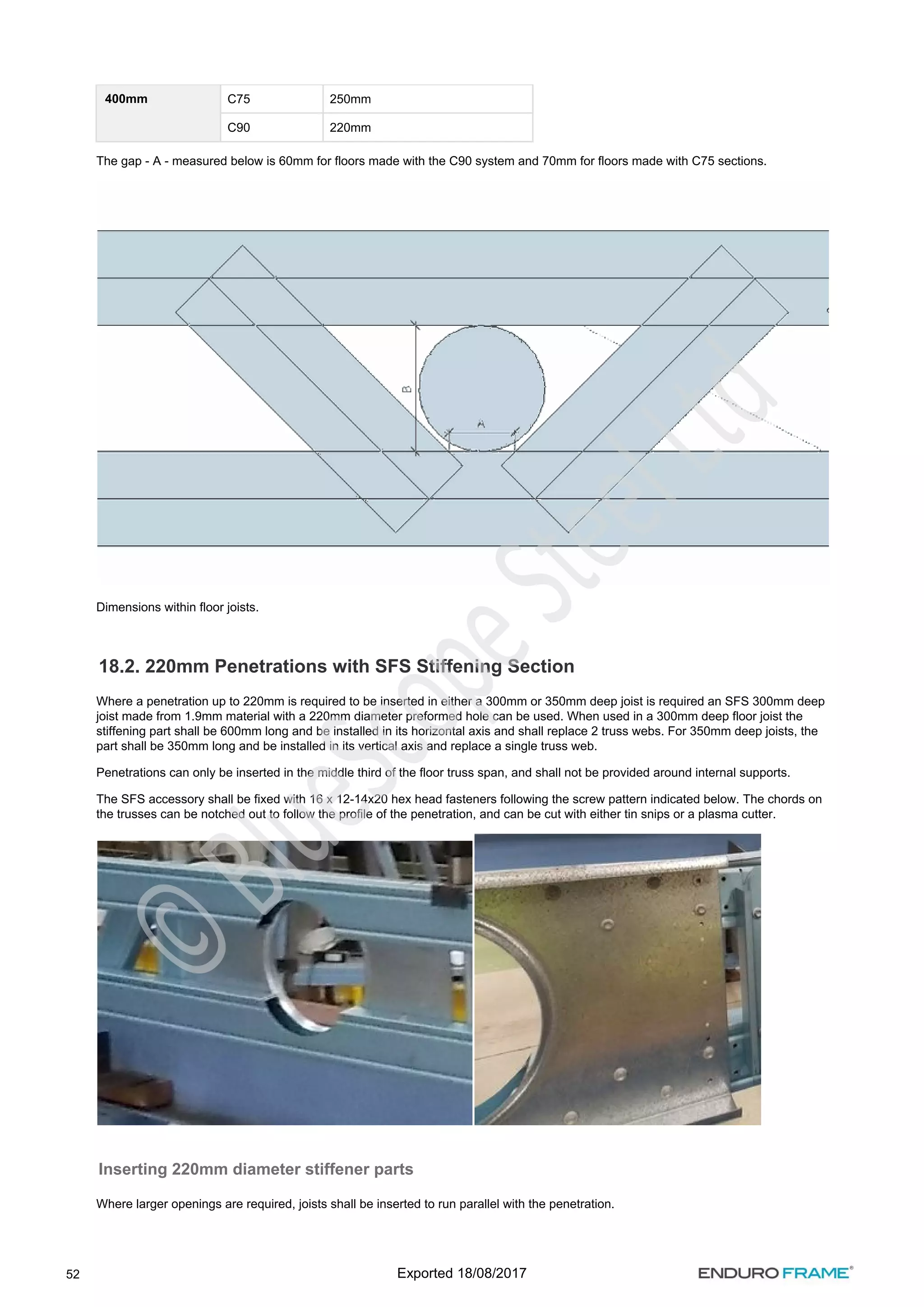
The gap - A - measured below is 60mm for floors made with the C90 system and 70mm for floors made with C75 sections.
Dimensions within floor joists.
18.2. 220mm Penetrations with SFS Stiffening Section
Where a penetration up to 220mm is required to be inserted in either a 300mm or 350mm deep joist is required an SFS 300mm deep
joist made from 1.9mm material with a 220mm diameter preformed hole can be used. When used in a 300mm deep floor joist the
stiffening part shall be 600mm long and be installed in its horizontal axis and shall replace 2 truss webs. For 350mm deep joists, the
part shall be 350mm long and be installed in its vertical axis and replace a single truss web.
Penetrations can only be inserted in the middle third of the floor truss span, and shall not be provided around internal supports.
The SFS accessory shall be fixed with 16 x 12-14x20 hex head fasteners following the screw pattern indicated below. The chords on
the trusses can be notched out to follow the profile of the penetration, and can be cut with either tin snips or a plasma cutter.
Inserting 220mm diameter stiffener parts
Where larger openings are required, joists shall be inserted to run parallel with the penetration.
Exported 18/08/2017
53
19. Installing beams around stair voids
C purlins may be called up in layout drawings around stair void and will follow the layout assembly diagram below.
Stair Void Beam Layout Assembly Diagram
The connection details to join beams together are shown in the diagram below.
Stair Void Beam connection details
20. Temporary Construction Bracing and Material Loads Positioning
All floor trusses are to be temporarily braced prior to the installation of flooring material. This will ensure the frame remains square,
floor trusses are in place and plumb.
Loads from heavy materials such as packs of flooring are to be placed over lines of support such as internal loadbearing walls under,
or near external load bearing walls. Loads are not to be placed at mid-span of floor trusses.
Exported 18/08/2017
54
Temporary bracing and material loads positioning
Exported 18/08/2017

ENDUROFLOOR Installation Manual

  • 1.
    ENDUROFLOOR™ Floor System InstallationManual The smart, simple solution to floor framing. Get the latest version at enduroframe.com Exported 18/08/2017
  • 2.
    1 ENDUROFLOOR™ Installation Manual Tableof Contents Table of Contents Table of Figures 1. Overview 2. Scope of Manual 2.1.1. Product performance 2.1.2. General notes to be read before you use this manual. 2.1.3. Important disclaimer about this construction manual 3. References 4. Design 5. Required on-site Tools and Equipment 5.1.1. Power Tools 5.1.2. Tool Accessories 5.1.3. Hand Tools 5.1.4. Essential Safety Equipment 6. Material specification 7. Components 7.1. Rollformed Sections 7.2. Lintels 7.3. Fasteners 7.4. Brackets 7.5. Bracing & Blocking 7.6. Beams & Bearers 8. Truss Connections 9. Notes on Vibration 10. Truss Assemblies 10.1. General 10.2. Flush Truss 10.3. Pre Camber 10.4. Manufacturing Crib Allowance 10.5. Floor truss component cribbing for Independent wall systems 10.6. Floor truss component cribbing for Integrated wall systems 10.7. Standard Floor Truss 10.8. Design Options 11. Connecting Floors from Upper Wall to Lower Wall 11.1. Connecting non-load bearing internal bracing wall on upper level to floor 11.1.1. Trimmer construction 11.1.2. Trimmer locations 11.1.3. Bracing wall bottom plate to trimmer / floor truss top chord uplift and shear capacity 12. Handling of Endurofloor trusses 13. Floor trusses exposure and storage 14. Truss identification 14.1. Standard Floor truss 14.2. Stepdown Truss 14.3. Cantilever Floor Truss 15. Truss Assembly 15.1. Chord to chord connection identification 15.2. Standard Truss Assembly 15.3. ENDUROFLOOR™ Floor Framing System stiffening and reinforcement 15.4. Web connection stiffening 15.5. Chord Boxing 16. Points for construction 16.1. Correct direction of ENDUROFLOOR™ chord profile 16.2. Straightness 16.3. Plumb 17. Floor Construction 17.1. General and design 17.2. Prior to construction 17.3. Independent wall to floor system 17.3.1. On-site installation 17.3.2. Prefabrication 17.4. Integrated wall to floor system Exported 18/08/2017
  • 3.
    2 17.5. End walllintel 17.6. Ceiling battens and plasterboard angles 17.7. Internal wall support and shear transfer 18. Floor Joist Penetrations 18.1. Maximum Hole Penetration Size through Joists 18.2. 220mm Penetrations with SFS Stiffening Section 19. Installing beams around stair voids 20. Temporary Construction Bracing and Material Loads Positioning Table of Figures ENDUROFRAME® sections Detail: Floor truss component cribbing - Independent wall system Detail: Floor truss component cribbing - Integrated wall system Detail: Typical standard floor truss - all webs at 45 degrees Detail: Typical standard floor truss - middle webs at minimum 35 degrees Detail: Typical standard floor truss - middle webs greater than 45 degrees Detail: Typical standard floor truss - Context and components Options for tying down walls to floors and floors to walls Detail: Typical floor Detail: Standard floor truss Detail: Stepdown truss Detail: Cantilever area truss Detail: Initial chord placement Detail: Hole alignment and trusstite installation Detail: Web separation Detail: Web placement Detail: Web fixing Detail: Check measure Detail: Reinforcement screw installation Detail: Screw distances Chord Boxing Detail Detail: Typical standard floor truss assembly sheet Detail: Straightness Detail: Plumb Picture: Packing beams Detail: Locating joist hanger support brackets Detail: Alternatives to using joist hanger support brackets Picture: Fixing Secondary support beams Inserting 220mm diameter stiffener parts Stair Void Beam Layout Assembly Diagram Stair Void Beam connection details Temporary bracing and material loads positioning 1. Overview The ENDUROFLOOR™ system has been developed as an add-on intermediate floor system to be manufactured from an ENDURO® rollformer using standard ENDUROFRAME® components. It shall be able to be manufactured from both a 75 and 90mm section. A 75mm system shall be able to be made from gauges between 0.55 – 1.2mm thick, and the 90mm system shall be able to be manufactured from 0.55 to 1.2mm thick steel. Where possible, options shall remain open so the floor system can be manufactured on a Smartruss rollformer. Due to potentially being manufactured on Smartruss rollformers – and to increase the strength of the trusses – it will be used in its strong axis. The ENDUROFLOOR™ system is designed to be used as part of the ENDUROFRAME® system but could also potentially be used as a standalone floor system to rest on other wall frames, providing the loads are similar to an ENDUROFRAME® building system. Due to the variable and generally high corrosivity found in subfloor environments, TRUECORE® steel is not recommended for this application. Exported 18/08/2017
  • 4.
    3 1. 2. 3. 4. a. b. c. 5. a. b. c. 6. 7. 8. 9. a. b. c. 10. 2. Scope ofManual This manual has been prepared for the construction of steel framed floors within the following parameters: Only ENDUROFLOOR™ components made from TRUECORE steel and made with the ENDURO rollformer can be used. ® ® Standard floor truss spacings are at 600mm or 450mm (max) centres dependent on floor truss design limitations. Other spacings may require additional engineering. Suitable for particle board sheeting and 75mm autoclaved lightweight concrete panels 2.1.1. Product performance The ENDUROFLOOR™ system has been designed in accordance with relevant Australian Standards and the requirements of the Building Code of Australia. The floor framing system will perform in accordance with ENDUROFLOOR™ design documentation if installed in accordance with the recommendations and details set down in this manual and related references. This manual contains vital information. Please read it carefully. For more information and technical support, contact: www.enduroframe.com Refer to for locations where ENDUROFRAME can be warranted. www.truecore.com.au ® 2.1.2. General notes to be read before you use this manual. This Manual has been prepared for a range of floor framing designs using ENDUROFLOOR™ building components manufactured from supplied by BlueScope Steel, its licensed manufacturers or dealers. The ENDUROFRAME® Building System has been designed as a complete framing system. All erection and connection details must be made in accordance with the relevant standard connection drawing details contained in this Manual or its supplements, or drawings output from the ENDUROCADD® software. Before commencement of any fabrication or construction develop a safety management plan to cover key risks. Key risks include, but are not limited to:- Working at heights Electrical safety Cuts and scratches Consider and install the appropriate level of safety equipment to manage identified risks. Safety equipment that may be required includes:- Personal protective equipment including safety glasses, gloves, hearing protection (when using power tools) and sunscreen; Appropriate fall protection equipment including guard rails, scaffolds, ladders, elevated platforms, safety mesh, and fall restraint harnesses A temporary earth should be established during the construction of steel frames and, upon completion, the steel house frames must be permanently earthed in accordance with the requirements of local electricity authorities. You should check with your local workplace health and safety authority to see what safety measures you need to put in place prior to and during construction. It is the responsibility of the installer/erector to ensure all local safe work practices are adhered to and the safety of the whole site is maintained at all times. For wiring in steel wall frames, nylon grommets shall be installed to run electrical cables through. Where insufficient detail is included in this manual for your project, seek specialist advice. Before you commence construction: You should check with your local government authority to see if any form of prior permission or approval is required; If you want to build or construct any attached structure, you should seek advice from a suitably qualified engineer to verify the capacity of your existing structure to withstand any additional load arising from the attached structure. You should also check with your local government authority to determine any specific requirements for the attachment to existing structures; You should check with your local workplace health and safety authority to see what safety measures you need to put in place prior to and during construction. It is the responsibility of the installer/erector to ensure all local safe work practices are adhered to and the safety of the whole site is maintained at all times. To ensure maximum lifespan of your house frame, consult your nearest ENDUROFRAME fabricator for information ® regarding maintenance, handling, storage and any other technical assistance you may require. 2.1.3. Important disclaimer about this construction manual Date of Issue This Manual was issued on April, 2016. BlueScope Steel may make changes to this Manual in its sole discretion. You should check you are using the current version of the Manual before you start construction. Refer to to check for the latest www.enduroframe.com version. Conditions of Use If you use this Manual, you acknowledge and agree that your use is subject to the terms and conditions in this Manual. BlueScope Steel, its agents, officers, employees, subcontractors or consultants make no representations, either expressed or implied, as to the Exported 18/08/2017
  • 5.
    4 suitability of theinformation and data in this Manual for your particular purposes. It's your responsibility to ensure the design you use is appropriate for your needs, the products you have purchased, your site and structural limitations and your building and construction capabilities. It is recommended that you obtain qualified expert advice. Use of Genuine Materials Structures in this Manual should only be built or constructed using ENDUROFLOOR™ made from TRUECORE steel and made with ® the ENDURO rollformer or recommended third party products. Except as otherwise provided in these terms, any warranties only ® apply to you (if at all) if you use the genuine BlueScope Steel or recommended third party products and method of construction. Check Delivery It is important that you check all materials delivered to site against your invoice before you use them in your building or construction to ensure all components have arrived, are of the appropriate quality and are ready for installation. Safety Ensure that all barriers, scaffolding, and fall protection used in order to comply with safe work practices are installed so as not to damage or overload floor components. Limitation of Liability By using this Manual, you accept the risks and responsibility for all losses, damages, costs and other consequences resulting directly or indirectly from using this Manual. Except to the extent to which liability may not lawfully be excluded or limited, BlueScope Steel will not be under or incur any liability to any person for any direct or indirect loss or damage (including, without limitation, consequential loss or damage such as loss of profit or anticipated profit, loss of use, damage to goodwill and loss due to delay) however caused (including, without limitation, breach of contract, negligence, breach of statute and/or in equity), which may be suffered or incurred in connection with this Manual. All rights reserved. No part of this brochure may be reproduced, stored in a retrieval system, or transmitted in any form or by any means, electronic, mechanical, recording or otherwise, without written permission of BlueScopeSteel Limited. ABN 16 000 011 058 3. References The following documents have been used in the development of this system: NASH Standard – Residential and Low-Rise Steel Framing Part 1: Design Criteria (2005) NASH Handbook – Design of residential & Low-rise Steel Framing (2009) NASH Technical Note 2 – Six Star Energy Efficiency Measures for Houses (March 2011) National Construction Code (Building Code of Australia - 2010), Australian Building Codes Board AS/NZS 1170.0: 2002 - Structural Design Actions - Part 0:General principles AS/NZS 1170.1: 2002 - Structural Design Actions - Part 1: Permanent, imposed and other actions principles AS/NZS 1170.2: 2011 - Structural Design Actions - Part 2: Wind actions AS4055:2012 - Wind loads for Housing AS/NZS 4600:2005 - Cold-formed steel structures AS 1684.2-2010 - Residential timber-framed construction – Non-cyclonic areas ABCB Protocol for Structural Software Draft Version 2010.1 Minister's Specification SA A2.2 'Structural Engineering Software' NASH standard Residential and Low rise steel framing 4. Design Components used in the ENDUROFLOOR™ system are specified by an ENDUROCADD® software Trained Software User referencing loads and span tables contained in the ENDUROFLOOR™ Design Manual. Any floors designed outside the scope of this Design Manual must be checked and signed off by a suitably qualified engineer. Any supporting beams, and connections required in the floor structure should are to be specified by others. 5. Required on-site Tools and Equipment When installing an ENDUROFLOOR™ Floor Framing System, the following tools and safety equipment may be required. 5.1.1. Power Tools screw gun metal cutting saw hand held metal cutting saw angle grinder Exported 18/08/2017
  • 6.
    5 5.1.2. Tool Accessories 8mm(5/16”) hexagon socket extension bar (length up to 150mm) suitable metal cutting blades 8mm (5/16”) spanner or socket and handle No.2 and No.3 Phillips head driver bits (length up to 100mm) 5.1.3. Hand Tools double action tin snips (left, right and straight cut) spirit level chalk line step ladder vice grips measuring tape 5.1.4. Essential Safety Equipment eye protection (safety goggles) High visibility personal protective clothing hearing protection (when using power tools) protective gloves earth leakage circuit breaker for electrical equipment fall protection harness scaffolding, ladders, etc. 6. Material specification ENDUROFLOOR™ sections are roll-formed from TRUECORE steel complying with AS1397:2011. The standard ® ENDUROFLOOR™ sections are shown in Figure . In the grade shown, the number prefixed with G indicates minimum yield stress x.x in MPa; and the number prefixed with AZ or AM indicates minimum coating mass in g/m2. 0.55mm BMT, TRUECORE® G550 AM150 steel 0.75mm BMT, TRUECORE® G550 AM150 steel 1.00mm BMT, TRUECORE® G550 AM150 steel 1.20mm BMT, TRUECORE® G500 AM150 steel Exported 18/08/2017
  • 7.
    6 ENDUROFRAME® sections 7. Components Afull list of components can be seen at this link - . https://enduroframe.atlassian.net/wiki/x/L4Ms 7.1. Rollformed Sections CEE section definition Part No. t D B1 B2 L Feed Width mm Section Type Cee Sections mm mm mm mm mm C7575ra 0.75 75 40 38 8 163 Ribbed ENDUROTRUSS® & ENDUROWALL® C7510ra 1.00 75 40 38 8 163 Ribbed C9075ra 0.75 90 40 38 9 178 Ribbed C9010ra 1.00 90 40 38 9 178 Ribbed C9012ra 1.20 90 40 38 9 178 Ribbed U section definition Part Code t D B1 B2 Feed width mm Usage mm mm mm mm U754475G550 0.75 78.5 43 45 163 Dwarf plate U754410G550 1.00 78.5 43 45 163 Dwarf plate U904475G550 0.75 93.5 43 45 178 Dwarf plate U904410G550 1.00 93.5 43 45 178 Dwarf plate U904412G550 1.20 93.5 43 45 178 Dwarf plate 7.2. Lintels Picture Size Application Part No. 200 x 35 x 1.5 Single lintel used to resist roll-over of floor trusses at ends. 7.3. Fasteners Important Please note equivalent fasteners may be used to those listed below. All fasteners shall be min. AS3566.2 Class 3 with the exception that class 4 fasteners should be used at less than 400m from high water mark of surf or exposed salt marine Exported 18/08/2017
  • 8.
    7 Picture Description ApplicationSuppliers 5/16-12 x 17 Hex Washer Trusstite Or 17-15 x 15mm GX screw Trilobular thread form Primary connection of truss components through pre-punched holes. Both screws listed are suitable for the application. ITW Buildex, Bremick, Ideal, Powers #10-16x16 hex head self drilling screw. Low strength fixing- ceiling batten fix, chord and web boxing. Used in all wall systems ITW Buildex, Bremick, Ideal, Powers Wall fastener – M6 x 1P x 15mm Smooth Top GX screw Wall tite (Trilobular thread form) Connecting wall frame components together through pre-punched holes. Used in ENDUROWALL™ FRAMING SYSTEM, ITW Buildex, Bremick, Ideal, Powers #12-14x20 hex head self drilling screws General Framing Screw- Roof, Wall and Floor frame installation Used as reinforcing in truss manufacture. ITW Buildex, Bremick, Ideal, Powers M6,0 x1P x 18,0 Smooth Top Gx Teks Stiffening stud to plate connections and connecting lintels to plates ITW Buildex, Bremick, Ideal, Powers The use of the correct fasteners in the quantities shown in the truss fabrication drawings are essential to ensure the design capacity of the trusses are achieved. 7.4. Brackets Picture Description Application Supplier Part No. influences. Do not use stainless steel fasteners with steel framing made from TRUECORE steel. ® Where a manufacturer is listed, alternative products may be used providing all corrosion and mechanical properties are the same as those supplied by the specified manufacturer and in compliance with AS3566.2 Class 3. All screws shall have shear and pull out values at least equivalent to those shown in the ENDUROFRAME® Design Manual. Product specifications from fastener suppliers may change from time-to-time so please check the latest technical data sheets from fastener suppliers to ensure that corrosion and mechanical properties comply with the values required for the ENDUROFRAME® system. Exported 18/08/2017
  • 9.
    8 CPAH Hold downbracket 1.9 mm B.M.T. Zincform G450 Z275 Hold down bracket to connect joists to masonry walls Pryda CPAH Purlin cleats Purlin cleats 100AC - 90x70EA 150AC - 140x70EA 200AAC - 190x70EA 250AAC - 240x70EA Connecting purlins to purlins Lysaght General purpose brackets Connecting purlins to purlins Lysaght ENDURO angle 45 x 45 x 1mm Trimmer Ceiling trim Exported 18/08/2017
  • 10.
    9 Enduro Floor Truss Bracket35 x 35 x 1mm Connection and support of floor trusses to bearers/beams SFS stiffening plate Insert an oversized service penetration in a 300mm floor truss in its vertical axis. Length = 600mm Can also be used on a 350mm deep floor truss in its vertical axis. Length = 350mm. SFS 7.5. Bracing & Blocking Picture Description Application Supplier Part No. Speedbrace Z275 ZincForm Steel ® G300 Rollover resistance brace Pryda SDB Strap bracing 25 x 1.0, G250 25 x 1.2, G250 32 x 1.0, G250 32 x 1.2, G250 51 x 1.2, G550 70 x 1.0, G250 Rollover resistance brace Diaphragm bracing Lysaght 7.6. Beams & Bearers Sections to be permitted for use in-plane, below floor truss or for cantilever applications. Section Definition Section Type Part No. t D B L Kg/m Supplier mm mm mm mm Purlin C10010 1.0 102 51 12.5 1.78 Lysaght Purlin C10012 1.2 102 51 12.5 2.10 Lysaght Purlin C10015 1.5 102 51 13.5 2.62 Lysaght Purlin C10019 1.9 102 51 14.5 3.29 Lysaght Purlin C15012 1.2 152 64 14.5 2.89 Lysaght Purlin C15015 1.5 152 64 15.5 3.59 Lysaght Purlin C15019 1.9 152 64 16.5 4.51 Lysaght Purlin C15024 2.4 152 64 18.5 5.70 Lysaght Purlin C20015 1.5 203 76 15.5 4.49 Lysaght Purlin C20019 1.9 203 76 19.0 5.74 Lysaght Exported 18/08/2017
  • 11.
    10 Purlin C20024 2.4203 76 21.0 7.24 Lysaght Purlin C25019 1.9 254 76 18.5 6.50 Lysaght Purlin C25024 2.4 254 76 20.5 8.16 Lysaght Purlin C30024 2.4 300 96 27.5 10.09 Lysaght Purlin C30030 3.0 300 96 31.5 12.76 Lysaght Purlin C35030 3.0 350 125 30.0 15.23 Lysaght Purlin SC40024 2.4 400 125 13.16 Lysaght Purlin SC40030 3.0 400 125 16.39 Lysaght PFC 150 * 150 75 N/A 17.7 PFC 180 * 180 75 N/A 20.9 PFC 200 * 200 75 N/A 22.9 PFC 230 * 230 75 N/A 25.1 PFC 250 * 250 90 N/A 35.5 PFC 300 * 300 90 N/A 40.1 PFC 380 * 380 100 N/A UB 150UB14.0 * 150 75 N/A 14.0 UB 150UB18.0 * 155 75 N/A 18.0 UB 180UB16.1 * 173 90 N/A 16.1 Exported 18/08/2017
  • 12.
    11 UB 180UB18.1 *175 90 N/A 18.1 UB 180UB22.2 * 179 90 N/A 22.2 UB 200UB18.2 * 198 99 N/A 18.2 UB 200UB22.3 * 202 133 N/A 22.3 UB 200UB25.4 * 203 133 N/A 25.4 UB 200UB29.8 * 207 134 N/A 29.8 UB 250UB25.7 * 248 124 N/A 25.7 UB 250UB31.4 * 252 146 N/A 31.4 UB 250UB37.3 * 256 146 N/A 37.3 UB 310UB32.0 * 298 149 N/A 32.0 UB 310UB40.4 * 304 165 N/A 40.4 UB 310UB46.2 * 307 166 N/A 46.2 RHS 150 X 50 2 150 50 N/A 6.07 2.5 150 50 N/A 7.53 3 150 50 N/A 8.96 4 150 50 N/A 11.6 5 150 50 N/A 14.2 6 150 50 N/A 16.7 RHS 125 X 75 2 125 75 N/A 6.07 2.5 125 75 N/A 7.53 3 125 75 N/A 8.96 4 125 75 N/A 11.6 5 125 75 N/A 14.2 6 125 75 N/A 16.7 RHS 100 X 50 1.6 100 50 N/A 3.64 2 100 50 N/A 4.50 2.5 100 50 N/A 5.56 3 100 50 N/A 6.60 3.5 100 50 N/A 7.53 4 100 50 N/A 8.49 5 100 50 N/A 10.3 6 100 50 N/A 12.0 RHS 75 X 50 1.6 75 50 N/A 3.01 2 75 50 N/A 3.72 2.5 75 50 N/A 4.58 3 75 50 N/A 5.42 4 75 50 N/A 6.92 5 75 50 N/A 8.35 Exported 18/08/2017
  • 13.
    12 6 75 50N/A 9.67 SHS 100 X 100 2.5 100 100 N/A 7.53 3 100 100 N/A 8.96 4 100 100 N/A 11.6 5 100 100 N/A 14.2 SHS 90 X 90 2 90 90 N/A 5.45 2.5 90 90 N/A 6.74 3.5 90 90 N/A SHS 75 X 75 2 75 75 N/A 4.5 2.5 75 75 N/A 5.56 3 75 75 N/A 6.60 3.5 75 75 N/A 7.53 4 75 75 N/A 8.49 5 75 75 N/A 10.3 6 75 75 N/A 12.0 Boxspan 100 x 50-12 0.6 100 50 N/A 2.05 Spantec Boxspan 100 x 50-16 0.8 100 50 N/A 2.71 Spantec Boxspan 150 x 50-12 0.6 150 50 N/A 2.51 Spantec Boxspan 150 x 50-16 0.8 150 50 N/A 3.33 Spantec Boxspan 150 x 50-20 1. 0 150 50 N/A 4.14 Spantec Boxspan 200 x 50-16 0.8 200 50 N/A 3.94 Spantec Boxspan 200 x 50-20 1.0 200 50 N/A 4.91 Spantec Boxspan 250 x 50-20 1.0 250 50 N/A 5.68 Spantec Exported 18/08/2017
  • 14.
    13 SFS Rollformed Joist1.5, 1.9 & 2.4mm 300 50 N/A SFS 8. Truss Connections Chord to chord connections do not have any name, and are treated the same as webs. The only information that is recorded in the connection are the number of fasteners, and these shall be the same for connection at each end of the chord or web. The only other type of connection is a step down connection which will be referred to as SD-6 which indicates the number of self tapping fasteners connecting the top chord with the step down chord. The number of screws indicated is the combined number of Trusstite and reinforcing screws. When assembling trusses adopt the following rules for screw placement:- Screws should be placed a minimum of 18mm centre to centre Screws should be placed a minimum of 10mm from the end of a component Screws should be placed a minimum of 8mm from the edge of a component Screws should be placed where shown on the connection drawings within the above spacing constraints Note Connections external to the truss - e.g. Bridge truss to Girder Truss, Rafter to truss, truss to support - are covered in the relevant block assembly sections of this manual. Connection between extended top chord of floor truss and dwarf wall stud. Exported 18/08/2017
  • 15.
    14 Connection between extendedbottom chord of floor truss and dwarf wall stud. Connection between web and top horizontal chord of floor truss. Connection between web and bottom horizontal chord of floor truss. Exported 18/08/2017
  • 16.
    15 Compound connection foruse in set downs such as bathroom wet areas and balconies. This connection compliments the bottom chord connection (below) Vertical chords and webs are non-flush only. Top chord of lower RL area is to be notched along its length to fit over the top chord of the higher RL area. Compound connection for use in set downs such as bathroom wet areas and balconies. This connection compliments the top chord connection (above) Vertical chords and webs are non-flush only. Connection between floor joist step down and end wall. 9. Notes on Vibration Sound Dampening between chords and webs can be seen at this link - . https://enduroframe.atlassian.net/wiki/x/J4A3 Floor vibration from general footfall traffic is subjective to each end user. Some people prefer a tight (high frequency) floor whilst others prefer a floor with more resilience (bounce). Each floor design is affected by multiple circumstances including joist span and spacing, flooring type and thickness, furniture supported, loads imposed from roof and supporting walls and supported partition (non-loadbearing) walls. The ENDUROFLOOR™ system defined in this manual has been tested to have a minimum harmonic frequency of 8 Hz with joists at a maximum span and centres indicated in the attached span tables, and sheathed with either 22mm or 19mm particleboard flooring Exported 18/08/2017
  • 17.
    16 fixed in accordanceto AS1860. This value is considered to be acceptable in most circumstances. Where a higher frequency (tighter) floor is required, reduced spans, the use of stiffer/thicker flooring or an extra layer of flooring may be utilised with varied results. 10. Truss Assemblies 10.1. General For ENDUROTRUSS pre-punched holes are formed in chords and webs during rollforming. The perimeter chords are connected ® using TRUSSTITE fasteners at changes in direction. The primary shape is formed by aligning pre-punched holes in the adjacent ® chord members and inserting a TRUSSTITE screw to form a connection. Additional screws, stiffeners or brackets may be required ® to form the connection. Webs join the chords of a truss forming triangular patterns transmitting tension or compression stresses. The web to chord connections are formed by aligning the pre-punched holes in the end of the webs with pre-punched holes along the chord members and inserting a TRUSSTITE fastener. Additional self drilling screws may be required to add strength to the ® connection. The full geometry of the truss is set by the connection of the pre-punched and notched components. ENDUROTRUSS® Channels have one flange wider than the other enabling the boxing of the section forming a tubular section with high torsional strength. To facilitate the boxing of chords after assembly the narrow flange must be placed on the external perimeter of the truss and on the top of horizontal rails within the truss. 10.2. Flush Truss Flush truss is not an option with the ENDUROFLOOR™ truss system. 10.3. Pre Camber There will be no pre-camber in the floors design or manufacture. 10.4. Manufacturing Crib Allowance Crib lengths are necessary for trusses to fit in between walls and beams. The standard crib length is 2mm of a truss from each end but can be adjusted as necessary by the Trained Software User in the ENDUROCADD software. The following crib lengths shall be assumed:- Beam lengths - User defined Length of trusses between 2 walls - 4mm or user defined Length of trusses between 2 beams - 10mm user defined or Length of trusses between a beam and a wall 5mm user defined or 10.5. Floor truss component cribbing for Independent wall systems Exported 18/08/2017
  • 18.
    17 Detail: Floor trusscomponent cribbing - Independent wall system 10.6. Floor truss component cribbing for Integrated wall systems Exported 18/08/2017
  • 19.
    18 10.6.1.1.1. Detail: Floor trusscomponent cribbing - Integrated wall system 10.7. Standard Floor Truss A standard floor truss has the top and bottom chord running parallel (vertical end chords may be used where specified). The end of a standard floor truss may either sit on top of a load bearing wall or bearer, fit into an integrated wall or butt up against a beam. Vertical webs are placed directly above, below or between load bearing walls and supporting beams. Common webs will be placed at 45 degrees from the end of the floor truss starting at the top chord, and any non-standard webs are in the middle of the truss span. This may mean that 2 webs in the centre of the truss are non-standard lengths and can vary between 35 degrees to 90 degrees (vertical). In order to simplify manufacturing and assembly of trusses, standard lengths are used for webs and vertical chords (where specified). This will enable standard parts to be pre-made and stored, and will make it easier to find parts during assembly. Only non-standard length parts will therefore need to be defined on assembly sheets which will greatly de-clutter drawings given these trusses will be quite dense. Location of standard webs shall be placed from the outside (support locations) working inward toward the middle of the span. In the majority of cases, this would only require a maximum of 2 webs to be individual. Detail: Typical standard floor truss - all webs at 45 degrees Exported 18/08/2017
  • 20.
    19 Detail: Typical standardfloor truss - middle webs at minimum 35 degrees Detail: Typical standard floor truss - middle webs greater than 45 degrees 10.8. Design Options The following options for standard floor trusses include:- Top chord section (where specified, the 2 vertical chords at the end of the truss shall be the same section) Single or boxed top chord section Bottom chord section. Single or boxed bottom chord section Web section. This also applies to any vertical sections above a load bearing wall. Truss depth (this shall be from 250mm, 300mm, 350mm, 400mm and 450mm) All chords have square end cuts. All floor trusses have the webs back-to-back with the chords. The configurations for standard floor trusses are shown below. Exported 18/08/2017
  • 21.
    20 Detail: Typical standardfloor truss - Context and components The end connection detail of a standard floor truss is shown in Figure 10 3 Typical standard floor truss end connection detail. The standard truss fits into and connects with Trusstite screws to the end wall which is manufactured separately to the standard floor truss. With the Integrated wall type the floor truss is supported by the nogging. not 10.8.1.1.1. Detail: End connection punch locations 11. Connecting Floors from Upper Wall to Lower Wall The following options are available to connect upper storey walls to lower storey walls is shown in the table below. This assumes that the plates used in both the upper and lower walls are minimum 0.75mm BMT. Exported 18/08/2017
  • 22.
    21 REF Connection Description UpperWall Lower Wall Capacity kN Ind Int None Ind Int None A 32 x 0.75mm strap fixed with min 2 x 12-14x20mm screws to each end Y Y Y Y NA Y B 0.75mm (min) transition part (TP bracket) fixed with min 2 x 12-14x20mm screws to face and tabs N N N N NA Y C 200 x 35 x 3mm HD strap tie-down fixed with min 2 x 12-14x20mm screws # Y Y Y Y NA Y D Pryda Trip-L-Grip fixed with min 6 x 12-14x20mm screws (2 in each direction) N N N N NA Y E Pryda QSH4 Strap tie fixed with min 2 x 12-14x20mm screws at each end Y Y Y Y NA Y F Min 12-14x20mm screws at max 300mm centers including into top chord of floor truss Y Y Y* Y NA NA #. Direct upper stud to floor truss alignement required. No continuous lintel on top of floor truss.. *. Continuous lintel on top of floor trusses required Refer to the image below for fixing details. Exported 18/08/2017
  • 23.
    22 1. 2. 1. 2. Options for tyingdown walls to floors and floors to walls 11.1. Connecting non-load bearing internal bracing wall on upper level to floor When the upper wall is a non-load bearing bracing wall which lands on a support floor truss and the bracing force needs to be transferred to the floor joists, refer to connection table below for selection of connection capacity. Where the wall is in between the floor joists, floor trimmers should be used to support bracing walls when: Wall parallel to floor truss and does not land directly on a floor truss Wall perpendicular/diagonal to floor truss and ends of bracing panel do not land on floor truss Note: bracing panel is the portion of a wall frame where cross bracing is used. End of bracing panel usually is located at the intersection between cross bracing and wall bottom plate. 11.1.1. Trimmer construction Floor truss trimmer consist of top, diagonal and bottom members. The trimmers should have the same size and BMT as the floor truss chord. The top trimmer is position at the same level as the floor truss top chord. The bottom trimmer is position at the same level as the floor truss bottom chord. A brace member of the same size and gauge as the trimmers should be fixed to the back of the top and bottom trimmers diagonally using 2x 12-14x20 metal teks per connection. Trimmer connection bracket must be minimum 45x45x1.0mm angle. Trimmer must be fixed to bracket with 2x 12-14x20 metal teks into each leg at each end. Where ever the trimmers clash with floor truss web members, adjust the location of trimmers away from the web junctions to allow for practical installation. To connect the trimmer to the open side of the top/bottom chord, use either method from below: Use an angle bracket with enough leg distance e.g. 100mm when fixed from the inside of the chord. Box the chord at the trimmer location using a 200mm chord section and connect the trimmer to the boxed chord using an angle bracket. Note for load bearing walls This does not cover load bearing walls which should be supported by a joist or a beam directly under the load bearing wall. Refer to the , and Section 3.2 for informaiton on tie downs between load bearing upper walls and lower walls connection . The design of supporting structure under load bearing walls should be referred to a suitably capacities in Section 3.3 qualified engineer. Exported 18/08/2017
  • 24.
    23 11.1.2. Trimmer locations Forbracing walls, trimmers are positioned at the end of bracing panels, for a single wall with 2 or more bracing panels, trimmers are required at the ends of each bracing panel. 11.1.3. Bracing wall bottom plate to trimmer / floor truss top chord uplift and shear capacity Floor joist top chord / trimmer BMT (mm) Connection capacities (kN) No. of fastener x fastener size 4x 12-14x20 6x 12-14x20 6x 14g-10 Uplift Shear Uplift Shear Uplift Shear 0.75 3.6 12.3 5.3 18.4 7.2 21.0 1 5 16.3 7.5 24.5 11.3 28.1 1.2 7.9 18.5 11.8 27.8 12.4 31.8 Intermiedate fixing along bottom plate of bracing panels to floor joist 12g-14 hex head metal teks at 450/600mm standard spacing between studs Uplift capacities are based on NASH figures, Shear capacities are based on AS4600 hole bearing calculation. 12. Handling of Endurofloor trusses Trusses must be fully supported in either horizontal or vertical planes when being transported. Care must be taken when tying down and lifting trusses not to put an excessive pressure on chords, webs or joints. An additional screw may be inserted to provide additional structural stiffness and ease of transportation. Most floor trusses work may be lifted by hand, however where cranage is required, use slings. Slings should be located at equal distances from truss centrelines, and be approximately one-third to one-half the truss length apart. The angle between the sling legs should be 60 degrees or less and where truss spans are greater than 9000 mm, a spreader bar with suitable attachments at the web-chord connection should be used. Note: When maneuvering any materials by hand, take care not to damage components. Components should be inspected on arrival to site. Damaged components may affect structural integrity and may require replacement. Exported 18/08/2017
  • 25.
    24 1. 2. 3. 13. Floor trussesexposure and storage Where trusses are stored on site, they should be blocked above firm ground so that they do not come into contact with the soil and to protect them from ground water: If the trusses are stored horizontally, as shown in Fig. , the blocking should be at 2.0m to 2.5m centres or as required at x.x joints, to prevent bending of the trusses. Avoid using copper, chemically treated timber or EPDM based materials as blocking. If the trusses are stored vertically as shown in Fig. , they should be supported at the designed support locations or bottom x.x chord panel points, and in a manner that will be prevented from tipping or toppling. The truss chords should be sloped such that water drains off. 14. Truss identification A summary of the description of floor trusses is shown in the image below. Wall have been removed in the attached image for clarity. Exported 18/08/2017
  • 26.
    25 Detail: Typical floor 14.1.Standard Floor truss A standard floor truss consists of parallel top and bottom chords that may be boxed (if necessary), and common webs. Detail: Standard floor truss 14.2. Stepdown Truss A stepdown truss is used where a reduced top level is required in a wet area such as a bathroom or laundry. Due consideration should be given for the possibility of increased floor dead loads from reinforced mortar bed tiling. Stepdown trusses can also be used on external deck areas or as an architectural feature in alternate floor levels. Exported 18/08/2017
  • 27.
    26 Detail: Stepdown truss 14.3.Cantilever Floor Truss A cantilevered floor truss is used where the span of the truss is required to be extended beyond the supporting wall (or beam) below. This may also incorporate a to facilitate a difference in level for rainwater drainage. Note: the truss is not self supporting stepdown and requires a support beam system tied back to the main structure. Detail: Cantilever area truss Exported 18/08/2017
  • 28.
    27 15. Truss Assembly ENDUROFLOOR™Floor Framing System marking and branding All ENDUROFLOOR™ Floor Framing System parts are coded with information to assist erectors in the assembly process. This matches the part information shown on the assembly drawings. All ENDUROFLOOR™ Floor Framing System chords, where they are long enough, are coded with the following: Part Number, Floor Truss Number, Job Name/Number, Part Length, and Part Usage. They also contain the rollformer number and date of manufacture for traceability purposes. ENDUROFLOOR™ webs are marked with the truss number and the part number. With this information, installers can identify what the part is and where it is intended to be used in the structure. The illustration below shows how the coding works: The example above illustrates that this member is for Job Number 1, it is part of floor truss number 7 (as numbered by the software in the construction drawings), it is part number 1 and is 7500mm in length. 15.1. Chord to chord connection identification The connection information is displayed at the top right of the ENDUROCADD® software generated fabrication sheet showing all the connections used in the specific floor truss. Unless specified, this number applies to all connections on the floor truss. All chords must be assembled with at least a single Trusstite and a single 12-14x20 hex head reinforcement fastener. 15.2. Standard Truss Assembly Exported 18/08/2017
  • 29.
    28 15.2.1.1. Step 1- Part Identification Unpack the trusses and sort into truss lots using the branding as a guide. Identify the chords and webs from the branding information on the parts. To simplify the assembly process, common webs with a predetermined length are used in the majority of the floor trusses with individual webs allowing for manufacture of different floor truss lengths. Refer to ENDUROTRUSS® Framing System for more information on how to identify parts. marking and branding 15.2.1.2. Step 2 - Truss Layout & Chord Assembly Identify the chords and lay toes down on a level surface or assembly table and align as per assembly drawing. Vertical chords will lay back-to-back with horizontal chords. Pre-punched holes are provided for locating truss screw to connect the chords together. All sections for chords have square cut ends. Note: Branding is on the side flange which will be on the outside of the truss chords which can aid in assembly and laying out. Detail: Initial chord placement 15.2.1.3. Step 3 - Align holes and install a locating truss screw When carrying out the primary assembly of the end webs and chords, align holes as shown and install a locating Trusstite screw in holes. Exported 18/08/2017
  • 30.
    29 Detail: Hole alignmentand trusstite installation 15.2.1.4. Step 4 - Web Installation If they are linked together, separate linked webs by cutting or snapping pieces apart. If webs are joined they will be attached in the order required for assembly (Left to right). Snip or snap the webs apart and position each one over the truss chords near their final location. As this is only a non-flush truss the branding on the webs will face towards the top of the truss and toes of the channel will face up and no notches are provided at the web ends. Detail: Web separation 15.2.1.5. Step 5 - Align holes and fix connection with a locating truss screw Using part identifier numbers layout the webs in accordance with the Assembly Sheet. Line up the 6mm locating holes on the ends of the webs with the appropriate holes on the floor truss chords. Install a locating Trusstite screw into the aligned holes ensuring ® that the screw is driven firmly home and does not strip. Should the locating truss screw strip, reduce the driver torque and place a 12-24x20mm self drilling screw 20mm minimum from the locating truss screw. Exported 18/08/2017
  • 31.
    30 Detail: Web placement Detail:Web fixing Step 6 - Check floor truss dimensions and alignment Before inserting any reinforcing screws check the overall dimensions of the floor truss against the Assembly Sheet. For a complex shape truss, lay it on top of a previously assembled one and check they are the same. Exported 18/08/2017
  • 32.
    31 Detail: Check measure 15.2.1.6.Step 7 - Reinforcement screw installation Once aligned, install 12-24x20mm hex head screws between the Trusstite fastener and the inside flange of the chord as shown in the detail below. Detail: Reinforcement screw installation 15.3. ENDUROFLOOR™ Floor Framing System stiffening and reinforcement Refer to the ENDUROCADD® software generated connection drawing and the assembly drawings to identify reinforcing screws required to complete truss assembly. Primary fixing screws are self-locating Trusstite screws fastened through pre-punched holes, ® while reinforcing screws are #12-14 x 20mm hex-head self-drilling fasteners, without washers. Stiffening screws should be installed a minimum of 21mm from each other and the locating screw and a minimum distance of 10mm from the edge and 17mm from the end. From the appropriate connection drawing, identify the location and the screws required. Install as shown on the drawing. Exported 18/08/2017
  • 33.
    32 Detail: Screw distances 15.4.Web connection stiffening Identify webs requiring reinforcing screws by referring to the span tables. For example, all web to chord connections require 2 screws which consists of 1 x Trusstite and 1 x 12/14 x 20mm Hex Head reinforcing screw. This is indicated in the span tables below ® in white background text. Where grey background is behind the text in the table below, 3 screws are required consisting of 1 x Trusstite and 2 x 12/14 x 20mm Hex Head reinforcing screw. ® 15.5. Chord Boxing Where called for in the Assembly Sheet, chords are to be boxed using supplied boxing channel. Boxing is to be fixed to the inside flanges of chords using either 10-16 x 16mm wafer head self drilling screws, or M6,0 x1P x 18,0 Smooth Top Gx Teks self drilling screws as per the diagram below. These are fixed 50mm from each end of the boxing and at 600 mm nominal centres along the boxing. The top flange of the top chord will restrained by screws fixing the flooring fixings, and the bottom flanges of the bottom chords are restrained by the ceiling batten fixings. Chord Boxing Detail 16. Points for construction Floor trusses must be installed plumb and straight While installing the floor, trusses must be fixed plumb and straight. After fixing, if a bow or tilt is evident, the trusses have not been installed correctly. In this case, the problem must be rectified before proceeding further. Warning Trusses must not be modified on site in any way without first seeking advice from a trained software user (TSU) or a Exported 18/08/2017
  • 34.
    33 16.1. Correct directionof ENDUROFLOOR™ chord profile The direction of the channel section used for the chord should be as depicted on Truss Assembly diagrams in (see Figure .) X.X Trusses should be oriented as shown on the truss layout drawing provided and ensure load bearing points shown on the assembly drawings align with load bearing walls. Truss chords are inkjet marked to indicate Top Chords - 'TC' - and Bottom Chords - 'BC'. Ensure that trusses are installed in the correct orientation. Detail: Typical standard floor truss assembly sheet 16.2. Straightness Trusses must be installed with an overall out of plane straightness not greater than L/500 where L is the length of the member as shown in the Detail below. Differential in vertical bows between adjacent members must not exceed 1/150 of their spacing or 6mm whichever is less. suitably qualified engineer who provides instructions that the modification can be carried out. in writing Exported 18/08/2017
  • 35.
    34 Detail: Straightness 16.3. Plumb Outof plumb at any point along the length of the truss from top to bottom must not exceed the minimum of h/100 or 20mm. Detail: Plumb 17. Floor Construction Exported 18/08/2017
  • 36.
    35 17.1. General anddesign The trusses are designed by the ENDUROCADD design software to suit the specific floor geometry and loads applicable to the site ® conditions. Additional loading such as spa baths, billiard tables, heavy fixed cabinetry etc. require special consideration at the time of design and the placing of these additional loads must be referred back to the designer. 17.2. Prior to construction Before commencing floor construction: Check the support structure in particular the plan dimensions, the plumb and level of the support structure, the straightness of the supporting walls or beams and that the structure is adequately braced, stable and tied down. Rectify support structure if found deficient prior to proceeding. Floor trusses must be inspected and any damaged parts must be reported immediately to the manufacturer to ensure correct rectification. Approval for on site rectification must be obtained from the truss manufacturer prior to installation. Check that the ENDUROCADD software generated truss layout matches the building and that all truss set-out dimensions ® and truss identification marks have been provided. Prior to lifting any floor trusses into place, mark out the support beam and floor truss locations on the top wall plate, using the supplied Floor Truss Framing Layout as a reference. It is generally best practice to install support beams before proceeding with the installation of standard floor truss runs. Whilst installing floor trusses ensure that each floor truss is placed in the correct position, correctly orientated and plumb (using a spirit level). If trusses are fixed to the support structure using brackets these are often installed in the marked positions prior to positioning the trusses. The floor trusses may be aligned to load bearing studs. In cases where it is not aligned, sufficient capacity shall be provided for top plate using lintels or stiffeners. Check that design floor truss spacings have not been exceeded. NOTE: Truss orientation and Position The layout drawings specifies the correct floor truss orientation. The front of the floor truss is the flat (unlipped) face of the floor truss horizontal chords. Looking at the floor truss from this direction identifies the Left and Right hand floor truss ends. Ensure floor trusses are orientated as shown on the floor truss layout, and with chord marked with TC at the top of the truss and BC at the bottom of the truss. ENDUROFLOOR™ system floor trusses have been designed to engineering standards and it is essential that to perform as designed, they are handled, erected and braced correctly. The following recommendations apply to floor trusses on standard domestic buildings. Exported 18/08/2017
  • 37.
    36 Floor Truss Numbering Duringthe detailing / fabrication process the floor trusses are numbered to accurately identify them. These numbers are shown on the floor truss layout and form part of the floor truss branding. Floor trusses may have identical shape but may differ in the material used or number of screws in the connections. Ensure that the correct floor truss is used in its specified location in the floor. Internal load bearing points Where floor trusses are supported by internal walls, the floor truss web configuration will be designed to satisfy the load concentration at the load bearing point. Ensure that the floor truss is installed such that bottom chord to web connections are within 5mm to the support points. The builder should ensure that these loads are accommodated in the footing design. 17.3. Independent wall to floor system The independent end wall floor system is suitable for either on-site fabrication, or as cassette system in factory pre-fabrication. Both methods are detailed below. 17.3.1. On-site installation Exported 18/08/2017
  • 38.
    37 Step 1: Placeend dwarf wall bottom plates into position on top of lower storey support walls and beams as indicated by the layout drawings (Ref item: 1 and 2). Note the location of the side flange notches to accommodate for the floor truss and supporting beam positions. Fix to the top plate of the wall below using 1 x 12-14x20 hex head fasteners on either side of the dwarf stud. End dwarf walls may be supplied to site pre-fabricated. Where this occurs, remove the dwarf wall top plate and install wall in the location defined in the Layout. Step 2: Lift primary support beams into place as indicated on the layout drawing. If necessary, pack to appropriate height or location as required. Packers may be placed to underside, top or face of the beam to set the correct location and level of the beam for fixing off the floor trusses. Exported 18/08/2017
  • 39.
  • 40.
    39 Picture: Packing beams Step3: Install connection brackets to primary support beams for all secondary support trimming beams and floor trusses (Note: connection to be specified by suitably qualified engineer or manufacturer). Examples of joist support brackets and their installation is shown below. Exported 18/08/2017
  • 41.
    40 Detail: Locating joisthanger support brackets Exported 18/08/2017
  • 42.
    41 Detail: Alternatives tousing joist hanger support brackets Step 4: Lift secondary support beams into position and fix in place as specified (Note: connection to be specified by suitably qualified engineer or manufacturer). Exported 18/08/2017
  • 43.
    42 Picture: Fixing Secondarysupport beams Step 5: Install connection brackets to secondary support trimming beams for floor trusses (Note: connection to be specified by suitably qualified engineer or manufacturer). This is the same as Step 3. Step 6: Install end dwarf studs into correct location and fix with 1 x Walltite screw to both flanges of the bottom plate. (Ref item: 4) ® Where the end dwarf wall is pre-fabricated, this step is omitted. Step 7: Lift floor trusses into place taking note of the direction of the truss in relation to toes left/right and up/down. (Ref item: 3) Step 8: Fix floor trusses to side of dwarf wall studs at the pre-punched hole location with 1 x Trusstite® into both the top and bottom chords. Provide reinforcing screws to each chord; the number reinforcing screws will be same as that provided for vertical end web. At support bracket locations insert 2 x 12-14x20 hex head fasteners into both the top and bottom chords. Exported 18/08/2017
  • 44.
    43 Step 9: Placeroll-over restraint (angle stud) at locations defined in the layout and fix with 1 x Walltite screw to each side of bottom ® plate. Maximum angle stud spacing is 1800mm c/c. Step 10: Place end dwarf wall top plate into position and cap the top chords of the floor trusses and dwarf studs. Some moving of the floor components and dwarf studs may be necessary to facilitate correct location. (Ref item: 5) Step 11: Fix all dwarf studs and roll-over restraint (angle stud) in place with 1 x Walltite screw to both the inside and outside of the ® top plate. Exported 18/08/2017
  • 45.
    44 Step 12: Installceiling battens into place as indicated on the layout drawings. Step 13: Install structural flooring to manufacturers recommendation or AS1860. Ensure the flooring used is suitable for the loading conditions and truss spacings. Note: Feature strip flooring is not suitable for fixing directly to the top chords of ENDUROFLOOR™ trusses. It is recommended that a sheet floor is installed as a structural layer first with strip flooring being installed on the top surface as a decorative layer to AS1684. 17.3.2. Prefabrication If the prefabrication method is used, most of the support structure is installed on site. Floors are generally made up of panels comprising of end dwarf walls with top and bottom plates pre-installed, floor trusses and structural flooring, that are transported to the worksite and lifted into place making for a more time and cost effective construction solution. The method of fabrication is virtuallly identical to the on-site method, except for the installation of lifting hardware and a specialist lifting team. Step 1: Place relevant end dwarf wall bottom plates onto fabrication table. Note the location of the side flange notches to accommodate for the floor truss and supporting beam positions. Step 2: If required, place primary support beams into place as indicated on the layout drawing. If necessary, pack to appropriate height as required. Step 3: Install connection brackets to primary support beams for all secondary support trimming beams and floor trusses (Note: connection to be specified by suitably qualified engineer). Step 4: If required, place secondary support beams into position and fix in place as specified (Note: connection to be specified by suitably qualified engineer). Step 5: Install connection brackets to secondary support trimming beams for floor trusses (Note: connection to be specified by suitably qualified engineer). Step 6: Install dwarf studs into correct location and fix with 1 x Walltite screw to both the inside and outside of the bottom plate. ® Step 7: Lift floor trusses into place taking note of the direction of the truss in relation to toes left/right and up/down. Step 8: Fix floor trusses to side of dwarf wall studs at the pre-punched hole location with 1 x Trusstite® per hole. Provide reinforcing screws to each chord; the number reinforcing screws will be same as that provided for vertical end web. Step 9: Place roll-over restraint (angle stud) at locations defined in the layout and fix with 1 x Walltite screw to both the inside and ® outside of the bottom plate. Step 10: Place end dwarf wall top plate into position. Some moving of the floor components and dwarf studs may be necessary to facilitate correct location. Step 11: Fix all dwarf studs and roll-over restraint (angle stud) in place with 1 x Walltite screw to both the inside and outside of the ® bottom plate. Step 12: Install lifting hardware as specified. Step 13: Install structural flooring to manufacturers recommendations or AS1860.2. Ensure the flooring used is suitable for the loading conditions and truss spacings. Note: Feature strip flooring is not suitable for fixing directly to the top chords of ENDUROFLOOR™ trusses. It is recommended that a sheet floor is installed as a structural layer first with strip flooring being installed on the top surface as a decorative layer to AS1684. Step 14: On-site, check dimensions of structural supports for compliance with floor truss layout to enable correct fitting. Step 15: Check panel size for correct fitting prior to lifting into position. Step 16: With the assistance of a specialist lifting team, safely lift floor panel into position and fix as specified by a suitably qualified engineer. Step 17: Install ceiling battens into place as indicated on the layout drawings (Refer: Ceiling battens and plasterboard angles). 17.4. Integrated wall to floor system Exported 18/08/2017
  • 46.
    45 The integrated wallto floor system is best suited to full on-site installation as the support walls provide an integral support and restraint for the floor trusses at the supporting wall location. Step 1: Using an appropriate driver tip, remove the top plates from the supporting walls and carefully place aside for re-use. (Ref item: 5) Step 2: Lift primary support beams into place as indicated on the layout drawing. If necessary, pack to appropriate height as required. Step 3: Install connection brackets to primary support beams for all secondary support trimming beams and floor trusses (Note: connection to be specified by suitably qualified engineer). Step 4: Lift secondary support beams into position and fix in place as specified (Note: Connection to be specified by suitably qualified engineer). Step 5: Install connection brackets to secondary support trimming beams for floor trusses (Note: Connection to be specified by suitably qualified engineer). Step 7: Lift floor trusses into place taking note of the direction of the truss in relation to toes left/right and up/down and correct location for fixing to the side of extended wall studs. (Ref item: 3) Exported 18/08/2017
  • 47.
    46 Step 8: Fixfloor trusses to side of extended wall studs at the pre-punched hole location with 1 x Trusstite per hole. ® Note: Where a balcony step down is present, the vertical chord on the floor truss is to be removed, with the extended wall studs being used in this position. The vertical chords have been installed for transportation and installation purposes only. Exported 18/08/2017
  • 48.
    47 Step 9: Installany extra fixing screws at floor truss to extended wall stud junction as specified. Step 10: Place top plate into position. Some minor moving of the floor components and extended studs may be necessary to facilitate correct location. (Ref item: 5) Step 11: Fix all extended wall studs in place with 1 x Walltite screw to both the inside and outside of the top plate. ® Step 12: Install ceiling battens into place as indicated on the layout drawings (Refer: Ceiling battens and plasterboard angles). Step 13: Install structural flooring to manufacturers recommendation or AS1860.2. Ensure the flooring used is suitable for the loading conditions and truss spacings. Note: Feature strip flooring is not suitable for fixing directly to the top chords of ENDUROFLOOR™ trusses. It is recommended that a sheet floor is installed as a structural layer first with strip flooring being installed on the top surface as a decorative layer to AS1684. 17.5. End wall lintel The end wall lintel system is a simple method of construction where a common floor truss with vertical and horizontal webs are placed onto a supporting wall and beam system. Rollover restraint is accommodated by the installation of a 200x35x1.5mm angle lintel as commonly used in the ENDUROWALL system. ® Where a lintel is specified to be installed at the end of floor trusses, fix in place with 3 x 12-14 x 20mm Hex Head self drilling screws through the face of the lintel into the vertical chord of the floor trusses. Exported 18/08/2017
  • 49.
    48 Step 1: Markposition of all floor components as indicated on the layout drawing. Step 2: Lift primary support beams into place as indicated on the layout drawing. If necessary, pack to appropriate height as required. Step 3: Install connection brackets to primary support beams for all secondary support trimming beams and floor trusses (Note: Connection to be specified by suitably qualified engineer). Step 4: Lift secondary support beams into position and fix in place as specified (Note: Connection to be specified by suitably qualified engineer). Step 5: Install connection brackets to secondary support trimming beams for floor trusses (Note: Connection to be specified by suitably qualified engineer). Step 6: Lift floor trusses into place taking note of the direction of the truss in relation to toes left/right and up/down. Step 7: Fix floor trusses to top plate at the correct locations with 1 x 12-14 x 20mm hex head self drilling screw. Alternative tie down types may be specified and should also be fixed at this stage. Step 8: Once floor trusses are in position, place angle lintel into position. Some minor moving of the floor components may be necessary to facilitate correct location. Step 9: Check plumb of floor components and once correct, install 3 x 12-14 x 20mm Hex Head self drilling screws through the face of the lintel into the vertical chord of the floor trusses. Step 10: Install ceiling battens into place as indicated on the layout drawings (Refer: Ceiling battens and plasterboard angles) Step 11: Install structural flooring to manufacturers recommendation or AS1860.2. Ensure the flooring used is suitable for the loading conditions and truss spacings. Note: Feature strip flooring is not suitable for fixing directly to the top chords of ENDUROFLOOR™ trusses. It is recommended that a sheet floor is installed as a structural layer first with strip flooring being installed on the top surface as a decorative layer to AS1684. Ensure that a screw is located at the cross-over point of the flooring, angle lintel and the floor truss top chord flange. 17.6. Ceiling battens and plasterboard angles Exported 18/08/2017
  • 50.
    49 As indicated inthe floor construction steps, ceiling battens must be fitted immediately after the floor trusses have been installed. By fixing the ceiling battens at this stage the floor trusses will be laterally restrained without the need of bottom chord ties. Step 1: When all floor trusses are installed, install ceiling battens to the underside of the bottom chords. Ceiling battens can be spaced at 600mm centres or 450mm centres depending on the type of plasterboard that will be used for the ceiling (check the plasterboard manufacturers specifications). Ceiling batten sizes shall be selected from batten manufacturer's technical literature and sized to suit span, spacings and loads. NOTE: Ceiling battens spacing is dependent on ceiling lining. For suspended ceilings, lateral restraints must be provided at spacings specified Floor Truss Layout Sheet. Step 2: Fix the ceiling battens with two #10-16x16mm hex head self drilling screws, one into each flange of the batten into the bottom chord of the floor truss. Step 3: Plasterboard angle must be used at the intersection of the ceiling batten/load bearing wall junction to support the ends of the ceiling battens. 17.7. Internal wall support and shear transfer Ceiling Battens as Bottom Chord Restraints Ceiling battens may also be restraining the bottom chord of floor truss and, as such, must be installed at spacings no further than specified in the floor truss certification sheet. In the event that plasterboard is fixed to the underside of the joists, battens shall be placed on the top flange of bottom chords, and no further than 2000mm apart. Exported 18/08/2017
  • 51.
    50 It is importantthat the truss can move up and down in this bracket so screws should be able to slide. To enable the trusses to slide ensure the fastener is placed in the middle of the slot and it is not over tightened. For shear transfer, refer to Wall Installation manual. Step 1: Fix one #10-16x16mm hex head self drilling screw down through the top of the bracket and into the top of the ceiling batten to stop the bracket sliding. Step 2: Bend the bracket down to the top plate of the internal wall and fix two #10-16x16mm hex head self drilling screws through the foot of the bracket into the top plate. Exported 18/08/2017
  • 52.
    51 Step 3: Installhitch brackets to the bottom chord of floor trusses at a maximum of 1200mm centres. Fix two #10-16x16mm hex head self drilling screws into the side of the flat face of the bottom chord. Step 4: Fix two #10-16x16mm hex head self drilling screws through the foot of the bracket into the top plate. 18. Floor Joist Penetrations 18.1. Maximum Hole Penetration Size through Joists The maximum size of penetrations that can fit through various joist sizes are as follows:- Floor Truss Depth Chord Section Max. round penetration diameter 250mm C75 100mm C90 70mm 300mm C75 150mm C90 120mm 350mm C75 200mm C90 170mm Exported 18/08/2017
  • 53.
    52 400mm C75 250mm C90220mm The gap - A - measured below is 60mm for floors made with the C90 system and 70mm for floors made with C75 sections. Dimensions within floor joists. 18.2. 220mm Penetrations with SFS Stiffening Section Where a penetration up to 220mm is required to be inserted in either a 300mm or 350mm deep joist is required an SFS 300mm deep joist made from 1.9mm material with a 220mm diameter preformed hole can be used. When used in a 300mm deep floor joist the stiffening part shall be 600mm long and be installed in its horizontal axis and shall replace 2 truss webs. For 350mm deep joists, the part shall be 350mm long and be installed in its vertical axis and replace a single truss web. Penetrations can only be inserted in the middle third of the floor truss span, and shall not be provided around internal supports. The SFS accessory shall be fixed with 16 x 12-14x20 hex head fasteners following the screw pattern indicated below. The chords on the trusses can be notched out to follow the profile of the penetration, and can be cut with either tin snips or a plasma cutter. Inserting 220mm diameter stiffener parts Where larger openings are required, joists shall be inserted to run parallel with the penetration. Exported 18/08/2017
  • 54.
    53 19. Installing beamsaround stair voids C purlins may be called up in layout drawings around stair void and will follow the layout assembly diagram below. Stair Void Beam Layout Assembly Diagram The connection details to join beams together are shown in the diagram below. Stair Void Beam connection details 20. Temporary Construction Bracing and Material Loads Positioning All floor trusses are to be temporarily braced prior to the installation of flooring material. This will ensure the frame remains square, floor trusses are in place and plumb. Loads from heavy materials such as packs of flooring are to be placed over lines of support such as internal loadbearing walls under, or near external load bearing walls. Loads are not to be placed at mid-span of floor trusses. Exported 18/08/2017
  • 55.
    54 Temporary bracing andmaterial loads positioning Exported 18/08/2017