Identify
Construction
Work Hazards
and Select Risk
Control
Part 2
How to Prepare a Job Safety
Analysis (JSA) and a Safe Work
Method Statement (SWMS)
Work Health and Safety Legislation
Reasonably Practicable
A duty-holder must meet the standard of behaviour expected of a reasonable person in the duty-holder’s position and
who is required to comply with the same duty and taking into account and weighing up all relevant matters including:
• The likelihood of the hazard or the risk concerned occurring
• The degree of harm that might result from the hazard or the risk
•
• What the person concerned knows, or ought reasonably to know, about the hazard or risk, and ways of eliminating
or minimising the risk
• The availability and suitability of ways to eliminate or minimise the risk
• After assessing the extent of the risk and the available ways of eliminating or minimising the risk, the cost associated
with available ways of eliminating or minimising the risk, including whether the cost is grossly disproportionate to
the risk.
• There is a clear presumption in favour of safety ahead of cost
Working Safely
The definition of Risk: the chances of a hazard causing injury or harm
Risk assessment is based on 3 factors
• The “likelihood” that it will do harm (probability)
• The “severity” of the harm it could do (consequence)
• The “number” of times people could be affected by it (frequency)
Safe working practices means working in a way that minimizes the risk to yourself, other people,
equipment, materials, the environment, work processes and public health and safety
Doing things such as:
• Do not take unnecessary risks
• Always look out for hazards
• Always use Personal Protective Equipment (PPE)
• If you must smoke, do so only in designated areas
• Keep your work area clean and tidy
• Enter and leave the workplace using proper routes
• Never attend work under the influence of drugs or alcohol
• Do not put the public at risk, eg release of chemical pollutants, dust, collapse of structures
Environmental and Public Health and Safety
Requirements
Environmental Health and Public Health and Safety risk include health impacts of:
• Chemical pollutants and contaminants in air, water, soil and food
• Pathogenic microbiological contaminants in food and water
• Radiation sources
• Electromagnetic fields (EMFs)
Environmental and Public Health and Safety
Requirements
Environmental health and Public Health and Safety risk include health impacts of:
• airborne dust
• Smoke, noise and air quality
• contaminated land fill, chemical spills or releases
• Damaged infrastructure
• Climate and climate change
Environmental and Public Health and Safety
Requirements
The effects of environmental and public health issues can include
• minor to life threatening health problems
• degradation of the land and water with impacts on crops, livestock and native flora and fauna
• Contamination of our food stocks
• Displacement/extinction of wildlife
• Resource depletion – forests, water and food
•
Work Health and Safety Requirements
WHS Requirements PCBU
• Consult with workers who carry out work for the business or undertaking
• Establish a Risk Management process – a risk Management process is a series of steps to
identify hazards and associated risks, controlling those risks and reviewing the risks and
controls to ensure safety of workers
• Ensure workers are given information, training, instruction and supervision - Construction
Induction, workplace specific training, task specific training
• Provide First Aid
Work Health and Safety Requirements
WHS Requirements PCBU
Provide a safe working environment including
• Personal Protective Equipment (PPE) - Eye protection, hearing protection, safety boots, gloves
• Safe Operating Procedures(SOP) for tools and equipment - A safe operating procedure (SOP)
is a set of step-by-step instructions compiled by an organisation to help workers carry out
complex and routine operations.
• Safety Data Sheets – Information sheets on chemicals, hazardous goods and materials, the
supply of and use is mandatory under the WHS Act
• JSA’s – Safety control document for carrying out a low to medium risk task
• Safe Work Method Statements (SWMS) for high risk activities – A mandatory safety control
document for High Risk tasks - Identifies hazards and risks, rates and controls those risk, and
documents authority and review.
Work Health and Safety Requirements
• WHS Requirements workers
• To cooperate with (or help) the PCBU on health and safety matters
• To take reasonable care to protect the health and safety of yourself and others who may be
affected by your actions
• Identify and report unsafe or dangerous situation or actions
•
• Work according to JSA’s and SWMS, if there is a change in the process notify the PCBU
Work Health and Safety Requirements
WHS Requirements workers
• Participate in the creation of JSA’s and SWMS’s
• If you have not done a task or used a tool before inform the PCBU know
• Carry out prestart check on tools and equipment
• Everyone involved in construction work has health and safety duties when carrying out the
Designed to give protection and limit or avoid damage
(it is not designed to prevent injury)
• Lowest control method in the hierarchy of control – you still need to think and act safely in your
work and actions
• Must be supplied by the PCBU
• The purpose of each item of PPE must be explained to you
• You must be trained to fit and use each item of PPE correctly
• Never deliberately misuse or damage PPE
Work Health and Safety Requirements – Personal Protective
Equipment
Work Health and Safety Requirements – Personal Protective
Equipment
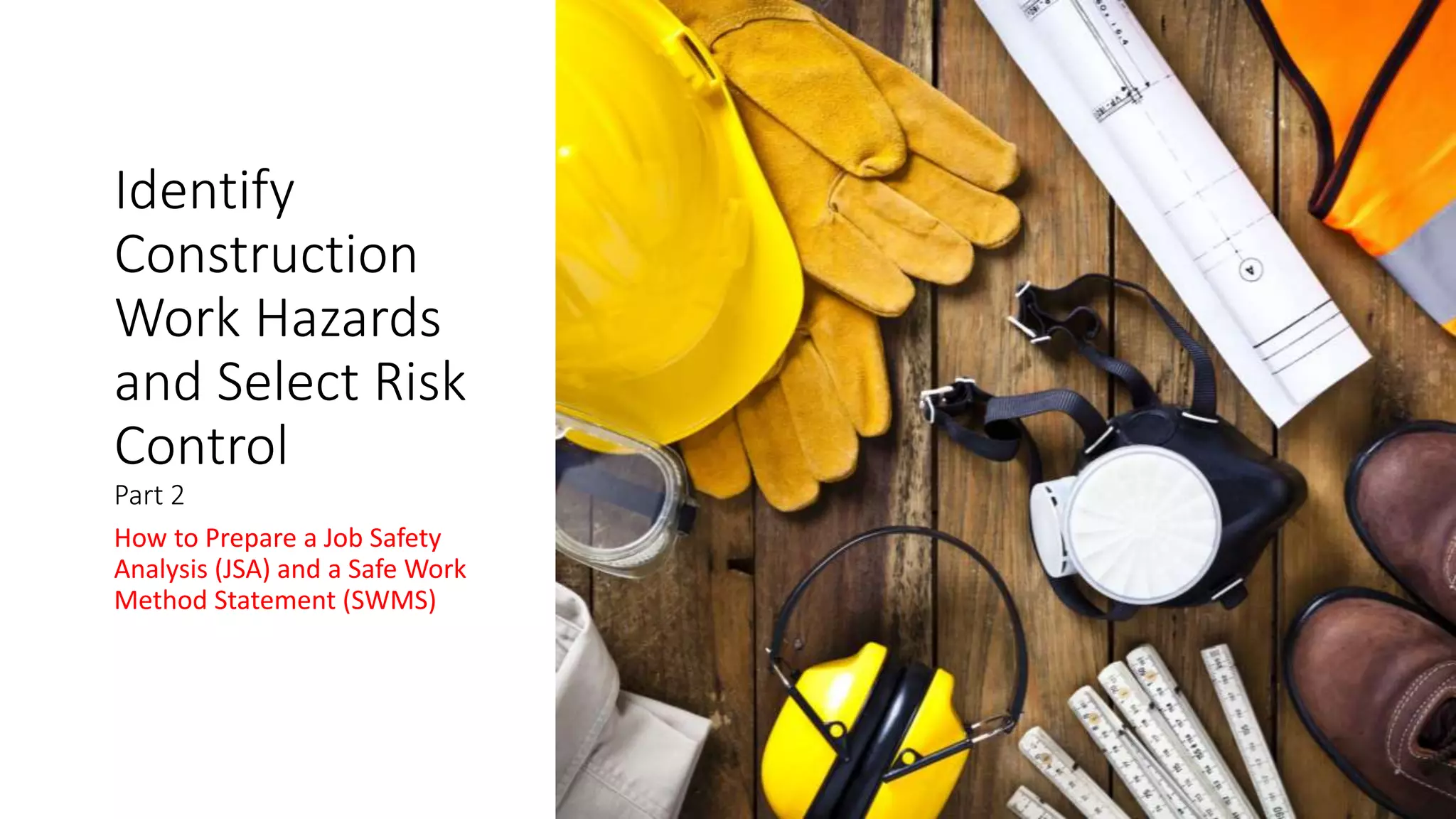
Common examples of PPE
• Headwear (eg hard hat, sun hats etc)
• Eye protection (goggles, welding mask etc)
• Hearing protection (ear plugs, muffs etc required for noise)
• Respiratory (lung/breathing protection –
full face or ½ face mask depending on the hazard)
• Hand protection (gloves)
• Body protection (clothing such as overall, coveralls and aprons, high visibility clothing and vests
etc)
• Feet protection (footwear which is steel-capped,
non slip etc)
Safety Data Sheets (SDS)
A Safety Data Sheet (SDS) is a detailed informational document prepared by the manufacturer or importer of a
hazardous chemical or goods It describes the physical and chemical properties of the product
An Safety Data Sheet (SDS) is a document that provides detailed information about a hazardous chemical,
including:
• the identity of the chemical product and its ingredients
• the hazards of the chemical including health hazards, physical hazards and environmental hazards
• physical properties of the chemical, like boiling point, flash point and incompatibilities with other
chemicals
• safe handling and storage procedures for the chemical
• what to do in the event of an emergency or spill
• first aid information
• transport information
• workplace exposure standards for airborne contaminants
• The correct PPE to use
And should be:
• Supplied by the PCBU
• Read and understood before the use of a chemical or hazardous substanc
• Used as part of a JSA or SWMS
Other Works Nearby: It is important to be aware of other work/workers going on around your
worksite and factor it into any safety planning
Near misses and dangerous incidents (Notifiable incidents) can include:
 damage to any plant, machinery or equipment that is likely to endanger the health or safety of
people in the workplace
 damage or collapse of the load bearing member or control device of a crane, hoist, conveyor,
lift, plant or scaffolding
 collapse or failure of excavations and related shoring
 collapse or partial collapse of a building or structure
 an uncontrolled fire, explosion or escape of gas, steam or dangerous substances
 any other occurrence involving imminent risk of fire, explosion or escape of hazardous
substances; risk of death or serious personal injury to
any person; or risk of substantial damage to property
Site Inspection
Site inspection plays a critical role in hazard identification and risk control, it enables:
•Record hazard details
•Monitor site control practices
•Check site facilities
•Review site tidiness and accessibility
•Assess the use of personal safety equipment
•Review first aid and fire safety procedures
•Inspect cranes and hoisting equipment
•Other workers working on/near worksite affected by your task

Identify ConstructionWork Hazards and Select Risk Control Strategies Part 2.pptx

  • 1.
    Identify Construction Work Hazards and SelectRisk Control Part 2 How to Prepare a Job Safety Analysis (JSA) and a Safe Work Method Statement (SWMS)
  • 2.
    Work Health andSafety Legislation Reasonably Practicable A duty-holder must meet the standard of behaviour expected of a reasonable person in the duty-holder’s position and who is required to comply with the same duty and taking into account and weighing up all relevant matters including: • The likelihood of the hazard or the risk concerned occurring • The degree of harm that might result from the hazard or the risk • • What the person concerned knows, or ought reasonably to know, about the hazard or risk, and ways of eliminating or minimising the risk • The availability and suitability of ways to eliminate or minimise the risk • After assessing the extent of the risk and the available ways of eliminating or minimising the risk, the cost associated with available ways of eliminating or minimising the risk, including whether the cost is grossly disproportionate to the risk. • There is a clear presumption in favour of safety ahead of cost
  • 3.
    Working Safely The definitionof Risk: the chances of a hazard causing injury or harm Risk assessment is based on 3 factors • The “likelihood” that it will do harm (probability) • The “severity” of the harm it could do (consequence) • The “number” of times people could be affected by it (frequency) Safe working practices means working in a way that minimizes the risk to yourself, other people, equipment, materials, the environment, work processes and public health and safety Doing things such as: • Do not take unnecessary risks • Always look out for hazards • Always use Personal Protective Equipment (PPE) • If you must smoke, do so only in designated areas • Keep your work area clean and tidy • Enter and leave the workplace using proper routes • Never attend work under the influence of drugs or alcohol • Do not put the public at risk, eg release of chemical pollutants, dust, collapse of structures
  • 4.
    Environmental and PublicHealth and Safety Requirements Environmental Health and Public Health and Safety risk include health impacts of: • Chemical pollutants and contaminants in air, water, soil and food • Pathogenic microbiological contaminants in food and water • Radiation sources • Electromagnetic fields (EMFs)
  • 5.
    Environmental and PublicHealth and Safety Requirements Environmental health and Public Health and Safety risk include health impacts of: • airborne dust • Smoke, noise and air quality • contaminated land fill, chemical spills or releases • Damaged infrastructure • Climate and climate change
  • 6.
    Environmental and PublicHealth and Safety Requirements The effects of environmental and public health issues can include • minor to life threatening health problems • degradation of the land and water with impacts on crops, livestock and native flora and fauna • Contamination of our food stocks • Displacement/extinction of wildlife • Resource depletion – forests, water and food •
  • 7.
    Work Health andSafety Requirements WHS Requirements PCBU • Consult with workers who carry out work for the business or undertaking • Establish a Risk Management process – a risk Management process is a series of steps to identify hazards and associated risks, controlling those risks and reviewing the risks and controls to ensure safety of workers • Ensure workers are given information, training, instruction and supervision - Construction Induction, workplace specific training, task specific training • Provide First Aid
  • 8.
    Work Health andSafety Requirements WHS Requirements PCBU Provide a safe working environment including • Personal Protective Equipment (PPE) - Eye protection, hearing protection, safety boots, gloves • Safe Operating Procedures(SOP) for tools and equipment - A safe operating procedure (SOP) is a set of step-by-step instructions compiled by an organisation to help workers carry out complex and routine operations. • Safety Data Sheets – Information sheets on chemicals, hazardous goods and materials, the supply of and use is mandatory under the WHS Act • JSA’s – Safety control document for carrying out a low to medium risk task • Safe Work Method Statements (SWMS) for high risk activities – A mandatory safety control document for High Risk tasks - Identifies hazards and risks, rates and controls those risk, and documents authority and review.
  • 9.
    Work Health andSafety Requirements • WHS Requirements workers • To cooperate with (or help) the PCBU on health and safety matters • To take reasonable care to protect the health and safety of yourself and others who may be affected by your actions • Identify and report unsafe or dangerous situation or actions • • Work according to JSA’s and SWMS, if there is a change in the process notify the PCBU
  • 10.
    Work Health andSafety Requirements WHS Requirements workers • Participate in the creation of JSA’s and SWMS’s • If you have not done a task or used a tool before inform the PCBU know • Carry out prestart check on tools and equipment • Everyone involved in construction work has health and safety duties when carrying out the
  • 11.
    Designed to giveprotection and limit or avoid damage (it is not designed to prevent injury) • Lowest control method in the hierarchy of control – you still need to think and act safely in your work and actions • Must be supplied by the PCBU • The purpose of each item of PPE must be explained to you • You must be trained to fit and use each item of PPE correctly • Never deliberately misuse or damage PPE Work Health and Safety Requirements – Personal Protective Equipment
  • 12.
    Work Health andSafety Requirements – Personal Protective Equipment Common examples of PPE • Headwear (eg hard hat, sun hats etc) • Eye protection (goggles, welding mask etc) • Hearing protection (ear plugs, muffs etc required for noise) • Respiratory (lung/breathing protection – full face or ½ face mask depending on the hazard) • Hand protection (gloves) • Body protection (clothing such as overall, coveralls and aprons, high visibility clothing and vests etc) • Feet protection (footwear which is steel-capped, non slip etc)
  • 13.
    Safety Data Sheets(SDS) A Safety Data Sheet (SDS) is a detailed informational document prepared by the manufacturer or importer of a hazardous chemical or goods It describes the physical and chemical properties of the product An Safety Data Sheet (SDS) is a document that provides detailed information about a hazardous chemical, including: • the identity of the chemical product and its ingredients • the hazards of the chemical including health hazards, physical hazards and environmental hazards • physical properties of the chemical, like boiling point, flash point and incompatibilities with other chemicals • safe handling and storage procedures for the chemical • what to do in the event of an emergency or spill • first aid information • transport information • workplace exposure standards for airborne contaminants • The correct PPE to use And should be: • Supplied by the PCBU • Read and understood before the use of a chemical or hazardous substanc • Used as part of a JSA or SWMS
  • 14.
    Other Works Nearby:It is important to be aware of other work/workers going on around your worksite and factor it into any safety planning Near misses and dangerous incidents (Notifiable incidents) can include:  damage to any plant, machinery or equipment that is likely to endanger the health or safety of people in the workplace  damage or collapse of the load bearing member or control device of a crane, hoist, conveyor, lift, plant or scaffolding  collapse or failure of excavations and related shoring  collapse or partial collapse of a building or structure  an uncontrolled fire, explosion or escape of gas, steam or dangerous substances  any other occurrence involving imminent risk of fire, explosion or escape of hazardous substances; risk of death or serious personal injury to any person; or risk of substantial damage to property
  • 15.
    Site Inspection Site inspectionplays a critical role in hazard identification and risk control, it enables: •Record hazard details •Monitor site control practices •Check site facilities •Review site tidiness and accessibility •Assess the use of personal safety equipment •Review first aid and fire safety procedures •Inspect cranes and hoisting equipment •Other workers working on/near worksite affected by your task