Integrated Definition (IDEF)
Modeling Techniques
Ozgun Demirag
Andy Johnson
Dima Nazzal
Yen-Tai Wan
Outline
What is IDEF?
IDEF Family:
 Overview
 Examples
 Strengths and Weaknesses
Rasmussen - Design Maps Definition
What is IDEF?
Definition: IDEF is the common name referring to
classes of enterprise modeling languages.
Objective: IDEF is used for modeling activities
necessary to support system analysis, design,
improvement or integration.
Originally, IDEF was developed to enhance
communication among people trying to understand
the system. Now, IDEF is being used for
documentation, understanding, design, analysis,
planning, and Integration.
IDEF History
In the 1970’s, IDEF0 originated in the U.S. Air
Force under the Integrated Computer Aided
Manufacturing(ICAM) program from a well-
established graphical language, the
Structured Analysis and Design Technique
(SADT).
IDEF Family
IDEF Family of Methods:
 IDEF0: for Function Modeling (purpose:description)
 IDEF1: for Information Modeling.
(purpose:description)
 IDEF1x: for Data Modeling. (purpose:design)
 IDEF3: for Process Modeling. (purpose:description)
 IDEF4: for Object-Oriented Design.
(purpose:design)
 IDEF5: for Ontology Description Capture.
(purpose:description)
IDEF0- Function Modeling
Method
IDEF0 models the decisions, actions, and
activities of an organization or system, in
order to communicate the functional
perspective of a system.
IDEF0 models are created as one of the first
tasks of a system development effort because
they describe:
 the functions that are performed,
 what is needed to perform those functions,
IDEF0 was released as a standard for Function
Modeling by the Computer Systems Laboratory of the
National Institute of Standards and Technology.
(1993)
IDEF0- Function Modeling
Method
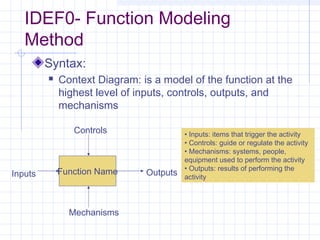
Syntax:
 Context Diagram: is a model of the function at the
highest level of inputs, controls, outputs, and
mechanisms
Mechanisms
Function Name
Controls
Inputs Outputs
• Inputs: items that trigger the activity
• Controls: guide or regulate the activity
• Mechanisms: systems, people,
equipment used to perform the activity
• Outputs: results of performing the
activity
IDEF0- Function Modeling
Method
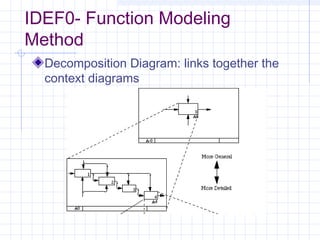
Decomposition Diagram: links together the
context diagrams
IDEF0- Function Modeling
Method
STRENGTHS
 The model has proven effective in detailing the system
activities for function modeling.
 IDEF0 models provide an abstraction away from timing,
sequencing and decision logic. However, it is easy to use
IDEF0 for modeling activity sequences whenever needed.
(Order the activities from left to right in the decomposition
diagram).
 Provides a concise description of systems, by using the
ICOMS. (Inputs, Controls, Output, Mechanism)
 The hierarchical nature of IDEF0 allows the system to be
easily refined into greater detail until the model is as
descriptive as necessary for the decision making task.
IDEF0- Function Modeling
Method
WEAKNESSES
 IDEF models might be so concise that only the domain
experts can understand.
 IDEF models are sometimes misinterpreted as representing
a sequence of activities.
 The abstraction away from timing, sequencing and decision
logic leads to comprehension difficulties for the people
outside the domain.
IDEF0- Function Modeling
Method
EXAMPLE (source: [4])
IDEF1- Information Modeling
Method
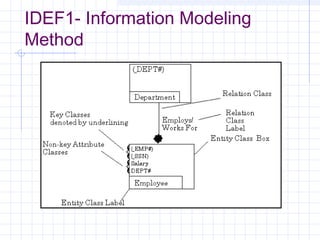
IDEF1 is a method for both analyzing and
communicating the structure and semantics of
information within a system.
IDEF1 models are used to:
 Identify what information is currently managed in a real-
world system, both automated system components, and
non-automated objects (e.g. people).
 Identify the rules for managing the information.
 Identify deficiencies in the current management of the
information.
 Specify what information will be managed in a TO-BE
implementation. (TO-BE implementation: Design of the
functional architecture)
IDEF1- Information Modeling
Method
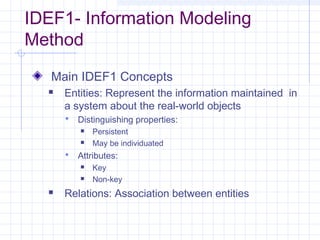
Main IDEF1 Concepts
 Entities: Represent the information maintained in
a system about the real-world objects
 Distinguishing properties:
 Persistent
 May be individuated
 Attributes:
 Key
 Non-key
 Relations: Association between entities
IDEF1- Information Modeling
Method
IDEF1- Information Modeling
Method
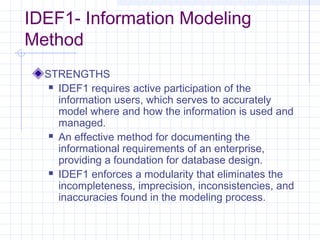
STRENGTHS
 IDEF1 requires active participation of the
information users, which serves to accurately
model where and how the information is used and
managed.
 An effective method for documenting the
informational requirements of an enterprise,
providing a foundation for database design.
 IDEF1 enforces a modularity that eliminates the
incompleteness, imprecision, inconsistencies, and
inaccuracies found in the modeling process.
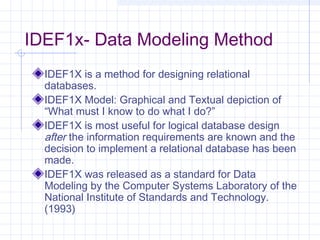
IDEF1x- Data Modeling Method
IDEF1X is a method for designing relational
databases.
IDEF1X Model: Graphical and Textual depiction of
“What must I know to do what I do?”
IDEF1X is most useful for logical database design
after the information requirements are known and the
decision to implement a relational database has been
made.
IDEF1X was released as a standard for Data
Modeling by the Computer Systems Laboratory of the
National Institute of Standards and Technology.
(1993)
IDEF1x- Data Modeling Method
EXAMPLE (ref:[2])
IDEF1x- Data Modeling Method
EXAMPLE (ref:[2])
IDEF1x- Data Modeling Method
STRENGTHS
 Powerful tool for data modeling.
 IDEF1X don’t have numerous variants, unlike ER.
 Depicts the rules governing the management of information.
 Used to validate the concepts in the associated IDEF0
model.
 Helps to discover underlying causes for problems.
WEAKNESSES
 The modeler must be experienced in order to create good
models.
 Not suited to serve as an AS-IS analysis tool.
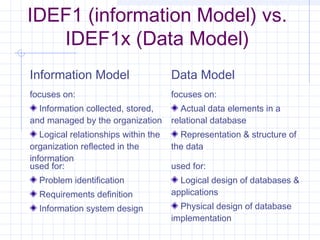
IDEF1 (information Model) vs.
IDEF1x (Data Model)
Information Model Data Model
focuses on:
Information collected, stored,
and managed by the organization
Logical relationships within the
organization reflected in the
information
focuses on:
Actual data elements in a
relational database
Representation & structure of
the data
used for:
Problem identification
Requirements definition
Information system design
used for:
Logical design of databases &
applications
Physical design of database
implementation
IDEF3- Process Description
Model
“IDEF3 is a mechanism for collecting and documenting
processes.… IDEF3 captures the behavioral aspects
of an existing or proposed system.” (temporal
information, including precedence and causality
relationships associated with enterprise processes.)
“The resulting IDEF3 descriptions provide a structured
knowledge base for constructing analytical and design
models. (unlike simulation languages that build
predictive mathematical models, IDEF3 builds
structured descriptions.)”
“These descriptions capture information about what a
system actually does or will do and also provide for the
organization and expression of different user views of
the system.”
Sounds
Familiar !
Source: http://www.idef.com/idef3.html
IDEF3- Process Description
Model
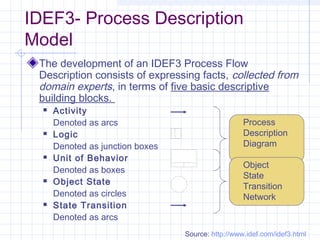
The development of an IDEF3 Process Flow
Description consists of expressing facts, collected from
domain experts, in terms of five basic descriptive
building blocks.
 Activity
Denoted as arcs
 Logic
Denoted as junction boxes
 Unit of Behavior
Denoted as boxes
 Object State
Denoted as circles
 State Transition
Denoted as arcs
Process
Description
Diagram
Object
State
Transition
Network
Source: http://www.idef.com/idef3.html
IDEF3- Process Description
Model
Organizing Structure: Scenario
A scenario can be thought of as a recurring situation, a set of
situations that describe a typical class of problems addressed by
an organization or system, or the setting within which a process
occurs.
Example
Scenario:
Parts enter the shop ready for the primer coat to be applied. We
apply one very heavy coat of primer paint at a very high
temperature. The paint is allowed to dry in a bake oven after which
a paint coverage test is performed on the part. If the test reveals
that not enough primer paint has been sprayed on the surface of
the part, the part is re-routed through the paint shop again. If the
part passes the inspection, it is routed to the next stop in the
process.
Source: http://www.idef.com/idef3.html
IDEF3- Process Description
Model
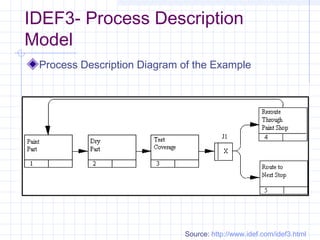
Process Description Diagram of the Example
Source: http://www.idef.com/idef3.html
IDEF3- Process Description
Model
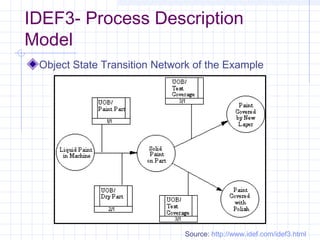
Object State Transition Network of the Example
Source: http://www.idef.com/idef3.html
IDEF3- Process Description
Model
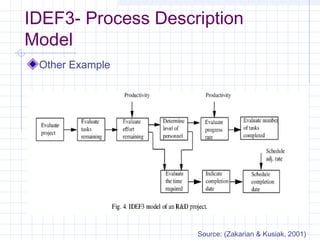
Other Example
Source: (Zakarian & Kusiak, 2001)
IDEF3- Process Description
Model
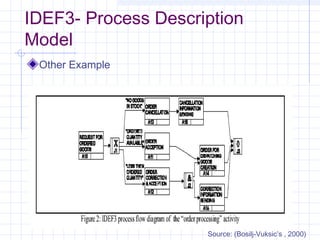
Other Example
Source: (Bosilj-Vuksic’s , 2000)
IDEF3- Process Description
Model
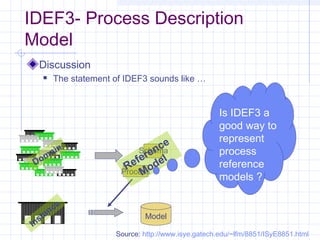
Discussion
 The statement of IDEF3 sounds like …
Domain
Instance
Model
Schema
Process
Reference
Model
Is IDEF3 a
good way to
represent
process
reference
models ?
Source: http://www.isye.gatech.edu/~lfm/8851/ISyE8851.html
IDEF4- O-O Design Method
IDEF4 method is designed to assist in creating object-
oriented programming software.
IDEF4 provides a framework for navigating an evolving
object-oriented design.
IDEF4 divides the object-oriented design activity into
discrete chunks. A graphical syntax highlights the design
decisions that must be made and their impact on other
perspectives of the design.
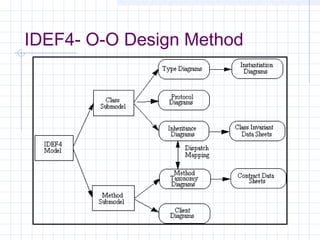
IDEF4 model consists of two submodels, the class
submodel and the method submodel. These two
structures capture all the information represented in a
design model.
IDEF4- O-O Design Method
IDEF5 - Ontology Description
Method
An ontology is a domain vocabulary complete
with a set of precise definitions or axioms that
constrain the meanings of the terms sufficiently,
to enable consistent interpretation of the data
that use that vocabulary.
General ontology construction steps:
1. catalog the terms;
2. capture the constraints that govern how
those terms can be used to make descriptive
statements about the domain; and
3. build the model.
IDEF5 - Ontology Description
Method
The IDEF5 ontology development process consists
of the following activities.
Data Collection of raw data needed for
ontology development.
Data Analysis to facilitate ontology extraction.
Initial Ontology Development to develop a
preliminary ontology from the data gathered.
Ontology Refinement and Validation.
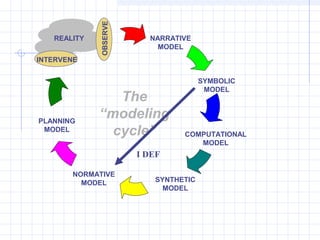
REALITY
INTERVENE
COMPUTATIONAL
MODEL
SYNTHETIC
MODEL
NORMATIVE
MODEL
PLANNING
MODEL
OBSERVE
NARRATIVE
MODEL
SYMBOLIC
MODEL
The
“modeling
cycle”
I DEF
Rasmussen - Design Maps
Definition
Map 1: Domain, tasks, and user in
context
Map 2: Knowledge base
Map 3: Road maps for navigation
Map 4: Knowledge representation in
design
Map 5: Display composition
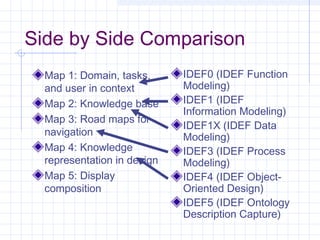
Side by Side Comparison
Map 1: Domain, tasks,
and user in context
Map 2: Knowledge base
Map 3: Road maps for
navigation
Map 4: Knowledge
representation in design
Map 5: Display
composition
IDEF0 (IDEF Function
Modeling)
IDEF1 (IDEF
Information Modeling)
IDEF1X (IDEF Data
Modeling)
IDEF3 (IDEF Process
Modeling)
IDEF4 (IDEF Object-
Oriented Design)
IDEF5 (IDEF Ontology
Description Capture)
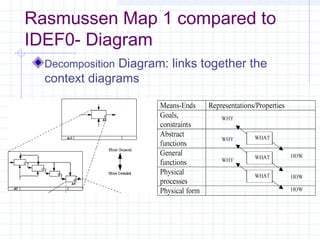
Rasmussen Map 1 compared to
IDEF0- Diagram
Decomposition Diagram: links together the
context diagrams
Key
Both require an expert in the field to use
and understand the model
 This is a result of the method being a very
high level concept and developing the
details for any single application is not a
trivial matter
Advantage of IDEF
IDEF 5 attempts to incorporate the
vocabulary of the specific application
References
 Colquhoun, G.J, Baines, R.W, Crossley, Roger, A State of
the Art Review of IDEF0, International Journal of Computer
Integrated Manufacturing, Vol. 6, No. 4, 1993, pp. 252-264.
 (2) Introduction to IDEF Methodology, USACE LCM
Manager’s Guide Version-2 http://www.usace.army.mil/
ci/impolicy/lcmis/lcma3.pdf
 (4) Bosilj-Vuksic’s paper (http://oliver.efzg.hr/~vbosilj/iceis2000.
pdf)

Idef v4

  • 1.
    Integrated Definition (IDEF) ModelingTechniques Ozgun Demirag Andy Johnson Dima Nazzal Yen-Tai Wan
  • 2.
    Outline What is IDEF? IDEFFamily:  Overview  Examples  Strengths and Weaknesses Rasmussen - Design Maps Definition
  • 3.
    What is IDEF? Definition:IDEF is the common name referring to classes of enterprise modeling languages. Objective: IDEF is used for modeling activities necessary to support system analysis, design, improvement or integration. Originally, IDEF was developed to enhance communication among people trying to understand the system. Now, IDEF is being used for documentation, understanding, design, analysis, planning, and Integration.
  • 4.
    IDEF History In the1970’s, IDEF0 originated in the U.S. Air Force under the Integrated Computer Aided Manufacturing(ICAM) program from a well- established graphical language, the Structured Analysis and Design Technique (SADT).
  • 5.
    IDEF Family IDEF Familyof Methods:  IDEF0: for Function Modeling (purpose:description)  IDEF1: for Information Modeling. (purpose:description)  IDEF1x: for Data Modeling. (purpose:design)  IDEF3: for Process Modeling. (purpose:description)  IDEF4: for Object-Oriented Design. (purpose:design)  IDEF5: for Ontology Description Capture. (purpose:description)
  • 6.
    IDEF0- Function Modeling Method IDEF0models the decisions, actions, and activities of an organization or system, in order to communicate the functional perspective of a system. IDEF0 models are created as one of the first tasks of a system development effort because they describe:  the functions that are performed,  what is needed to perform those functions, IDEF0 was released as a standard for Function Modeling by the Computer Systems Laboratory of the National Institute of Standards and Technology. (1993)
  • 7.
    IDEF0- Function Modeling Method Syntax: Context Diagram: is a model of the function at the highest level of inputs, controls, outputs, and mechanisms Mechanisms Function Name Controls Inputs Outputs • Inputs: items that trigger the activity • Controls: guide or regulate the activity • Mechanisms: systems, people, equipment used to perform the activity • Outputs: results of performing the activity
  • 8.
    IDEF0- Function Modeling Method DecompositionDiagram: links together the context diagrams
  • 9.
    IDEF0- Function Modeling Method STRENGTHS The model has proven effective in detailing the system activities for function modeling.  IDEF0 models provide an abstraction away from timing, sequencing and decision logic. However, it is easy to use IDEF0 for modeling activity sequences whenever needed. (Order the activities from left to right in the decomposition diagram).  Provides a concise description of systems, by using the ICOMS. (Inputs, Controls, Output, Mechanism)  The hierarchical nature of IDEF0 allows the system to be easily refined into greater detail until the model is as descriptive as necessary for the decision making task.
  • 10.
    IDEF0- Function Modeling Method WEAKNESSES IDEF models might be so concise that only the domain experts can understand.  IDEF models are sometimes misinterpreted as representing a sequence of activities.  The abstraction away from timing, sequencing and decision logic leads to comprehension difficulties for the people outside the domain.
  • 11.
  • 12.
    IDEF1- Information Modeling Method IDEF1is a method for both analyzing and communicating the structure and semantics of information within a system. IDEF1 models are used to:  Identify what information is currently managed in a real- world system, both automated system components, and non-automated objects (e.g. people).  Identify the rules for managing the information.  Identify deficiencies in the current management of the information.  Specify what information will be managed in a TO-BE implementation. (TO-BE implementation: Design of the functional architecture)
  • 13.
    IDEF1- Information Modeling Method MainIDEF1 Concepts  Entities: Represent the information maintained in a system about the real-world objects  Distinguishing properties:  Persistent  May be individuated  Attributes:  Key  Non-key  Relations: Association between entities
  • 14.
  • 15.
    IDEF1- Information Modeling Method STRENGTHS IDEF1 requires active participation of the information users, which serves to accurately model where and how the information is used and managed.  An effective method for documenting the informational requirements of an enterprise, providing a foundation for database design.  IDEF1 enforces a modularity that eliminates the incompleteness, imprecision, inconsistencies, and inaccuracies found in the modeling process.
  • 16.
    IDEF1x- Data ModelingMethod IDEF1X is a method for designing relational databases. IDEF1X Model: Graphical and Textual depiction of “What must I know to do what I do?” IDEF1X is most useful for logical database design after the information requirements are known and the decision to implement a relational database has been made. IDEF1X was released as a standard for Data Modeling by the Computer Systems Laboratory of the National Institute of Standards and Technology. (1993)
  • 17.
    IDEF1x- Data ModelingMethod EXAMPLE (ref:[2])
  • 18.
    IDEF1x- Data ModelingMethod EXAMPLE (ref:[2])
  • 19.
    IDEF1x- Data ModelingMethod STRENGTHS  Powerful tool for data modeling.  IDEF1X don’t have numerous variants, unlike ER.  Depicts the rules governing the management of information.  Used to validate the concepts in the associated IDEF0 model.  Helps to discover underlying causes for problems. WEAKNESSES  The modeler must be experienced in order to create good models.  Not suited to serve as an AS-IS analysis tool.
  • 20.
    IDEF1 (information Model)vs. IDEF1x (Data Model) Information Model Data Model focuses on: Information collected, stored, and managed by the organization Logical relationships within the organization reflected in the information focuses on: Actual data elements in a relational database Representation & structure of the data used for: Problem identification Requirements definition Information system design used for: Logical design of databases & applications Physical design of database implementation
  • 21.
    IDEF3- Process Description Model “IDEF3is a mechanism for collecting and documenting processes.… IDEF3 captures the behavioral aspects of an existing or proposed system.” (temporal information, including precedence and causality relationships associated with enterprise processes.) “The resulting IDEF3 descriptions provide a structured knowledge base for constructing analytical and design models. (unlike simulation languages that build predictive mathematical models, IDEF3 builds structured descriptions.)” “These descriptions capture information about what a system actually does or will do and also provide for the organization and expression of different user views of the system.” Sounds Familiar ! Source: http://www.idef.com/idef3.html
  • 22.
    IDEF3- Process Description Model Thedevelopment of an IDEF3 Process Flow Description consists of expressing facts, collected from domain experts, in terms of five basic descriptive building blocks.  Activity Denoted as arcs  Logic Denoted as junction boxes  Unit of Behavior Denoted as boxes  Object State Denoted as circles  State Transition Denoted as arcs Process Description Diagram Object State Transition Network Source: http://www.idef.com/idef3.html
  • 23.
    IDEF3- Process Description Model OrganizingStructure: Scenario A scenario can be thought of as a recurring situation, a set of situations that describe a typical class of problems addressed by an organization or system, or the setting within which a process occurs. Example Scenario: Parts enter the shop ready for the primer coat to be applied. We apply one very heavy coat of primer paint at a very high temperature. The paint is allowed to dry in a bake oven after which a paint coverage test is performed on the part. If the test reveals that not enough primer paint has been sprayed on the surface of the part, the part is re-routed through the paint shop again. If the part passes the inspection, it is routed to the next stop in the process. Source: http://www.idef.com/idef3.html
  • 24.
    IDEF3- Process Description Model ProcessDescription Diagram of the Example Source: http://www.idef.com/idef3.html
  • 25.
    IDEF3- Process Description Model ObjectState Transition Network of the Example Source: http://www.idef.com/idef3.html
  • 26.
    IDEF3- Process Description Model OtherExample Source: (Zakarian & Kusiak, 2001)
  • 27.
    IDEF3- Process Description Model OtherExample Source: (Bosilj-Vuksic’s , 2000)
  • 28.
    IDEF3- Process Description Model Discussion The statement of IDEF3 sounds like … Domain Instance Model Schema Process Reference Model Is IDEF3 a good way to represent process reference models ? Source: http://www.isye.gatech.edu/~lfm/8851/ISyE8851.html
  • 29.
    IDEF4- O-O DesignMethod IDEF4 method is designed to assist in creating object- oriented programming software. IDEF4 provides a framework for navigating an evolving object-oriented design. IDEF4 divides the object-oriented design activity into discrete chunks. A graphical syntax highlights the design decisions that must be made and their impact on other perspectives of the design. IDEF4 model consists of two submodels, the class submodel and the method submodel. These two structures capture all the information represented in a design model.
  • 30.
  • 31.
    IDEF5 - OntologyDescription Method An ontology is a domain vocabulary complete with a set of precise definitions or axioms that constrain the meanings of the terms sufficiently, to enable consistent interpretation of the data that use that vocabulary. General ontology construction steps: 1. catalog the terms; 2. capture the constraints that govern how those terms can be used to make descriptive statements about the domain; and 3. build the model.
  • 32.
    IDEF5 - OntologyDescription Method The IDEF5 ontology development process consists of the following activities. Data Collection of raw data needed for ontology development. Data Analysis to facilitate ontology extraction. Initial Ontology Development to develop a preliminary ontology from the data gathered. Ontology Refinement and Validation.
  • 33.
  • 34.
    Rasmussen - DesignMaps Definition Map 1: Domain, tasks, and user in context Map 2: Knowledge base Map 3: Road maps for navigation Map 4: Knowledge representation in design Map 5: Display composition
  • 35.
    Side by SideComparison Map 1: Domain, tasks, and user in context Map 2: Knowledge base Map 3: Road maps for navigation Map 4: Knowledge representation in design Map 5: Display composition IDEF0 (IDEF Function Modeling) IDEF1 (IDEF Information Modeling) IDEF1X (IDEF Data Modeling) IDEF3 (IDEF Process Modeling) IDEF4 (IDEF Object- Oriented Design) IDEF5 (IDEF Ontology Description Capture)
  • 36.
    Rasmussen Map 1compared to IDEF0- Diagram Decomposition Diagram: links together the context diagrams
  • 37.
    Key Both require anexpert in the field to use and understand the model  This is a result of the method being a very high level concept and developing the details for any single application is not a trivial matter
  • 38.
    Advantage of IDEF IDEF5 attempts to incorporate the vocabulary of the specific application
  • 39.
    References  Colquhoun, G.J,Baines, R.W, Crossley, Roger, A State of the Art Review of IDEF0, International Journal of Computer Integrated Manufacturing, Vol. 6, No. 4, 1993, pp. 252-264.  (2) Introduction to IDEF Methodology, USACE LCM Manager’s Guide Version-2 http://www.usace.army.mil/ ci/impolicy/lcmis/lcma3.pdf  (4) Bosilj-Vuksic’s paper (http://oliver.efzg.hr/~vbosilj/iceis2000. pdf)

Editor's Notes

  • #31 The class submodel is composed of the following diagram types: 1) Inheritance diagrams that specify class inheritance relations; 2) Type diagrams that specify class composition; 3) Protocol diagrams that specify method invocation protocols; and 4) Instantiation diagrams that describe object instantiation scenarios that assist the designer in validating the design. The method submodel is composed of the following two diagram types: 1) Method taxonomy diagrams which classify method types by behavior similarity and 2) Client diagrams which illustrate clients and suppliers of methods, to specify functional decomposition.