Balancing the Two Faces of E-PortfoliosDr. Helen BarrettUniversity of Alaska Anchorage (retired)Seattle Pacific University (adjunct)New England College (adjunct)International Researcher & ConsultantFounder, REAL ePortfolio AcademyElectronic Portfolios and Digital Storytelling for Lifelong and Life Wide Learning
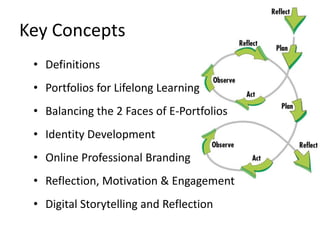
Key ConceptsDefinitionsPortfolios for Lifelong LearningBalancing the 2 Faces of E-PortfoliosIdentity DevelopmentOnline Professional BrandingReflection, Motivation & EngagementDigital Storytelling and Reflection
Legacy from the Portfolio LiteratureMuch to learn fromthe literature onpaper-based portfolios
As adult learners, we have much to learn from how children approach portfolios“Everything I know about portfolios was confirmed working with a kindergartener”
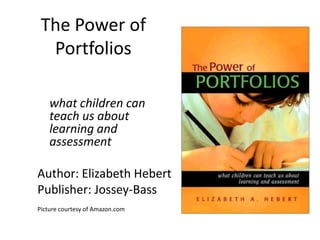
The Power of Portfolios	what children can teach us about learning and assessmentAuthor: Elizabeth HebertPublisher: Jossey-BassPicture courtesy of Amazon.com
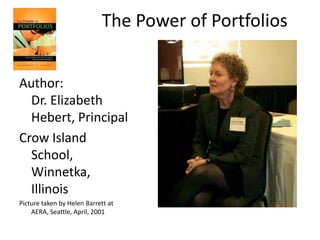
The Power of PortfoliosAuthor: Dr. Elizabeth Hebert, PrincipalCrow Island School, Winnetka, IllinoisPicture taken by Helen Barrett at AERA, Seattle, April, 2001
From the Preface (1)Hebert, Elizabeth (2001) The Power of Portfolios. Jossey-Bass, p.ix“Portfolios have been with us for a very long time. Those of us who grew up in the 1950s or earlier recognize portfolios as reincarnations of the large memory boxes or drawers where our parents collected starred spelling tests, lacy valentines, science fair posters, early attempts at poetry, and (of course) the obligatory set of plaster hands. Each item was selected by our parents because it represented our acquisition of a new skill or our feelings of accomplishment. Perhaps  an entry was accompanied by a special notation of praise from a teacher or maybe it was placed in the box just because we did it.”
From the Preface (2)Hebert, Elizabeth (2001) The Power of Portfolios. Jossey-Bass, p.ix		“We formed part of our identity from the contents of these memory boxes. We recognized each piece and its association with a particular time or experience. We shared these collections with grandparents to reinforce feelings of pride and we reexamined them on rainy days when friends were unavailable for play.  Reflecting on the collection allowed us to attribute importance to these artifacts, and by extension to ourselves, as they gave witness to the story of our early school experiences.”
From the Preface (3)Hebert, Elizabeth (2001) The Power of Portfolios. Jossey-Bass, p.ix-x		“Our parents couldn’t possibly envision that these memory boxes would be the inspiration for an innovative way of thinking about children’s learning. These collections, lovingly stored away on our behalf, are the genuine exemplar for documenting children’s learning over time. But now these memory boxes have a different meaning. It’s not purely private or personal, although the personal is what gives power to what they can mean.”
Let’s get personal…Think for a minute about:Something about your COLLECTIONS:Suggested topics:If you are a parent, what you saved for your children
What your parents saved for you
What you collect…
Why you collect…Some issues to considerWhat do your collections say about what you value?
Is there a difference between what you purposefully save and what you can’t throw away?
How can we use our personal collections experiences to help learners as they develop their portfolios?The power of portfolios [to support deep learning] is personal.
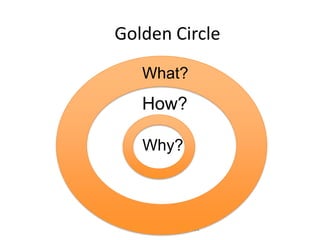
Golden Circle        What?How?Why?11
Audio • Video • Text • ImagesWHAT?Digital RepositoryElectronic PortfolioShowcaseWorkspace
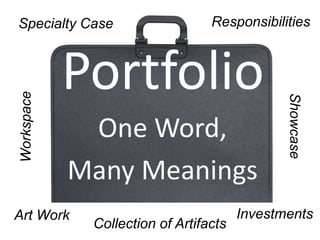
ResponsibilitiesSpecialty CasePortfolioOne Word, Many MeaningsWorkspaceShowcaseInvestmentsArt WorkCollection of Artifacts
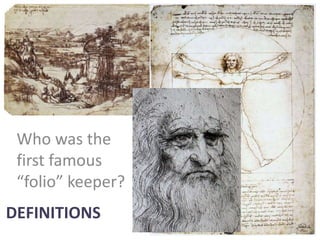
Who was the first famous “folio” keeper?Definitions
Leonardo da Vinci’s Folio
What is a Portfolio?Dictionary definition: a flat, portable case for carrying loose papers, drawings, etc.Financial portfolio: document accumulation of fiscal capitalEducational portfolio: document development of human capital
What is a Portfolio in Education?A portfolio is a purposeful collection of [academic] work that exhibits the [learner/worker’s] efforts, progress and achievements in one or more areas[over time].	(Northwest Evaluation Association, 1990)
+Electronicdigital artifacts organized online combining various media (audio/video/text/images)
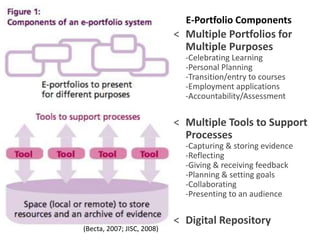
E-Portfolio ComponentsMultiple Portfolios for Multiple Purposes-Celebrating Learning-Personal Planning-Transition/entry to courses-Employment applications-Accountability/Assessment
Multiple Tools to Support Processes-Capturing & storing evidence-Reflecting-Giving & receiving feedback-Planning & setting goals-Collaborating-Presenting to an audience
Digital Repository(Becta, 2007; JISC, 2008)
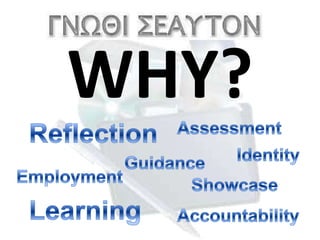
WHY?ReflectionAssessmentIdentityGuidanceEmploymentShowcaseLearningAccountability
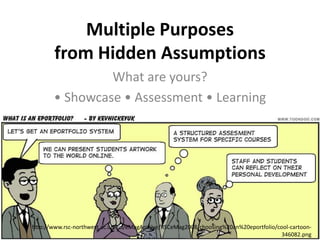
Multiple Purposes from Hidden AssumptionsWhat are yours?• Showcase • Assessment • Learning •http://www.rsc-northwest.ac.uk/acl/eMagArchive/RSCeMag2008/choosing%20an%20eportfolio/cool-cartoon-346082.png
PurposeThe overarching purpose of portfolios is to create a sense of personal ownership over one’s accomplishments, because ownership engenders feelings of pride, responsibility, and dedication. (p.10)Paris, S & Ayres, L. (1994) Becoming Reflective Students and Teachers. American Psychological Association
Deep Learninginvolves reflection,is developmental,is integrative,is self-directive, andis lifelongCambridge (2004)
“metacognition lies at the root of all learning”“…self-knowledge, awareness of how and why we think as we do, and the ability to adapt and learn, are critical to our survival as individuals…”- James Zull (2011) From Brain to Mind: Using Neuroscience to Guide Change in Education
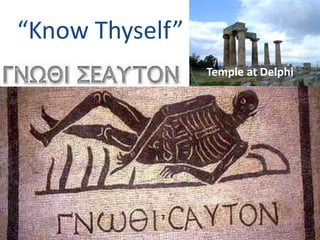
“Know Thyself”Temple at Delphi
Managing OneselfPeter Drucker, (2005) Harvard Business Review“Success in the knowledge economy comes to those who know themselves – their strengths, their values, and how best they perform.”Purpose: Use ePortfolios for managing knowledge workers' career developmentWhat are my strengths?How do I perform?What are my values?Where do I belong?What should I contribute?Responsibility for RelationshipsThe Second Half of your Life
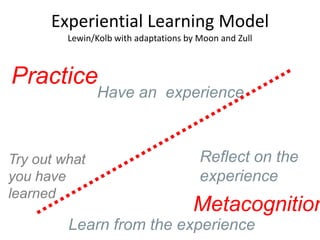
Experiential Learning ModelLewin/Kolb with adaptations by Moon and ZullPracticeHave an  experienceReflect on the experienceTry out what you have learnedMetacognitionLearn from the experience
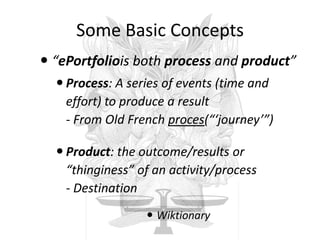
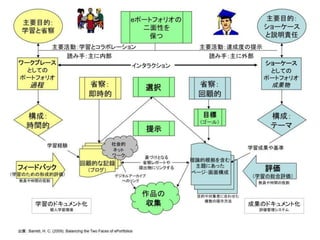
Some Basic Concepts“ePortfoliois both process and product”
Process: A series of events (time and effort) to produce a result- From Old French proces(“‘journey’”)
Product: the outcome/results or “thinginess” of an activity/process- Destination
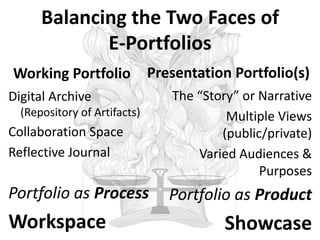
WiktionaryBalancing the Two Faces of E-PortfoliosPresentation Portfolio(s)Working PortfolioThe “Story” or NarrativeMultiple Views (public/private)Varied Audiences & PurposesPortfolio as ProductShowcaseDigital Archive (Repository of Artifacts)Collaboration SpaceReflective JournalPortfolio as ProcessWorkspace
Japanese
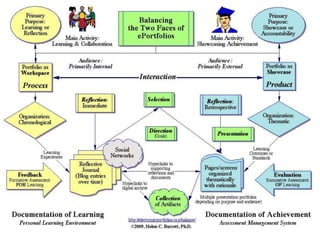
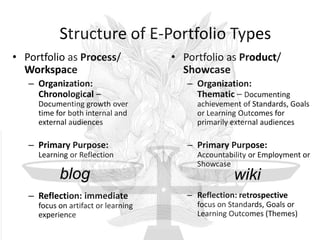
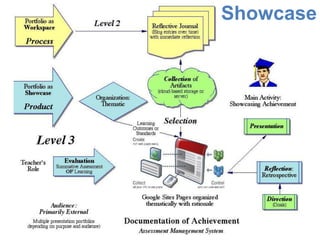
Structure of E-Portfolio TypesPortfolio as Process/ WorkspaceOrganization: Chronological – Documenting growth over time for both internal and external audiencesPrimary Purpose: Learning or ReflectionReflection: immediate focus on artifact or learning experiencePortfolio as Product/ ShowcaseOrganization: Thematic – Documenting achievement of Standards, Goals or Learning Outcomes for primarily external audiencesPrimary Purpose: Accountability or Employment or ShowcaseReflection: retrospective focus on Standards, Goals or Learning Outcomes (Themes)blogwiki
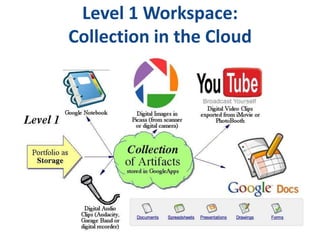
Level 1 Workspace: Collection in the Cloud
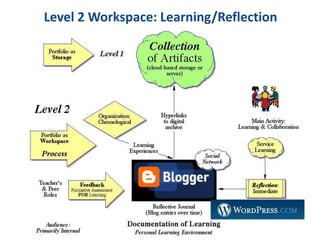
Level 2 Workspace: Learning/Reflection
ShowcaseLevel 3: Primary Purpose: Showcase/Accountability
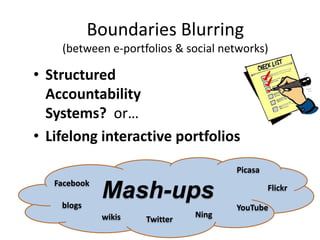
Boundaries Blurring (between e-portfolios & social networks)Structured Accountability Systems?  or…Lifelong interactive portfoliosPicasaMash-upsFacebookFlickrblogsYouTubeNingwikisTwitter
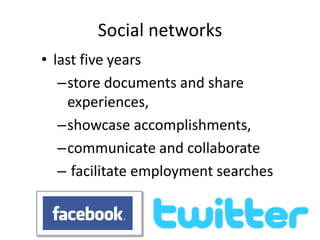
Social networks last five years store documents and share experiences, showcase accomplishments, communicate and collaborate facilitate employment searches
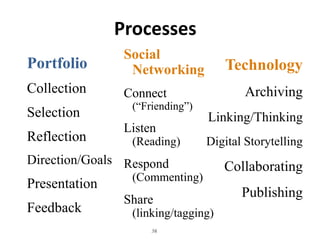
ProcessesSocial NetworkingConnect(“Friending”)Listen(Reading)Respond(Commenting)Share(linking/tagging)PortfolioCollectionSelectionReflectionDirection/GoalsPresentationFeedbackTechnology  ArchivingLinking/ThinkingDigital Storytelling  Collaborating  Publishing38
Portfolios can help learners find their Voice… and explore their Purpose and Passions through Choice!
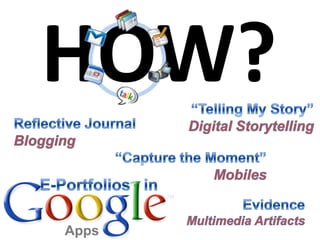
HOW?“Telling My Story”Digital StorytellingReflective JournalBlogging“Capture the Moment”MobilesE-Portfolios   inEvidenceMultimedia Artifacts
Tools?Expressive vs. Structured Models
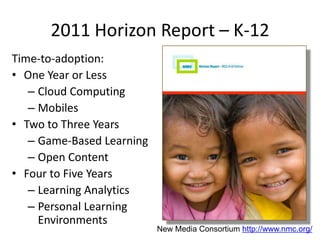
2011 Horizon Report – K-12Time-to-adoption: One Year or LessCloud ComputingMobilesTwo to Three YearsGame-Based LearningOpen ContentFour to Five YearsLearning AnalyticsPersonal Learning EnvironmentsNew Media Consortium http://www.nmc.org/
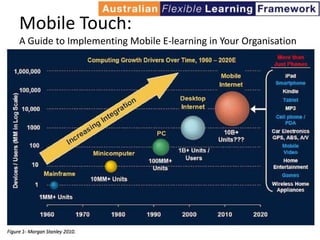
Mobile Touch: A Guide to Implementing Mobile E-learning in Your Organisation
Why Mobile is a MustKids today are captivated by the personalization and socialization of online tools--the ability to build large networks of friends; share their thoughts, feelings, and goals; and communicate as they wish. …And not only is it possible, it's possible anytime and anywhere, via a plethora of devices and widely available cellular and WiFi networks.The upshot is, these digital natives now have in their hands the tools to shape their own education in once unimagined ways. They have the ability to interact with other learners at their convenience, with differences in time and place presenting no hurdle. They can research, on the spot, any topic of interest. And they can capture the moment, whether it's in a picture, a video, or a blog entry. -- Mary McCaffrey “Why Mobile is a Must” T.H.E. Journal http://thejournal.com/articles/2011/02/08/why-mobile-is-a-must.aspx
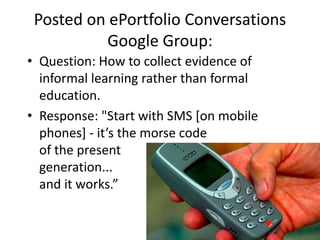
Posted on ePortfolio Conversations Google Group:Question: How to collect evidence of informal learning rather than formal education. Response: "Start with SMS [on mobile phones] - it’s the morse codeof the presentgeneration...and it works.”
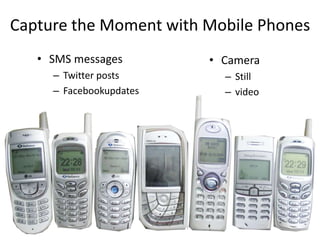
Capture the Moment with Mobile PhonesSMS messagesTwitter postsFacebookupdatesCamera Still video
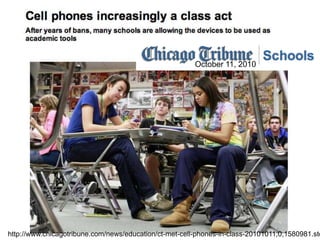
October 11, 2010http://www.chicagotribune.com/news/education/ct-met-cell-phones-in-class-20101011,0,1580981.story
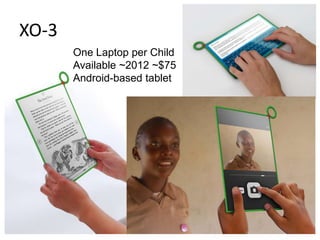
XO-3One Laptop per Child Available ~2012 ~$75 Android-based tablet
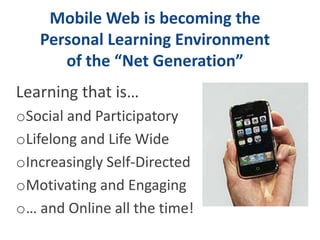
Mobile Web is becoming the Personal Learning Environment of the “Net Generation”Learning that is… Social and Participatory
Lifelong and Life Wide
Increasingly Self-Directed
Motivating and Engaging
… and Online all the time!Think!Engagement Factors?Social networks?ePortfolios?
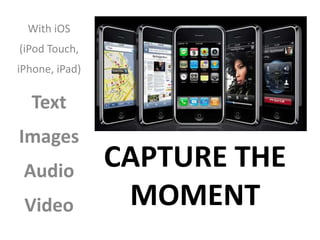
With iOS (iPod Touch, iPhone, iPad) Text    Images   Audio  VideoCapture the Moment
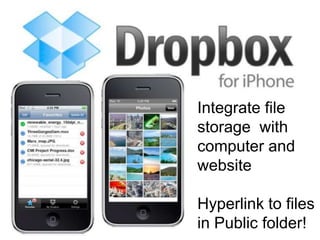
Integrate file storage  with computer and websiteHyperlink to files in Public folder!
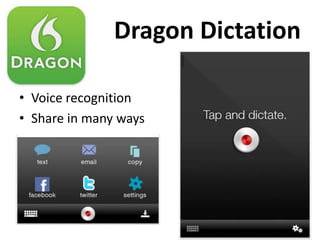
Dragon DictationVoice recognitionShare in many ways
JotNot Scanner Pro ($.99)Scan Multi-page documentsRemove Shadows & NoiseSave as PDFEmail, Fax and Share your ScansSend the image directly via email or upload it to cloud storage services including Evernote, Box.net, Dropbox, or Google Docs. (not with free version)
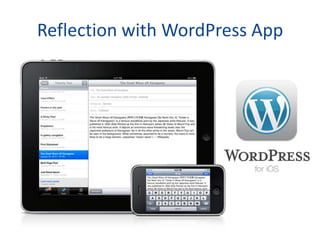
Reflection with WordPress App
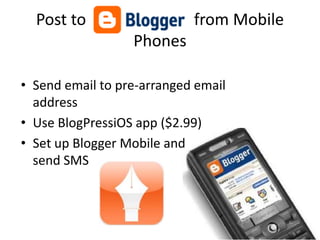
Post to                           from Mobile PhonesSend email to pre-arranged email addressUse BlogPressiOS app ($2.99)Set up Blogger Mobile and send SMS
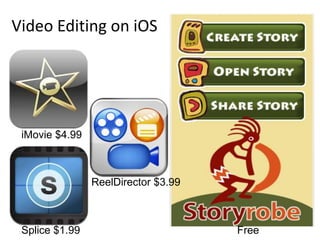
Blogging* by eMail*the act of sharing yourselfTumblrPosterousSet up account on websiteSend email to: myaccount.tumblr.comiPhone AppCall in your posts for audio post to blogCross-post to Facebook & TwitterJust email to post@posterous.com iPhone AppCross-post to Facebook & Twitter
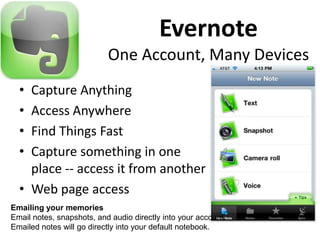
EvernoteOne Account, Many DevicesCapture AnythingAccess AnywhereFind Things FastCapture something in one place -- access it from anotherWeb page accessEmailing your memoriesEmail notes, snapshots, and audio directly into your account. Emailed notes will go directly into your default notebook.
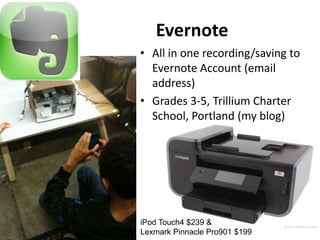
EvernoteAll in one recording/saving to Evernote Account (email address)Grades 3-5, Trillium Charter School, Portland (my blog)iPod Touch4 $239 & Lexmark Pinnacle Pro901 $199
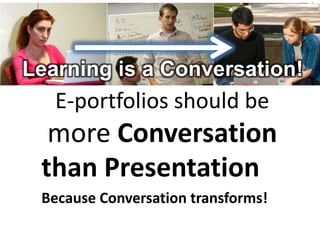
Learning is a Conversation!E-portfolios should be more Conversationthan PresentationBecause Conversation transforms!
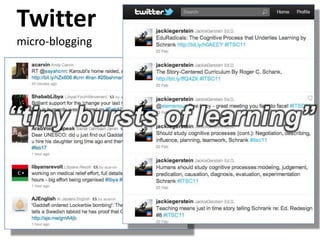
Twittermicro-blogging“tiny bursts of learning”
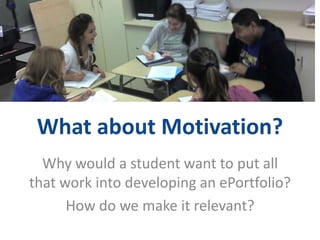
What about Motivation?Why would a student want to put all that work into developing an ePortfolio?How do we make it relevant?
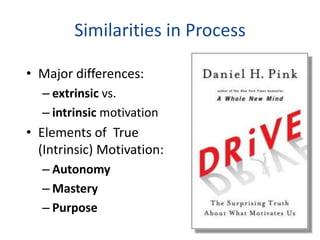
Similarities in ProcessMajor differences:extrinsic vs. intrinsic motivation Elements of  True (Intrinsic) Motivation:AutonomyMasteryPurpose
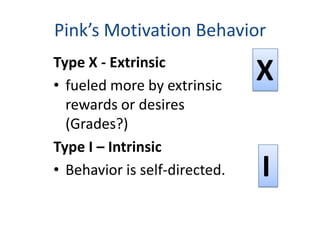
Pink’s Motivation BehaviorX  Type X - Extrinsicfueled more by extrinsic rewards or desires (Grades?)Type I – IntrinsicBehavior is self-directed.I
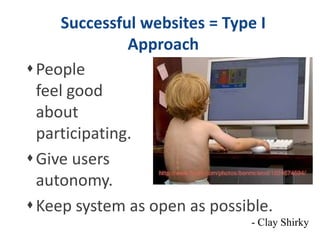
Successful websites = Type I ApproachPeople feel good about participating.
Give users autonomy.
Keep system as open as possible.- Clay Shirky
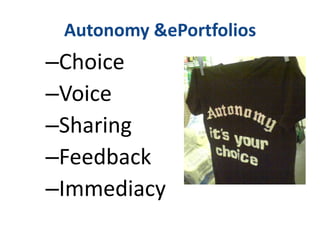
Autonomy & ePortfoliosChoiceVoiceSharing FeedbackImmediacyhttp://www.flickr.com/photos/kenturamon/342946821/
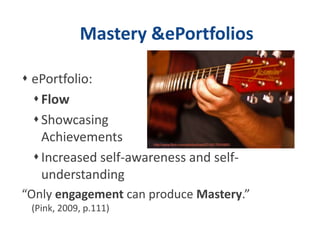
Mastery & ePortfoliosePortfolio:
Flow
Showcasing Achievements
Increased self-awareness and self-understanding“Only engagement can produce Mastery.” (Pink, 2009, p.111)
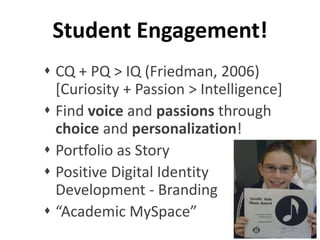
Student Engagement!CQ + PQ > IQ (Friedman, 2006)[Curiosity + Passion > Intelligence]
Find voice and passions through choice and personalization!
Portfolio as Story
Positive Digital Identity Development - Branding

Idaho Balancing2011

  • 1.
    Balancing the TwoFaces of E-PortfoliosDr. Helen BarrettUniversity of Alaska Anchorage (retired)Seattle Pacific University (adjunct)New England College (adjunct)International Researcher & ConsultantFounder, REAL ePortfolio AcademyElectronic Portfolios and Digital Storytelling for Lifelong and Life Wide Learning
  • 2.
    Key ConceptsDefinitionsPortfolios forLifelong LearningBalancing the 2 Faces of E-PortfoliosIdentity DevelopmentOnline Professional BrandingReflection, Motivation & EngagementDigital Storytelling and Reflection
  • 3.
    Legacy from thePortfolio LiteratureMuch to learn fromthe literature onpaper-based portfolios
  • 4.
    As adult learners,we have much to learn from how children approach portfolios“Everything I know about portfolios was confirmed working with a kindergartener”
  • 5.
    The Power ofPortfolios what children can teach us about learning and assessmentAuthor: Elizabeth HebertPublisher: Jossey-BassPicture courtesy of Amazon.com
  • 6.
    The Power ofPortfoliosAuthor: Dr. Elizabeth Hebert, PrincipalCrow Island School, Winnetka, IllinoisPicture taken by Helen Barrett at AERA, Seattle, April, 2001
  • 7.
    From the Preface(1)Hebert, Elizabeth (2001) The Power of Portfolios. Jossey-Bass, p.ix“Portfolios have been with us for a very long time. Those of us who grew up in the 1950s or earlier recognize portfolios as reincarnations of the large memory boxes or drawers where our parents collected starred spelling tests, lacy valentines, science fair posters, early attempts at poetry, and (of course) the obligatory set of plaster hands. Each item was selected by our parents because it represented our acquisition of a new skill or our feelings of accomplishment. Perhaps an entry was accompanied by a special notation of praise from a teacher or maybe it was placed in the box just because we did it.”
  • 8.
    From the Preface(2)Hebert, Elizabeth (2001) The Power of Portfolios. Jossey-Bass, p.ix “We formed part of our identity from the contents of these memory boxes. We recognized each piece and its association with a particular time or experience. We shared these collections with grandparents to reinforce feelings of pride and we reexamined them on rainy days when friends were unavailable for play. Reflecting on the collection allowed us to attribute importance to these artifacts, and by extension to ourselves, as they gave witness to the story of our early school experiences.”
  • 9.
    From the Preface(3)Hebert, Elizabeth (2001) The Power of Portfolios. Jossey-Bass, p.ix-x “Our parents couldn’t possibly envision that these memory boxes would be the inspiration for an innovative way of thinking about children’s learning. These collections, lovingly stored away on our behalf, are the genuine exemplar for documenting children’s learning over time. But now these memory boxes have a different meaning. It’s not purely private or personal, although the personal is what gives power to what they can mean.”
  • 10.
    Let’s get personal…Thinkfor a minute about:Something about your COLLECTIONS:Suggested topics:If you are a parent, what you saved for your children
  • 11.
    What your parentssaved for you
  • 12.
  • 13.
    Why you collect…Someissues to considerWhat do your collections say about what you value?
  • 14.
    Is there adifference between what you purposefully save and what you can’t throw away?
  • 15.
    How can weuse our personal collections experiences to help learners as they develop their portfolios?The power of portfolios [to support deep learning] is personal.
  • 16.
    Golden Circle What?How?Why?11
  • 17.
    Audio • Video• Text • ImagesWHAT?Digital RepositoryElectronic PortfolioShowcaseWorkspace
  • 18.
    ResponsibilitiesSpecialty CasePortfolioOne Word,Many MeaningsWorkspaceShowcaseInvestmentsArt WorkCollection of Artifacts
  • 19.
    Who was thefirst famous “folio” keeper?Definitions
  • 20.
  • 21.
    What is aPortfolio?Dictionary definition: a flat, portable case for carrying loose papers, drawings, etc.Financial portfolio: document accumulation of fiscal capitalEducational portfolio: document development of human capital
  • 22.
    What is aPortfolio in Education?A portfolio is a purposeful collection of [academic] work that exhibits the [learner/worker’s] efforts, progress and achievements in one or more areas[over time]. (Northwest Evaluation Association, 1990)
  • 23.
    +Electronicdigital artifacts organizedonline combining various media (audio/video/text/images)
  • 24.
    E-Portfolio ComponentsMultiple Portfoliosfor Multiple Purposes-Celebrating Learning-Personal Planning-Transition/entry to courses-Employment applications-Accountability/Assessment
  • 25.
    Multiple Tools toSupport Processes-Capturing & storing evidence-Reflecting-Giving & receiving feedback-Planning & setting goals-Collaborating-Presenting to an audience
  • 26.
  • 27.
  • 28.
    Multiple Purposes fromHidden AssumptionsWhat are yours?• Showcase • Assessment • Learning •http://www.rsc-northwest.ac.uk/acl/eMagArchive/RSCeMag2008/choosing%20an%20eportfolio/cool-cartoon-346082.png
  • 29.
    PurposeThe overarching purposeof portfolios is to create a sense of personal ownership over one’s accomplishments, because ownership engenders feelings of pride, responsibility, and dedication. (p.10)Paris, S & Ayres, L. (1994) Becoming Reflective Students and Teachers. American Psychological Association
  • 30.
    Deep Learninginvolves reflection,isdevelopmental,is integrative,is self-directive, andis lifelongCambridge (2004)
  • 31.
    “metacognition lies atthe root of all learning”“…self-knowledge, awareness of how and why we think as we do, and the ability to adapt and learn, are critical to our survival as individuals…”- James Zull (2011) From Brain to Mind: Using Neuroscience to Guide Change in Education
  • 32.
  • 33.
    Managing OneselfPeter Drucker,(2005) Harvard Business Review“Success in the knowledge economy comes to those who know themselves – their strengths, their values, and how best they perform.”Purpose: Use ePortfolios for managing knowledge workers' career developmentWhat are my strengths?How do I perform?What are my values?Where do I belong?What should I contribute?Responsibility for RelationshipsThe Second Half of your Life
  • 34.
    Experiential Learning ModelLewin/Kolbwith adaptations by Moon and ZullPracticeHave an experienceReflect on the experienceTry out what you have learnedMetacognitionLearn from the experience
  • 35.
    Some Basic Concepts“ePortfolioisboth process and product”
  • 36.
    Process: A seriesof events (time and effort) to produce a result- From Old French proces(“‘journey’”)
  • 37.
    Product: the outcome/resultsor “thinginess” of an activity/process- Destination
  • 38.
    WiktionaryBalancing the TwoFaces of E-PortfoliosPresentation Portfolio(s)Working PortfolioThe “Story” or NarrativeMultiple Views (public/private)Varied Audiences & PurposesPortfolio as ProductShowcaseDigital Archive (Repository of Artifacts)Collaboration SpaceReflective JournalPortfolio as ProcessWorkspace
  • 40.
  • 41.
    Structure of E-PortfolioTypesPortfolio as Process/ WorkspaceOrganization: Chronological – Documenting growth over time for both internal and external audiencesPrimary Purpose: Learning or ReflectionReflection: immediate focus on artifact or learning experiencePortfolio as Product/ ShowcaseOrganization: Thematic – Documenting achievement of Standards, Goals or Learning Outcomes for primarily external audiencesPrimary Purpose: Accountability or Employment or ShowcaseReflection: retrospective focus on Standards, Goals or Learning Outcomes (Themes)blogwiki
  • 42.
    Level 1 Workspace:Collection in the Cloud
  • 43.
    Level 2 Workspace:Learning/Reflection
  • 44.
    ShowcaseLevel 3: PrimaryPurpose: Showcase/Accountability
  • 45.
    Boundaries Blurring (betweene-portfolios & social networks)Structured Accountability Systems? or…Lifelong interactive portfoliosPicasaMash-upsFacebookFlickrblogsYouTubeNingwikisTwitter
  • 46.
    Social networks lastfive years store documents and share experiences, showcase accomplishments, communicate and collaborate facilitate employment searches
  • 47.
  • 48.
    Portfolios can helplearners find their Voice… and explore their Purpose and Passions through Choice!
  • 49.
    HOW?“Telling My Story”DigitalStorytellingReflective JournalBlogging“Capture the Moment”MobilesE-Portfolios inEvidenceMultimedia Artifacts
  • 50.
  • 51.
    2011 Horizon Report– K-12Time-to-adoption: One Year or LessCloud ComputingMobilesTwo to Three YearsGame-Based LearningOpen ContentFour to Five YearsLearning AnalyticsPersonal Learning EnvironmentsNew Media Consortium http://www.nmc.org/
  • 53.
    Mobile Touch: AGuide to Implementing Mobile E-learning in Your Organisation
  • 54.
    Why Mobile isa MustKids today are captivated by the personalization and socialization of online tools--the ability to build large networks of friends; share their thoughts, feelings, and goals; and communicate as they wish. …And not only is it possible, it's possible anytime and anywhere, via a plethora of devices and widely available cellular and WiFi networks.The upshot is, these digital natives now have in their hands the tools to shape their own education in once unimagined ways. They have the ability to interact with other learners at their convenience, with differences in time and place presenting no hurdle. They can research, on the spot, any topic of interest. And they can capture the moment, whether it's in a picture, a video, or a blog entry. -- Mary McCaffrey “Why Mobile is a Must” T.H.E. Journal http://thejournal.com/articles/2011/02/08/why-mobile-is-a-must.aspx
  • 55.
    Posted on ePortfolioConversations Google Group:Question: How to collect evidence of informal learning rather than formal education. Response: "Start with SMS [on mobile phones] - it’s the morse codeof the presentgeneration...and it works.”
  • 56.
    Capture the Momentwith Mobile PhonesSMS messagesTwitter postsFacebookupdatesCamera Still video
  • 57.
  • 58.
    XO-3One Laptop perChild Available ~2012 ~$75 Android-based tablet
  • 59.
    Mobile Web isbecoming the Personal Learning Environment of the “Net Generation”Learning that is… Social and Participatory
  • 60.
  • 61.
  • 62.
  • 63.
    … and Onlineall the time!Think!Engagement Factors?Social networks?ePortfolios?
  • 64.
    With iOS (iPodTouch, iPhone, iPad) Text Images Audio VideoCapture the Moment
  • 65.
    Integrate file storage with computer and websiteHyperlink to files in Public folder!
  • 66.
  • 67.
    JotNot Scanner Pro($.99)Scan Multi-page documentsRemove Shadows & NoiseSave as PDFEmail, Fax and Share your ScansSend the image directly via email or upload it to cloud storage services including Evernote, Box.net, Dropbox, or Google Docs. (not with free version)
  • 68.
  • 69.
    Post to from Mobile PhonesSend email to pre-arranged email addressUse BlogPressiOS app ($2.99)Set up Blogger Mobile and send SMS
  • 70.
    Blogging* by eMail*theact of sharing yourselfTumblrPosterousSet up account on websiteSend email to: myaccount.tumblr.comiPhone AppCall in your posts for audio post to blogCross-post to Facebook & TwitterJust email to post@posterous.com iPhone AppCross-post to Facebook & Twitter
  • 71.
    EvernoteOne Account, ManyDevicesCapture AnythingAccess AnywhereFind Things FastCapture something in one place -- access it from anotherWeb page accessEmailing your memoriesEmail notes, snapshots, and audio directly into your account. Emailed notes will go directly into your default notebook.
  • 72.
    EvernoteAll in onerecording/saving to Evernote Account (email address)Grades 3-5, Trillium Charter School, Portland (my blog)iPod Touch4 $239 & Lexmark Pinnacle Pro901 $199
  • 73.
    Learning is aConversation!E-portfolios should be more Conversationthan PresentationBecause Conversation transforms!
  • 74.
  • 75.
    What about Motivation?Whywould a student want to put all that work into developing an ePortfolio?How do we make it relevant?
  • 76.
    Similarities in ProcessMajordifferences:extrinsic vs. intrinsic motivation Elements of True (Intrinsic) Motivation:AutonomyMasteryPurpose
  • 77.
    Pink’s Motivation BehaviorX Type X - Extrinsicfueled more by extrinsic rewards or desires (Grades?)Type I – IntrinsicBehavior is self-directed.I
  • 78.
    Successful websites =Type I ApproachPeople feel good about participating.
  • 79.
  • 80.
    Keep system asopen as possible.- Clay Shirky
  • 81.
    Autonomy & ePortfoliosChoiceVoiceSharingFeedbackImmediacyhttp://www.flickr.com/photos/kenturamon/342946821/
  • 82.
  • 83.
  • 84.
  • 85.
    Increased self-awareness andself-understanding“Only engagement can produce Mastery.” (Pink, 2009, p.111)
  • 86.
    Student Engagement!CQ +PQ > IQ (Friedman, 2006)[Curiosity + Passion > Intelligence]
  • 87.
    Find voice andpassions through choice and personalization!
  • 88.
  • 89.
    Positive Digital IdentityDevelopment - Branding

Editor's Notes

  • #14 Adjectives to describe purpose
  • #25 In his newest book still to be released, called From Brain to Mind: Using Neuroscience to Guide Change in Education, coming out in May
  • #26 Who knows what this means?
  • #27 Success in the knowledge economy comes to those who know themselves – their strengths, their values, and how best they perform.
  • #31 Japanese!
  • #34 Collection -- Creating the Digital Archive (regularly – weekly/monthly)Digital Conversion (Collection)Artifacts represent integration of technology in one curriculum area (i.e., Language Arts) Stored in GoogleDocs
  • #35 Level 2Collection/Reflection (Immediate Reflection on Learning & Artifacts in Collection) (regularly) organized chronologically (in a blog?)Captions (Background Information on assignment, Response)Artifacts represent integration of technology in most curriculum areas (i.e., Language Arts, Social Studies, Science, Math) (in GoogleDocs?)
  • #36 Level 3Selection/Reflection and Direction (each semester? End of year?) organized thematically (in web pages or wiki)Why did I choose these pieces? What am I most proud to highlight about my work?What do they show about my learning? What more can I learn (Goals for the Future)?Presentation (annually)
  • #37 The boundaries are blurring between eportfolios and social networks. As we consider the potential of lifelong e-portfolios, will they resemble the structured accountability systems that are currently being implemented in many educational institutions? Or are we beginning to see lifelong interactive portfolios emerging as… mash-ups in the Web 2.0 cloud, using Blogs or wikis or Twitter, Facebook or Ning, Flickr or Picasa or YouTube, etc.?
  • #38 How is social networking impacting ePortfolio development? It is having a huge impact on our social and political world!Social networks have emerged over the last five years, and are used by individuals and groups to store documents and share experiences, showcase accomplishments, communicate and collaborate with friends and family, and, in some cases, facilitate employment searches.[Erin’s story – Messiah – feedback immediate.]
  • #41 How do we implement ePortfolios in a manner that engages students and helps achieve the purposes?
  • #42 Common Tools vs. Proprietary systems
  • #44 We have witnessed a revolution in mobile computing this year with the iPad. A new version will be announced on Wednesday. But most of the world has plain mobile phone.
  • #49 Look at the way that technology supports those processes: digitizing/archiving, hyper-linking/embedding, storytelling, collaborating, publishing, aggregating. We need to help students develop lifelong skills that will last after they graduate. If students are using "world ware" (tools in use it the world) then they are developing skills that can be applied in the "real world" outside of formal education. We should also look at how students are naturally using technology in their lives: social networking, mobile communications, capturing and storing images, audio and video, etc. We could build on the tools that students are already using... and look at the intrinsic motivation factors that drive the use of social networking, and apply those factors to the ePortfolio environment: autonomy, mastery and purpose (thanks to Dan Pink's book, Drive). We are looking at a future that is well integrated with mobile devices.
  • #52 So I’d like you to think: What are the engagement factors that drive the use of social networks and how can we incorporate those factors into ePortfolios?
  • #60 Grade 3-5 classroom in Portland using Evernote. Scanner wirelessly emails documents to each student’s Evernote account. Use of tags, software recognizes text in scanned docs.
  • #61 BUT! “Portfolios should be less about tellingand more about talking!” Julie Hughes, University of WolverhamptonLearning is a Conversation. (Chris Betcher)
  • #63 I’m not convinced that deep reflection can be represented in 140-160 characters of a tweet or SMS message. But this format can be an effective way to document process over time --to capture the moment-- and can later be aggregated and analyzed for deeper understanding. As a current example, the tweets that were coming out of Egypt prior to February 11 told a very compelling story of the revolution as it was happening (as curated and retweeted by PBS’s Andy Carvin [@acarvin] - an incredible service!). We have seen the power of digital media in social change; it can also be part of individual transformation through understanding oneself and showcasing achievements in reflective portfolios. “tiny bursts of learning”: http://chrisbetcher.com/2011/04/1483/
  • #65 There are many similarities between these two processes; the major differences are often in extrinsic vs. intrinsic motivation Dan Pink describes the essential elements of true (intrinsic) motivation in his new book, Drive, the concepts of autonomy, mastery, and purpose.
  • #66 Pink says, “It is devoted to becoming better and better at something that matters. And it connects that quest for excellence to a larger purpose.” (p. 80-81) Pink identifies two types of Motivation Behavior: Type X Extrinsic, fueled by extrinsic rewards or desires. And Type I Intrinsic, where behavior is self-directed. I am on a campaign to make electronic portfolios a more intrinsically-motivated process.
  • #67 Pink quotes Internet scholar Clay Shirky ...the most successful websites and electronic forums have a certain Type I approach [to motivation] in their DNA. They're designed-often explicitly--to tap into intrinsic motivation. You can do the same with your online presences if you listen to Shirky and: Create an environment that makes people feel good about participating.Give users autonomy.Keep the system as open as possible. That’s also good advice for developing ePortfolios.
  • #68 The urge for Self-Direction is basic human need.It is a Natural state to be Active and EngagedePortfolio Implementation should adopt the motivating characteristics of autonomy found in social networksChoiceVoiceSharing and FeedbackImmediacy
  • #69 In their spare time, people gravitate toward activities where they gain masteryePortfolio Implementation should adopt the motivating characteristics of mastery found in social networksFlow, Showcasing Achievements, Increased self-awareness and self-understanding“Only engagement can produce Mastery.” (Pink, 2009, p.111)
  • #70 According to Will Richardson, “Our job in education is to engage, deepen, and extend a student's passions and interestsThomas Friedman, in his book, The World is Flat, presents this formula: CQ + PQ > IQ (Friedman, 2006) [Curiosity + Passion > Innate Intelligence]Learners find their voice and passions through choice and personalization!A portfolio is a student’s Story of their own Learning. It’s Positive Digital Identity Development or Personal Online Branding – In my earlier research, some students called their ePortfolios, their “academic MySpace”
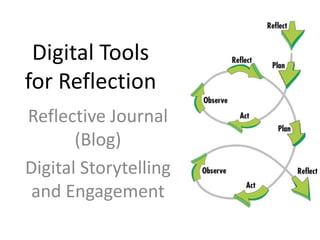
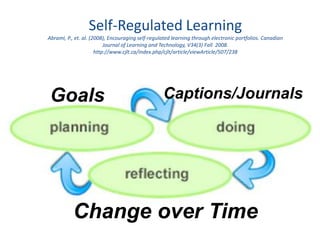
  • #73 How do portfolios and reflection fit into the learning process?BEFORE - goal-setting (reflection in the future tense), DURING - immediate reflection (in the present tense), where students write (or dictate) the reason why they chose a specific artifact to include in their collectionAFTER - retrospective (in the past tense) where students look back over a collection of work and describe what they have learned and how they have changed over a period of time (in a Level 3 portfolio)
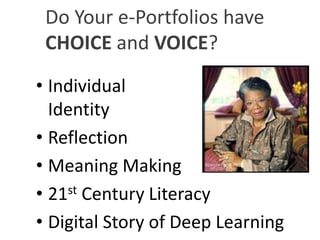
  • #74 Do your e-portfolios have Voice? As Maya Angelou said, “When words are infused by the human voice, they come alive.”Do your portfolios represent individual identity, include reflection, and provide an opportunity to make meaning? ePortfolios are essential for 21st Century Literacy.
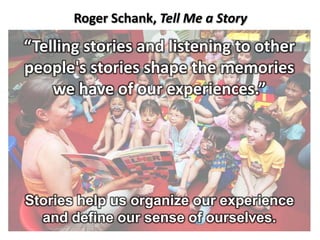
  • #77 In TELL ME A STORY, Schank argues that storytelling is at the heart of intelligence. We think of storytelling primarily as entertainment, secondarily as a form of art, yet it also—and perhaps more fundamentally—has a cognitive function:
  • #80 Using the computing power we carry in our pockets can dramatically enhance student engagement in documenting and showcasing their own learning. And with other tablets emerging in the market, we have many opportunities for research and implementation.