Portfolio LearningE-portfolios for student engagement and life-long learning Dr. Helen Barrettelectronicportfolios.orgTwitter: @eportfolioshashtag: #eportfolioshttp://www.slideshare.net/eportfolios/
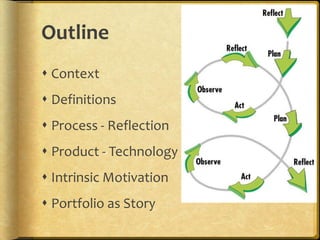
Outline ContextDefinitionsProcess - ReflectionProduct - TechnologyIntrinsic MotivationPortfolio as Story
What if…
ContextWhy Electronic Portfolios Now?
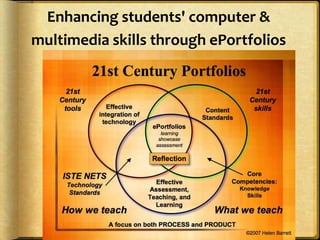
Enhancing students' computer & multimedia skills through ePortfolios
Draft National Educational Technology Plan (2010)Technology also gives students opportunities for taking ownership of their learning. Student-managed electronic learning portfolios can be part of a persistent learning record and help students develop the self-awareness required to set their own learning goals, express their own views of their strengths, weaknesses, and achievements, and take responsibility for them. Educators can use them to gauge students’ development, and they also can be shared with peers, parents, and others who are part of students’ extended network. (p.12)
Legacy from the Portfolio LiteratureMuch to learn fromthe literature onpaper-based portfolios
As adult learners, we have much to learn from how children approach portfolios“Everything I know about portfolios was confirmed working with a kindergartener”
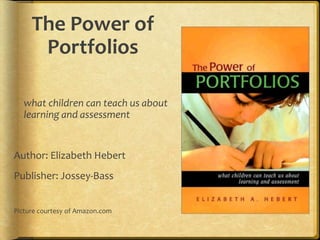
The Power of Portfolios	what children can teach us about learning and assessmentAuthor: Elizabeth HebertPublisher: Jossey-BassPicture courtesy of Amazon.com
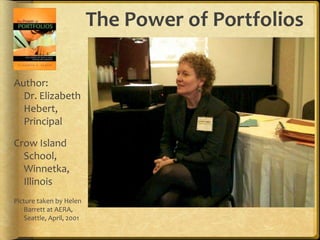
The Power of PortfoliosAuthor: Dr. Elizabeth Hebert, PrincipalCrow Island School, Winnetka, IllinoisPicture taken by Helen Barrett at AERA, Seattle, April, 2001
From the Preface (1)Hebert, Elizabeth (2001) The Power of Portfolios. Jossey-Bass, p.ix“Portfolios have been with us for a very long time. Those of us who grew up in the 1950s or earlier recognize portfolios as reincarnations of the large memory boxes or drawers where our parents collected starred spelling tests, lacy valentines, science fair posters, early attempts at poetry, and (of course) the obligatory set of plaster hands. Each item was selected by our parents because it represented our acquisition of a new skill or our feelings of accomplishment. Perhaps  an entry was accompanied by a special notation of praise from a teacher or maybe it was placed in the box just because we did it.”
From the Preface (2)Hebert, Elizabeth (2001) The Power of Portfolios. Jossey-Bass, p.ix		“We formed part of our identity from the contents of these memory boxes. We recognized each piece and its association with a particular time or experience. We shared these collections with grandparents to reinforce feelings of pride and we reexamined them on rainy days when friends were unavailable for play.  Reflecting on the collection allowed us to attribute importance to these artifacts, and by extension to ourselves, as they gave witness to the story of our early school experiences.”
From the Preface (3)Hebert, Elizabeth (2001) The Power of Portfolios. Jossey-Bass, p.ix-x		“Our parents couldn’t possibly envision that these memory boxes would be the inspiration for an innovative way of thinking about children’s learning. These collections, lovingly stored away on our behalf, are the genuine exemplar for documenting children’s learning over time. But now these memory boxes have a different meaning. It’s not purely private or personal, although the personal is what gives power to what they can mean.”
Let’s get personal…Think for a minute about:Something about your COLLECTIONS:Suggested topics:If you are a parent, what you saved for your children
What your parents saved for you
What you collect…
Why you collect…Some issues to considerWhat do your collections say about what you value?
Is there a difference between what you purposefully save and what you can’t throw away?
How can we use our personal collections experiences to help learners as they develop their portfolios?The power of portfolios [to support deep learning] is personal.
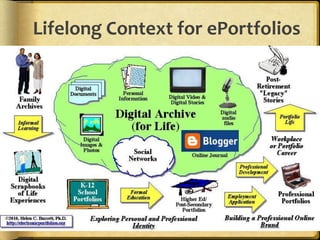
Lifelong Context for ePortfolios
School District’s ePortfolio Vision Statement (Draft)By implementing e-portfolios, we will empower students to become active participants in their own personalized education. Through use of reflection, technology, and collaboration, students and teachers will develop skills that will lead them to achieve  their lifelong goals.
Technology & ReflectionTwo Themes across the Lifespan with ePortfolio Development and Social Networking17
PortfolioOne Word, Many Meanings
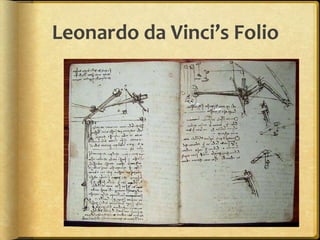
Who was the first famous “folio” keeper?Definitions
Leonardo da Vinci’s Folio
What is a Portfolio?Dictionary definition: a flat, portable case for carrying loose papers, drawings, etc.Financial portfolio: document accumulation of fiscalcapitalEducational portfolio: document development of humancapital
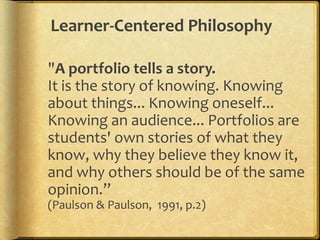
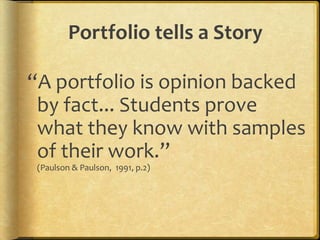
PortfolioA purposeful collection of artifacts (learning/work products with reflection) demonstrating efforts, progress, goals, and achievement over time
Electronicdigital artifacts organized online combining various media (audio/video/text/images)
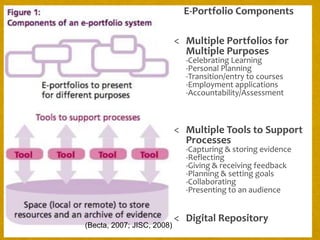
E-Portfolio ComponentsMultiple Portfolios for Multiple Purposes-Celebrating Learning-Personal Planning-Transition/entry to courses-Employment applications-Accountability/Assessment
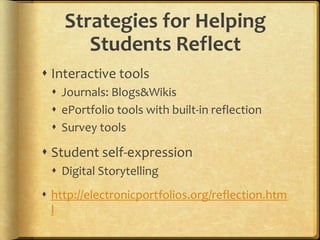
Multiple Tools to Support Processes-Capturing & storing evidence-Reflecting-Giving & receiving feedback-Planning & setting goals-Collaborating-Presenting to an audience
Digital Repository(Becta, 2007; JISC, 2008)
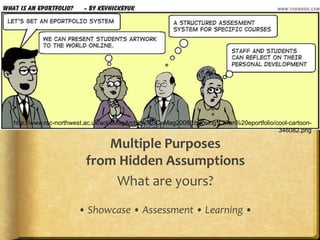
Multiple Purposes from Hidden AssumptionsWhat are yours?• Showcase • Assessment • Learning •http://www.rsc-northwest.ac.uk/acl/eMagArchive/RSCeMag2008/choosing%20an%20eportfolio/cool-cartoon-346082.png
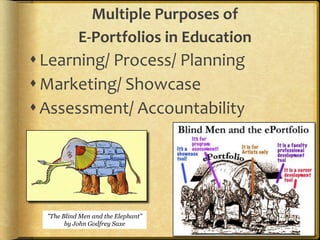
Multiple Purposes of E-Portfolios in EducationLearning/ Process/ PlanningMarketing/ Showcase Assessment/ Accountability"The Blind Men and the Elephant” by John Godfrey Saxe
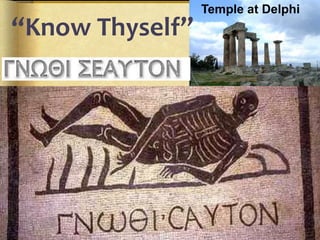
Temple at Delphi“Know Thyself”
Managing OneselfPeter Drucker, (2005) Harvard Business Review“Success in the knowledge economy comes to those who know themselves – their strengths, their values, and how best they perform.”
New Purpose: Use ePortfolios for managing knowledge workers' career development
What are my strengths?
How do I perform?
What are my values?
Where do I belong?
What should I contribute?
Responsibility for Relationships
The Second Half of your Life	(a suggested framework for organizing reflection in learning portfolio?)
Portfolio CareersUse e-portfolios to help students: explore their life purpose and goalsexplore their personal & professional identitybuild their professional online brandprepare for portfolio career/life
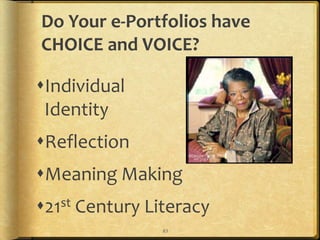
Creating Digital Identity“YouTube and other social media can mitigate the cultural tension between teens’ conflicting needs for independence and community by offering them ‘connection without constraints.’ What looks like narcissism and individuality is actually a search for identity and recognition.Wesch: ‘In a society that doesn’t automatically grant identity and recognition, you have to create your own.’PopTech: Michael Wesch on Using Social Networking For Good, September 23, 2010
Deep Learninginvolves reflection,
is developmental,
is integrative,
is self-directive, and
is lifelongCambridge (2004)
Resource on Biology of LearningEnriching the Practice of Teaching by Exploring the Biology of LearningJames E. ZullStylus Publishing Co.
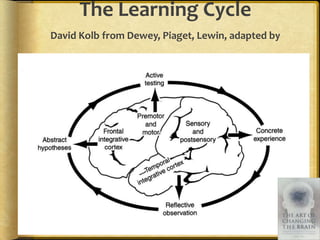
The Learning CycleDavid Kolb from Dewey, Piaget, Lewin, adapted by Zull
What is Reflection?Major theoretical roots: DeweyHabermasKolbSchönDewey: “We do not learn from experience…we learn from reflecting on experience.”
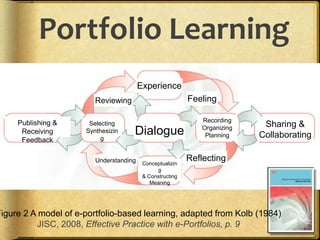
Portfolio LearningExperienceFeelingReviewingRecording Organizing PlanningPublishing &Receiving FeedbackSharing &CollaboratingSelecting SynthesizingDialogueReflectingUnderstandingConceptualizing& Constructing MeaningFigure 2 A model of e-portfolio-based learning, adapted from Kolb (1984)JISC, 2008, Effective Practice with e-Portfolios, p. 9
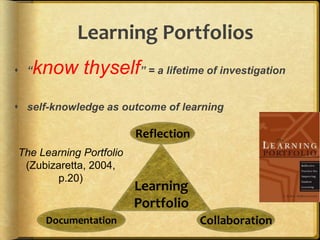
Learning PortfoliosReflectionLearningPortfolioCollaborationDocumentation“know thyself” = a lifetime of investigationself-knowledge as outcome of learning The Learning Portfolio (Zubizaretta, 2004, p.20)
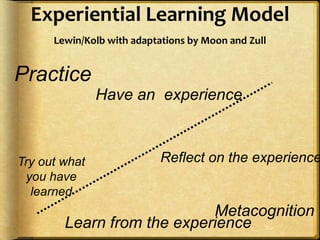
Experiential Learning ModelLewin/Kolb with adaptations by Moon and ZullPracticeHave an  experienceReflect on the experienceTry out what you have learnedMetacognitionLearn from the experience
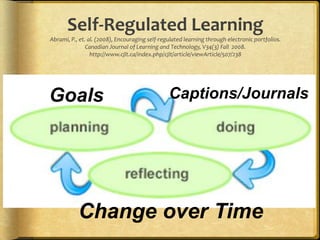
Self-Regulated LearningAbrami, P., et. al. (2008), Encouraging self-regulated learning through electronic portfolios. Canadian Journal of Learning and Technology, V34(3) Fall  2008. http://www.cjlt.ca/index.php/cjlt/article/viewArticle/507/238 GoalsCaptions/JournalsChange over Time
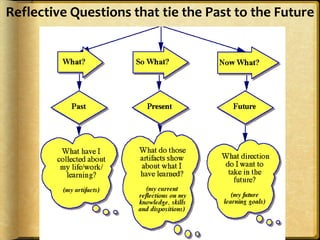
Reflective Questions that tie the Past to the Future
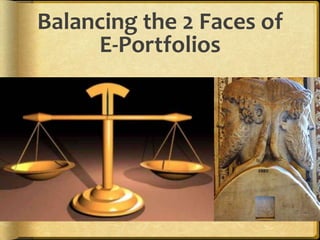
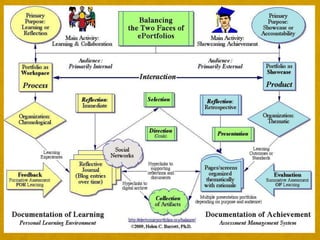
Balancing the 2 Faces of E-Portfolios
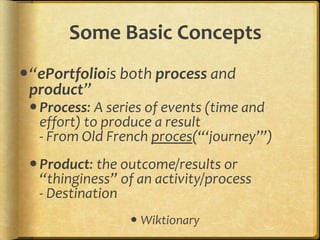
Some Basic Concepts“ePortfoliois both process and product”
Process: A series of events (time and effort) to produce a result- From Old French proces(“‘journey’”)
Product: the outcome/results or “thinginess” of an activity/process- Destination
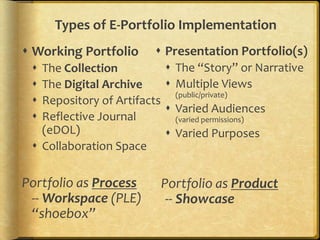
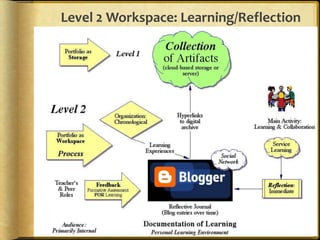
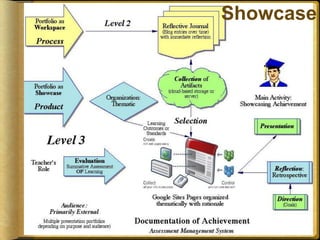
WiktionaryTypes of E-Portfolio ImplementationWorking PortfolioThe CollectionThe Digital ArchiveRepository of Artifacts Reflective Journal(eDOL)Collaboration SpacePortfolio as Process-- Workspace (PLE)“shoebox”Presentation Portfolio(s)The “Story” or NarrativeMultiple Views (public/private)Varied Audiences(varied permissions)Varied Purposes  Portfolio as Product-- Showcase
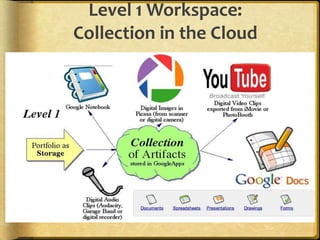
Level 1 Workspace: Collection in the Cloud
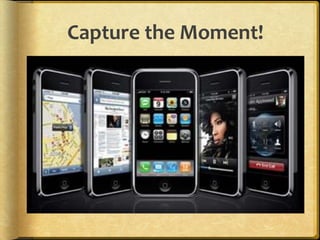
Capture the Moment!
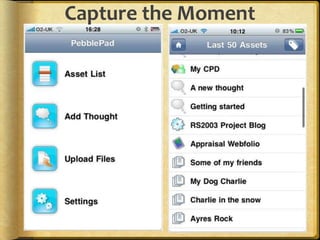
Capture the Moment
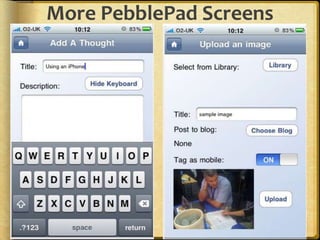
More PebblePad Screens
Level 2 Workspace: Learning/Reflection
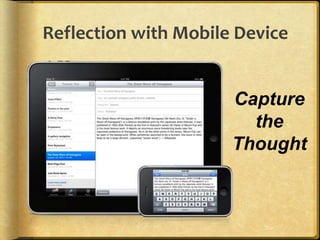
Reflection with Mobile DeviceCapture the Thought
ShowcaseLevel 3: Primary Purpose: Showcase/Accountability
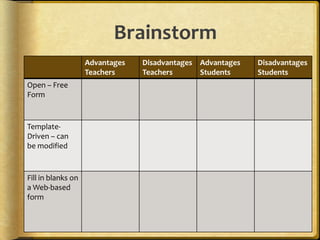
Format?Expressive vs. Structured Models
Brainstorm
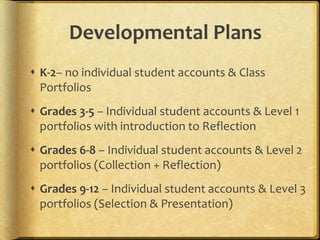
Developmental PlansK-2– no individual student accounts & Class Portfolios Grades 3-5 – Individual student accounts & Level 1 portfolios with introduction to ReflectionGrades 6-8 – Individual student accounts & Level 2 portfolios (Collection + Reflection)Grades 9-12 – Individual student accounts & Level 3 portfolios (Selection & Presentation)
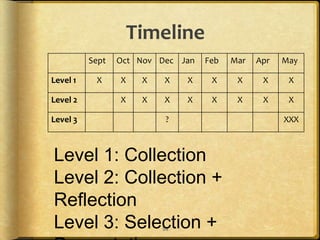
Timeline54Level 1: CollectionLevel 2: Collection + ReflectionLevel 3: Selection + Presentation
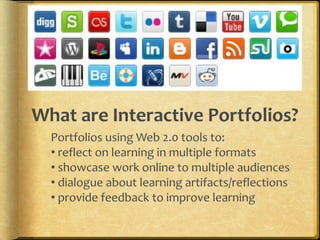
What are Interactive Portfolios?Portfolios using Web 2.0 tools to:  reflect on learning in multiple formats
 showcase work online to multiple audiences
 dialogue about learning artifacts/reflections
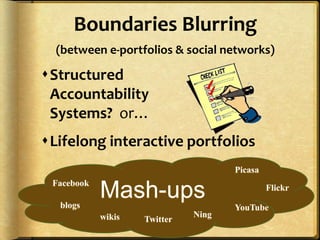
 provide feedback to improve learning Boundaries Blurring (between e-portfolios & social networks)Structured Accountability Systems?  or…Lifelong interactive portfoliosPicasaMash-upsFacebookFlickrblogsYouTubeNingwikisTwitter56
Electronic Portfolios almost two decades (since 1991)used primarily in education to store documents reflect on learningfeedback for improvement showcase achievements for accountability or employment57
QUOTEThe e-portfolio is the central and common point for the student experience… It is a reflection of the student as a person undergoing continuous personal development, not just a store of evidence.-Geoff Rebbeck, e-Learning Coordinator, Thanet College, quoted in JISC, 2008, Effective Practice with e-PortfoliosPurposeThe overarching purpose of portfolios is to create a sense of personal ownership over one’s accomplishments, because ownership engenders feelings of pride, responsibility, and dedication. (p.10)Paris, S & Ayres, L. (1994) Becoming Reflective Students and Teachers. American Psychological Association
Social networks last five years store documents and share experiences, showcase accomplishments, communicate and collaborate facilitate employment searches60
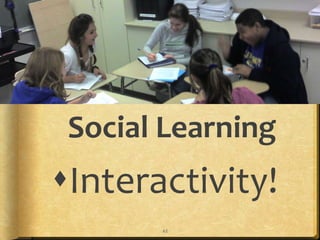
Social LearningInteractivity!61
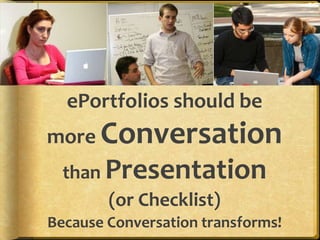
ePortfolios should be more Conversationthan Presentation(or Checklist)Because Conversation transforms!
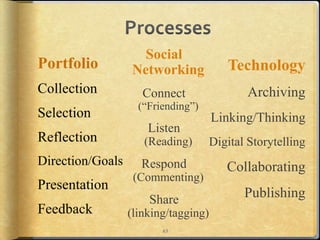
ProcessesSocial NetworkingConnect(“Friending”)Listen(Reading)Respond(Commenting)Share(linking/tagging)PortfolioCollectionSelectionReflectionDirection/GoalsPresentationFeedbackTechnology  ArchivingLinking/ThinkingDigital Storytelling  Collaborating  Publishing63
Discuss!Engagement Factors?Social networks?ePortfolios?64
The Future of mPortfolios (m=mobile)My current research! More in my next session!
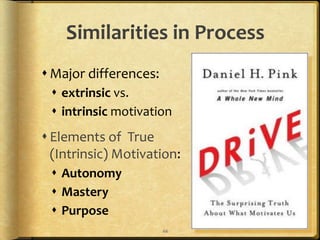
66Similarities in ProcessMajor differences:extrinsic vs. intrinsic motivation Elements of  True (Intrinsic) Motivation:AutonomyMasteryPurpose
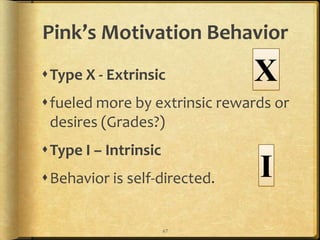
Pink’s Motivation BehaviorX  Type X - Extrinsicfueled more by extrinsic rewards or desires (Grades?)Type I – IntrinsicBehavior is self-directed.I  67
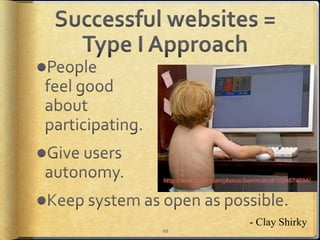
Successful websites = Type I ApproachPeople feel good about participating.
Give users autonomy.
Keep system as open as possible.- Clay Shirky68
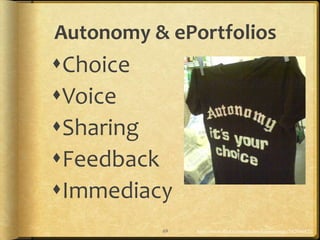
Autonomy & ePortfoliosChoiceVoiceSharing FeedbackImmediacy69http://www.flickr.com/photos/kenturamon/342946821/
Mastery & ePortfoliosExhilaration in Learning
Sports? Games?
Compliance vs. Personal Mastery
Open Source movement (Wikipedia vs. Encarta)

Calgary1Students

  • 1.
    Portfolio LearningE-portfolios forstudent engagement and life-long learning Dr. Helen Barrettelectronicportfolios.orgTwitter: @eportfolioshashtag: #eportfolioshttp://www.slideshare.net/eportfolios/
  • 2.
    Outline ContextDefinitionsProcess -ReflectionProduct - TechnologyIntrinsic MotivationPortfolio as Story
  • 3.
  • 4.
  • 5.
    Enhancing students' computer& multimedia skills through ePortfolios
  • 6.
    Draft National EducationalTechnology Plan (2010)Technology also gives students opportunities for taking ownership of their learning. Student-managed electronic learning portfolios can be part of a persistent learning record and help students develop the self-awareness required to set their own learning goals, express their own views of their strengths, weaknesses, and achievements, and take responsibility for them. Educators can use them to gauge students’ development, and they also can be shared with peers, parents, and others who are part of students’ extended network. (p.12)
  • 7.
    Legacy from thePortfolio LiteratureMuch to learn fromthe literature onpaper-based portfolios
  • 8.
    As adult learners,we have much to learn from how children approach portfolios“Everything I know about portfolios was confirmed working with a kindergartener”
  • 9.
    The Power ofPortfolios what children can teach us about learning and assessmentAuthor: Elizabeth HebertPublisher: Jossey-BassPicture courtesy of Amazon.com
  • 10.
    The Power ofPortfoliosAuthor: Dr. Elizabeth Hebert, PrincipalCrow Island School, Winnetka, IllinoisPicture taken by Helen Barrett at AERA, Seattle, April, 2001
  • 11.
    From the Preface(1)Hebert, Elizabeth (2001) The Power of Portfolios. Jossey-Bass, p.ix“Portfolios have been with us for a very long time. Those of us who grew up in the 1950s or earlier recognize portfolios as reincarnations of the large memory boxes or drawers where our parents collected starred spelling tests, lacy valentines, science fair posters, early attempts at poetry, and (of course) the obligatory set of plaster hands. Each item was selected by our parents because it represented our acquisition of a new skill or our feelings of accomplishment. Perhaps an entry was accompanied by a special notation of praise from a teacher or maybe it was placed in the box just because we did it.”
  • 12.
    From the Preface(2)Hebert, Elizabeth (2001) The Power of Portfolios. Jossey-Bass, p.ix “We formed part of our identity from the contents of these memory boxes. We recognized each piece and its association with a particular time or experience. We shared these collections with grandparents to reinforce feelings of pride and we reexamined them on rainy days when friends were unavailable for play. Reflecting on the collection allowed us to attribute importance to these artifacts, and by extension to ourselves, as they gave witness to the story of our early school experiences.”
  • 13.
    From the Preface(3)Hebert, Elizabeth (2001) The Power of Portfolios. Jossey-Bass, p.ix-x “Our parents couldn’t possibly envision that these memory boxes would be the inspiration for an innovative way of thinking about children’s learning. These collections, lovingly stored away on our behalf, are the genuine exemplar for documenting children’s learning over time. But now these memory boxes have a different meaning. It’s not purely private or personal, although the personal is what gives power to what they can mean.”
  • 14.
    Let’s get personal…Thinkfor a minute about:Something about your COLLECTIONS:Suggested topics:If you are a parent, what you saved for your children
  • 15.
    What your parentssaved for you
  • 16.
  • 17.
    Why you collect…Someissues to considerWhat do your collections say about what you value?
  • 18.
    Is there adifference between what you purposefully save and what you can’t throw away?
  • 19.
    How can weuse our personal collections experiences to help learners as they develop their portfolios?The power of portfolios [to support deep learning] is personal.
  • 20.
  • 21.
    School District’s ePortfolioVision Statement (Draft)By implementing e-portfolios, we will empower students to become active participants in their own personalized education. Through use of reflection, technology, and collaboration, students and teachers will develop skills that will lead them to achieve their lifelong goals.
  • 22.
    Technology & ReflectionTwoThemes across the Lifespan with ePortfolio Development and Social Networking17
  • 23.
  • 24.
    Who was thefirst famous “folio” keeper?Definitions
  • 25.
  • 26.
    What is aPortfolio?Dictionary definition: a flat, portable case for carrying loose papers, drawings, etc.Financial portfolio: document accumulation of fiscalcapitalEducational portfolio: document development of humancapital
  • 27.
    PortfolioA purposeful collectionof artifacts (learning/work products with reflection) demonstrating efforts, progress, goals, and achievement over time
  • 28.
    Electronicdigital artifacts organizedonline combining various media (audio/video/text/images)
  • 29.
    E-Portfolio ComponentsMultiple Portfoliosfor Multiple Purposes-Celebrating Learning-Personal Planning-Transition/entry to courses-Employment applications-Accountability/Assessment
  • 30.
    Multiple Tools toSupport Processes-Capturing & storing evidence-Reflecting-Giving & receiving feedback-Planning & setting goals-Collaborating-Presenting to an audience
  • 31.
  • 32.
    Multiple Purposes fromHidden AssumptionsWhat are yours?• Showcase • Assessment • Learning •http://www.rsc-northwest.ac.uk/acl/eMagArchive/RSCeMag2008/choosing%20an%20eportfolio/cool-cartoon-346082.png
  • 33.
    Multiple Purposes ofE-Portfolios in EducationLearning/ Process/ PlanningMarketing/ Showcase Assessment/ Accountability"The Blind Men and the Elephant” by John Godfrey Saxe
  • 34.
  • 35.
    Managing OneselfPeter Drucker,(2005) Harvard Business Review“Success in the knowledge economy comes to those who know themselves – their strengths, their values, and how best they perform.”
  • 36.
    New Purpose: UseePortfolios for managing knowledge workers' career development
  • 37.
    What are mystrengths?
  • 38.
    How do Iperform?
  • 39.
  • 40.
    Where do Ibelong?
  • 41.
    What should Icontribute?
  • 42.
  • 43.
    The Second Halfof your Life (a suggested framework for organizing reflection in learning portfolio?)
  • 44.
    Portfolio CareersUse e-portfoliosto help students: explore their life purpose and goalsexplore their personal & professional identitybuild their professional online brandprepare for portfolio career/life
  • 45.
    Creating Digital Identity“YouTubeand other social media can mitigate the cultural tension between teens’ conflicting needs for independence and community by offering them ‘connection without constraints.’ What looks like narcissism and individuality is actually a search for identity and recognition.Wesch: ‘In a society that doesn’t automatically grant identity and recognition, you have to create your own.’PopTech: Michael Wesch on Using Social Networking For Good, September 23, 2010
  • 46.
  • 47.
  • 48.
  • 49.
  • 50.
  • 51.
    Resource on Biologyof LearningEnriching the Practice of Teaching by Exploring the Biology of LearningJames E. ZullStylus Publishing Co.
  • 52.
    The Learning CycleDavidKolb from Dewey, Piaget, Lewin, adapted by Zull
  • 53.
    What is Reflection?Majortheoretical roots: DeweyHabermasKolbSchönDewey: “We do not learn from experience…we learn from reflecting on experience.”
  • 54.
    Portfolio LearningExperienceFeelingReviewingRecording OrganizingPlanningPublishing &Receiving FeedbackSharing &CollaboratingSelecting SynthesizingDialogueReflectingUnderstandingConceptualizing& Constructing MeaningFigure 2 A model of e-portfolio-based learning, adapted from Kolb (1984)JISC, 2008, Effective Practice with e-Portfolios, p. 9
  • 55.
    Learning PortfoliosReflectionLearningPortfolioCollaborationDocumentation“know thyself”= a lifetime of investigationself-knowledge as outcome of learning The Learning Portfolio (Zubizaretta, 2004, p.20)
  • 56.
    Experiential Learning ModelLewin/Kolbwith adaptations by Moon and ZullPracticeHave an experienceReflect on the experienceTry out what you have learnedMetacognitionLearn from the experience
  • 57.
    Self-Regulated LearningAbrami, P.,et. al. (2008), Encouraging self-regulated learning through electronic portfolios. Canadian Journal of Learning and Technology, V34(3) Fall 2008. http://www.cjlt.ca/index.php/cjlt/article/viewArticle/507/238 GoalsCaptions/JournalsChange over Time
  • 58.
    Reflective Questions thattie the Past to the Future
  • 59.
    Balancing the 2Faces of E-Portfolios
  • 60.
    Some Basic Concepts“ePortfolioisboth process and product”
  • 61.
    Process: A seriesof events (time and effort) to produce a result- From Old French proces(“‘journey’”)
  • 62.
    Product: the outcome/resultsor “thinginess” of an activity/process- Destination
  • 63.
    WiktionaryTypes of E-PortfolioImplementationWorking PortfolioThe CollectionThe Digital ArchiveRepository of Artifacts Reflective Journal(eDOL)Collaboration SpacePortfolio as Process-- Workspace (PLE)“shoebox”Presentation Portfolio(s)The “Story” or NarrativeMultiple Views (public/private)Varied Audiences(varied permissions)Varied Purposes Portfolio as Product-- Showcase
  • 65.
    Level 1 Workspace:Collection in the Cloud
  • 66.
  • 67.
  • 68.
  • 69.
    Level 2 Workspace:Learning/Reflection
  • 70.
    Reflection with MobileDeviceCapture the Thought
  • 71.
    ShowcaseLevel 3: PrimaryPurpose: Showcase/Accountability
  • 72.
  • 73.
  • 74.
    Developmental PlansK-2– noindividual student accounts & Class Portfolios Grades 3-5 – Individual student accounts & Level 1 portfolios with introduction to ReflectionGrades 6-8 – Individual student accounts & Level 2 portfolios (Collection + Reflection)Grades 9-12 – Individual student accounts & Level 3 portfolios (Selection & Presentation)
  • 75.
    Timeline54Level 1: CollectionLevel2: Collection + ReflectionLevel 3: Selection + Presentation
  • 76.
    What are InteractivePortfolios?Portfolios using Web 2.0 tools to: reflect on learning in multiple formats
  • 77.
    showcase workonline to multiple audiences
  • 78.
    dialogue aboutlearning artifacts/reflections
  • 79.
    provide feedbackto improve learning Boundaries Blurring (between e-portfolios & social networks)Structured Accountability Systems? or…Lifelong interactive portfoliosPicasaMash-upsFacebookFlickrblogsYouTubeNingwikisTwitter56
  • 80.
    Electronic Portfolios almosttwo decades (since 1991)used primarily in education to store documents reflect on learningfeedback for improvement showcase achievements for accountability or employment57
  • 81.
    QUOTEThe e-portfolio isthe central and common point for the student experience… It is a reflection of the student as a person undergoing continuous personal development, not just a store of evidence.-Geoff Rebbeck, e-Learning Coordinator, Thanet College, quoted in JISC, 2008, Effective Practice with e-PortfoliosPurposeThe overarching purpose of portfolios is to create a sense of personal ownership over one’s accomplishments, because ownership engenders feelings of pride, responsibility, and dedication. (p.10)Paris, S & Ayres, L. (1994) Becoming Reflective Students and Teachers. American Psychological Association
  • 82.
    Social networks lastfive years store documents and share experiences, showcase accomplishments, communicate and collaborate facilitate employment searches60
  • 83.
  • 84.
    ePortfolios should bemore Conversationthan Presentation(or Checklist)Because Conversation transforms!
  • 85.
  • 86.
  • 87.
    The Future ofmPortfolios (m=mobile)My current research! More in my next session!
  • 88.
    66Similarities in ProcessMajordifferences:extrinsic vs. intrinsic motivation Elements of True (Intrinsic) Motivation:AutonomyMasteryPurpose
  • 89.
    Pink’s Motivation BehaviorX Type X - Extrinsicfueled more by extrinsic rewards or desires (Grades?)Type I – IntrinsicBehavior is self-directed.I 67
  • 90.
    Successful websites =Type I ApproachPeople feel good about participating.
  • 91.
  • 92.
    Keep system asopen as possible.- Clay Shirky68
  • 93.
    Autonomy & ePortfoliosChoiceVoiceSharingFeedbackImmediacy69http://www.flickr.com/photos/kenturamon/342946821/
  • 94.
  • 95.
  • 96.
  • 97.
    Open Source movement(Wikipedia vs. Encarta)

Editor's Notes

  • #19 Adjectives to describe purpose
  • #28 Who knows what this means?
  • #29 Success in the knowledge economy comes to those who know themselves – their strengths, their values, and how best they perform.
  • #30 I also want to look at
  • #31 Michael Wesch is a cultural anthropologist from Kansas State University, famous for his YouTube videos on the impact of the Internet on our lives and learning (The computer is us/using us
  • #39 How do portfolios and reflection fit into the learning process?BEFORE - goal-setting (reflection in the future tense), DURING - immediate reflection (in the present tense), where students write (or dictate) the reason why they chose a specific artifact to include in their collectionAFTER - retrospective (in the past tense) where students look back over a collection of work and describe what they have learned and how they have changed over a period of time (in a Level 3 portfolio)
  • #41 There are the two major approaches to implementing e-portfolios. Janus is the Roman god of gates and doors, beginnings and endings, and hence represented with a double-faced head, each looking in opposite directions. He was worshipped at the beginning of the harvest time, planting, marriage, birth, and other types of beginnings, especially the beginnings of important events in a person's life. Janus also represents the transition between primitive life and civilization, between the countryside and the city, peace and war, and the growing-up of young people.
  • #52 Common Tools vs. Proprietary systems
  • #59 As defined in a JISC publication, Effective Practices with e-portfolios: The e-portfolio is the central and common point for the student experience… It is a reflection of the student as a person undergoing continuous personal development, not just a store of evidence. (Geoff Rebbeck, e-Learning Coordinator, Thanet College, quoted in JISC, 2008, Effective Practice with e-Portfolios)
  • #62 “Portfolios should be less about tellingand more about talking!” Julie Hughes, University of Wolverhampton
  • #65 ISTE preconference workshop in Philadelphia
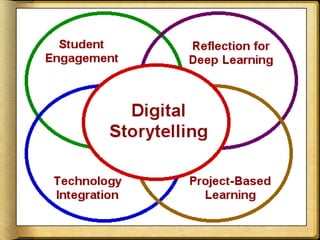
  • #78 Begin to develop successful ePortfolio Processes this week through your PD. Here are the strategies you need to include: Students develop multimedia artifacts through Project-Based Learning & Learning with Laptops.Engage students in reflection to facilitate deep learning through Digital Storytelling and Journals/Blogs & Presentation Portfolios.