1

INFORMATION
TECHNOLOGY AND RURAL
DEVELOPMENT

Kaushik Patidar
CONTENTS
2













Introduction
A notion of harmonious society
Inoculation of IT in rural areas
IT, Economics and Development
Characteristics
Issues and Conceptual Framework
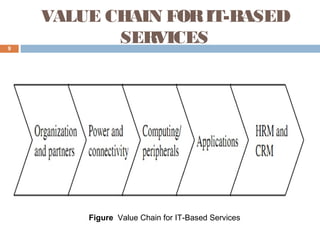
Value Chain for IT-Based Services
ODL Technologies
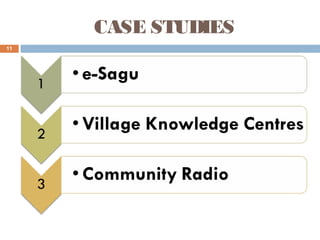
Case Studies
Conclusion
References
INTRODUCTION
3







Poverty line will no longer be measured in
terms of money, but in terms of information
Encourage people to utilize IT in their
socioeconomic and cultural development in a
better and more sophisticated way
To offer development ideas and solutions to
the people who are deprived of basic
facilities, at their village doorsteps
4

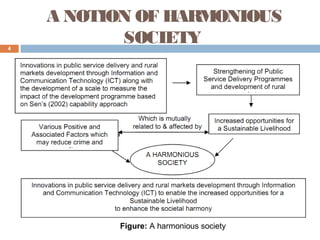
A NOTION OF HARMONIOUS
SOCIETY

Figure: A harmonious society
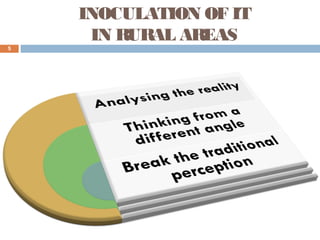
INOCULATION OF IT
IN RURAL AREAS
5
6

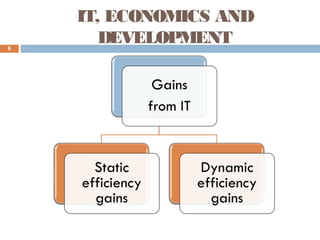
IT, ECONOMICS AND
DEVELOPMENT
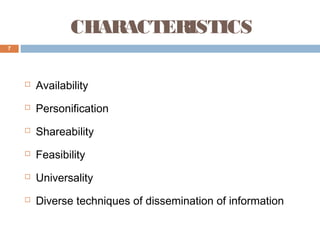
CHARACTERISTICS
7



Availability



Personification



Shareability



Feasibility



Universality



Diverse techniques of dissemination of information
8

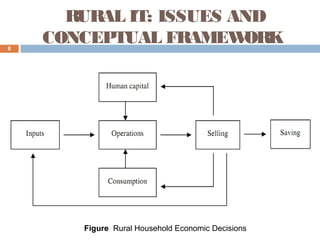
RURAL IT: ISSUES AND
CONCEPTUAL FRAMEW
ORK

Figure Rural Household Economic Decisions
9

VALUE CHAIN FOR IT-BASED
SERVICES

Figure Value Chain for IT-Based Services
ODL TECHNOLOGIES FOR
DEVELOPMENT OF
LIVELIHOODS

10







Imparting education, skill development,
awareness building among the people through
formal education system is practically difficult
To create a learning environment suitable to
the target learners utilising appropriate
Information and Communication Technologies
ODL provide content, methods, language,
physical access, literacy, course development
and technology adoption
CASE STUDIES
11
e-Sagu
12

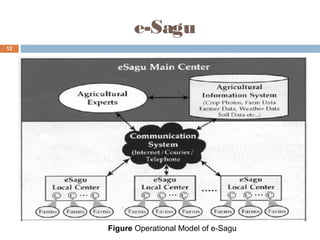
Figure Operational Model of e-Sagu
BENEFITS
13









It provides a quality personalized agro-advice
to the farmers and averts problematic
situations.
It enables farmers to cultivate with the same
efficiency as agricultural experts
It enhances rural livelihoods and generates
rural employment
It provides strong database to support
decision making and documents success
stories and new problems
LIABILITIES
14

The problems are:
 Dependency of farmers on coordinators
 Exploitation of farmers by the coordinators
 No direct interface for farmers to learn new
technologies
15

VILLAGE KNOW
LEDGE
CENTRES (VKC)

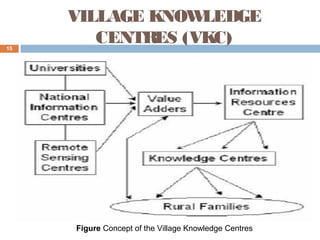
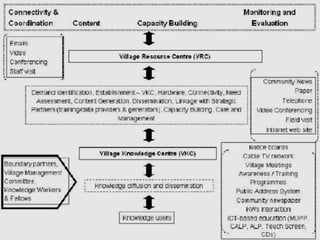
Figure Concept of the Village Knowledge Centres
16
17

COMMUNITY RADIO FOR THE
RURAL W
OMEN DEVELOPMENT


Community Radio was set up in Machanur in
Andhra Pradesh by Deccan Development Society
a NGO with the help of UNESCO

Benefits







It bridges the information gap
It is the by-product of participatory process of
consultation, reflections, and discussions
It becomes a part of wide ranging activities with
in the ‘sangham’ (rural women self-help groups)
community.
It is a kind of communication tool for negotiation
with the outside world for the people, who are not
CONCLUSION
18







IT has suggested that there is a broad range
of services that can be provided to a crosssection of rural households, even at relatively
low levels of income
The case studies of Rural India reflect on the
need, scope and necessity of partnership of
organisations in realising the development of
livelihoods
The need for intervention of concerned
Governments, national and international
bodies like UNO etc.
REFERENCES
19











Nirvikar Singh, Information Technology and Rural
Development in India , University of California,
Santa Cruz, USA
Kris hna Re d d y , P. , A novel framework of
information technology-based agricultural
information dissemination system to improve crop
productivity.
Rita Sha rm a , Reforms in Agricultural extension:
New policy framework. Econ. Political Wkly, 27
July 2002, pp. 3124–3131.
Kra m e r, J. , N ro nha , S. and Ve rg o , J. , A usero
centred design approach to personalization.
Commun. ACM, 2000, 43.
Indian Council of Agricultural Research, 2002,
20

Any Queries ?
21

ThankYou

HarmonicSociety:IT in Rural Development

  • 1.
  • 2.
    CONTENTS 2            Introduction A notion ofharmonious society Inoculation of IT in rural areas IT, Economics and Development Characteristics Issues and Conceptual Framework Value Chain for IT-Based Services ODL Technologies Case Studies Conclusion References
  • 3.
    INTRODUCTION 3    Poverty line willno longer be measured in terms of money, but in terms of information Encourage people to utilize IT in their socioeconomic and cultural development in a better and more sophisticated way To offer development ideas and solutions to the people who are deprived of basic facilities, at their village doorsteps
  • 4.
    4 A NOTION OFHARMONIOUS SOCIETY Figure: A harmonious society
  • 5.
    INOCULATION OF IT INRURAL AREAS 5
  • 6.
  • 7.
  • 8.
    8 RURAL IT: ISSUESAND CONCEPTUAL FRAMEW ORK Figure Rural Household Economic Decisions
  • 9.
    9 VALUE CHAIN FORIT-BASED SERVICES Figure Value Chain for IT-Based Services
  • 10.
    ODL TECHNOLOGIES FOR DEVELOPMENTOF LIVELIHOODS 10    Imparting education, skill development, awareness building among the people through formal education system is practically difficult To create a learning environment suitable to the target learners utilising appropriate Information and Communication Technologies ODL provide content, methods, language, physical access, literacy, course development and technology adoption
  • 11.
  • 12.
  • 13.
    BENEFITS 13     It provides aquality personalized agro-advice to the farmers and averts problematic situations. It enables farmers to cultivate with the same efficiency as agricultural experts It enhances rural livelihoods and generates rural employment It provides strong database to support decision making and documents success stories and new problems
  • 14.
    LIABILITIES 14 The problems are: Dependency of farmers on coordinators  Exploitation of farmers by the coordinators  No direct interface for farmers to learn new technologies
  • 15.
    15 VILLAGE KNOW LEDGE CENTRES (VKC) FigureConcept of the Village Knowledge Centres
  • 16.
  • 17.
    17 COMMUNITY RADIO FORTHE RURAL W OMEN DEVELOPMENT  Community Radio was set up in Machanur in Andhra Pradesh by Deccan Development Society a NGO with the help of UNESCO Benefits     It bridges the information gap It is the by-product of participatory process of consultation, reflections, and discussions It becomes a part of wide ranging activities with in the ‘sangham’ (rural women self-help groups) community. It is a kind of communication tool for negotiation with the outside world for the people, who are not
  • 18.
    CONCLUSION 18    IT has suggestedthat there is a broad range of services that can be provided to a crosssection of rural households, even at relatively low levels of income The case studies of Rural India reflect on the need, scope and necessity of partnership of organisations in realising the development of livelihoods The need for intervention of concerned Governments, national and international bodies like UNO etc.
  • 19.
    REFERENCES 19      Nirvikar Singh, InformationTechnology and Rural Development in India , University of California, Santa Cruz, USA Kris hna Re d d y , P. , A novel framework of information technology-based agricultural information dissemination system to improve crop productivity. Rita Sha rm a , Reforms in Agricultural extension: New policy framework. Econ. Political Wkly, 27 July 2002, pp. 3124–3131. Kra m e r, J. , N ro nha , S. and Ve rg o , J. , A usero centred design approach to personalization. Commun. ACM, 2000, 43. Indian Council of Agricultural Research, 2002,
  • 20.
  • 21.