Gizaw Tulu (ITIL, PRINCE2, PMP, COBIT5, EA,
Cloud )
Interest in: IT Service Management (ITSM)
Key Challenges of ICT in Ethiopia
[High level]
https://www.linkedin.com/in/gizawt
2
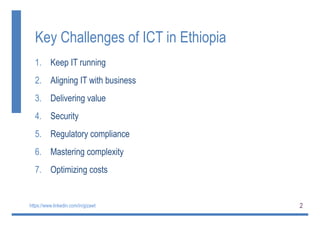
Key Challenges of ICT in Ethiopia
1. Keep IT running
2. Aligning IT with business
3. Delivering value
4. Security
5. Regulatory compliance
6. Mastering complexity
7. Optimizing costs
https://www.linkedin.com/in/gizawt
3
1. Keep IT running
 IT operational failures
 Errors when introducing changes
 Insufficient testing [Decent coding but No/limited independent testing company]
 Poor planning of infrastructure within the organization
 Insufficient resilience of backup and backup testing
 Single provider of Network/Internet connectivity and Connection instability
 Poor user enablement
https://www.linkedin.com/in/gizawt
4
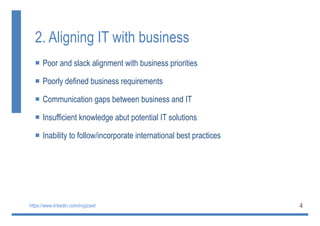
2. Aligning IT with business
 Poor and slack alignment with business priorities
 Poorly defined business requirements
 Communication gaps between business and IT
 Insufficient knowledge abut potential IT solutions
 Inability to follow/incorporate international best practices
https://www.linkedin.com/in/gizawt
5
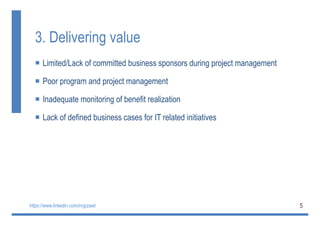
3. Delivering value
 Limited/Lack of committed business sponsors during project management
 Poor program and project management
 Inadequate monitoring of benefit realization
 Lack of defined business cases for IT related initiatives
https://www.linkedin.com/in/gizawt
6
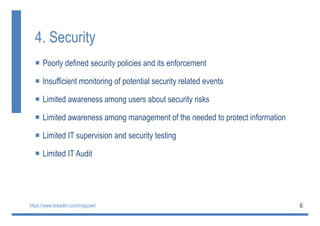
4. Security
 Poorly defined security policies and its enforcement
 Insufficient monitoring of potential security related events
 Limited awareness among users about security risks
 Limited awareness among management of the needed to protect information
 Limited IT supervision and security testing
 Limited IT Audit
https://www.linkedin.com/in/gizawt
7
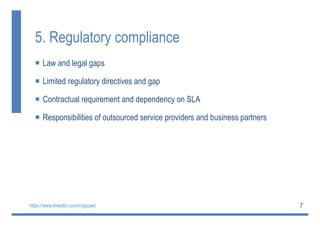
5. Regulatory compliance
 Law and legal gaps
 Limited regulatory directives and gap
 Contractual requirement and dependency on SLA
 Responsibilities of outsourced service providers and business partners
https://www.linkedin.com/in/gizawt
8
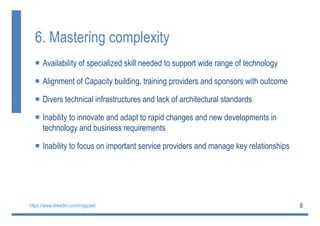
6. Mastering complexity
 Availability of specialized skill needed to support wide range of technology
 Alignment of Capacity building, training providers and sponsors with outcome
 Divers technical infrastructures and lack of architectural standards
 Inability to innovate and adapt to rapid changes and new developments in
technology and business requirements
 Inability to focus on important service providers and manage key relationships
https://www.linkedin.com/in/gizawt
9
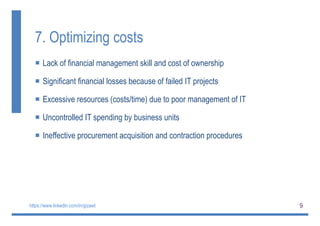
7. Optimizing costs
 Lack of financial management skill and cost of ownership
 Significant financial losses because of failed IT projects
 Excessive resources (costs/time) due to poor management of IT
 Uncontrolled IT spending by business units
 Ineffective procurement acquisition and contraction procedures
https://www.linkedin.com/in/gizawt
10
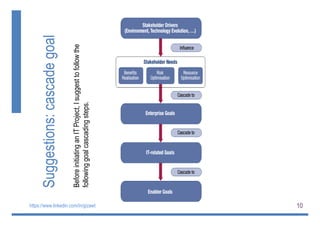
Suggestions:cascadegoal
https://www.linkedin.com/in/gizawt
BeforeinitiatinganITProject,Isuggesttofollowthe
followinggoalcascadingsteps.
11
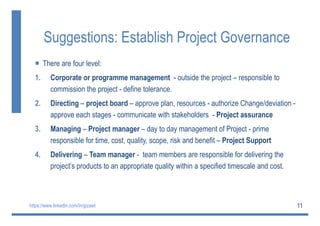
Suggestions: Establish Project Governance
 There are four level:
1. Corporate or programme management - outside the project – responsible to
commission the project - define tolerance.
2. Directing – project board – approve plan, resources - authorize Change/deviation -
approve each stages - communicate with stakeholders - Project assurance
3. Managing – Project manager – day to day management of Project - prime
responsible for time, cost, quality, scope, risk and benefit – Project Support
4. Delivering – Team manager - team members are responsible for delivering the
project’s products to an appropriate quality within a specified timescale and cost.
https://www.linkedin.com/in/gizawt
12
Suggestions
 More white paper in all seven challenges
 IT Audit organizations and Academes
 IT Regulatory framework
https://www.linkedin.com/in/gizawt
13
Note from compiler
 This document is not a research paper, everything written are a general
perspective not particularly related with any organization reside in Ethiopia.
 Written from a decade of experience.
 Government and private sectors spends billions to enable the business with IT
 I witness an organization who are actively understand most of the challenges
listed in this document and work proactively in an amazing pace.
 Lets work together to minimize our challenges.
https://www.linkedin.com/in/gizawt
14
Next
 IT opportunities in Ethiopia outweigh the challenges…
 Coming soon … “Key IT opportunity in Ethiopia”
https://www.linkedin.com/in/gizawt
15
References
 Cobit 5-A Business Framework for the Governance and Management of
Enterprise IT
 https://www.devex.com/news/the-five-key-challenges-in-implementing-ict-for-
development-82499
https://www.linkedin.com/in/gizawt

ICT challange in ethiopia

  • 1.
    Gizaw Tulu (ITIL,PRINCE2, PMP, COBIT5, EA, Cloud ) Interest in: IT Service Management (ITSM) Key Challenges of ICT in Ethiopia [High level] https://www.linkedin.com/in/gizawt
  • 2.
    2 Key Challenges ofICT in Ethiopia 1. Keep IT running 2. Aligning IT with business 3. Delivering value 4. Security 5. Regulatory compliance 6. Mastering complexity 7. Optimizing costs https://www.linkedin.com/in/gizawt
  • 3.
    3 1. Keep ITrunning  IT operational failures  Errors when introducing changes  Insufficient testing [Decent coding but No/limited independent testing company]  Poor planning of infrastructure within the organization  Insufficient resilience of backup and backup testing  Single provider of Network/Internet connectivity and Connection instability  Poor user enablement https://www.linkedin.com/in/gizawt
  • 4.
    4 2. Aligning ITwith business  Poor and slack alignment with business priorities  Poorly defined business requirements  Communication gaps between business and IT  Insufficient knowledge abut potential IT solutions  Inability to follow/incorporate international best practices https://www.linkedin.com/in/gizawt
  • 5.
    5 3. Delivering value Limited/Lack of committed business sponsors during project management  Poor program and project management  Inadequate monitoring of benefit realization  Lack of defined business cases for IT related initiatives https://www.linkedin.com/in/gizawt
  • 6.
    6 4. Security  Poorlydefined security policies and its enforcement  Insufficient monitoring of potential security related events  Limited awareness among users about security risks  Limited awareness among management of the needed to protect information  Limited IT supervision and security testing  Limited IT Audit https://www.linkedin.com/in/gizawt
  • 7.
    7 5. Regulatory compliance Law and legal gaps  Limited regulatory directives and gap  Contractual requirement and dependency on SLA  Responsibilities of outsourced service providers and business partners https://www.linkedin.com/in/gizawt
  • 8.
    8 6. Mastering complexity Availability of specialized skill needed to support wide range of technology  Alignment of Capacity building, training providers and sponsors with outcome  Divers technical infrastructures and lack of architectural standards  Inability to innovate and adapt to rapid changes and new developments in technology and business requirements  Inability to focus on important service providers and manage key relationships https://www.linkedin.com/in/gizawt
  • 9.
    9 7. Optimizing costs Lack of financial management skill and cost of ownership  Significant financial losses because of failed IT projects  Excessive resources (costs/time) due to poor management of IT  Uncontrolled IT spending by business units  Ineffective procurement acquisition and contraction procedures https://www.linkedin.com/in/gizawt
  • 10.
  • 11.
    11 Suggestions: Establish ProjectGovernance  There are four level: 1. Corporate or programme management - outside the project – responsible to commission the project - define tolerance. 2. Directing – project board – approve plan, resources - authorize Change/deviation - approve each stages - communicate with stakeholders - Project assurance 3. Managing – Project manager – day to day management of Project - prime responsible for time, cost, quality, scope, risk and benefit – Project Support 4. Delivering – Team manager - team members are responsible for delivering the project’s products to an appropriate quality within a specified timescale and cost. https://www.linkedin.com/in/gizawt
  • 12.
    12 Suggestions  More whitepaper in all seven challenges  IT Audit organizations and Academes  IT Regulatory framework https://www.linkedin.com/in/gizawt
  • 13.
    13 Note from compiler This document is not a research paper, everything written are a general perspective not particularly related with any organization reside in Ethiopia.  Written from a decade of experience.  Government and private sectors spends billions to enable the business with IT  I witness an organization who are actively understand most of the challenges listed in this document and work proactively in an amazing pace.  Lets work together to minimize our challenges. https://www.linkedin.com/in/gizawt
  • 14.
    14 Next  IT opportunitiesin Ethiopia outweigh the challenges…  Coming soon … “Key IT opportunity in Ethiopia” https://www.linkedin.com/in/gizawt
  • 15.
    15 References  Cobit 5-ABusiness Framework for the Governance and Management of Enterprise IT  https://www.devex.com/news/the-five-key-challenges-in-implementing-ict-for- development-82499 https://www.linkedin.com/in/gizawt