Dr V. Camilleri - vanessa.camilleri@um.edu.mt December 2020
Foundations of Ai
Introduction to Natural Language Processing
Natural language processing
(NLP) is the automatic
extraction, analysis, and
generation of human language.
a branch of artificial intelligence
https://www.youtube.com/watch?v=IIaYk2hIYKk
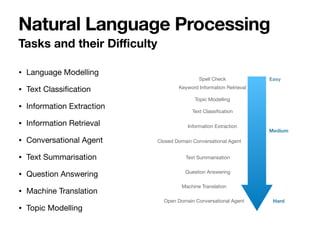
• Language Modelling

• Text Classification

• Information Extraction

• Information Retrieval 

• Conversational Agent

• Text Summarisation 

• Question Answering

• Machine Translation

• Topic Modelling
Tasks and their Difficulty
Natural Language Processing
Easy
Medium
Hard
Spell Check
Keyword Information Retrieval
Topic Modelling
Text Classification
Information Extraction
Closed Domain Conversational Agent
Text Summarisation
Question Answering
Machine Translation
Open Domain Conversational Agent
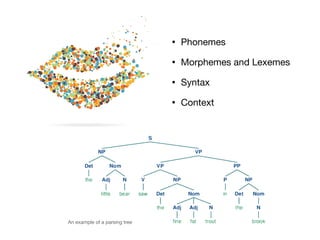
What is language?
• Phonemes

• Morphemes and Lexemes

• Syntax

• Context
An example of a parsing tree
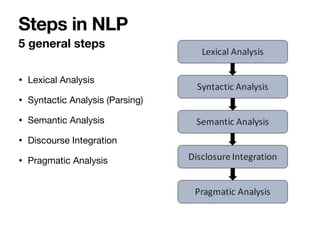
• Lexical Analysis 

• Syntactic Analysis (Parsing) 

• Semantic Analysis 

• Discourse Integration 

• Pragmatic Analysis
5 general steps
Steps in NLP
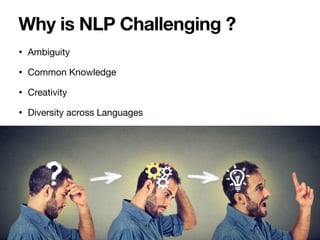
• Ambiguity

• Common Knowledge

• Creativity

• Diversity across Languages
Why is NLP Challenging ?
Time for some questions …
• What is the goal of Machine Learning?

• List the three paradigms of ML

• What is the difference between them? 

• Give me an example of a supervised learning problem
related to language

• Explain the main concept behind deep learning
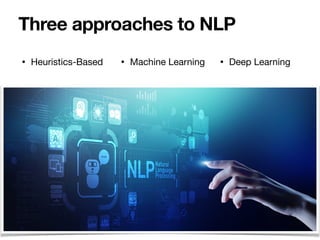
• Heuristics-Based
 • Machine Learning 
 • Deep Learning
Three approaches to NLP
• Rule-based systems for words (Thesaurus/Dictionaries/Word
relationships)

• Regular expressions (REGEX)

• Context-free grammar (CFG)
Heuristics-based
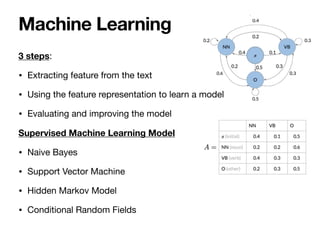
3 steps: 

• Extracting feature from the text 

• Using the feature representation to learn a model 

• Evaluating and improving the model

Supervised Machine Learning Model
• Naive Bayes

• Support Vector Machine

• Hidden Markov Model

• Conditional Random Fields
Machine Learning
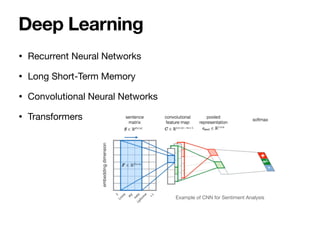
• Recurrent Neural Networks 

• Long Short-Term Memory

• Convolutional Neural Networks

• Transformers
Deep Learning
Example of CNN for Sentiment Analysis
• For text classification LSTM and CNN-based models have
surpassed the performance of standard ML techniques like
Naive Bayes & SVM; 

• For sequence labelling tasks LSTMs have performed better than
CRF models;

• For most NLP tasks, ranging from text classification to sequence
labelling, transformer models have become state of the art.
Deep Learning - a recap
• Overfitting on small datasets

• Few shot learning (learning from few training examples) and
synthetic data generation 

• Domain Adaptation

• Interpretable models

• Common sense and world knowledge

• Cost

• On-device deployment
Deep Learning
Still many challenges in NLP
Activity time
Work in groups (use chat/social media/…)
So now let us think back at our Self-driving
ambulance scenario; describe one possible
scenario in detail and discuss the major NLP
components that might be involved. 

Describe these components in more detail.

ICS1020 NLP 2020

  • 1.
    Dr V. Camilleri- vanessa.camilleri@um.edu.mt December 2020 Foundations of Ai Introduction to Natural Language Processing
  • 3.
    Natural language processing (NLP)is the automatic extraction, analysis, and generation of human language. a branch of artificial intelligence
  • 5.
  • 6.
    • Language Modelling •Text Classification • Information Extraction • Information Retrieval • Conversational Agent • Text Summarisation • Question Answering • Machine Translation • Topic Modelling Tasks and their Difficulty Natural Language Processing Easy Medium Hard Spell Check Keyword Information Retrieval Topic Modelling Text Classification Information Extraction Closed Domain Conversational Agent Text Summarisation Question Answering Machine Translation Open Domain Conversational Agent
  • 7.
  • 8.
    • Phonemes • Morphemesand Lexemes • Syntax • Context An example of a parsing tree
  • 9.
    • Lexical Analysis • Syntactic Analysis (Parsing) • Semantic Analysis • Discourse Integration • Pragmatic Analysis 5 general steps Steps in NLP
  • 10.
    • Ambiguity • CommonKnowledge • Creativity • Diversity across Languages Why is NLP Challenging ?
  • 11.
    Time for somequestions …
  • 12.
    • What isthe goal of Machine Learning? • List the three paradigms of ML • What is the difference between them? • Give me an example of a supervised learning problem related to language • Explain the main concept behind deep learning
  • 13.
    • Heuristics-Based •Machine Learning • Deep Learning Three approaches to NLP
  • 14.
    • Rule-based systemsfor words (Thesaurus/Dictionaries/Word relationships) • Regular expressions (REGEX) • Context-free grammar (CFG) Heuristics-based
  • 15.
    3 steps: •Extracting feature from the text • Using the feature representation to learn a model • Evaluating and improving the model Supervised Machine Learning Model • Naive Bayes • Support Vector Machine • Hidden Markov Model • Conditional Random Fields Machine Learning
  • 16.
    • Recurrent NeuralNetworks • Long Short-Term Memory • Convolutional Neural Networks • Transformers Deep Learning Example of CNN for Sentiment Analysis
  • 17.
    • For textclassification LSTM and CNN-based models have surpassed the performance of standard ML techniques like Naive Bayes & SVM; • For sequence labelling tasks LSTMs have performed better than CRF models; • For most NLP tasks, ranging from text classification to sequence labelling, transformer models have become state of the art. Deep Learning - a recap
  • 18.
    • Overfitting onsmall datasets • Few shot learning (learning from few training examples) and synthetic data generation • Domain Adaptation • Interpretable models • Common sense and world knowledge • Cost • On-device deployment Deep Learning Still many challenges in NLP
  • 19.
    Activity time Work ingroups (use chat/social media/…) So now let us think back at our Self-driving ambulance scenario; describe one possible scenario in detail and discuss the major NLP components that might be involved. Describe these components in more detail.