Natural Language Processing
(NLP)
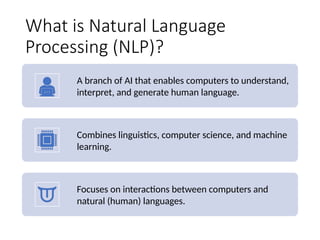
What is Natural Language
Processing (NLP)?
A branch of AI that enables computers to understand,
interpret, and generate human language.
Combines linguistics, computer science, and machine
learning.
Focuses on interactions between computers and
natural (human) languages.
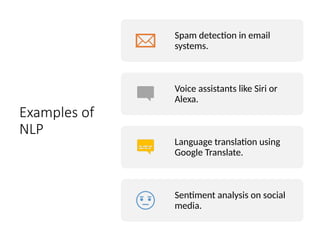
Examples of
NLP
Spam detection in email
systems.
Voice assistants like Siri or
Alexa.
Language translation using
Google Translate.
Sentiment analysis on social
media.
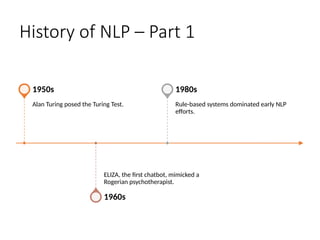
History of NLP – Part 1
Alan Turing posed the Turing Test.
1950s
ELIZA, the first chatbot, mimicked a
Rogerian psychotherapist.
1960s
Rule-based systems dominated early NLP
efforts.
1980s
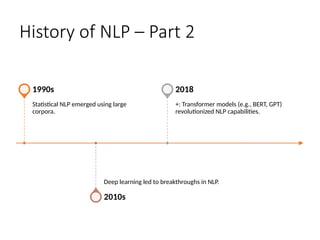
History of NLP – Part 2
Statistical NLP emerged using large
corpora.
1990s
Deep learning led to breakthroughs in NLP.
2010s
+: Transformer models (e.g., BERT, GPT)
revolutionized NLP capabilities.
2018
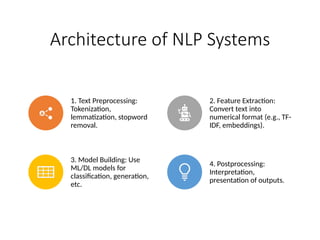
Architecture of NLP Systems
1. Text Preprocessing:
Tokenization,
lemmatization, stopword
removal.
2. Feature Extraction:
Convert text into
numerical format (e.g., TF-
IDF, embeddings).
3. Model Building: Use
ML/DL models for
classification, generation,
etc.
4. Postprocessing:
Interpretation,
presentation of outputs.
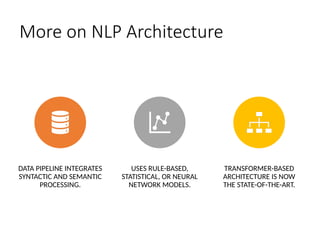
More on NLP Architecture
DATA PIPELINE INTEGRATES
SYNTACTIC AND SEMANTIC
PROCESSING.
USES RULE-BASED,
STATISTICAL, OR NEURAL
NETWORK MODELS.
TRANSFORMER-BASED
ARCHITECTURE IS NOW
THE STATE-OF-THE-ART.
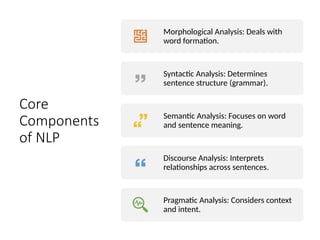
Core
Components
of NLP
Morphological Analysis: Deals with
word formation.
Syntactic Analysis: Determines
sentence structure (grammar).
Semantic Analysis: Focuses on word
and sentence meaning.
Discourse Analysis: Interprets
relationships across sentences.
Pragmatic Analysis: Considers context
and intent.
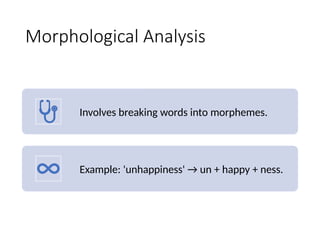
Morphological Analysis
Involves breaking words into morphemes.
Example: 'unhappiness' → un + happy + ness.
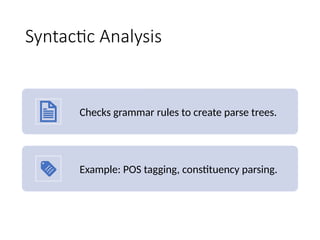
Syntactic Analysis
Checks grammar rules to create parse trees.
Example: POS tagging, constituency parsing.
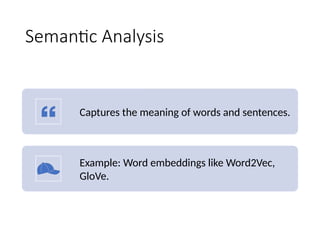
Semantic Analysis
Captures the meaning of words and sentences.
Example: Word embeddings like Word2Vec,
GloVe.
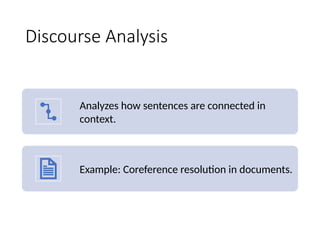
Discourse Analysis
Analyzes how sentences are connected in
context.
Example: Coreference resolution in documents.
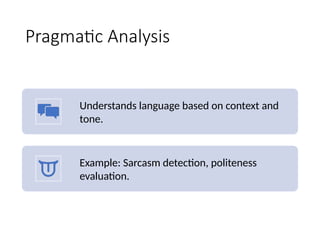
Pragmatic Analysis
Understands language based on context and
tone.
Example: Sarcasm detection, politeness
evaluation.
Text Classification
ASSIGNS CATEGORIES TO TEXT. EXAMPLES: SPAM DETECTION,
SENTIMENT ANALYSIS.
Text Generation
CREATES NEW TEXT BASED
ON PROMPTS OR PATTERNS.
EXAMPLES: CHATGPT, GPT-4,
TEXT SUMMARIZERS.
Named Entity Recognition (NER)
IDENTIFIES AND CLASSIFIES NAMED
ENTITIES IN TEXT.
EXAMPLES: RECOGNIZING NAMES,
PLACES, ORGANIZATIONS.
Machine Translation
TRANSLATES TEXT FROM ONE
LANGUAGE TO ANOTHER.
EXAMPLE: GOOGLE
TRANSLATE.
Speech Recognition and Processing
CONVERTS SPOKEN LANGUAGE
INTO TEXT.
EXAMPLES: SIRI, GOOGLE
ASSISTANT, TRANSCRIPTION TOOLS.
Advantages
of NLP
Automates text-based tasks
efficiently.
Improves customer service and
user experience.
Enables real-time language
translation.
Extracts insights from large
volumes of text.
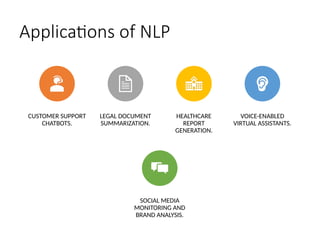
Applications of NLP
CUSTOMER SUPPORT
CHATBOTS.
LEGAL DOCUMENT
SUMMARIZATION.
HEALTHCARE
REPORT
GENERATION.
VOICE-ENABLED
VIRTUAL ASSISTANTS.
SOCIAL MEDIA
MONITORING AND
BRAND ANALYSIS.
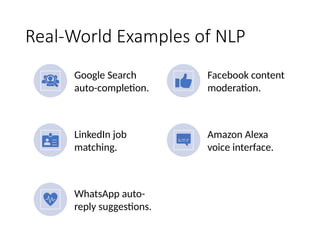
Real-World Examples of NLP
Google Search
auto-completion.
Facebook content
moderation.
LinkedIn job
matching.
Amazon Alexa
voice interface.
WhatsApp auto-
reply suggestions.
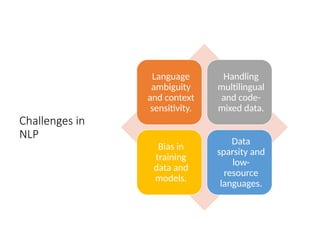
Challenges in
NLP
Language
ambiguity
and context
sensitivity.
Handling
multilingual
and code-
mixed data.
Bias in
training
data and
models.
Data
sparsity and
low-
resource
languages.
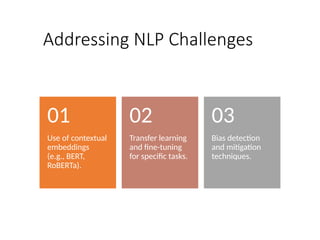
Addressing NLP Challenges
Use of contextual
embeddings
(e.g., BERT,
RoBERTa).
01
Transfer learning
and fine-tuning
for specific tasks.
02
Bias detection
and mitigation
techniques.
03
Case Study 1: Google BERT
INTRODUCED DEEP BIDIRECTIONAL
UNDERSTANDING OF CONTEXT.
IMPROVED SEARCH QUERY
RELEVANCE SIGNIFICANTLY.
Case Study 2: OpenAI GPT
CAPABLE OF GENERATING
COHERENT AND HUMAN-LIKE TEXT.
USED IN WRITING, CODING, AND
DIALOGUE APPLICATIONS.
Case Study 3: Grammarly
USES NLP FOR GRAMMAR AND
WRITING STYLE SUGGESTIONS.
REAL-TIME ERROR DETECTION
AND CORRECTION.
Case Study 4: Amazon Alexa
COMBINES NLP WITH SPEECH
RECOGNITION.
SUPPORTS SMART ASSISTANT
FUNCTIONALITIES AND USER COMMANDS.
Case Study 5: IBM Watson for
Health
ANALYZES CLINICAL DATA AND
LITERATURE USING NLP.
ASSISTS DOCTORS IN DIAGNOSING
AND DECISION MAKING.
Natural Language Processing - Lecture.pptx

  • 1.
  • 2.
    What is NaturalLanguage Processing (NLP)? A branch of AI that enables computers to understand, interpret, and generate human language. Combines linguistics, computer science, and machine learning. Focuses on interactions between computers and natural (human) languages.
  • 3.
    Examples of NLP Spam detectionin email systems. Voice assistants like Siri or Alexa. Language translation using Google Translate. Sentiment analysis on social media.
  • 4.
    History of NLP– Part 1 Alan Turing posed the Turing Test. 1950s ELIZA, the first chatbot, mimicked a Rogerian psychotherapist. 1960s Rule-based systems dominated early NLP efforts. 1980s
  • 5.
    History of NLP– Part 2 Statistical NLP emerged using large corpora. 1990s Deep learning led to breakthroughs in NLP. 2010s +: Transformer models (e.g., BERT, GPT) revolutionized NLP capabilities. 2018
  • 6.
    Architecture of NLPSystems 1. Text Preprocessing: Tokenization, lemmatization, stopword removal. 2. Feature Extraction: Convert text into numerical format (e.g., TF- IDF, embeddings). 3. Model Building: Use ML/DL models for classification, generation, etc. 4. Postprocessing: Interpretation, presentation of outputs.
  • 7.
    More on NLPArchitecture DATA PIPELINE INTEGRATES SYNTACTIC AND SEMANTIC PROCESSING. USES RULE-BASED, STATISTICAL, OR NEURAL NETWORK MODELS. TRANSFORMER-BASED ARCHITECTURE IS NOW THE STATE-OF-THE-ART.
  • 8.
    Core Components of NLP Morphological Analysis:Deals with word formation. Syntactic Analysis: Determines sentence structure (grammar). Semantic Analysis: Focuses on word and sentence meaning. Discourse Analysis: Interprets relationships across sentences. Pragmatic Analysis: Considers context and intent.
  • 9.
    Morphological Analysis Involves breakingwords into morphemes. Example: 'unhappiness' → un + happy + ness.
  • 10.
    Syntactic Analysis Checks grammarrules to create parse trees. Example: POS tagging, constituency parsing.
  • 11.
    Semantic Analysis Captures themeaning of words and sentences. Example: Word embeddings like Word2Vec, GloVe.
  • 12.
    Discourse Analysis Analyzes howsentences are connected in context. Example: Coreference resolution in documents.
  • 13.
    Pragmatic Analysis Understands languagebased on context and tone. Example: Sarcasm detection, politeness evaluation.
  • 14.
    Text Classification ASSIGNS CATEGORIESTO TEXT. EXAMPLES: SPAM DETECTION, SENTIMENT ANALYSIS.
  • 15.
    Text Generation CREATES NEWTEXT BASED ON PROMPTS OR PATTERNS. EXAMPLES: CHATGPT, GPT-4, TEXT SUMMARIZERS.
  • 16.
    Named Entity Recognition(NER) IDENTIFIES AND CLASSIFIES NAMED ENTITIES IN TEXT. EXAMPLES: RECOGNIZING NAMES, PLACES, ORGANIZATIONS.
  • 17.
    Machine Translation TRANSLATES TEXTFROM ONE LANGUAGE TO ANOTHER. EXAMPLE: GOOGLE TRANSLATE.
  • 18.
    Speech Recognition andProcessing CONVERTS SPOKEN LANGUAGE INTO TEXT. EXAMPLES: SIRI, GOOGLE ASSISTANT, TRANSCRIPTION TOOLS.
  • 19.
    Advantages of NLP Automates text-basedtasks efficiently. Improves customer service and user experience. Enables real-time language translation. Extracts insights from large volumes of text.
  • 20.
    Applications of NLP CUSTOMERSUPPORT CHATBOTS. LEGAL DOCUMENT SUMMARIZATION. HEALTHCARE REPORT GENERATION. VOICE-ENABLED VIRTUAL ASSISTANTS. SOCIAL MEDIA MONITORING AND BRAND ANALYSIS.
  • 21.
    Real-World Examples ofNLP Google Search auto-completion. Facebook content moderation. LinkedIn job matching. Amazon Alexa voice interface. WhatsApp auto- reply suggestions.
  • 22.
    Challenges in NLP Language ambiguity and context sensitivity. Handling multilingual andcode- mixed data. Bias in training data and models. Data sparsity and low- resource languages.
  • 23.
    Addressing NLP Challenges Useof contextual embeddings (e.g., BERT, RoBERTa). 01 Transfer learning and fine-tuning for specific tasks. 02 Bias detection and mitigation techniques. 03
  • 24.
    Case Study 1:Google BERT INTRODUCED DEEP BIDIRECTIONAL UNDERSTANDING OF CONTEXT. IMPROVED SEARCH QUERY RELEVANCE SIGNIFICANTLY.
  • 25.
    Case Study 2:OpenAI GPT CAPABLE OF GENERATING COHERENT AND HUMAN-LIKE TEXT. USED IN WRITING, CODING, AND DIALOGUE APPLICATIONS.
  • 26.
    Case Study 3:Grammarly USES NLP FOR GRAMMAR AND WRITING STYLE SUGGESTIONS. REAL-TIME ERROR DETECTION AND CORRECTION.
  • 27.
    Case Study 4:Amazon Alexa COMBINES NLP WITH SPEECH RECOGNITION. SUPPORTS SMART ASSISTANT FUNCTIONALITIES AND USER COMMANDS.
  • 28.
    Case Study 5:IBM Watson for Health ANALYZES CLINICAL DATA AND LITERATURE USING NLP. ASSISTS DOCTORS IN DIAGNOSING AND DECISION MAKING.