Infectious diseases and vaccination in cats and dogs Rachel Dean and Jenny Stavisky
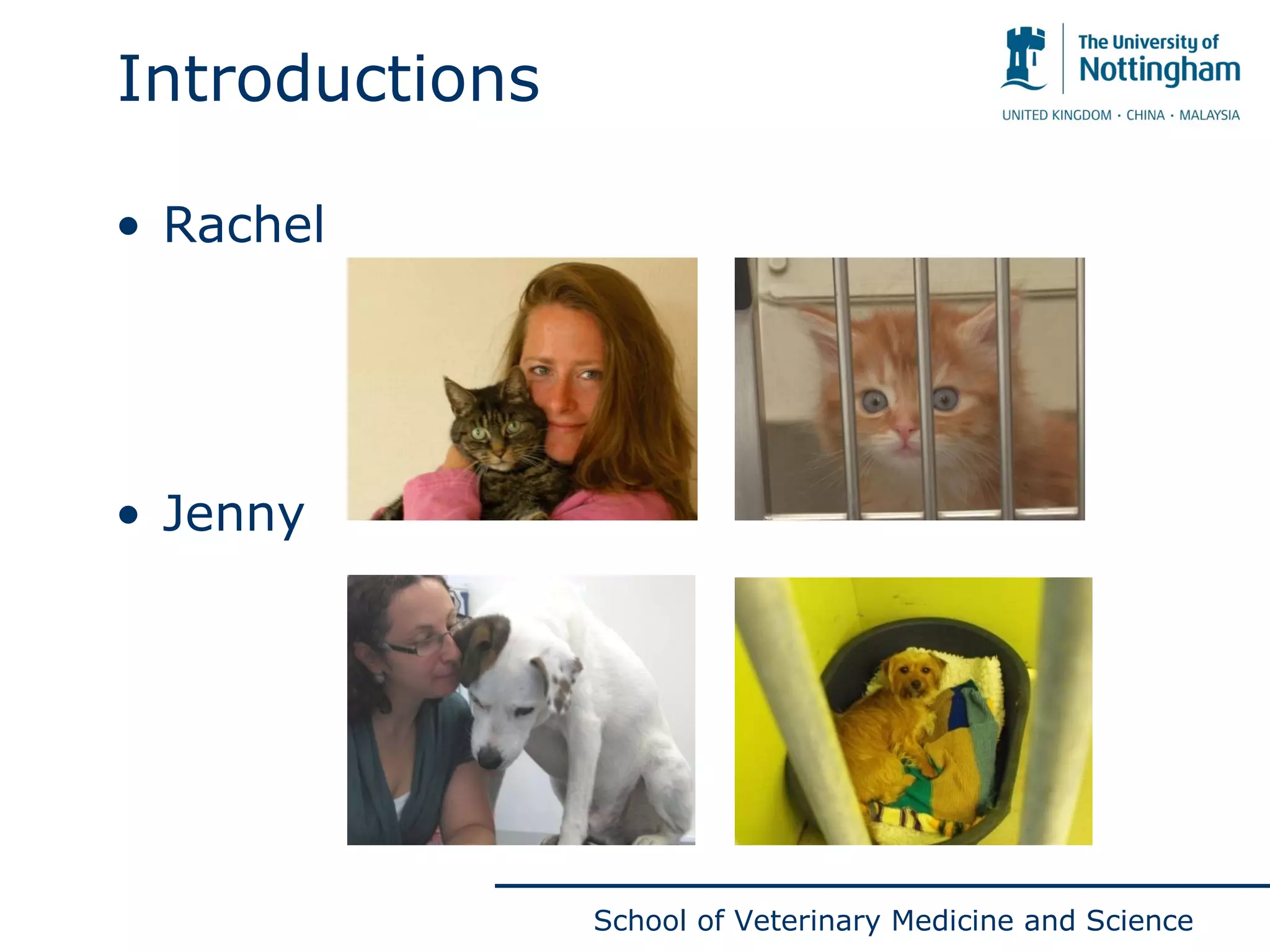
Introductions Rachel Jenny
What we do.... Visit Teach Help
The Plan Principles of disease prevention & control Bug, Host, Environment Prevent, Protect, Control Infectious diseases Parvovirus in dogs Parvovirus in cats Cat flu Kennel cough
The problem Lots of animals Lots of bugs Stressful environment Bugs are cleverer than we are The ideal future:  no overpopulation + responsible pet ownership = no shelters
Infectious diseases common in shelters Caused by a variety of ‘bugs’ Bacteria, viruses, fungi, worms.... Viruses probably the biggest problem Infectious diseases
Bug Host Environment Relationships
The Bug Which one(s) Which animals are affected How easily it’s transmitted How well it survives in the environment Bug
The Host Age Pregnancy/ birth Stress (physical or psychological) Immunity (vaccination)
Environment Contact between animals Presence of FOMITES Hygiene – cleaning, surfaces, drains, bedding Presence of quarantine/ isolation
Bug Host Environment Relationships DISEASE
Three Part Strategy PREVENT PROTECT CONTROL
PREVENT Are the animals in a healthy environment?
 
PREVENT Are the animals in a healthy environment?  Nutrition and changes in diet
 
PREVENT Are the animals in a healthy environment?  Nutrition and changes in diet Stress
 
PREVENT Are the animals in a healthy environment?  Nutrition and changes in diet Stress  Most vulnerable animals
 
PREVENT Are the animals in a healthy environment?  Nutrition and changes in diet Stress  Most vulnerable animals  Vaccination
PROTECT Quarantine facilities for new arrivals
 
PROTECT Quarantine facilities for new arrivals Vaccinate!
What is a vaccine? Similar to natural infection Immune system responds to the vaccine and protects the animal for a period of time The body remembers
Types of vaccine Lots of different types Vaccination is safer than natural infection
Expectations Nothing can stop an animal meeting a bug Some vaccines stop clinical disease and shedding of virus – canine parvovirus Some vaccines reduce clinical disease and shedding of virus – cat flu
PROTECT
PROTECT At least two vaccines when they start their vaccines Vaccinate as soon as possible after entering the shelter
PROTECT Quarantine facilities for new arrivals Vaccinate! Vaccinate at the right age
Can be too young
Exception to the rule Poor start in life High risk
Never too old
PROTECT Quarantine facilities for new arrivals Vaccinate! Vaccinate at the right age Isolate sick animals
 
PROTECT Quarantine facilities for new arrivals Vaccinate! Vaccinate at the right time Isolate sick animals Avoid spread of disease
 
PREVENT
CONTROL Recognise a problem early
CONTROL Recognise a problem early Get EVERYONE involved
CONTROL Recognise a problem early Get EVERYONE involved Shut the area/shelter
 
CONTROL Recognise a problem early Get EVERYONE involved Shut the area/shelter Euthanasia
CONTROL
Think PREVENT PROTECT CONTROL
Teamwork! eds_catherding_low.MPG
The Plan Principles of disease prevention & control Bug, Host, Environment Prevent, Protect, Control Infectious diseases Parvovirus in dogs Parvovirus in cats Cat flu Kennel cough
Canine parvovirus The bug Small virus Very hardy and difficult to kill Faecal-oral transmission Likes rapidly dividing cells
Canine parvovirus The host Puppies At time of weaning Change of diet, stress, disease Canine parvovirus (and other causes of diarrhoea)
Canine parvovirus The environment Presence of lots of virus Other diseases Stress Canine parvovirus (and other causes of diarrhoea)
Canine parvovirus The disease Diarrhoea, often bloody Vomiting Miserable and lethargic Dead litters
Canine parvovirus Prevent Most vulnerable Foster pregnant bitches and litters Hygiene
Canine parvovirus Protect Dispose of faeces Isolate where possible Staff for isolation/clean last Vaccinate Canine parvovirus (and other causes of diarrhoea)
Canine parvovirus The vaccine works well Stops disease and shedding When and how frequently you give it will depend on the situation Pups get immunity directly from mother’s milk – maternal antibody Maternal antibody protects pups BUT interferes with vaccine
Canine parvovirus Maternal antibody gives protection in first weeks of life Amount depends on: Immunity of mum Mum’s milk production How much puppy suckles
Age of pup (weeks) 0  4  8  12  16 Maternal antibody level PREVENT
Canine parvovirus If in doubt vaccinate Start early and finish late!
Canine parvovirus Control Be suspicious early Alert your vet Hygiene very important Euthanasia Canine parvovirus (and other causes of diarrhoea)
Feline parvovirus = Feline Panleukopenia = Feline Infectious Enteritis
Feline Parvovirus The bug Very similar to the dog Can spread to dogs The host 3. The environment
Special cases wobblycat.avi
Feline Parvovirus Prevent Protect Vaccination is very good Control ISOLATE! Euthanasia?
Cat flu The bug(s) There are lots of them – viruses and bacteria Cat-cat spread Some are very good at living outside the body – FOMITES Can be infected with no signs – ‘Carriers’ Latent infection
Cat flu 2. The host Kittens are very vulnerable (> 6 weeks) Adults can get ill too


Cat flu 3. The environment Lots of bugs and lots of cats Bugs survive well outside the cat Carriers
Cat flu 3. The environment Stress makes it worse  Latency
Cat flu PREVENT Hygiene Barriers Ventilation
Cat flu 2. PROTECT Keep quarantined until vaccinated Vaccination reduces amount of disease/virus does not prevent infection Isolate cats with flu
Cat flu 3. CONTROL After infection takes time to see disease One sneeze = TROUBLE! Call your vet Isolate Clean
Kennel cough 1. Bug Lots of bugs 2. Host Most dogs 3. Environment Many kennels
Kennel cough kennel cough.avi
Kennel cough Disease Coughing!!! Snotty noses Some mildly ill Few very ill Pneumonia Kennel cough
Kennel cough 1. Prevent Quarantine new dogs 2. Protect Vaccines may help 3. Control Isolate Fomites! Cats/humans Kennel cough
Think PREVENT PROTECT CONTROL
Thank you Centre for Evidence based Veterinary Medicine School of Veterinary Medicine and Science ICAWC Shelters and animals Brigita
 

ICAWC 2011: Rachel Dean and Jenny Stavisky - Feline and Canine Infectious Diseases

  • 1.
    Infectious diseases andvaccination in cats and dogs Rachel Dean and Jenny Stavisky
  • 2.
  • 3.
    What we do....Visit Teach Help
  • 4.
    The Plan Principlesof disease prevention & control Bug, Host, Environment Prevent, Protect, Control Infectious diseases Parvovirus in dogs Parvovirus in cats Cat flu Kennel cough
  • 5.
    The problem Lotsof animals Lots of bugs Stressful environment Bugs are cleverer than we are The ideal future: no overpopulation + responsible pet ownership = no shelters
  • 6.
    Infectious diseases commonin shelters Caused by a variety of ‘bugs’ Bacteria, viruses, fungi, worms.... Viruses probably the biggest problem Infectious diseases
  • 7.
    Bug Host EnvironmentRelationships
  • 8.
    The Bug Whichone(s) Which animals are affected How easily it’s transmitted How well it survives in the environment Bug
  • 9.
    The Host AgePregnancy/ birth Stress (physical or psychological) Immunity (vaccination)
  • 10.
    Environment Contact betweenanimals Presence of FOMITES Hygiene – cleaning, surfaces, drains, bedding Presence of quarantine/ isolation
  • 11.
    Bug Host EnvironmentRelationships DISEASE
  • 12.
    Three Part StrategyPREVENT PROTECT CONTROL
  • 13.
    PREVENT Are theanimals in a healthy environment?
  • 14.
  • 15.
    PREVENT Are theanimals in a healthy environment? Nutrition and changes in diet
  • 16.
  • 17.
    PREVENT Are theanimals in a healthy environment? Nutrition and changes in diet Stress
  • 18.
  • 19.
    PREVENT Are theanimals in a healthy environment? Nutrition and changes in diet Stress Most vulnerable animals
  • 20.
  • 21.
    PREVENT Are theanimals in a healthy environment? Nutrition and changes in diet Stress Most vulnerable animals Vaccination
  • 22.
  • 23.
  • 24.
    PROTECT Quarantine facilitiesfor new arrivals Vaccinate!
  • 25.
    What is avaccine? Similar to natural infection Immune system responds to the vaccine and protects the animal for a period of time The body remembers
  • 26.
    Types of vaccineLots of different types Vaccination is safer than natural infection
  • 27.
    Expectations Nothing canstop an animal meeting a bug Some vaccines stop clinical disease and shedding of virus – canine parvovirus Some vaccines reduce clinical disease and shedding of virus – cat flu
  • 28.
  • 29.
    PROTECT At leasttwo vaccines when they start their vaccines Vaccinate as soon as possible after entering the shelter
  • 30.
    PROTECT Quarantine facilitiesfor new arrivals Vaccinate! Vaccinate at the right age
  • 31.
  • 32.
    Exception to therule Poor start in life High risk
  • 33.
  • 34.
    PROTECT Quarantine facilitiesfor new arrivals Vaccinate! Vaccinate at the right age Isolate sick animals
  • 35.
  • 36.
    PROTECT Quarantine facilitiesfor new arrivals Vaccinate! Vaccinate at the right time Isolate sick animals Avoid spread of disease
  • 37.
  • 38.
  • 39.
    CONTROL Recognise aproblem early
  • 40.
    CONTROL Recognise aproblem early Get EVERYONE involved
  • 41.
    CONTROL Recognise aproblem early Get EVERYONE involved Shut the area/shelter
  • 42.
  • 43.
    CONTROL Recognise aproblem early Get EVERYONE involved Shut the area/shelter Euthanasia
  • 44.
  • 45.
  • 46.
  • 47.
    The Plan Principlesof disease prevention & control Bug, Host, Environment Prevent, Protect, Control Infectious diseases Parvovirus in dogs Parvovirus in cats Cat flu Kennel cough
  • 48.
    Canine parvovirus Thebug Small virus Very hardy and difficult to kill Faecal-oral transmission Likes rapidly dividing cells
  • 49.
    Canine parvovirus Thehost Puppies At time of weaning Change of diet, stress, disease Canine parvovirus (and other causes of diarrhoea)
  • 50.
    Canine parvovirus Theenvironment Presence of lots of virus Other diseases Stress Canine parvovirus (and other causes of diarrhoea)
  • 51.
    Canine parvovirus Thedisease Diarrhoea, often bloody Vomiting Miserable and lethargic Dead litters
  • 52.
    Canine parvovirus PreventMost vulnerable Foster pregnant bitches and litters Hygiene
  • 53.
    Canine parvovirus ProtectDispose of faeces Isolate where possible Staff for isolation/clean last Vaccinate Canine parvovirus (and other causes of diarrhoea)
  • 54.
    Canine parvovirus Thevaccine works well Stops disease and shedding When and how frequently you give it will depend on the situation Pups get immunity directly from mother’s milk – maternal antibody Maternal antibody protects pups BUT interferes with vaccine
  • 55.
    Canine parvovirus Maternalantibody gives protection in first weeks of life Amount depends on: Immunity of mum Mum’s milk production How much puppy suckles
  • 56.
    Age of pup(weeks) 0 4 8 12 16 Maternal antibody level PREVENT
  • 57.
    Canine parvovirus Ifin doubt vaccinate Start early and finish late!
  • 58.
    Canine parvovirus ControlBe suspicious early Alert your vet Hygiene very important Euthanasia Canine parvovirus (and other causes of diarrhoea)
  • 59.
    Feline parvovirus =Feline Panleukopenia = Feline Infectious Enteritis
  • 60.
    Feline Parvovirus Thebug Very similar to the dog Can spread to dogs The host 3. The environment
  • 61.
  • 62.
    Feline Parvovirus PreventProtect Vaccination is very good Control ISOLATE! Euthanasia?
  • 63.
    Cat flu Thebug(s) There are lots of them – viruses and bacteria Cat-cat spread Some are very good at living outside the body – FOMITES Can be infected with no signs – ‘Carriers’ Latent infection
  • 64.
    Cat flu 2.The host Kittens are very vulnerable (> 6 weeks) Adults can get ill too
  • 65.
  • 66.
  • 67.
  • 68.
  • 69.
    Cat flu 3.The environment Lots of bugs and lots of cats Bugs survive well outside the cat Carriers
  • 70.
    Cat flu 3.The environment Stress makes it worse Latency
  • 71.
    Cat flu PREVENTHygiene Barriers Ventilation
  • 72.
    Cat flu 2.PROTECT Keep quarantined until vaccinated Vaccination reduces amount of disease/virus does not prevent infection Isolate cats with flu
  • 73.
    Cat flu 3.CONTROL After infection takes time to see disease One sneeze = TROUBLE! Call your vet Isolate Clean
  • 74.
    Kennel cough 1.Bug Lots of bugs 2. Host Most dogs 3. Environment Many kennels
  • 75.
  • 76.
    Kennel cough DiseaseCoughing!!! Snotty noses Some mildly ill Few very ill Pneumonia Kennel cough
  • 77.
    Kennel cough 1.Prevent Quarantine new dogs 2. Protect Vaccines may help 3. Control Isolate Fomites! Cats/humans Kennel cough
  • 78.
  • 79.
    Thank you Centrefor Evidence based Veterinary Medicine School of Veterinary Medicine and Science ICAWC Shelters and animals Brigita
  • 80.

Editor's Notes

  • #17 Need a better pic here!
  • #19 – for dogs, may be frustration and social isolation; for cats, constant presence of other cats
  • #21 Can pups or kittens be fostered or otherwise protected? Pregnant bitches/ queens
  • #23 Do not mix until sure they are healthy/ pref vaccinated
  • #24 Do not mix until sure they are healthy/ pref vaccinated
  • #25 Do not mix until sure they are healthy/ pref vaccinated
  • #29 Live versus killed vaccines Parenteral/ intranasal Vaccine breakdown (maybe too detailed)
  • #30 MDA and immunity gap
  • #31 Do not mix until sure they are healthy/ pref vaccinated
  • #35 Do not mix until sure they are healthy/ pref vaccinated
  • #37 Do not mix until sure they are healthy/ pref vaccinated
  • #39 Isolation picture Colour co-ordinated equipment Keep staff to one area Or at least clean high risk animals last One-way traffic
  • #41 Cost implications – but actually being proactive about vetting can help save costs long term Get a vet who will visit the shelter if possible – may not always be appropriate but really useful to visit at least on occasion Diagnostic tests might not be needed every time, but defo if an outbreak, vac or treatment failure or new disease signs Target treatment and prevention
  • #42 Cost implications – but actually being proactive about vetting can help save costs long term Get a vet who will visit the shelter if possible – may not always be appropriate but really useful to visit at least on occasion Diagnostic tests might not be needed every time, but defo if an outbreak, vac or treatment failure or new disease signs Target treatment and prevention
  • #44 Cost implications – but actually being proactive about vetting can help save costs long term Get a vet who will visit the shelter if possible – may not always be appropriate but really useful to visit at least on occasion Diagnostic tests might not be needed every time, but defo if an outbreak, vac or treatment failure or new disease signs Target treatment and prevention
  • #45 Ownership and understanding of a problem
  • #51 Isolation can be stressful Kept in groups hard to control disease, can also be stressful Kennels with shared open drainage
  • #57 MDA and immunity gap