Services Science and its
application to the delivery of
the Galileo “Early Services”
Dr. ing. Marco Lisi
European Space Agency
Special Advisor to the European Commission
IBM Systems Engineering Symposium,
14 November 2013, Roma
Navigation solutions powered by Europe
Objectives

•
•
•
•
•

To recognize the importance of Services Science
Management and Engineering (SSME);
To explain what a service oriented, large and complex
system means;
To present the Galileo present status and the
preparation to its Early Services phase;
To describe the pragmatic approach taken and the
engineering activities needed for the provision of
Galileo services;
To suggest that beyond the obvious technological and
technical challenges, a service provision perspective
requires a conceptual paradigm shift much more
difficult to accept than that required by systems
engineering.
What is a Service System?
•

•

Service (or service-oriented) systems are systems
meant to provide value-added services through the use
of technology (mainly communications and computer
technologies);
A “service system” has been defined as a dynamic
configuration of people, technology, organizational
networks and shared information (such as languages,
processes, metrics, prices, policies, and laws)
designed to deliver services that satisfy the needs,
wants, or aspirations of customers.
Characteristics of Service Systems
•
•
•
•
•
•

Large and complex systems
Software intensive (several million lines of code)
Capabilities-based rather than platform-based
Organization and governance (human factor)
Technical performance is a prerequisite for production and
delivery of services, not a final objective
Requirements related to operations, in addition to technical
ones, assume a very high relevance:
Quality of Service (QoS)
Reliability, Availability, Continuity
Maintainability
Safety
Security

5

Flexibility
Expandability
Interoperability
Resilience
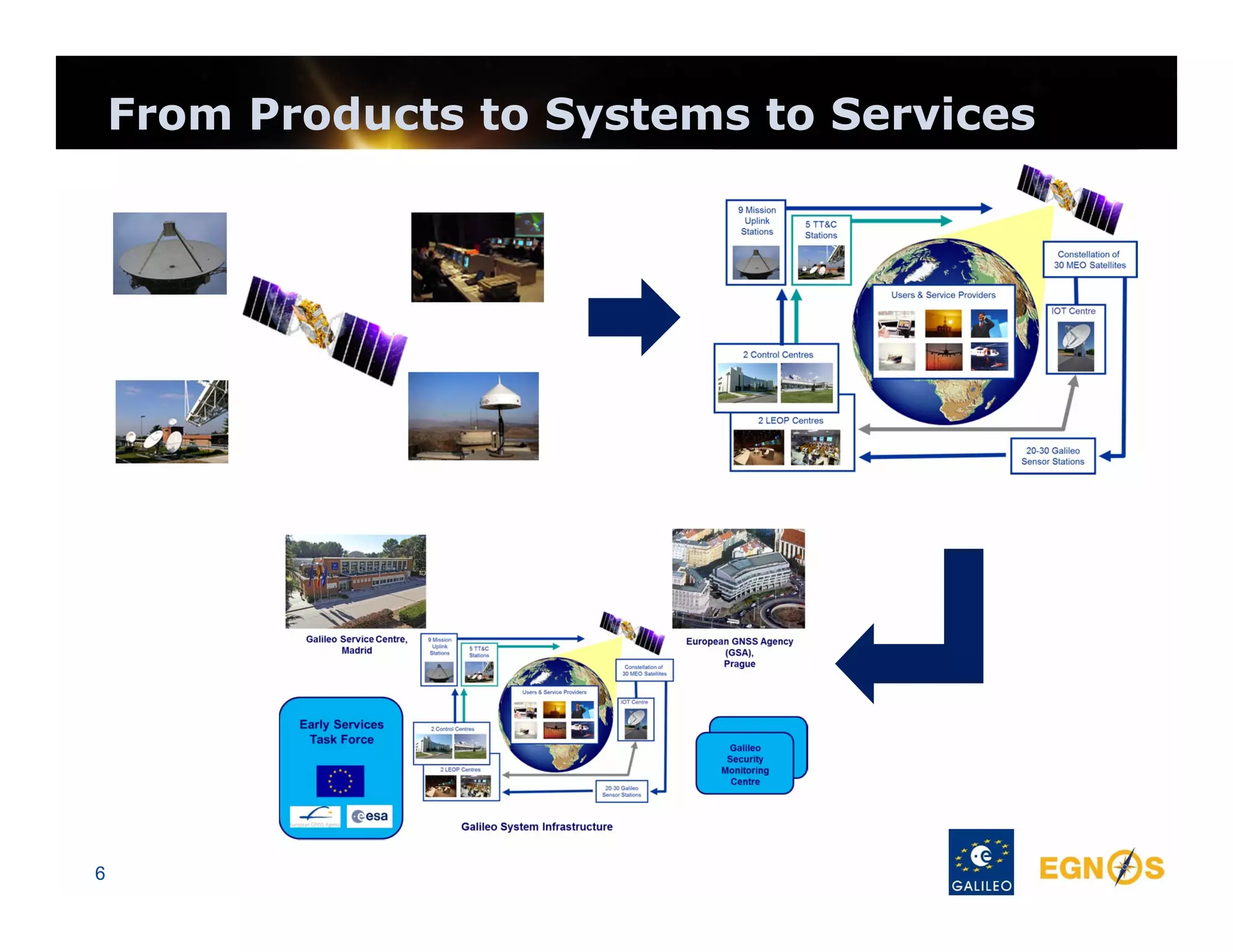
From Products to Systems to Services

6
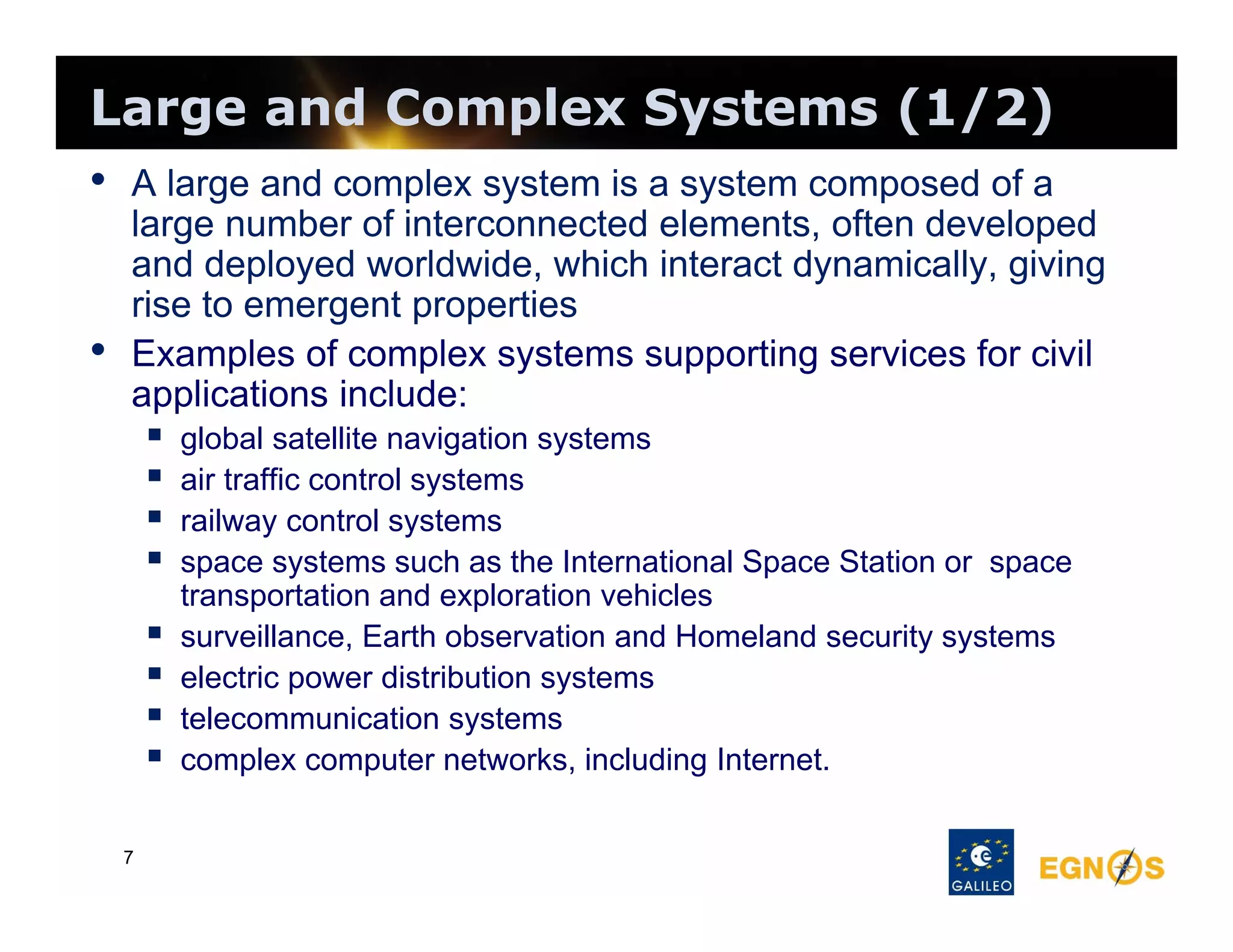
Large and Complex Systems (1/2)
• A large and complex system is a system composed of a
•

large number of interconnected elements, often developed
and deployed worldwide, which interact dynamically, giving
rise to emergent properties
Examples of complex systems supporting services for civil
applications include:










7

global satellite navigation systems
air traffic control systems
railway control systems
space systems such as the International Space Station or space
transportation and exploration vehicles
surveillance, Earth observation and Homeland security systems
electric power distribution systems
telecommunication systems
complex computer networks, including Internet.
Large and Complex Systems (2/2)
•

•
•

8

A complex system often integrates existing systems (or
parts of them) in an overall large-scale architecture
containing a large number of interfaces and implementing
multiple modes of operation, in a highly dynamic
environment
Large and complex systems require extensive logistics and
maintenance support capabilities
Large and complex space-based systems (e.g. Galileo)
are conceived to be in service for a long time; in this case
the evolution of the system (up-gradings and
modifications) has to be taken into account from the
beginning.
Specifying a Service System
•
•
•
•

9

Functional and technical performance:



System Requirements Document (SRD)

Operational requirements and scenarios:



Concept of Operations (CONOPS) document

Expected service behavior and non-functional
performance:



Service Level Agreement (SLA)

A typical SLA defines Key Performance Indicators (KPI’s)
and Key Quality Indicators (KQI’s), with target values and
target ranges to be achieved over a certain time period.
New Procurement Approach
•
•

•
•

Current systems engineering, project management and
acquisition practices still rely on their historical hardware
engineering and acquisition legacy;
Product-oriented, fixed-price, build-to-specification
contracts give the illusion of a delivery within the
allocated budget, but usually result in cost and schedule
overruns;
Many projects have difficulties integrating hardware,
software and human factor aspects;
Many projects fail to capture (and optimize) in their
acquisition processes the multifaceted aspects of the
systems they try to realize.

10
What is Galileo?
• EGNOS and Galileo are the key elements of the European

•

•
•

navigation “system of systems”, a strategic and critical
infrastructure of the European Union;
The Galileo global navigation satellite system, joint initiative by
the European Union and the European Space Agency, is one of
the most ambitious and technologically advanced service
systems being developed in Europe, by European industries and
with European resources;
While the system procurement and deployment proceed following
an incremental Implementation Plan, all steps are being taken for
the delivery of Early Services;
After a political decision of Vice-President Antonio Tajani, then
included by President Manuel Barroso in the agenda of the
European Commission, Galileo will start officially delivering Early
Services, i.e. the guaranteed and committed delivery of
capabilities to the community of potential customers/users, as
from the end of 2014.
Galileo Deployed Configuration
Galileo Service Centers in Europe
Galileo Stations for Early Services
Galileo Implementation Plan
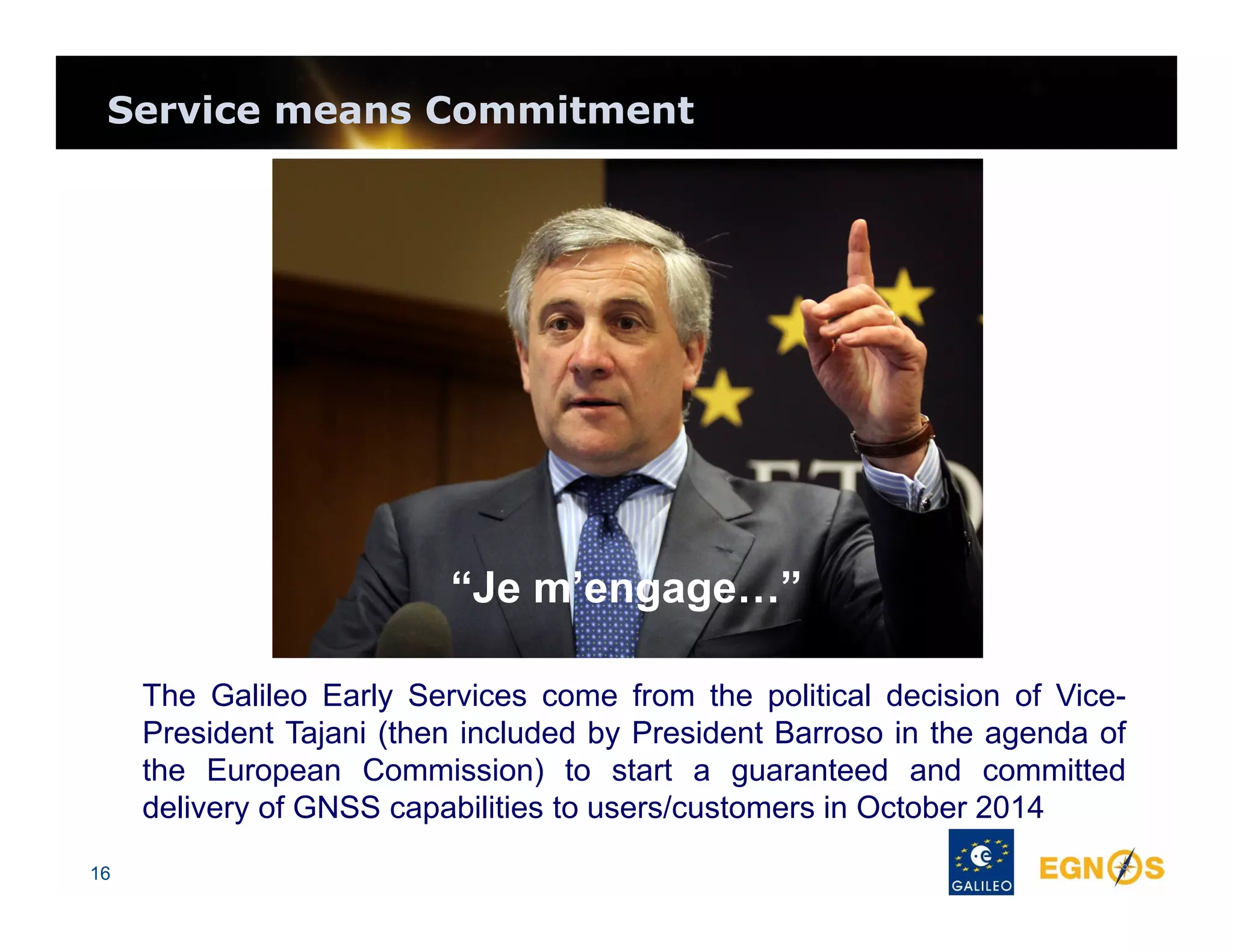
Service means Commitment

“Je m’engage…”
The Galileo Early Services come from the political decision of VicePresident Tajani (then included by President Barroso in the agenda of
the European Commission) to start a guaranteed and committed
delivery of GNSS capabilities to users/customers in October 2014
16
Galileo Early Services: What?
Early services for OS,SAR and PRS will be provided
from 2014
Open Service (OS)

Public Regulated Service
(PRS)
Search and Rescue
Service (SAR)

Commercial Service (CS)

Delivery of a stable signal in space from a
number of satellites in orbit, allowing
ranging interoperable with GPS; time
broadcasting
Delivery of a stable secure signal in
space allowing Pilot Projects with EU
Member States
Guaranteed “forward link” which allows
the detection and localization of distress
signals; validation with Cospas-Sarsat
Initial demonstration projects with
potential service providers
The former “Safety-of-Life” Service
is being re-profiled:

Integrity Monitoring
Service

17

Provides vital integrity information
for life-critical applications
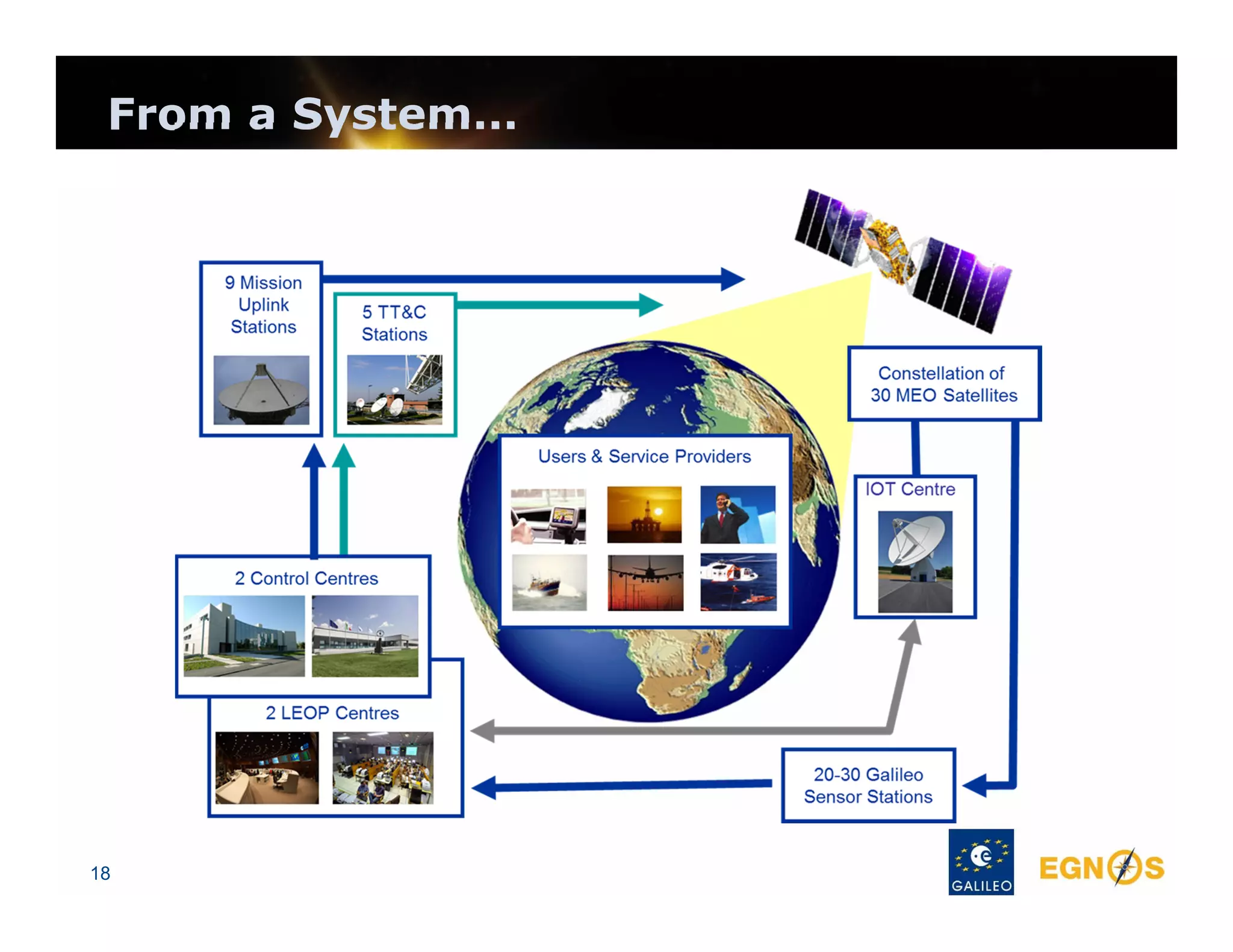
From a System…

18
…to a Service

Galileo Service Centre,
Madrid

European GNSS Agency
(GSA),
Prague

Early Services
Task Force

Galileo
Security
Monitoring
Centre

Galileo System Infrastructure

19
“Loyola de Palacio” GNSS Service Centre

Come and visit us at: www.gsc-europa.eu
20
Galileo Development & Acquisition Process
Assets
(Satellite Constellation, GCC’s,
GCS, GMS, GDDN, etc.)

Galileo System
Requirements

Galileo
System

Galileo System
Performance &
Operations

People

Processes

(ESA Project Team,
Subco’s, EC, GSA, etc.)

(Engineering Board, VCB,
CCB, CM, Ops
Procedures, etc.)
Galileo Service Provision Process
Assets
(Galileo System, GSC, GPEC, etc.)

Galileo
Services
Requirements

Galileo
Services

Galileo
Services
Provision

People

Processes

(EC, GSA, ESA Support,
Member States, Services
Providers, Operators, etc.)

(Services Validation, KPIs
Monitoring, Security
Monitoring, Helpdesk, etc.)
Service Lifecycle (ITIL Standard)
The ITIL Process Model
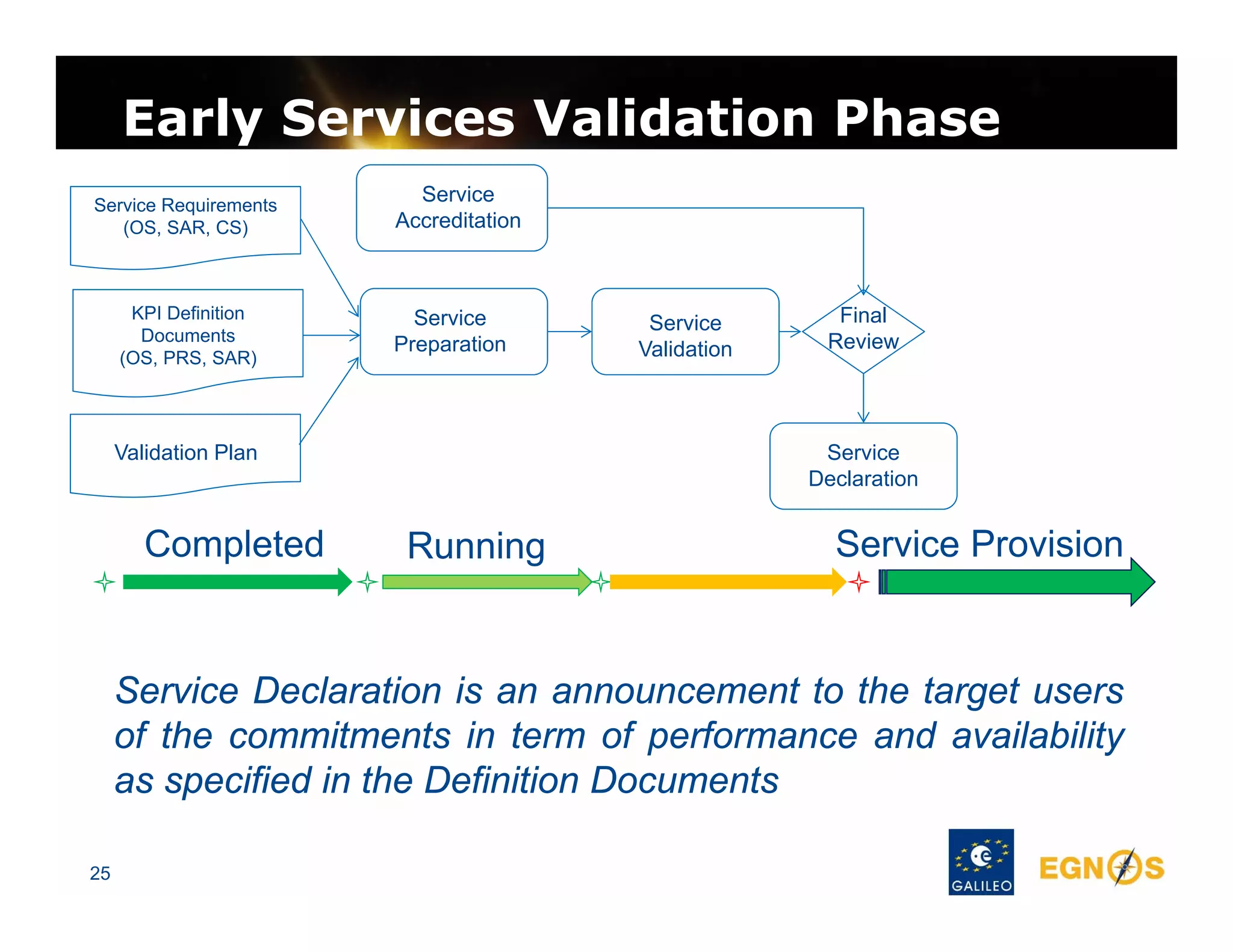
Early Services Validation Phase
Service Requirements
(OS, SAR, CS)

KPI Definition
Documents
(OS, PRS, SAR)

Service
Accreditation

Service
Preparation

Validation Plan

Completed

Service
Validation

Final
Review

Service
Declaration

Running

Service Provision

Service Declaration is an announcement to the target users
of the commitments in term of performance and availability
as specified in the Definition Documents
25
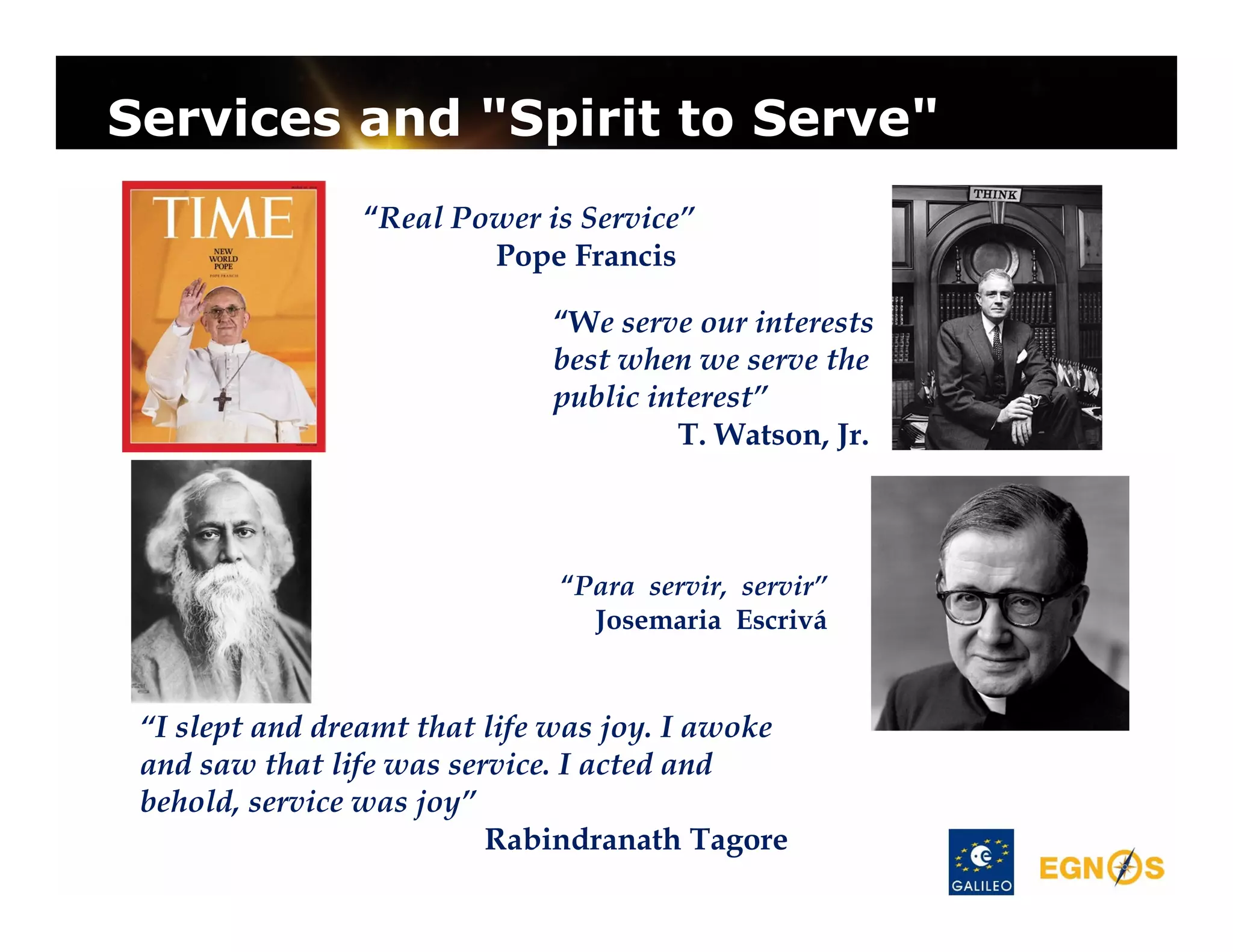
Services and "Spirit to Serve"
“Real Power is Service”
Pope Francis
“We serve our interests
best when we serve the
public interest”
T. Watson, Jr.

“Para servir, servir”
Josemaria Escrivá

“I slept and dreamt that life was joy. I awoke
and saw that life was service. I acted and
behold, service was joy”
Rabindranath Tagore
Conclusions (1/2)

•
•

•
•

•

Our economy is more and more depending on large,
strategic and complex service infrastructures, based on
large, strategic and complex systems;
The design of a complex service enterprise requires a
wide range of skills and expertise's, covering
organizational, engineering, social, legal and
contractual aspects;
A Services Science is indeed needed, but it has to
provide quick-winning and pragmatic answers;
The advent of a services economy imposes a radical
conceptual paradigm shift, more difficult to metabolize
than that required by a systems engineering
perspective;
The “spirit to serve” (call it “customer focus”, if you like)
is at the basis of all services.
Conclusions (2/2)

Galileo is ready
and
eager to serve
28
Traditional
Chinese

Thai

Gracias

Thank
You

Russian

Arabic

Spanish

Obrigado
Brazilian
Portuguese

English

Danke

Grazie
Korean

Italian

Simplified
Chinese

Merci

German

French

‫תודה‬
Japanese

Jewish

Ibmse symposium2013 lisi_v01

  • 1.
    Services Science andits application to the delivery of the Galileo “Early Services” Dr. ing. Marco Lisi European Space Agency Special Advisor to the European Commission IBM Systems Engineering Symposium, 14 November 2013, Roma Navigation solutions powered by Europe
  • 3.
    Objectives • • • • • To recognize theimportance of Services Science Management and Engineering (SSME); To explain what a service oriented, large and complex system means; To present the Galileo present status and the preparation to its Early Services phase; To describe the pragmatic approach taken and the engineering activities needed for the provision of Galileo services; To suggest that beyond the obvious technological and technical challenges, a service provision perspective requires a conceptual paradigm shift much more difficult to accept than that required by systems engineering.
  • 4.
    What is aService System? • • Service (or service-oriented) systems are systems meant to provide value-added services through the use of technology (mainly communications and computer technologies); A “service system” has been defined as a dynamic configuration of people, technology, organizational networks and shared information (such as languages, processes, metrics, prices, policies, and laws) designed to deliver services that satisfy the needs, wants, or aspirations of customers.
  • 5.
    Characteristics of ServiceSystems • • • • • • Large and complex systems Software intensive (several million lines of code) Capabilities-based rather than platform-based Organization and governance (human factor) Technical performance is a prerequisite for production and delivery of services, not a final objective Requirements related to operations, in addition to technical ones, assume a very high relevance: Quality of Service (QoS) Reliability, Availability, Continuity Maintainability Safety Security 5 Flexibility Expandability Interoperability Resilience
  • 6.
    From Products toSystems to Services 6
  • 7.
    Large and ComplexSystems (1/2) • A large and complex system is a system composed of a • large number of interconnected elements, often developed and deployed worldwide, which interact dynamically, giving rise to emergent properties Examples of complex systems supporting services for civil applications include:         7 global satellite navigation systems air traffic control systems railway control systems space systems such as the International Space Station or space transportation and exploration vehicles surveillance, Earth observation and Homeland security systems electric power distribution systems telecommunication systems complex computer networks, including Internet.
  • 8.
    Large and ComplexSystems (2/2) • • • 8 A complex system often integrates existing systems (or parts of them) in an overall large-scale architecture containing a large number of interfaces and implementing multiple modes of operation, in a highly dynamic environment Large and complex systems require extensive logistics and maintenance support capabilities Large and complex space-based systems (e.g. Galileo) are conceived to be in service for a long time; in this case the evolution of the system (up-gradings and modifications) has to be taken into account from the beginning.
  • 9.
    Specifying a ServiceSystem • • • • 9 Functional and technical performance:  System Requirements Document (SRD) Operational requirements and scenarios:  Concept of Operations (CONOPS) document Expected service behavior and non-functional performance:  Service Level Agreement (SLA) A typical SLA defines Key Performance Indicators (KPI’s) and Key Quality Indicators (KQI’s), with target values and target ranges to be achieved over a certain time period.
  • 10.
    New Procurement Approach • • • • Currentsystems engineering, project management and acquisition practices still rely on their historical hardware engineering and acquisition legacy; Product-oriented, fixed-price, build-to-specification contracts give the illusion of a delivery within the allocated budget, but usually result in cost and schedule overruns; Many projects have difficulties integrating hardware, software and human factor aspects; Many projects fail to capture (and optimize) in their acquisition processes the multifaceted aspects of the systems they try to realize. 10
  • 11.
    What is Galileo? •EGNOS and Galileo are the key elements of the European • • • navigation “system of systems”, a strategic and critical infrastructure of the European Union; The Galileo global navigation satellite system, joint initiative by the European Union and the European Space Agency, is one of the most ambitious and technologically advanced service systems being developed in Europe, by European industries and with European resources; While the system procurement and deployment proceed following an incremental Implementation Plan, all steps are being taken for the delivery of Early Services; After a political decision of Vice-President Antonio Tajani, then included by President Manuel Barroso in the agenda of the European Commission, Galileo will start officially delivering Early Services, i.e. the guaranteed and committed delivery of capabilities to the community of potential customers/users, as from the end of 2014.
  • 12.
  • 13.
  • 14.
    Galileo Stations forEarly Services
  • 15.
  • 16.
    Service means Commitment “Jem’engage…” The Galileo Early Services come from the political decision of VicePresident Tajani (then included by President Barroso in the agenda of the European Commission) to start a guaranteed and committed delivery of GNSS capabilities to users/customers in October 2014 16
  • 17.
    Galileo Early Services:What? Early services for OS,SAR and PRS will be provided from 2014 Open Service (OS) Public Regulated Service (PRS) Search and Rescue Service (SAR) Commercial Service (CS) Delivery of a stable signal in space from a number of satellites in orbit, allowing ranging interoperable with GPS; time broadcasting Delivery of a stable secure signal in space allowing Pilot Projects with EU Member States Guaranteed “forward link” which allows the detection and localization of distress signals; validation with Cospas-Sarsat Initial demonstration projects with potential service providers The former “Safety-of-Life” Service is being re-profiled: Integrity Monitoring Service 17 Provides vital integrity information for life-critical applications
  • 18.
  • 19.
    …to a Service GalileoService Centre, Madrid European GNSS Agency (GSA), Prague Early Services Task Force Galileo Security Monitoring Centre Galileo System Infrastructure 19
  • 20.
    “Loyola de Palacio”GNSS Service Centre Come and visit us at: www.gsc-europa.eu 20
  • 21.
    Galileo Development &Acquisition Process Assets (Satellite Constellation, GCC’s, GCS, GMS, GDDN, etc.) Galileo System Requirements Galileo System Galileo System Performance & Operations People Processes (ESA Project Team, Subco’s, EC, GSA, etc.) (Engineering Board, VCB, CCB, CM, Ops Procedures, etc.)
  • 22.
    Galileo Service ProvisionProcess Assets (Galileo System, GSC, GPEC, etc.) Galileo Services Requirements Galileo Services Galileo Services Provision People Processes (EC, GSA, ESA Support, Member States, Services Providers, Operators, etc.) (Services Validation, KPIs Monitoring, Security Monitoring, Helpdesk, etc.)
  • 23.
  • 24.
  • 25.
    Early Services ValidationPhase Service Requirements (OS, SAR, CS) KPI Definition Documents (OS, PRS, SAR) Service Accreditation Service Preparation Validation Plan Completed Service Validation Final Review Service Declaration Running Service Provision Service Declaration is an announcement to the target users of the commitments in term of performance and availability as specified in the Definition Documents 25
  • 26.
    Services and "Spiritto Serve" “Real Power is Service” Pope Francis “We serve our interests best when we serve the public interest” T. Watson, Jr. “Para servir, servir” Josemaria Escrivá “I slept and dreamt that life was joy. I awoke and saw that life was service. I acted and behold, service was joy” Rabindranath Tagore
  • 27.
    Conclusions (1/2) • • • • • Our economyis more and more depending on large, strategic and complex service infrastructures, based on large, strategic and complex systems; The design of a complex service enterprise requires a wide range of skills and expertise's, covering organizational, engineering, social, legal and contractual aspects; A Services Science is indeed needed, but it has to provide quick-winning and pragmatic answers; The advent of a services economy imposes a radical conceptual paradigm shift, more difficult to metabolize than that required by a systems engineering perspective; The “spirit to serve” (call it “customer focus”, if you like) is at the basis of all services.
  • 28.
    Conclusions (2/2) Galileo isready and eager to serve 28
  • 29.