Hackathon launch
Berlin, Wherecamp Conference
3 November 2016
App developers we
want you!
A-GNSS
providers
Users
Chipset
Manufacturers
Device
Manufacturers
App
Developers
Mobile
Network
Operators
Full Integration of Galileo Capabilities
Greater awareness
and real use
Up-to-now mainly performed actions targeting the
integration of Galileo at hardware level
Completed or almost there Some actions performed but not there yet Main focus
All top
manufacturers
engaged and
progressively
integrating
Galileo
A-GNSS products
and service with
Galileo already
available in the
market
Awareness
events
organized, to be
intensified
along the
availability of
Galileo devices
First Galileo
enabled devices
appeared in Q3
2016
Galileo
awareness
campaign
planned
leveraging
Galileo Initial
Services
Consultation
conducted
with main
Network
operators
With Initial Services, the goal is to stimulate a real
Galileo use moving further towards users
The agenda
Hackathon Talks
Hackathon Introduction Jacopo Ovarelli European GNSS Agency
Launch of Galileo-enabled BQ Aquaris X5 Plus
Alvaro
Fructuoso
BQ
Galileo testings Michele Bavaro EU Joint Research Center
Introduction to GNSS RAW measurements
provided by Android Nougat
Lukasz
Bonenberg
Nottingham University
Funding opportunities at ESA BIC Angelika Daniels European Space Agency
Hackathon launch Jacopo Ovarelli European GNSS Agency
Hackathon continuous in Hackathon Space in Foyer until Friday
12:30 h
Come up with innovative applications able to bring an added
commercial or societal value by using Galileo services!
Two winning teams will be announced:
• Most innovative Galileo-based app
• Most impactful Galileo-based app (i.e. social impact)
The challenge
Why Galileo?
Data-less signal of
Galileo
Development of new value-
added services
Enhancement of existing ones
Multi-constellation
Galileo OS
Authentication
Multipath Resistant
Data-less signal of
Galileo
Multi-constellation
Galileo OS
Authentication
Multipath Resistant
= Galileo differentiators= Galileo together other GNSS
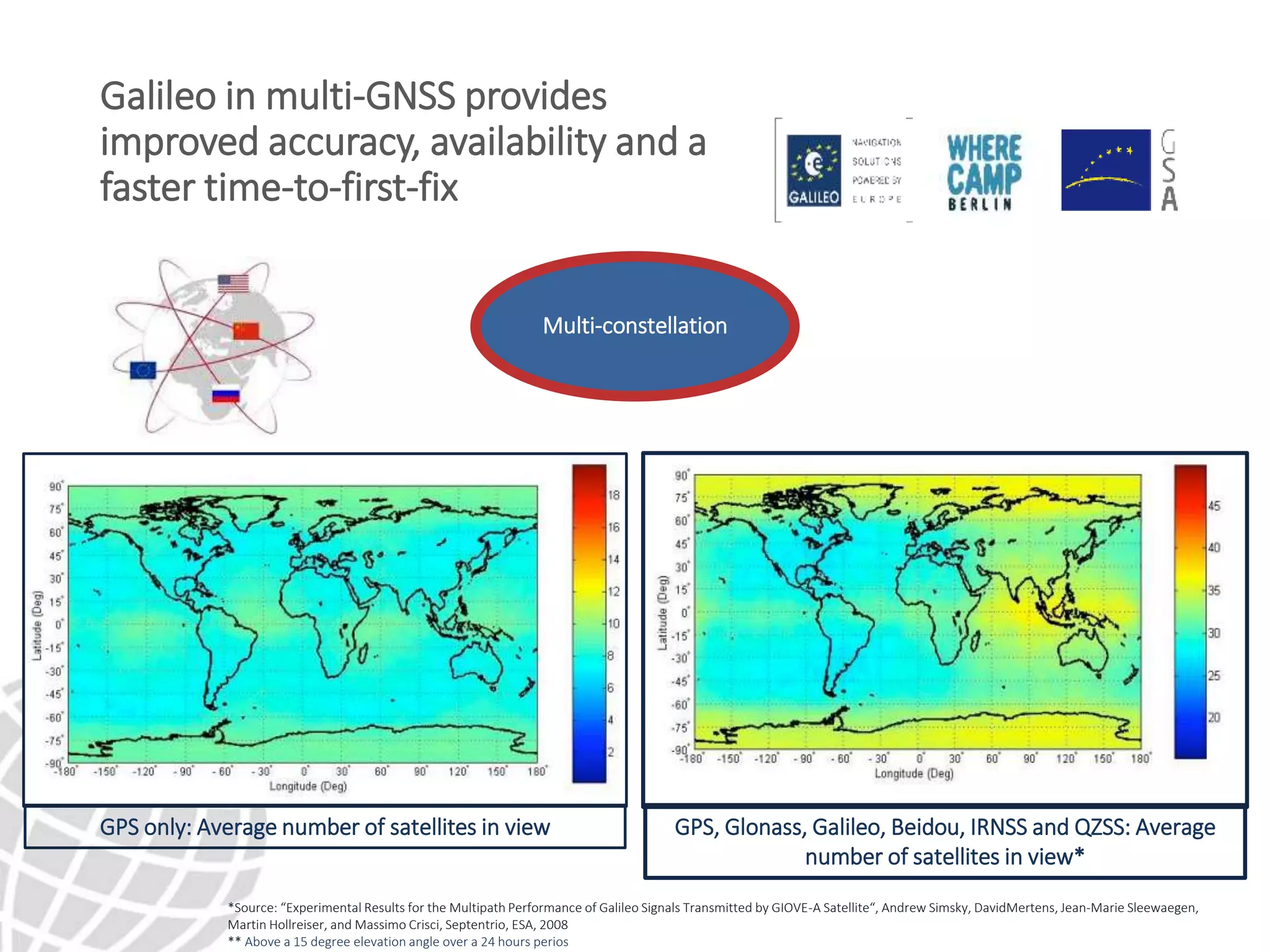
Galileo in multi-GNSS provides
improved accuracy, availability and a
faster time-to-first-fix
Multi-constellation
*Source: “Experimental Results for the Multipath Performance of Galileo Signals Transmitted by GIOVE-A Satellite“, Andrew Simsky, DavidMertens, Jean-Marie Sleewaegen,
Martin Hollreiser, and Massimo Crisci, Septentrio, ESA, 2008
** Above a 15 degree elevation angle over a 24 hours perios
GPS only: Average number of satellites in view GPS, Glonass, Galileo, Beidou, IRNSS and QZSS: Average
number of satellites in view*
OS authentication enhances the use
of GNSS location in commercially -
sensitive apps
• Galileo is expected to be the only GNSS providing Open Service authentication
• A data encryption solution enhancing GNSS reliability:
– Enabling commercially sensitive applications
– Enhancing big data collection
Galileo OS
Authentication
Todd Humphreys* at TED
*Director of the University of Texas at Austin's Radionavigation Laboratory and leading expert on security issues related
to GNSS, full video available at https://www.youtube.com/watch?v=r4UdHE3JNnU
Galileo improves GNSS location in
challenging urban environments
Multipath Resistant
**Source: “Estimating the Time-To-First-Fix for GNSS Signals Theory and Simulation Results”‘ Marco Anghileri, Matteo Paonni, Stefan Wallner, José-Ángel Ávila-Rodríguez, Bernd
Eissfeller, Institute of Geodesy and Navigation, University FAF Munich, Germany’
The strength of Galileo signal, together with
an advanced code modulations, makes Galileo
better mitigating multipath effects (especially
in E5, but also E1)**
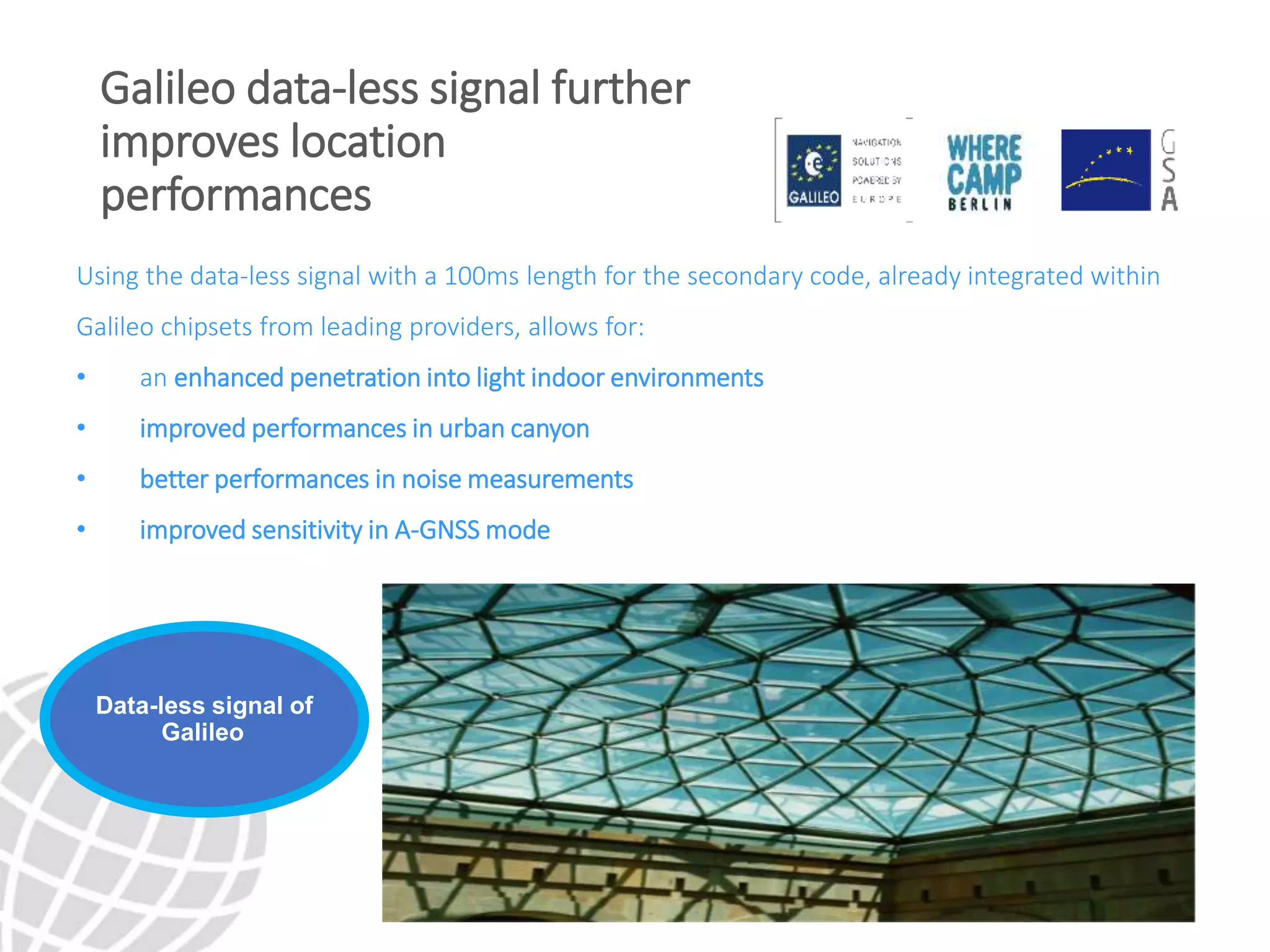
Galileo data-less signal further
improves location
performances
Using the data-less signal with a 100ms length for the secondary code, already integrated within
Galileo chipsets from leading providers, allows for:
• an enhanced penetration into light indoor environments
• improved performances in urban canyon
• better performances in noise measurements
• improved sensitivity in A-GNSS mode
Data-less signal of
Galileo
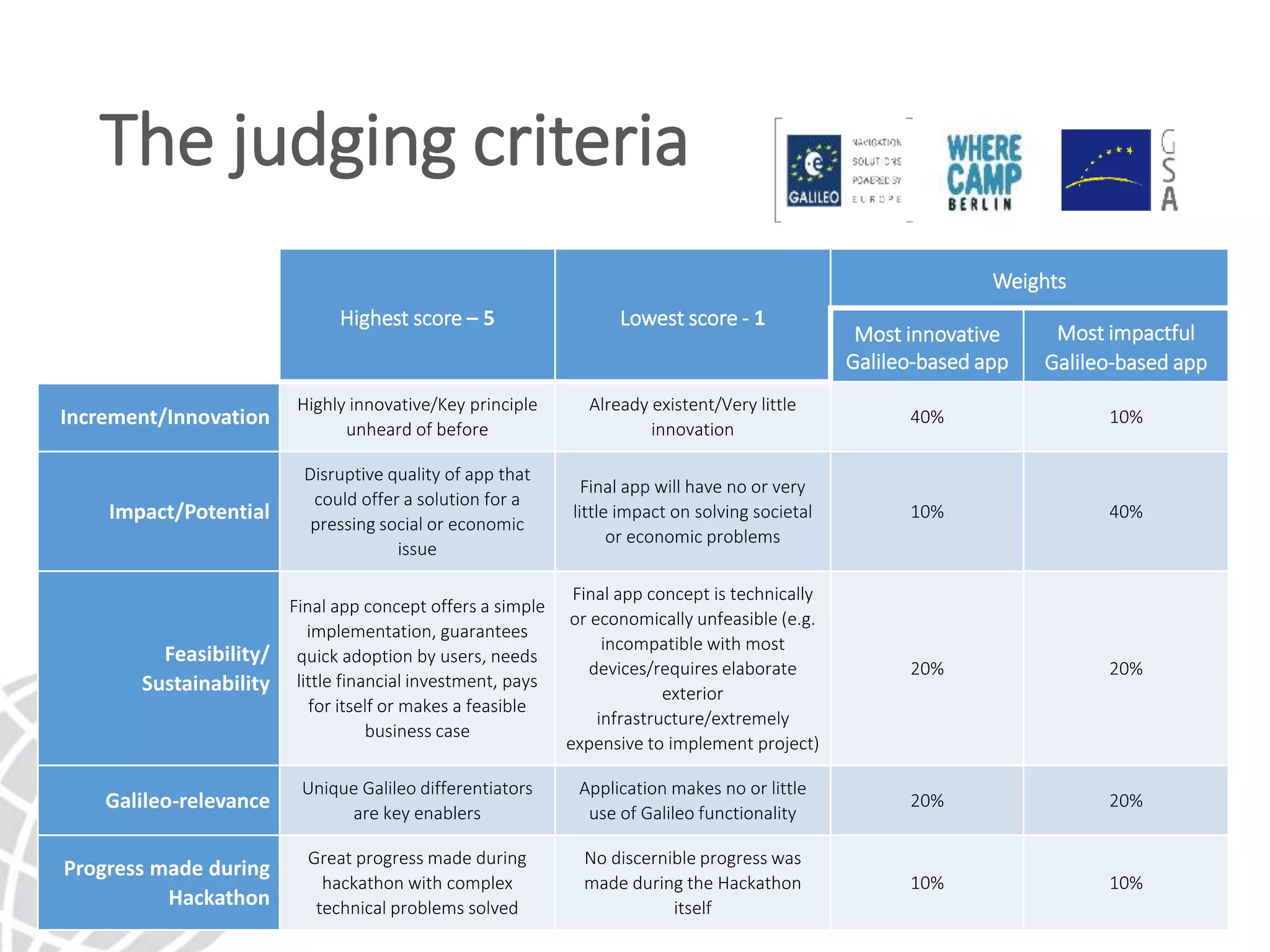
The judging criteria
Highest score – 5 Lowest score - 1
Weights
Most innovative
Galileo-based app
Most impactful
Galileo-based app
Increment/Innovation
Highly innovative/Key principle
unheard of before
Already existent/Very little
innovation
40% 10%
Impact/Potential
Disruptive quality of app that
could offer a solution for a
pressing social or economic
issue
Final app will have no or very
little impact on solving societal
or economic problems
10% 40%
Feasibility/
Sustainability
Final app concept offers a simple
implementation, guarantees
quick adoption by users, needs
little financial investment, pays
for itself or makes a feasible
business case
Final app concept is technically
or economically unfeasible (e.g.
incompatible with most
devices/requires elaborate
exterior
infrastructure/extremely
expensive to implement project)
20% 20%
Galileo-relevance
Unique Galileo differentiators
are key enablers
Application makes no or little
use of Galileo functionality
20% 20%
Progress made during
Hackathon
Great progress made during
hackathon with complex
technical problems solved
No discernible progress was
made during the Hackathon
itself
10% 10%
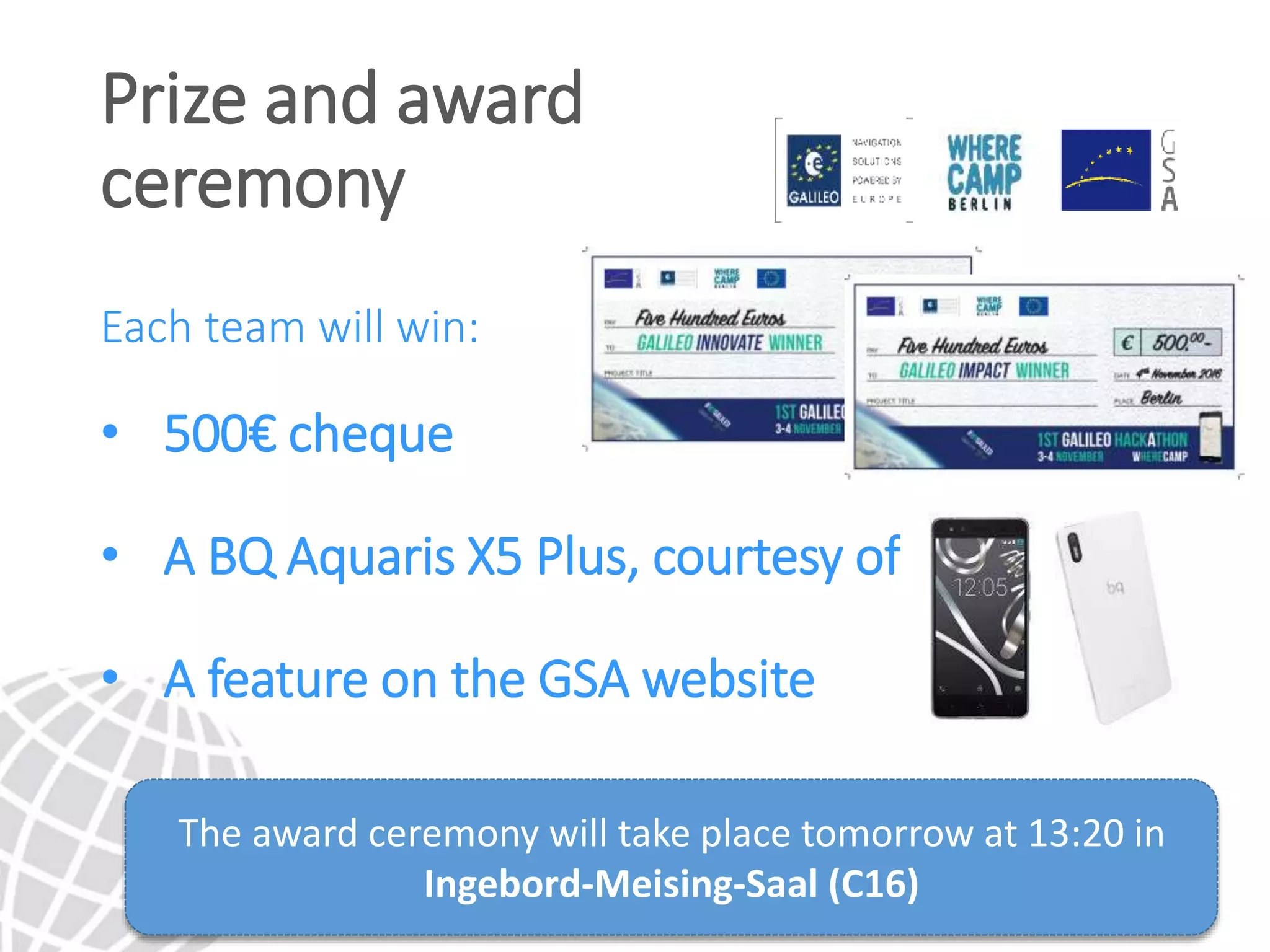
Each team will win:
• 500€ cheque
• A BQ Aquaris X5 Plus, courtesy of BQ
• A feature on the GSA website
Prize and award
ceremony
The award ceremony will take place tomorrow at 13:20 in
Ingebord-Meising-Saal (C16)
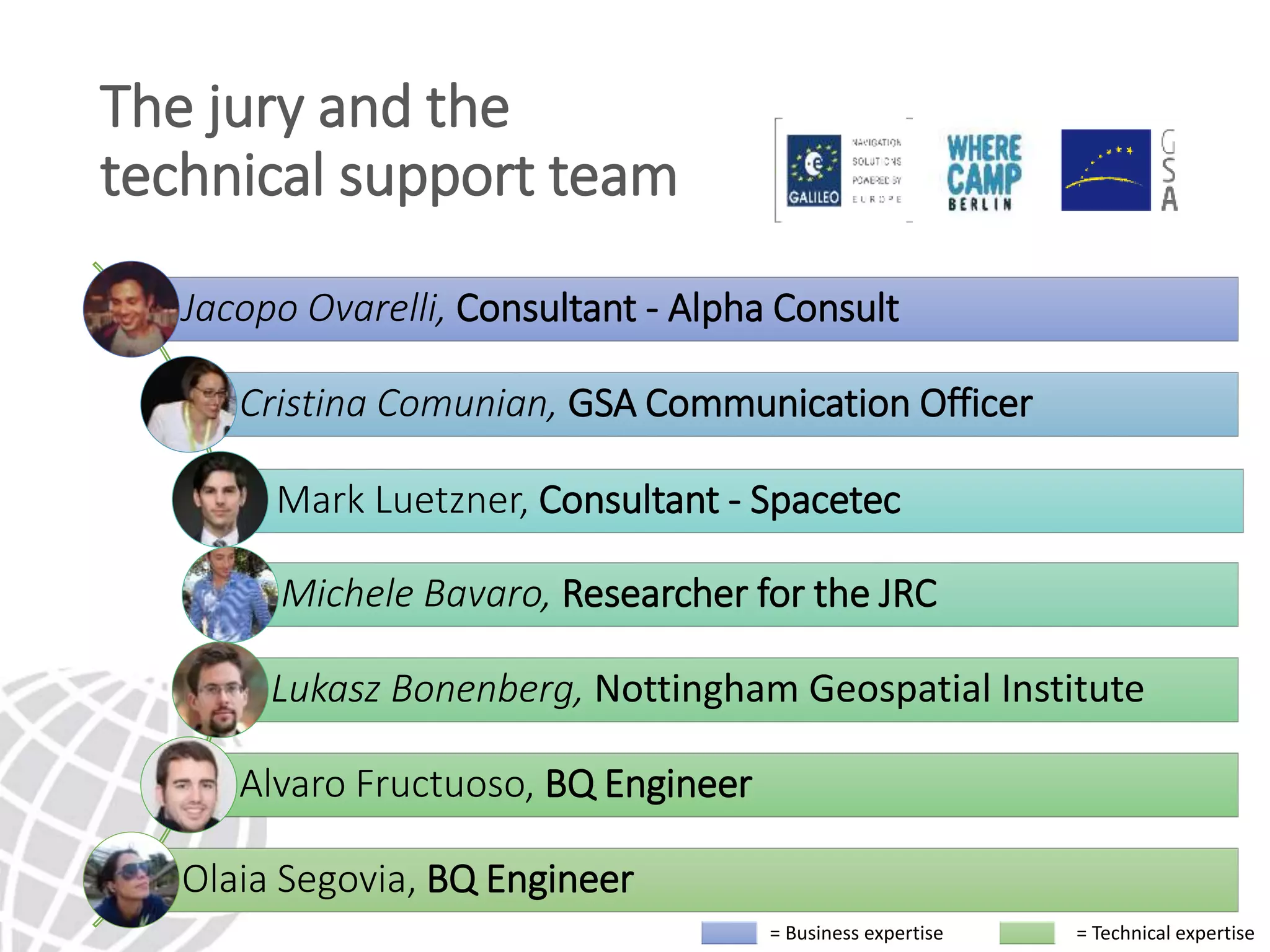
The jury and the
technical support team
Jacopo Ovarelli, Consultant - Alpha Consult
Cristina Comunian, GSA Communication Officer
Mark Luetzner, Consultant - Spacetec
Michele Bavaro, Researcher for the JRC
Lukasz Bonenberg, Nottingham Geospatial Institute
Alvaro Fructuoso, BQ Engineer
Olaia Segovia, BQ Engineer
= Business expertise = Technical expertise
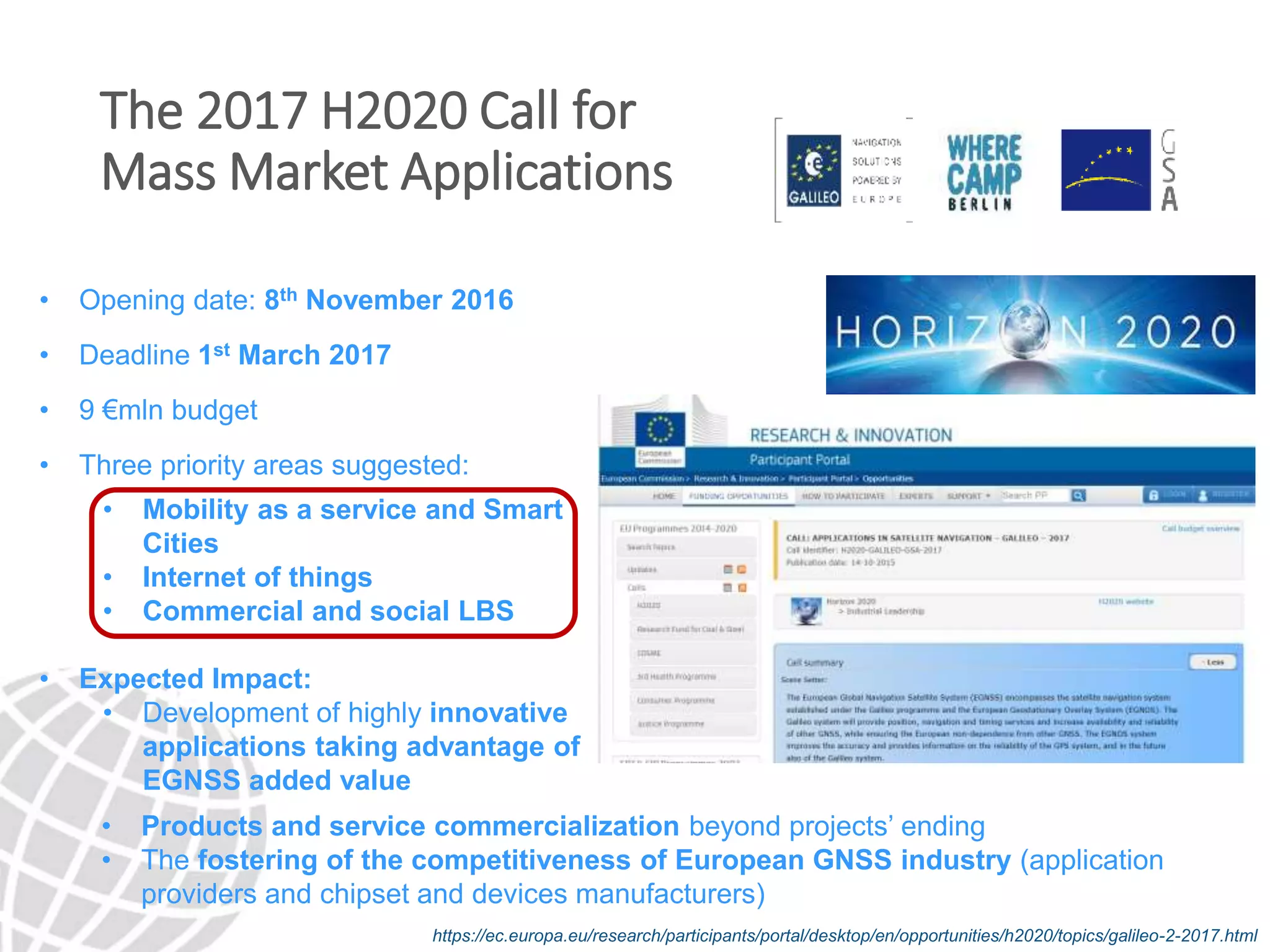
The 2017 H2020 Call for
Mass Market Applications
• Opening date: 8th November 2016
• Deadline 1st March 2017
• 9 €mln budget
• Three priority areas suggested:
• Mobility as a service and Smart
Cities
• Internet of things
• Commercial and social LBS
• Expected Impact:
• Development of highly innovative
applications taking advantage of
EGNSS added value
https://ec.europa.eu/research/participants/portal/desktop/en/opportunities/h2020/topics/galileo-2-2017.html
• Products and service commercialization beyond projects’ ending
• The fostering of the competitiveness of European GNSS industry (application
providers and chipset and devices manufacturers)
Engaging the community
in future events
Thank you
See you in the Hackathon Space in Foyer
Back-up
Galileo is the European GNSS and GSA is in
charge to bring it to the users
 Worldwide navigation system “made in EU”
 Fully interoperable with GPS
 Open service free of charge, delivering dual frequencies
 Signal authentication
 14 satellites already launched and 4 to be launched on Nov 17th
 Initial Service Capability will be declared in December 2016
 Full Operational Capability in 2020 leveraging on 30 satellites
17
The GSA’s mission is to support European Union
objectives and achieve the highest return on
European GNSS investment, in terms of benefits to
users and economic growth and competitiveness
 Staff: c.a. 135
 Nationalities: 21
 Headquarters: Prague
 14 satellites have been launched
 16 satellites are in production:
 4 to be launched in Q4 2016
 The remaining ones by 2020
Galileo’s implementation is progressing with
INITIAL SERVICES in 2016
Initial Operational Capability
Initial services for OS, SAR, PRS,
and demonstrator for CS
2016
Full Operational Capability
Full services, 30 satellites
An independent civilian infrastructure
Galileo is implemented in a step-wise
approach
2020
Test signal for OS-NMA Authentication2018/2019
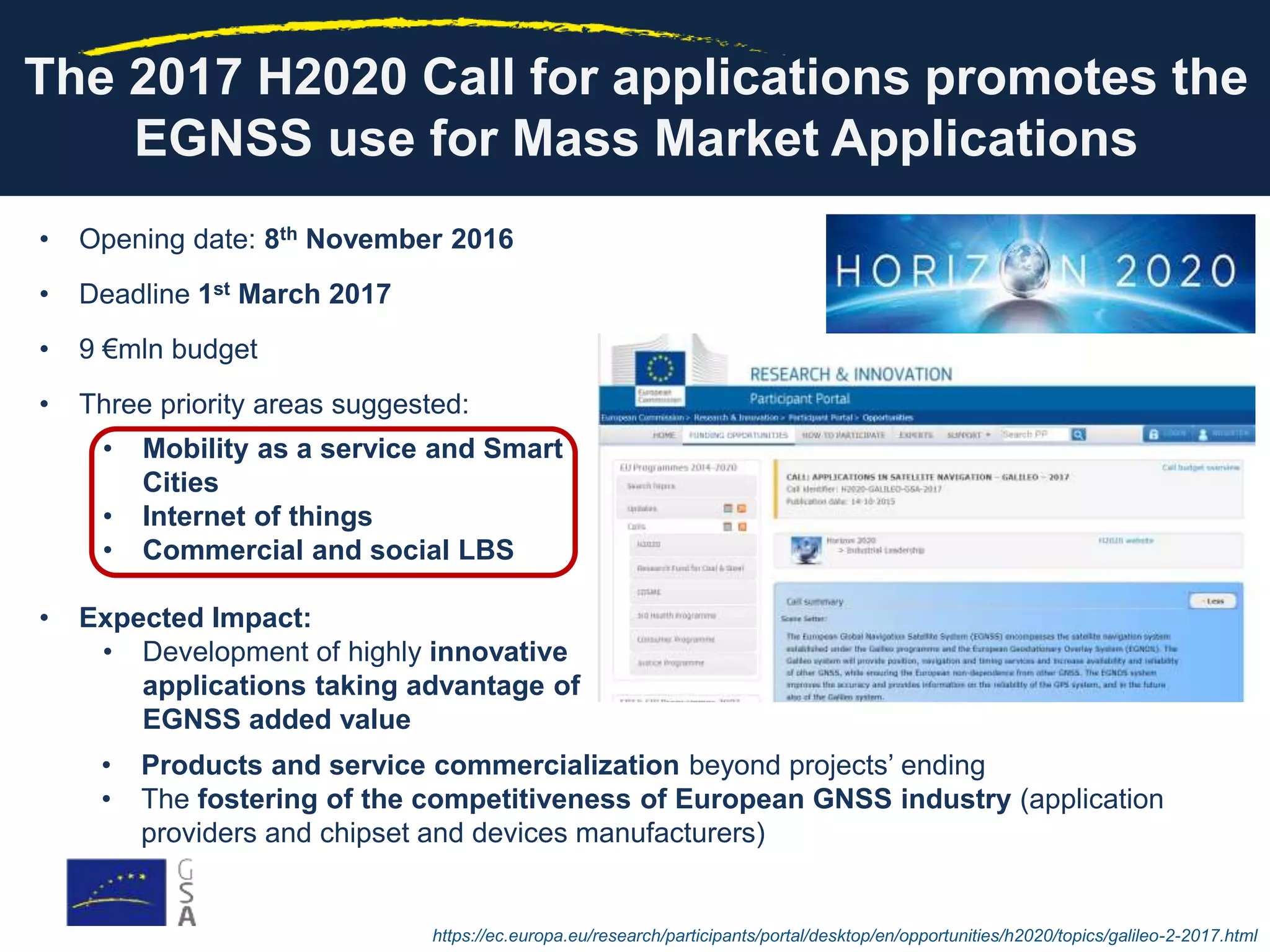
The 2017 H2020 Call for applications promotes the
EGNSS use for Mass Market Applications
• Opening date: 8th November 2016
• Deadline 1st March 2017
• 9 €mln budget
• Three priority areas suggested:
• Mobility as a service and Smart
Cities
• Internet of things
• Commercial and social LBS
• Expected Impact:
• Development of highly innovative
applications taking advantage of
EGNSS added value
https://ec.europa.eu/research/participants/portal/desktop/en/opportunities/h2020/topics/galileo-2-2017.html
• Products and service commercialization beyond projects’ ending
• The fostering of the competitiveness of European GNSS industry (application
providers and chipset and devices manufacturers)

1. Wherecamp Galileo Hackathon Launch Presentation

  • 1.
    Hackathon launch Berlin, WherecampConference 3 November 2016
  • 2.
    App developers we wantyou! A-GNSS providers Users Chipset Manufacturers Device Manufacturers App Developers Mobile Network Operators Full Integration of Galileo Capabilities Greater awareness and real use Up-to-now mainly performed actions targeting the integration of Galileo at hardware level Completed or almost there Some actions performed but not there yet Main focus All top manufacturers engaged and progressively integrating Galileo A-GNSS products and service with Galileo already available in the market Awareness events organized, to be intensified along the availability of Galileo devices First Galileo enabled devices appeared in Q3 2016 Galileo awareness campaign planned leveraging Galileo Initial Services Consultation conducted with main Network operators With Initial Services, the goal is to stimulate a real Galileo use moving further towards users
  • 3.
    The agenda Hackathon Talks HackathonIntroduction Jacopo Ovarelli European GNSS Agency Launch of Galileo-enabled BQ Aquaris X5 Plus Alvaro Fructuoso BQ Galileo testings Michele Bavaro EU Joint Research Center Introduction to GNSS RAW measurements provided by Android Nougat Lukasz Bonenberg Nottingham University Funding opportunities at ESA BIC Angelika Daniels European Space Agency Hackathon launch Jacopo Ovarelli European GNSS Agency Hackathon continuous in Hackathon Space in Foyer until Friday 12:30 h
  • 4.
    Come up withinnovative applications able to bring an added commercial or societal value by using Galileo services! Two winning teams will be announced: • Most innovative Galileo-based app • Most impactful Galileo-based app (i.e. social impact) The challenge
  • 5.
    Why Galileo? Data-less signalof Galileo Development of new value- added services Enhancement of existing ones Multi-constellation Galileo OS Authentication Multipath Resistant Data-less signal of Galileo Multi-constellation Galileo OS Authentication Multipath Resistant = Galileo differentiators= Galileo together other GNSS
  • 6.
    Galileo in multi-GNSSprovides improved accuracy, availability and a faster time-to-first-fix Multi-constellation *Source: “Experimental Results for the Multipath Performance of Galileo Signals Transmitted by GIOVE-A Satellite“, Andrew Simsky, DavidMertens, Jean-Marie Sleewaegen, Martin Hollreiser, and Massimo Crisci, Septentrio, ESA, 2008 ** Above a 15 degree elevation angle over a 24 hours perios GPS only: Average number of satellites in view GPS, Glonass, Galileo, Beidou, IRNSS and QZSS: Average number of satellites in view*
  • 7.
    OS authentication enhancesthe use of GNSS location in commercially - sensitive apps • Galileo is expected to be the only GNSS providing Open Service authentication • A data encryption solution enhancing GNSS reliability: – Enabling commercially sensitive applications – Enhancing big data collection Galileo OS Authentication Todd Humphreys* at TED *Director of the University of Texas at Austin's Radionavigation Laboratory and leading expert on security issues related to GNSS, full video available at https://www.youtube.com/watch?v=r4UdHE3JNnU
  • 8.
    Galileo improves GNSSlocation in challenging urban environments Multipath Resistant **Source: “Estimating the Time-To-First-Fix for GNSS Signals Theory and Simulation Results”‘ Marco Anghileri, Matteo Paonni, Stefan Wallner, José-Ángel Ávila-Rodríguez, Bernd Eissfeller, Institute of Geodesy and Navigation, University FAF Munich, Germany’ The strength of Galileo signal, together with an advanced code modulations, makes Galileo better mitigating multipath effects (especially in E5, but also E1)**
  • 9.
    Galileo data-less signalfurther improves location performances Using the data-less signal with a 100ms length for the secondary code, already integrated within Galileo chipsets from leading providers, allows for: • an enhanced penetration into light indoor environments • improved performances in urban canyon • better performances in noise measurements • improved sensitivity in A-GNSS mode Data-less signal of Galileo
  • 10.
    The judging criteria Highestscore – 5 Lowest score - 1 Weights Most innovative Galileo-based app Most impactful Galileo-based app Increment/Innovation Highly innovative/Key principle unheard of before Already existent/Very little innovation 40% 10% Impact/Potential Disruptive quality of app that could offer a solution for a pressing social or economic issue Final app will have no or very little impact on solving societal or economic problems 10% 40% Feasibility/ Sustainability Final app concept offers a simple implementation, guarantees quick adoption by users, needs little financial investment, pays for itself or makes a feasible business case Final app concept is technically or economically unfeasible (e.g. incompatible with most devices/requires elaborate exterior infrastructure/extremely expensive to implement project) 20% 20% Galileo-relevance Unique Galileo differentiators are key enablers Application makes no or little use of Galileo functionality 20% 20% Progress made during Hackathon Great progress made during hackathon with complex technical problems solved No discernible progress was made during the Hackathon itself 10% 10%
  • 11.
    Each team willwin: • 500€ cheque • A BQ Aquaris X5 Plus, courtesy of BQ • A feature on the GSA website Prize and award ceremony The award ceremony will take place tomorrow at 13:20 in Ingebord-Meising-Saal (C16)
  • 12.
    The jury andthe technical support team Jacopo Ovarelli, Consultant - Alpha Consult Cristina Comunian, GSA Communication Officer Mark Luetzner, Consultant - Spacetec Michele Bavaro, Researcher for the JRC Lukasz Bonenberg, Nottingham Geospatial Institute Alvaro Fructuoso, BQ Engineer Olaia Segovia, BQ Engineer = Business expertise = Technical expertise
  • 13.
    The 2017 H2020Call for Mass Market Applications • Opening date: 8th November 2016 • Deadline 1st March 2017 • 9 €mln budget • Three priority areas suggested: • Mobility as a service and Smart Cities • Internet of things • Commercial and social LBS • Expected Impact: • Development of highly innovative applications taking advantage of EGNSS added value https://ec.europa.eu/research/participants/portal/desktop/en/opportunities/h2020/topics/galileo-2-2017.html • Products and service commercialization beyond projects’ ending • The fostering of the competitiveness of European GNSS industry (application providers and chipset and devices manufacturers)
  • 14.
  • 15.
    Thank you See youin the Hackathon Space in Foyer
  • 16.
  • 17.
    Galileo is theEuropean GNSS and GSA is in charge to bring it to the users  Worldwide navigation system “made in EU”  Fully interoperable with GPS  Open service free of charge, delivering dual frequencies  Signal authentication  14 satellites already launched and 4 to be launched on Nov 17th  Initial Service Capability will be declared in December 2016  Full Operational Capability in 2020 leveraging on 30 satellites 17 The GSA’s mission is to support European Union objectives and achieve the highest return on European GNSS investment, in terms of benefits to users and economic growth and competitiveness  Staff: c.a. 135  Nationalities: 21  Headquarters: Prague
  • 18.
     14 satelliteshave been launched  16 satellites are in production:  4 to be launched in Q4 2016  The remaining ones by 2020 Galileo’s implementation is progressing with INITIAL SERVICES in 2016 Initial Operational Capability Initial services for OS, SAR, PRS, and demonstrator for CS 2016 Full Operational Capability Full services, 30 satellites An independent civilian infrastructure Galileo is implemented in a step-wise approach 2020 Test signal for OS-NMA Authentication2018/2019
  • 19.
    The 2017 H2020Call for applications promotes the EGNSS use for Mass Market Applications • Opening date: 8th November 2016 • Deadline 1st March 2017 • 9 €mln budget • Three priority areas suggested: • Mobility as a service and Smart Cities • Internet of things • Commercial and social LBS • Expected Impact: • Development of highly innovative applications taking advantage of EGNSS added value https://ec.europa.eu/research/participants/portal/desktop/en/opportunities/h2020/topics/galileo-2-2017.html • Products and service commercialization beyond projects’ ending • The fostering of the competitiveness of European GNSS industry (application providers and chipset and devices manufacturers)