Global Information Infrastructure and Networking Symposium (GIIS 2018)Global Information Infrastructure and Networking Symposium (GIIS 2018)
A Survey on Medium Access Control Schemes for
5G Vehicular Cloud Computing Systems
Emmanouil Skondras1, Angelos Michalas2, Dimitrios D. Vergados1
1Department of Informatics, University of Piraeus, Piraeus, Greece,
Email: {skondras, vergados}@unipi.gr
2Department of Informatics Engineering, Technological Educational Institute of Western
Macedonia, Kastoria, Greece, Email: amichalas@kastoria.teiwm.gr
1
Global Information Infrastructure and Networking Symposium (GIIS 2018)Global Information Infrastructure and Networking Symposium (GIIS 2018)
Outline
2
• Introduction.
• Brief overview of existing MAC schemes.
• TDMA-based MAC schemes.
• CSMA/CA-based MAC schemes.
• Hybrid MAC schemes.
• Discussion.
• Conclusion.
Global Information Infrastructure and Networking Symposium (GIIS 2018)Global Information Infrastructure and Networking Symposium (GIIS 2018)
Introduction
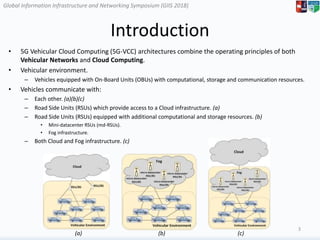
• 5G Vehicular Cloud Computing (5G-VCC) architectures combine the operating principles of both
Vehicular Networks and Cloud Computing.
• Vehicular environment.
– Vehicles equipped with On-Board Units (OBUs) with computational, storage and communication resources.
• Vehicles communicate with:
– Each other. (a)(b)(c)
– Road Side Units (RSUs) which provide access to a Cloud infrastructure. (a)
– Road Side Units (RSUs) equipped with additional computational and storage resources. (b)
• Mini-datacenter RSUs (md-RSUs).
• Fog infrastructure.
– Both Cloud and Fog infrastructure. (c)
3
(a) (b) (c)
Global Information Infrastructure and Networking Symposium (GIIS 2018)Global Information Infrastructure and Networking Symposium (GIIS 2018)
Introduction
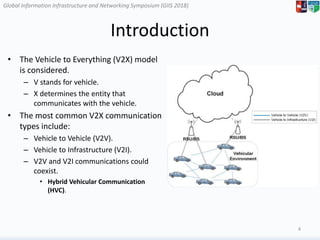
• The Vehicle to Everything (V2X) model
is considered.
– V stands for vehicle.
– X determines the entity that
communicates with the vehicle.
• The most common V2X communication
types include:
– Vehicle to Vehicle (V2V).
– Vehicle to Infrastructure (V2I).
– V2V and V2I communications could
coexist.
• Hybrid Vehicular Communication
(HVC).
4
Global Information Infrastructure and Networking Symposium (GIIS 2018)Global Information Infrastructure and Networking Symposium (GIIS 2018)
Introduction
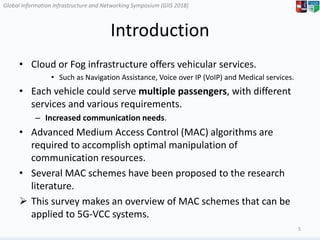
• Cloud or Fog infrastructure offers vehicular services.
• Such as Navigation Assistance, Voice over IP (VoIP) and Medical services.
• Each vehicle could serve multiple passengers, with different
services and various requirements.
– Increased communication needs.
• Advanced Medium Access Control (MAC) algorithms are
required to accomplish optimal manipulation of
communication resources.
• Several MAC schemes have been proposed to the research
literature.
 This survey makes an overview of MAC schemes that can be
applied to 5G-VCC systems.
5
Global Information Infrastructure and Networking Symposium (GIIS 2018)Global Information Infrastructure and Networking Symposium (GIIS 2018)
Brief overview of existing MAC schemes
6
Global Information Infrastructure and Networking Symposium (GIIS 2018)Global Information Infrastructure and Networking Symposium (GIIS 2018)
Medium Access Control (MAC)
schemes for 5G-VCC systems
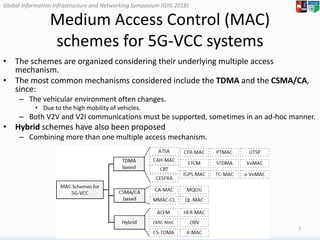
• The schemes are organized considering their underlying multiple access
mechanism.
• The most common mechanisms considered include the TDMA and the CSMA/CA,
since:
– The vehicular environment often changes.
• Due to the high mobility of vehicles.
– Both V2V and V2I communications must be supported, sometimes in an ad-hoc manner.
• Hybrid schemes have also been proposed
– Combining more than one multiple access mechanism.
7
Global Information Infrastructure and Networking Symposium (GIIS 2018)Global Information Infrastructure and Networking Symposium (GIIS 2018)
TDMA-based MAC schemes
• TDMA-based MAC schemes share the
medium in the field of time.
 Adaptive TDMA Slot Assignment (ATSA)
[yang2013]
• Each vehicle selects a frame length, which is:
– reduced to improve channel utilization when
vehicle density becomes low,
– increased when vehicle density becomes high to
ensure that each vehicle can access the medium.
• Time slots are divided in two sets.
– Left and Right set.
• A slot management mechanism based on a
binary tree model is used.
– The vehicles on the left sub-tree can compete for
the Left time slots.
– The vehicles on the right sub-tree can compete
for the Right time slots.
• When a vehicle receives slot allocation
information from its neighbors, it discovers
which slots are in use.
– The remaining slots are available to compete for.
8
Global Information Infrastructure and Networking Symposium (GIIS 2018)Global Information Infrastructure and Networking Symposium (GIIS 2018)
TDMA-based MAC schemes
 Cluster Based TDMA (CBT) [sheu2014].
• It provides a mechanism for both intra-cluster and inter-
cluster communication.
– To minimize the packet collisions that could occur when two
clusters are moving in close places.
• In each cluster:
– The vehicles are timely synchronized using their GPS devices.
– One vehicle is elected as the Cluster Head (CH).
• A TDMA technique is used where each frame consists of N
time slots.
• The CH:
– Maintains a Slot Allocation Map (SAM) allocating time slots to
vehicles.
– Periodically broadcasts its SAM to its cluster's vehicles as well as
a beacon frame.
• The cluster remains in intra-cluster communication state if
beacon frames from CHs of other clusters are not received.
• If a beacon frame comes from an external CH.
– The two neighboring clusters' CHs exchange their SAMs in order
inter-cluster interference to be prevented.
• The CH that successfully sends first its SAM is considered as
the Winner.
– The other CH is considered as the Looser and must reschedule
its own SAM.
9
Global Information Infrastructure and Networking Symposium (GIIS 2018)Global Information Infrastructure and Networking Symposium (GIIS 2018)
TDMA-based MAC schemes
 Cross-layer Extended Sliding Frame
Reservation Aloha (CESFRA)
[rahman2014].
• It defines that safety information is
disseminated up to the third hop
neighboring vehicles.
– Without any routing scheme.
• The scheme divides each frame into N time
slots.
• All the vehicles are timely synchronized
using their GPS devices.
• When a vehicle has packets to transmit.
– Allocates an idle time slot.
– Starts transmitting its packets.
– The time slot is reserved by the vehicle in the
subsequent frames in order to transmit the
remaining packets.
10
Global Information Infrastructure and Networking Symposium (GIIS 2018)Global Information Infrastructure and Networking Symposium (GIIS 2018)
TDMA-based MAC schemes
 Collision Free Reservation MAC (CFR-MAC)
[zou2014].
• It considers the vehicles' traffic flows as well as
their velocities.
• Time slots are divided into two sets:
– The Left and the Right set.
• The Left set is assigned to vehicles that are moving
to the one direction.
• The Right set is assigned to vehicles moving to the
other.
• When multiple vehicles move on the same street
with different velocities.
– The interference levels are constantly changing.
• Leading on unpredictable changes in the medium
quality.
• CFR-MAC addresses this problem by dividing each
slots set into three subsets, while each subset is
associated to a specific velocity, namely:
– High velocity.
– Medium velocity.
– Low velocity.
• The interference levels inside each subset become
less variable and the medium quality more
resistant.
11
Global Information Infrastructure and Networking Symposium (GIIS 2018)Global Information Infrastructure and Networking Symposium (GIIS 2018)
TDMA-based MAC schemes
 Enhanced TDMA Cluster-based MAC
(ETCM) [shahin2016].
• The vehicles are organized into
clusters.
• A vehicle of each cluster is defined as
the CH.
• The CH applies a TDMA based method
to assign time slots to cluster's
vehicles.
12
Global Information Infrastructure and Networking Symposium (GIIS 2018)Global Information Infrastructure and Networking Symposium (GIIS 2018)
TDMA-based MAC schemes
 Prediction-based TDMA MAC (PTMAC)
[jiang2015].
• Its main operating principle is the packet
collisions prediction.
• PTMAC consists of three parts:
– Collision prediction.
• Data traffic and vehicles mobility
information is used in order potential
future data collisions to be predicted.
– Collision detection.
• It uses time slots information to detect
collisions that occurred in cases where
two vehicles transmit data using the
same time slot.
– Collision elimination.
• It reschedules the slots considering
information obtained from both collision
prediction and collision detection parts.
– In order the packet collisions to be
eliminated.
13
Global Information Infrastructure and Networking Symposium (GIIS 2018)Global Information Infrastructure and Networking Symposium (GIIS 2018)
TDMA-based MAC schemes
 Unified TDMA-Based Scheduling
Protocol (UTSP) [zhang2015].
• Centralized resource allocation
mechanism for V2I communication.
• The RSU:
– Collects information about:
• Channel state.
• Vehicles' velocities.
• Priorities of the vehicles' services.
– Uses a weighted function to compute
a score for each vehicle.
– Assigns TDMA time slots to each
vehicle according to its score.
14
Global Information Infrastructure and Networking Symposium (GIIS 2018)Global Information Infrastructure and Networking Symposium (GIIS 2018)
TDMA-based MAC schemes
• Vehicular MAC (VeMAC) [omar2013].
• Similar to CBT and CFR-MAC schemes, two
vehicles' moving directions are considered.
– The Left and the Right direction.
• A set of time slots is assigned to vehicles
that move in each direction.
• Using these time slots, the vehicles of each
direction communicate with each other.
 In [nguyen2014] the enhanced-VeMAC (e-
VeMAC) scheme is proposed.
– It is based on the insight of the one-hop
neighboring vehicles.
• To improve the performance of the VeMAC
scheme when parallel transmission occurs.
15
Global Information Infrastructure and Networking Symposium (GIIS 2018)Global Information Infrastructure and Networking Symposium (GIIS 2018)
TDMA-based MAC schemes
• Other TDMA-based schemes include:
– The Cooperative ADHOC MAC (CAH-
MAC) [bharati2013].
– The Improved Generalized Prime
Sequence Based MAC (IGPS-MAC)
[zheng2014].
– The Self-organizing Time Division
Multiple Access (STDMA) [yu2013].
– The TDMA Cluster-based MAC (TC-
MAC) [almalag2012].
16
Global Information Infrastructure and Networking Symposium (GIIS 2018)Global Information Infrastructure and Networking Symposium (GIIS 2018)
CSMA/CA-based MAC schemes
• The schemes of this category share the
medium by applying the CSMA/CA
operating principles.
 Context Aware MAC (CA-MAC) [yi2014].
• It considers the network load status.
• Two parts:
– Reasoning part.
• Obtains the network load based on context
information.
• The network is characterized as congested, idle
or normal.
– Self-adaption part.
• Considers the obtained network load
• Dynamically adjusts the size of a Contention
Window, which is used for channel reservation
by the vehicles.
– If high network load is observed,
» the CW is incremented to reduce the
collisions probability.
– If low network load is observed
» the CW is decreased to avoid
unnecessary medium access delays.
– The CW will remain unchanged, if the Reasoning
part indicates that the network status is normal.
17
Global Information Infrastructure and Networking Symposium (GIIS 2018)Global Information Infrastructure and Networking Symposium (GIIS 2018)
CSMA/CA-based MAC schemes
 Multichannel MAC - Cross Layer
(MMAC-CL) [fazio2015].
• It aims to reduce the interference
between vehicles.
– Using two multichannel radio
interfaces per vehicle.
• Transmission channels are selected
considering a Signal to Interference
Ratio (SIR) evaluation.
– To minimize the cochannel
interference observed by the vehicles.
18
Global Information Infrastructure and Networking Symposium (GIIS 2018)Global Information Infrastructure and Networking Symposium (GIIS 2018)
CSMA/CA-based MAC schemes
• Multichannel QoS Cognitive MAC
(MQOG) [el2012].
• It is multichannel scheme using:
– A CCH for control information
exchange.
– Multiple SCHs for data transmission.
• Each vehicle:
– Tracks its neighbors' communications
using a Channel Neighbor State Table
(CNST).
– Assesses the interference level in each
channel.
– Acquires the best SCH channel for data
transmission.
• Vehicles obtain information from the
CCH in order to update their CNST
tables.
19
Global Information Infrastructure and Networking Symposium (GIIS 2018)Global Information Infrastructure and Networking Symposium (GIIS 2018)
CSMA/CA-based MAC schemes
• Q-Learning MAC (QL-MAC)
[wu2014].
• A Contention Window (CW) is
defined.
– The best CW size is evaluated
using a Q-Learning algorithm.
• A positive reward is awarded to
each vehicle when a data frame is
successfully transferred.
• A negative reward is given when a
data frame transmission is failed.
• The dynamic CW size adjustment:
– Reduces the packet collisions.
– Succeeds low medium access
delay.
20
Global Information Infrastructure and Networking Symposium (GIIS 2018)Global Information Infrastructure and Networking Symposium (GIIS 2018)
Hybrid MAC schemes
• Use more than one multiple access mechanisms.
• Adaptive Collision Free MAC (ACFM) [guo2012]
scheme combines both TDMA and FDMA.
• It implements a time slot reservation mechanism
located at each RSU.
• Each frame operates in a specific frequency and
contains 36 time slots that can be used for data
transmission and 1 slot that is called RSU Slot (RS).
• Each RSU maintains a Slot Assignment Cycle (SAC)
for the next 100ms of time, while each cycle can
contain from 1 and up to 5 frames according to the
vehicles density.
– If vehicles density is low, the RSU uses few frames in
order to avoid situations where a lot of slots remain
unused.
– If vehicles density is high, the RSU uses more frames
in order to support the increased needs for
resources.
21
Global Information Infrastructure and Networking Symposium (GIIS 2018)Global Information Infrastructure and Networking Symposium (GIIS 2018)
Hybrid MAC schemes
• Cluster Based RSU Centric MAC
(CBRC-MAC) [zhang2013].
– Similar to ACFM scheme, it combines
both TDMA and FDMA for providing
multiple access to vehicles.
• CSMA-based Self-Organizing TDMA
(CS-TDMA) [zhang2014].
– Combines TDMA, CSMA/CA and SDMA to
support both safety and non-safety
applications.
• Some schemes combine TDMA with
CSMA/CA to accomplish the multiple
access:
– Hybrid Efficient and Reliable MAC (HER-
MAC) [dang2014].
– OFDMA-based MAC scheme for VANETs
(OBV) [bazzi2015].
– Risk-Aware MAC (R-MAC) [guo2013].
22
Global Information Infrastructure and Networking Symposium (GIIS 2018)Global Information Infrastructure and Networking Symposium (GIIS 2018)
Discussion
• Most of the available MAC schemes have been
designed for vehicular systems.
– Not necessarily for 5G-VCC systems.
• However, they could be easily applied to the
vehicular part of a 5G-VCC architecture.
• The study of these schemes reveal that
different approaches have been proposed to
the literature.
23
Global Information Infrastructure and Networking Symposium (GIIS 2018)Global Information Infrastructure and Networking Symposium (GIIS 2018)
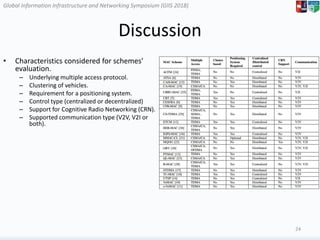
Discussion
• Characteristics considered for schemes’
evaluation.
– Underlying multiple access protocol.
– Clustering of vehicles.
– Requirement for a positioning system.
– Control type (centralized or decentralized)
– Support for Cognitive Radio Networking (CRN).
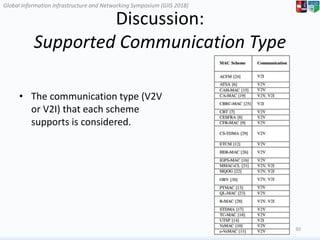
– Supported communication type (V2V, V2I or
both).
24
Global Information Infrastructure and Networking Symposium (GIIS 2018)Global Information Infrastructure and Networking Symposium (GIIS 2018)
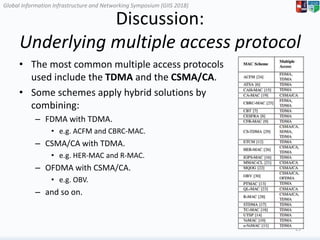
Discussion:
Underlying multiple access protocol
• The most common multiple access protocols
used include the TDMA and the CSMA/CA.
• Some schemes apply hybrid solutions by
combining:
– FDMA with TDMA.
• e.g. ACFM and CBRC-MAC.
– CSMA/CA with TDMA.
• e.g. HER-MAC and R-MAC.
– OFDMA with CSMA/CA.
• e.g. OBV.
– and so on.
25
Global Information Infrastructure and Networking Symposium (GIIS 2018)Global Information Infrastructure and Networking Symposium (GIIS 2018)
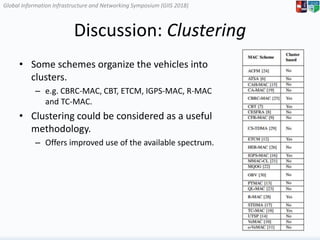
Discussion: Clustering
• Some schemes organize the vehicles into
clusters.
– e.g. CBRC-MAC, CBT, ETCM, IGPS-MAC, R-MAC
and TC-MAC.
• Clustering could be considered as a useful
methodology.
– Offers improved use of the available spectrum.
26
Global Information Infrastructure and Networking Symposium (GIIS 2018)Global Information Infrastructure and Networking Symposium (GIIS 2018)
Discussion:
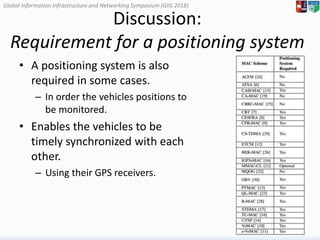
Requirement for a positioning system
• A positioning system is also
required in some cases.
– In order the vehicles positions to
be monitored.
• Enables the vehicles to be
timely synchronized with each
other.
– Using their GPS receivers.
27
Global Information Infrastructure and Networking Symposium (GIIS 2018)Global Information Infrastructure and Networking Symposium (GIIS 2018)
Discussion:
Control type
• Distributed control distributes the
resource manipulation workload.
– It could be applied to 5G-VCC architectures:
• Considering the operating principles of the Fog
computing [mahmud2018].
• Centralized control simplifies the
manipulation of communication resources.
– It could be applied to 5G-VCC architectures:
• Using a Software Defined Network (SDN)
[li2018] controller.
• Which supervises the manipulation of the entire
system.
28
Global Information Infrastructure and Networking Symposium (GIIS 2018)Global Information Infrastructure and Networking Symposium (GIIS 2018)
Discussion:
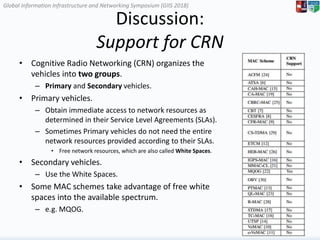
Support for CRN
• Cognitive Radio Networking (CRN) organizes the
vehicles into two groups.
– Primary and Secondary vehicles.
• Primary vehicles.
– Obtain immediate access to network resources as
determined in their Service Level Agreements (SLAs).
– Sometimes Primary vehicles do not need the entire
network resources provided according to their SLAs.
• Free network resources, which are also called White Spaces.
• Secondary vehicles.
– Use the White Spaces.
• Some MAC schemes take advantage of free white
spaces into the available spectrum.
– e.g. MQOG.
29
Global Information Infrastructure and Networking Symposium (GIIS 2018)Global Information Infrastructure and Networking Symposium (GIIS 2018)
Discussion:
Supported Communication Type
• The communication type (V2V
or V2I) that each scheme
supports is considered.
30
Global Information Infrastructure and Networking Symposium (GIIS 2018)Global Information Infrastructure and Networking Symposium (GIIS 2018)
Conclusion
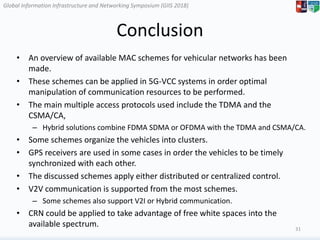
• An overview of available MAC schemes for vehicular networks has been
made.
• These schemes can be applied in 5G-VCC systems in order optimal
manipulation of communication resources to be performed.
• The main multiple access protocols used include the TDMA and the
CSMA/CA,
– Hybrid solutions combine FDMA SDMA or OFDMA with the TDMA and CSMA/CA.
• Some schemes organize the vehicles into clusters.
• GPS receivers are used in some cases in order the vehicles to be timely
synchronized with each other.
• The discussed schemes apply either distributed or centralized control.
• V2V communication is supported from the most schemes.
– Some schemes also support V2I or Hybrid communication.
• CRN could be applied to take advantage of free white spaces into the
available spectrum. 31
Global Information Infrastructure and Networking Symposium (GIIS 2018)Global Information Infrastructure and Networking Symposium (GIIS 2018)
32

A Survey on Medium Access Control Schemes for 5G Vehicular Cloud Computing Systems (presentation)

  • 1.
    Global Information Infrastructureand Networking Symposium (GIIS 2018)Global Information Infrastructure and Networking Symposium (GIIS 2018) A Survey on Medium Access Control Schemes for 5G Vehicular Cloud Computing Systems Emmanouil Skondras1, Angelos Michalas2, Dimitrios D. Vergados1 1Department of Informatics, University of Piraeus, Piraeus, Greece, Email: {skondras, vergados}@unipi.gr 2Department of Informatics Engineering, Technological Educational Institute of Western Macedonia, Kastoria, Greece, Email: amichalas@kastoria.teiwm.gr 1
  • 2.
    Global Information Infrastructureand Networking Symposium (GIIS 2018)Global Information Infrastructure and Networking Symposium (GIIS 2018) Outline 2 • Introduction. • Brief overview of existing MAC schemes. • TDMA-based MAC schemes. • CSMA/CA-based MAC schemes. • Hybrid MAC schemes. • Discussion. • Conclusion.
  • 3.
    Global Information Infrastructureand Networking Symposium (GIIS 2018)Global Information Infrastructure and Networking Symposium (GIIS 2018) Introduction • 5G Vehicular Cloud Computing (5G-VCC) architectures combine the operating principles of both Vehicular Networks and Cloud Computing. • Vehicular environment. – Vehicles equipped with On-Board Units (OBUs) with computational, storage and communication resources. • Vehicles communicate with: – Each other. (a)(b)(c) – Road Side Units (RSUs) which provide access to a Cloud infrastructure. (a) – Road Side Units (RSUs) equipped with additional computational and storage resources. (b) • Mini-datacenter RSUs (md-RSUs). • Fog infrastructure. – Both Cloud and Fog infrastructure. (c) 3 (a) (b) (c)
  • 4.
    Global Information Infrastructureand Networking Symposium (GIIS 2018)Global Information Infrastructure and Networking Symposium (GIIS 2018) Introduction • The Vehicle to Everything (V2X) model is considered. – V stands for vehicle. – X determines the entity that communicates with the vehicle. • The most common V2X communication types include: – Vehicle to Vehicle (V2V). – Vehicle to Infrastructure (V2I). – V2V and V2I communications could coexist. • Hybrid Vehicular Communication (HVC). 4
  • 5.
    Global Information Infrastructureand Networking Symposium (GIIS 2018)Global Information Infrastructure and Networking Symposium (GIIS 2018) Introduction • Cloud or Fog infrastructure offers vehicular services. • Such as Navigation Assistance, Voice over IP (VoIP) and Medical services. • Each vehicle could serve multiple passengers, with different services and various requirements. – Increased communication needs. • Advanced Medium Access Control (MAC) algorithms are required to accomplish optimal manipulation of communication resources. • Several MAC schemes have been proposed to the research literature.  This survey makes an overview of MAC schemes that can be applied to 5G-VCC systems. 5
  • 6.
    Global Information Infrastructureand Networking Symposium (GIIS 2018)Global Information Infrastructure and Networking Symposium (GIIS 2018) Brief overview of existing MAC schemes 6
  • 7.
    Global Information Infrastructureand Networking Symposium (GIIS 2018)Global Information Infrastructure and Networking Symposium (GIIS 2018) Medium Access Control (MAC) schemes for 5G-VCC systems • The schemes are organized considering their underlying multiple access mechanism. • The most common mechanisms considered include the TDMA and the CSMA/CA, since: – The vehicular environment often changes. • Due to the high mobility of vehicles. – Both V2V and V2I communications must be supported, sometimes in an ad-hoc manner. • Hybrid schemes have also been proposed – Combining more than one multiple access mechanism. 7
  • 8.
    Global Information Infrastructureand Networking Symposium (GIIS 2018)Global Information Infrastructure and Networking Symposium (GIIS 2018) TDMA-based MAC schemes • TDMA-based MAC schemes share the medium in the field of time.  Adaptive TDMA Slot Assignment (ATSA) [yang2013] • Each vehicle selects a frame length, which is: – reduced to improve channel utilization when vehicle density becomes low, – increased when vehicle density becomes high to ensure that each vehicle can access the medium. • Time slots are divided in two sets. – Left and Right set. • A slot management mechanism based on a binary tree model is used. – The vehicles on the left sub-tree can compete for the Left time slots. – The vehicles on the right sub-tree can compete for the Right time slots. • When a vehicle receives slot allocation information from its neighbors, it discovers which slots are in use. – The remaining slots are available to compete for. 8
  • 9.
    Global Information Infrastructureand Networking Symposium (GIIS 2018)Global Information Infrastructure and Networking Symposium (GIIS 2018) TDMA-based MAC schemes  Cluster Based TDMA (CBT) [sheu2014]. • It provides a mechanism for both intra-cluster and inter- cluster communication. – To minimize the packet collisions that could occur when two clusters are moving in close places. • In each cluster: – The vehicles are timely synchronized using their GPS devices. – One vehicle is elected as the Cluster Head (CH). • A TDMA technique is used where each frame consists of N time slots. • The CH: – Maintains a Slot Allocation Map (SAM) allocating time slots to vehicles. – Periodically broadcasts its SAM to its cluster's vehicles as well as a beacon frame. • The cluster remains in intra-cluster communication state if beacon frames from CHs of other clusters are not received. • If a beacon frame comes from an external CH. – The two neighboring clusters' CHs exchange their SAMs in order inter-cluster interference to be prevented. • The CH that successfully sends first its SAM is considered as the Winner. – The other CH is considered as the Looser and must reschedule its own SAM. 9
  • 10.
    Global Information Infrastructureand Networking Symposium (GIIS 2018)Global Information Infrastructure and Networking Symposium (GIIS 2018) TDMA-based MAC schemes  Cross-layer Extended Sliding Frame Reservation Aloha (CESFRA) [rahman2014]. • It defines that safety information is disseminated up to the third hop neighboring vehicles. – Without any routing scheme. • The scheme divides each frame into N time slots. • All the vehicles are timely synchronized using their GPS devices. • When a vehicle has packets to transmit. – Allocates an idle time slot. – Starts transmitting its packets. – The time slot is reserved by the vehicle in the subsequent frames in order to transmit the remaining packets. 10
  • 11.
    Global Information Infrastructureand Networking Symposium (GIIS 2018)Global Information Infrastructure and Networking Symposium (GIIS 2018) TDMA-based MAC schemes  Collision Free Reservation MAC (CFR-MAC) [zou2014]. • It considers the vehicles' traffic flows as well as their velocities. • Time slots are divided into two sets: – The Left and the Right set. • The Left set is assigned to vehicles that are moving to the one direction. • The Right set is assigned to vehicles moving to the other. • When multiple vehicles move on the same street with different velocities. – The interference levels are constantly changing. • Leading on unpredictable changes in the medium quality. • CFR-MAC addresses this problem by dividing each slots set into three subsets, while each subset is associated to a specific velocity, namely: – High velocity. – Medium velocity. – Low velocity. • The interference levels inside each subset become less variable and the medium quality more resistant. 11
  • 12.
    Global Information Infrastructureand Networking Symposium (GIIS 2018)Global Information Infrastructure and Networking Symposium (GIIS 2018) TDMA-based MAC schemes  Enhanced TDMA Cluster-based MAC (ETCM) [shahin2016]. • The vehicles are organized into clusters. • A vehicle of each cluster is defined as the CH. • The CH applies a TDMA based method to assign time slots to cluster's vehicles. 12
  • 13.
    Global Information Infrastructureand Networking Symposium (GIIS 2018)Global Information Infrastructure and Networking Symposium (GIIS 2018) TDMA-based MAC schemes  Prediction-based TDMA MAC (PTMAC) [jiang2015]. • Its main operating principle is the packet collisions prediction. • PTMAC consists of three parts: – Collision prediction. • Data traffic and vehicles mobility information is used in order potential future data collisions to be predicted. – Collision detection. • It uses time slots information to detect collisions that occurred in cases where two vehicles transmit data using the same time slot. – Collision elimination. • It reschedules the slots considering information obtained from both collision prediction and collision detection parts. – In order the packet collisions to be eliminated. 13
  • 14.
    Global Information Infrastructureand Networking Symposium (GIIS 2018)Global Information Infrastructure and Networking Symposium (GIIS 2018) TDMA-based MAC schemes  Unified TDMA-Based Scheduling Protocol (UTSP) [zhang2015]. • Centralized resource allocation mechanism for V2I communication. • The RSU: – Collects information about: • Channel state. • Vehicles' velocities. • Priorities of the vehicles' services. – Uses a weighted function to compute a score for each vehicle. – Assigns TDMA time slots to each vehicle according to its score. 14
  • 15.
    Global Information Infrastructureand Networking Symposium (GIIS 2018)Global Information Infrastructure and Networking Symposium (GIIS 2018) TDMA-based MAC schemes • Vehicular MAC (VeMAC) [omar2013]. • Similar to CBT and CFR-MAC schemes, two vehicles' moving directions are considered. – The Left and the Right direction. • A set of time slots is assigned to vehicles that move in each direction. • Using these time slots, the vehicles of each direction communicate with each other.  In [nguyen2014] the enhanced-VeMAC (e- VeMAC) scheme is proposed. – It is based on the insight of the one-hop neighboring vehicles. • To improve the performance of the VeMAC scheme when parallel transmission occurs. 15
  • 16.
    Global Information Infrastructureand Networking Symposium (GIIS 2018)Global Information Infrastructure and Networking Symposium (GIIS 2018) TDMA-based MAC schemes • Other TDMA-based schemes include: – The Cooperative ADHOC MAC (CAH- MAC) [bharati2013]. – The Improved Generalized Prime Sequence Based MAC (IGPS-MAC) [zheng2014]. – The Self-organizing Time Division Multiple Access (STDMA) [yu2013]. – The TDMA Cluster-based MAC (TC- MAC) [almalag2012]. 16
  • 17.
    Global Information Infrastructureand Networking Symposium (GIIS 2018)Global Information Infrastructure and Networking Symposium (GIIS 2018) CSMA/CA-based MAC schemes • The schemes of this category share the medium by applying the CSMA/CA operating principles.  Context Aware MAC (CA-MAC) [yi2014]. • It considers the network load status. • Two parts: – Reasoning part. • Obtains the network load based on context information. • The network is characterized as congested, idle or normal. – Self-adaption part. • Considers the obtained network load • Dynamically adjusts the size of a Contention Window, which is used for channel reservation by the vehicles. – If high network load is observed, » the CW is incremented to reduce the collisions probability. – If low network load is observed » the CW is decreased to avoid unnecessary medium access delays. – The CW will remain unchanged, if the Reasoning part indicates that the network status is normal. 17
  • 18.
    Global Information Infrastructureand Networking Symposium (GIIS 2018)Global Information Infrastructure and Networking Symposium (GIIS 2018) CSMA/CA-based MAC schemes  Multichannel MAC - Cross Layer (MMAC-CL) [fazio2015]. • It aims to reduce the interference between vehicles. – Using two multichannel radio interfaces per vehicle. • Transmission channels are selected considering a Signal to Interference Ratio (SIR) evaluation. – To minimize the cochannel interference observed by the vehicles. 18
  • 19.
    Global Information Infrastructureand Networking Symposium (GIIS 2018)Global Information Infrastructure and Networking Symposium (GIIS 2018) CSMA/CA-based MAC schemes • Multichannel QoS Cognitive MAC (MQOG) [el2012]. • It is multichannel scheme using: – A CCH for control information exchange. – Multiple SCHs for data transmission. • Each vehicle: – Tracks its neighbors' communications using a Channel Neighbor State Table (CNST). – Assesses the interference level in each channel. – Acquires the best SCH channel for data transmission. • Vehicles obtain information from the CCH in order to update their CNST tables. 19
  • 20.
    Global Information Infrastructureand Networking Symposium (GIIS 2018)Global Information Infrastructure and Networking Symposium (GIIS 2018) CSMA/CA-based MAC schemes • Q-Learning MAC (QL-MAC) [wu2014]. • A Contention Window (CW) is defined. – The best CW size is evaluated using a Q-Learning algorithm. • A positive reward is awarded to each vehicle when a data frame is successfully transferred. • A negative reward is given when a data frame transmission is failed. • The dynamic CW size adjustment: – Reduces the packet collisions. – Succeeds low medium access delay. 20
  • 21.
    Global Information Infrastructureand Networking Symposium (GIIS 2018)Global Information Infrastructure and Networking Symposium (GIIS 2018) Hybrid MAC schemes • Use more than one multiple access mechanisms. • Adaptive Collision Free MAC (ACFM) [guo2012] scheme combines both TDMA and FDMA. • It implements a time slot reservation mechanism located at each RSU. • Each frame operates in a specific frequency and contains 36 time slots that can be used for data transmission and 1 slot that is called RSU Slot (RS). • Each RSU maintains a Slot Assignment Cycle (SAC) for the next 100ms of time, while each cycle can contain from 1 and up to 5 frames according to the vehicles density. – If vehicles density is low, the RSU uses few frames in order to avoid situations where a lot of slots remain unused. – If vehicles density is high, the RSU uses more frames in order to support the increased needs for resources. 21
  • 22.
    Global Information Infrastructureand Networking Symposium (GIIS 2018)Global Information Infrastructure and Networking Symposium (GIIS 2018) Hybrid MAC schemes • Cluster Based RSU Centric MAC (CBRC-MAC) [zhang2013]. – Similar to ACFM scheme, it combines both TDMA and FDMA for providing multiple access to vehicles. • CSMA-based Self-Organizing TDMA (CS-TDMA) [zhang2014]. – Combines TDMA, CSMA/CA and SDMA to support both safety and non-safety applications. • Some schemes combine TDMA with CSMA/CA to accomplish the multiple access: – Hybrid Efficient and Reliable MAC (HER- MAC) [dang2014]. – OFDMA-based MAC scheme for VANETs (OBV) [bazzi2015]. – Risk-Aware MAC (R-MAC) [guo2013]. 22
  • 23.
    Global Information Infrastructureand Networking Symposium (GIIS 2018)Global Information Infrastructure and Networking Symposium (GIIS 2018) Discussion • Most of the available MAC schemes have been designed for vehicular systems. – Not necessarily for 5G-VCC systems. • However, they could be easily applied to the vehicular part of a 5G-VCC architecture. • The study of these schemes reveal that different approaches have been proposed to the literature. 23
  • 24.
    Global Information Infrastructureand Networking Symposium (GIIS 2018)Global Information Infrastructure and Networking Symposium (GIIS 2018) Discussion • Characteristics considered for schemes’ evaluation. – Underlying multiple access protocol. – Clustering of vehicles. – Requirement for a positioning system. – Control type (centralized or decentralized) – Support for Cognitive Radio Networking (CRN). – Supported communication type (V2V, V2I or both). 24
  • 25.
    Global Information Infrastructureand Networking Symposium (GIIS 2018)Global Information Infrastructure and Networking Symposium (GIIS 2018) Discussion: Underlying multiple access protocol • The most common multiple access protocols used include the TDMA and the CSMA/CA. • Some schemes apply hybrid solutions by combining: – FDMA with TDMA. • e.g. ACFM and CBRC-MAC. – CSMA/CA with TDMA. • e.g. HER-MAC and R-MAC. – OFDMA with CSMA/CA. • e.g. OBV. – and so on. 25
  • 26.
    Global Information Infrastructureand Networking Symposium (GIIS 2018)Global Information Infrastructure and Networking Symposium (GIIS 2018) Discussion: Clustering • Some schemes organize the vehicles into clusters. – e.g. CBRC-MAC, CBT, ETCM, IGPS-MAC, R-MAC and TC-MAC. • Clustering could be considered as a useful methodology. – Offers improved use of the available spectrum. 26
  • 27.
    Global Information Infrastructureand Networking Symposium (GIIS 2018)Global Information Infrastructure and Networking Symposium (GIIS 2018) Discussion: Requirement for a positioning system • A positioning system is also required in some cases. – In order the vehicles positions to be monitored. • Enables the vehicles to be timely synchronized with each other. – Using their GPS receivers. 27
  • 28.
    Global Information Infrastructureand Networking Symposium (GIIS 2018)Global Information Infrastructure and Networking Symposium (GIIS 2018) Discussion: Control type • Distributed control distributes the resource manipulation workload. – It could be applied to 5G-VCC architectures: • Considering the operating principles of the Fog computing [mahmud2018]. • Centralized control simplifies the manipulation of communication resources. – It could be applied to 5G-VCC architectures: • Using a Software Defined Network (SDN) [li2018] controller. • Which supervises the manipulation of the entire system. 28
  • 29.
    Global Information Infrastructureand Networking Symposium (GIIS 2018)Global Information Infrastructure and Networking Symposium (GIIS 2018) Discussion: Support for CRN • Cognitive Radio Networking (CRN) organizes the vehicles into two groups. – Primary and Secondary vehicles. • Primary vehicles. – Obtain immediate access to network resources as determined in their Service Level Agreements (SLAs). – Sometimes Primary vehicles do not need the entire network resources provided according to their SLAs. • Free network resources, which are also called White Spaces. • Secondary vehicles. – Use the White Spaces. • Some MAC schemes take advantage of free white spaces into the available spectrum. – e.g. MQOG. 29
  • 30.
    Global Information Infrastructureand Networking Symposium (GIIS 2018)Global Information Infrastructure and Networking Symposium (GIIS 2018) Discussion: Supported Communication Type • The communication type (V2V or V2I) that each scheme supports is considered. 30
  • 31.
    Global Information Infrastructureand Networking Symposium (GIIS 2018)Global Information Infrastructure and Networking Symposium (GIIS 2018) Conclusion • An overview of available MAC schemes for vehicular networks has been made. • These schemes can be applied in 5G-VCC systems in order optimal manipulation of communication resources to be performed. • The main multiple access protocols used include the TDMA and the CSMA/CA, – Hybrid solutions combine FDMA SDMA or OFDMA with the TDMA and CSMA/CA. • Some schemes organize the vehicles into clusters. • GPS receivers are used in some cases in order the vehicles to be timely synchronized with each other. • The discussed schemes apply either distributed or centralized control. • V2V communication is supported from the most schemes. – Some schemes also support V2I or Hybrid communication. • CRN could be applied to take advantage of free white spaces into the available spectrum. 31
  • 32.
    Global Information Infrastructureand Networking Symposium (GIIS 2018)Global Information Infrastructure and Networking Symposium (GIIS 2018) 32

Editor's Notes

  • #30 Whenever a Primary vehicle requires the resources defined to its SLA. It immediately reserves them. The Secondary vehicles should obtain access to other free network resources.