INTERNATIONAL STRATEGY
INTRODUCTION
• International business strategies are a normal part of doing
business no matter where your business is located in the
world
• Global businesses will compete with you, do business with
you, and even put you out of business if you aren't careful
• Businesses, large and small, must formulate international
business strategies to function in the global economy.
• Global business activity is just as normal today as doing
business in your local community was 50 years ago
APPEALING FACTORS
 Build a broader customer base.
 Prevent adverse effects of
seasonal business swings.
 Utilize excess manufacturing
capacity sitting idle at home.
 Lower production costs by
using lower priced labour
abroad
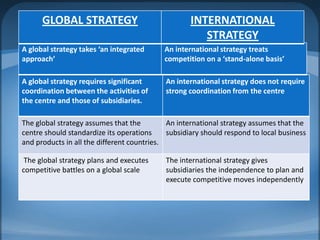
A global strategy requires significant
coordination between the activities of
the centre and those of subsidiaries.
An international strategy does not require
strong coordination from the centre
The global strategy assumes that the
centre should standardize its operations
and products in all the different countries.
An international strategy assumes that the
subsidiary should respond to local business
The global strategy plans and executes
competitive battles on a global scale
The international strategy gives
subsidiaries the independence to plan and
execute competitive moves independently
A global strategy takes ‘an integrated
approach’
An international strategy treats
competition on a ‘stand-alone basis’
GLOBAL STRATEGY INTERNATIONAL
STRATEGY
 Companies go international for a
variety of reasons but the typical
goal is company growth or
expansion
 Overseas operations are often
attractive to executives seeking to
reduce their budgets
 The majority of an industry's
business may shift overseas,
making global expansion all the
more desirable.
WHY GLOBALIZATION?
 Economic ‘globalization’ is a historical
process.
 Refers to the increasing integration of
economies around the world.
 As globalization accelerates there will be
increased opportunities for collaboration
between nations, multinational corporations
and communities.
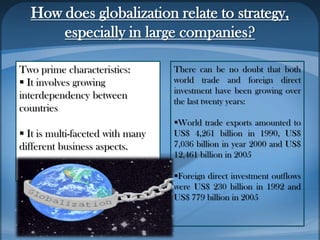
How does globalization relate to strategy,
especially in large companies?
Two prime characteristics:
 It involves growing
interdependency between
countries
 It is multi-faceted with many
different business aspects.
There can be no doubt that both
world trade and foreign direct
investment have been growing over
the last twenty years:
World trade exports amounted to
US$ 4,261 billion in 1990, US$
7,036 billion in year 2000 and US$
12,461 billion in 2005
Foreign direct investment outflows
were US$ 230 billion in 1992 and
US$ 779 billion in 2005
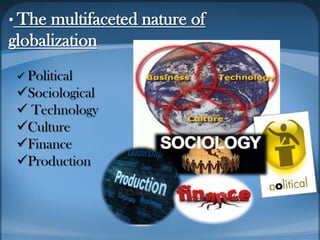
• The multifaceted nature of
globalization
 Political
Sociological
 Technology
Culture
Finance
Production
COSTS OF GOING GLOBAL
Transaction
C
O
S
T
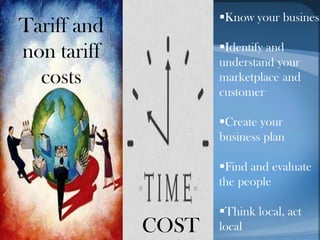
Tariff and
non tariff
costs
COST
Know your business
Identify and
understand your
marketplace and
customer
Create your
business plan
Find and evaluate
the people
Think local, act
local
•Global strategy
•Multi national
strategy
•Transnational
strategy
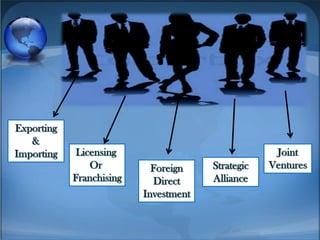
Foreign Entry Modes
Exporting
&
Importing Licensing
Or
Franchising
Joint
VenturesStrategic
Alliance
Foreign
Direct
Investment
Contract Manufacturing
Management contracting
Turnkey contracts
Mergers & Acquisitions
Counter Trade
Other Expansion Modes
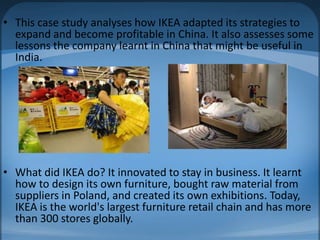
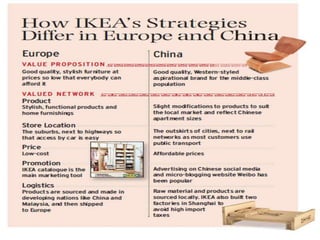
• This case study analyses how IKEA adapted its strategies to
expand and become profitable in China. It also assesses some
lessons the company learnt in China that might be useful in
India.
• What did IKEA do? It innovated to stay in business. It learnt
how to design its own furniture, bought raw material from
suppliers in Poland, and created its own exhibitions. Today,
IKEA is the world's largest furniture retail chain and has more
than 300 stores globally.
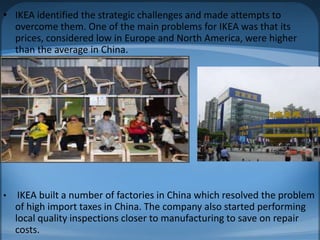
• IKEA identified the strategic challenges and made attempts to
overcome them. One of the main problems for IKEA was that its
prices, considered low in Europe and North America, were higher
than the average in China.
• IKEA built a number of factories in China which resolved the problem
of high import taxes in China. The company also started performing
local quality inspections closer to manufacturing to save on repair
costs.
• Since 1999, IKEA has been working on becoming
more eco-friendly. It has been charging for plastic
bags, asking suppliers for green products, and
increasing the use of renewable energy in its stores.
All this proved difficult to implement in China.
Price-sensitive Chinese consumers seem to be
annoyed when asked to pay extra for plastic bags
and they did not want to bring their own shopping
bags.
CONCLUSION
• International Business Strategy is a homework any firms
aiming to expand international market must take seriously.
• After carefully scaling the pressures for cost reduction and
local responsiveness, firms are to finely position their
international business strategy.
• Globalization of business has led to the emergence of global
strategic management.
• The firm with the choice of an effective global strategy that
takes into consideration its strengths and weaknesses in the
face of the opportunities and threats in the environment, will
survive.
Ibbb

Ibbb

  • 1.
  • 2.
    INTRODUCTION • International businessstrategies are a normal part of doing business no matter where your business is located in the world • Global businesses will compete with you, do business with you, and even put you out of business if you aren't careful • Businesses, large and small, must formulate international business strategies to function in the global economy. • Global business activity is just as normal today as doing business in your local community was 50 years ago
  • 3.
    APPEALING FACTORS  Builda broader customer base.  Prevent adverse effects of seasonal business swings.  Utilize excess manufacturing capacity sitting idle at home.  Lower production costs by using lower priced labour abroad
  • 4.
    A global strategyrequires significant coordination between the activities of the centre and those of subsidiaries. An international strategy does not require strong coordination from the centre The global strategy assumes that the centre should standardize its operations and products in all the different countries. An international strategy assumes that the subsidiary should respond to local business The global strategy plans and executes competitive battles on a global scale The international strategy gives subsidiaries the independence to plan and execute competitive moves independently A global strategy takes ‘an integrated approach’ An international strategy treats competition on a ‘stand-alone basis’ GLOBAL STRATEGY INTERNATIONAL STRATEGY
  • 5.
     Companies gointernational for a variety of reasons but the typical goal is company growth or expansion  Overseas operations are often attractive to executives seeking to reduce their budgets  The majority of an industry's business may shift overseas, making global expansion all the more desirable.
  • 6.
    WHY GLOBALIZATION?  Economic‘globalization’ is a historical process.  Refers to the increasing integration of economies around the world.  As globalization accelerates there will be increased opportunities for collaboration between nations, multinational corporations and communities.
  • 7.
    How does globalizationrelate to strategy, especially in large companies? Two prime characteristics:  It involves growing interdependency between countries  It is multi-faceted with many different business aspects. There can be no doubt that both world trade and foreign direct investment have been growing over the last twenty years: World trade exports amounted to US$ 4,261 billion in 1990, US$ 7,036 billion in year 2000 and US$ 12,461 billion in 2005 Foreign direct investment outflows were US$ 230 billion in 1992 and US$ 779 billion in 2005
  • 8.
    • The multifacetednature of globalization  Political Sociological  Technology Culture Finance Production
  • 9.
    COSTS OF GOINGGLOBAL Transaction C O S T
  • 10.
    Tariff and non tariff costs COST Knowyour business Identify and understand your marketplace and customer Create your business plan Find and evaluate the people Think local, act local
  • 11.
  • 12.
  • 13.
  • 14.
    Contract Manufacturing Management contracting Turnkeycontracts Mergers & Acquisitions Counter Trade Other Expansion Modes
  • 16.
    • This casestudy analyses how IKEA adapted its strategies to expand and become profitable in China. It also assesses some lessons the company learnt in China that might be useful in India. • What did IKEA do? It innovated to stay in business. It learnt how to design its own furniture, bought raw material from suppliers in Poland, and created its own exhibitions. Today, IKEA is the world's largest furniture retail chain and has more than 300 stores globally.
  • 17.
    • IKEA identifiedthe strategic challenges and made attempts to overcome them. One of the main problems for IKEA was that its prices, considered low in Europe and North America, were higher than the average in China. • IKEA built a number of factories in China which resolved the problem of high import taxes in China. The company also started performing local quality inspections closer to manufacturing to save on repair costs.
  • 18.
    • Since 1999,IKEA has been working on becoming more eco-friendly. It has been charging for plastic bags, asking suppliers for green products, and increasing the use of renewable energy in its stores. All this proved difficult to implement in China. Price-sensitive Chinese consumers seem to be annoyed when asked to pay extra for plastic bags and they did not want to bring their own shopping bags.
  • 20.
    CONCLUSION • International BusinessStrategy is a homework any firms aiming to expand international market must take seriously. • After carefully scaling the pressures for cost reduction and local responsiveness, firms are to finely position their international business strategy. • Globalization of business has led to the emergence of global strategic management. • The firm with the choice of an effective global strategy that takes into consideration its strengths and weaknesses in the face of the opportunities and threats in the environment, will survive.