Business & Practice
SEPTEMBER 201320
THE USE OF INSTRUMENTASSISTED SOFTTISSUE MOBI
LIZATION IASTM is on the rise among health care
practitioners, particularly doctors of chiropractic
(DCs). In fact, Graston Technique, the most well-
known of IASTM modalities, is used by more than
16,000 clinicians worldwide. ACANews spoke with
experts in IASTM to discover the benefits—both for
patients and for DCs—of using the instruments.
What Is a Soft-Tissue Injury?
A soft-tissue injury involves damage to the muscles,
ligaments, tendons and/or myofascia. Sprains and
strains are the most common soft-tissue injuries and
are the result of either a trauma, such as falling or
twisting an ankle, or repetitive use, such as a person
who plays tennis five times a week and develops
pain in his or her shoulder. “It’s either misuse (i.e.,
the wrong muscles are used to complete an action)
or over-use (i.e., using a muscle too often without
proper recovery time),”explains Marc Heller, DC, an
expert in IASTM who practices in southern Oregon.
“ ere’s almost always a soft-tissue component
associated with any injury or condition,” says Tra-
vis McCathie, DC, ATC, director of the Northwest-
ern Health Sciences University’s Center for Sports
and Rehabilitation.
What Is IASTM?
ough doctors of chiropractic (DCs) have always
used their hands to increase blood flow and break up
restrictions in injured soft tissue, fingers alone can’t
detect restrictions at deeper levels or treat the full
range of restrictions. Because of this, several compa-
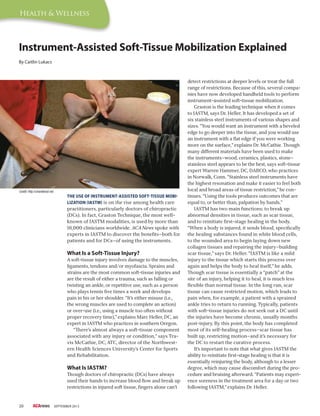
nies have now developed handheld tools to perform
instrument-assisted soft-tissue mobilization.
Graston is the leading technique when it comes
to IASTM, says Dr. Heller. It has developed a set of
six stainless steel instruments of various shapes and
sizes. “You would want an instrument with a beveled
edge to go deeper into the tissue, and you would use
an instrument with a flat edge if you were working
more on the surface,”explains Dr. McCathie. ough
many different materials have been used to make
the instruments—wood, ceramics, plastics, stone—
stainless steel appears to be the best, says soft-tissue
expert Warren Hammer, DC, DABCO, who practices
in Norwalk, Conn. “Stainless steel instruments have
the highest resonation and make it easier to feel both
local and broad areas of tissue restriction,”he con-
tinues. “Using the tools produces outcomes that are
equal to, or better than, palpation by hands.”
IASTM has two main functions: to break up
abnormal densities in tissue, such as scar tissue,
and to reinitiate first-stage healing in the body.
“When a body is injured, it sends blood, specifically
the healing substances found in white blood cells,
to the wounded area to begin laying down new
collagen tissues and repairing the injury—building
scar tissue,” says Dr. Heller. “IASTM is like a mild
injury to the tissue which starts this process over
again and helps the body to heal itself,” he adds.
ough scar tissue is essentially a “patch” at the
site of an injury, helping it to heal, it is much less
flexible than normal tissue. In the long run, scar
tissue can cause restricted motion, which leads to
pain when, for example, a patient with a sprained
ankle tries to return to running. Typically, patients
with soft-tissue injuries do not seek out a DC until
the injuries have become chronic, usually months
post-injury. By this point, the body has completed
most of its self-healing process—scar tissue has
built up, restricting motion—and it’s necessary for
the DC to restart the curative process.
It’s important to note that what gives IASTM the
ability to reinitiate first-stage healing is that it is
essentially reinjuring the body, although to a lesser
degree, which may cause discomfort during the pro-
cedure and bruising afterward. “Patients may experi-
ence soreness in the treatment area for a day or two
following IASTM,”explains Dr. Heller.
Instrument-Assisted Soft-Tissue Mobilization Explained
By Caitlin Lukacs
Business & PracticeHealth & Wellness
Credit: http://chandlerpt.net
21www.acatoday.org SEPTEMBER 2013
Dr. Hammer explains that most of the
tissue treated by DCs is not actually scar
tissue but is densification of the loose
connective tissue beneath the deep fascia
due to entanglement of hyaluronic acid
(HA) molecules, causing a gel-like restric-
tion. It has been found that increased
temperature and friction normalize the
HA, allowing freedom of the gliding
between the fascial layers to return.
According to Dr. Hammer, the inju-
ries—or types of injuries—that respond
best to IASTM include acute and chronic
spinal and extremity problems, such as
tendinopathies, Achilles tendinosis, rota-
tor cuff injuries, IT band syndrome and
plantar fasciitis, among others. And Dr.
Heller notes that the patients who see the
best results from IASTM are those who
are younger and more physically active.
“A person who is willing to exercise the
involved tissues is more likely to respond
well to this particular type of treatment,”
he says. “But that doesn’t mean that it
won’t work on older patients or on those
with a more sedentary lifestyle.”
Treatment Protocol
In very basic, general terms, Dr.
McCathie recommends a three-step
approach to IASTM.
1. Warm up the tissue to make it
more pliable;
2. Perform IASTM; and
3. Have the patient engage in light
exercise.
“You want to start with tissue in its
most workable state,” he explains. “ is
helps you get the most benefit from
the treatment.” en, after performing
IASTM, you should guide your patient
through some form of easy exercise—
usually a lower-intensity, higher-rep
workout. For example, if you’re working
on a hamstring and you break up some
of the scar tissue with an instrument,
it’s important to then put that muscle
through light exercises to restore its
movement pattern, says Dr. McCathie.
IASTM is often accompanied by
home exercise: stretching muscles to
build flexibility and strength in the area
of the injury. While soft-tissue injuries,
particularly chronic soft-tissue inju-
ries, can’t be healed overnight, patients
who perform the home stretches and
exercises prescribed by their DC greatly
accelerate the process.
Contraindications
ough IASTM is a very effective treat-
ment modality, there are certainly
situations in which you wouldn’t want
to use it, says Dr. McCathie. “Be smart
about it,” he cautions. “You wouldn’t
want to use instruments on a patient
with a skin infection or an open wound
or a bone fracture.” Dr. Hammer also
recommends avoiding recent suture
sites and not using IASTM on patients
with uncontrolled hypertension, kidney
dysfunction, hematoma or osteomy-
elitis. He suggests adopting a more
delicate approach when using instru-
ments on patients who are taking anti-
coagulant medications and on patients
with varicose veins, cancer, rheuma-
toid arthritis or acute inflammatory
conditions. “It doesn’t mean you can’t
treat them; it just means you need to
be careful with your pressure,” says Dr.
McCathie.
Additionally, IASTM may not be the
first-choice modality for a very recent
injury. “In this case, the body’s already
working on its first-stage healing,”
explains Dr. Heller. “IASTM has a pro-
inflammatory effect, and if the patient is
already inflamed, I would be hesitant to
use it on him or her.”
Benefits for DCs
In addition to improved diagnostic
treatment/outcomes and increased
patient satisfaction, IASTM also reduces
the stress placed on the hands and arms
of the practitioner and expands busi-
ness opportunities. Dr. Hammer notes
that many studies have shown that the
most frequent injuries to clinicians in
the physical therapy field involve the
wrists and upper extremities. “IASTM
would certainly save the practitioner
over the years,” he says.
Instrument-assisted soft-tissue
mobilization can also help bring in new
patients. “It’s becoming somewhat of
a niche now. People are getting good
results, and it’s becoming well-known
to the general population,” says Dr.
Hammer. is is resulting in more and
more patients seeking out practitioners
who use instruments.
Too often DCs rely entirely on spi-
nal or joint manipulations, and that’s
not sufficient for treating the whole
structure. DCs need to work with the
connective tissues and the muscular
system as well, says Dr. Hammer. “ e
future of chiropractic depends on us
being more aware of, and treating, soft-
tissue modalities and not simply falling
back on manipulation,” he warns.
Certification
Graston has set the standard for train-
ing within the IASTM field. A practitio-
ner must be certified to use Graston
instruments. While there is no cer-
tification test, there are two Module
courses offered, which include two-day
seminars of hands-on skill building.
“IASTM is a relatively easy concept,
but it takes years to really master it,”
explains Dr. McCathie.
ere are companies that will sell
the tools without a certification course,
but experts agree that it’s necessary to
have specific training with the instru-
ments. “It’s bothersome that now any-
body can buy instruments online and
perform IASTM without training and
potentially cause harm to patients,”
says Dr. McCathie.
ough he is a Graston instructor,
Dr. McCathie explains that it doesn’t
matter which company you decide to
work with as long as you do your due
diligence, make sure there is research
that supports the product and go
through a training course. e most
important considerations are that you
understand the healing process and are
comfortable with the instruments that
you choose, he says.
Dr. McCathie also recommends that
any practitioner interested in adding
IASTM to his or her repertoire should
experience the treatment for him- or
herself. “Everyone should understand
what it feels like to have it done by a
skilled provider,” he notes.

IASTM

  • 1.
    Business & Practice SEPTEMBER201320 THE USE OF INSTRUMENTASSISTED SOFTTISSUE MOBI LIZATION IASTM is on the rise among health care practitioners, particularly doctors of chiropractic (DCs). In fact, Graston Technique, the most well- known of IASTM modalities, is used by more than 16,000 clinicians worldwide. ACANews spoke with experts in IASTM to discover the benefits—both for patients and for DCs—of using the instruments. What Is a Soft-Tissue Injury? A soft-tissue injury involves damage to the muscles, ligaments, tendons and/or myofascia. Sprains and strains are the most common soft-tissue injuries and are the result of either a trauma, such as falling or twisting an ankle, or repetitive use, such as a person who plays tennis five times a week and develops pain in his or her shoulder. “It’s either misuse (i.e., the wrong muscles are used to complete an action) or over-use (i.e., using a muscle too often without proper recovery time),”explains Marc Heller, DC, an expert in IASTM who practices in southern Oregon. “ ere’s almost always a soft-tissue component associated with any injury or condition,” says Tra- vis McCathie, DC, ATC, director of the Northwest- ern Health Sciences University’s Center for Sports and Rehabilitation. What Is IASTM? ough doctors of chiropractic (DCs) have always used their hands to increase blood flow and break up restrictions in injured soft tissue, fingers alone can’t detect restrictions at deeper levels or treat the full range of restrictions. Because of this, several compa- nies have now developed handheld tools to perform instrument-assisted soft-tissue mobilization. Graston is the leading technique when it comes to IASTM, says Dr. Heller. It has developed a set of six stainless steel instruments of various shapes and sizes. “You would want an instrument with a beveled edge to go deeper into the tissue, and you would use an instrument with a flat edge if you were working more on the surface,”explains Dr. McCathie. ough many different materials have been used to make the instruments—wood, ceramics, plastics, stone— stainless steel appears to be the best, says soft-tissue expert Warren Hammer, DC, DABCO, who practices in Norwalk, Conn. “Stainless steel instruments have the highest resonation and make it easier to feel both local and broad areas of tissue restriction,”he con- tinues. “Using the tools produces outcomes that are equal to, or better than, palpation by hands.” IASTM has two main functions: to break up abnormal densities in tissue, such as scar tissue, and to reinitiate first-stage healing in the body. “When a body is injured, it sends blood, specifically the healing substances found in white blood cells, to the wounded area to begin laying down new collagen tissues and repairing the injury—building scar tissue,” says Dr. Heller. “IASTM is like a mild injury to the tissue which starts this process over again and helps the body to heal itself,” he adds. ough scar tissue is essentially a “patch” at the site of an injury, helping it to heal, it is much less flexible than normal tissue. In the long run, scar tissue can cause restricted motion, which leads to pain when, for example, a patient with a sprained ankle tries to return to running. Typically, patients with soft-tissue injuries do not seek out a DC until the injuries have become chronic, usually months post-injury. By this point, the body has completed most of its self-healing process—scar tissue has built up, restricting motion—and it’s necessary for the DC to restart the curative process. It’s important to note that what gives IASTM the ability to reinitiate first-stage healing is that it is essentially reinjuring the body, although to a lesser degree, which may cause discomfort during the pro- cedure and bruising afterward. “Patients may experi- ence soreness in the treatment area for a day or two following IASTM,”explains Dr. Heller. Instrument-Assisted Soft-Tissue Mobilization Explained By Caitlin Lukacs Business & PracticeHealth & Wellness Credit: http://chandlerpt.net
  • 2.
    21www.acatoday.org SEPTEMBER 2013 Dr.Hammer explains that most of the tissue treated by DCs is not actually scar tissue but is densification of the loose connective tissue beneath the deep fascia due to entanglement of hyaluronic acid (HA) molecules, causing a gel-like restric- tion. It has been found that increased temperature and friction normalize the HA, allowing freedom of the gliding between the fascial layers to return. According to Dr. Hammer, the inju- ries—or types of injuries—that respond best to IASTM include acute and chronic spinal and extremity problems, such as tendinopathies, Achilles tendinosis, rota- tor cuff injuries, IT band syndrome and plantar fasciitis, among others. And Dr. Heller notes that the patients who see the best results from IASTM are those who are younger and more physically active. “A person who is willing to exercise the involved tissues is more likely to respond well to this particular type of treatment,” he says. “But that doesn’t mean that it won’t work on older patients or on those with a more sedentary lifestyle.” Treatment Protocol In very basic, general terms, Dr. McCathie recommends a three-step approach to IASTM. 1. Warm up the tissue to make it more pliable; 2. Perform IASTM; and 3. Have the patient engage in light exercise. “You want to start with tissue in its most workable state,” he explains. “ is helps you get the most benefit from the treatment.” en, after performing IASTM, you should guide your patient through some form of easy exercise— usually a lower-intensity, higher-rep workout. For example, if you’re working on a hamstring and you break up some of the scar tissue with an instrument, it’s important to then put that muscle through light exercises to restore its movement pattern, says Dr. McCathie. IASTM is often accompanied by home exercise: stretching muscles to build flexibility and strength in the area of the injury. While soft-tissue injuries, particularly chronic soft-tissue inju- ries, can’t be healed overnight, patients who perform the home stretches and exercises prescribed by their DC greatly accelerate the process. Contraindications ough IASTM is a very effective treat- ment modality, there are certainly situations in which you wouldn’t want to use it, says Dr. McCathie. “Be smart about it,” he cautions. “You wouldn’t want to use instruments on a patient with a skin infection or an open wound or a bone fracture.” Dr. Hammer also recommends avoiding recent suture sites and not using IASTM on patients with uncontrolled hypertension, kidney dysfunction, hematoma or osteomy- elitis. He suggests adopting a more delicate approach when using instru- ments on patients who are taking anti- coagulant medications and on patients with varicose veins, cancer, rheuma- toid arthritis or acute inflammatory conditions. “It doesn’t mean you can’t treat them; it just means you need to be careful with your pressure,” says Dr. McCathie. Additionally, IASTM may not be the first-choice modality for a very recent injury. “In this case, the body’s already working on its first-stage healing,” explains Dr. Heller. “IASTM has a pro- inflammatory effect, and if the patient is already inflamed, I would be hesitant to use it on him or her.” Benefits for DCs In addition to improved diagnostic treatment/outcomes and increased patient satisfaction, IASTM also reduces the stress placed on the hands and arms of the practitioner and expands busi- ness opportunities. Dr. Hammer notes that many studies have shown that the most frequent injuries to clinicians in the physical therapy field involve the wrists and upper extremities. “IASTM would certainly save the practitioner over the years,” he says. Instrument-assisted soft-tissue mobilization can also help bring in new patients. “It’s becoming somewhat of a niche now. People are getting good results, and it’s becoming well-known to the general population,” says Dr. Hammer. is is resulting in more and more patients seeking out practitioners who use instruments. Too often DCs rely entirely on spi- nal or joint manipulations, and that’s not sufficient for treating the whole structure. DCs need to work with the connective tissues and the muscular system as well, says Dr. Hammer. “ e future of chiropractic depends on us being more aware of, and treating, soft- tissue modalities and not simply falling back on manipulation,” he warns. Certification Graston has set the standard for train- ing within the IASTM field. A practitio- ner must be certified to use Graston instruments. While there is no cer- tification test, there are two Module courses offered, which include two-day seminars of hands-on skill building. “IASTM is a relatively easy concept, but it takes years to really master it,” explains Dr. McCathie. ere are companies that will sell the tools without a certification course, but experts agree that it’s necessary to have specific training with the instru- ments. “It’s bothersome that now any- body can buy instruments online and perform IASTM without training and potentially cause harm to patients,” says Dr. McCathie. ough he is a Graston instructor, Dr. McCathie explains that it doesn’t matter which company you decide to work with as long as you do your due diligence, make sure there is research that supports the product and go through a training course. e most important considerations are that you understand the healing process and are comfortable with the instruments that you choose, he says. Dr. McCathie also recommends that any practitioner interested in adding IASTM to his or her repertoire should experience the treatment for him- or herself. “Everyone should understand what it feels like to have it done by a skilled provider,” he notes.