LIBRARY RESEARCH FOR BIOL/BIOT 6838
Clarke Iakovakis
Research & Instruction Librarian
Neumann Library
“Improving Crop Yields” image courtesy BASF via Flickr. Licensed under CC
BY-NC-ND 2.0
http://libguides.uhcl.edu/BIOL6838
OUTLINE FOR TODAY
 Academic Research
 Principles of Good Searching
 Searching in the Research Databases &
Library Catalog
 Citing Sources & EndNote
SECTION 1:
ACADEMIC
RESEARCH
Scholar. Image licensed under CC BY-NC-ND 2.0 on Flickr by Anjan Chatterjee.
 A literature review is part of the published work referencing
related research, theory, and background information
 A review of the literature (literature search) may be conducted
to…
 understand a topic
 help you form a research question
 provide confirmation of an already existing
hypothesis
 analyze and interpret your own data
 gain exposure to past, current, and ongoing
research about a subject you are exploring for
research of your own
REVIEWING LITERATURE
PEER REVIEW
 A process for establishing authority of
scholarly research
 Experts in the field/discipline review the
original ideas to certify the accuracy, validity,
and value of the results
Chubin, D. E., & Hackett, E. J. (2005). Peer Review. In C. Mitcham (Ed.), Encyclopedia of Science, Technology, and
Ethics (Vol. 3, pp. 1390-1394). Detroit: Macmillan Reference USA. Retrieved from
http://libproxy.uhcl.edu/login?url=http://go.galegroup.com/ps/i.do?id=GALE%7CCX3434900491&v=2.1&u=txshr
acd2589&it=r&p=GVRL&sw=w&asid=67e06d81c0d758521a67ba637722e45c
“AUTHORITATIVE” INFORMATION:
WHAT ARE SOME SOURCES OF
SCHOLARLY INFORMATION?
Peer-reviewed journal articles
Books
Reference works (encyclopedias, textbooks)
Gray literature
 Reports (government, industry,
non-governmental organizations)
 Theses & dissertations
 Conference proceedings
Archives
“Computer laptop” by Steve Hillebrand, licensed under public domain
PERIODICALS (JOURNALS, MAGAZINES)
Peer-reviewed
Refereed
Scholarly
Academic
Trade
Professional
Practitioner
Industry
General
Popular
DISSECT THIS CITATION
What is the…
 Article title
 Authors
 Journal name
 Volume number
 Issue number
 Page number range
 Year of publication
 DOI
Hails RS, Morley K. 2005. Genes invading
new populations: a risk assessment
perspective. Trends Ecol Evol. 20(5):245-
252. doi:10.1016/j.tree.2005.02.006
HOW DO I FIND AN ARTICLE
WHEN I HAVE A CITATION?
A. Google
B. OneSearch
C. A subscription database, such as
Biological Abstracts or BioOne
Hails RS, Morley K. 2005. Genes invading
new populations: a risk assessment
perspective. Trends Ecol Evol. 20(5):245-
252. doi:10.1016/j.tree.2005.02.006
EXERCISE 1: SEE PAPER HANDOUT
Title: Proposed Definition of Environmental Damage Illustrated
by the Cases of Genetically Modified Crops and Invasive Species
Lead Author: Bartz
Journal name? Database? Year of Publication?
Using OneSearch, search for the subject:
genetically modified crops invasiveness
Use the refinement tools on the left to limit the results to journal articles
published in the last 10 years and browse the results for a relevant article
SECTION 2: PRINCIPLES OF GOOD
SEARCHING
On the Scent. Image licensed CC-BY on Flickr by stephen bowler.
• Determine your research question1
• Identify the key concepts2
• List alternate keywords, synonyms, and related words3
• Join terms and concepts with appropriate Boolean operators4
• Make use of database’s limiters & suggested subject terms5
• Organize and cite your sources6
SEARCH PROCESS
One
• What are some ecological risks of introducing
genetically modified crops into the environment?
Two
• What effects do genetically modified crops have
on invasiveness, vertical/horizontal gene flow,
biodiversity, and influence on other products?
Three
• What are the risks of genetically modified crops
invading natural communities?
1. DETERMINE YOUR RESEARCH QUESTION
2. IDENTIFY THE KEY CONCEPTS
Genetically modified crops
invasiveness
risks
What are the risks of genetically
modified crops invading natural
communities?
Geneticall
y modified
crops
Genetically
modified foods
Genetically
modified
organisms OR
GMO
Transgenic
plants
Biotech
crops
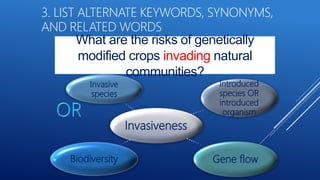
3. LIST ALTERNATE KEYWORDS, SYNONYMS,
AND RELATED WORDS
What are the risks of genetically
modified crops invading natural
communities?
Invasiveness
Invasive
species
Introduced
species OR
introduced
organism
Gene flowBiodiversity
3. LIST ALTERNATE KEYWORDS, SYNONYMS,
AND RELATED WORDS
What are the risks of genetically
modified crops invading natural
communities?
WHICH STATEMENT BELOW WILL
GENERATE MORE SEARCH RESULTS?
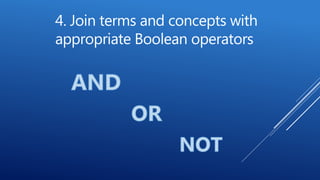
4. Join terms and concepts with
appropriate Boolean operators
Transgenic
plants
Genetically
modified crops
Biotech crops
Genetically modified crops OR transgenic plants OR
biotech crops
Invasiv* OR
eigenfaces OR skin texture analysis
Genetically modified crops
OR transgenic plants
OR biotech crops
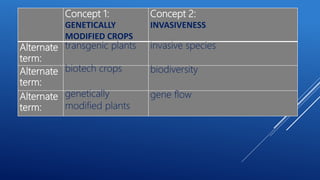
Concept 1:
GENETICALLY
MODIFIED CROPS
Concept 2:
INVASIVENESS
Alternate
term:
transgenic plants invasive species
Alternate
term:
biotech crops biodiversity
Alternate
term:
genetically
modified plants
gene flow
m
QUOTATION MARKS: EXACT PHRASE
TRUNCATION (WILDCARDS)
predator
predators
predation
predate
predating
predat*
*
predatory
WHICH STATEMENT BELOW WILL
GENERATE MORE SEARCH RESULTS?
WHICH SEARCH WILL FIND
FEWER RESULTS?
A.
B.
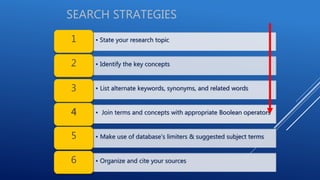
• State your research topic1
• Identify the key concepts2
• List alternate keywords, synonyms, and related words3
• Join terms and concepts with appropriate Boolean operators4
• Make use of database’s limiters & suggested subject terms5
• Organize and cite your sources6
SEARCH STRATEGIES
SECTION 3: RESEARCH DATABASES
&
LIBRARY CATALOG
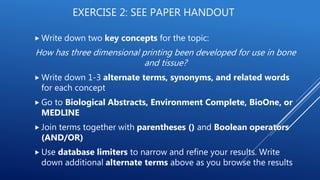
EXERCISE 2: SEE PAPER HANDOUT
 Write down two key concepts for the topic:
How has three dimensional printing been developed for use in bone
and tissue?
 Write down 1-3 alternate terms, synonyms, and related words
for each concept
 Go to Biological Abstracts, Environment Complete, BioOne, or
MEDLINE
 Join terms together with parentheses () and Boolean operators
(AND/OR)
 Use database limiters to narrow and refine your results. Write
down additional alternate terms above as you browse the results
SECTION 4: CITING SOURCES
Too much information?
Ask a Librarian
Stop by the reference desk or schedule a
research consultation!In person
library@uhcl.edu
Email
281-283-3910
Phone
Text
http://libanswers.uhcl.edu
281-816-4341
IM
FEEDBACK PLEASE!

Biot6838 2016 fall presentation

  • 1.
    LIBRARY RESEARCH FORBIOL/BIOT 6838 Clarke Iakovakis Research & Instruction Librarian Neumann Library “Improving Crop Yields” image courtesy BASF via Flickr. Licensed under CC BY-NC-ND 2.0
  • 2.
  • 3.
    OUTLINE FOR TODAY Academic Research  Principles of Good Searching  Searching in the Research Databases & Library Catalog  Citing Sources & EndNote
  • 4.
    SECTION 1: ACADEMIC RESEARCH Scholar. Imagelicensed under CC BY-NC-ND 2.0 on Flickr by Anjan Chatterjee.
  • 5.
     A literaturereview is part of the published work referencing related research, theory, and background information  A review of the literature (literature search) may be conducted to…  understand a topic  help you form a research question  provide confirmation of an already existing hypothesis  analyze and interpret your own data  gain exposure to past, current, and ongoing research about a subject you are exploring for research of your own REVIEWING LITERATURE
  • 6.
    PEER REVIEW  Aprocess for establishing authority of scholarly research  Experts in the field/discipline review the original ideas to certify the accuracy, validity, and value of the results Chubin, D. E., & Hackett, E. J. (2005). Peer Review. In C. Mitcham (Ed.), Encyclopedia of Science, Technology, and Ethics (Vol. 3, pp. 1390-1394). Detroit: Macmillan Reference USA. Retrieved from http://libproxy.uhcl.edu/login?url=http://go.galegroup.com/ps/i.do?id=GALE%7CCX3434900491&v=2.1&u=txshr acd2589&it=r&p=GVRL&sw=w&asid=67e06d81c0d758521a67ba637722e45c “AUTHORITATIVE” INFORMATION:
  • 7.
    WHAT ARE SOMESOURCES OF SCHOLARLY INFORMATION? Peer-reviewed journal articles Books Reference works (encyclopedias, textbooks) Gray literature  Reports (government, industry, non-governmental organizations)  Theses & dissertations  Conference proceedings Archives “Computer laptop” by Steve Hillebrand, licensed under public domain
  • 8.
  • 9.
    DISSECT THIS CITATION Whatis the…  Article title  Authors  Journal name  Volume number  Issue number  Page number range  Year of publication  DOI Hails RS, Morley K. 2005. Genes invading new populations: a risk assessment perspective. Trends Ecol Evol. 20(5):245- 252. doi:10.1016/j.tree.2005.02.006
  • 10.
    HOW DO IFIND AN ARTICLE WHEN I HAVE A CITATION? A. Google B. OneSearch C. A subscription database, such as Biological Abstracts or BioOne
  • 11.
    Hails RS, MorleyK. 2005. Genes invading new populations: a risk assessment perspective. Trends Ecol Evol. 20(5):245- 252. doi:10.1016/j.tree.2005.02.006
  • 12.
    EXERCISE 1: SEEPAPER HANDOUT Title: Proposed Definition of Environmental Damage Illustrated by the Cases of Genetically Modified Crops and Invasive Species Lead Author: Bartz Journal name? Database? Year of Publication? Using OneSearch, search for the subject: genetically modified crops invasiveness Use the refinement tools on the left to limit the results to journal articles published in the last 10 years and browse the results for a relevant article
  • 13.
    SECTION 2: PRINCIPLESOF GOOD SEARCHING On the Scent. Image licensed CC-BY on Flickr by stephen bowler.
  • 14.
    • Determine yourresearch question1 • Identify the key concepts2 • List alternate keywords, synonyms, and related words3 • Join terms and concepts with appropriate Boolean operators4 • Make use of database’s limiters & suggested subject terms5 • Organize and cite your sources6 SEARCH PROCESS
  • 15.
    One • What aresome ecological risks of introducing genetically modified crops into the environment? Two • What effects do genetically modified crops have on invasiveness, vertical/horizontal gene flow, biodiversity, and influence on other products? Three • What are the risks of genetically modified crops invading natural communities? 1. DETERMINE YOUR RESEARCH QUESTION
  • 16.
    2. IDENTIFY THEKEY CONCEPTS Genetically modified crops invasiveness risks What are the risks of genetically modified crops invading natural communities?
  • 17.
    Geneticall y modified crops Genetically modified foods Genetically modified organismsOR GMO Transgenic plants Biotech crops 3. LIST ALTERNATE KEYWORDS, SYNONYMS, AND RELATED WORDS What are the risks of genetically modified crops invading natural communities?
  • 18.
    Invasiveness Invasive species Introduced species OR introduced organism Gene flowBiodiversity 3.LIST ALTERNATE KEYWORDS, SYNONYMS, AND RELATED WORDS What are the risks of genetically modified crops invading natural communities?
  • 19.
    WHICH STATEMENT BELOWWILL GENERATE MORE SEARCH RESULTS?
  • 20.
    4. Join termsand concepts with appropriate Boolean operators
  • 22.
    Transgenic plants Genetically modified crops Biotech crops Geneticallymodified crops OR transgenic plants OR biotech crops
  • 23.
    Invasiv* OR eigenfaces ORskin texture analysis Genetically modified crops OR transgenic plants OR biotech crops
  • 24.
    Concept 1: GENETICALLY MODIFIED CROPS Concept2: INVASIVENESS Alternate term: transgenic plants invasive species Alternate term: biotech crops biodiversity Alternate term: genetically modified plants gene flow
  • 25.
  • 26.
  • 27.
  • 28.
    WHICH STATEMENT BELOWWILL GENERATE MORE SEARCH RESULTS?
  • 29.
    WHICH SEARCH WILLFIND FEWER RESULTS? A. B.
  • 30.
    • State yourresearch topic1 • Identify the key concepts2 • List alternate keywords, synonyms, and related words3 • Join terms and concepts with appropriate Boolean operators4 • Make use of database’s limiters & suggested subject terms5 • Organize and cite your sources6 SEARCH STRATEGIES
  • 31.
    SECTION 3: RESEARCHDATABASES & LIBRARY CATALOG
  • 34.
    EXERCISE 2: SEEPAPER HANDOUT  Write down two key concepts for the topic: How has three dimensional printing been developed for use in bone and tissue?  Write down 1-3 alternate terms, synonyms, and related words for each concept  Go to Biological Abstracts, Environment Complete, BioOne, or MEDLINE  Join terms together with parentheses () and Boolean operators (AND/OR)  Use database limiters to narrow and refine your results. Write down additional alternate terms above as you browse the results
  • 35.
  • 36.
  • 37.
    Ask a Librarian Stopby the reference desk or schedule a research consultation!In person library@uhcl.edu Email 281-283-3910 Phone Text http://libanswers.uhcl.edu 281-816-4341 IM
  • 38.