LIBRARY
RESEARCH
FOR
COMPUTER
SCIENCE
Clarke Iakovakis
Research &
Instruction Librarian
Neumann Library
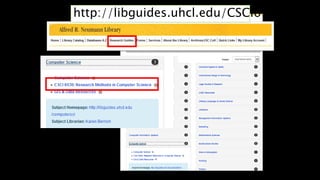
http://libguides.uhcl.edu/CSCI6530
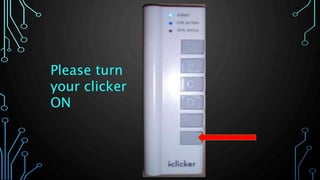
Please turn
your clicker
ON
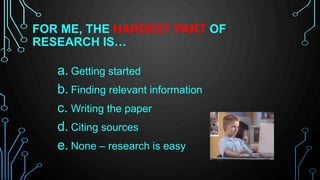
FOR ME, THE HARDEST PART OF
RESEARCH IS…
a. Getting started
b. Finding relevant information
c. Writing the paper
d. Citing sources
e. None – research is easy
OUTLINE FOR
TODAY
• Academic Research
• Principles of Good
Searching
• Searching in the
Research Databases &
Library Catalog
SECTION 1: ACADEMIC
RESEARCH
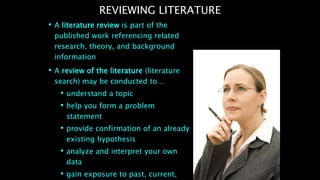
• A literature review is part of the
published work referencing related
research, theory, and background
information
• A review of the literature (literature
search) may be conducted to…
• understand a topic
• help you form a problem
statement
• provide confirmation of an already
existing hypothesis
• analyze and interpret your own
data
• gain exposure to past, current,
REVIEWING LITERATURE
“AUTHORITATIVE” INFORMATION
“Authority” is a type of influence recognized
or exerted in a community
Disciplines have acknowledged authorities--
scholars & publications
Approach “authoritative” perspectives with
informed skepticism.
WHAT IS PEER REVIEW?
 A process for establishing
authority of scholarly research
 Experts in the field/discipline
review the original ideas to certify
the accuracy, validity, and value
of the results Chubin, D. E., & Hackett, E. J. (2005). Peer Review. In C.
Mitcham (Ed.), Encyclopedia of Science, Technology, and
Ethics (Vol. 3, pp. 1390-1394). Detroit: Macmillan
Reference USA. Retrieved from
http://libproxy.uhcl.edu/login?url=http://go.galegroup.co
m/ps/i.do?id=GALE%7CCX3434900491&v=2.1&u=txshrac
d2589&it=r&p=GVRL&sw=w&asid=67e06d81c0d758521a
67ba637722e45c
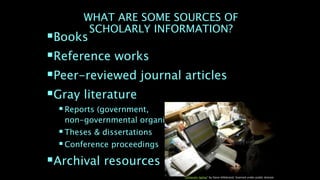
WHAT ARE SOME SOURCES OF
SCHOLARLY INFORMATION?
Books
Reference works
Peer-reviewed journal articles
Gray literature
Reports (government,
non-governmental organizations)
Theses & dissertations
Conference proceedings
Archival resources
“Computer laptop” by Steve Hillebrand, licensed under public domain
PERIODICALS (JOURNALS,
MAGAZINES)
Peer-reviewed
Refereed
Scholarly
Academic
Trade
Professional
Practitioner
Industry
General
Popular
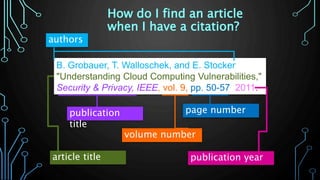
B. Grobauer, T. Walloschek, and E. Stocker,
"Understanding Cloud Computing Vulnerabilities,"
Security & Privacy, IEEE, vol. 9, pp. 50-57, 2011.
article title
publication
title
volume number
page number
publication year
authors
How do I find an article
when I have a citation?
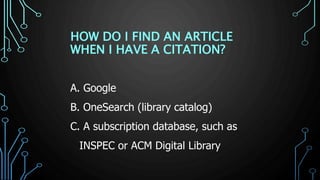
HOW DO I FIND AN ARTICLE
WHEN I HAVE A CITATION?
A. Google
B. OneSearch (library catalog)
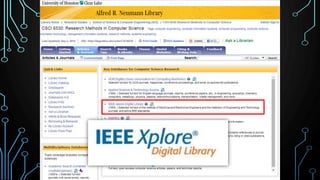
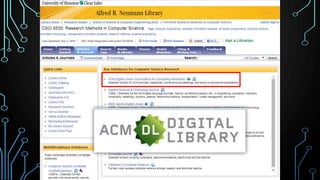
C. A subscription database, such as
INSPEC or ACM Digital Library
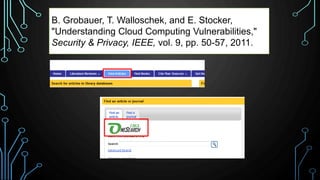
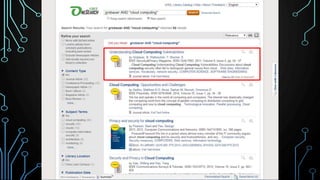
B. Grobauer, T. Walloschek, and E. Stocker,
"Understanding Cloud Computing Vulnerabilities,"
Security & Privacy, IEEE, vol. 9, pp. 50-57, 2011.
TRY IT
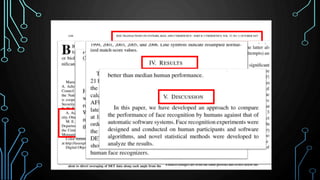
Age-Invariant Face Recognition
Author name?
Journal name? Journal year?
SECTION 2: PRINCIPLES OF
GOOD SEARCHING
On the Scent. Image licensed CC-BY on Flickr by stephen
bowler.
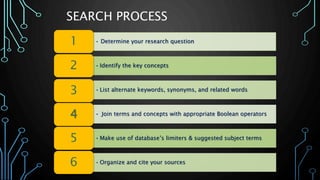
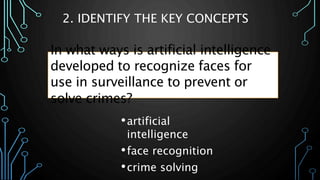
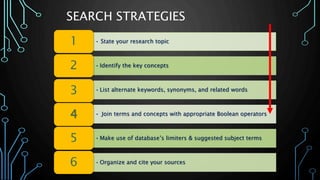
• Determine your research question1
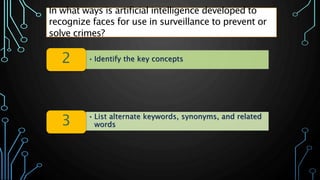
• Identify the key concepts2
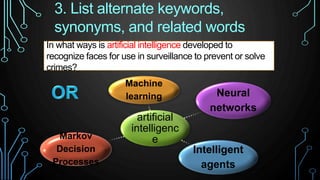
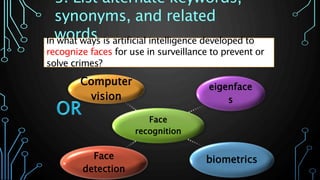
• List alternate keywords, synonyms, and related words3
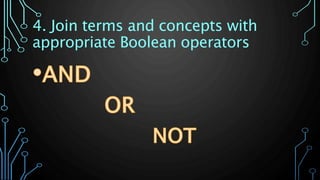
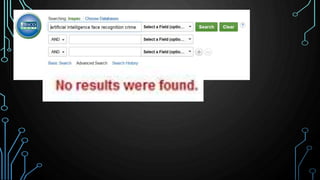
• Join terms and concepts with appropriate Boolean operators4
• Make use of database’s limiters & suggested subject terms5
• Organize and cite your sources6
SEARCH PROCESS
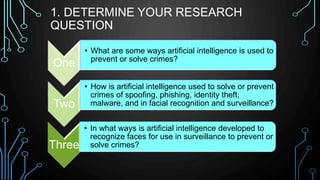
One
• What are some ways artificial intelligence is used to
prevent or solve crimes?
Two
• How is artificial intelligence used to solve or prevent
crimes of spoofing, phishing, identity theft,
malware, and in facial recognition and surveillance?
Three
• In what ways is artificial intelligence developed to
recognize faces for use in surveillance to prevent or
solve crimes?
1. DETERMINE YOUR RESEARCH
QUESTION
2. IDENTIFY THE KEY CONCEPTS
•artificial
intelligence
•face recognition
•crime solving
In what ways is artificial intelligence
developed to recognize faces for
use in surveillance to prevent or
solve crimes?
artificial
intelligenc
e
Machine
learning Neural
networks
Intelligent
agents
Markov
Decision
Processes
3. List alternate keywords,
synonyms, and related words
In what ways is artificial intelligence developed to
recognize faces for use in surveillance to prevent or solve
crimes?
Face
recognition
Computer
vision
eigenface
s
biometricsFace
detection
3. List alternate keywords,
synonyms, and related
wordsIn what ways is artificial intelligence developed to
recognize faces for use in surveillance to prevent or
solve crimes?
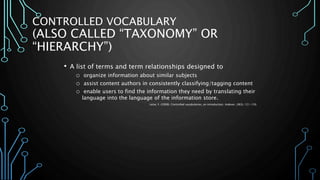
CONTROLLED VOCABULARY
(ALSO CALLED “TAXONOMY” OR
“HIERARCHY”)
• A list of terms and term relationships designed to
o organize information about similar subjects
o assist content authors in consistently classifying/tagging content
o enable users to find the information they need by translating their
language into the language of the information store.
Leise, F. (2008). Controlled vocabularies, an introduction. Indexer, 26(3), 121-126.
• Identify the key concepts2
• List alternate keywords, synonyms, and related
words3
In what ways is artificial intelligence developed to
recognize faces for use in surveillance to prevent or
solve crimes?
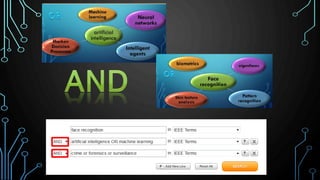
4. Join terms and concepts with
appropriate Boolean operators
Machine
learning
Artificial
intelligence Intelligent
agents
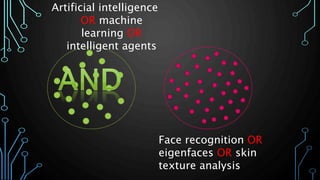
Artificial intelligence OR machine
learning OR intelligent agents
Face recognition OR
eigenfaces OR skin
texture analysis
Artificial intelligence
OR machine
learning OR
intelligent agents
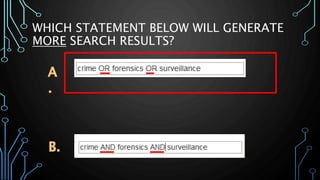
WHICH STATEMENT BELOW WILL GENERATE
MORE SEARCH RESULTS?
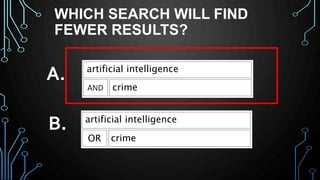
WHICH SEARCH WILL FIND
FEWER RESULTS?
A.
B.
OR
artificial intelligence
crime
crime
m
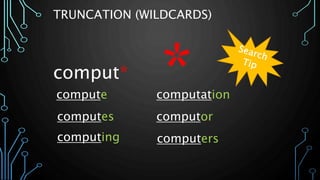
TRUNCATION (WILDCARDS)
compute
computes
computing
computation
computor
computers
comput*
*
• State your research topic1
• Identify the key concepts2
• List alternate keywords, synonyms, and related words3
• Join terms and concepts with appropriate Boolean operators4
• Make use of database’s limiters & suggested subject terms5
• Organize and cite your sources6
SEARCH STRATEGIES
SECTION 3: RESEARCH
DATABASES &
LIBRARY CATALOG
Screenshot from Wargames © United Artists. Retrieved from Tumblr
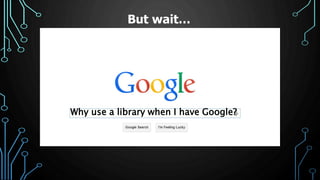
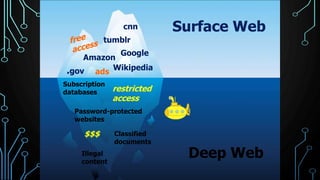
Why use a library when I have Google?
But wait…
tumblr
.gov Wikipedia
Subscription
databases
Password-protected
websites
restricted
access
$$$
Illegal
content
Classified
documents
Surface Web
Deep Web
Amazon
cnn
Google
ads
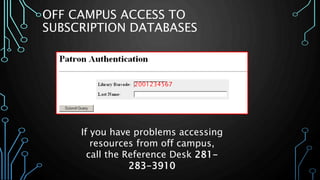
OFF CAMPUS ACCESS TO
SUBSCRIPTION DATABASES
If you have problems accessing
resources from off campus,
call the Reference Desk 281-
283-3910
2001234567
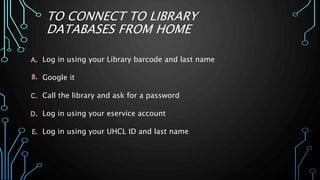
TO CONNECT TO LIBRARY
DATABASES FROM HOME
Log in using your UHCL ID and last name
Log in using your eservice account
Call the library and ask for a password
Google it
Log in using your Library barcode and last name
SECTION 4: CITING SOURCES
Too much
information?
Ask a Librarian
Stop by the reference desk or schedule a
research consultation!In person
library@uhcl.edu
Email
281-283-3910
Phone
Text
http://libanswers.uhcl.edu
281-816-4341
IM
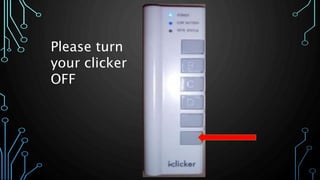
Please turn
your clicker
OFF
FEEDBACK PLEASE!

CSCI6530: Library Instruction for Research Methods in Computer Science