Using	Metaphor,	Simile,	and	Analogies	in	Technical	Writing
1
Huh, these are
literary terms
aren’t they?
Yes, but technical
writers also use them.
Metaphors,	Similes,	and	Analogies
2
} Help readers understand something unfamiliar to them by comparing it to
something that is more familiar.
} Metaphors state that one thing IS another thing. A metaphor makes an
explicit comparison.
} Example: The heart is a pump.
} Similes state that one thing is LIKE another thing. A simile more openly
acknowledges that A is only LIKE B.
} Example: The heart is like a pump.
Analogies
3
} Are constructing a logical argument when comparing the unfamiliar to the
familiar.
} Analogies argue that the relationship between A and B is so close you can
get a pretty good idea of how A works or what A is like by understanding
something more familiar (i.e. B).
} Using metaphors, similes, and analogies may help you extend the technical
definition and develop the technical description.
As	Roald	Hoffman	explains:
4
} If I want to explain the uncertainty implicit in measuring simultaneously
the position and velocity of a moving electron using photons, I resort to a
thought experiment that measures the same observables for a baseball,
with, say, tennis balls thrown at it.
} As I think about how to explain the vibrational-translational energy transfer
necessary for the greenhouse gas carbon dioxide, CO2, molecules of which
have absorbed infrared radiation, to heat the rest of the atmosphere
(predominantly oxygen, nitrogen and argon), I envision the bending and
unbending CO2 molecule as a gym rat exercising, once in a while kicking an
O2 dumbbell that comes near.
} The Metaphor, Unchained. American Scientist, October 2006
Example	1:	Analogy
5
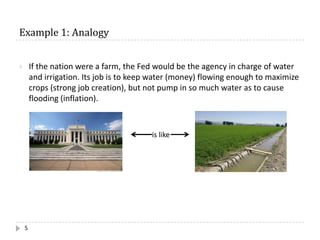
} If the nation were a farm, the Fed would be the agency in charge of water
and irrigation. Its job is to keep water (money) flowing enough to maximize
crops (strong job creation), but not pump in so much water as to cause
flooding (inflation).
is like
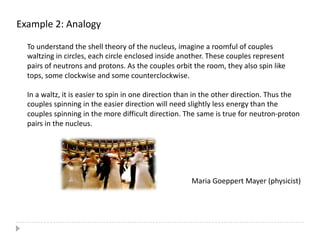
To understand the shell theory of the nucleus, imagine a roomful of couples
waltzing in circles, each circle enclosed inside another. These couples represent
pairs of neutrons and protons. As the couples orbit the room, they also spin like
tops, some clockwise and some counterclockwise.
In a waltz, it is easier to spin in one direction than in the other direction. Thus the
couples spinning in the easier direction will need slightly less energy than the
couples spinning in the more difficult direction. The same is true for neutron-proton
pairs in the nucleus.
Maria Goeppert Mayer (physicist)
Example 2: Analogy
Metaphors,	Similes,	and	Analogies	are	also	Generative	
7
} This means they also drive creative thinking about problems in
science, engineering, and technology.
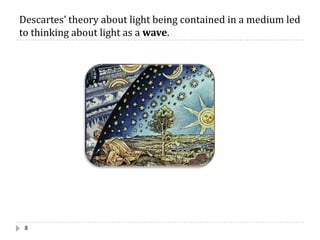
Descartes’	theory	about	light	being	contained	in	a	medium	led	
to	thinking	about	light	as	a	wave.
8
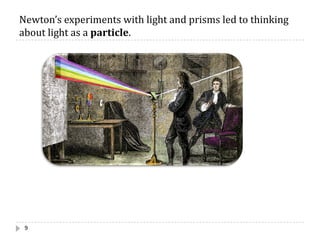
Newton’s	experiments	with	light	and	prisms	led	to	thinking	
about	light	as	a	particle.
9
Today,	technical	communicators	use	metaphors	about	light	
depending	on	application.
10
Fiber Optic Cable: industry uses wave and particle
metaphors to communicate to lay audiences.
Wave metaphor is used to communicate how fiber
optic cables work.
Particle metaphor is used to communicate how
images appear on a screen via the internet.
Metaphors,	however,	are	also	generative.
11
} This means they also drive how scientists and engineers think about the
work they do.
} Metaphors can drive how this thinking changes.
} Example: John Smeaton’s Eddystone Lighthouse.
John	Smeaton’s		Lighthouse	and	Eddystone	Reef
12
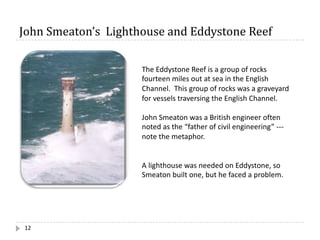
The Eddystone Reef is a group of rocks
fourteen miles out at sea in the English
Channel. This group of rocks was a graveyard
for vessels traversing the English Channel.
John Smeaton was a British engineer often
noted as the “father of civil engineering” ---
note the metaphor.
A lighthouse was needed on Eddystone, so
Smeaton built one, but he faced a problem.
John	Smeaton’s		Lighthouse	and	Eddystone	Reef
13
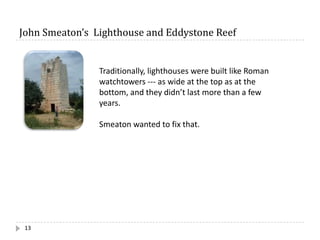
Traditionally, lighthouses were built like Roman
watchtowers --- as wide at the top as at the
bottom, and they didn’t last more than a few
years.
Smeaton wanted to fix that.
Smeaton’s	journals	reveal	how	
14
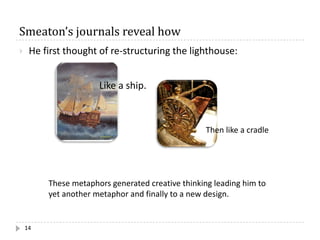
} He first thought of re-structuring the lighthouse:
Like a ship.
Then like a cradle
These metaphors generated creative thinking leading him to
yet another metaphor and finally to a new design.
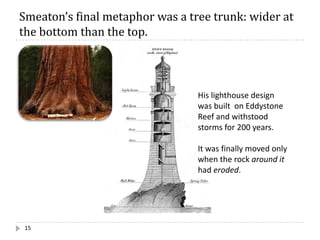
Smeaton’s	final	metaphor	was	a	tree	trunk:	wider	at	
the	bottom	than	the	top.
15
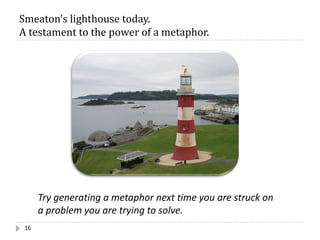
His lighthouse design
was built on Eddystone
Reef and withstood
storms for 200 years.
It was finally moved only
when the rock around it
had eroded.
Smeaton’s	lighthouse	today.		
A	testament	to	the	power	of	a	metaphor.
16
Try generating a metaphor next time you are struck on
a problem you are trying to solve.
Problem	with	metaphors,	similes,	and	analogies.
17
} Although they extend familiar relationships to unfamiliar contexts, and
help writers communicate new ideas to others.
This connection is problematic because the scientific, engineering, or other
technical contexts that originate the relationship are not static. The
interpretation of specific terms may change as new information and
evidence emerges while the understanding of these remains stuck in an
outdated comparison.
} Therefore, metaphors, similes, and analogies can constrain our thinking as
easily as they facilitate it, particularly, if their use establishes a paradigm
that prevents us from understanding something from any other frame of
reference.

Engl317 project2 slidedoc4_optional_metaphors_similiesanalogies