Colgate Palmolive
The Precision Toothbrush
Harvard business school case Analysis
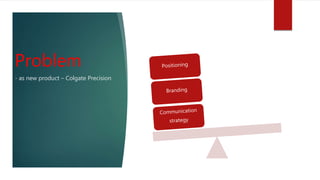
Problem
- as new product – Colgate Precision
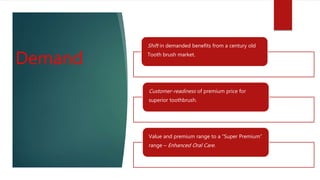
Demand
Shift in demanded benefits from a century old
Tooth brush market.
Customer-readiness of premium price for
superior toothbrush.
Value and premium range to a “Super Premium”
range – Enhanced Oral Care.
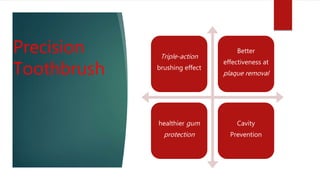
Precision
Toothbrush
Triple-action
brushing effect
Better
effectiveness at
plaque removal
healthier gum
protection
Cavity
Prevention
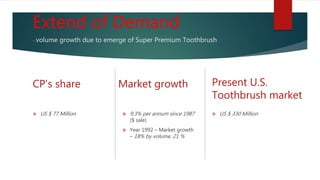
Extend of Demand
- volume growth due to emerge of Super Premium Toothbrush
CP’s share Market growth
 9.3% per annum since 1987
($ sale)
 Year 1992 – Market growth
– 18% by volume, 21 %
Present U.S.
Toothbrush market
 US $ 330 Million US $ 77 Million
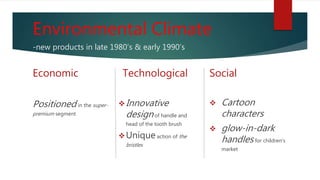
Environmental Climate
-new products in late 1980’s & early 1990’s
Economic
Positioned in the super-
premium segment
Technological
Innovative
designof handle and
head of the tooth brush
Uniqueaction of the
bristles
Social
 Cartoon
characters
 glow-in-dark
handles for children's
market
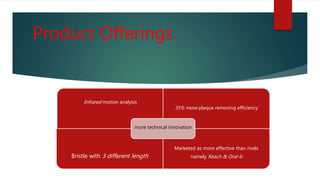
Product Offerings
Infrared motion analysis
35% more plaque removing efficiency
Bristle with 3 different length
Marketed as more effective than rivals
namely Reach & Oral-b
more technical innovation
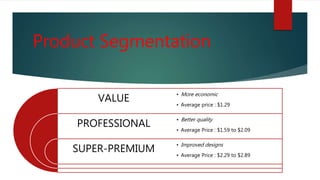
Product Segmentation
VALUE
PROFESSIONAL
SUPER-PREMIUM
• More economic
• Average price : $1.29
• Better quality
• Average Price : $1.59 to $2.09
• Improved designs
• Average Price : $2.29 to $2.89
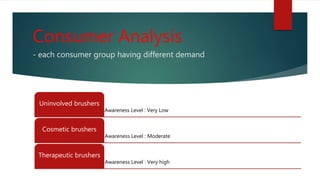
Consumer Analysis
- each consumer group having different demand
Awareness Level : Very Low
Uninvolved brushers
Awareness Level : Moderate
Cosmetic brushers
Awareness Level : Very high
Therapeutic brushers
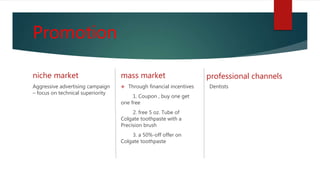
Promotion
niche market
Aggressive advertising campaign
– focus on technical superiority
mass market
 Through financial incentives
1. Coupon , buy one get
one free
2. free 5 oz. Tube of
Colgate toothpaste with a
Precision brush
3. a 50%-off offer on
Colgate toothpaste
professional channels
Dentists
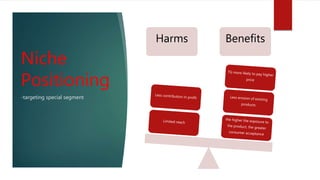
Niche
Positioning
-targeting special segment
Harms Benefits
Mainstream
Positioning
- attention to mass
production, distribution,
promotion
Harms Benefits
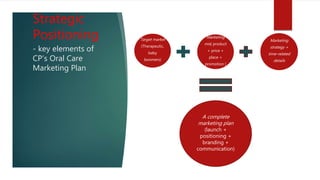
Strategic
Positioning
- key elements of
CP’s Oral Care
Marketing Plan
Target market
(Therapeutic,
baby
boomers)
Marketing
mix( product
+ price +
place +
promotion )
Marketing
strategy +
time-related
details
A complete
marketing plan
(launch +
positioning +
branding +
communication)
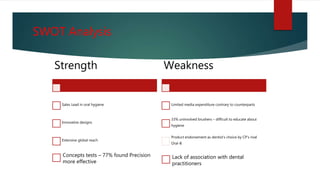
SWOT Analysis
Strength
Sales Lead in oral hygiene
Innovative designs
Extensive global reach
Weakness
Limited media expenditure contrary to counterparts
33% uninvolved brushers – difficult to educate about
hygiene
Product endorsement as dentist’s choice by CP’s rival
Oral-B
Concepts tests – 77% found Precision
more effective
Lack of association with dental
practitioners
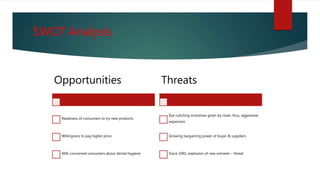
SWOT Analysis
Opportunities
Readiness of consumers to try new products
Willingness to pay higher price
46% concerned consumers about dental hygiene
Threats
Eye-catching incentives given by rivals, thus, aggressive
expansion
Growing bargaining power of buyer & suppliers
Since 1991, explosion of new entrants – threat
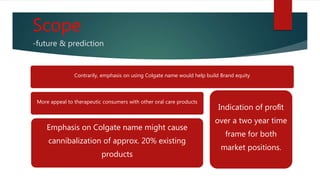
Scope
-future & prediction
Contrarily, emphasis on using Colgate name would help build Brand equity
More appeal to therapeutic consumers with other oral care products
Emphasis on Colgate name might cause
cannibalization of approx. 20% existing
products
Indication of profit
over a two year time
frame for both
market positions.
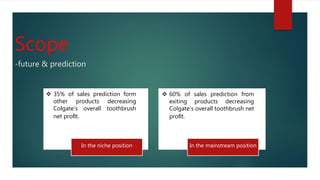
Scope
-future & prediction
In the niche position In the mainstream position
 35% of sales prediction form
other products decreasing
Colgate’s overall toothbrush
net profit.
 60% of sales prediction from
exiting products decreasing
Colgate’s overall toothbrush net
profit.
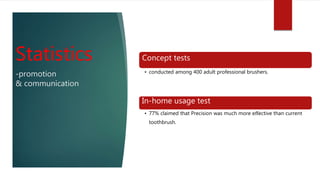
Statistics
-promotion
& communication
Concept tests
• conducted among 400 adult professional brushers.
In-home usage test
• 77% claimed that Precision was much more effective than current
toothbrush.
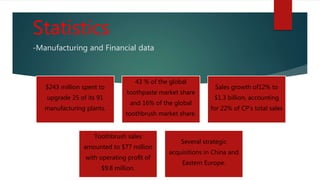
Statistics
-Manufacturing and Financial data
$243 million spent to
upgrade 25 of its 91
manufacturing plants.
43 % of the global
toothpaste market share
and 16% of the global
toothbrush market share.
Sales growth of12% to
$1.3 billion, accounting
for 22% of CP’s total sales
Toothbrush sales
amounted to $77 million
with operating profit of
$9.8 million.
Several strategic
acquisitions in China and
Eastern Europe.
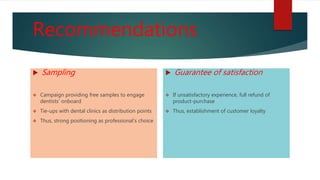
Recommendations
 Sampling
 Campaign providing free samples to engage
dentists’ onboard
 Tie-ups with dental clinics as distribution points
 Thus, strong positioning as professional’s choice
 Guarantee of satisfaction
 If unsatisfactory experience, full refund of
product-purchase
 Thus, establishment of customer loyalty
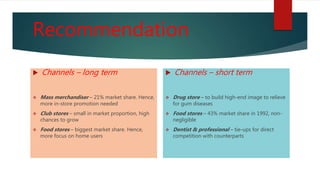
Recommendation
 Channels – long term
 Mass merchandiser – 21% market share. Hence,
more in-store promotion needed
 Club stores – small in market proportion, high
chances to grow
 Food stores – biggest market share. Hence,
more focus on home users
 Channels – short term
 Drug store – to build high-end image to relieve
for gum diseases
 Food stores – 43% market share in 1992, non-
negligible
 Dentist & professional – tie-ups for direct
competition with counterparts
Created as an assignment during Marketing Management Internship, under
Professor Sameer Mathur
IIM Lucknow
Ph.D.: Carnegie Mellon University
By
Sharanya Ray
West Bengal University of Technology
Thank You!

Colgate Palmolive - The Precision Toothbrush - Case Study Analysis

  • 1.
    Colgate Palmolive The PrecisionToothbrush Harvard business school case Analysis
  • 2.
    Problem - as newproduct – Colgate Precision
  • 3.
    Demand Shift in demandedbenefits from a century old Tooth brush market. Customer-readiness of premium price for superior toothbrush. Value and premium range to a “Super Premium” range – Enhanced Oral Care.
  • 4.
  • 5.
    Extend of Demand -volume growth due to emerge of Super Premium Toothbrush CP’s share Market growth  9.3% per annum since 1987 ($ sale)  Year 1992 – Market growth – 18% by volume, 21 % Present U.S. Toothbrush market  US $ 330 Million US $ 77 Million
  • 6.
    Environmental Climate -new productsin late 1980’s & early 1990’s Economic Positioned in the super- premium segment Technological Innovative designof handle and head of the tooth brush Uniqueaction of the bristles Social  Cartoon characters  glow-in-dark handles for children's market
  • 7.
    Product Offerings Infrared motionanalysis 35% more plaque removing efficiency Bristle with 3 different length Marketed as more effective than rivals namely Reach & Oral-b more technical innovation
  • 8.
    Product Segmentation VALUE PROFESSIONAL SUPER-PREMIUM • Moreeconomic • Average price : $1.29 • Better quality • Average Price : $1.59 to $2.09 • Improved designs • Average Price : $2.29 to $2.89
  • 9.
    Consumer Analysis - eachconsumer group having different demand Awareness Level : Very Low Uninvolved brushers Awareness Level : Moderate Cosmetic brushers Awareness Level : Very high Therapeutic brushers
  • 10.
    Promotion niche market Aggressive advertisingcampaign – focus on technical superiority mass market  Through financial incentives 1. Coupon , buy one get one free 2. free 5 oz. Tube of Colgate toothpaste with a Precision brush 3. a 50%-off offer on Colgate toothpaste professional channels Dentists
  • 11.
  • 12.
    Mainstream Positioning - attention tomass production, distribution, promotion Harms Benefits
  • 13.
    Strategic Positioning - key elementsof CP’s Oral Care Marketing Plan Target market (Therapeutic, baby boomers) Marketing mix( product + price + place + promotion ) Marketing strategy + time-related details A complete marketing plan (launch + positioning + branding + communication)
  • 14.
    SWOT Analysis Strength Sales Leadin oral hygiene Innovative designs Extensive global reach Weakness Limited media expenditure contrary to counterparts 33% uninvolved brushers – difficult to educate about hygiene Product endorsement as dentist’s choice by CP’s rival Oral-B Concepts tests – 77% found Precision more effective Lack of association with dental practitioners
  • 15.
    SWOT Analysis Opportunities Readiness ofconsumers to try new products Willingness to pay higher price 46% concerned consumers about dental hygiene Threats Eye-catching incentives given by rivals, thus, aggressive expansion Growing bargaining power of buyer & suppliers Since 1991, explosion of new entrants – threat
  • 16.
    Scope -future & prediction Contrarily,emphasis on using Colgate name would help build Brand equity More appeal to therapeutic consumers with other oral care products Emphasis on Colgate name might cause cannibalization of approx. 20% existing products Indication of profit over a two year time frame for both market positions.
  • 17.
    Scope -future & prediction Inthe niche position In the mainstream position  35% of sales prediction form other products decreasing Colgate’s overall toothbrush net profit.  60% of sales prediction from exiting products decreasing Colgate’s overall toothbrush net profit.
  • 18.
    Statistics -promotion & communication Concept tests •conducted among 400 adult professional brushers. In-home usage test • 77% claimed that Precision was much more effective than current toothbrush.
  • 19.
    Statistics -Manufacturing and Financialdata $243 million spent to upgrade 25 of its 91 manufacturing plants. 43 % of the global toothpaste market share and 16% of the global toothbrush market share. Sales growth of12% to $1.3 billion, accounting for 22% of CP’s total sales Toothbrush sales amounted to $77 million with operating profit of $9.8 million. Several strategic acquisitions in China and Eastern Europe.
  • 20.
    Recommendations  Sampling  Campaignproviding free samples to engage dentists’ onboard  Tie-ups with dental clinics as distribution points  Thus, strong positioning as professional’s choice  Guarantee of satisfaction  If unsatisfactory experience, full refund of product-purchase  Thus, establishment of customer loyalty
  • 21.
    Recommendation  Channels –long term  Mass merchandiser – 21% market share. Hence, more in-store promotion needed  Club stores – small in market proportion, high chances to grow  Food stores – biggest market share. Hence, more focus on home users  Channels – short term  Drug store – to build high-end image to relieve for gum diseases  Food stores – 43% market share in 1992, non- negligible  Dentist & professional – tie-ups for direct competition with counterparts
  • 22.
    Created as anassignment during Marketing Management Internship, under Professor Sameer Mathur IIM Lucknow Ph.D.: Carnegie Mellon University By Sharanya Ray West Bengal University of Technology Thank You!