































Code for Documentation!   Audit for Compliance! Richard J Hamburger MD Professor Emeritus of Medicine Indiana University Indianapolis IN Debra H. Lawson, CPC, PCS Nephrology Billing & Management  Services, LLC Rogersville, TN
Objectives     interaction requested Session I Review Changes in codes ESRD Infusion Consultation v. referral New patient v. your patient Hospitalist care Session II Discharge day Hospital dialysis Intensive care Definition & rules Tips Compliance Assessment
ESRD Codes Where are we? Previous CPT family (1995-2003) 90918-90925 G-code living (2004-2008) G0308-G0327 The new times (2009- ) 90951-90970
End Stage Renal Disease Services  (ESRD) CPT codes 90918 – 90925 have been deleted and new codes are under a new section entitled End Stage Renal Disease Services G codes for ESRD disappeared CPT codes 90951 – 90970 have been added with new code descriptors
What are we trying to capture? Physician work for patients on dialysis Excluded: Inpatient services E&M services that cannot be furnished on dialysis (non-renal related) Non-ESRD dialysis services performed in an outpatient setting
Approach to the family CPT groupings by age Youngest to oldest In center code values first Home dialysis values to follow Daily visit code values to conclude
End-Stage Renal Disease Services Codes 90951-90962 are reported  once  per month to distinguish age-specific services related to the patient's end-stage renal disease (ESRD) performed in an outpatient setting with three levels of service based on the number of face-to-face visits. ESRD-related physician services include establishment of a dialyzing cycle, outpatient evaluation and management of the dialysis visits, telephone calls, and patient management during the dialysis provided during a full month. In the circumstances where the patient has had a complete assessment visit during the month and services are provided over a period of less than a month, 90951-90962 may be used according to the number of visits performed.
End-Stage Renal Disease Services Evaluation and Management services unrelated to ESRD services that cannot be performed during the dialysis session may be reported separately. Codes 90967-90970 are reported to distinguish age-specific services for end-stage renal disease (ESRD) services for less than a full month of service, per day, for services provided under the following circumstances: home dialysis patients less than a full month, transient patients, partial month where there was one or more face-to-face visits without the complete assessment, the patient was hospitalized before a complete assessment was furnished, dialysis was stopped due to recovery or death, or the patient received a kidney transplant. For reporting purposes, each month is considered 30 days.
End-Stage Renal Disease Services ●   90960  End-stage renal disease (ESRD)  related services monthly, for  patients 20 years of age and  older; with 4 or more face-to-face  physician visits per month ●   90961  with 2-3 face-to-face physician  visits per month ●   90962  with 1 face-to-face physician  visit per month
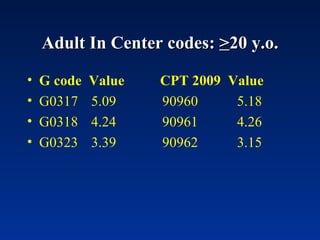
Adult In Center codes:  > 20 y.o. G code  Value  CPT 2009  Value G0317 5.09   90960   5.18 G0318 4.24   90961   4.26 G0323 3.39   90962   3.15
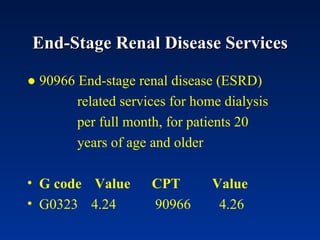
End-Stage Renal Disease Services ●  90966 End-stage renal disease (ESRD)  related services for home dialysis  per full month, for patients 20  years of age and older  G code  Value  CPT   Value G0323 4.24 90966 4.26
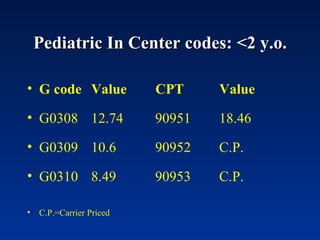
Pediatric In Center codes: <2 y.o. G code Value  CPT   Value G0308 12.74 90951 18.46 G0309 10.6 90952 C.P. G0310 8.49 90953 C.P. C.P.=Carrier Priced
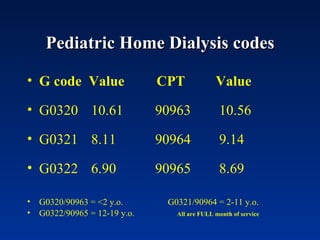
Pediatric Home Dialysis codes G code  Value  CPT   Value G0320 10.61 90963 10.56 G0321 8.11 90964 9.14 G0322 6.90 90965 8.69 G0320/90963 = <2 y.o.  G0321/90964 = 2-11 y.o. G0322/90965 = 12-19 y.o.   All are FULL month of service
MCP GUIDELINES A POLICY REVIEW
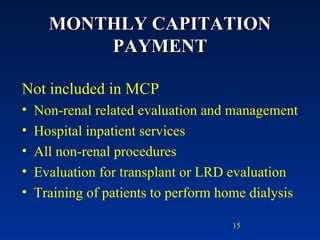
MONTHLY CAPITATION PAYMENT Not included in MCP Non-renal related evaluation and management Hospital inpatient services All non-renal procedures Evaluation for transplant or LRD evaluation Training of patients to perform home dialysis
MONTHLY CAPITATION PAYMENT Included in the MCP All renal-related  outpatient  services rendered to the dialysis patient Interpretation of ancillary testing (nerve conduction studies, bone density, doppler studies) Services rendered to the dialysis patient while on dialysis Physicals required by the dialysis facility for the renal patient
MONTHLY CAPITATION PAYMENT Included in the MCP Certification of the need for items & services such as DME & home health care Care plan oversight services described by CPT code 99375
MONTHLY CAPITATION PAYMENT Included in the MCP Periodic visits (at least one per month) to the patient during dialysis to determine if the dialysis is working well both physiologically & psychologically.  During this encounter the physician will determine if any elements of the plan need to be revised to optimize the patient’s treatment and/or care. Coordination & direction of the multi-disciplinary team involved in the patient’s  care.
OUTPATIENT SETTINGS The MCP covers all  outpatient  services related to the patient’s renal condition Services may be rendered in the in-center dialysis unit, patient’s home, practitioner’s office, outpatient hospital, observation care, emergency room and outpatient surgery Inpatient services cannot count as MCP encounters
PRACTITIONER DEFINITIONS MCP physician is the  physician  who performs the “major” (care plan) visit during the month.  This physician is the billing physician Non-physician practitioner – NP/PA who is employed by the same entity as the physician Must be able under statute to furnish services that would be physician services Non-MCP physician – must have a relationship with the MCP physician such as partner
USE OF NON-PHYSICIAN PRACTITIONERS MCP   physician (billing physician) must provide the visit with the complete assessment of the patient, establish the plan of care, and submit the bill for the monthly service  –  Must see the patient at least once a month Non-physicians can provide some of the visits to equal total # submitted Non MCP physician can provide some of the visits Non-physician must have a relationship with the physician (employee)
PARTIAL MONTH RULE 90967-90970 ESRD related services for dialysis less than a full month of service  Use limited to: Transient patients Home dialysis patients Patients who have a permanent change in their MCP physician during the month Partial month with one or more face-to-face visits without the comprehensive visit but only in patients with Dialysis stopped due to death.  Dialysis patient transplanted Dialysis patient hospitalized during the month
PARTIAL MONTH RULE Partial month rule  does not  apply to patients who start dialysis during the month Without a complete assessment, these patients cannot be billed for this first month on dialysis Cannot bill 90967-90970
TRANSIENT PATIENTS Only one physician can bill for the management of a patient per month Bill 90970  daily for the number of days the patient is under the transient physician’s care If the transient patient is in the transient dialysis unit for a full month, then transient MD becomes MCP physician and the same rules apply as with any other in-center patient.
PATIENTS WITH LESS THAN A FULL MONTH MCP Bill as if the patient had a full month of dialysis with the appropriate CPT code for the number of encounters if: Dies during the month Transplants during the month  Transfers during the month Patient must have  complete assessment  to bill using the appropriate CPT code
HOSPITAL OBSERVATION STATUS ESRD-related visits furnished in hospital observation status  count as an MCP encounter  Visit will count towards the total number of encounters submitted (CPT code) Describe (document) in the medical record the type of ESRD-related service rendered in observation status
HOSPITALIZATION  & the  MCP  in  IN-CENTER PATIENTS ESRD patients, other than home dialysis patients, hospitalized during the month will be billed for the number of face-to-face encounters that occurred when the patient was  not  hospitalized Since the MCP is no longer “time” dependent, but based on encounters face-to-face, the practitioners no longer “carve out” hospital days. Bill inpatient care  and  the CPT code for the number of outpatient face-to-face encounters
HOME DIALYSIS Payment similar to 2-3 visit payment level approximately $221.66 Monthly visit is the routine – bill using full month code (90966 for 20+ years old) If patient has less than full month at home– bill using daily code – (90970 for 20+ years old) Home patients are billed similarly to how MCP was billed historically
HOME DIALYSIS If the home patient receives in-center dialysis during the month, the provider would still bill the management fee for the month under the home dialysis provision The physician  cannot  bill the in-center CPT code  or  CPT 90935-90937 for the encounters in-center
HOSPITALIZATION  & the   MCP - HOME DIALYSIS Home patients continue to be billed in a full month or partial month format similar to previous coding If the patient is home for the 1 st  -10 th  hospitalized from the 11 th -20 th , then back home from the 21 st -30 th , you would bill for the 90970 (adult) for the 1-10 (10 days), inpatient codes for 11-20, then 90970 for the 21-30 (10 days)
TEACHING PHYSICIANS Patient visits by residents or fellows who are counted towards an institution’s Medicare graduate medical education (GME) payment may  not  be counted towards the MCP visits in place of the MCP physician
TEACHING PHYSICIANS **NEW**  Patient visits furnished by residents & fellows may be counted toward the MCP comprehensive visit if the teaching MCP physician is physically present during the visit.  The teaching physician may utilize the resident’s notes,  HOWEVER,  the teaching physician must document his or her physical presence during the visit(s) and that he/she reviewed the notes.  This then may be used for the MCP note.  Change request 5932
MODALITY CHANGES If a patient switches modalities during the month, bill the entire month using the appropriate  HOME  dialysis code 90963-90966 If partial month care bill using 90967-90970
CHANGES IN DOCUMENTATION REQUIREMENTS CMS stopped short of dictating documentation requirements however were very specific on what was necessary With requirements now for verification of physician’s face to face visits, documentation of encounters will be necessary RPA offers a documentation tool to meet CMS recommendations
CHANGES IN DOCUMENTATION REQUIREMENTS (cont) Document what is clinically relevant i ncluding  but  not limited  to: patient's current status and complaints,  a clinically appropriate physical examination, assessment of the patient's treatment for ESRD that includes assessment of the adequacy of the dialysis treatment, the status of the patient's vascular access, assessment and treatment of the other conditions associated with ESRD, such as anemia, electrolyte management, and bone density, as well as changes to the patient's management
ADDITIONAL DOCUMENTATION NEEDED FOR PEDIATRIC PATIENTS In addition to the requirements for adult patients, pediatric nephrologists also need to: Monitor the patient for adequacy of nutrition Assess for growth and development Counsel parents Documentation must show these elements  In addition to the adult documentation requirements
CHANGES IN DOCUMENTATION REQUIREMENTS (cont) Documentation of the “major” visit is required Documentation that the physician performed a service for the patient is required for the other encounters Signing a dialysis flow sheet or any other form if not enough…the physician must document they are performing a service at each encounter
IMPORTANT TIP! Patients starting new with you or your facility CANNOT be brought into your office prior to going on dialysis and a new patient E&M billed.  This service is done because they are ESRD (renal related), in the outpatient setting, it is part of the MCP
HOME DIALYSIS  TRAINING
HOME TRAINING DIALYSIS MANAGEMENT 90989  - Dialysis training, patient, including helper where applicable, any mode, complete course 90993  - Dialysis training, patient, including helper where applicable, any mode, course not completed, per training session (billed by units completed) Physician  must  have direct participation in the training to bill
HOME TRAINING DIALYSIS MANAGEMENT Example of billing for training Patient on hemodialysis March 1-15, 2009 Seen with comprehensive visit 2 times Patient began home PD training March 16 continued through March 21, 2009.  Physician participated directly in training – 90989, PD training complete, March 16,17,19,20,21, 2009 Patient at home for the full month (90963-90966)
HOME TRAINING DIALYSIS MANAGEMENT A completed course is reimbursed with a maximum $500 allowable A completed course should be reported with 90989 with a quantity of “one” For a training course not completed bill 90993 for the number of sessions completed and reimbursed at a $20 per session allowable
Infusion Codes Non facility codes where physician work involves affirmation of treatment plan and direct supervision of staff Hydration  96360  31min-1 hr   96361   > 1hr Therapeutic, prophylactic or diagnostic IV infusion of substances or drugs 96365-96376
CONSULT  V  REFERRAL CORRECT CODING CAN MEAN $$$$ INCORRECT CODING….
CONSULTATION At the request of a referring physician or other appropriate source for  opinion or advice  Requires evaluation and/or management of a  specific  problem Requires written communication to the requesting physician or other appropriate source
CONSULTATION Documentation must properly reflect work done according to CPT description of consultation (key and contributing components)
Concurrent Care and Transfer of Care Currently accepted for CPT 2010 Concurrent care is the provision of similar services (e.g., hospital visits) to the same patient by more than one physician on the same day. When concurrent care is provided, no special reporting is required.
Concurrent Care and Transfer of Care Currently accepted for CPT 2010 Consultation codes should not be reported by the physician who has agreed to accept transfer of care before an initial evaluation, but are appropriate to report if the decision to accept transfer of care cannot be made until after the initial consultation evaluation, regardless of site of service.
Concurrent Care and Transfer of Care Currently accepted for CPT 2010 Transfer of care is the process whereby a physician who is providing management for some/all of a patient’s problems relinquishes this responsibility to another physician who explicitly agrees to accept this responsibility, and who from the initial encounter is not providing consultative services.  The physician transferring care is then no longer providing care for these problems, though may continue providing care for other conditions when appropriate
Concurrent Care and Transfer of Care Currently accepted for CPT 2010 A consultation is a type of evaluation and management service provided by a physician at the request of another physician or appropriate source to either recommend care for a specific condition/problem or to determine whether to accept responsibility for ongoing management of the patient’s entire care or for the care of a specific condition/problem
Concurrent Care and Transfer of Care Currently accepted for CPT 2010 The written or verbal request for  consultation may be made by a physician or other appropriate source and documented in the patient's medical record by either the consulting or requesting physician or appropriate source.  The consultant's opinion and any services that were ordered or performed must also be documented in the patient's medical record and communicated by written report to the requesting physician or other appropriate source.
CONSULTATION The service meets the requirement for a consult when: The service is not simply a continuation of care by a consultant for an established clinical problem of an established patient For example, treatment in a different clinical setting such as an E/M service for continuation of previously established outpatient care in the inpatient setting for patients admitted by another physician for a separate reason
CONSULTATION The opinion rendered is of such a nature that it will be used by, and in some manner will affect, the requesting physician’s own management of, or decision-making about, the patient. When the referring physician will not be involved in any subsequent decision-making about the problem for which the referral has been made, the service should not be coded as a consultation.
NON-PHYSICIAN PRACTITIONERS & CONSULTS  Initial consults in the outpatient setting must be performed entirely by the physician Non-physician practitioners cannot perform any portion of an initial consult and bill the consult under the physician’s provider number “ Incident to” requires non-physician practitioner’s services to follow the treatment plan of the physician and the physician must continue to have ongoing care and update with the patient
NON-PHYSICIAN PRACTITIONERS & CONSULTS Consults performed in the inpatient setting cannot be shared services between the non-physician practitioner and the physician If the non-physician practitioner is involved, the consult must be billed under the NPP’s provider number
PRE-OPERATIVE CLEARANCE Covered Medicare service Record must demonstrate preoperative medical evaluation is reasonable and necessary given the patient’s medical condition and the nature of the proposed surgical procedure Opinion of the consultant will be used by the requesting surgeon in perioperative management of the patient
PRE-OPERATIVE CLEARANCE The E/M service documented must  not  constitute any of the following: E/M service provided to fulfill the mandatory preoperative or preadmission H&P (part of the operating surgeon’s global) Substitute for proper preoperative clearance by surgeon E/M is a continuation of outpatient services which would not affect the operating surgeon’s decision-making regarding the patient
WHAT IS NOT A CONSULT Initiated by patient and/or patient’s family If initiated at the request of a third party payer visit is reported as a consult Requires use of Modifier “-32”, mandated services (not recognized by Medicare) Requires report back to third party payer
REFERRAL Physician refers a patient to another physician for the management of a particular condition –concurrent care First visit is reported as new patient visit Referring physician relinquishes care for that particular condition to the new physician
CONSULTATION CODES 99241-99245 – Office or Outpatient Consult  99251-99255 – Inpatient Consult Codes 99251-99255 –  Initial Consults in the Skilled Nursing Facility/Nursing Facility
USE OF HOSPITALISTS Many facilities in an effort to retain monies within the hospital system have added hospitalists to their staff Facilities are encouraging associated providers to utilize hospitalists for admitting their patients Many physicians are utilizing hospitalists because it eliminates the “extra” work of an admission
USE OF HOSPITALISTS As a substitute for this “quality of life” issue for the nephrologist using hospitalists there is a economic issue When you initiate a “ consult”  by requesting a hospitalist admit, it is difficult to meet the criteria for a consultation thus making the initial encounter in the inpatient setting subsequent care or dialysis
USE OF HOSPITALISTS There are arguments for using hospitalists, including hospital relations  One must weigh the positives and negatives to determine if this is a choice the individual nephrologist or group makes
CONSULT TIDBITS Inpatient consultation may only be reported once per consultant per facility admission If the consultant continues to care for the patient following the initial consultation, report additional visits using established patient visit codes Reason for the consultation must be documented in the medical record along with the name of the requesting provider
TIPS FOR PREVENTING CODING ERRORS WITH E/M CODING Consultation – before coding a consult ask these questions about the service – if the answer is “NO” to any, do not report as a consult Did you receive a request for an opinion from another provider? Does your documentation of the service clearly demonstrate who made the request and the nature of the opinion requested?
TIPS FOR PREVENTING CODING ERRORS WITH E/M CODING Consults – cont. Have you provided a written report of your opinion/advice to the requesting physician? Though the requesting physician may have asked for a “consultation” should the service provided be reported as a consult? Will your opinion be used by, and in some manner effect the requesting physician’s own management of the patient or is it a transfer of care for a particular problem?
TIPS FOR PREVENTING CODING ERRORS WITH E/M CODING Consults – cont. Will the requesting physician be involved in subsequent decision making about the problem for which the request has been made? For pre-operative “consultations”, is the service requested specifically for pre-operative clearance that is medically necessary considering the patient’s condition and the procedure planned? Is the pre-operative “consultation” a substitute for the mandatory H&P to be provided by the operating surgeon?  THIS IS NOT A SEPARATELY BILLABLE SERVICE
DISCHARGE  MANAGEMENT SERVICES
DISCHARGE CRITERIA The hospital discharge day management codes are to be used to report the total duration of time spent by a physician for final hospital discharge of a patient. The codes include, as appropriate, final examination of the patient, discussion of the hospital stay, even if the time spent by the physician on that date is not continuous, instructions for continuing care to all relevant caregivers, and preparation of discharge records, prescriptions and referral forms.
DISCHARGE CRITERIA **NEW** - CHANGE REQUEST 5794 – TRANSMITTAL 1460 – Effective Date April 1, 2008 – Implementation Date April 7, 2008 Discharge services are considered a face-to-face service Billable only by the attending physician Discharge day services by other physicians are billing used 99231-99233 Bill on the day the visit by the physician is done even if the patient is discharged on a different calendar day
DISCHARGE CRITERIA Medicare pays for the paperwork of patient discharge as part of the pre- and post-work of the E&M service Medicare does not pay for a subsequent hospital visit (99231-99233) on the same day as a discharge Medicare pays for the hospital discharge in addition to a nursing home admit when billed by the same physician on the same date of service Change request 5794,  transmittal 1460
DISCHARGE CRITERIA Medicare pays only for the physician who personally performs the pronouncement of death for the discharge day management service.  The date of pronouncement shall reflect the calendar date of service on the day it was performed even though the paperwork is delayed. This can be the attending or any other physician These changes are reflected by CR 5794, Transmittal 1460
DISCHARGE MANAGEMENT 99238 – Discharge management – 30 minutes or less 99239 – Discharge management – over 30 minutes Since time driven code requires documentation of services rendered and time spent performing services If time is not documented, 99238 is billed
NEPHROLOGY  SPECIFIC  CPT  CODING
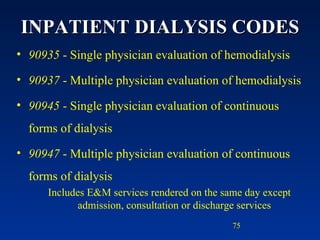
INPATIENT DIALYSIS CODES 90935  - Single physician evaluation of hemodialysis 90937  - Multiple physician evaluation of hemodialysis 90945  - Single physician evaluation of continuous forms of dialysis 90947  - Multiple physician evaluation of continuous forms of dialysis Includes E&M services rendered on the same day except admission, consultation or discharge services
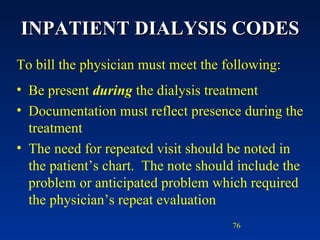
INPATIENT DIALYSIS CODES To bill the physician must meet the following: Be present  during  the dialysis treatment Documentation must reflect presence during the treatment The need for repeated visit should be noted in the patient’s chart.  The note should include the problem or anticipated problem which required the physician’s repeat evaluation
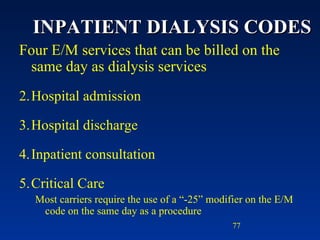
INPATIENT DIALYSIS CODES Four E/M services that can be billed on the same day as dialysis services Hospital admission Hospital discharge Inpatient consultation Critical Care Most carriers require the use of a “-25” modifier on the E/M code on the same day as a procedure
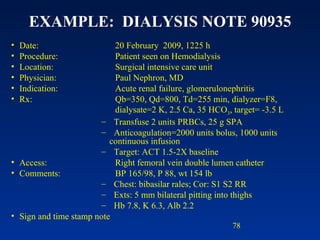
EXAMPLE:  DIALYSIS NOTE 90935 Date: 20 February  2009, 1225 h Procedure: Patient seen on Hemodialysis Location:  Surgical intensive care unit Physician: Paul Nephron, MD Indication: Acute renal failure, glomerulonephritis Rx: Qb=350, Qd=800, Td=255 min, dialyzer=F8,  dialysate=2 K, 2.5 Ca, 35 HCO 3 , target= -3.5 L Transfuse 2 units PRBCs, 25 g SPA Anticoagulation=2000 units bolus, 1000 units  continuous infusion Target: ACT 1.5-2X baseline Access: Right femoral vein double lumen catheter Comments: BP 165/98, P 88, wt 154 lb Chest: bibasilar rales; Cor: S1 S2 RR Exts: 5 mm bilateral pitting into thighs Hb 7.8, K 6.3, Alb 2.2 Sign and time stamp note
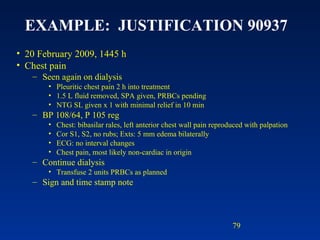
EXAMPLE:  JUSTIFICATION 90937   20 February 2009, 1445 h Chest pain Seen again on dialysis Pleuritic chest pain 2 h into treatment 1.5 L fluid removed, SPA given, PRBCs pending NTG SL given x 1 with minimal relief in 10 min BP 108/64, P 105 reg Chest: bibasilar rales, left anterior chest wall pain reproduced with palpation Cor S1, S2, no rubs; Exts: 5 mm edema bilaterally ECG: no interval changes Chest pain, most likely non-cardiac in origin Continue dialysis Transfuse 2 units PRBCs as planned Sign and time stamp note
90937 vs CRITICAL CARE WHEN IS EACH APPROPRIATE?
CODING FOR CRITICAL CARE
99291 Critical care, evaluation and management of the critically ill or critically injured patient; first 30-74 minutes
99292 Critical care, evaluation and management of the critically ill or critically injured patient; each additional 30 minutes
CPT DEFINITION  CRITICAL ILLNESS OR INJURY “ A critical illness or injury acutely impairs one or more vital organ system(s) such that there is a high probability of imminent or life threatening deterioration in the patient’s condition.”
CPT DEFINITION  CRITICAL CARE SERVICES “ Critical care is the  direct delivery  by a physician(s) of medical care for a critically ill or injured patient.” “ Involves decision making of high complexity to assess, manipulate, and support system function(s), to treat single or multiple vital organ system failure and/or to prevent further life threatening deterioration of the patient’s condition.”
CPT DEFINITION  CRITICAL CARE SERVICES Examples of Vital Organ System Failure   Central nervous system failure Shock Circulatory failure Renal failure Hepatic failure Respiratory failure Metabolic failure
CPT DEFINITION  CRITICAL CARE SERVICES Critical care may be provided on multiple days, even if no changes are made in the treatment rendered to the patient, provided that the patient’s condition continues to require the level of physician attention as previously described.
WHERE CRITICAL CARE  IS PROVIDED Critical care is usually, but not always, given in a critical care area, such as the coronary care unit, intensive care unit, pediatric intensive care unit, respiratory care unit, or the emergency care facility.
CRITICAL CARE  TREATMENT CRITERION Critical care services require direct  personal  management by the physician. They are life and organ supporting interventions that require frequent, personal assessment and manipulation by the physician. Failure to provide these interventions on an urgent basis would result in life threatening deterioration in the patient’s condition.
CRITICAL CARE  “FULL ATTENTION” REQUIREMENT “ Critical care is used to report the total duration of time spent by a physician providing critical care services to a critically ill or injured patient, even if the time spent by the physician on that date is not continuous.  For the time spent, the physician must devote his or her  full  attention to the patient…”
WHERE IS CRITICAL CARE PROVIDED Time spent with the individual patient  must  be recorded in the patient’s record. Time spent can be reported if spent is at the bedside or on the unit or floor, i.e.. Coordinating care, but  cannot  be in caring for another patient.  Can include time spent with family, etc. when the patient cannot make decisions for self.
CRITICAL CARE DOCUMENTION  FOR MEDICAL REVIEW Must indicate full attention provided Since time based, must contain documentation of total time involved  Time involved with family to gain pertinent history or make decisions must be documented Telephone calls to family members to be considered must meet same criteria as face-to-face
SERVICES  NOT  INCLUDED IN CRITICAL CARE TIME Time spent providing services not bundled into critical care time such as dialysis or access placement are not included Services rendered earlier in the day prior to the patient’s need for critical care.  This service can be reported separately, but documentation needs to be sent with the claim and a modifier  (-25) needs to be appended to this service.  CR 5792  Time spent updating patient’s family about status not meeting previous criteria regardless of how lengthy
CRITICAL CARE & DIALYSIS Dialysis (90935, 90937, 90945, 90947) is not included in Critical Care time Make sure a separate note is made for dialysis and all the criteria for billing dialysis are met…physical presence during the treatment Append a “-25” modifier to the Critical Care code
CRITICAL CARE TIDBITS 99291 is used to report first hour (30-74 minutes) of critical care 99292 is used to report each additional 30 minutes 99292 is used to report final 15-30 minutes of critical care Critical care of less than 30 minutes is reported using appropriate E/M code  Only one physician may bill for a given hour of critical care even if more than one physician is providing care
TIPS FOR PREVENTING CODING ERRORS WITH E/M CODING Critical Care – Before coding for critical care, ask the following questions.  If the answer is “NO” do not report as critical care. Does the record documented show work performed to be more intense than work of other E/M services of the same time duration? Does the record demonstrate the patient has  acute  impairment of one or more vital organ systems and has a high probability of  imminent  or  life-threatening  deterioration?
TIPS FOR PREVENTING CODING ERRORS WITH E/M CODING Critical Care – cont. Does the documentation demonstrate all of the following? Direct personal management. Frequent personal assessment and manipulation (not just the general once-a-day visit). High-complexity decision-making to assess, manipulate and support vital system function(s) to treat single or multiple organ system failure or to prevent further deterioration.
TIPS FOR PREVENTING CODING ERRORS WITH E/M CODING Critical Care – cont. Interventions of a nature that failure to initiate these interventions on an urgent basis would likely result in sudden clinically significant or life-threatening deterioration in the patient’s condition. What about the time spent providing critical care? Is specifically recorded? Is it reasonable considering the documented work provided? Does it exclude time spent performing procedures separately billable? If it includes time spent with family, was the family members operating as a surrogate decision-maker because the patient was unable to make decisions?
Compliance  Assessment
Compliance Assessment Who What  Where  When Why
Compliance Assessment Why To get paid for your work you must document Audit and review within a practice produces better coding and billing PQRI will be replaced by deductions so – be prepared
 
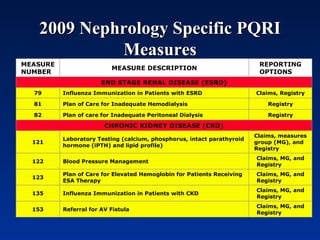
2009 Nephrology Specific PQRI Measures MEASURE NUMBER MEASURE DESCRIPTION REPORTING OPTIONS END STAGE RENAL DISEASE (ESRD) 79 Influenza Immunization in Patients with ESRD Claims, Registry 81 Plan of Care for Inadequate Hemodialysis  Registry 82 Plan of care for Inadequate Peritoneal Dialysis Registry CHRONIC KIDNEY DISEASE (CKD) 121 Laboratory Testing (calcium, phosphorus, intact parathyroid hormone (iPTH) and lipid profile) Claims, measures group (MG), and Registry 122 Blood Pressure Management Claims, MG, and Registry 123 Plan of Care for Elevated Hemoglobin for Patients Receiving ESA Therapy Claims, MG, and Registry 135 Influenza Immunization in Patients with CKD Claims, MG, and Registry 153 Referral for AV Fistula Claims, MG, and Registry
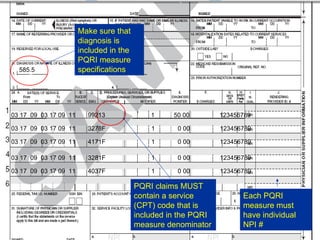
2009 Claims Based Reporting Same reporting requirements from 2007 and 2008 programs Must report at least 3 quality measures on at least 80% of claims where PQRI measures could be reported. Validation through denominator coding.  Applicable cases defined by CPT codes included in the denominator of each PQRI measure. ESRD PQRI measures – denominator codes include all MCP codes as well as inpatient dialysis codes  CKD PQRI measures – denominator coding includes E/M codes  Diabetes PQRI measures – denominator coding includes E/M codes as well as diabetes self management codes  Claims must contain a line-item ICD-9 diagnosis code accompanied by a specific CPT patient encounter code  along with PQRI quality data codes (QDCs )
03 17  09  03 17 09  11  99213  1  50 00  123456789  03 17  09  03 17 09  11  3278F  1  0 00  123456789  585.5 03 17  09  03 17 09  11  3281F  1  0 00  123456789  Make sure that diagnosis is included in the PQRI measure specifications Each PQRI measure must have individual NPI # PQRI claims MUST contain a service (CPT) code that is included in the PQRI measure denominator 03 17  09  03 17 09  11  4171F  1  0 00  123456789  03 17  09  03 17 09  11  4037F  1  0 00  123456789
PQRI and eRx resources available on RPA’s website www.renalmd.org/pqri   Contains nephrology-specific information on PQRI and eRx incentive programs Provides information
Compliance Assessment What Hospital records v billing Office records v billing Dialysis services v billing Receipts v billing
BILLING FOR  ERYTHROPOIETIC STIMULATING AGENTS
CAUTION ! POLICIES CHANGE QUICKLY!! Please review your own carriers LCD on a monthly basis. Also review the NCD regularly. Knowledge in this arena is vital.  An ounce of prevention……….
Pretreatment HCT Level of less than 30 Creatinine of 3.0 or greater  OR Documented renal insufficiency (stage 3-5) Patient ’ s current weight in kilograms Date of lab (within 7 days - this may vary by location) Please understand this is an example & not intended to be taken as policy! INITIAL  ESA  (Epoetin Alfa &  Darbepoetin Alfa)   ADMINISTRATION  EXAMPLE   GUIDELINES
FOLLOW-UP ESA  (Epoetin Alfa &  Darbepoetin Alfa)   ADMINISTRATION  EXAMPLE   GUIDELINES Current HCT level to max of 36 or multiply of Hgb x 3 Date of Laboratory Data (within the last 30 days) ICD-9 code appropriate for state Please understand this is an example & not  intended to be taken as policy!
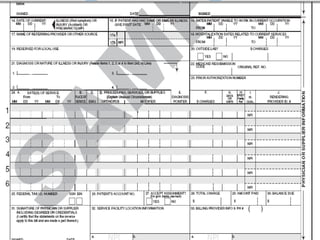
COMPLETING HCFA 1500 Form Diagnosis codes 285.21 Anemia in CKD & stage of CKD if required Dates of service HCPCS code: J0885 (Procrit); J0881(Aranesp) Units administered  –  per 1000 units Other data as required Intermediary/carrier specific Hct or Hb, SCr with date, weight in kg, exceptions requests (altitude, comorbid condition), EJ modifier
DRUG CODES J0881 – Darbepoetin alfa, 1 mcg (non-ESRD) J0882 – Darbepoetin alfa, 1 mcg (ESRD use) J0885 – Epoetin alfa, 1000 units (non-ESRD) J0886 – Epoetin alfa, 1000 units (ESRD use)
BILLING FOR  ADMINISTRATION OF  ESA Drug and administration is covered “incident to” physician service  If the purpose of the visit is for an injection, use 96372 for the subcutaneous administration of either Procrit or Aranesp 99211 is only used when another service, not protocol for the injection, is provided
BILLING FOR  ADMINISTRATION OF  ESA When the drug is administered “incident to” a physician’s visit, bill the appropriate level of E&M for the physician visit with a “-25” modifier (CCI edit effective 10/1/05), the administration fee 96372 and the drug.  REMEMBER :  The provider must be physically present in the suite when the injection is given to bill for the administration or the drug
CHANGES IN BILLING FOR ESA Effective January 1, 2008 Effective for all non-ESRD claims with J0881 and J0885 EA : ESA, anemia, chemo-induced EB : ESA, anemia, radio-induced EC : ESA, anemia, non-chemo/radio induced Without modifier will deny w/MA130 (no appeal rights submit new claim)
CHANGES IN BILLING FOR ESA Test results are reported in Item 19 of the CMS 1500  For electronic claims (837P) report H/H readings in Loop 2400 MEA segment MEA01=TR (test results), MEA02=R1 (hemoglobin) R2 (hematocrit), and the most recent result (3-digits) Ex: 10.5 hgb (TR/R1/10.5)

07 Am09 Presentations Hamburger & Lawson

  • 1.
    Code for Documentation!  Audit for Compliance! Richard J Hamburger MD Professor Emeritus of Medicine Indiana University Indianapolis IN Debra H. Lawson, CPC, PCS Nephrology Billing & Management Services, LLC Rogersville, TN
  • 2.
    Objectives interaction requested Session I Review Changes in codes ESRD Infusion Consultation v. referral New patient v. your patient Hospitalist care Session II Discharge day Hospital dialysis Intensive care Definition & rules Tips Compliance Assessment
  • 3.
    ESRD Codes Whereare we? Previous CPT family (1995-2003) 90918-90925 G-code living (2004-2008) G0308-G0327 The new times (2009- ) 90951-90970
  • 4.
    End Stage RenalDisease Services (ESRD) CPT codes 90918 – 90925 have been deleted and new codes are under a new section entitled End Stage Renal Disease Services G codes for ESRD disappeared CPT codes 90951 – 90970 have been added with new code descriptors
  • 5.
    What are wetrying to capture? Physician work for patients on dialysis Excluded: Inpatient services E&M services that cannot be furnished on dialysis (non-renal related) Non-ESRD dialysis services performed in an outpatient setting
  • 6.
    Approach to thefamily CPT groupings by age Youngest to oldest In center code values first Home dialysis values to follow Daily visit code values to conclude
  • 7.
    End-Stage Renal DiseaseServices Codes 90951-90962 are reported once per month to distinguish age-specific services related to the patient's end-stage renal disease (ESRD) performed in an outpatient setting with three levels of service based on the number of face-to-face visits. ESRD-related physician services include establishment of a dialyzing cycle, outpatient evaluation and management of the dialysis visits, telephone calls, and patient management during the dialysis provided during a full month. In the circumstances where the patient has had a complete assessment visit during the month and services are provided over a period of less than a month, 90951-90962 may be used according to the number of visits performed.
  • 8.
    End-Stage Renal DiseaseServices Evaluation and Management services unrelated to ESRD services that cannot be performed during the dialysis session may be reported separately. Codes 90967-90970 are reported to distinguish age-specific services for end-stage renal disease (ESRD) services for less than a full month of service, per day, for services provided under the following circumstances: home dialysis patients less than a full month, transient patients, partial month where there was one or more face-to-face visits without the complete assessment, the patient was hospitalized before a complete assessment was furnished, dialysis was stopped due to recovery or death, or the patient received a kidney transplant. For reporting purposes, each month is considered 30 days.
  • 9.
    End-Stage Renal DiseaseServices ● 90960 End-stage renal disease (ESRD) related services monthly, for patients 20 years of age and older; with 4 or more face-to-face physician visits per month ● 90961 with 2-3 face-to-face physician visits per month ● 90962 with 1 face-to-face physician visit per month
  • 10.
    Adult In Centercodes: > 20 y.o. G code Value CPT 2009 Value G0317 5.09 90960 5.18 G0318 4.24 90961 4.26 G0323 3.39 90962 3.15
  • 11.
    End-Stage Renal DiseaseServices ● 90966 End-stage renal disease (ESRD) related services for home dialysis per full month, for patients 20 years of age and older G code Value CPT Value G0323 4.24 90966 4.26
  • 12.
    Pediatric In Centercodes: <2 y.o. G code Value CPT Value G0308 12.74 90951 18.46 G0309 10.6 90952 C.P. G0310 8.49 90953 C.P. C.P.=Carrier Priced
  • 13.
    Pediatric Home Dialysiscodes G code Value CPT Value G0320 10.61 90963 10.56 G0321 8.11 90964 9.14 G0322 6.90 90965 8.69 G0320/90963 = <2 y.o. G0321/90964 = 2-11 y.o. G0322/90965 = 12-19 y.o. All are FULL month of service
  • 14.
    MCP GUIDELINES APOLICY REVIEW
  • 15.
    MONTHLY CAPITATION PAYMENTNot included in MCP Non-renal related evaluation and management Hospital inpatient services All non-renal procedures Evaluation for transplant or LRD evaluation Training of patients to perform home dialysis
  • 16.
    MONTHLY CAPITATION PAYMENTIncluded in the MCP All renal-related outpatient services rendered to the dialysis patient Interpretation of ancillary testing (nerve conduction studies, bone density, doppler studies) Services rendered to the dialysis patient while on dialysis Physicals required by the dialysis facility for the renal patient
  • 17.
    MONTHLY CAPITATION PAYMENTIncluded in the MCP Certification of the need for items & services such as DME & home health care Care plan oversight services described by CPT code 99375
  • 18.
    MONTHLY CAPITATION PAYMENTIncluded in the MCP Periodic visits (at least one per month) to the patient during dialysis to determine if the dialysis is working well both physiologically & psychologically. During this encounter the physician will determine if any elements of the plan need to be revised to optimize the patient’s treatment and/or care. Coordination & direction of the multi-disciplinary team involved in the patient’s care.
  • 19.
    OUTPATIENT SETTINGS TheMCP covers all outpatient services related to the patient’s renal condition Services may be rendered in the in-center dialysis unit, patient’s home, practitioner’s office, outpatient hospital, observation care, emergency room and outpatient surgery Inpatient services cannot count as MCP encounters
  • 20.
    PRACTITIONER DEFINITIONS MCPphysician is the physician who performs the “major” (care plan) visit during the month. This physician is the billing physician Non-physician practitioner – NP/PA who is employed by the same entity as the physician Must be able under statute to furnish services that would be physician services Non-MCP physician – must have a relationship with the MCP physician such as partner
  • 21.
    USE OF NON-PHYSICIANPRACTITIONERS MCP physician (billing physician) must provide the visit with the complete assessment of the patient, establish the plan of care, and submit the bill for the monthly service – Must see the patient at least once a month Non-physicians can provide some of the visits to equal total # submitted Non MCP physician can provide some of the visits Non-physician must have a relationship with the physician (employee)
  • 22.
    PARTIAL MONTH RULE90967-90970 ESRD related services for dialysis less than a full month of service Use limited to: Transient patients Home dialysis patients Patients who have a permanent change in their MCP physician during the month Partial month with one or more face-to-face visits without the comprehensive visit but only in patients with Dialysis stopped due to death. Dialysis patient transplanted Dialysis patient hospitalized during the month
  • 23.
    PARTIAL MONTH RULEPartial month rule does not apply to patients who start dialysis during the month Without a complete assessment, these patients cannot be billed for this first month on dialysis Cannot bill 90967-90970
  • 24.
    TRANSIENT PATIENTS Onlyone physician can bill for the management of a patient per month Bill 90970 daily for the number of days the patient is under the transient physician’s care If the transient patient is in the transient dialysis unit for a full month, then transient MD becomes MCP physician and the same rules apply as with any other in-center patient.
  • 25.
    PATIENTS WITH LESSTHAN A FULL MONTH MCP Bill as if the patient had a full month of dialysis with the appropriate CPT code for the number of encounters if: Dies during the month Transplants during the month Transfers during the month Patient must have complete assessment to bill using the appropriate CPT code
  • 26.
    HOSPITAL OBSERVATION STATUSESRD-related visits furnished in hospital observation status count as an MCP encounter Visit will count towards the total number of encounters submitted (CPT code) Describe (document) in the medical record the type of ESRD-related service rendered in observation status
  • 27.
    HOSPITALIZATION &the MCP in IN-CENTER PATIENTS ESRD patients, other than home dialysis patients, hospitalized during the month will be billed for the number of face-to-face encounters that occurred when the patient was not hospitalized Since the MCP is no longer “time” dependent, but based on encounters face-to-face, the practitioners no longer “carve out” hospital days. Bill inpatient care and the CPT code for the number of outpatient face-to-face encounters
  • 28.
    HOME DIALYSIS Paymentsimilar to 2-3 visit payment level approximately $221.66 Monthly visit is the routine – bill using full month code (90966 for 20+ years old) If patient has less than full month at home– bill using daily code – (90970 for 20+ years old) Home patients are billed similarly to how MCP was billed historically
  • 29.
    HOME DIALYSIS Ifthe home patient receives in-center dialysis during the month, the provider would still bill the management fee for the month under the home dialysis provision The physician cannot bill the in-center CPT code or CPT 90935-90937 for the encounters in-center
  • 30.
    HOSPITALIZATION &the MCP - HOME DIALYSIS Home patients continue to be billed in a full month or partial month format similar to previous coding If the patient is home for the 1 st -10 th hospitalized from the 11 th -20 th , then back home from the 21 st -30 th , you would bill for the 90970 (adult) for the 1-10 (10 days), inpatient codes for 11-20, then 90970 for the 21-30 (10 days)
  • 31.
    TEACHING PHYSICIANS Patientvisits by residents or fellows who are counted towards an institution’s Medicare graduate medical education (GME) payment may not be counted towards the MCP visits in place of the MCP physician
  • 32.
    TEACHING PHYSICIANS **NEW** Patient visits furnished by residents & fellows may be counted toward the MCP comprehensive visit if the teaching MCP physician is physically present during the visit. The teaching physician may utilize the resident’s notes, HOWEVER, the teaching physician must document his or her physical presence during the visit(s) and that he/she reviewed the notes. This then may be used for the MCP note. Change request 5932
  • 33.
    MODALITY CHANGES Ifa patient switches modalities during the month, bill the entire month using the appropriate HOME dialysis code 90963-90966 If partial month care bill using 90967-90970
  • 34.
    CHANGES IN DOCUMENTATIONREQUIREMENTS CMS stopped short of dictating documentation requirements however were very specific on what was necessary With requirements now for verification of physician’s face to face visits, documentation of encounters will be necessary RPA offers a documentation tool to meet CMS recommendations
  • 35.
    CHANGES IN DOCUMENTATIONREQUIREMENTS (cont) Document what is clinically relevant i ncluding but not limited to: patient's current status and complaints, a clinically appropriate physical examination, assessment of the patient's treatment for ESRD that includes assessment of the adequacy of the dialysis treatment, the status of the patient's vascular access, assessment and treatment of the other conditions associated with ESRD, such as anemia, electrolyte management, and bone density, as well as changes to the patient's management
  • 36.
    ADDITIONAL DOCUMENTATION NEEDEDFOR PEDIATRIC PATIENTS In addition to the requirements for adult patients, pediatric nephrologists also need to: Monitor the patient for adequacy of nutrition Assess for growth and development Counsel parents Documentation must show these elements In addition to the adult documentation requirements
  • 37.
    CHANGES IN DOCUMENTATIONREQUIREMENTS (cont) Documentation of the “major” visit is required Documentation that the physician performed a service for the patient is required for the other encounters Signing a dialysis flow sheet or any other form if not enough…the physician must document they are performing a service at each encounter
  • 38.
    IMPORTANT TIP! Patientsstarting new with you or your facility CANNOT be brought into your office prior to going on dialysis and a new patient E&M billed. This service is done because they are ESRD (renal related), in the outpatient setting, it is part of the MCP
  • 39.
  • 40.
    HOME TRAINING DIALYSISMANAGEMENT 90989 - Dialysis training, patient, including helper where applicable, any mode, complete course 90993 - Dialysis training, patient, including helper where applicable, any mode, course not completed, per training session (billed by units completed) Physician must have direct participation in the training to bill
  • 41.
    HOME TRAINING DIALYSISMANAGEMENT Example of billing for training Patient on hemodialysis March 1-15, 2009 Seen with comprehensive visit 2 times Patient began home PD training March 16 continued through March 21, 2009. Physician participated directly in training – 90989, PD training complete, March 16,17,19,20,21, 2009 Patient at home for the full month (90963-90966)
  • 42.
    HOME TRAINING DIALYSISMANAGEMENT A completed course is reimbursed with a maximum $500 allowable A completed course should be reported with 90989 with a quantity of “one” For a training course not completed bill 90993 for the number of sessions completed and reimbursed at a $20 per session allowable
  • 43.
    Infusion Codes Nonfacility codes where physician work involves affirmation of treatment plan and direct supervision of staff Hydration 96360 31min-1 hr 96361 > 1hr Therapeutic, prophylactic or diagnostic IV infusion of substances or drugs 96365-96376
  • 44.
    CONSULT V REFERRAL CORRECT CODING CAN MEAN $$$$ INCORRECT CODING….
  • 45.
    CONSULTATION At therequest of a referring physician or other appropriate source for opinion or advice Requires evaluation and/or management of a specific problem Requires written communication to the requesting physician or other appropriate source
  • 46.
    CONSULTATION Documentation mustproperly reflect work done according to CPT description of consultation (key and contributing components)
  • 47.
    Concurrent Care andTransfer of Care Currently accepted for CPT 2010 Concurrent care is the provision of similar services (e.g., hospital visits) to the same patient by more than one physician on the same day. When concurrent care is provided, no special reporting is required.
  • 48.
    Concurrent Care andTransfer of Care Currently accepted for CPT 2010 Consultation codes should not be reported by the physician who has agreed to accept transfer of care before an initial evaluation, but are appropriate to report if the decision to accept transfer of care cannot be made until after the initial consultation evaluation, regardless of site of service.
  • 49.
    Concurrent Care andTransfer of Care Currently accepted for CPT 2010 Transfer of care is the process whereby a physician who is providing management for some/all of a patient’s problems relinquishes this responsibility to another physician who explicitly agrees to accept this responsibility, and who from the initial encounter is not providing consultative services. The physician transferring care is then no longer providing care for these problems, though may continue providing care for other conditions when appropriate
  • 50.
    Concurrent Care andTransfer of Care Currently accepted for CPT 2010 A consultation is a type of evaluation and management service provided by a physician at the request of another physician or appropriate source to either recommend care for a specific condition/problem or to determine whether to accept responsibility for ongoing management of the patient’s entire care or for the care of a specific condition/problem
  • 51.
    Concurrent Care andTransfer of Care Currently accepted for CPT 2010 The written or verbal request for consultation may be made by a physician or other appropriate source and documented in the patient's medical record by either the consulting or requesting physician or appropriate source. The consultant's opinion and any services that were ordered or performed must also be documented in the patient's medical record and communicated by written report to the requesting physician or other appropriate source.
  • 52.
    CONSULTATION The servicemeets the requirement for a consult when: The service is not simply a continuation of care by a consultant for an established clinical problem of an established patient For example, treatment in a different clinical setting such as an E/M service for continuation of previously established outpatient care in the inpatient setting for patients admitted by another physician for a separate reason
  • 53.
    CONSULTATION The opinionrendered is of such a nature that it will be used by, and in some manner will affect, the requesting physician’s own management of, or decision-making about, the patient. When the referring physician will not be involved in any subsequent decision-making about the problem for which the referral has been made, the service should not be coded as a consultation.
  • 54.
    NON-PHYSICIAN PRACTITIONERS &CONSULTS Initial consults in the outpatient setting must be performed entirely by the physician Non-physician practitioners cannot perform any portion of an initial consult and bill the consult under the physician’s provider number “ Incident to” requires non-physician practitioner’s services to follow the treatment plan of the physician and the physician must continue to have ongoing care and update with the patient
  • 55.
    NON-PHYSICIAN PRACTITIONERS &CONSULTS Consults performed in the inpatient setting cannot be shared services between the non-physician practitioner and the physician If the non-physician practitioner is involved, the consult must be billed under the NPP’s provider number
  • 56.
    PRE-OPERATIVE CLEARANCE CoveredMedicare service Record must demonstrate preoperative medical evaluation is reasonable and necessary given the patient’s medical condition and the nature of the proposed surgical procedure Opinion of the consultant will be used by the requesting surgeon in perioperative management of the patient
  • 57.
    PRE-OPERATIVE CLEARANCE TheE/M service documented must not constitute any of the following: E/M service provided to fulfill the mandatory preoperative or preadmission H&P (part of the operating surgeon’s global) Substitute for proper preoperative clearance by surgeon E/M is a continuation of outpatient services which would not affect the operating surgeon’s decision-making regarding the patient
  • 58.
    WHAT IS NOTA CONSULT Initiated by patient and/or patient’s family If initiated at the request of a third party payer visit is reported as a consult Requires use of Modifier “-32”, mandated services (not recognized by Medicare) Requires report back to third party payer
  • 59.
    REFERRAL Physician refersa patient to another physician for the management of a particular condition –concurrent care First visit is reported as new patient visit Referring physician relinquishes care for that particular condition to the new physician
  • 60.
    CONSULTATION CODES 99241-99245– Office or Outpatient Consult 99251-99255 – Inpatient Consult Codes 99251-99255 – Initial Consults in the Skilled Nursing Facility/Nursing Facility
  • 61.
    USE OF HOSPITALISTSMany facilities in an effort to retain monies within the hospital system have added hospitalists to their staff Facilities are encouraging associated providers to utilize hospitalists for admitting their patients Many physicians are utilizing hospitalists because it eliminates the “extra” work of an admission
  • 62.
    USE OF HOSPITALISTSAs a substitute for this “quality of life” issue for the nephrologist using hospitalists there is a economic issue When you initiate a “ consult” by requesting a hospitalist admit, it is difficult to meet the criteria for a consultation thus making the initial encounter in the inpatient setting subsequent care or dialysis
  • 63.
    USE OF HOSPITALISTSThere are arguments for using hospitalists, including hospital relations One must weigh the positives and negatives to determine if this is a choice the individual nephrologist or group makes
  • 64.
    CONSULT TIDBITS Inpatientconsultation may only be reported once per consultant per facility admission If the consultant continues to care for the patient following the initial consultation, report additional visits using established patient visit codes Reason for the consultation must be documented in the medical record along with the name of the requesting provider
  • 65.
    TIPS FOR PREVENTINGCODING ERRORS WITH E/M CODING Consultation – before coding a consult ask these questions about the service – if the answer is “NO” to any, do not report as a consult Did you receive a request for an opinion from another provider? Does your documentation of the service clearly demonstrate who made the request and the nature of the opinion requested?
  • 66.
    TIPS FOR PREVENTINGCODING ERRORS WITH E/M CODING Consults – cont. Have you provided a written report of your opinion/advice to the requesting physician? Though the requesting physician may have asked for a “consultation” should the service provided be reported as a consult? Will your opinion be used by, and in some manner effect the requesting physician’s own management of the patient or is it a transfer of care for a particular problem?
  • 67.
    TIPS FOR PREVENTINGCODING ERRORS WITH E/M CODING Consults – cont. Will the requesting physician be involved in subsequent decision making about the problem for which the request has been made? For pre-operative “consultations”, is the service requested specifically for pre-operative clearance that is medically necessary considering the patient’s condition and the procedure planned? Is the pre-operative “consultation” a substitute for the mandatory H&P to be provided by the operating surgeon? THIS IS NOT A SEPARATELY BILLABLE SERVICE
  • 68.
  • 69.
    DISCHARGE CRITERIA Thehospital discharge day management codes are to be used to report the total duration of time spent by a physician for final hospital discharge of a patient. The codes include, as appropriate, final examination of the patient, discussion of the hospital stay, even if the time spent by the physician on that date is not continuous, instructions for continuing care to all relevant caregivers, and preparation of discharge records, prescriptions and referral forms.
  • 70.
    DISCHARGE CRITERIA **NEW**- CHANGE REQUEST 5794 – TRANSMITTAL 1460 – Effective Date April 1, 2008 – Implementation Date April 7, 2008 Discharge services are considered a face-to-face service Billable only by the attending physician Discharge day services by other physicians are billing used 99231-99233 Bill on the day the visit by the physician is done even if the patient is discharged on a different calendar day
  • 71.
    DISCHARGE CRITERIA Medicarepays for the paperwork of patient discharge as part of the pre- and post-work of the E&M service Medicare does not pay for a subsequent hospital visit (99231-99233) on the same day as a discharge Medicare pays for the hospital discharge in addition to a nursing home admit when billed by the same physician on the same date of service Change request 5794, transmittal 1460
  • 72.
    DISCHARGE CRITERIA Medicarepays only for the physician who personally performs the pronouncement of death for the discharge day management service. The date of pronouncement shall reflect the calendar date of service on the day it was performed even though the paperwork is delayed. This can be the attending or any other physician These changes are reflected by CR 5794, Transmittal 1460
  • 73.
    DISCHARGE MANAGEMENT 99238– Discharge management – 30 minutes or less 99239 – Discharge management – over 30 minutes Since time driven code requires documentation of services rendered and time spent performing services If time is not documented, 99238 is billed
  • 74.
  • 75.
    INPATIENT DIALYSIS CODES90935 - Single physician evaluation of hemodialysis 90937 - Multiple physician evaluation of hemodialysis 90945 - Single physician evaluation of continuous forms of dialysis 90947 - Multiple physician evaluation of continuous forms of dialysis Includes E&M services rendered on the same day except admission, consultation or discharge services
  • 76.
    INPATIENT DIALYSIS CODESTo bill the physician must meet the following: Be present during the dialysis treatment Documentation must reflect presence during the treatment The need for repeated visit should be noted in the patient’s chart. The note should include the problem or anticipated problem which required the physician’s repeat evaluation
  • 77.
    INPATIENT DIALYSIS CODESFour E/M services that can be billed on the same day as dialysis services Hospital admission Hospital discharge Inpatient consultation Critical Care Most carriers require the use of a “-25” modifier on the E/M code on the same day as a procedure
  • 78.
    EXAMPLE: DIALYSISNOTE 90935 Date: 20 February 2009, 1225 h Procedure: Patient seen on Hemodialysis Location: Surgical intensive care unit Physician: Paul Nephron, MD Indication: Acute renal failure, glomerulonephritis Rx: Qb=350, Qd=800, Td=255 min, dialyzer=F8, dialysate=2 K, 2.5 Ca, 35 HCO 3 , target= -3.5 L Transfuse 2 units PRBCs, 25 g SPA Anticoagulation=2000 units bolus, 1000 units continuous infusion Target: ACT 1.5-2X baseline Access: Right femoral vein double lumen catheter Comments: BP 165/98, P 88, wt 154 lb Chest: bibasilar rales; Cor: S1 S2 RR Exts: 5 mm bilateral pitting into thighs Hb 7.8, K 6.3, Alb 2.2 Sign and time stamp note
  • 79.
    EXAMPLE: JUSTIFICATION90937 20 February 2009, 1445 h Chest pain Seen again on dialysis Pleuritic chest pain 2 h into treatment 1.5 L fluid removed, SPA given, PRBCs pending NTG SL given x 1 with minimal relief in 10 min BP 108/64, P 105 reg Chest: bibasilar rales, left anterior chest wall pain reproduced with palpation Cor S1, S2, no rubs; Exts: 5 mm edema bilaterally ECG: no interval changes Chest pain, most likely non-cardiac in origin Continue dialysis Transfuse 2 units PRBCs as planned Sign and time stamp note
  • 80.
    90937 vs CRITICALCARE WHEN IS EACH APPROPRIATE?
  • 81.
  • 82.
    99291 Critical care,evaluation and management of the critically ill or critically injured patient; first 30-74 minutes
  • 83.
    99292 Critical care,evaluation and management of the critically ill or critically injured patient; each additional 30 minutes
  • 84.
    CPT DEFINITION CRITICAL ILLNESS OR INJURY “ A critical illness or injury acutely impairs one or more vital organ system(s) such that there is a high probability of imminent or life threatening deterioration in the patient’s condition.”
  • 85.
    CPT DEFINITION CRITICAL CARE SERVICES “ Critical care is the direct delivery by a physician(s) of medical care for a critically ill or injured patient.” “ Involves decision making of high complexity to assess, manipulate, and support system function(s), to treat single or multiple vital organ system failure and/or to prevent further life threatening deterioration of the patient’s condition.”
  • 86.
    CPT DEFINITION CRITICAL CARE SERVICES Examples of Vital Organ System Failure Central nervous system failure Shock Circulatory failure Renal failure Hepatic failure Respiratory failure Metabolic failure
  • 87.
    CPT DEFINITION CRITICAL CARE SERVICES Critical care may be provided on multiple days, even if no changes are made in the treatment rendered to the patient, provided that the patient’s condition continues to require the level of physician attention as previously described.
  • 88.
    WHERE CRITICAL CARE IS PROVIDED Critical care is usually, but not always, given in a critical care area, such as the coronary care unit, intensive care unit, pediatric intensive care unit, respiratory care unit, or the emergency care facility.
  • 89.
    CRITICAL CARE TREATMENT CRITERION Critical care services require direct personal management by the physician. They are life and organ supporting interventions that require frequent, personal assessment and manipulation by the physician. Failure to provide these interventions on an urgent basis would result in life threatening deterioration in the patient’s condition.
  • 90.
    CRITICAL CARE “FULL ATTENTION” REQUIREMENT “ Critical care is used to report the total duration of time spent by a physician providing critical care services to a critically ill or injured patient, even if the time spent by the physician on that date is not continuous. For the time spent, the physician must devote his or her full attention to the patient…”
  • 91.
    WHERE IS CRITICALCARE PROVIDED Time spent with the individual patient must be recorded in the patient’s record. Time spent can be reported if spent is at the bedside or on the unit or floor, i.e.. Coordinating care, but cannot be in caring for another patient. Can include time spent with family, etc. when the patient cannot make decisions for self.
  • 92.
    CRITICAL CARE DOCUMENTION FOR MEDICAL REVIEW Must indicate full attention provided Since time based, must contain documentation of total time involved Time involved with family to gain pertinent history or make decisions must be documented Telephone calls to family members to be considered must meet same criteria as face-to-face
  • 93.
    SERVICES NOT INCLUDED IN CRITICAL CARE TIME Time spent providing services not bundled into critical care time such as dialysis or access placement are not included Services rendered earlier in the day prior to the patient’s need for critical care. This service can be reported separately, but documentation needs to be sent with the claim and a modifier (-25) needs to be appended to this service. CR 5792 Time spent updating patient’s family about status not meeting previous criteria regardless of how lengthy
  • 94.
    CRITICAL CARE &DIALYSIS Dialysis (90935, 90937, 90945, 90947) is not included in Critical Care time Make sure a separate note is made for dialysis and all the criteria for billing dialysis are met…physical presence during the treatment Append a “-25” modifier to the Critical Care code
  • 95.
    CRITICAL CARE TIDBITS99291 is used to report first hour (30-74 minutes) of critical care 99292 is used to report each additional 30 minutes 99292 is used to report final 15-30 minutes of critical care Critical care of less than 30 minutes is reported using appropriate E/M code Only one physician may bill for a given hour of critical care even if more than one physician is providing care
  • 96.
    TIPS FOR PREVENTINGCODING ERRORS WITH E/M CODING Critical Care – Before coding for critical care, ask the following questions. If the answer is “NO” do not report as critical care. Does the record documented show work performed to be more intense than work of other E/M services of the same time duration? Does the record demonstrate the patient has acute impairment of one or more vital organ systems and has a high probability of imminent or life-threatening deterioration?
  • 97.
    TIPS FOR PREVENTINGCODING ERRORS WITH E/M CODING Critical Care – cont. Does the documentation demonstrate all of the following? Direct personal management. Frequent personal assessment and manipulation (not just the general once-a-day visit). High-complexity decision-making to assess, manipulate and support vital system function(s) to treat single or multiple organ system failure or to prevent further deterioration.
  • 98.
    TIPS FOR PREVENTINGCODING ERRORS WITH E/M CODING Critical Care – cont. Interventions of a nature that failure to initiate these interventions on an urgent basis would likely result in sudden clinically significant or life-threatening deterioration in the patient’s condition. What about the time spent providing critical care? Is specifically recorded? Is it reasonable considering the documented work provided? Does it exclude time spent performing procedures separately billable? If it includes time spent with family, was the family members operating as a surrogate decision-maker because the patient was unable to make decisions?
  • 99.
  • 100.
    Compliance Assessment WhoWhat Where When Why
  • 101.
    Compliance Assessment WhyTo get paid for your work you must document Audit and review within a practice produces better coding and billing PQRI will be replaced by deductions so – be prepared
  • 102.
  • 103.
    2009 Nephrology SpecificPQRI Measures MEASURE NUMBER MEASURE DESCRIPTION REPORTING OPTIONS END STAGE RENAL DISEASE (ESRD) 79 Influenza Immunization in Patients with ESRD Claims, Registry 81 Plan of Care for Inadequate Hemodialysis Registry 82 Plan of care for Inadequate Peritoneal Dialysis Registry CHRONIC KIDNEY DISEASE (CKD) 121 Laboratory Testing (calcium, phosphorus, intact parathyroid hormone (iPTH) and lipid profile) Claims, measures group (MG), and Registry 122 Blood Pressure Management Claims, MG, and Registry 123 Plan of Care for Elevated Hemoglobin for Patients Receiving ESA Therapy Claims, MG, and Registry 135 Influenza Immunization in Patients with CKD Claims, MG, and Registry 153 Referral for AV Fistula Claims, MG, and Registry
  • 104.
    2009 Claims BasedReporting Same reporting requirements from 2007 and 2008 programs Must report at least 3 quality measures on at least 80% of claims where PQRI measures could be reported. Validation through denominator coding. Applicable cases defined by CPT codes included in the denominator of each PQRI measure. ESRD PQRI measures – denominator codes include all MCP codes as well as inpatient dialysis codes CKD PQRI measures – denominator coding includes E/M codes Diabetes PQRI measures – denominator coding includes E/M codes as well as diabetes self management codes Claims must contain a line-item ICD-9 diagnosis code accompanied by a specific CPT patient encounter code along with PQRI quality data codes (QDCs )
  • 105.
    03 17 09 03 17 09 11 99213 1 50 00 123456789 03 17 09 03 17 09 11 3278F 1 0 00 123456789 585.5 03 17 09 03 17 09 11 3281F 1 0 00 123456789 Make sure that diagnosis is included in the PQRI measure specifications Each PQRI measure must have individual NPI # PQRI claims MUST contain a service (CPT) code that is included in the PQRI measure denominator 03 17 09 03 17 09 11 4171F 1 0 00 123456789 03 17 09 03 17 09 11 4037F 1 0 00 123456789
  • 106.
    PQRI and eRxresources available on RPA’s website www.renalmd.org/pqri Contains nephrology-specific information on PQRI and eRx incentive programs Provides information
  • 107.
    Compliance Assessment WhatHospital records v billing Office records v billing Dialysis services v billing Receipts v billing
  • 108.
    BILLING FOR ERYTHROPOIETIC STIMULATING AGENTS
  • 109.
    CAUTION ! POLICIESCHANGE QUICKLY!! Please review your own carriers LCD on a monthly basis. Also review the NCD regularly. Knowledge in this arena is vital. An ounce of prevention……….
  • 110.
    Pretreatment HCT Levelof less than 30 Creatinine of 3.0 or greater OR Documented renal insufficiency (stage 3-5) Patient ’ s current weight in kilograms Date of lab (within 7 days - this may vary by location) Please understand this is an example & not intended to be taken as policy! INITIAL ESA (Epoetin Alfa & Darbepoetin Alfa) ADMINISTRATION EXAMPLE GUIDELINES
  • 111.
    FOLLOW-UP ESA (Epoetin Alfa & Darbepoetin Alfa) ADMINISTRATION EXAMPLE GUIDELINES Current HCT level to max of 36 or multiply of Hgb x 3 Date of Laboratory Data (within the last 30 days) ICD-9 code appropriate for state Please understand this is an example & not intended to be taken as policy!
  • 112.
    COMPLETING HCFA 1500Form Diagnosis codes 285.21 Anemia in CKD & stage of CKD if required Dates of service HCPCS code: J0885 (Procrit); J0881(Aranesp) Units administered – per 1000 units Other data as required Intermediary/carrier specific Hct or Hb, SCr with date, weight in kg, exceptions requests (altitude, comorbid condition), EJ modifier
  • 113.
    DRUG CODES J0881– Darbepoetin alfa, 1 mcg (non-ESRD) J0882 – Darbepoetin alfa, 1 mcg (ESRD use) J0885 – Epoetin alfa, 1000 units (non-ESRD) J0886 – Epoetin alfa, 1000 units (ESRD use)
  • 114.
    BILLING FOR ADMINISTRATION OF ESA Drug and administration is covered “incident to” physician service If the purpose of the visit is for an injection, use 96372 for the subcutaneous administration of either Procrit or Aranesp 99211 is only used when another service, not protocol for the injection, is provided
  • 115.
    BILLING FOR ADMINISTRATION OF ESA When the drug is administered “incident to” a physician’s visit, bill the appropriate level of E&M for the physician visit with a “-25” modifier (CCI edit effective 10/1/05), the administration fee 96372 and the drug. REMEMBER : The provider must be physically present in the suite when the injection is given to bill for the administration or the drug
  • 116.
    CHANGES IN BILLINGFOR ESA Effective January 1, 2008 Effective for all non-ESRD claims with J0881 and J0885 EA : ESA, anemia, chemo-induced EB : ESA, anemia, radio-induced EC : ESA, anemia, non-chemo/radio induced Without modifier will deny w/MA130 (no appeal rights submit new claim)
  • 117.
    CHANGES IN BILLINGFOR ESA Test results are reported in Item 19 of the CMS 1500 For electronic claims (837P) report H/H readings in Loop 2400 MEA segment MEA01=TR (test results), MEA02=R1 (hemoglobin) R2 (hematocrit), and the most recent result (3-digits) Ex: 10.5 hgb (TR/R1/10.5)