Hypertensive emergencies
By
Dr.AWS NITHAM KREADY
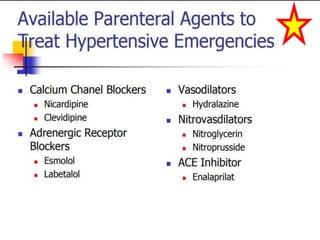
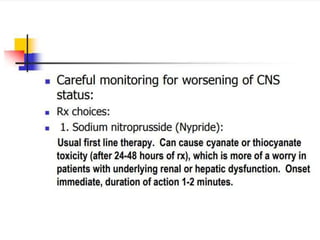
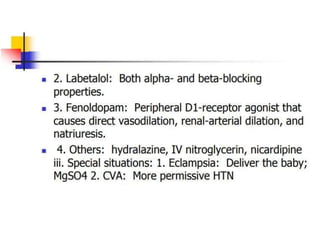
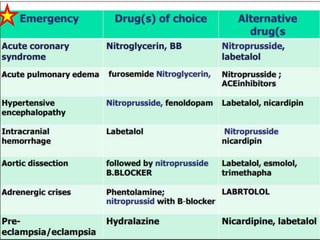
• The most commonly used intravenous drug
is nitroprusside. An alternative for patients with
renal insufficiency is
intravenous fenoldopam. Labetalol is another
common alternative, providing easy transition
from intravenous to oral dosing. However,
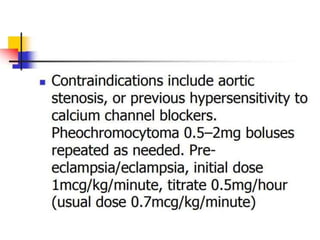
intravenous calcium blockers (eg, nicardipine)
could be useful in quickly and safely reducing BP
to target levels and seemed more effective than
intravenous labetalol.
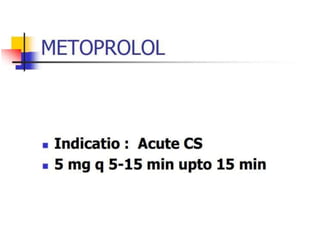
• Beta-blockade can be accomplished
intravenously with esmolol or metoprolol.
Also available parenterally
are diltiazem, verapamil,
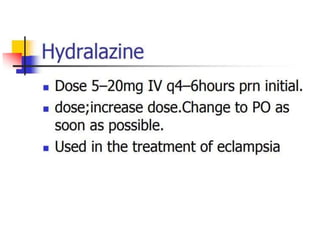
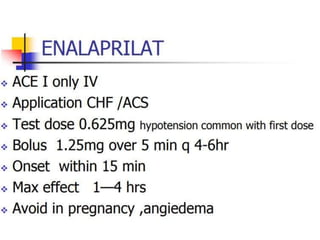
and enalapril. Hydralazine is reserved for use
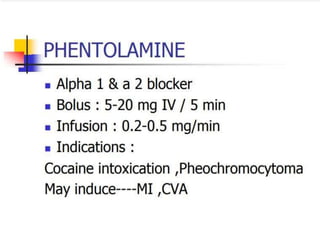
in pregnant patients, whereas phentolamine is
the drug of choice for a pheochromocytoma
crisis. Oral medications should be initiated as
soon as possible in order to ease transition to
an outpatient setting.
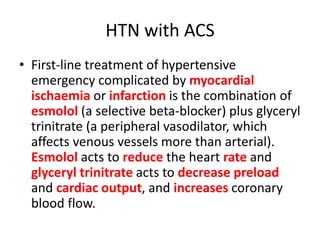
HTN with ACS
• First-line treatment of hypertensive
emergency complicated by myocardial
ischaemia or infarction is the combination of
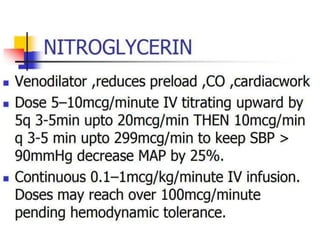
esmolol (a selective beta-blocker) plus glyceryl
trinitrate (a peripheral vasodilator, which
affects venous vessels more than arterial).
Esmolol acts to reduce the heart rate and
glyceryl trinitrate acts to decrease preload
and cardiac output, and increases coronary
blood flow.
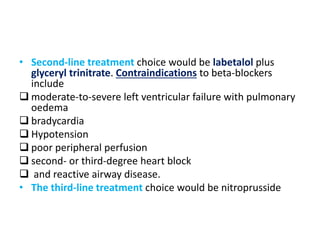
• Second-line treatment choice would be labetalol plus
glyceryl trinitrate. Contraindications to beta-blockers
include
 moderate-to-severe left ventricular failure with pulmonary
oedema
 bradycardia
 Hypotension
 poor peripheral perfusion
 second- or third-degree heart block
 and reactive airway disease.
• The third-line treatment choice would be nitroprusside
Left ventricular failure or pulmonary
odema
• First-line treatment of hypertensive
emergency with left ventricular failure and/or
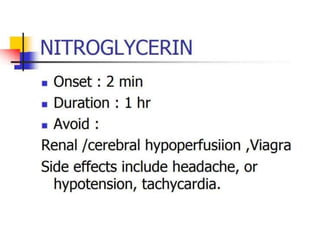
pulmonary oedema is glyceryl trinitrate or
clevidipine. Nitroprusside (a potent arterial
and venous vasodilator that decreases
afterload and preload) is the second-line
treatment choice in this situation.
• If the patient is not already on a loop diuretic,
one should be started (e.g., furosemide). Beta-
blockers are contraindicated in moderate-to-
severe left ventricular failure with pulmonary
oedema
Acute kidney injury
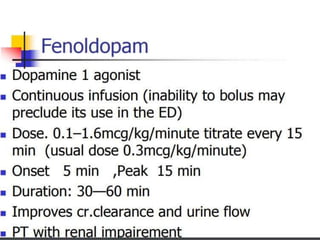
• Fenoldopam is the first-line treatment choice of
hypertensive emergency complicated by acute
kidney injury. This drug (a selective peripheral
dopamine-1-receptor agonist with arterial
vasodilator effects) is particularly useful in renal
insufficiency because it acts to both decrease
afterload and increase renal perfusion. Other
potential first-line agents are dihydropyridine
calcium-channel blockers (clevidipine or
nicardipine), which increase stroke volume and
have strong cerebral and coronary vasodilatory
activity.
Hyperadrenergic states
• Hyperadrenergic states include:
Phaeochromocytoma
Sympathomimetic drug use - for example,
cocaine, amphetamines,
phenylpropanolamine, phencyclidine, or the
combination of monoamine oxidase inhibitors
with foods rich in tyramine
 Following abrupt discontinuation of a short-
acting sympathetic blocker.
• If the hyperadrenergic state is due to
sympathomimetic drug use, the first-line
agents are benzodiazepines, and anti-
hypertensive medications are given only if the
BP response is inadequate. In all other clinical
situations, the first-line treatment choice is
phentolamine (which acts by blocking alpha-
adrenoceptors) or calcium-channel blockers
(clevidipine and nicardipine).
• A beta-blocker (such as labetalol) can be
added after sufficient alpha-adrenoceptor
blockade. The administration of a beta-blocker
alone is contraindicated, since inhibition of
beta-adrenoceptor-induced vasodilation
results in unopposed alpha-adrenergic
vasoconstriction and a further rise in BP
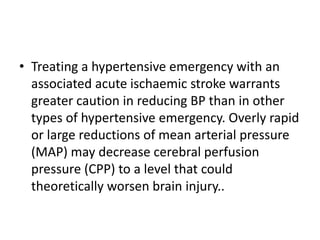
• Treating a hypertensive emergency with an
associated acute ischaemic stroke warrants
greater caution in reducing BP than in other
types of hypertensive emergency. Overly rapid
or large reductions of mean arterial pressure
(MAP) may decrease cerebral perfusion
pressure (CPP) to a level that could
theoretically worsen brain injury..
• The following may be used as guidance. If the
systolic BP is >220 mmHg or the diastolic BP is
>120 mmHg, it may be reasonable to lower the
BP by 15% during the first 24 hours after the
onset of stroke. If the systolic BP is <220 mmHg
and the diastolic BP is <120 mmHg, then it is
reasonable to maintain close observation without
direct intervention to reduce BP, unless: There is
other end-organ involvement such as aortic
dissection, renal failure, or acute myocardial
infarction .
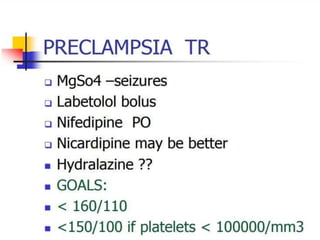
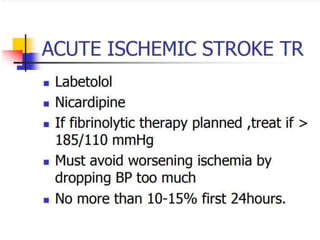
• The patient is to receive thrombolysis, in which
case the target systolic BP should be <185 mmHg
and diastolic BP <110 mmHg. The BP should be
maintained <185/105 mmHg for at least 24 hours
after initiating intravenous thrombolysis. If the
systolic BP is >220 mmHg or diastolic BP is
between 121-140 mmHg, then labetalol,
nicardipine, or clevidipine should be used to
achieve a 10% to 15% reduction in BP in 24 hours.
If diastolic BP is >140 mmHg, then nitroprusside
is used to achieve a 10% to 15% reduction over
24 hours
SBP >220mmHg or DBP 121-140mmHg
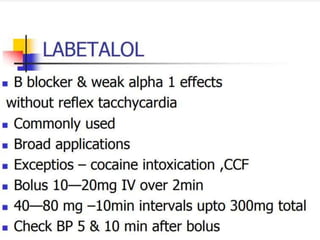
1st line : Labetalol
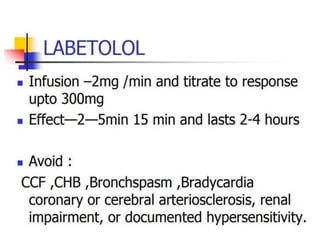
• labetalol20 mg intravenously every 10 minutes
according to response, maximum 300 mg total dose; or
0.5 to 2 mg/minute intravenous infusion
• If the systolic BP is above 220 mmHg or the diastolic BP
is between 121-140 mmHg, labetalol can be used to
achieve a 10% to 15% reduction in BP within 24 hours.
Labetalol acts as an alpha-1-blocker and non-selective
beta-blocker, and its haemodynamic effects include
decreasing systemic vascular resistance, MAP, and
heart rate, accompanied by a slight decrease or
minimal change in cardiac output. Onset of action: 5-
10 minutes. Duration of action: 3-8 hours. Continue
until the BP is controlled on oral agents
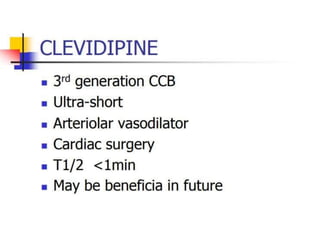
Nicardipine or clevidipine
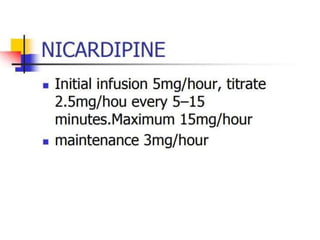
• Nicardipine 4mg/hour IV initially
• Increase by 2.5 mg/hour increment every 15
min according to response maximum
15mg/hr
• clevidipine1-2 mg/hour intravenously initially,
dose may be doubled every 90 seconds
initially until blood pressure reaches target,
usual dose 4-6 mg/hour, maximum 32
mg/hour (maximum duration 72 hours)
• If the systolic BP is above 220 mmHg or the
diastolic BP is between 121-140 mmHg,
nicardipine or clevidipine can be used to achieve
a 10% to 15% reduction in BP within 24 hours.
Nicardipine and clevidipine are dihydropyridine
calcium-channel blockers, which increase stroke
volume and have strong cerebral and coronary
vasodilatory activity. Nicardipine onset of action:
5-10 minutes. Duration of action: 2-4 hours.
Clevidipine onset of action: 2-4 minutes. Duration
of action: 5-15 minutes. Continue until the BP is
controlled on oral agents
If DBP >140 mmHG
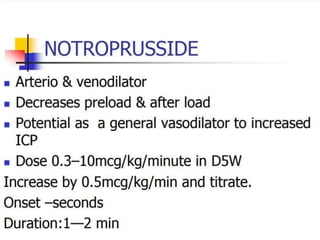
• Nitroprusside 0.3 to 0.5
micrograms/kg/minute intravenously initially,
increase by 0.5 micrograms/kg/minute
increments according to response, maximum
10 micrograms/kg/minute
• If the diastolic BP is above 140 mmHg,
nitroprusside may be used to achieve a 10% to
15% reduction over 24 hours.
• It acts as a potent arterial and venous vasodilator,
thereby reducing afterload and preload. Its
haemodynamic effects are to decrease MAP, with a
modest increase or no change in cardiac output. Onset
of action: immediate. Duration of action: 3-5 minutes.
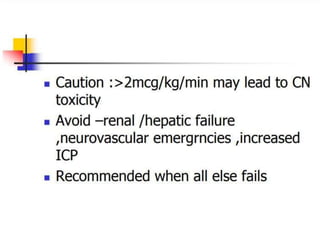
Patients should be monitored by drawing thiocyanate
levels after 48 hours of therapy (levels maintained
<2064 micromol/L [<12 mg/dL or 120 mg/L]). The
maximum dose should be delivered for less than 10
minutes to decrease the chance of cyanide toxicity.
Continue until the BP is controlled on oral agents
•
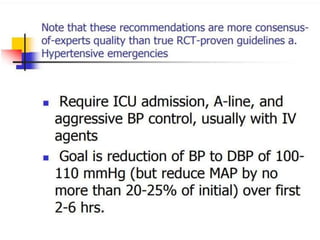
Rate of Bp reduction
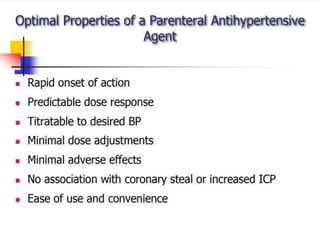
• The specific parenteral agents used for treating a
hypertensive emergency should be dictated by
the end-organ systems that have been damaged,
patient comorbidities, and overall clinical
condition. Oral therapies are generally
discouraged as first-line treatment options. initial
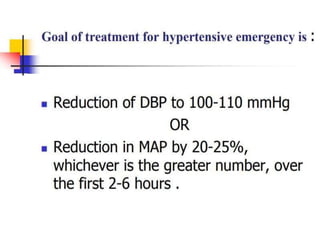
goal of therapy in hypertensive emergencies is to
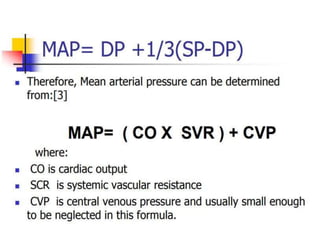
reduce mean arterial BP by no more than 25%
(within minutes to 1 hour), then, if stable, to 160
mmHg systolic and 100-110 mmHg diastolic
within the next 2-6 hours.
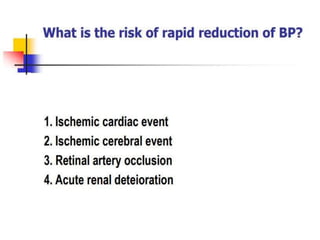
• Excessive falls in pressure that may precipitate
renal, cerebral, or coronary ischaemia should
be avoided. If the initial level of reduced BP is
well tolerated and the patient is clinically
stable, further gradual reductions towards a
normal BP can be implemented over the next
24-48 hours
• . Exceptions to the above recommendation include:
 Patients with an ischaemic stroke, as there is no clear
evidence from clinical trials to support the use of
immediate antihypertensive treatment
 . Patients who are candidates for thrombolytic therapy
(typically those with ischaemic stroke), who should have
their BP slowly lowered to systolic BP <185 mmHg and
diastolic BP <110 mmHg before intravenous tissue
plasminogen activator is initiated
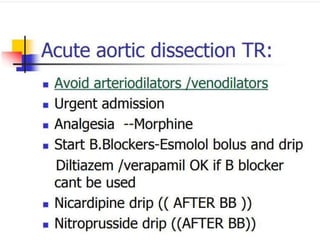
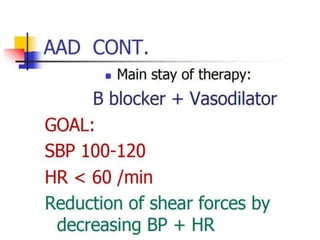
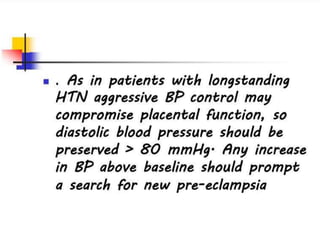
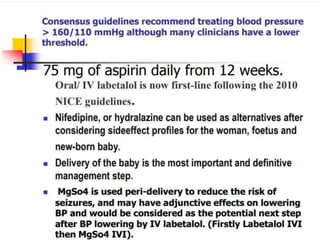
 . Patients with aortic dissection, severe pre-eclampsia,
eclampsia, or phaeochromocytoma crisis, in whom systolic
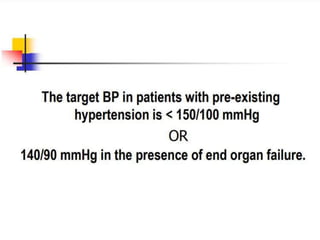
BP should be reduced to <140 mmHg in the first hour.
hypertension emergencies

hypertension emergencies

  • 1.
  • 19.
    • The mostcommonly used intravenous drug is nitroprusside. An alternative for patients with renal insufficiency is intravenous fenoldopam. Labetalol is another common alternative, providing easy transition from intravenous to oral dosing. However, intravenous calcium blockers (eg, nicardipine) could be useful in quickly and safely reducing BP to target levels and seemed more effective than intravenous labetalol.
  • 20.
    • Beta-blockade canbe accomplished intravenously with esmolol or metoprolol. Also available parenterally are diltiazem, verapamil, and enalapril. Hydralazine is reserved for use in pregnant patients, whereas phentolamine is the drug of choice for a pheochromocytoma crisis. Oral medications should be initiated as soon as possible in order to ease transition to an outpatient setting.
  • 23.
    HTN with ACS •First-line treatment of hypertensive emergency complicated by myocardial ischaemia or infarction is the combination of esmolol (a selective beta-blocker) plus glyceryl trinitrate (a peripheral vasodilator, which affects venous vessels more than arterial). Esmolol acts to reduce the heart rate and glyceryl trinitrate acts to decrease preload and cardiac output, and increases coronary blood flow.
  • 24.
    • Second-line treatmentchoice would be labetalol plus glyceryl trinitrate. Contraindications to beta-blockers include  moderate-to-severe left ventricular failure with pulmonary oedema  bradycardia  Hypotension  poor peripheral perfusion  second- or third-degree heart block  and reactive airway disease. • The third-line treatment choice would be nitroprusside
  • 25.
    Left ventricular failureor pulmonary odema • First-line treatment of hypertensive emergency with left ventricular failure and/or pulmonary oedema is glyceryl trinitrate or clevidipine. Nitroprusside (a potent arterial and venous vasodilator that decreases afterload and preload) is the second-line treatment choice in this situation.
  • 26.
    • If thepatient is not already on a loop diuretic, one should be started (e.g., furosemide). Beta- blockers are contraindicated in moderate-to- severe left ventricular failure with pulmonary oedema
  • 27.
    Acute kidney injury •Fenoldopam is the first-line treatment choice of hypertensive emergency complicated by acute kidney injury. This drug (a selective peripheral dopamine-1-receptor agonist with arterial vasodilator effects) is particularly useful in renal insufficiency because it acts to both decrease afterload and increase renal perfusion. Other potential first-line agents are dihydropyridine calcium-channel blockers (clevidipine or nicardipine), which increase stroke volume and have strong cerebral and coronary vasodilatory activity.
  • 28.
    Hyperadrenergic states • Hyperadrenergicstates include: Phaeochromocytoma Sympathomimetic drug use - for example, cocaine, amphetamines, phenylpropanolamine, phencyclidine, or the combination of monoamine oxidase inhibitors with foods rich in tyramine  Following abrupt discontinuation of a short- acting sympathetic blocker.
  • 29.
    • If thehyperadrenergic state is due to sympathomimetic drug use, the first-line agents are benzodiazepines, and anti- hypertensive medications are given only if the BP response is inadequate. In all other clinical situations, the first-line treatment choice is phentolamine (which acts by blocking alpha- adrenoceptors) or calcium-channel blockers (clevidipine and nicardipine).
  • 30.
    • A beta-blocker(such as labetalol) can be added after sufficient alpha-adrenoceptor blockade. The administration of a beta-blocker alone is contraindicated, since inhibition of beta-adrenoceptor-induced vasodilation results in unopposed alpha-adrenergic vasoconstriction and a further rise in BP
  • 38.
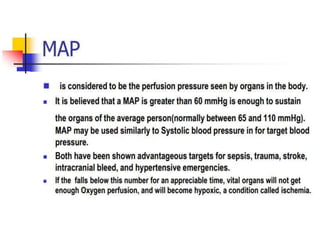
    • Treating ahypertensive emergency with an associated acute ischaemic stroke warrants greater caution in reducing BP than in other types of hypertensive emergency. Overly rapid or large reductions of mean arterial pressure (MAP) may decrease cerebral perfusion pressure (CPP) to a level that could theoretically worsen brain injury..
  • 39.
    • The followingmay be used as guidance. If the systolic BP is >220 mmHg or the diastolic BP is >120 mmHg, it may be reasonable to lower the BP by 15% during the first 24 hours after the onset of stroke. If the systolic BP is <220 mmHg and the diastolic BP is <120 mmHg, then it is reasonable to maintain close observation without direct intervention to reduce BP, unless: There is other end-organ involvement such as aortic dissection, renal failure, or acute myocardial infarction .
  • 40.
    • The patientis to receive thrombolysis, in which case the target systolic BP should be <185 mmHg and diastolic BP <110 mmHg. The BP should be maintained <185/105 mmHg for at least 24 hours after initiating intravenous thrombolysis. If the systolic BP is >220 mmHg or diastolic BP is between 121-140 mmHg, then labetalol, nicardipine, or clevidipine should be used to achieve a 10% to 15% reduction in BP in 24 hours. If diastolic BP is >140 mmHg, then nitroprusside is used to achieve a 10% to 15% reduction over 24 hours
  • 41.
    SBP >220mmHg orDBP 121-140mmHg 1st line : Labetalol • labetalol20 mg intravenously every 10 minutes according to response, maximum 300 mg total dose; or 0.5 to 2 mg/minute intravenous infusion • If the systolic BP is above 220 mmHg or the diastolic BP is between 121-140 mmHg, labetalol can be used to achieve a 10% to 15% reduction in BP within 24 hours. Labetalol acts as an alpha-1-blocker and non-selective beta-blocker, and its haemodynamic effects include decreasing systemic vascular resistance, MAP, and heart rate, accompanied by a slight decrease or minimal change in cardiac output. Onset of action: 5- 10 minutes. Duration of action: 3-8 hours. Continue until the BP is controlled on oral agents
  • 42.
    Nicardipine or clevidipine •Nicardipine 4mg/hour IV initially • Increase by 2.5 mg/hour increment every 15 min according to response maximum 15mg/hr
  • 43.
    • clevidipine1-2 mg/hourintravenously initially, dose may be doubled every 90 seconds initially until blood pressure reaches target, usual dose 4-6 mg/hour, maximum 32 mg/hour (maximum duration 72 hours)
  • 44.
    • If thesystolic BP is above 220 mmHg or the diastolic BP is between 121-140 mmHg, nicardipine or clevidipine can be used to achieve a 10% to 15% reduction in BP within 24 hours. Nicardipine and clevidipine are dihydropyridine calcium-channel blockers, which increase stroke volume and have strong cerebral and coronary vasodilatory activity. Nicardipine onset of action: 5-10 minutes. Duration of action: 2-4 hours. Clevidipine onset of action: 2-4 minutes. Duration of action: 5-15 minutes. Continue until the BP is controlled on oral agents
  • 45.
    If DBP >140mmHG • Nitroprusside 0.3 to 0.5 micrograms/kg/minute intravenously initially, increase by 0.5 micrograms/kg/minute increments according to response, maximum 10 micrograms/kg/minute • If the diastolic BP is above 140 mmHg, nitroprusside may be used to achieve a 10% to 15% reduction over 24 hours.
  • 46.
    • It actsas a potent arterial and venous vasodilator, thereby reducing afterload and preload. Its haemodynamic effects are to decrease MAP, with a modest increase or no change in cardiac output. Onset of action: immediate. Duration of action: 3-5 minutes. Patients should be monitored by drawing thiocyanate levels after 48 hours of therapy (levels maintained <2064 micromol/L [<12 mg/dL or 120 mg/L]). The maximum dose should be delivered for less than 10 minutes to decrease the chance of cyanide toxicity. Continue until the BP is controlled on oral agents •
  • 49.
    Rate of Bpreduction • The specific parenteral agents used for treating a hypertensive emergency should be dictated by the end-organ systems that have been damaged, patient comorbidities, and overall clinical condition. Oral therapies are generally discouraged as first-line treatment options. initial goal of therapy in hypertensive emergencies is to reduce mean arterial BP by no more than 25% (within minutes to 1 hour), then, if stable, to 160 mmHg systolic and 100-110 mmHg diastolic within the next 2-6 hours.
  • 50.
    • Excessive fallsin pressure that may precipitate renal, cerebral, or coronary ischaemia should be avoided. If the initial level of reduced BP is well tolerated and the patient is clinically stable, further gradual reductions towards a normal BP can be implemented over the next 24-48 hours
  • 51.
    • . Exceptionsto the above recommendation include:  Patients with an ischaemic stroke, as there is no clear evidence from clinical trials to support the use of immediate antihypertensive treatment  . Patients who are candidates for thrombolytic therapy (typically those with ischaemic stroke), who should have their BP slowly lowered to systolic BP <185 mmHg and diastolic BP <110 mmHg before intravenous tissue plasminogen activator is initiated  . Patients with aortic dissection, severe pre-eclampsia, eclampsia, or phaeochromocytoma crisis, in whom systolic BP should be reduced to <140 mmHg in the first hour.