Recent advances and latest treatment guidelines
• Cardiovascular morbidity and mortality increase as both SBP and DBP
• over 50 years, SBP and PP are better predictors of complications .
• prevalence increases with age, more common in blacks .
• Adequate control reduces ACS by 20–25%, stroke by 30–35%, and
CHF by 50%.
2017 guidelines from the ACC/AHA
conventional office based measurement,
• NORMAL < 120/80 mm Hg,
• ELEVATED/PREHYPERTENSION 120–129/< 80 mm Hg,
• stage 1 130–139/80–89 mm Hg
• stage 2 >/= 140/90 mm Hg
• Hypertensive crisis: Systolic over 180 and/or diastolic over 120, with patients
needing prompt changes in medication if there are no other indications of
problems, or immediate hospitalization if there are signs of organ damage.
Primary Essential Hypertension
• in 95% ,complex interactions between multiple genetic and
environmental factors.
• overactivation of the sympathetic nervous and RAAS, blunting of the
pressure-natriuresis relationship, CV and renal development, and
elevated intracellular Na and Ca levels.
• obesity, sleep apnea, increased salt intake, excessive alcohol
use,smoking, polycythemia, NSAID and low potassium intake
Secondary Hypertension
• at early age or after 50 years
• in those previously well controlled who become refractory to
treatment
• genetic syndromes; kidney disease; renal vascular disease; primary
hyperaldosteronism; Cushing syndrome; pheochromocytoma;
coarctation of the aorta and preclampsia, estrogen use,thyroid or
parathyroid ds and medications.
Complications of Untreated Hypertension
• Hypertensive Cardiovascular Disease
• Hypertensive Cerebrovascular Disease and Dementia
• Hypertensive Kidney Disease
• Aortic Dissection
• Atherosclerotic Complications
Nonpharmacological Therapy of Hypertension
• Reduction in weight.
• DASH diet
• Restricting Na+ consumption.
• Restriction of ethanol (consumption/d < 20 g in women, < 40 g in men).
• Smoking cessation
• Increased physical activity.
• Renal denervation in resistant hypertension.
• Bariatric surgery .
Principles of blood pressure regulation and its
modification by drugs.
Resistant hypertension
• the failure to reach blood pressure control in patients who are
adherent to full doses of an appropriate three-drug regimen
(including a diuretic).
• confirm compliance and rule out “white coat hypertension,”
• Aldosterone may play an important role in resistant hypertension and
aldosterone receptor blockers can be very useful.
HYPERTENSIVE URGENCIES
• patients with asymptomatic severe hypertension (SBP > 220 mm Hg
or DBP> 120 mm Hg that persists after a period of observation) and
those without evidence of end organ damage.
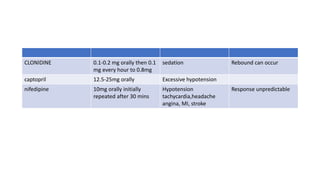
CLONIDINE 0.1-0.2 mg orally then 0.1
mg every hour to 0.8mg
sedation Rebound can occur
captopril 12.5-25mg orally Excessive hypotension
nifedipine 10mg orally initially
repeated after 30 mins
Hypotension
tachycardia,headache
angina, MI, stroke
Response unpredictable
HYPERTENSIVE EMERGENCIES
• though BP is usually strikingly elevated (DBP 130 mm Hg), the
correlation between pressure and end-organ damage is often poor.
• hypertensive encephalopathy, hypertensive nephropathy, intracranial
hemorrhage, aortic dissection, preeclampsia-eclampsia, pulmonary
edema, unstable angina, or MI
• Parenteral therapy is indicated, especially if encephalopathy is
present. initial goal is to reduce the BP by no more than 25% (within
minutes to 1 or 2 hours) and then toward a level of 160/100 mm Hg
within 2–6 hours.
Pharmacologic Management
• A. Parenteral Agents
enalapritat 1.25mg iv every 6 hours hypotension May protect kidney function
furosemide 10-80 mg orally Hypokalemia, hypotension Additive with diuretic, may
continued orally
hydralazine 5-20 mg iv ,can be repeated
after 20 min
Tachycardia,headache Adjunct to vasodilator
Nitroglycerine 0.25-5 mcg/kg/min iv Headache,nausea,hypotensio
n,bradycardia
Tolerance develops,used
primarily with MI
nitroprusside 0.25-10mcg/kg/min iv Thiocyanate and CN toxicity
with renal and hepatic
dysfunction,hypotension,coro
nary steal,decreased cerebral
blood flow,increased ICP
NO LONGER FIRST LINE DRUG
New drug classes
• Centrally Acting Aminopeptidase Inhibitors
• Vasopeptidase Inhibitors
• Dual-Acting Angiotensin Receptor–Neprilysin Inhibitors
• Soluble Epoxide Hydrolase Inhibitors
• Intestinal Na+/H+ Exchanger 3 Inhibitor
• Dopamine β-hydroxylase (DβH) Inhibitor
Anti-Aldosterone Agents
Drugs targeting the classical and counter
regulatory renin angiotensin systems (RAS).
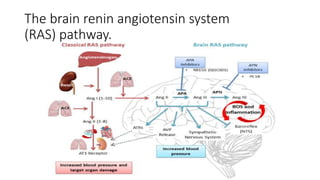
The brain renin angiotensin system
(RAS) pathway.
Vasopeptidase inhibitors.
Interventional Treatments
• Renal Denervation
• Baroreflex Activation Therapy
• Carotid Body Ablation
• Arteriovenous Fistula
• Neurovascular Decompression
• Renal Artery Stenting (Revascularization)
Hypertension

Hypertension

  • 1.
    Recent advances andlatest treatment guidelines
  • 2.
    • Cardiovascular morbidityand mortality increase as both SBP and DBP • over 50 years, SBP and PP are better predictors of complications . • prevalence increases with age, more common in blacks . • Adequate control reduces ACS by 20–25%, stroke by 30–35%, and CHF by 50%.
  • 3.
    2017 guidelines fromthe ACC/AHA conventional office based measurement, • NORMAL < 120/80 mm Hg, • ELEVATED/PREHYPERTENSION 120–129/< 80 mm Hg, • stage 1 130–139/80–89 mm Hg • stage 2 >/= 140/90 mm Hg • Hypertensive crisis: Systolic over 180 and/or diastolic over 120, with patients needing prompt changes in medication if there are no other indications of problems, or immediate hospitalization if there are signs of organ damage.
  • 8.
    Primary Essential Hypertension •in 95% ,complex interactions between multiple genetic and environmental factors. • overactivation of the sympathetic nervous and RAAS, blunting of the pressure-natriuresis relationship, CV and renal development, and elevated intracellular Na and Ca levels. • obesity, sleep apnea, increased salt intake, excessive alcohol use,smoking, polycythemia, NSAID and low potassium intake
  • 9.
    Secondary Hypertension • atearly age or after 50 years • in those previously well controlled who become refractory to treatment • genetic syndromes; kidney disease; renal vascular disease; primary hyperaldosteronism; Cushing syndrome; pheochromocytoma; coarctation of the aorta and preclampsia, estrogen use,thyroid or parathyroid ds and medications.
  • 10.
    Complications of UntreatedHypertension • Hypertensive Cardiovascular Disease • Hypertensive Cerebrovascular Disease and Dementia • Hypertensive Kidney Disease • Aortic Dissection • Atherosclerotic Complications
  • 11.
    Nonpharmacological Therapy ofHypertension • Reduction in weight. • DASH diet • Restricting Na+ consumption. • Restriction of ethanol (consumption/d < 20 g in women, < 40 g in men). • Smoking cessation • Increased physical activity. • Renal denervation in resistant hypertension. • Bariatric surgery .
  • 15.
    Principles of bloodpressure regulation and its modification by drugs.
  • 18.
    Resistant hypertension • thefailure to reach blood pressure control in patients who are adherent to full doses of an appropriate three-drug regimen (including a diuretic). • confirm compliance and rule out “white coat hypertension,” • Aldosterone may play an important role in resistant hypertension and aldosterone receptor blockers can be very useful.
  • 20.
    HYPERTENSIVE URGENCIES • patientswith asymptomatic severe hypertension (SBP > 220 mm Hg or DBP> 120 mm Hg that persists after a period of observation) and those without evidence of end organ damage.
  • 21.
    CLONIDINE 0.1-0.2 mgorally then 0.1 mg every hour to 0.8mg sedation Rebound can occur captopril 12.5-25mg orally Excessive hypotension nifedipine 10mg orally initially repeated after 30 mins Hypotension tachycardia,headache angina, MI, stroke Response unpredictable
  • 22.
    HYPERTENSIVE EMERGENCIES • thoughBP is usually strikingly elevated (DBP 130 mm Hg), the correlation between pressure and end-organ damage is often poor. • hypertensive encephalopathy, hypertensive nephropathy, intracranial hemorrhage, aortic dissection, preeclampsia-eclampsia, pulmonary edema, unstable angina, or MI • Parenteral therapy is indicated, especially if encephalopathy is present. initial goal is to reduce the BP by no more than 25% (within minutes to 1 or 2 hours) and then toward a level of 160/100 mm Hg within 2–6 hours.
  • 24.
    Pharmacologic Management • A.Parenteral Agents enalapritat 1.25mg iv every 6 hours hypotension May protect kidney function furosemide 10-80 mg orally Hypokalemia, hypotension Additive with diuretic, may continued orally hydralazine 5-20 mg iv ,can be repeated after 20 min Tachycardia,headache Adjunct to vasodilator Nitroglycerine 0.25-5 mcg/kg/min iv Headache,nausea,hypotensio n,bradycardia Tolerance develops,used primarily with MI nitroprusside 0.25-10mcg/kg/min iv Thiocyanate and CN toxicity with renal and hepatic dysfunction,hypotension,coro nary steal,decreased cerebral blood flow,increased ICP NO LONGER FIRST LINE DRUG
  • 26.
  • 27.
    • Centrally ActingAminopeptidase Inhibitors • Vasopeptidase Inhibitors • Dual-Acting Angiotensin Receptor–Neprilysin Inhibitors • Soluble Epoxide Hydrolase Inhibitors • Intestinal Na+/H+ Exchanger 3 Inhibitor • Dopamine β-hydroxylase (DβH) Inhibitor
  • 28.
  • 29.
    Drugs targeting theclassical and counter regulatory renin angiotensin systems (RAS).
  • 30.
    The brain reninangiotensin system (RAS) pathway.
  • 31.
  • 32.
    Interventional Treatments • RenalDenervation • Baroreflex Activation Therapy • Carotid Body Ablation • Arteriovenous Fistula • Neurovascular Decompression • Renal Artery Stenting (Revascularization)

Editor's Notes

  • #2 uncontrolled in half population. among them, about 36% unaware. among treated, control only 60%.
  • #4 intermittent self-monitoring (home blood pressure) with an automated device programmed to take measurements at regular intervals (ambulatory blood pressure)
  • #5 the guidelines stress the importance of using proper technique to measure blood pressure; recommend use of home blood pressure monitoring using validated devices; and highlight the value of appropriate training of health care providers to reveal "white-coat hypertension."
  • #6 Ambulatory BP readings normally lowest at night and the loss of nocturnal dip is dominant predictor of CV risk, thrombotic stroke. Accentuation of normal morning increase in BP associated with increased likelihood of cerebral hemorrhage. variability of SBP predicts CV events independently of mean SBP.
  • #10  if AutomatedOfficeBP measurements are not available, blood pressures recorded manually in the office may be substituted if taken as the mean of the last two readings of three consecutive readings. Note that the blood pressure threshold for diagnosing hypertension is higher if recorded manually in these guidelines. If home blood pressure monitoring is unavailable, office measurements recorded over three to five separate visits can be substituted. Ambulatory bp measurement If aobp is used use mean calculated and displayed by the device,if non aobp is used take at least 3 readings, discardfirst
  • #12 —Hypertension has been associated with hypercalcemia, acromegaly, hyperthyroidism, hypothyroidism, baroreceptor denervation, compression of the rostral ventrolateral medulla, and increased intracranial pressure cyclosporine, tacrolimus, angiogenesis inhibitors, and erythrocyte-stimulating agents (such as erythropoietin). Decongestants, NSAIDs, cocaine and alcohol should also be considered. Over-the-counter products should not be overlooked, eg, a dietary supplement marketed to enhance libido was found to contain yohimbine, an alpha-2–antagonist, which can produce severe rebound hypertension in patients taking clonidine.
  • #14 Dietary Approaches to Stop Hypertension (DASH) emphasizes vegetables, fruits and low-fat dairy foods — and moderate amounts of whole grains, fish, poultry and nuts
  • #18 Cardiac output and peripheral arteriolar resistance, the major determinants of arterial blood pressure, are regulated by myriad mechanisms, including the SNS (main peripheral neurotransmitter NE), the balance between salt intake by the intestine (GI) and salt excretion by the kidneys, the RAAS (main agonists AngII and Aldo), and natriuretic peptides produced in the heart (ANP and BNP). Sensors (green circles) provide afferent input on pressure in the heart and great vessels and on salt concentrations in the kidney. Note positive feedback between the SNS and RAAS via β1-stimulated renin release and AngII-stimulated NE release. Drug classes are indicated in boldface type at their main site of action. Arrows indicate blood pressure-increasing (red) and -decreasing (green) effects. Neprilysin inhibitors (e.g., sacubitril) are in clinical testing for hypertension and have been approved for the treatment of heart failure (in combination with an ARB).
  • #40 Excessive reductions in pressure may precipitate coronary, cerebral, or renal ischemia.
  • #41 To avoid such declines, the use of agents that have a predictable, dose-dependent, transient, and progressive antihypertensive effect is preferable. In that regard, the use of sublingual or oral fast-acting nifedipine preparations is best avoided.
  • #45 asoactive intestinal peptide (VIP) is a neuropeptide with vasodilator and positive inotropic/chronotropic properties that are mediated via the G-protein-coupled receptors VPAC1 and VPAC 2.106 Deficiency in VIP and alterations in properties of VPAC1 and 2 have been described in various forms of cardiopulmonary disease, and VIP is a therapeutic target for hypertension, both systemic and pulmonary, as well as HF Orally active dual inhibitors of neprilysin and endothelinconverting enzyme have been developed, and one of these (daglutril, SLV-306) has been studied in rodent models of diabetes mellitus and in patients with hypertension, HF, and type 2 diabetes mellitus89–93 (Figure 4; Table). Daglutril is a prodrug that is hydrolyzed after oral administration to the active metabolite KC-12615, a mixed inhibitor of neprilysin and endothelin-converting enzyme.89 In diabetic rat models, daglutril and a similar compound have been shown to reduce BP and proteinuria and prevent nephrosclerosis as effectively as the ACE inhibitor captopril.90,94 Daglutril has also been shown to be safe and well tolerated in healthy volunteers,92,95 and biomarker measurements confirmed dual suppression of neprilysin and endothelin-converting enzyme activity in these subjects.92
  • #46 Aldosterone synthase inhibitors (ASIs), such as LCI699, inhibit the rate limiting step of aldosterone production. Mineralocorticoid receptor agonists (MRAs), such as finerenone, compete for the binding sites of aldosterone and effectively decrease blood pressure and aldosterone-mediated gene transcription. Both approaches have been shown to be useful in treating aldosterone-mediated hypertension and vascular disease. Aldosterone synthesis, green; cortisol synthesis, red; antialdosterone drugs, blue.
  • #47 Activation of the classical RAS pathway increases BP and target organ damage, and this pathway is the target for many currently available antihypertensive drugs, including angiotensin-converting enzyme (ACE) inhibitors and angiotensin receptor blockers (ARBs). Novel approaches to RAS inhibition, including vaccines targeting angiotensin II (Ang II) and the angiotensin II type 1 (AT1) receptor, are being evaluated in preclinical and clinical trials. In contrast, activation of the more recently described counter regulatory RAS pathway decreases blood pressure (BP) and target organ damage, and drugs that activate this pathway are beginning to be developed as antihypertensive agents. These include ACE2 activators, Ang (1–7) analogs, AT2 receptor agonists, peptide and nonpeptide activators of the Mas receptor, and alamandine complexed with cyclodextrin. Classical RAS, red; counter regulatory RAS, green; drugs, blue. ATR indicates AT1 receptor; MrgD, Masrelated G-protein-coupled receptor, member D; rhACE2, recombinant human ACE2. Downloaded from
  • #48 Activation of the brain RAS in response to oxidative stress and inflammation increases sympathetic nervous system outflow and arginine vasopressin (AVP) release and inhibits the baroflex, thus raising BP. Angiotensin (Ang) III, which is generated from Ang II by aminopeptidase A (APA), is the predominant pressor peptide in brain in animal models, and APA is a therapeutic target for treatment of hypertension. The APA inhibitor RB150 (QGC 001) has been shown to pass the blood–brain barrier and lower BP in animal models; exploratory studies are underway in humans. Red, classical RAS; light blue, brain RAS pathway; blue, drugs, dotted arrows indicate crosstalk between the systems. APN indicates aminopeptidase N; AT1, angiotensin II type 1; ATR, AT1 receptor; and ROS, reactive oxygen species. Two membrane-bound zinc metalloproteases, aminopeptidase A (APA) and aminopeptidase N, are involved in the metabolism of brain Ang II and III, respectively (Figure 3). APA cleaves the N-terminal Asp from Ang II to form Ang III, and aminopeptidase N cleaves the N-terminal Arg from Ang III to form Ang IV. Ang II and Ang III have similar affinities for Ang II receptors and both peptides stimulate pressor responses by activating sympathetic nervous system activity, inhibiting the baroreflex at the level of the nucleus tractus solitarius and increasing release of arginine vasopressin into the circulation. Studies using selective APA (EC33) and aminopeptidase N (PC18) inhibitors have demonstrated that brain Ang III (not Ang II, as in the periphery) plays a predominant role in BP control in animal models and have identified APA as a potential therapeutic target for the treatment of hypertension68
  • #49 Combining an inhibitor of the natriuretic peptide degrading enzyme neprilysin with an angiotensin receptor blocker (ARB) or an endothelin converting enzyme (ECE) inhibitor in the same molecule offers the theoretical advantage of enhancing the favorable vasodilator/natruiretic effects of the natriuretic peptides and reducing the deleterious vasoconstrictor/ proinflammatory effects of angiotensin II (Ang II) and endothelin-1 (ET-1) on blood pressure (BP) and target organ damage. The ARB– neprilysin inhibitor (ARNI), LCZ696, is a single molecule comprising the ARB valsartan and the neprilysin inhibitor pro-drug AHU377 (sacubitril). LCZ696 has been shown to lower BP, particularly in Asian populations, and to prevent death from cardiovascular (CV) causes and hospitalization for heart failure (HF) in patients with reduced left ventricular ejection fraction (LVEF). The ECE–neprilysin inhibitor dagutril has been shown to lower BP in patients with type 2 diabetes mellitus and nephropathy and to reduce pulmonary arterial pressure in patients with HF. Red, classical RAS; orange, natriuretic peptide system; purple, endothelin system; blue, LCZ696; green, dagutril.
  • #51 n a small, randomized, crossover, placebo-controlled study, deactivation of CB chemoreceptors by hyperoxia (respiration with 100% oxygen) attenuated the enhanced muscle sympathetic nerve activity in untreated hypertensive men, but no change was observed in controls.177 It has also been shown that hyperoxia decreases BP acutely in patients with hypertension, but not in normotensive controls. 178 Several mechanisms are hypothesized to cause BP reduction after creation of an AVF.182 Reduction in total systemic vascular resistance, despite an increment in cardiac output, is considered to be the key mechanism. Enhanced tissue oxygen delivery caused by increased arterial oxygen content may reduce peripheral and renal chemoreceptor activation and thus decrease sympathetic activity. Reductions in systemic vascular compliance and effective arterial volume may also improve arterial compliance, contributing to a reduced cardiac workload, despite increased cardiac output.182 Animal studies have shown that pulsatile compression of the rostral ventrolateral medulla at the root-entry zone of cranial nerves IX and X increases both BP and sympathetic outflow,184,185 and clinical data suggest that neurosurgical decompression of the rostral ventrolateral medulla (used for neurological disorders) leads to BP reduction.186 In the ASTRAL trial, renal arterial revascularization did not result in a clinically relevant reduction in BP, but did cause a high incidence (17%) of adverse procedure-related complications. 192