Hypertension:
The Silent Killer
Manik Chhabra Pharm.D
Department Of Pharmacy
Practice
ISFCP , Moga
Hypertension (HTN)
Hypertension is common disease that is simply
defined as persistent elevated arterial blood
pressure (BP)
Hypertension (HTN), also known as high blood
pressure (BP), affects millions of people. High
blood pressure is defined as BP ≥140/90
millimeters of mercury (mmHg). As per JNC 8
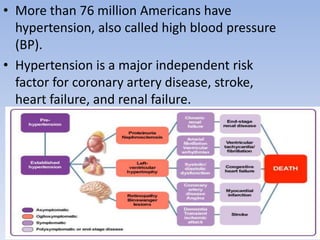
• More than 76 million Americans have
hypertension, also called high blood pressure
(BP).
• Hypertension is a major independent risk
factor for coronary artery disease, stroke,
heart failure, and renal failure.
Approximately 77.9 million American adults (1 in 3
people) and approximately 970 million people worldwide
have high BP. It is estimated that by 2025, 1.56 billion
adults will be living with HTN.The overall occurrence is
similar between both men and women, but differs with
age. For those younger than 45 years old, high blood
pressure is more common in men than women. For those
65 years old or older, high blood pressure affects women
more than men.2,3 African Americans (47% in women,
43% in men) develop high blood pressure more often and
at an earlier age, followed by Caucasians (31% in women,
33% in men) and Mexican Americans (29% in women,
30% in men). BP values increase with age, and HTN is very
common with the elderly.
Epidemiology
Etiology
• For the majority of patients with high blood
pressure, the cause is unknown. This is
classified as primary or essential HTN. Over
90% of patients with high blood pressure have
primary HTN. Primary HTN cannot be cured,
but it can be controlled with appropriate
therapy (including lifestyle modifications and
medications). Genetic factors may play an
important role in the development of primary
HTN.
• A small portion of patients have a specific
cause of their high blood pressure, which is
classified as secondary HTN. Less than 10% of
patients with high blood pressure have
secondary HTN. 1 Secondary HTN is caused by
an underlying medical condition or medication
. Controlling the underlying medical condition
or removing the causative medication(s) will
result in a decrease of blood pressure thereby
resolving secondary HTN. The most common
cause of secondary HTN is associated with
kidney impairment such as chronic kidney
disease (CKD)
White-Coat Hypertension
White-coat hypertension refers to patients without
target-organ disease who have consistently elevated
BP values measured in a clinical environment (e.g.,
physician's office) that are significantly higher than
those obtained by either a manual reading outside
this environment (e.g., home) or with 24-hour
ambulatory monitoring.
Symptoms
HTN is known as the “silent killer” because it
typically has no warning signs or symptoms, and
many people do not know they have it. Even
when blood pressure levels are dangerously
high, most people do not have any signs or
symptoms. A small amount of people may
experience symptoms such as dull headaches,
vomiting, dizzy spells, and more frequent
nosebleeds. These symptoms usually do not
occur until blood pressure levels have reached a
severe or life-threatening stage
The classification of blood pressure in adults (18
years and older) is based on the average of two or
more properly measured blood pressure readings
from two or more clinical visits
Recommended Technique for Auscultatory
BP Measurement in Adults.
 Patient should be seated for 5 minutes with arm
bared, unrestricted by clothing, and supported at
heart level. Smoking or food ingestion should not
have occurred within 30 minutes before the
measurement.
 An appropriately sized cuff should be chosen. The
internal inflatable bladder width should be at least
40% and the bladder length at least 80% of the
upper arm circumference. The cuff should be
wrapped snugly around the arm with the center of
the bladder over the brachial artery.
 Measurements should be taken with a mercury
sphygmomanometer, a recently calibrated
aneroid manometer, or a validated electronic
device.
 The palpatory method should be used to
estimate SBP. The cuff is inflated while
simultaneously palpating the radial pulse on the
cuffed arm and observing the manometer. The
point at which the radial pulse is no longer
palpable is the estimated SBP. The cuff is then
deflated.
 The BP should be measured with a stethoscope
positioned over the brachial artery and the cuff
rapidly inflated to 20 to 30 mm Hg above the
estimated SBP from the palpatory method. The cuff
is deflated at a rate of 2 mm Hg per second while
listening for Phase 1 (the first appearance of
sounds) and Phase 5 (the disappearance of sounds)
Korotkoff sounds and observing the manometer.
When 10 to 20 mm Hg below Phase 5, the cuff can
be rapidly deflated.
 The BP should be recorded. The Phase 1 (SBP) and
Phase 5 (DBP) value should be recorded in even
numbers (rounded up form an odd number) along
with the patient's position, arm used, and cuff size
documented.
 A second measurement should be taken after 1 to
2 minutes in the same arm. If the readings differ by
more than 5 mm Hg, additional measurements
should be obtained. The mean of these two values
should be used to make clinical decisions. BP
should be taken in both arms at the initial visit with
the BP taken in the arm with the higher reading at
subsequent visits.
Principles of Treatment
 Treatment for hypertensive patients includes both
nonpharmacologic (lifestyle changes) and
pharmacologic (medication) therapy to lower
blood pressure and prevent cardiovascular (heart)
events such as a heart attack.
DASH Diet
DASH (Dietary Approaches to Stop Hypertension) diet is rich
in fruits, vegetables, and low-fat dairy foods, coupled with
reduced saturated and total fat.This diet can substantially
reduce BP (8 to 14 mm Hg in SBP for most patients) The
low-fat component of this diet is important as weight loss is
more readily achieved by a low-fat diet and it also reduces
the risk of CVD by improving cholesterol.
I. DIURETICS
Bumetanide, furosemide, hydrochlorthiazide, spironolactone, triamterene
II. b-BLOCKERS
Atenolol, labetalol, metoprolol, propranolol, timolol
III. ACE INHIBITORS
Captopril, benazepril, enalapril, fosinopril, lisinopril, moexipril, quinapril, ramipril
IV. ANGIOTENSIN II ANTAGONIST
Losartan,candesartan ,irbesartan, temisartan
V. Ca++CHANNEL BLOCKERS
Amlodipine, diltiazem, felodipine, isradipine, nicardipine, nifedipine, nisoldipine,
verapamil
VI. a-BLOCKERS
Doxazosin, prazosin, terazosin
VII. OTHER
Clonidine, diazoxide, hydralazine, a-methyldopa, minoxidil, sodium nitropr
Htn HYpertension
Htn HYpertension
Htn HYpertension
Htn HYpertension
Htn HYpertension
Htn HYpertension
Htn HYpertension
Htn HYpertension

Htn HYpertension

  • 1.
    Hypertension: The Silent Killer ManikChhabra Pharm.D Department Of Pharmacy Practice ISFCP , Moga
  • 2.
    Hypertension (HTN) Hypertension iscommon disease that is simply defined as persistent elevated arterial blood pressure (BP) Hypertension (HTN), also known as high blood pressure (BP), affects millions of people. High blood pressure is defined as BP ≥140/90 millimeters of mercury (mmHg). As per JNC 8
  • 3.
    • More than76 million Americans have hypertension, also called high blood pressure (BP). • Hypertension is a major independent risk factor for coronary artery disease, stroke, heart failure, and renal failure.
  • 4.
    Approximately 77.9 millionAmerican adults (1 in 3 people) and approximately 970 million people worldwide have high BP. It is estimated that by 2025, 1.56 billion adults will be living with HTN.The overall occurrence is similar between both men and women, but differs with age. For those younger than 45 years old, high blood pressure is more common in men than women. For those 65 years old or older, high blood pressure affects women more than men.2,3 African Americans (47% in women, 43% in men) develop high blood pressure more often and at an earlier age, followed by Caucasians (31% in women, 33% in men) and Mexican Americans (29% in women, 30% in men). BP values increase with age, and HTN is very common with the elderly. Epidemiology
  • 5.
    Etiology • For themajority of patients with high blood pressure, the cause is unknown. This is classified as primary or essential HTN. Over 90% of patients with high blood pressure have primary HTN. Primary HTN cannot be cured, but it can be controlled with appropriate therapy (including lifestyle modifications and medications). Genetic factors may play an important role in the development of primary HTN.
  • 6.
    • A smallportion of patients have a specific cause of their high blood pressure, which is classified as secondary HTN. Less than 10% of patients with high blood pressure have secondary HTN. 1 Secondary HTN is caused by an underlying medical condition or medication . Controlling the underlying medical condition or removing the causative medication(s) will result in a decrease of blood pressure thereby resolving secondary HTN. The most common cause of secondary HTN is associated with kidney impairment such as chronic kidney disease (CKD)
  • 7.
    White-Coat Hypertension White-coat hypertensionrefers to patients without target-organ disease who have consistently elevated BP values measured in a clinical environment (e.g., physician's office) that are significantly higher than those obtained by either a manual reading outside this environment (e.g., home) or with 24-hour ambulatory monitoring.
  • 9.
    Symptoms HTN is knownas the “silent killer” because it typically has no warning signs or symptoms, and many people do not know they have it. Even when blood pressure levels are dangerously high, most people do not have any signs or symptoms. A small amount of people may experience symptoms such as dull headaches, vomiting, dizzy spells, and more frequent nosebleeds. These symptoms usually do not occur until blood pressure levels have reached a severe or life-threatening stage
  • 14.
    The classification ofblood pressure in adults (18 years and older) is based on the average of two or more properly measured blood pressure readings from two or more clinical visits
  • 15.
    Recommended Technique forAuscultatory BP Measurement in Adults.  Patient should be seated for 5 minutes with arm bared, unrestricted by clothing, and supported at heart level. Smoking or food ingestion should not have occurred within 30 minutes before the measurement.  An appropriately sized cuff should be chosen. The internal inflatable bladder width should be at least 40% and the bladder length at least 80% of the upper arm circumference. The cuff should be wrapped snugly around the arm with the center of the bladder over the brachial artery.
  • 16.
     Measurements shouldbe taken with a mercury sphygmomanometer, a recently calibrated aneroid manometer, or a validated electronic device.  The palpatory method should be used to estimate SBP. The cuff is inflated while simultaneously palpating the radial pulse on the cuffed arm and observing the manometer. The point at which the radial pulse is no longer palpable is the estimated SBP. The cuff is then deflated.
  • 17.
     The BPshould be measured with a stethoscope positioned over the brachial artery and the cuff rapidly inflated to 20 to 30 mm Hg above the estimated SBP from the palpatory method. The cuff is deflated at a rate of 2 mm Hg per second while listening for Phase 1 (the first appearance of sounds) and Phase 5 (the disappearance of sounds) Korotkoff sounds and observing the manometer. When 10 to 20 mm Hg below Phase 5, the cuff can be rapidly deflated.
  • 18.
     The BPshould be recorded. The Phase 1 (SBP) and Phase 5 (DBP) value should be recorded in even numbers (rounded up form an odd number) along with the patient's position, arm used, and cuff size documented.  A second measurement should be taken after 1 to 2 minutes in the same arm. If the readings differ by more than 5 mm Hg, additional measurements should be obtained. The mean of these two values should be used to make clinical decisions. BP should be taken in both arms at the initial visit with the BP taken in the arm with the higher reading at subsequent visits.
  • 24.
    Principles of Treatment Treatment for hypertensive patients includes both nonpharmacologic (lifestyle changes) and pharmacologic (medication) therapy to lower blood pressure and prevent cardiovascular (heart) events such as a heart attack. DASH Diet DASH (Dietary Approaches to Stop Hypertension) diet is rich in fruits, vegetables, and low-fat dairy foods, coupled with reduced saturated and total fat.This diet can substantially reduce BP (8 to 14 mm Hg in SBP for most patients) The low-fat component of this diet is important as weight loss is more readily achieved by a low-fat diet and it also reduces the risk of CVD by improving cholesterol.
  • 28.
    I. DIURETICS Bumetanide, furosemide,hydrochlorthiazide, spironolactone, triamterene II. b-BLOCKERS Atenolol, labetalol, metoprolol, propranolol, timolol III. ACE INHIBITORS Captopril, benazepril, enalapril, fosinopril, lisinopril, moexipril, quinapril, ramipril IV. ANGIOTENSIN II ANTAGONIST Losartan,candesartan ,irbesartan, temisartan V. Ca++CHANNEL BLOCKERS Amlodipine, diltiazem, felodipine, isradipine, nicardipine, nifedipine, nisoldipine, verapamil VI. a-BLOCKERS Doxazosin, prazosin, terazosin VII. OTHER Clonidine, diazoxide, hydralazine, a-methyldopa, minoxidil, sodium nitropr