SYSTEMIC HYPERTENSION
MADE BY: Prabhsimar
DEFINITION
• According to JNC VIII( Joint National
Committee)report systolic BP of less than 120 and
diastolic is taken as normal in adults greater than
18 yrs of age. A person with BP >120/80 is either
prehypertensive or hypertensive.
• Defined arbitrarily at levels above generally
accepted ‘normal’ 140/90 upto 50 yrs of age.
TERMS
• Labile hypertensive– patients who sometimes have
arterial pressure within the hypertensive range, turn
out to have borderline hypertension.
• White coat hypertension- patients who have normal
pressure but tends to increase whenever he/she
visits a doctor.
• 90-104 is mild hypertension, 105- 114 is moderate
hypertension, 115hg or more is severe
hypertension.
• Systolic blood pressure above 160 is isolated
systolic hypertension.
• Accelerated
hypertension-
significant rise over
previous hypertensive
levels associated with
vascular damage on
fundoscopic
examination but without
pappiloedema.
• Malignant
hypertension- blood
pressure above
200/130 mm hg
associated with
pappiloedema.
ETIOLOGY
PRIMARY – Essential or Idiopathic
SECONDARY- Environmental factors- obesity,
alcohol intake, smoking, sedentary
lifestyle,increase intake of fatty foods.
• Endocrine disorders- insulin resistance, glucose
intolerance, hyperinsulinemia, hyperparathyroidism,
cushing syndrome, hypothyroidism.
• Renal diseases- renal artery stenosis, acute and
chronic glomerulonephritis,polycystic renal disease.
• Pregnancy related
• Drug induced- oral
contraceptives,
sympathomimetic
agents , NSAIDs,
corticosteroids,
anabolic steroids.
PATHOPHYSIOLOGY
• In larger arteries there is thickening of internal
elastic lamina, hypertrophy of smooth muscles and
fibrous tissue is deposited.the walls become less
compliant.
• In smaller arteries, atheroma is perpetuated hyaline
atherosclerosis, occurs in the walls,the lumen
narrows and aneurysm may develops.they lead to
an increase in peripheral vascular resistance
leading to rise in pressure and acceleration of
atheroma within vessel walls.
CLINICAL FEATURES
SYMPTOMS
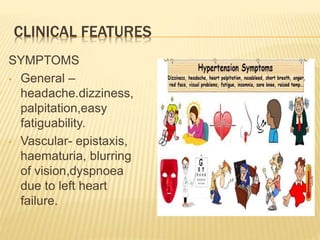
• General –
headache.dizziness,
palpitation,easy
fatiguability.
• Vascular- epistaxis,
haematuria, blurring
of vision,dyspnoea
due to left heart
failure.
• Symptoms due to
underlying disease in
secondary hypertension-
• Episodic
headache,palpitation,sw
eating, postural
hypotension.
Polyuria,polydipsia,weig
ht gain,emotional lability,
truncal obesity due to
Cushing syndrome.
PHYSICAL SIGNS
• Physical examination starts with patient’s general
appearance, Rounded faces with truncal obesity and
pink striae suggest Cushing syndrome.
• Compare the blood pressures and pulses in both the
upper extremeties, measurements of supine position
must be compared with measurements during
standing, A rise in diastolic pressure from supine to
standing suggests essential hypertension
• Detection of delay between radial and femoral pulses
suggests coarctation of aorta.
• Fall in the absence of antihypertensive drugs
suggests secondary hypertension
COMPLICATIONS
• Aortic aneurysm formation, coronary artery
disease.
• Left ventricular hypertrophy causes cardiac failure
• Cerebral atheroma and transient cerebral
ischaemic attacks/stroke.
• Hypertensive encephalopathy, subarachnoid
hemmorhage.
• Hypertensive retinopathy( pappiledema)
• Renal failure due to chronic decrease in blood
supply to kidneys.
INVESTIGATIONS
BASIC- urine for protein, blood and glucose.
• Blood glucose
• Haematocrit
• Serum pottasium (for hypokalemic alkalosis or
diuretic therapy)
• Plasma urea/cretinine
• ECG(left ventricular hypertrophy or
ischaemia),Echocardiogram (chamber
enlargement)
• Chest X-RAY(Cardiomegaly or heart failure)
MEASURING BLOOD PRESSURE
• The instrument used is sphygmomanometer.
• Always measure B.P when patient is relaxed
• The cuff of apparatus should cover up to three-
fourth of his arm, the tubings must be parallel to
arteries of arms
• Inflate it when there is radial pulse depression then
deflate and measure the value.
FOR SECONDARY HYPERTENSION
• Renal arteriography for renal artery stenosis.
• Plasma renin activity, plasma aldosterone, and
plasma aldosterone/renin ratio for Conn’s
syndrome.
• Urinary and plasma cortisol for Cushing syndrome.
• Angiography/MRI for coarctation of aorta
• Intravenous pyelogram and renal ultrasound. If
renal disease is suspected (polycystic disease)
MANAGEMENT
• GENERAL - relief of stress, regular exercise, quit
smoking, reduction of alcohol consumption, low
sodium intake diet.
• DRUG THERAPY-
 ACE Inhibitors- Captopril 6.25mg daily, Enalapril
2.5mg daily slowly increased to effective
maintenance dose Captopril 25-75mg daily
• Enalapril 15-20mg or lisnopril 10-20mg daily.
SIDE EFFECTS – first dose
hypotension,rashes,proteinuria,intractable cough
and metallic taste.
 ANGIOTENSIN RECEPTOR BLOCKERS –
Used for treatment of hypertension associated with
diabetes and renal diseases.they are less toxic
than ACE inhibitors and has less side effects.
• Losartan (25-100mg in single or two doses).
• Irbesartan (150-300mg once or two divided doses).
• Telmisartan (20-40mg)
 BETA BLOCKERS –
• Atenolol (50-100mg daily)
• Metoprolol (100-200mg/day)
• Pindolol (15-30mg/daily)
They are drugs of first choice in patients of hypertension
with angina and previous MI.
Propanolol is lipid soluble and thus has CNS effects-
depression,drowsiness nightmares etc.
OTHER SIDE EFFECTS
Decreases the cardiac output as well as heart rate, can
precipitate asthma.
 CALCIUM CHANNEL BLOCKERS – verapamil (80mg 8
hourly)
• Amlodipine (5-10mg daily)or
• Long acting nifedipine (5-10mg sublingual).
SIDE EFFECTS – flushing, palpitation,fluid retention and
constipation.
Verapamil causes bradycardia.
 DIURETICS – related to sodium diuresis and volume
depletion
• Frusemide (40mg daily)
• Spironolactone(25-100mg daily)
• Thiazide diuretics
SIDE EFFECTS – gynaecomastia, hyperkalemia and
breast pain
Side effects of thiazide diuretics are- hypokalemia,
hyperuricemia, hyperglycemia, hyperlipdemia.
 OTHER DRUGS –alpha blockers and vasodialators.
MALIGNANT HYPERTENSION
• Marked elevation ofblood pressure(200/140mghg)
associated with pappiloedema.
• Manifestations- hypertensive encephalopathy
(headache,vomiting,visual
disturbances,paralysis,convulsions,coma)
• Cardiac decompenstaion (tachcardia,and signs of
congestive heart failure)
• Impairment of renal functions (oligouria and
uremia)
PATHOGENESIS – dialation of cerebral arteries and
generalised arteriolar fibrinoid necrosis contribute
to the sysmptoms.
MANAGEMENT
• I.V infusion of sodium nitroprusside(0.3-
1.0µg/kg/min upto 6µg/kg/min. may be required)
• I.V or I.M labetolol (2mg/min to maximum of
200mg) or I.M hydralazine(5-10mg)aliquot repeated
at half hourly interval and dose is titrated to desired
response.
• In addition to this, bed rest, sedation by I.V
diazepam may also be helpful.
• Rapid diuresis helps to relieve symptoms of
encephalopathy and CHF.
RESISTANT HYPERTENSION
• Defined as failure to achieve B.P control in patients
who adhere to full drug regime.it may be true or
pseudoresistant
PSEUDORESISTANT HYPERTENSION – causes
include improper BP measuremen,white coat
hypertension, concurrent use of NSAIDs alcohol
etc.
MANAGEMENT – Proper BP measurement
• Restrict salt intake
• Treatment – regime with a diuretic, an ACE
inhibitor,a long acting calcium channel blocker and
a beta blocker
• Add spironolactone or amiloride as an alternative.

Systemic hypertension

  • 1.
  • 2.
    DEFINITION • According toJNC VIII( Joint National Committee)report systolic BP of less than 120 and diastolic is taken as normal in adults greater than 18 yrs of age. A person with BP >120/80 is either prehypertensive or hypertensive. • Defined arbitrarily at levels above generally accepted ‘normal’ 140/90 upto 50 yrs of age.
  • 3.
    TERMS • Labile hypertensive–patients who sometimes have arterial pressure within the hypertensive range, turn out to have borderline hypertension. • White coat hypertension- patients who have normal pressure but tends to increase whenever he/she visits a doctor. • 90-104 is mild hypertension, 105- 114 is moderate hypertension, 115hg or more is severe hypertension. • Systolic blood pressure above 160 is isolated systolic hypertension.
  • 4.
    • Accelerated hypertension- significant riseover previous hypertensive levels associated with vascular damage on fundoscopic examination but without pappiloedema. • Malignant hypertension- blood pressure above 200/130 mm hg associated with pappiloedema.
  • 5.
    ETIOLOGY PRIMARY – Essentialor Idiopathic SECONDARY- Environmental factors- obesity, alcohol intake, smoking, sedentary lifestyle,increase intake of fatty foods. • Endocrine disorders- insulin resistance, glucose intolerance, hyperinsulinemia, hyperparathyroidism, cushing syndrome, hypothyroidism. • Renal diseases- renal artery stenosis, acute and chronic glomerulonephritis,polycystic renal disease. • Pregnancy related
  • 6.
    • Drug induced-oral contraceptives, sympathomimetic agents , NSAIDs, corticosteroids, anabolic steroids.
  • 7.
    PATHOPHYSIOLOGY • In largerarteries there is thickening of internal elastic lamina, hypertrophy of smooth muscles and fibrous tissue is deposited.the walls become less compliant. • In smaller arteries, atheroma is perpetuated hyaline atherosclerosis, occurs in the walls,the lumen narrows and aneurysm may develops.they lead to an increase in peripheral vascular resistance leading to rise in pressure and acceleration of atheroma within vessel walls.
  • 8.
    CLINICAL FEATURES SYMPTOMS • General– headache.dizziness, palpitation,easy fatiguability. • Vascular- epistaxis, haematuria, blurring of vision,dyspnoea due to left heart failure.
  • 9.
    • Symptoms dueto underlying disease in secondary hypertension- • Episodic headache,palpitation,sw eating, postural hypotension. Polyuria,polydipsia,weig ht gain,emotional lability, truncal obesity due to Cushing syndrome.
  • 10.
    PHYSICAL SIGNS • Physicalexamination starts with patient’s general appearance, Rounded faces with truncal obesity and pink striae suggest Cushing syndrome. • Compare the blood pressures and pulses in both the upper extremeties, measurements of supine position must be compared with measurements during standing, A rise in diastolic pressure from supine to standing suggests essential hypertension • Detection of delay between radial and femoral pulses suggests coarctation of aorta. • Fall in the absence of antihypertensive drugs suggests secondary hypertension
  • 11.
    COMPLICATIONS • Aortic aneurysmformation, coronary artery disease. • Left ventricular hypertrophy causes cardiac failure • Cerebral atheroma and transient cerebral ischaemic attacks/stroke. • Hypertensive encephalopathy, subarachnoid hemmorhage. • Hypertensive retinopathy( pappiledema) • Renal failure due to chronic decrease in blood supply to kidneys.
  • 12.
    INVESTIGATIONS BASIC- urine forprotein, blood and glucose. • Blood glucose • Haematocrit • Serum pottasium (for hypokalemic alkalosis or diuretic therapy) • Plasma urea/cretinine • ECG(left ventricular hypertrophy or ischaemia),Echocardiogram (chamber enlargement) • Chest X-RAY(Cardiomegaly or heart failure)
  • 13.
    MEASURING BLOOD PRESSURE •The instrument used is sphygmomanometer. • Always measure B.P when patient is relaxed • The cuff of apparatus should cover up to three- fourth of his arm, the tubings must be parallel to arteries of arms • Inflate it when there is radial pulse depression then deflate and measure the value.
  • 14.
    FOR SECONDARY HYPERTENSION •Renal arteriography for renal artery stenosis. • Plasma renin activity, plasma aldosterone, and plasma aldosterone/renin ratio for Conn’s syndrome. • Urinary and plasma cortisol for Cushing syndrome. • Angiography/MRI for coarctation of aorta • Intravenous pyelogram and renal ultrasound. If renal disease is suspected (polycystic disease)
  • 15.
    MANAGEMENT • GENERAL -relief of stress, regular exercise, quit smoking, reduction of alcohol consumption, low sodium intake diet. • DRUG THERAPY-  ACE Inhibitors- Captopril 6.25mg daily, Enalapril 2.5mg daily slowly increased to effective maintenance dose Captopril 25-75mg daily • Enalapril 15-20mg or lisnopril 10-20mg daily. SIDE EFFECTS – first dose hypotension,rashes,proteinuria,intractable cough and metallic taste.
  • 16.
     ANGIOTENSIN RECEPTORBLOCKERS – Used for treatment of hypertension associated with diabetes and renal diseases.they are less toxic than ACE inhibitors and has less side effects. • Losartan (25-100mg in single or two doses). • Irbesartan (150-300mg once or two divided doses). • Telmisartan (20-40mg)  BETA BLOCKERS – • Atenolol (50-100mg daily) • Metoprolol (100-200mg/day) • Pindolol (15-30mg/daily)
  • 17.
    They are drugsof first choice in patients of hypertension with angina and previous MI. Propanolol is lipid soluble and thus has CNS effects- depression,drowsiness nightmares etc. OTHER SIDE EFFECTS Decreases the cardiac output as well as heart rate, can precipitate asthma.  CALCIUM CHANNEL BLOCKERS – verapamil (80mg 8 hourly) • Amlodipine (5-10mg daily)or • Long acting nifedipine (5-10mg sublingual). SIDE EFFECTS – flushing, palpitation,fluid retention and constipation.
  • 18.
    Verapamil causes bradycardia. DIURETICS – related to sodium diuresis and volume depletion • Frusemide (40mg daily) • Spironolactone(25-100mg daily) • Thiazide diuretics SIDE EFFECTS – gynaecomastia, hyperkalemia and breast pain Side effects of thiazide diuretics are- hypokalemia, hyperuricemia, hyperglycemia, hyperlipdemia.  OTHER DRUGS –alpha blockers and vasodialators.
  • 20.
    MALIGNANT HYPERTENSION • Markedelevation ofblood pressure(200/140mghg) associated with pappiloedema. • Manifestations- hypertensive encephalopathy (headache,vomiting,visual disturbances,paralysis,convulsions,coma) • Cardiac decompenstaion (tachcardia,and signs of congestive heart failure) • Impairment of renal functions (oligouria and uremia) PATHOGENESIS – dialation of cerebral arteries and generalised arteriolar fibrinoid necrosis contribute to the sysmptoms.
  • 21.
    MANAGEMENT • I.V infusionof sodium nitroprusside(0.3- 1.0µg/kg/min upto 6µg/kg/min. may be required) • I.V or I.M labetolol (2mg/min to maximum of 200mg) or I.M hydralazine(5-10mg)aliquot repeated at half hourly interval and dose is titrated to desired response. • In addition to this, bed rest, sedation by I.V diazepam may also be helpful. • Rapid diuresis helps to relieve symptoms of encephalopathy and CHF.
  • 22.
    RESISTANT HYPERTENSION • Definedas failure to achieve B.P control in patients who adhere to full drug regime.it may be true or pseudoresistant PSEUDORESISTANT HYPERTENSION – causes include improper BP measuremen,white coat hypertension, concurrent use of NSAIDs alcohol etc. MANAGEMENT – Proper BP measurement • Restrict salt intake • Treatment – regime with a diuretic, an ACE inhibitor,a long acting calcium channel blocker and a beta blocker • Add spironolactone or amiloride as an alternative.