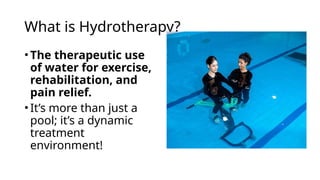
What is Hydrotherapy?
•The therapeutic use
of water for exercise,
rehabilitation, and
pain relief.
• It’s more than just a
pool; it’s a dynamic
treatment
environment!
5.
Today, we’re divinginto how water behaves and how we harness its
properties for rehabilitation. We’ll cover:
Fluid Statics (Water at Rest):
• Buoyancy: The upward push of water.
• Hydrostatic Pressure: The all-around compression from water.
Fluid Dynamics (Water in Motion):
• Viscosity: The internal friction that creates resistance.
• Surface Tension: The “skin” on the water’s surface.
• Hydrodynamic Principles: How objects move through water (Drag &
Turbulence).
6.
Why understand thephysics behind it?
• Optimize Treatment: Design the most effective and
appropriate exercises.
• Explain Benefits: Clearly communicate to patients why
water helps them.
• Ensure Safety: Understand physiological effects and
adapt for patient conditions.
• Progress Patients: Know how to make exercises easier
or harder.
7.
Buoyancy – FeelingLighter in Water!
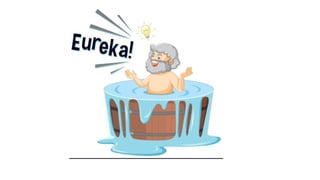
• Buoyancy is the upward force that works opposite to gravity.
• Archimedes’ principle states that an immersed body
experiences upward thrust equal to the volume of liquid
displaced.
9.
Why it’s crucialfor hydrotherapy:
○ Reduces Weight-Bearing: Significantly decreases stress on
joints (e.g., for arthritis, post-surgical recovery, spinal
decompression).
○ Assists Movement: Makes it easier for weak muscles to move
limbs against gravity.
○ Increases Range of Motion (ROM): Less gravitational pull allows
for greater freedom of movement and less pain.
10.
Buoyancy in Action:Clinical
Applications & Depth
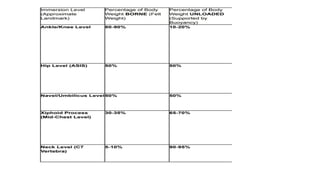
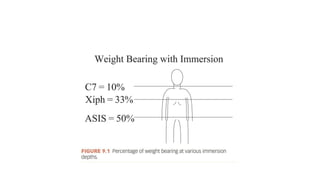
The Deeper You Go, the Lighter You Feel!
The volume of water displaced depends on how much of the
body is submerged.
• More body submerged = Greater volume of water displaced
= Stronger buoyant force = Less weight-bearing.
13.
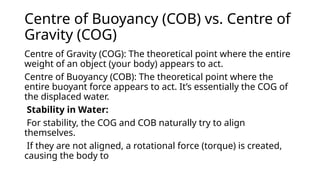
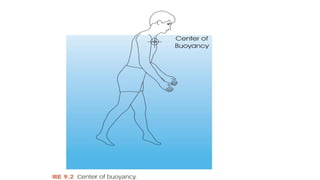
Centre of Buoyancy(COB) vs. Centre of
Gravity (COG)
Centre of Gravity (COG): The theoretical point where the entire
weight of an object (your body) appears to act.
Centre of Buoyancy (COB): The theoretical point where the
entire buoyant force appears to act. It’s essentially the COG of
the displaced water.
Stability in Water:
For stability, the COG and COB naturally try to align
themselves.
If they are not aligned, a rotational force (torque) is created,
causing the body to
15.
Hydrostatic Pressure
• Definition:The pressure exerted by a fluid at rest due to the
weight of the fluid above it.
• Key Characteristics:
• Increases with Depth: Deeper water means more pressure.
• Exerts Equally on All Surfaces (Pascal’s Law): At any given
depth, the pressure is uniform on all sides of an immersed
object.
• Perpendicular to the Surface: Always pushes directly
inwards.
16.
Clinical Implications:
Reduces Edema(Swelling): Acts like a natural compression
bandage, helping to push fluid out of swollen limbs.
Improved Venous Return: Assists blood flow back to the
heart, promoting circulation.
Respiratory Benefits: Increased pressure on the chest and
abdomen can strengthen respiratory muscles (requires
careful monitoring for patients with respiratory compromise).
• Enhanced Proprioception: Provides continuous, even
sensory input around the body, improving body awareness
and stability.
17.
Fluid Dynamics –Water in Motion
Viscosity –
The internal friction within a fluid that opposes its flow or the
movement of an object through it.
Why it matters for hydrotherapy: Creates resistance to
movement.
Key Concept: The faster you move through water, the more
resistance you encounter due to viscosity.
○ Slow movement = Less resistance
○ Fast movement = More resistance
18.
Viscosity Clinical Applications
ProgressiveResistive Exercise:
Instructing a patient to move a limb more quickly through the water
provides a safe, progressive strengthening challenge without external
weights.
Controlled Movement: Viscosity naturally encourages slower, smoother,
and more controlled movements, which is beneficial for patients with
impaired motor control or spasticity.
Proprioceptive Feedback: The constant resistance provides continuous
sensory feedback to the nervous system, aiding motor learning and body
awareness.
Customizable Resistance: Easily adjust the exercise intensity by simply
changing the speed of movement.
19.
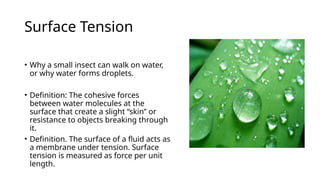
Surface Tension
• Whya small insect can walk on water,
or why water forms droplets.
• Definition: The cohesive forces
between water molecules at the
surface that create a slight “skin” or
resistance to objects breaking through
it.
• Definition. The surface of a fluid acts as
a membrane under tension. Surface
tension is measured as force per unit
length.
20.
• Clinical Implication:It offers minor resistance, primarily
when you’re breaking the surface of the water.
• You might notice a tiny bit more effort required to lift a limb
out of the water than to push it into the water.
• Can be used for very gentle, early-stage resistance or for
sensory stimulation.
21.
Hydromechanics or Hydrodynamics
•Hydromechanics comprise the physical properties and
characteristics of fluid in motion.
• Or
• Hydrodynamics” is simply the study of how water (or other
fluids) behaves when it’s moving, and how objects interact
with that moving water.
22.
Drag: The Resistanceto Movement
• Think of it as:
The “push-back” or “friction” you feel from the water when
you try to move through it. It’s the force that resists your
motion.
Key Factors Influencing Drag:
* Speed of Movement: This is the BIG one!
* Slow Movement = Less Drag. (Easier to move).
* Fast Movement = More Drag. (Harder to move).
23.
Shape of theObject (Form Drag):
* Streamlined Shapes = Less Drag. (Think of a fish or a
boat's hull – they cut through water easily).
* Blunt/Flat Shapes = More Drag. (Think of pushing a
paddle flat through the water – lots of resistance!).
* Size of the Object (Surface Area):
* Smaller Surface Area = Less Drag.
* Larger Surface Area = More Drag.
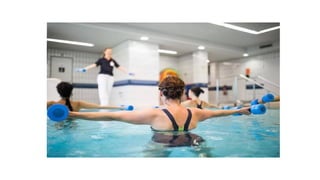
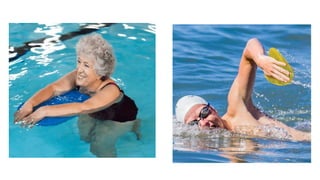
* Using paddles or fins in hydrotherapy increases surface
area, significantly increasing resistance.
25.
• Turbulence flow- Movement in which molecules do not
move parallel to each other, typically faster movements.
• Laminar flow - Movement in which all molecules move
parallel to each other, typically slow movement.




![J._CONTRAST_BATH_THERAPY[1].pptx](https://cdn.slidesharecdn.com/ss_thumbnails/j-230713132551-5c45004c-thumbnail.jpg?width=640&height=640&fit=bounds)


![PROFESSIONAL ISSUES [INCLUDING ETHICS] IN PHYSIOTHERAPY SRS](https://cdn.slidesharecdn.com/ss_thumbnails/professionalissuesandethicssrs-200404153912-thumbnail.jpg?width=640&height=640&fit=bounds)


