Hydrostatic pressureHydrostatic pressure
HydromechanicsHydromechanics
The unique properties of water and
immersion have profound physiological
implications in the delivery of
therapeutic exercise
Stephan BetterBodyz van Breenen
Aquatic Fitness Therapy Training
The properties provided by buoyancy,
hydrostatic pressure, viscosity, and
surface tension have a direct effect on
the body in the aquatic environment
Stephan BetterBodyz van Breenen
Aquatic Fitness Therapy Training
Buoyancy is the upward force that works
opposite to gravity
Stephan BetterBodyz van Breenen
Aquatic Fitness Therapy Training
Properties. Archimedes’ principle states
that an immersed body experiences
upward thrust equal to the volume of
liquid displaced
Stephan BetterBodyz van Breenen
Aquatic Fitness Therapy Training
Clinical Significance Buoyancy provides
the person with relative weightlessness
and joint unloading, allowing
performance of active motion with
increased ease. Buoyancy allows the
practitioner three-dimensional access to
the person.
Stephan BetterBodyz van Breenen
Aquatic Fitness Therapy Training
Hydrostatic pressure is the pressure
exerted on immersed objects.
Stephan BetterBodyz van Breenen
Aquatic Fitness Therapy Training
Pascal’s law states that the pressure
exerted by fluid on an immersed object
is equal on all surfaces of the object. As
the density of water and depth of
immersion increase, so does hydrostatic
pressure
Stephan BetterBodyz van Breenen
Aquatic Fitness Therapy Training
Increased pressure reduces or limits
effusion, assists venous return, induces
bradycardia, and centralizes peripheral
blood flow. The proportionality of depth
and pressure allows you to perform
exercise more easily when closer to the
surface.
Stephan BetterBodyz van Breenen
Aquatic Fitness Therapy Training
Viscosity is friction occurring between
molecules
of liquid resulting in resistance to flow
Stephan BetterBodyz van Breenen
Aquatic Fitness Therapy Training
Resistance from viscosity is proportional
to the
velocity of movement through liquid
Stephan BetterBodyz van Breenen
Aquatic Fitness Therapy Training
Water’s viscosity creates resistance with
all active movements. A shorter lever
arm results in increased resistance.
During manual resistance exercises
stabilizing an extremity proximally
require you to perform more work.
Stephan BetterBodyz van Breenen
Aquatic Fitness Therapy Training
Stabilizing an extremity distally requires
you to perform less work.
Increasing the surface area moving
through water increases resistance
Stephan BetterBodyz van Breenen
Aquatic Fitness Therapy Training
The surface of a fluid acts as a
membrane
under tension. Surface tension is
measured as force per unit length.
Stephan BetterBodyz van Breenen
Aquatic Fitness Therapy Training
The attraction of surface molecules is
parallel to the surface.
The resistive force of surface tension
changes proportionally to the size of the
object moving through the fluid surface
Stephan BetterBodyz van Breenen
Aquatic Fitness Therapy Training
An extremity that moves through the
surface performs more work than if kept
under water.
Using equipment at the surface of the
water increases the resistance
Stephan BetterBodyz van Breenen
Aquatic Fitness Therapy Training
Hydromechanics comprise the physical
properties and characteristics of fluid in
motion
Stephan BetterBodyz van Breenen
Aquatic Fitness Therapy Training
Laminar flow. Movement where all
molecules move parallel to each other,
typically slow movement.
Stephan BetterBodyz van Breenen
Aquatic Fitness Therapy Training
Turbulent flow. Movement where
molecules do not move parallel to each
other, typically faster movements.
Stephan BetterBodyz van Breenen
Aquatic Fitness Therapy Training
Drag. The cumulative effects of
turbulence and fluid viscosity acting on
an object in motion
Stephan BetterBodyz van Breenen
Aquatic Fitness Therapy Training
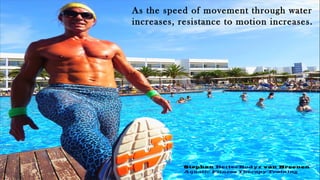
As the speed of movement through water
increases, resistance to motion increases.
Stephan BetterBodyz van Breenen
Aquatic Fitness Therapy Training
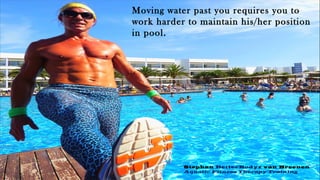
Moving water past you requires you to
work harder to maintain his/her position
in pool.
Stephan BetterBodyz van Breenen
Aquatic Fitness Therapy Training
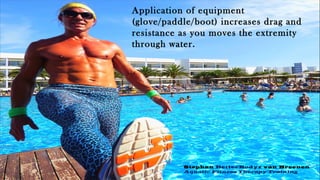
Application of equipment
(glove/paddle/boot) increases drag and
resistance as you moves the extremity
through water.
Stephan BetterBodyz van Breenen
Aquatic Fitness Therapy Training

Hydrodynamics and Aquatic Therapy

  • 1.
  • 2.
    The unique propertiesof water and immersion have profound physiological implications in the delivery of therapeutic exercise Stephan BetterBodyz van Breenen Aquatic Fitness Therapy Training
  • 3.
    The properties providedby buoyancy, hydrostatic pressure, viscosity, and surface tension have a direct effect on the body in the aquatic environment Stephan BetterBodyz van Breenen Aquatic Fitness Therapy Training
  • 4.
    Buoyancy is theupward force that works opposite to gravity Stephan BetterBodyz van Breenen Aquatic Fitness Therapy Training
  • 5.
    Properties. Archimedes’ principlestates that an immersed body experiences upward thrust equal to the volume of liquid displaced Stephan BetterBodyz van Breenen Aquatic Fitness Therapy Training
  • 6.
    Clinical Significance Buoyancyprovides the person with relative weightlessness and joint unloading, allowing performance of active motion with increased ease. Buoyancy allows the practitioner three-dimensional access to the person. Stephan BetterBodyz van Breenen Aquatic Fitness Therapy Training
  • 7.
    Hydrostatic pressure isthe pressure exerted on immersed objects. Stephan BetterBodyz van Breenen Aquatic Fitness Therapy Training
  • 8.
    Pascal’s law statesthat the pressure exerted by fluid on an immersed object is equal on all surfaces of the object. As the density of water and depth of immersion increase, so does hydrostatic pressure Stephan BetterBodyz van Breenen Aquatic Fitness Therapy Training
  • 9.
    Increased pressure reducesor limits effusion, assists venous return, induces bradycardia, and centralizes peripheral blood flow. The proportionality of depth and pressure allows you to perform exercise more easily when closer to the surface. Stephan BetterBodyz van Breenen Aquatic Fitness Therapy Training
  • 10.
    Viscosity is frictionoccurring between molecules of liquid resulting in resistance to flow Stephan BetterBodyz van Breenen Aquatic Fitness Therapy Training
  • 11.
    Resistance from viscosityis proportional to the velocity of movement through liquid Stephan BetterBodyz van Breenen Aquatic Fitness Therapy Training
  • 12.
    Water’s viscosity createsresistance with all active movements. A shorter lever arm results in increased resistance. During manual resistance exercises stabilizing an extremity proximally require you to perform more work. Stephan BetterBodyz van Breenen Aquatic Fitness Therapy Training
  • 13.
    Stabilizing an extremitydistally requires you to perform less work. Increasing the surface area moving through water increases resistance Stephan BetterBodyz van Breenen Aquatic Fitness Therapy Training
  • 14.
    The surface ofa fluid acts as a membrane under tension. Surface tension is measured as force per unit length. Stephan BetterBodyz van Breenen Aquatic Fitness Therapy Training
  • 15.
    The attraction ofsurface molecules is parallel to the surface. The resistive force of surface tension changes proportionally to the size of the object moving through the fluid surface Stephan BetterBodyz van Breenen Aquatic Fitness Therapy Training
  • 16.
    An extremity thatmoves through the surface performs more work than if kept under water. Using equipment at the surface of the water increases the resistance Stephan BetterBodyz van Breenen Aquatic Fitness Therapy Training
  • 17.
    Hydromechanics comprise thephysical properties and characteristics of fluid in motion Stephan BetterBodyz van Breenen Aquatic Fitness Therapy Training
  • 18.
    Laminar flow. Movementwhere all molecules move parallel to each other, typically slow movement. Stephan BetterBodyz van Breenen Aquatic Fitness Therapy Training
  • 19.
    Turbulent flow. Movementwhere molecules do not move parallel to each other, typically faster movements. Stephan BetterBodyz van Breenen Aquatic Fitness Therapy Training
  • 20.
    Drag. The cumulativeeffects of turbulence and fluid viscosity acting on an object in motion Stephan BetterBodyz van Breenen Aquatic Fitness Therapy Training
  • 21.
    As the speedof movement through water increases, resistance to motion increases. Stephan BetterBodyz van Breenen Aquatic Fitness Therapy Training
  • 22.
    Moving water pastyou requires you to work harder to maintain his/her position in pool. Stephan BetterBodyz van Breenen Aquatic Fitness Therapy Training
  • 23.
    Application of equipment (glove/paddle/boot)increases drag and resistance as you moves the extremity through water. Stephan BetterBodyz van Breenen Aquatic Fitness Therapy Training