MAULANA AZAD NATIONAL INSTITUTE OF
TECHNOLOGY
BHOPAL
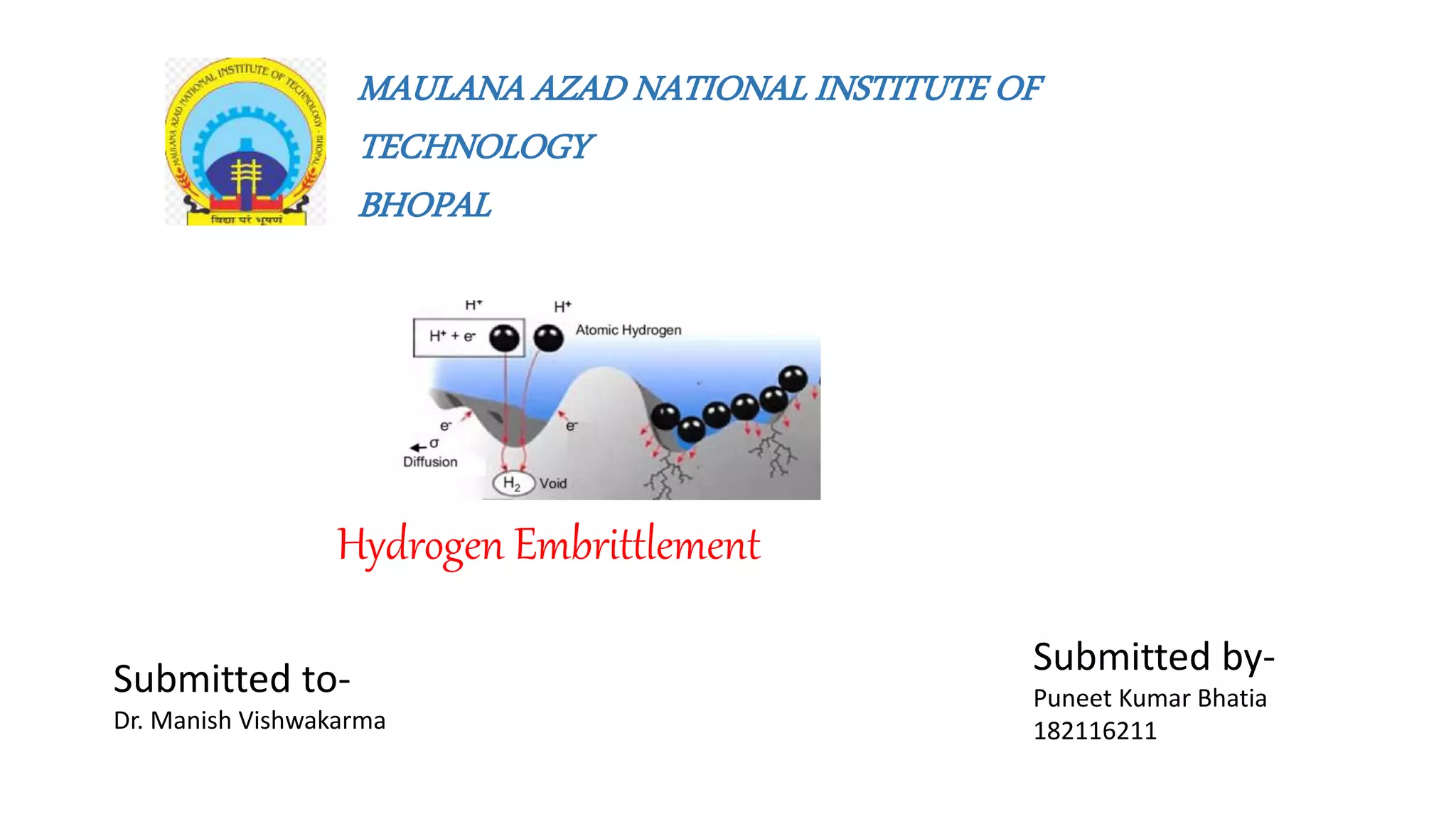
Hydrogen Embrittlement
Submitted by-
Puneet Kumar Bhatia
182116211
Submitted to-
Dr. Manish Vishwakarma
Hydrogen Embrittlement
 Hydrogen embrittlement is the process by which
hydride-forming metals such as titanium, vanadium,
zirconium, tantalum, and niobium
become brittle and fracture due to the introduction and
subsequent diffusion of hydrogen into the metal.
 Loss of Ductility of a material that is due to the effect of
hydrogen absorption.
Hydrogen may be introduced
during-
During melting & entrapped during
solidification.
Anodic reaction during corrossion.
Hydrogen gas welding & moisture.
Mechanism
 hydrogen-enhanced de-cohesion (HEDE)
(Brittle fracture)
 hydrogen-enhanced local plasticity (HELP)
(Ductile fracture)
 adsorption-induced dislocation
emission(AIDE)
Proposed Mechanism
Hydrogen-enhanced de-cohesion (HEDE)
(Brittle fracture)
o The HEDE mechanism was introduced by Troiano in 1959 .
o The HEDE mechanism proposes that hydro-gen causes a
reduction in the cohesive bond strength of the steel.
o Troiano suggested that the drop in cohesive strength was due to
a transfer of the hydrogen 1s electron to the unfilled 3d shell of
iron.
o Consequently, the tensile separation of atoms occurs instead of
lattice sliding asso-ciated with slip and plastic deformation.
Hydrogen-enhanced local plasticity (HELP)
(Ductile fracture)
o The HELP mechanism was first suggested by
Beachem.
o The HELP mechanism has considerable support,
although, at first blush, the terms enhanced
plasticity and embrittlement appear contradictory.
o The HELP mechanism proposes that as solute hydrogen
accumulates locally in regions near crack tips, caused by
thepresence of hydrostatic stresses or hydrogen entry at
the crack tip, deformation becomes localized owing to
the ability of hydrogen to promote dislocation motion.
Adsorption-induced dislocation
emission(AIDE)
o An important aspect of the AIDE mechanism is the
concept of dislocation emission, which includes both
nucleation, as facilitated by hydrogen adsorption, and
movement of dislocations away from the advancing
crack tip.
o Dislocation nucleation occurs by a process of coop-
erative shearing, a consequence of the weakening of
interatomic bonds over a several atomic distances in
the vicinity of high hydrogen concentrations.
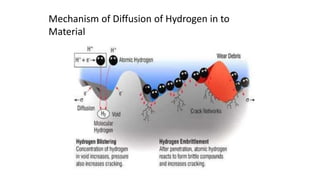
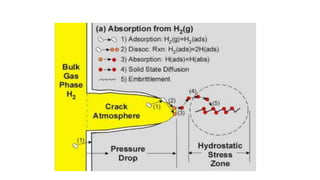
Mechanism of Diffusion of Hydrogen in to
Material
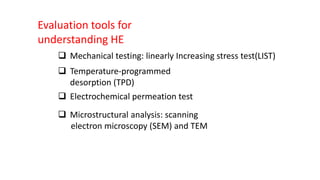
Evaluation tools for
understanding HE
 Mechanical testing: linearly Increasing stress test(LIST)
 Temperature-programmed
desorption (TPD)
 Electrochemical permeation test
 Microstructural analysis: scanning
electron microscopy (SEM) and TEM
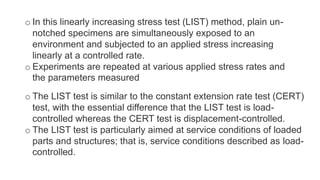
Mechanical testing: linearly increasing
stress test (LIST)
o In this linearly increasing stress test (LIST) method, plain un-
notched specimens are simultaneously exposed to an
environment and subjected to an applied stress increasing
linearly at a controlled rate.
o Experiments are repeated at various applied stress rates and
the parameters measured
o The LIST test is similar to the constant extension rate test (CERT)
test, with the essential difference that the LIST test is load-
controlled whereas the CERT test is displacement-controlled.
o The LIST test is particularly aimed at service conditions of loaded
parts and structures; that is, service conditions described as load-
controlled.
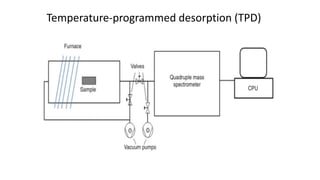
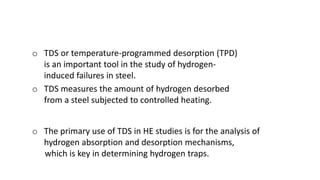
Temperature-programmed desorption (TPD)
o TDS or temperature-programmed desorption (TPD)
is an important tool in the study of hydrogen-
induced failures in steel.
o TDS measures the amount of hydrogen desorbed
from a steel subjected to controlled heating.
o The primary use of TDS in HE studies is for the analysis of
hydrogen absorption and desorption mechanisms,
which is key in determining hydrogen traps.
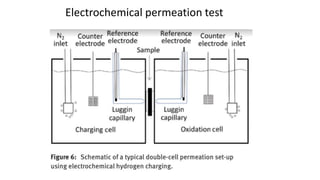
Electrochemical permeation test
o The test uses two chambers, the charging (entry) cell and the
oxidation(exit) cell, separated by a thin steel membrane.
o Hydrogen is introduced at the charging cell, diffuses through the
membrane, and emerges at the oxidation cell.
o Hydrogen charging is done via an electrochemical process in an
appropriate electrolyte.
o The amount of hydrogen at the entry side may be controlled
potentiostatically or galva-nostatically.
o Alternatively, hydrogen charging may be done in a high-pressure gas
chamber.
o The hydrogen permeation test is a relatively simple test to
measure diffusivity or permeability of hydrogen in steel.
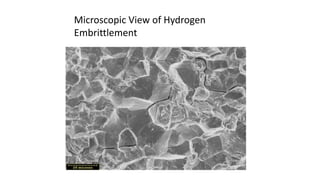
Microscopic View of Hydrogen
Embrittlement
• https://en.wikipedia.org/wiki/Hydrogen_embrittlement
• https://nptel.ac.in/courses/112107241/1
• https://www.nace.org/resources/general-resources/corrosion-basics/group-
3/hydrogen-embrittlement
• https://www.youtube.com/watch?v=zH01GdfGlew
• https://www.imetllc.com/training-article/hydrogen-embrittlement-steel/
• https://www.researchgate.net/figure/Schematic-view-of-hydrogen-
embrittlement-process-1_fig1_305926666
• https://www.aatprod.com/hydrogen-embrittlement/
Hydrogen embrittlement

Hydrogen embrittlement

  • 1.
    MAULANA AZAD NATIONALINSTITUTE OF TECHNOLOGY BHOPAL Hydrogen Embrittlement Submitted by- Puneet Kumar Bhatia 182116211 Submitted to- Dr. Manish Vishwakarma
  • 2.
    Hydrogen Embrittlement  Hydrogenembrittlement is the process by which hydride-forming metals such as titanium, vanadium, zirconium, tantalum, and niobium become brittle and fracture due to the introduction and subsequent diffusion of hydrogen into the metal.  Loss of Ductility of a material that is due to the effect of hydrogen absorption.
  • 3.
    Hydrogen may beintroduced during- During melting & entrapped during solidification. Anodic reaction during corrossion. Hydrogen gas welding & moisture.
  • 4.
  • 5.
     hydrogen-enhanced de-cohesion(HEDE) (Brittle fracture)  hydrogen-enhanced local plasticity (HELP) (Ductile fracture)  adsorption-induced dislocation emission(AIDE) Proposed Mechanism
  • 6.
    Hydrogen-enhanced de-cohesion (HEDE) (Brittlefracture) o The HEDE mechanism was introduced by Troiano in 1959 . o The HEDE mechanism proposes that hydro-gen causes a reduction in the cohesive bond strength of the steel. o Troiano suggested that the drop in cohesive strength was due to a transfer of the hydrogen 1s electron to the unfilled 3d shell of iron. o Consequently, the tensile separation of atoms occurs instead of lattice sliding asso-ciated with slip and plastic deformation.
  • 7.
    Hydrogen-enhanced local plasticity(HELP) (Ductile fracture) o The HELP mechanism was first suggested by Beachem. o The HELP mechanism has considerable support, although, at first blush, the terms enhanced plasticity and embrittlement appear contradictory. o The HELP mechanism proposes that as solute hydrogen accumulates locally in regions near crack tips, caused by thepresence of hydrostatic stresses or hydrogen entry at the crack tip, deformation becomes localized owing to the ability of hydrogen to promote dislocation motion.
  • 8.
    Adsorption-induced dislocation emission(AIDE) o Animportant aspect of the AIDE mechanism is the concept of dislocation emission, which includes both nucleation, as facilitated by hydrogen adsorption, and movement of dislocations away from the advancing crack tip. o Dislocation nucleation occurs by a process of coop- erative shearing, a consequence of the weakening of interatomic bonds over a several atomic distances in the vicinity of high hydrogen concentrations.
  • 9.
    Mechanism of Diffusionof Hydrogen in to Material
  • 12.
    Evaluation tools for understandingHE  Mechanical testing: linearly Increasing stress test(LIST)  Temperature-programmed desorption (TPD)  Electrochemical permeation test  Microstructural analysis: scanning electron microscopy (SEM) and TEM
  • 13.
    Mechanical testing: linearlyincreasing stress test (LIST)
  • 14.
    o In thislinearly increasing stress test (LIST) method, plain un- notched specimens are simultaneously exposed to an environment and subjected to an applied stress increasing linearly at a controlled rate. o Experiments are repeated at various applied stress rates and the parameters measured o The LIST test is similar to the constant extension rate test (CERT) test, with the essential difference that the LIST test is load- controlled whereas the CERT test is displacement-controlled. o The LIST test is particularly aimed at service conditions of loaded parts and structures; that is, service conditions described as load- controlled.
  • 15.
  • 16.
    o TDS ortemperature-programmed desorption (TPD) is an important tool in the study of hydrogen- induced failures in steel. o TDS measures the amount of hydrogen desorbed from a steel subjected to controlled heating. o The primary use of TDS in HE studies is for the analysis of hydrogen absorption and desorption mechanisms, which is key in determining hydrogen traps.
  • 17.
  • 18.
    o The testuses two chambers, the charging (entry) cell and the oxidation(exit) cell, separated by a thin steel membrane. o Hydrogen is introduced at the charging cell, diffuses through the membrane, and emerges at the oxidation cell. o Hydrogen charging is done via an electrochemical process in an appropriate electrolyte. o The amount of hydrogen at the entry side may be controlled potentiostatically or galva-nostatically. o Alternatively, hydrogen charging may be done in a high-pressure gas chamber. o The hydrogen permeation test is a relatively simple test to measure diffusivity or permeability of hydrogen in steel.
  • 19.
    Microscopic View ofHydrogen Embrittlement
  • 25.
    • https://en.wikipedia.org/wiki/Hydrogen_embrittlement • https://nptel.ac.in/courses/112107241/1 •https://www.nace.org/resources/general-resources/corrosion-basics/group- 3/hydrogen-embrittlement • https://www.youtube.com/watch?v=zH01GdfGlew • https://www.imetllc.com/training-article/hydrogen-embrittlement-steel/ • https://www.researchgate.net/figure/Schematic-view-of-hydrogen- embrittlement-process-1_fig1_305926666 • https://www.aatprod.com/hydrogen-embrittlement/