Sidheshwar Kumar
107MM024
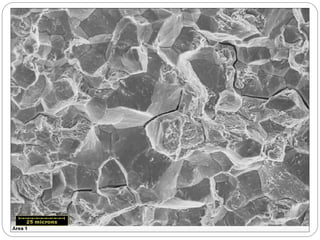
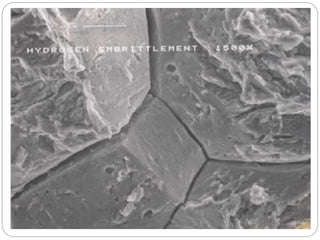
Hydrogen Embrittlement :
Causes, Effects & Prevention
Department of Metallurgical and Materials Engineering
NIT – Rourkela, 769008
Contents
ď‚— Introduction
ď‚— Causes
ď‚— Mechanism
ď‚— Effects
ď‚— Prevention Techniques
ď‚— References
Introduction
Embrittlement is a loss of ductility of a
material, or making it brittle.
If embrittlement occurs due to the effect
of hydrogen absorption then it known as
Hydrogen Embrittlement.
It is more susceptible to BCC and HCP
structured metals as compare to FCC
structured metals. As Little as 0.0001 weight
percent of hydrogen can cause cracking in
steel.
Hydrogen may be introduced during :
[1] During Melting & Entrapped during
Solidification,
[2] Anodic Reaction during Corrosion,
[3] Hydrogen Gas Welding & Moistured
Electrode
The Chief characteristics of Hydrogen
Embrittlement :
[1] Strain Rate Sensitivity increases,
[2] Susceptibility to Delayed Fracture
increases.
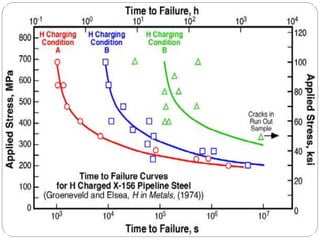
Hydrogen Embrittlement is enhanced by slow strain rates.
At low temperatures and high temperatures hydrogen
embrittlement is negligible, but it is most severe at Room
Temperature for example steel. Slow bend test and
Notched and Unnotched tension tests will detect hydrogen
Embrittlement by a drastic decrease in ductility, but
Mechanism
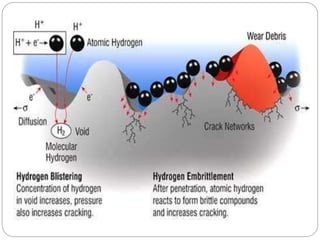
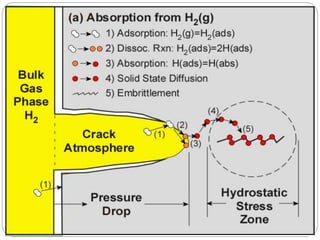
The exact mechanism of hydrogen
embrittlement is not well known. The initial
causes is the same: penetration of atomic
hydrogen into the metal structure.
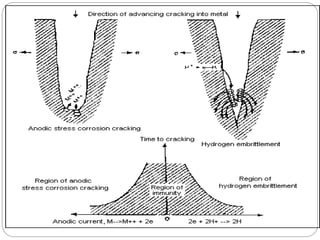
Most of the mechanisms that
have been proposed for hydrogen
embrittlement are based on slip interference
by dissolved hydrogen. This slip interference
may be due to accumulation of hydrogen
near dislocation sites or microvoids, but the
precise mechanism is still in doubt.
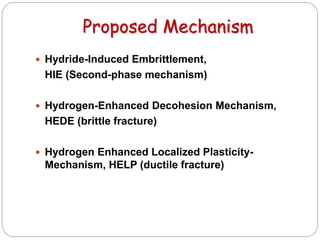
Proposed Mechanism
ď‚— Hydride-Induced Embrittlement,
HIE (Second-phase mechanism)
ď‚— Hydrogen-Enhanced Decohesion Mechanism,
HEDE (brittle fracture)
ď‚— Hydrogen Enhanced Localized Plasticity-
Mechanism, HELP (ductile fracture)
Prevention Techniques
ď‚— Reducing Corrosion Rate
ď‚— Hydrogen embrittlement occurs frequently
during pickling operations where corrosion
of the base metal produces vigorous
hydrogen evolution. By careful inhibitor
additions, base-metal corrosion can
largely be eliminated during pickling with a
susequent decrease in hydrogen pickup.
Prevention Techniques
ď‚— Using Clean Steel
ď‚— Rimmed steels tend to have numerous
voids, and the subtitution of killed steel
greatly increases the resistance to
hydrogen interstitials for embrittlement
because of the Less number of voids in
this material.
Prevention Techniques
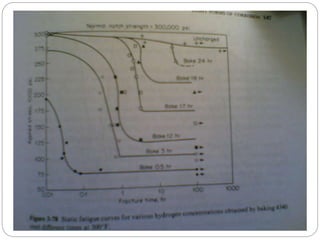
ď‚— Baking
ď‚— Hydrogen embrittlement is an almost
reversible process, especially in steels.
That is, if the hydrogen is removed, the
mechanical properties of the treated
material are only slightly different from
those of hydogen-free steel. A common
way of removing hydrogen in steels is by
baking at relatively low temperatures at
200-300 F.
Prevention Techniques
ď‚— Practicing Proper Welding
ď‚— Low-hydrogen welding rods should be
specified for welding if hydrogen
embrittlement is a problem. Also, it is
important to maintain dry conditions during
welding since water and water vapor are
major sources of hydrogen.
Prevention Techniques
ď‚— Substituting Alloys
ď‚— The materials most susceptible to
hydrogen embrittlement are the very high-
strength steels. Alloying with Ni or Mo
reduces susceptibility. Because, Nickel-
containing steels and Nickel-base alloys
have very low hydrogen diffusion rates
and best way to prevent from hydrogen
embrittlement.
References
 [1] George E. Dieter and David Bacon, “Mechanical Metallurgy,”
McGraw-Hill Book Company, ISBN 0-07-100406-8.
 [2] Mar G. Fontana, “Corrosion Engineering,” McGraw-Hill Book
Company, ISBN 978-0-07-060744-6.
 [3] G. Alefeld and J. Volkl (eds.), "Hydrogen in Metals,“ Springer-
Verlag, Berlin, Vols. 1 and 2, 1978.
ď‚— [4] R. Kirchheim, E. Fromm, E. Wicke, eds., Verlag, Munchen,
"Metals-Hydrogen Systems," 1989.
 [5] A.M. Brass, J. Chêne, “Hydrogen Uptake in 316L Stainless
Steel: Conseq- uences on Tensile Properties,” Corrosion
Science 48 (2006) 3222-3242.
 [6] C. L. Briant and S. K. Banerji (eds.), “Embrittlement of
Engineering Alloys,” Academic Press , New York, 1983.
 [7] R. Gibala, R. F. Hehnemann (eds.), “Hydrogen Embrittlement
and Stress Corrosion Cracking,” American Society for Metals,
Metals Park, Ohio, 1984.
Cont..
 [8] I. M. Bernstein and A. W. Thompson (eds.), “Hydrogen in
Metals,” Amer Soc. For Metals, Metals Park Ohio, 1974.
 [9] L . W. Tsay, T. Y. Yang, “Reduction of hydrogen
embrittlement in an ultra-high-strength steel by laser surface
annealing,” Fatigue Fract Engng Mater Struct, 23, p325–333.
ď‚— [10] H. Kamoutsi, G.N. Haidemenopoulos, V. Bontozoglou, S.
Pantelakis, “Corrosion-induced hydrogen embrittlement in
aluminum alloy 2024,” Corrosion Science, 48 (2006), p1209–
1224.
 [11] R.A. Siddiqui, H.A. Abdullah, “Hydrogen embrittlement in
0.31% carbon steel used for petrochemical applications”,
Journal of Materials Processing Technology, 170 (2005) ,p430–
435.
 [12] C. Pan, Y.J. Su, W.Y. Chu, et al, “Hydrogen embrittlement of
weld metal of austenitic stainless steels”, Corrosion Science,
44 (2002), p1983.
 [13] P. Sofronis, I.M. Robertson, “Viable Mechanisms of
Hydrogen embrittlement-A Review,” American Institute of
Thank You

Hydrogen 110416120206-phpapp02 hydrogen embrittlement

  • 1.
    Sidheshwar Kumar 107MM024 Hydrogen Embrittlement: Causes, Effects & Prevention Department of Metallurgical and Materials Engineering NIT – Rourkela, 769008
  • 2.
    Contents ď‚— Introduction ď‚— Causes ď‚—Mechanism ď‚— Effects ď‚— Prevention Techniques ď‚— References
  • 3.
    Introduction Embrittlement is aloss of ductility of a material, or making it brittle. If embrittlement occurs due to the effect of hydrogen absorption then it known as Hydrogen Embrittlement. It is more susceptible to BCC and HCP structured metals as compare to FCC structured metals. As Little as 0.0001 weight percent of hydrogen can cause cracking in steel.
  • 4.
    Hydrogen may beintroduced during : [1] During Melting & Entrapped during Solidification, [2] Anodic Reaction during Corrosion, [3] Hydrogen Gas Welding & Moistured Electrode
  • 5.
    The Chief characteristicsof Hydrogen Embrittlement : [1] Strain Rate Sensitivity increases, [2] Susceptibility to Delayed Fracture increases. Hydrogen Embrittlement is enhanced by slow strain rates. At low temperatures and high temperatures hydrogen embrittlement is negligible, but it is most severe at Room Temperature for example steel. Slow bend test and Notched and Unnotched tension tests will detect hydrogen Embrittlement by a drastic decrease in ductility, but
  • 6.
    Mechanism The exact mechanismof hydrogen embrittlement is not well known. The initial causes is the same: penetration of atomic hydrogen into the metal structure. Most of the mechanisms that have been proposed for hydrogen embrittlement are based on slip interference by dissolved hydrogen. This slip interference may be due to accumulation of hydrogen near dislocation sites or microvoids, but the precise mechanism is still in doubt.
  • 7.
    Proposed Mechanism ď‚— Hydride-InducedEmbrittlement, HIE (Second-phase mechanism) ď‚— Hydrogen-Enhanced Decohesion Mechanism, HEDE (brittle fracture) ď‚— Hydrogen Enhanced Localized Plasticity- Mechanism, HELP (ductile fracture)
  • 16.
    Prevention Techniques ď‚— ReducingCorrosion Rate ď‚— Hydrogen embrittlement occurs frequently during pickling operations where corrosion of the base metal produces vigorous hydrogen evolution. By careful inhibitor additions, base-metal corrosion can largely be eliminated during pickling with a susequent decrease in hydrogen pickup.
  • 17.
    Prevention Techniques ď‚— UsingClean Steel ď‚— Rimmed steels tend to have numerous voids, and the subtitution of killed steel greatly increases the resistance to hydrogen interstitials for embrittlement because of the Less number of voids in this material.
  • 18.
    Prevention Techniques ď‚— Baking ď‚—Hydrogen embrittlement is an almost reversible process, especially in steels. That is, if the hydrogen is removed, the mechanical properties of the treated material are only slightly different from those of hydogen-free steel. A common way of removing hydrogen in steels is by baking at relatively low temperatures at 200-300 F.
  • 20.
    Prevention Techniques ď‚— PracticingProper Welding ď‚— Low-hydrogen welding rods should be specified for welding if hydrogen embrittlement is a problem. Also, it is important to maintain dry conditions during welding since water and water vapor are major sources of hydrogen.
  • 21.
    Prevention Techniques ď‚— SubstitutingAlloys ď‚— The materials most susceptible to hydrogen embrittlement are the very high- strength steels. Alloying with Ni or Mo reduces susceptibility. Because, Nickel- containing steels and Nickel-base alloys have very low hydrogen diffusion rates and best way to prevent from hydrogen embrittlement.
  • 22.
    References  [1] GeorgeE. Dieter and David Bacon, “Mechanical Metallurgy,” McGraw-Hill Book Company, ISBN 0-07-100406-8.  [2] Mar G. Fontana, “Corrosion Engineering,” McGraw-Hill Book Company, ISBN 978-0-07-060744-6.  [3] G. Alefeld and J. Volkl (eds.), "Hydrogen in Metals,“ Springer- Verlag, Berlin, Vols. 1 and 2, 1978.  [4] R. Kirchheim, E. Fromm, E. Wicke, eds., Verlag, Munchen, "Metals-Hydrogen Systems," 1989.  [5] A.M. Brass, J. Chêne, “Hydrogen Uptake in 316L Stainless Steel: Conseq- uences on Tensile Properties,” Corrosion Science 48 (2006) 3222-3242.  [6] C. L. Briant and S. K. Banerji (eds.), “Embrittlement of Engineering Alloys,” Academic Press , New York, 1983.  [7] R. Gibala, R. F. Hehnemann (eds.), “Hydrogen Embrittlement and Stress Corrosion Cracking,” American Society for Metals, Metals Park, Ohio, 1984.
  • 23.
    Cont..  [8] I.M. Bernstein and A. W. Thompson (eds.), “Hydrogen in Metals,” Amer Soc. For Metals, Metals Park Ohio, 1974.  [9] L . W. Tsay, T. Y. Yang, “Reduction of hydrogen embrittlement in an ultra-high-strength steel by laser surface annealing,” Fatigue Fract Engng Mater Struct, 23, p325–333.  [10] H. Kamoutsi, G.N. Haidemenopoulos, V. Bontozoglou, S. Pantelakis, “Corrosion-induced hydrogen embrittlement in aluminum alloy 2024,” Corrosion Science, 48 (2006), p1209– 1224.  [11] R.A. Siddiqui, H.A. Abdullah, “Hydrogen embrittlement in 0.31% carbon steel used for petrochemical applications”, Journal of Materials Processing Technology, 170 (2005) ,p430– 435.  [12] C. Pan, Y.J. Su, W.Y. Chu, et al, “Hydrogen embrittlement of weld metal of austenitic stainless steels”, Corrosion Science, 44 (2002), p1983.  [13] P. Sofronis, I.M. Robertson, “Viable Mechanisms of Hydrogen embrittlement-A Review,” American Institute of
  • 24.