The name hydrogen comes from the Greek Words 
hydro and genes, meaning “water forming.” Hydrogen 
was detected in England in 1766 by Henry Cavendish 
as a new gas. A person named A. L. Lavoisier in 1783 
named it "hydrogen".
HYDROGEN 
On The Periodic Table 
Chemical symbol H 
Average atomic mass 1.00794 
Atomic number 1 
Protons 1 
Neutrons 0 
Group on the periodic table 1 
The origins of hydrogen in nature 
In oil and natural gas 
In Earth's Crust 
In Earth's Ocean 
In Human Body 
It is prepared industrially by two processes-Both reactions require high temperatures 
the "water gas reaction" using coke and water 
the steam reforming process using natural gas and water
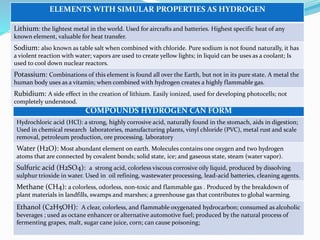
ELEMENTS WITH SIMULAR PROPERTIES AS HYDROGEN 
Lithium: the lightest metal in the world. Used for aircrafts and batteries. Highest specific heat of any 
known element, valuable for heat transfer. 
Sodium: also known as table salt when combined with chloride. Pure sodium is not found naturally, it has 
a violent reaction with water; vapors are used to create yellow lights; in liquid can be uses as a coolant; Is 
used to cool down nuclear reactors. 
Potassium: Combinations of this element is found all over the Earth, but not in its pure state. A metal the 
human body uses as a vitamin; when combined with hydrogen creates a highly flammable gas. 
Rubidium: A side effect in the creation of lithium. Easily ionized, used for developing photocells; not 
completely understood. 
COMPOUNDS HYDROGEN CAN FORM 
Hydrochloric acid (HCl): a strong, highly corrosive acid, naturally found in the stomach, aids in digestion; 
Used in chemical research laboratories, manufacturing plants, vinyl chloride (PVC), metal rust and scale 
removal, petroleum production, ore processing. laboratory 
Water (H2O): Most abundant element on earth. Molecules contains one oxygen and two hydrogen 
atoms that are connected by covalent bonds; solid state, ice; and gaseous state, steam (water vapor). 
Sulfuric acid (H2SO4): a strong acid, colorless viscous corrosive oily liquid, produced by dissolving 
sulphur trioxide in water. Used in oil refining, wastewater processing, lead-acid batteries, cleaning agents. 
Methane (CH4): a colorless, odorless, non-toxic and flammable gas . Produced by the breakdown of 
plant materials in landfills, swamps and marshes; a greenhouse gas that contributes to global warming. 
Ethanol (C2H5OH): A clear, colorless, and flammable oxygenated hydrocarbon; consumed as alcoholic 
beverages ; used as octane enhancer or alternative automotive fuel; produced by the natural process of 
fermenting grapes, malt, sugar cane juice, corn; can cause poisoning;
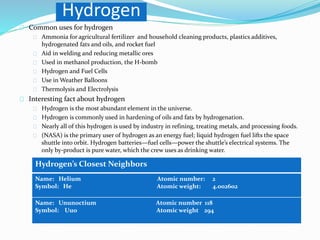
Hydrogen 
Common uses for hydrogen 
Ammonia for agricultural fertilizer and household cleaning products, plastics additives, 
hydrogenated fats and oils, and rocket fuel 
Aid in welding and reducing metallic ores 
Used in methanol production, the H-bomb 
Hydrogen and Fuel Cells 
Use in Weather Balloons 
Thermolysis and Electrolysis 
Interesting fact about hydrogen 
Hydrogen is the most abundant element in the universe. 
Hydrogen is commonly used in hardening of oils and fats by hydrogenation. 
Nearly all of this hydrogen is used by industry in refining, treating metals, and processing foods. 
(NASA) is the primary user of hydrogen as an energy fuel; liquid hydrogen fuel lifts the space 
shuttle into orbit. Hydrogen batteries—fuel cells—power the shuttle’s electrical systems. The 
only by-product is pure water, which the crew uses as drinking water. 
Hydrogen’s Closest Neighbors 
Name: Helium Atomic number: 2 
Symbol: He Atomic weight: 4.002602 
Name: Ununoctium Atomic number 118 
Symbol: Uuo Atomic weight 294

Hydrogen-SHARAADB

  • 1.
    The name hydrogencomes from the Greek Words hydro and genes, meaning “water forming.” Hydrogen was detected in England in 1766 by Henry Cavendish as a new gas. A person named A. L. Lavoisier in 1783 named it "hydrogen".
  • 2.
    HYDROGEN On ThePeriodic Table Chemical symbol H Average atomic mass 1.00794 Atomic number 1 Protons 1 Neutrons 0 Group on the periodic table 1 The origins of hydrogen in nature In oil and natural gas In Earth's Crust In Earth's Ocean In Human Body It is prepared industrially by two processes-Both reactions require high temperatures the "water gas reaction" using coke and water the steam reforming process using natural gas and water
  • 3.
    ELEMENTS WITH SIMULARPROPERTIES AS HYDROGEN Lithium: the lightest metal in the world. Used for aircrafts and batteries. Highest specific heat of any known element, valuable for heat transfer. Sodium: also known as table salt when combined with chloride. Pure sodium is not found naturally, it has a violent reaction with water; vapors are used to create yellow lights; in liquid can be uses as a coolant; Is used to cool down nuclear reactors. Potassium: Combinations of this element is found all over the Earth, but not in its pure state. A metal the human body uses as a vitamin; when combined with hydrogen creates a highly flammable gas. Rubidium: A side effect in the creation of lithium. Easily ionized, used for developing photocells; not completely understood. COMPOUNDS HYDROGEN CAN FORM Hydrochloric acid (HCl): a strong, highly corrosive acid, naturally found in the stomach, aids in digestion; Used in chemical research laboratories, manufacturing plants, vinyl chloride (PVC), metal rust and scale removal, petroleum production, ore processing. laboratory Water (H2O): Most abundant element on earth. Molecules contains one oxygen and two hydrogen atoms that are connected by covalent bonds; solid state, ice; and gaseous state, steam (water vapor). Sulfuric acid (H2SO4): a strong acid, colorless viscous corrosive oily liquid, produced by dissolving sulphur trioxide in water. Used in oil refining, wastewater processing, lead-acid batteries, cleaning agents. Methane (CH4): a colorless, odorless, non-toxic and flammable gas . Produced by the breakdown of plant materials in landfills, swamps and marshes; a greenhouse gas that contributes to global warming. Ethanol (C2H5OH): A clear, colorless, and flammable oxygenated hydrocarbon; consumed as alcoholic beverages ; used as octane enhancer or alternative automotive fuel; produced by the natural process of fermenting grapes, malt, sugar cane juice, corn; can cause poisoning;
  • 4.
    Hydrogen Common usesfor hydrogen Ammonia for agricultural fertilizer and household cleaning products, plastics additives, hydrogenated fats and oils, and rocket fuel Aid in welding and reducing metallic ores Used in methanol production, the H-bomb Hydrogen and Fuel Cells Use in Weather Balloons Thermolysis and Electrolysis Interesting fact about hydrogen Hydrogen is the most abundant element in the universe. Hydrogen is commonly used in hardening of oils and fats by hydrogenation. Nearly all of this hydrogen is used by industry in refining, treating metals, and processing foods. (NASA) is the primary user of hydrogen as an energy fuel; liquid hydrogen fuel lifts the space shuttle into orbit. Hydrogen batteries—fuel cells—power the shuttle’s electrical systems. The only by-product is pure water, which the crew uses as drinking water. Hydrogen’s Closest Neighbors Name: Helium Atomic number: 2 Symbol: He Atomic weight: 4.002602 Name: Ununoctium Atomic number 118 Symbol: Uuo Atomic weight 294
Editor's Notes

  • #3  Atomic number: 118 Atomic weight: unknown