9.1 Hydrogen
1. Introduction
1.Chemistry of atomic and nascent hydrogen
2. Isotopes of hydrogen and their uses
3. Application of hydrogen as fuel
4. Heavy water and its applications
o Highly Inflammable, colorless, odorless & lighter than air.
o Greek ( Hydro = water, gene= produce, Water producer)
o Named by Antoine Lavoisier
o Discovery of metal acid reaction- Robert Boyle in 1671
o Hydrogen was first recognized(discovered) by Henry Cavendish in 1766
o First hydrogen-filled balloon was invented by Jacques Charles in 1783.
o Invention of the first hydrogen-lifted airship by Henri Giffard in 1852
o Symbol = H , Atomic number=1 , Atomic number = 1, At. Mass = 1.008,
o Molecular mass = 2.016, ,Equivalent mass = 1.008, Electronic configuration = 1s1
o Valency =1,
Isotopes of Hydrogen & their uses
1. Protium or ordinary hydrogen
This isotope of hydrogen has one electron, one proton. Neutron is absent.
Uses of ordinary hydrogen:
It is used in manufacture of ammonia gas ( Haber’s process) , vegetable ghee from vegetable
oil ( hydrogenation),
It is used to fill the weather balloons , in oxy-hydrogen metal welding torch, in rockets and
missiles as thrust fuel in modern hybrid vehicles ( Which uses hydrogen fuel cell), in Hydrogen
bomb
It is also used as reducing agent in many chemical reactions.
2. Deuterium or Heavy hydrogen
This isotope of hydrogen has one electron, one proton & one neutron.
Uses of heavy hydrogen:
It is used to produce heavy water which is used as moderated fission reactors, usually as liquid
D2O, to slowdown the neutrons thereby controlling fission reaction.
It is most commonly used in hydrogen nuclear magnetic resonance spectroscopy (proton
NMR) , organic chemists utilize NMR for mapping protein interactions or identifying small
compounds )
In chemistry, biochemistry and environmental sciences, deuterium is used as a non-
radioactive, stable isotopic tracer to find out the reaction pathways (reaction mechanism)
2
Govinda Pathak, Department of Chemistry, Rehdon college and school.
3.
3. Tritium orRadioactive hydrogen:
This isotope of hydrogen has one electron one proton and two neutrons.
Uses of radioactive hydrogen:
Tritium is used as a radioactive tracer i.e. it can be used to explore the mechanism of chemical
reactions by tracing the path that the radioisotope follows from reactants to products)
in radio luminescent light sources for watches and instruments,
Along with deuterium, as a fuel for nuclear fusion reactions with applications in energy
generation and as nuclear weapons.
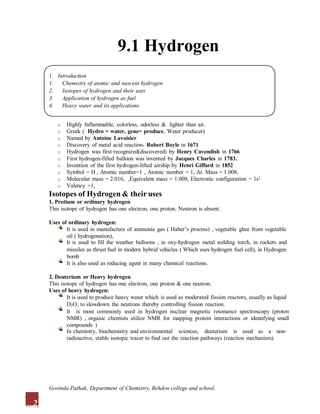
Reactive Forms of hydrogen (Nascent and Atomic Hydrogen)
Nascent Hydrogen Atomic Hydrogen
Hydrogen obtain in situ or at the moment of
formation by chemical reactions ( Latin,
Nascor = newly born)
Zn + H2SO4 (dil.) ZnSO4 + 2 [H]
Hydrogen obtain by the dissociation of
molecular hydrogen by using high temperature
or electric discharge.
H2 (g) + 436 KJ H + H
Reactive than molecular hydrogen but less
than that of atomic hydrogen.
Reactive, energetic than both molecular and
nascent hydrogen.
Longer half-life than atomic hydrogen Shorter half-life than atomic hydrogen
Nascent Hydrogen combines to give molecular
hydrogen with the release of small amount of
energy.
Atomic hydrogen combines to give molecular
hydrogen with the release of large amount of
energy
Reducing properties of Nascent and molecular hydrogen
Nascent hydrogen is more powerful reducing agent than molecular hydrogen. This can be illustrated
by following chemical tests in laboratory.
Acidified KMnO4 test:
KMnO4 + H2SO4
Potassium permanganate
(pink)
+ H2 No reaction ( pink color not discharged)
Molecular hydrogen
Zn + dilH2SO4
+2
K2SO4 + 2MnSO4 + 8H2O
Manganese sulfate
(colorless)
Zn + dilH2SO4
Nascent hydrogen
Potassium permanganate
(pink)
+7
2KMnO4 + 3 H2SO4 + 10[H]
3
Govinda Pathak, Department of Chemistry, Rehdon college and school.
4.
Acidified K2Cr2O7 test:
K2Cr2O7+ H2SO4 + H2 No reaction ( Orange color not discharged)
Potassium dichromate
(Orange)
+6
K2Cr2O7 + 4H2SO4
Potassiumdichromate
(Orange)
Zn + dilH2SO4
Molecular hydrogen
+ 6[H] + 7H2O
+3
K2SO4 + Cr2(SO4)3
Chromium sulfate
(Green)
Nascenthydrogen
Zn + dilH2SO4
FeCl3 test:
No reaction ( Reddish brown color not discharged)
Zn + dilH2SO4
Molecular hydrogen
FeCl3 + H2
Ferric Chloride
(Reddish brown)
FeCl2 + HCl
+3
FeCl3 +
FerricChloride
(Reddishbrown)
[H]
Nascent hydrogen FerrousChloride
(light green)
4
Zn + dilH2SO4 +2
Although molecular hydrogen is less powerful reducing agent than nascent hydrogen but also used
as reducing agent in many chemical reactions such as in catalytic hydrogenation of vegetable oil into
Vanaspati ghee etc.
Hydrogen as Fuel
Hydrogen is locked up in enormous quantities in water, hydrocarbons, and other organic matter. One
of the challenges of using hydrogen as a fuel comes from being able to extract hydrogen efficiently
from these compounds.
Hydrogen fuel can also provide motive power for liquid-propellant rockets, cars, trucks, trains, boats
and airplanes, portable fuel cell applications or stationary fuel cell applications, which can power an
electric motor. The problems of using hydrogen fuel in cars arise from the fact that hydrogen is difficult
to store in either a high pressure tank or a cryogenic tank.
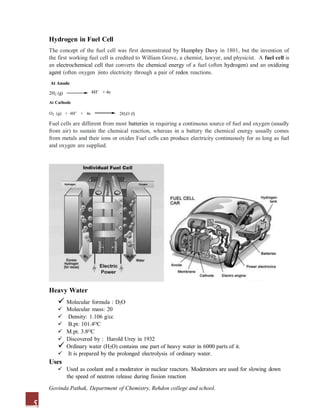
Fuel cells present the most attractive choice for energy conversion from hydrogen directly towards
electricity, due to their high efficiency, low noise, and limited number of moving parts. Fuel cells are
of interest for both stationary and mobile power generation from hydrogen. Fuel cells are often
considered as part of a vehicle propulsion system.
A fuel cell vehicle (FCV) or fuel cell electric vehicle (FCEV) is an electric vehicle that uses a fuel
cell, sometimes in combination with a small battery or supercapacitor, to power its onboard electric
motor. Fuel cells in vehicles generate electricity generally using oxygen from the air and compressed
hydrogen. Most fuel cell vehicles are classified as zero-emissions vehicles that emit only water and
heat.
Govinda Pathak, Department of Chemistry, Rehdon college and school.
5.
Hydrogen in FuelCell
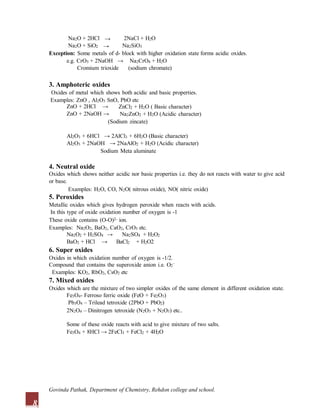
The concept of the fuel cell was first demonstrated by Humphry Davy in 1801, but the invention of
the first working fuel cell is credited to William Grove, a chemist, lawyer, and physicist. A fuel cell is
an electrochemical cell that converts the chemical energy of a fuel (often hydrogen) and an oxidizing
agent (often oxygen )into electricity through a pair of redox reactions.
At Anode
Heavy Water
Molecular formula : D2O
Molecular mass: 20
Density: 1.106 g/cc
B.pt: 101.4OC
M.pt. 3.8OC
Discovered by : Harold Urey in 1932
Ordinary water (H2O) contains one part of heavy water in 6000 parts of it.
It is prepared by the prolonged electrolysis of ordinary water.
Uses
Used as coolant and a moderator in nuclear reactors. Moderators are used for slowing down
the speed of neutron release during fission reaction
2H2 (g) 4H+ + 4e
At Cathode
O2 (g) + 4H+ + 4e 2H2O (l)
Fuel cells are different from most batteries in requiring a continuous source of fuel and oxygen (usually
from air) to sustain the chemical reaction, whereas in a battery the chemical energy usually comes
from metals and their ions or oxides. Fuel cells can produce electricity continuously for as long as fuel
and oxygen are supplied.
5
Govinda Pathak, Department of Chemistry, Rehdon college and school.
6.
9.2 Oxygen
2. Introduction& Allotropes of Oxygen
1. Definition of allotropy and examples
2. Oxygen: Types of oxides (acidic, basic, neutral, amphoteric, peroxide and mixed oxides)
3. Applications of hydrogen peroxide
4. Medical and industrial application of oxygen
o Greek words (Oxys= sour, genus= producer “acid producer”)
o Discovered by & first prepared by Carl Wilhelm Scheele (1771) .The name oxygen was
coined in 1777 by Antoine Lavoisier; Atomic number = 8
o Electronic configuration =1s22s22p4 ; Valency = 2 ; Oxidation state = -2 ( But in peroxide = -
1 & in superoxide = -1/2); Isotopes = 16O, 17O, 18O ; Allotropes of oxygen = (O3) ozone
o Most abundant 16O = 99.76% There are 8 neutron and 8 proton in 16 O isotope.
o First member of Group VI A or 16 group (Chalcogen family-ore forming) & it is P-block
element.
Occurrence & production
In atmospheric air along with Nitrogen .In combined state or in the form of oxides, hydroxides,
carbonates, sulphates, nitrates etc. Green Plants produce oxygen by photosynthesis reaction.
Industrially oxygen is produced from the electrolysis of water.
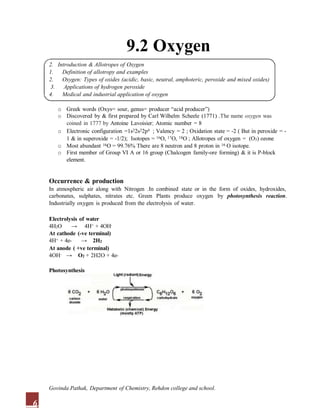
Electrolysis of water
4H2O → 4H+ + 4OH-
At cathode (-ve terminal)
4H+ + 4e- → 2H2
At anode ( +ve terminal)
4OH- → O2 + 2H2O + 4e-
Photosynthesis
6
Govinda Pathak, Department of Chemistry, Rehdon college and school.
7.
Oxides
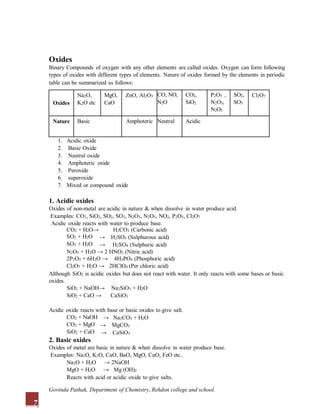
Binary Compounds ofoxygen with any other elements are called oxides. Oxygen can form following
types of oxides with different types of elements. Nature of oxides formed by the elements in periodic
table can be summarized as follows:
Govinda Pathak, Department of Chemistry, Rehdon college and school.
7
1. Acidic oxide
2. Basic Oxide
3. Neutral oxide
4. Amphoteric oxide
5. Peroxide
6. superoxide
7. Mixed or compound oxide
1. Acidic oxides
Oxides of non-metal are acidic in nature & when dissolve in water produce acid.
Examples: CO2, SiO2, SO2, SO3, N2O3, N2O5, NO2, P2O5, Cl2O7
Acidic oxide reacts with water to produce base.
CO2 + H2O→
SO2 + H2O
SO3 + H2O
H2CO3 (Carbonic acid)
→ H2SO3 (Sulphurous acid)
→ H2SO4 (Sulphuric acid)
N2O5 + H2O → 2 HNO3 (Nitric acid)
2P2O5 + 6H2O → 4H3PO4 (Phosphoric acid)
Cl2O7 + H2O → 2HClO4 (Per chloric acid)
Although SiO2 is acidic oxides but does not react with water. It only reacts with some bases or basic
oxides.
SiO2 + NaOH→ Na2SiO3 + H2O
SiO2 + CaO → CaSiO3
Acidic oxide reacts with base or basic oxides to give salt.
→ Na2CO3 + H2O
→ MgCO3
→ CaSiO3
CO2 + NaOH
CO2 + MgO
SiO2 + CaO
2. Basic oxides
Oxides of metal are basic in nature & when dissolve in water produce base.
Examples: Na2O, K2O, CaO, BaO, MgO, CuO, FeO etc..
Na2O + H2O → 2NaOH
MgO + H2O → Mg (OH)2
Reacts with acid or acidic oxide to give salts.
Oxides
Na2O,
K2O etc
MgO,
CaO
ZnO, Al2O3 CO, NO,
N2O
CO2,
SiO2
P2O5 ,
N2O3,
N2O5
SO2,
SO3
Cl2O7
Nature Basic Amphoteric Neutral Acidic
8.
Na2O + 2HCl
Na2O+ SiO2
8
→
→
2NaCl + H2O
Na2SiO3
Exception: Some metals of d- block with higher oxidation state forms acidic oxides.
e.g. CrO3 + 2NaOH → Na2CrO4 + H2O
Cromium trioxide (sodium chromate)
3. Amphoteric oxides
Oxides of metal which shows both acidic and basic properties.
Examples: ZnO , Al2O3 SnO, PbO etc
ZnO + 2HCl →
ZnO + 2NaOH →
ZnCl2 + H2O ( Basic character)
Na2ZnO2 + H2O (Acidic character)
(Sodium zincate)
Al2O3 + 6HCl → 2AlCl3 + 6H2O (Basic character)
Al2O3 + 2NaOH → 2NaAlO2 + H2O (Acidic character)
Sodium Meta aluminate
4. Neutral oxide
Oxides which shows neither acidic nor basic properties i.e. they do not reacts with water to give acid
or base.
Examples: H2O, CO, N2O( nitrous oxide), NO( nitric oxide)
5. Peroxides
Metallic oxides which gives hydrogen peroxide when reacts with acids.
In this type of oxide oxidation number of oxygen is -1
These oxide contains (O-O)2- ion.
Examples: Na2O2, BaO2, CaO2, CrO5 etc.
Na2O2 + H2SO4 → Na2SO4 + H2O2
BaO2 + HCl → BaCl2 + H2O2
6. Super oxides
Oxides in which oxidation number of oxygen is -1/2.
Compound that contains the superoxide anion i.e. O2−
Examples: KO2, RbO2, CsO2 etc
7. Mixed oxides
Oxides which are the mixture of two simpler oxides of the same element in different oxidation state.
Fe3O4- Ferroso ferric oxide (FeO + Fe2O3)
Pb3O4 – Trilead tetroxide (2PbO + PbO2)
2N2O4 – Dinitrogen tetroxide (N2O3 + N2O5) etc..
Some of these oxide reacts with acid to give mixture of two salts.
Fe3O4 + 8HCl → 2FeCl3 + FeCl2 + 4H2O
Govinda Pathak, Department of Chemistry, Rehdon college and school.
9.
Uses of Oxygen
Itis used to make acids, sulfuric acid, nitric acid and other compounds.
Hot oxygen air is required to make steel and iron in blast furnaces. Some mining companies
use it to destroy rocks.
Industries use the oxygen gas for cutting, welding and melting metals- oxy-hydrogen and
oxy-acetylene blow torches are used in welding process.
Liquid oxygen, it burns spacecraft fuel. This produces the thrust needed in space. Astronauts’
spacesuits have close to pure oxygen.
In hospitals, oxygen supplies are kept in stock. These are provided to patients who have
difficulty in breathing.
Scuba divers, in submarines in airplane oxygen is used.
This gas is also used in polyester polymers and antifreeze production.
Applications of Hydrogen peroxide
Hydrogen peroxide is a chemical compound with the formula H2O2. In its pure form, it is a
very pale blue
It is used as an oxidizer, bleaching agent, and antiseptic
Biological Importance of O2
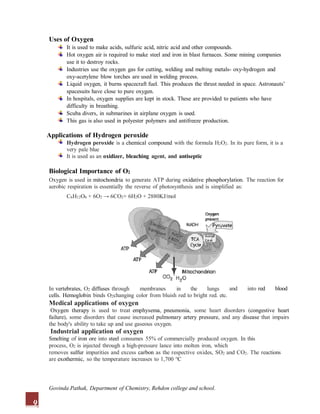
Oxygen is used in mitochondria to generate ATP during oxidative phosphorylation. The reaction for
aerobic respiration is essentially the reverse of photosynthesis and is simplified as:
C6H12O6 + 6O2 → 6CO2+ 6H2O + 2880KJ/mol
In vertebrates, O2 diffuses through membranes in the lungs and into red blood
cells. Hemoglobin binds O2changing color from bluish red to bright red. etc.
Medical applications of oxygen
Oxygen therapy is used to treat emphysema, pneumonia, some heart disorders (congestive heart
failure), some disorders that cause increased pulmonary artery pressure, and any disease that impairs
the body's ability to take up and use gaseous oxygen.
Industrial application of oxygen
Smelting of iron ore into steel consumes 55% of commercially produced oxygen. In this
process, O2 is injected through a high-pressure lance into molten iron, which
removes sulfur impurities and excess carbon as the respective oxides, SO2 and CO2. The reactions
are exothermic, so the temperature increases to 1,700 °C
9
Govinda Pathak, Department of Chemistry, Rehdon college and school.
10.
9.3 Ozone
3. Ozone
1.Occurrence
2. Preparation of ozone from oxygen
3. Structure of ozone
4. Test for ozone
5. Ozone layer depletion (causes, effects and control measures)
6. Uses of ozone
o Introduction
o Van Marum ( Dutch Chemist) in 1785 first noticed the formation of ozone.
o Schönbein (in 1840) is generally credited with the discovery of ozone.
o The name ozone derives from ozein (Greek word) -referring to ozone's distinctive smell.
o In standard conditions, ozone is a pale blue gas that condenses at progressively low temperatures
to a dark blue liquid and finally a violet-black solid.
o Powerful oxidizing agent than O2
o Nepal has been Celebrating September 16 as Ozone day from 1997.
Occurrence
The ozone layer lies in the stratosphere between 12 to 25Km from the surface of earth
Formation of ozone in stratosphere
It is formed naturally in stratosphere by the action of ultraviolet radiation from sun.
O2
UV light
O + O
O2 + O O3
Ozone
Oxygen molecule Oxygen atoms
Formation of ozone in Troposphere region (ground level)
Ground level ozone levels are highest in cities with high levels automobile traffic during daylight
hours in the summer.
NO2
O2 + O
UV light
NO + O
O3
Ozone
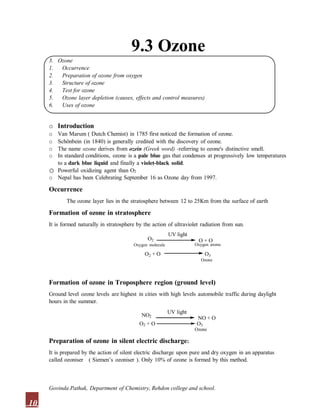
Preparation of ozone in silent electric discharge:
It is prepared by the action of silent electric discharge upon pure and dry oxygen in an apparatus
called ozoniser ( Siemen’s ozoniser ). Only 10% of ozone is formed by this method.
10
Govinda Pathak, Department of Chemistry, Rehdon college and school.
11.
O2
electric spark
O +O
O2 + O O3
Ozone
Oxygen molecule Oxygen atoms
O O
O O O
Structure of ozone
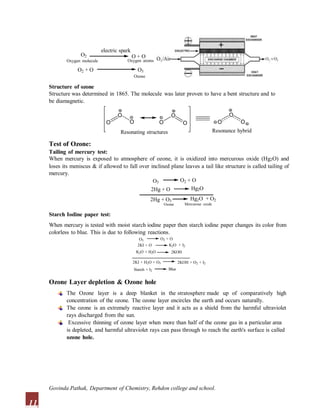
Structure was determined in 1865. The molecule was later proven to have a bent structure and to
be diamagnetic.
O O O
O
Resonating structures Resonance hybrid
Test of Ozone:
Tailing of mercury test:
When mercury is exposed to atmosphere of ozone, it is oxidized into mercurous oxide (Hg2O) and
loses its meniscus & if allowed to fall over inclined plane leaves a tail like structure is called tailing of
mercury.
O3 O2 + O
2Hg + O Hg2O
2Hg + O3 Hg2O + O2
Mercurous oxide
Ozone
Starch Iodine paper test:
When mercury is tested with moist starch iodine paper then starch iodine paper changes its color from
colorless to blue. This is due to following reactions.
Ozone Layer depletion & Ozone hole
The Ozone layer is a deep blanket in the stratosphere made up of comparatively high
concentration of the ozone. The ozone layer encircles the earth and occurs naturally.
The ozone is an extremely reactive layer and it acts as a shield from the harmful ultraviolet
rays discharged from the sun.
Excessive thinning of ozone layer when more than half of the ozone gas in a particular area
is depleted, and harmful ultraviolet rays can pass through to reach the earth's surface is called
ozone hole.
O3
2KI + O
K2O + H2O
O2 + O
K2O + I2
2KOH
2KI + H2O + O3 2KOH + O2 + I2
Starch + I2 Blue
11
Govinda Pathak, Department of Chemistry, Rehdon college and school.
12.
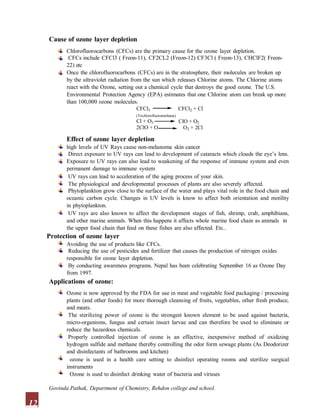
Cause of ozonelayer depletion
Chlorofluorocarbons (CFCs) are the primary cause for the ozone layer depletion.
CFCs include CFCl3 ( Freon-11), CF2CL2 (Freon-12) CF3Cl ( Freon-13), CHClF2( Freon-
22) etc
Once the chlorofluorocarbons (CFCs) are in the stratosphere, their molecules are broken up
by the ultraviolet radiation from the sun which releases Chlorine atoms. The Chlorine atoms
react with the Ozone, setting out a chemical cycle that destroys the good ozone. The U.S.
Environmental Protection Agency (EPA) estimates that one Chlorine atom can break up more
than 100,000 ozone molecules.
CFCl3 CFCl2 + Cl
(Trichlorofluoromethane)
Cl + O3
2ClO + O
ClO + O2
O2 + 2Cl
Effect of ozone layer depletion
high levels of UV Rays cause non-melanoma skin cancer
Direct exposure to UV rays can lead to development of cataracts which clouds the eye’s lens.
Exposure to UV rays can also lead to weakening of the response of immune system and even
permanent damage to immune system
UV rays can lead to acceleration of the aging process of your skin.
The physiological and developmental processes of plants are also severely affected.
Phytoplankton grow close to the surface of the water and plays vital role in the food chain and
oceanic carbon cycle. Changes in UV levels is know to affect both orientation and motility
in phytoplankton.
UV rays are also known to affect the development stages of fish, shrimp, crab, amphibians,
and other marine animals. When this happens it affects whole marine food chain as animals in
the upper food chain that feed on these fishes are also affected. Etc..
Protection of ozone layer
Avoiding the use of products like CFCs.
Reducing the use of pesticides and fertilizer that causes the production of nitrogen oxides
responsible for ozone layer depletion.
By conducting awareness programs. Nepal has been celebrating September 16 as Ozone Day
from 1997.
Applications of ozone:
Ozone is now approved by the FDA for use in meat and vegetable food packaging / processing
plants (and other foods) for more thorough cleansing of fruits, vegetables, other fresh produce,
and meats.
The sterilizing power of ozone is the strongest known element to be used against bacteria,
micro-organisms, fungus and certain insect larvae and can therefore be used to eliminate or
reduce the hazardous chemicals.
Properly controlled injection of ozone is an effective, inexpensive method of oxidizing
hydrogen sulfide and methane thereby controlling the odor form sewage plants (As Deodorizer
and disinfectants of bathrooms and kitchen)
ozone is used in a health care setting to disinfect operating rooms and sterilize surgical
instruments
Ozone is used to disinfect drinking water of bacteria and viruses
12
Govinda Pathak, Department of Chemistry, Rehdon college and school.
13.
9.6 Carbon
NEB syllabus_076
6.Introduction
1. Allotropes of carbon (crystalline and amorphous) including fullerenes (structure,
general properties and uses only)
2. Properties (reducing action, reaction with metals and nonmetals) and uses of carbon
monoxide
Position in Periodic table:
o P- block element, Group IV ( or 14 group) & second period
o Symbol: C
o Atomic number : 6
o Atomic mass : 12 amu
o Atomic number = 6,
o Valency = 4 ,
o Oxidation states = - 4(CH4) to + 4 (CO2)
o Configuration = 1s2 2s2 2p2 or [He] 2s22p2
o Valency : 4
o Nature of element : Non-metal
o Most abundant isotope : 6C12 other isotopes are 6C13 , 6C14 (used in C-dating)
Allotropes of Carbon:
Element that can exists in different forms (different molecular structure) but in same phase
are called allotropes & phenomenon is called allotropy.
Carbon Allotropes
Crystalline allotropes Amorphous allotropes
Diamond Graphite Fullurenes Coal Charcoal lampblack
Fig. Flow chart diagramof types of carbon allotropes
Diamond:
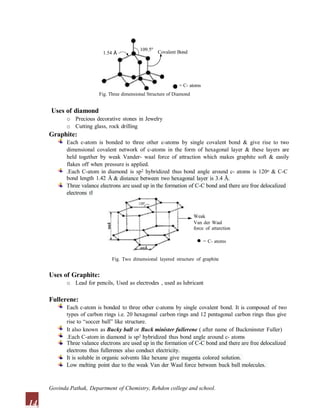
Each c-atom is tetrahedrally bonded to four other c-atoms by single covalent bond & give rise
to giant three dimensional covalent network of c-atoms which makes it very hard, and has high
melting and boiling points.
Each C-atom in diamond is sp3 hybridized thus bond angle around c- atoms is 109.5o & C-C
bond length 1.54 Å.
All valance electrons are used up in the formation of C-C bond and there are no any free
delocalized electrons thus diamond are bad conductor of electricity.
13
Govinda Pathak, Department of Chemistry, Rehdon college and school.
14.
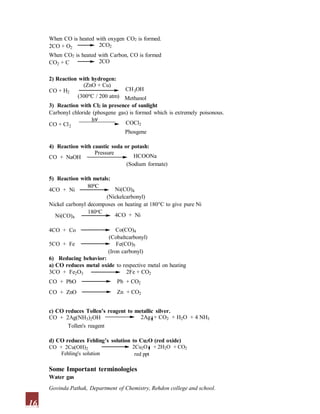
bond length 1.42Å & distance between two hexagonal layer is 3.4 Å.
Three valance electrons are used up in the formation of C-C bond and there are free delocalized
electrons thus graphite are conductor of electricity.
Three valance electrons are used up in the formation of C-C bond and there are free delocalized
electrons thus fullerenes also conduct electricity.
It is soluble in organic solvents like hexane give magenta colored solution.
Low melting point due to the weak Van der Waal force between buck ball molecules.
109.5o
1.54 Å
= C- atoms
Fig. Three dimensional Structure of Diamond
Uses of diamond
o Precious decorative stones in Jewelry
o Cutting glass, rock drilling
Graphite:
Each c-atom is bonded to three other c-atoms by single covalent bond & give rise to two
dimensional covalent network of c-atoms in the form of hexagonal layer & these layers are
held together by weak Vander- waal force of attraction which makes graphite soft & easily
flakes off when pressure is applied.
.Each C-atom in diamond is sp2 hybridized thus bond angle around c- atoms is 120o & C-C
Covalent Bond
120o
Weak
Van der Waal
force of attarction
= C- atoms
Fig. Two dimensional layered structure of graphite
Uses of Graphite:
o Lead for pencils, Used as electrodes , used as lubricant
Fullerene:
Each c-atom is bonded to three other c-atoms by single covalent bond. It is composed of two
types of carbon rings i.e. 20 hexagonal carbon rings and 12 pentagonal carbon rings thus give
rise to “soccer ball” like structure.
It also known as Bucky ball or Buck minister fullerene ( after name of Buckminster Fuller)
.Each C-atom in diamond is sp2 hybridized thus bond angle around c- atoms
14
Govinda Pathak, Department of Chemistry, Rehdon college and school.
15.
Uses & futurescopes of fullerene:
o
o
o
As Molecular ball bearing machines
As drug delivery vehicle
Nano electronic devices
Carbon monoxide [CO]
In laboratory, carbon monoxide can be prepared by heating oxalic acid crystal or formic acid with
conc. H2SO4. Here conc. H2SO4 acts as dehydrating agent.
(COOH)2 .2H2O + conc. H2SO4
Oxalic acid crystal
OR,
CO + CO2 + H2SO4 . 3H2O
When Methanoic acid (formic acid) heated with conc. Sulphuric acid then carbon monoxide gas
is formed.
CO + H2SO4 . H2O
HCOOH + conc. H2SO4
Formic acid
Physical Properties
It is colorless, poisonous gas with faint smell. It is slightly soluble in water and lighter than air.
NEB Q: Why CO is poisonous to us?
It is highly poisonous gas. Carbon monoxide has about twenty times more affinity towards hemoglobin
than does oxygen. Carbon monoxide combine with hemoglobin to form carboxyhemoglobin.
Carboxyhemoglobin is more stable complex and is not able to carry oxygen. This causes deficiency of
oxygen in the body, resulting into suffocation and even death. Due to this CO is extremely poisonous.
Hb + CO HbCO (Carboxy hemoglobin)
Chemical properties
1. Reaction with oxygen (Combustion)
It burns in air with a pale blue flame to form CO2.
2CO + O2
2CO2 + heat
burn
NEB Q Convert CO to CO2 and vice versa?
Fig. Fullerene (C60)
15
Govinda Pathak, Department of Chemistry, Rehdon college and school.
16.
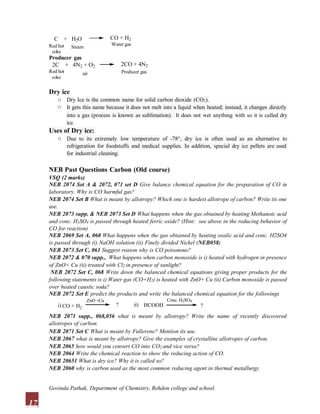
When CO isheated with oxygen CO2 is formed.
2CO + O2 2CO2
When CO2 is heated with Carbon, CO is formed
CO2 + C 2CO
2) Reaction with hydrogen:
3
Methanol
CO + H2
(ZnO + Cu)
CH OH
(300oC / 200 atm)
CO + Cl2
COCl2
Phosgene
3) Reaction with Cl2 in presence of sunlight
Carbonyl chloride (phosgene gas) is formed which is extremely poisonous.
hv
4) Reaction with caustic soda or potash:
CO + NaOH HCOONa
(Sodium formate)
Pressure
5) Reaction with metals:
4CO + Ni
80oC
Ni(CO)4
(Nickelcarbonyl)
Nickel carbonyl decomposes on heating at 180°C to give pure Ni
Ni(CO)4
180oC
4CO + Ni
4CO + Co
5CO + Fe
Co(CO)4
(Cobaltcarbonyl)
Fe(CO)5
(Iron carbonyl)
6) Reducing behavior:
a) CO reduces metal oxide to respective metal on heating
3CO + Fe2O3
CO + PbO
CO + ZnO
2Fe + CO2
Pb + CO2
Zn + CO2
c) CO reduces Tollen’s reagent to metallic silver.
Tollen's reagent
CO + 2Ag(NH3)2OH 2Ag + CO2 + H2O + 4 NH3
d) CO reduces Fehling’s solution to Cu2O (red oxide)
CO + 2Cu(OH)2
Fehling's solution
2Cu2O + 2H2O + CO2
red ppt
16
Some Important terminologies
Water gas
Govinda Pathak, Department of Chemistry, Rehdon college and school.
17.
C + H2OCO + H2
Water gas
Red hot
coke
Steam
Producer gas
2C + 4N2 + O2
Red hot
2CO + 4N2
Producer gas
coke
air
Dry ice
o
o
Dry Ice is the common name for solid carbon dioxide (CO2).
It gets this name because it does not melt into a liquid when heated; instead, it changes directly
into a gas (process is known as sublimation). It does not wet anything with so it is called dry
ice.
Uses of Dry ice:
o Due to its extremely low temperature of -78°, dry ice is often used as an alternative to
refrigeration for foodstuffs and medical supplies. In addition, special dry ice pellets are used
for industrial cleaning.
NEB Past Questions Carbon (Old course)
VSQ (2 marks)
NEB 2074 Set A & 2072, 071 set D Give balance chemical equation for the preparation of CO in
laboratory. Why is CO harmful gas?
NEB 2074 Set B What is meant by allotropy? Which one is hardest allotrope of carbon? Write its one
use.
NEB 2073 supp. & NEB 2073 Set D What happens when the gas obtained by heating Methanoic acid
and conc. H2SO4 is passed through heated ferric oxide? (Hint: see above in the reducing behavior of
CO for reaction)
NEB 2069 Set A, 060 What happens when the gas obtained by heating oxalic acid and conc. H2SO4
is passed through (i) NaOH solution (ii) Finely divided Nickel (NEB058)
NEB 2073 Set C, 061 Suggest reason why is CO poisonous?
NEB 2072 & 070 supp., What happens when carbon monoxide is i) heated with hydrogen in presence
of ZnO+ Cu (ii) treated with Cl2 in presence of sunlight?
NEB 2072 Set C, 068 Write down the balanced chemical equations giving proper products for the
following statements is i) Water gas (CO+H2) is heated with ZnO+ Cu (ii) Carbon monoxide is passed
over heated caustic soda?
NEB 2072 Set E predict the products and write the balanced chemical equation for the followings
2
i) CO + H
ZnO +Cu
? ii)
17
Conc. H2SO4
HCOOH ?
NEB 2071 supp., 068,056 what is meant by allotropy? Write the name of recently discovered
allotropes of carbon.
NEB 2071 Set C What is meant by Fullerene? Mention its use.
NEB 2067 what is meant by allotropy? Give the examples of crystalline allotropes of carbon.
NEB 2065 how would you convert CO into CO2 and vice versa?
NEB 2064 Write the chemical reaction to show the reducing action of CO.
NEB 20651 What is dry ice? Why it is called so?
NEB 2060 why is carbon used as the most common reducing agent in thermal metallurgy.
Govinda Pathak, Department of Chemistry, Rehdon college and school.
18.
9.7 Phosphorous
NEB syllabus_076
7.Introduction
1. Allotropes of phosphorus (name only)
2. Preparation (no diagram and description is required), properties (basic nature, reducing nature,
action with halogens and oxygen) and uses of phosphine
Occurrence, Position in periodic table
Symbol: P
At no.: 15
At mass: 31
Valency= 3 & 5
Position in periodic table: Group VA or 15
Electronic configuration: 1s22s22p63s23p3
Occurrence: Phosphorite or phosphate rock (Ca3(PO4)2), Fluoroapatite ( 3Ca3(PO4)2. CaF2),
Hydroxyapatite (3Ca3(PO4)2. Ca(OH)2 ) ,animal bones, teeth ( 58% calcium phosphate), occurs in
DNA, RNA, Adenosine triphosphate( ATP), Adenosine Diphosphate (ADP)
Allotropes of phosphorus
a) White or yellow phosphorus b) Red phosphorus c) Black phosphorus d) Violet phosphorous
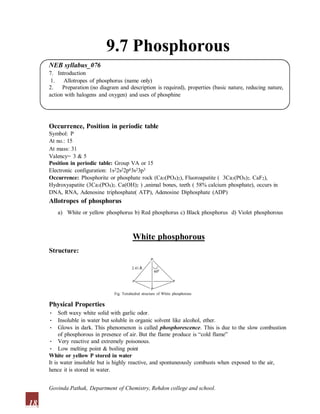
White phosphorous
Structure:
P
2.41 Å
600
P P
P
Fig. Tetrahedral structure of White phosphorous
Physical Properties
• Soft waxy white solid with garlic odor.
• Insoluble in water but soluble in organic solvent like alcohol, ether.
• Glows in dark. This phenomenon is called phosphorescence. This is due to the slow combustion
of phosphorous in presence of air. But the flame produce is “cold flame”
• Very reactive and extremely poisonous.
• Low melting point & boiling point
White or yellow P stored in water
It is water insoluble but is highly reactive, and spontaneously combusts when exposed to the air,
hence it is stored in water.
18
Govinda Pathak, Department of Chemistry, Rehdon college and school.
19.
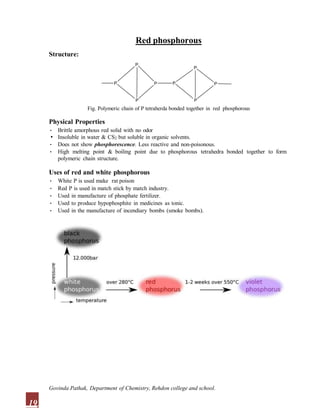
Red phosphorous
Structure:
P
P
P
P
P
P
P P
Fig.Polymeric chain of P tetraherda bonded together in red phosphorous
Physical Properties
• Brittle amorphous red solid with no odor
• Insoluble in water & CS2 but soluble in organic solvents.
• Does not show phosphorescence. Less reactive and non-poisonous.
• High melting point & boiling point due to phosphorous tetrahedra bonded together to form
polymeric chain structure.
Uses of red and white phosphorous
• White P is used make rat poison
• Red P is used in match stick by match industry.
• Used in manufacture of phosphate fertilizer.
• Used to produce hypophosphite in medicines as tonic.
• Used in the manufacture of incendiary bombs (smoke bombs).
19
Govinda Pathak, Department of Chemistry, Rehdon college and school.
20.
Phosphine (PH3)
Preparation ofPhosphine ( PH3) gas
In Laboratory: Phosphine is prepared by heating white phosphorus with concentrated solution of
alkalis in inert atmosphere of carbon dioxide in round bottom flask.
P4 + 3NaOH + 3H2O PH3 + 3NaH2PO2
As soon as the bubbles of gas come in contact with air, they catch fire, spontaneously forming vortex
rings of phosphorus pentoxide:
The combustion of gas is due to presence of trace amount of highly inflammable diphosphine (P2H4)
as impurity.
P4 + 4NaOH + 4H2O
P2H4 + 7/2O2
4NaH2PO2 + PH3 + P2H4
P2O5 + 2H2O
Thus the mixture of gas is passed through U-tube containing freezing mixture, where diphosphine gas
freezes out and unfrozen phosphine gas is collected in gas jar by downward displacement of water.
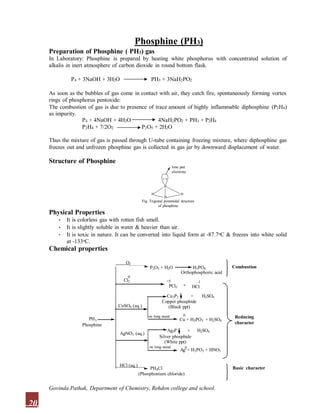
Structure of Phosphine
P
H H
H
Fig. Trigonal pyramidal structure
of phosphine
lone pair
electrons
PH3
Physical Properties
• It is colorless gas with rotten fish smell.
• It is slightly soluble in water & heavier than air.
• It is toxic in nature. It can be converted into liquid form at -87.7oC & freezes into white solid
at -133oC.
Chemical properties
O2
P2O5 + H2O
+
CuSO4 (aq.)
Cu3P2 + H2SO4
HCl (aq.)
Phosphine
Cl2
H3PO4
-1
HCl
AgNO3 (aq.)
Copper phosphide
(Black ppt)
Ag3P + H2SO4
Silver phosphide
(White ppt)
PH4Cl
(Phosphonium chloride)
Orthophosphoric acid
0
Cu + H3PO3 + H2SO4
Ag
0
+ H3PO3 + HNO3
Reducing
character
Basic character
Combustion
+5
PCl5
0
on long stand
on long stand
20
Govinda Pathak, Department of Chemistry, Rehdon college and school.
21.
Uses of Phosphine
1.It is used as smoke screen during wars. Calcium phosphide is allowed to react with water to
produce inflammable PH3 gas, which then form P2O5 and finally H3PO4 as dense fumes.
2. It is used in the production of Holme’s signals.
NOTE Holme’s signal: A mixture of calcium carbide and calcium phosphide is taken in a
container which is pierced and thrown out of the submarine in the sea. Phosphine liberated
catches fire and lights up acetylene which serves as signal to ships in neighboring area called
Holme’s signal.( Patent right: marine signal lights and foghorns, John Holmes,
a telegraph engineer , UK )
Comparison of PH3 and NH3
PH3 NH3
• Heavier than air.
• Slightly soluble in water.
• It has lower boiling point due to the
absence of hydrogen bonding.
• Rotten fish smell.
• Less basic; no effect on litmus.
• Highly poisonous.
• Lighter than air.
• Highly soluble in water.
• Higher boiling point than PH3 due the hydrogen
bonding between the molecules.
• Pungent smell.
• More basic than PH3.
• Non-poisonous.
CuSO4 (aq.) +PH3(aq.) Cu3P2 + H2SO4
Coper phosphide
( Black ppt.)
CuSO4 (aq.) + NH3(aq.) Cu (NH3)4SO4 (aq.)
Tetraammine copper sulphate
( deep blue solution)
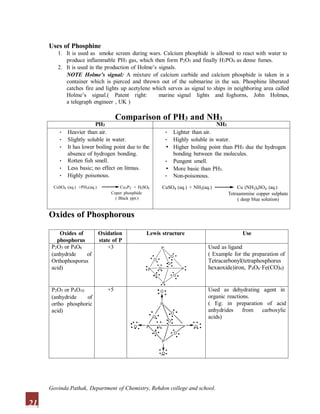
Oxides of Phosphorous
Oxides of
phosphorus
Oxidation
state of P
Lewis structure Use
P2O3 or P4O6
(anhydride of
Orthophosporus
acid)
+3
P
O
P
O
O
O
P
Used as ligand
( Example for the preparation of
Tetracarbonyl(tetraphosphorus
hexaoxide)iron, P4O6·Fe(CO)4)
O O
P
P2O5 or P4O10
(anhydride of
ortho phosphoric
acid)
+5
O P
O
O
P
O
O
O
P O
Used as dehydrating agent in
organic reactions.
( Eg: in preparation of acid
anhydrides from carboxylic
acids)
O O
P
O
21
Govinda Pathak, Department of Chemistry, Rehdon college and school.
22.
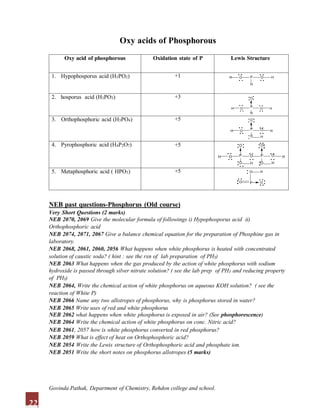
Oxy acids ofPhosphorous
Oxy acid of phosphorous Oxidation state of P Lewis Structure
1. Hypophosporus acid (H3PO2) +1 H O P
H
O H
2. hosporus acid (H3PO3) +3
H O
O
P
H
O H
3. Orthophosphoric acid (H3PO4) +5
H O
O
P
O
O
H
H
4. Pyrophosphoric acid (H4P2O7) +5
H O
O
P
O
O
H
O
P
O
O
H
H
5. Metaphosphoric acid ( HPO3) +5
O
O
P
H
O
NEB past questions-Phosphorus (Old course)
Very Short Questions (2 marks)
NEB 2070, 2069 Give the molecular formula of followings i) Hypophosporus acid ii)
Orthophosphoric acid
NEB 2074, 2071, 2067 Give a balance chemical equation for the preparation of Phosphine gas in
laboratory.
NEB 2068, 2061, 2060, 2056 What happens when white phosphorus is heated with concentrated
solution of caustic soda? ( hint : see the rxn of lab preparation of PH3)
NEB 2063 What happens when the gas produced by the action of white phosphorus with sodium
hydroxide is passed through silver nitrate solution? ( see the lab prep of PH3 and reducing property
of PH3)
NEB 2064, Write the chemical action of white phosphorus on aqueous KOH solution? ( see the
reaction of White P)
NEB 2066 Name any two allotropes of phosphorus, why is phosphorus stored in water?
NEB 2065 Write uses of red and white phosphorus
NEB 2062 what happens when white phosphorus is exposed in air? (See phosphorescence)
NEB 2064 Write the chemical action of white phosphorus on conc. Nitric acid?
NEB 2061, 2057 how is white phosphorus converted in red phosphorus?
NEB 2059 What is effect of heat on Orthophosphoric acid?
NEB 2054 Write the Lewis structure of Orthophosphoric acid and phosphate ion.
NEB 2051 Write the short notes on phosphorus allotropes (5 marks)
22
Govinda Pathak, Department of Chemistry, Rehdon college and school.
![Unit-9
Inorganic Chemistry
[NON-METALS]
(Hydrogen, Oxygen, Ozone, Carbon, Phosphorous)
Govinda Pathak
Chemistry Lecturer
Samakhusi, Kathmandu 44600
Nepal
Email: Pathakgovinda32@gmail.com](https://image.slidesharecdn.com/class-11-notes-from-all-inorganic-250429163359-4fc1c077/85/Class-11-notes-from-all-inorganic-_Govinda-Pathak-1-320.jpg)
![Unit-9
Inorganic Chemistry
[NON-METALS]
(Hydrogen, Oxygen, Ozone, Carbon, Phosphorous)
Govinda Pathak
Chemistry Lecturer
Samakhusi, Kathmandu 44600
Nepal
Email: Pathakgovinda32@gmail.com](https://image.slidesharecdn.com/class-11-notes-from-all-inorganic-250429163359-4fc1c077/75/Class-11-notes-from-all-inorganic-_Govinda-Pathak-1-2048.jpg)
![3. Tritium or Radioactive hydrogen:
This isotope of hydrogen has one electron one proton and two neutrons.
Uses of radioactive hydrogen:
Tritium is used as a radioactive tracer i.e. it can be used to explore the mechanism of chemical
reactions by tracing the path that the radioisotope follows from reactants to products)
in radio luminescent light sources for watches and instruments,
Along with deuterium, as a fuel for nuclear fusion reactions with applications in energy
generation and as nuclear weapons.
Reactive Forms of hydrogen (Nascent and Atomic Hydrogen)
Nascent Hydrogen Atomic Hydrogen
Hydrogen obtain in situ or at the moment of
formation by chemical reactions ( Latin,
Nascor = newly born)
Zn + H2SO4 (dil.) ZnSO4 + 2 [H]
Hydrogen obtain by the dissociation of
molecular hydrogen by using high temperature
or electric discharge.
H2 (g) + 436 KJ H + H
Reactive than molecular hydrogen but less
than that of atomic hydrogen.
Reactive, energetic than both molecular and
nascent hydrogen.
Longer half-life than atomic hydrogen Shorter half-life than atomic hydrogen
Nascent Hydrogen combines to give molecular
hydrogen with the release of small amount of
energy.
Atomic hydrogen combines to give molecular
hydrogen with the release of large amount of
energy
Reducing properties of Nascent and molecular hydrogen
Nascent hydrogen is more powerful reducing agent than molecular hydrogen. This can be illustrated
by following chemical tests in laboratory.
Acidified KMnO4 test:
KMnO4 + H2SO4
Potassium permanganate
(pink)
+ H2 No reaction ( pink color not discharged)
Molecular hydrogen
Zn + dilH2SO4
+2
K2SO4 + 2MnSO4 + 8H2O
Manganese sulfate
(colorless)
Zn + dilH2SO4
Nascent hydrogen
Potassium permanganate
(pink)
+7
2KMnO4 + 3 H2SO4 + 10[H]
3
Govinda Pathak, Department of Chemistry, Rehdon college and school.](https://image.slidesharecdn.com/class-11-notes-from-all-inorganic-250429163359-4fc1c077/85/Class-11-notes-from-all-inorganic-_Govinda-Pathak-3-320.jpg)
![Acidified K2Cr2O7 test:
K2Cr2O7 + H2SO4 + H2 No reaction ( Orange color not discharged)
Potassium dichromate
(Orange)
+6
K2Cr2O7 + 4H2SO4
Potassiumdichromate
(Orange)
Zn + dilH2SO4
Molecular hydrogen
+ 6[H] + 7H2O
+3
K2SO4 + Cr2(SO4)3
Chromium sulfate
(Green)
Nascenthydrogen
Zn + dilH2SO4
FeCl3 test:
No reaction ( Reddish brown color not discharged)
Zn + dilH2SO4
Molecular hydrogen
FeCl3 + H2
Ferric Chloride
(Reddish brown)
FeCl2 + HCl
+3
FeCl3 +
FerricChloride
(Reddishbrown)
[H]
Nascent hydrogen FerrousChloride
(light green)
4
Zn + dilH2SO4 +2
Although molecular hydrogen is less powerful reducing agent than nascent hydrogen but also used
as reducing agent in many chemical reactions such as in catalytic hydrogenation of vegetable oil into
Vanaspati ghee etc.
Hydrogen as Fuel
Hydrogen is locked up in enormous quantities in water, hydrocarbons, and other organic matter. One
of the challenges of using hydrogen as a fuel comes from being able to extract hydrogen efficiently
from these compounds.
Hydrogen fuel can also provide motive power for liquid-propellant rockets, cars, trucks, trains, boats
and airplanes, portable fuel cell applications or stationary fuel cell applications, which can power an
electric motor. The problems of using hydrogen fuel in cars arise from the fact that hydrogen is difficult
to store in either a high pressure tank or a cryogenic tank.
Fuel cells present the most attractive choice for energy conversion from hydrogen directly towards
electricity, due to their high efficiency, low noise, and limited number of moving parts. Fuel cells are
of interest for both stationary and mobile power generation from hydrogen. Fuel cells are often
considered as part of a vehicle propulsion system.
A fuel cell vehicle (FCV) or fuel cell electric vehicle (FCEV) is an electric vehicle that uses a fuel
cell, sometimes in combination with a small battery or supercapacitor, to power its onboard electric
motor. Fuel cells in vehicles generate electricity generally using oxygen from the air and compressed
hydrogen. Most fuel cell vehicles are classified as zero-emissions vehicles that emit only water and
heat.
Govinda Pathak, Department of Chemistry, Rehdon college and school.](https://image.slidesharecdn.com/class-11-notes-from-all-inorganic-250429163359-4fc1c077/85/Class-11-notes-from-all-inorganic-_Govinda-Pathak-4-320.jpg)
![9.6 Carbon
NEB syllabus_076
6. Introduction
1. Allotropes of carbon (crystalline and amorphous) including fullerenes (structure,
general properties and uses only)
2. Properties (reducing action, reaction with metals and nonmetals) and uses of carbon
monoxide
Position in Periodic table:
o P- block element, Group IV ( or 14 group) & second period
o Symbol: C
o Atomic number : 6
o Atomic mass : 12 amu
o Atomic number = 6,
o Valency = 4 ,
o Oxidation states = - 4(CH4) to + 4 (CO2)
o Configuration = 1s2 2s2 2p2 or [He] 2s22p2
o Valency : 4
o Nature of element : Non-metal
o Most abundant isotope : 6C12 other isotopes are 6C13 , 6C14 (used in C-dating)
Allotropes of Carbon:
Element that can exists in different forms (different molecular structure) but in same phase
are called allotropes & phenomenon is called allotropy.
Carbon Allotropes
Crystalline allotropes Amorphous allotropes
Diamond Graphite Fullurenes Coal Charcoal lampblack
Fig. Flow chart diagramof types of carbon allotropes
Diamond:
Each c-atom is tetrahedrally bonded to four other c-atoms by single covalent bond & give rise
to giant three dimensional covalent network of c-atoms which makes it very hard, and has high
melting and boiling points.
Each C-atom in diamond is sp3 hybridized thus bond angle around c- atoms is 109.5o & C-C
bond length 1.54 Å.
All valance electrons are used up in the formation of C-C bond and there are no any free
delocalized electrons thus diamond are bad conductor of electricity.
13
Govinda Pathak, Department of Chemistry, Rehdon college and school.](https://image.slidesharecdn.com/class-11-notes-from-all-inorganic-250429163359-4fc1c077/85/Class-11-notes-from-all-inorganic-_Govinda-Pathak-13-320.jpg)
![Uses & future scopes of fullerene:
o
o
o
As Molecular ball bearing machines
As drug delivery vehicle
Nano electronic devices
Carbon monoxide [CO]
In laboratory, carbon monoxide can be prepared by heating oxalic acid crystal or formic acid with
conc. H2SO4. Here conc. H2SO4 acts as dehydrating agent.
(COOH)2 .2H2O + conc. H2SO4
Oxalic acid crystal
OR,
CO + CO2 + H2SO4 . 3H2O
When Methanoic acid (formic acid) heated with conc. Sulphuric acid then carbon monoxide gas
is formed.
CO + H2SO4 . H2O
HCOOH + conc. H2SO4
Formic acid
Physical Properties
It is colorless, poisonous gas with faint smell. It is slightly soluble in water and lighter than air.
NEB Q: Why CO is poisonous to us?
It is highly poisonous gas. Carbon monoxide has about twenty times more affinity towards hemoglobin
than does oxygen. Carbon monoxide combine with hemoglobin to form carboxyhemoglobin.
Carboxyhemoglobin is more stable complex and is not able to carry oxygen. This causes deficiency of
oxygen in the body, resulting into suffocation and even death. Due to this CO is extremely poisonous.
Hb + CO HbCO (Carboxy hemoglobin)
Chemical properties
1. Reaction with oxygen (Combustion)
It burns in air with a pale blue flame to form CO2.
2CO + O2
2CO2 + heat
burn
NEB Q Convert CO to CO2 and vice versa?
Fig. Fullerene (C60)
15
Govinda Pathak, Department of Chemistry, Rehdon college and school.](https://image.slidesharecdn.com/class-11-notes-from-all-inorganic-250429163359-4fc1c077/85/Class-11-notes-from-all-inorganic-_Govinda-Pathak-15-320.jpg)


![Polymer [ बहुलक ] Chemistry Notes PDF - Irfanullah Mehar - JJ Sir Chemistry.pdf](https://cdn.slidesharecdn.com/ss_thumbnails/polymerchemistrynotespdf-irfanullahmehar-jjsirchemistry-260210172118-3f9b37f7-thumbnail.jpg?width=640&height=640&fit=bounds)


