School of Mechanical &
Manufacturing Engineering
Ollscoil Chaithair Bhaile Atha Cliath
Dublin City University
Hydroforming of Tubes
Student: Eamonn Brennan, Mechanical And Manufacturing Engineering Supervisor: Dr. Bryan MacDonald
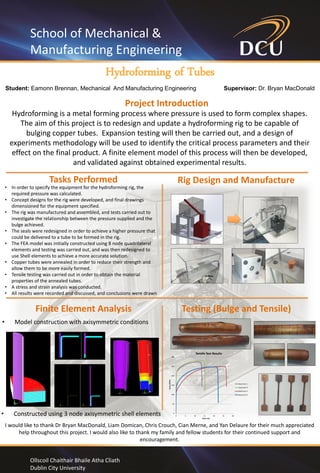
Hydroforming is a metal forming process where pressure is used to form complex shapes.
The aim of this project is to redesign and update a hydroforming rig to be capable of
bulging copper tubes. Expansion testing will then be carried out, and a design of
experiments methodology will be used to identify the critical process parameters and their
effect on the final product. A finite element model of this process will then be developed,
and validated against obtained experimental results.
Project Introduction
I would like to thank Dr Bryan MacDonald, Liam Domican, Chris Crouch, Cian Merne, and Yan Delaure for their much appreciated
help throughout this project. I would also like to thank my family and fellow students for their continued support and
encouragement.
Tasks Performed Rig Design and Manufacture
Finite Element Analysis Testing (Bulge and Tensile)
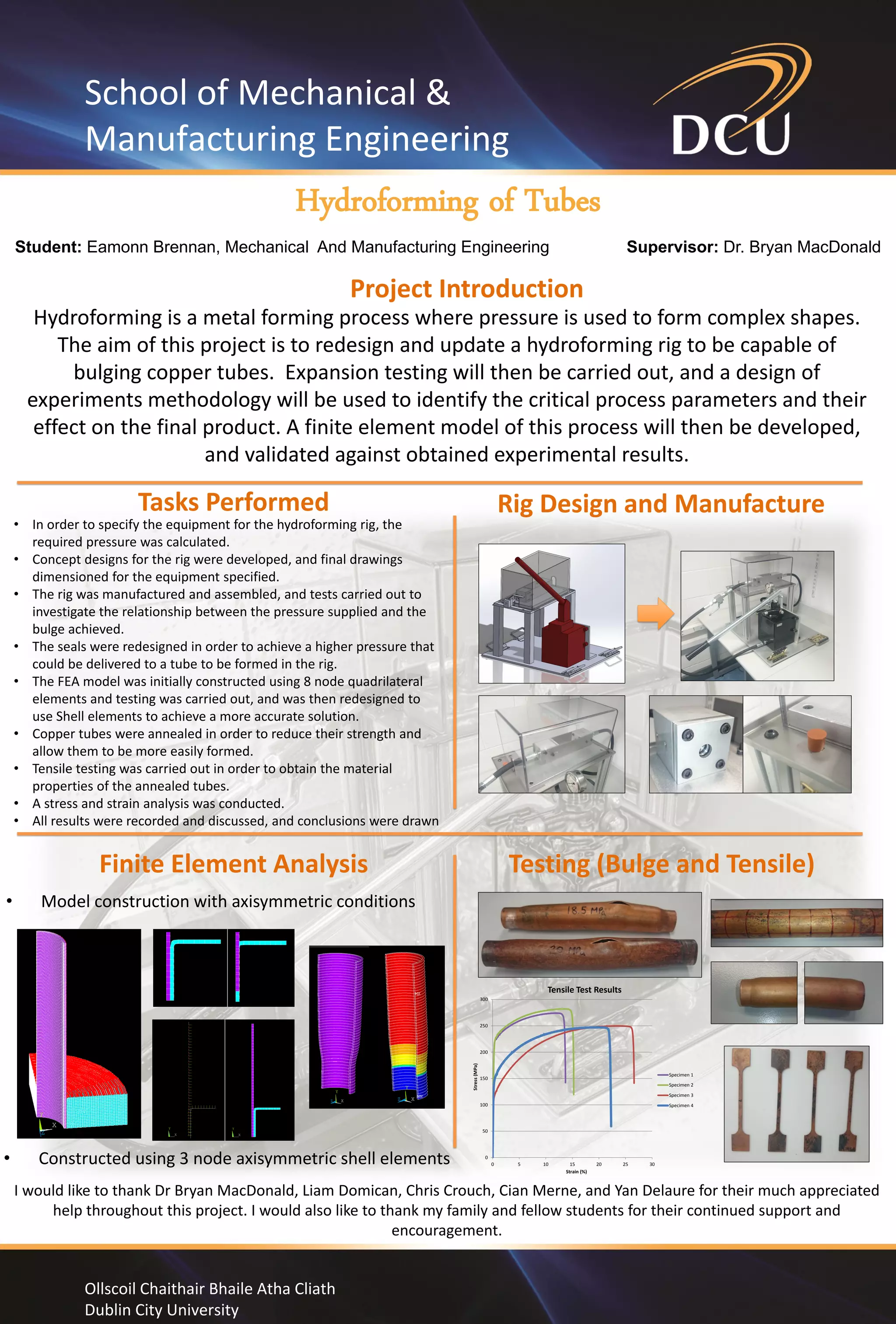
• In order to specify the equipment for the hydroforming rig, the
required pressure was calculated.
• Concept designs for the rig were developed, and final drawings
dimensioned for the equipment specified.
• The rig was manufactured and assembled, and tests carried out to
investigate the relationship between the pressure supplied and the
bulge achieved.
• The seals were redesigned in order to achieve a higher pressure that
could be delivered to a tube to be formed in the rig.
• The FEA model was initially constructed using 8 node quadrilateral
elements and testing was carried out, and was then redesigned to
use Shell elements to achieve a more accurate solution.
• Copper tubes were annealed in order to reduce their strength and
allow them to be more easily formed.
• Tensile testing was carried out in order to obtain the material
properties of the annealed tubes.
• A stress and strain analysis was conducted.
• All results were recorded and discussed, and conclusions were drawn
• Model construction with axisymmetric conditions
• Constructed using 3 node axisymmetric shell elements 0
50
100
150
200
250
300
0 5 10 15 20 25 30
Stress(MPa)
Strain (%)
Tensile Test Results
Specimen 1
Specimen 2
Specimen 3
Specimen 4

EXPO Poster Eamonn Brennan

  • 1.
    School of Mechanical& Manufacturing Engineering Ollscoil Chaithair Bhaile Atha Cliath Dublin City University Hydroforming of Tubes Student: Eamonn Brennan, Mechanical And Manufacturing Engineering Supervisor: Dr. Bryan MacDonald Hydroforming is a metal forming process where pressure is used to form complex shapes. The aim of this project is to redesign and update a hydroforming rig to be capable of bulging copper tubes. Expansion testing will then be carried out, and a design of experiments methodology will be used to identify the critical process parameters and their effect on the final product. A finite element model of this process will then be developed, and validated against obtained experimental results. Project Introduction I would like to thank Dr Bryan MacDonald, Liam Domican, Chris Crouch, Cian Merne, and Yan Delaure for their much appreciated help throughout this project. I would also like to thank my family and fellow students for their continued support and encouragement. Tasks Performed Rig Design and Manufacture Finite Element Analysis Testing (Bulge and Tensile) • In order to specify the equipment for the hydroforming rig, the required pressure was calculated. • Concept designs for the rig were developed, and final drawings dimensioned for the equipment specified. • The rig was manufactured and assembled, and tests carried out to investigate the relationship between the pressure supplied and the bulge achieved. • The seals were redesigned in order to achieve a higher pressure that could be delivered to a tube to be formed in the rig. • The FEA model was initially constructed using 8 node quadrilateral elements and testing was carried out, and was then redesigned to use Shell elements to achieve a more accurate solution. • Copper tubes were annealed in order to reduce their strength and allow them to be more easily formed. • Tensile testing was carried out in order to obtain the material properties of the annealed tubes. • A stress and strain analysis was conducted. • All results were recorded and discussed, and conclusions were drawn • Model construction with axisymmetric conditions • Constructed using 3 node axisymmetric shell elements 0 50 100 150 200 250 300 0 5 10 15 20 25 30 Stress(MPa) Strain (%) Tensile Test Results Specimen 1 Specimen 2 Specimen 3 Specimen 4