HVAC
Heating, Ventilation and Air-Conditioning
EXECUTION DESIGN II
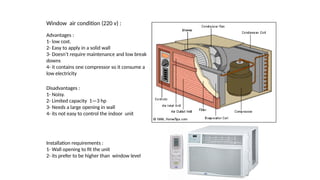
Window air condition (220 v) :
Advantages :
1- low cost.
2- Easy to apply in a solid wall
3- Doesn’t require maintenance and low break
downs
4- it contains one compressor so it consume a
low electricity
Disadvantages :
1- Noisy.
2- Limited capacity 1—3 hp
3- Needs a large opening in wall
4- its not easy to control the indoor unit
Installation requirements :
1- Wall opening to fit the unit
2- its prefer to be higher than window level
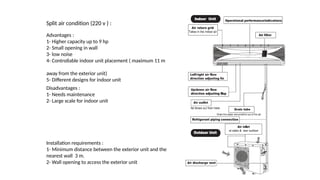
Split air condition (220 v ) :
Advantages :
1- Higher capacity up to 9 hp
2- Small opening in wall
3- low noise
4- Controllable indoor unit placement ( maximum 11 m
away from the exterior unit)
5- Different designs for indoor unit
Disadvantages :
1- Needs maintenance
2- Large scale for indoor unit
Installation requirements :
1- Minimum distance between the exterior unit and the
nearest wall 3 m.
2- Wall opening to access the exterior unit
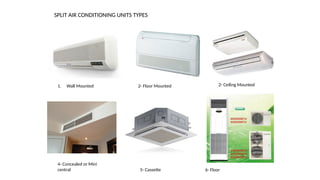
SPLIT AIR CONDITIONING UNITS TYPES
1. Wall Mounted 2- Floor Mounted 2- Ceiling Mounted
5- Cassette
4- Concealed or Mini
central 6- Floor
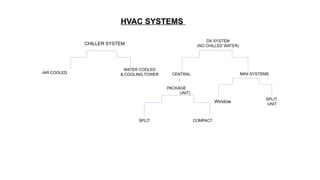
HVAC SYSTEMS
SPLIT
UNIT
CHILLER SYSTEM
DX SYSTEM
(NO CHILLED WATER)
WATER COOLED
& COOLING TOWER
AIR COOLED
PACKAGE
UNIT)
Window
COMPACT
SPLIT
MINI SYSTEMS
CENTRAL
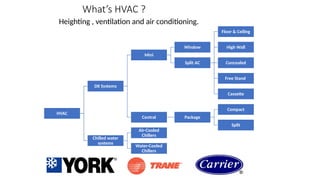
What’s HVAC ?
Heighting , ventilation and air conditioning.
HVAC
DX Systems
Mini
Window
Split AC
Floor & Ceiling
High Wall
Concealed
Free Stand
Cassette
Central Package
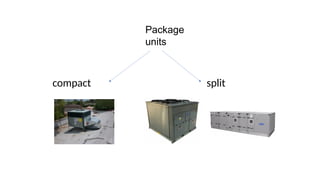
Compact
Split
Chilled water
systems
Air-Cooled
Chillers
Water-Cooled
Chillers
Package
units
compact split
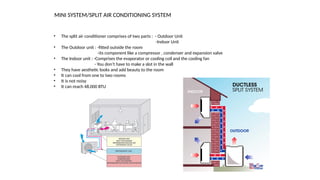
MINI SYSTEM/SPLIT AIR CONDITIONING SYSTEM
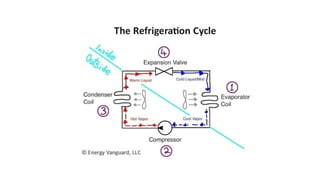
• The split air conditioner comprises of two parts : - Outdoor Unit
-Indoor Unit
• The Outdoor unit : -fitted outside the room
-its component like a compressor , condenser and expansion valve
• The Indoor unit : -Comprises the evaporator or cooling coil and the cooling fan
- You don’t have to make a slot in the wall
• They have aesthetic looks and add beauty to the room
• It can cool from one to two rooms
• It is not noisy
• It can reach 48,000 BTU
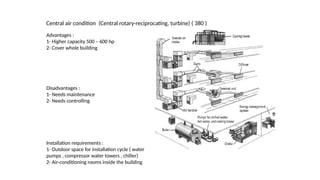
Central air condition (Central rotary-reciprocating, turbine) ( 380 )
Advantages :
1- Higher capacity 500 – 600 hp
2- Cover whole building
Disadvantages :
1- Needs maintenance
2- Needs controlling
Installation requirements :
1- Outdoor space for installation cycle ( water
pumps , compressor water towers , chiller)
2- Air-conditioning rooms inside the building
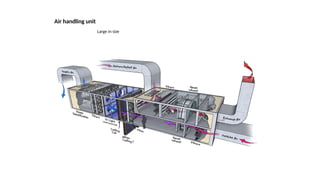
Air handling unit
Large in size
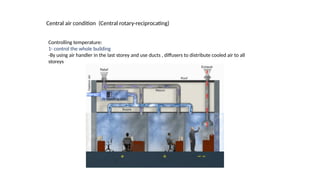
Central air condition (Central rotary-reciprocating)
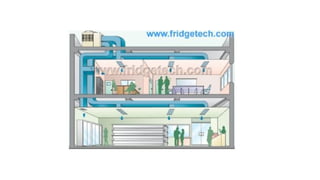
Controlling temperature:
1- control the whole building
-By using air handler in the last storey and use ducts , diffusers to distribute cooled air to all
storeys
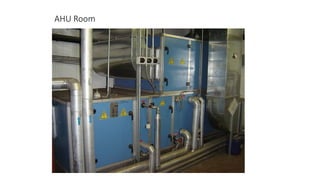
AHU Room
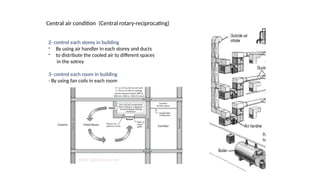
Central air condition (Central rotary-reciprocating)
2- control each storey in building
- By using air handler in each storey and ducts
- to distribute the cooled air to different spaces
in the sotrey
3- control each room in building
- By using fan coils in each room
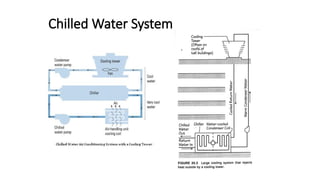
Chilled Water System
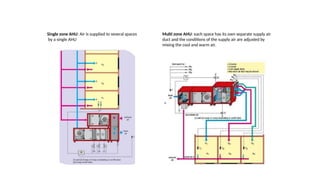
Single zone AHU: Air is supplied to several spaces
by a single AHU
Multi zone AHU: each space has its own separate supply air
duct and the conditions of the supply air are adjusted by
mixing the cool and warm air.
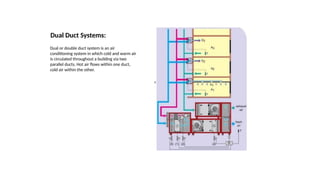
Dual Duct Systems:
Dual or double duct system is an air
conditioning system in which cold and warm air
is circulated throughout a building via two
parallel ducts. Hot air flows within one duct,
cold air within the other.
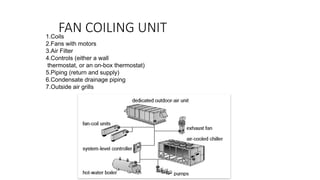
FAN COILING UNIT
1.Coils
2.Fans with motors
3.Air Filter
4.Controls (either a wall
thermostat, or an on-box thermostat)
5.Piping (return and supply)
6.Condensate drainage piping
7.Outside air grills
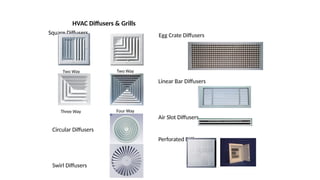
Circular Diffusers
Perforated Diffusers
Air Slot Diffusers
Four Way
Two Way Two Way
Square Diffusers
Swirl Diffusers
Egg Crate Diffusers
Linear Bar Diffusers
Three Way
HVAC Diffusers & Grills

HVAC (1).pptx hvac design and different systems

  • 1.
    HVAC Heating, Ventilation andAir-Conditioning EXECUTION DESIGN II
  • 3.
    Window air condition(220 v) : Advantages : 1- low cost. 2- Easy to apply in a solid wall 3- Doesn’t require maintenance and low break downs 4- it contains one compressor so it consume a low electricity Disadvantages : 1- Noisy. 2- Limited capacity 1—3 hp 3- Needs a large opening in wall 4- its not easy to control the indoor unit Installation requirements : 1- Wall opening to fit the unit 2- its prefer to be higher than window level
  • 4.
    Split air condition(220 v ) : Advantages : 1- Higher capacity up to 9 hp 2- Small opening in wall 3- low noise 4- Controllable indoor unit placement ( maximum 11 m away from the exterior unit) 5- Different designs for indoor unit Disadvantages : 1- Needs maintenance 2- Large scale for indoor unit Installation requirements : 1- Minimum distance between the exterior unit and the nearest wall 3 m. 2- Wall opening to access the exterior unit
  • 5.
    SPLIT AIR CONDITIONINGUNITS TYPES 1. Wall Mounted 2- Floor Mounted 2- Ceiling Mounted 5- Cassette 4- Concealed or Mini central 6- Floor
  • 6.
    HVAC SYSTEMS SPLIT UNIT CHILLER SYSTEM DXSYSTEM (NO CHILLED WATER) WATER COOLED & COOLING TOWER AIR COOLED PACKAGE UNIT) Window COMPACT SPLIT MINI SYSTEMS CENTRAL
  • 7.
    What’s HVAC ? Heighting, ventilation and air conditioning. HVAC DX Systems Mini Window Split AC Floor & Ceiling High Wall Concealed Free Stand Cassette Central Package Compact Split Chilled water systems Air-Cooled Chillers Water-Cooled Chillers
  • 9.
  • 11.
    MINI SYSTEM/SPLIT AIRCONDITIONING SYSTEM • The split air conditioner comprises of two parts : - Outdoor Unit -Indoor Unit • The Outdoor unit : -fitted outside the room -its component like a compressor , condenser and expansion valve • The Indoor unit : -Comprises the evaporator or cooling coil and the cooling fan - You don’t have to make a slot in the wall • They have aesthetic looks and add beauty to the room • It can cool from one to two rooms • It is not noisy • It can reach 48,000 BTU
  • 12.
    Central air condition(Central rotary-reciprocating, turbine) ( 380 ) Advantages : 1- Higher capacity 500 – 600 hp 2- Cover whole building Disadvantages : 1- Needs maintenance 2- Needs controlling Installation requirements : 1- Outdoor space for installation cycle ( water pumps , compressor water towers , chiller) 2- Air-conditioning rooms inside the building
  • 13.
  • 14.
    Central air condition(Central rotary-reciprocating) Controlling temperature: 1- control the whole building -By using air handler in the last storey and use ducts , diffusers to distribute cooled air to all storeys
  • 15.
  • 16.
    Central air condition(Central rotary-reciprocating) 2- control each storey in building - By using air handler in each storey and ducts - to distribute the cooled air to different spaces in the sotrey 3- control each room in building - By using fan coils in each room
  • 18.
  • 19.
    Single zone AHU:Air is supplied to several spaces by a single AHU Multi zone AHU: each space has its own separate supply air duct and the conditions of the supply air are adjusted by mixing the cool and warm air.
  • 20.
    Dual Duct Systems: Dualor double duct system is an air conditioning system in which cold and warm air is circulated throughout a building via two parallel ducts. Hot air flows within one duct, cold air within the other.
  • 21.
    FAN COILING UNIT 1.Coils 2.Fanswith motors 3.Air Filter 4.Controls (either a wall thermostat, or an on-box thermostat) 5.Piping (return and supply) 6.Condensate drainage piping 7.Outside air grills
  • 22.
    Circular Diffusers Perforated Diffusers AirSlot Diffusers Four Way Two Way Two Way Square Diffusers Swirl Diffusers Egg Crate Diffusers Linear Bar Diffusers Three Way HVAC Diffusers & Grills