DISCLAIMER
This presentation is simply a compilation of information
gathered from various sources (internet, newspaper). I am not
the author of any piece of information & due credit goes to all
those who did research & made this information available for
mankind
The images and video used in this presentation are also
downloaded from various sites on the internet & due credit goes
to the respective creators of these images.
HUMANOIDS
A REPLACEMENT TO HUMANS
INTRODUCTION
• A humanoid robot is a robot with its body shape built to resemble
the human body.
• The design may be for functional purposes, such as interacting
with humans, tools and environments, for experimental purposes
or for other purposes.
• In general, humanoid robots have a torso, a head, two arms, and
two legs, though some forms of humanoid robots may model only
a part of the body, for example, from the waist up. Some
humanoid robots also have heads designed to replicate human
facial features such as eyes and mouths.
• The first commercial, digital and programmable robot was built
by George Devol in 1954 and was named the Unimate and sold to
General Motors.
PURPOSE
• Work in Dangerous environments.
• Exhaustive and repetitive tasks
• Division of labour with humans in cooperative
tasks
• Anthropomorphism
• Embodiment
• Interaction and Communication
SOPHIA
• Sophia is a social humanoid robot developed by Hong
Kong-based company Hanson Robotics. Sophia was
activated on April 19, 2015 and made her first public
appearance at South by Southwest Festival (SXSW) in
mid-March 2016 in Austin, Texas, United States.
• In October 2017, the robot became a Saudi Arabian citizen,
the first robot to receive citizenship of any country.
• In November 2017, Sophia was named the United Nations
Development Programme's first ever Innovation
Champion, and the first non-human to be given any United
Nations title.
• She also made an appearance in IIT, Bombay during its
cultural extravaganza TechFest.
FEATURES
• Sophia runs on artificially intelligent software that is constantly being trained in the lab,
so her conversations are likely to get faster, Sophia's expressions are likely to have fewer
errors, and she should answer increasingly complex questions with more accuracy.
• Cameras within her eyes combined with computer algorithms allow Sophia to see. She can
follow faces, sustain eye contact, and recognize individuals.
• Sophia also sometimes runs a dialogue system, where it can look at people, listen to what
they say, and choose a pre-written response based on what the person said. She is able to
process speech and have conversations using Alphabet’s Google Chrome voice recognition
technology and other tools.
• She uses actuators that perform like muscles and joints, though with a different structure.
To achieve the same effect as human motion, humanoid robots use mainly rotary actuators.
OTHER HUMANOID ROBOTS
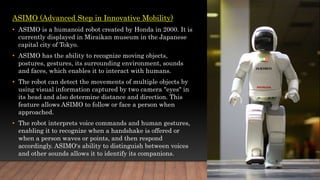
ASIMO (Advanced Step in Innovative Mobility)
• ASIMO is a humanoid robot created by Honda in 2000. It is
currently displayed in Miraikan museum in the Japanese
capital city of Tokyo.
• ASIMO has the ability to recognize moving objects,
postures, gestures, its surrounding environment, sounds
and faces, which enables it to interact with humans.
• The robot can detect the movements of multiple objects by
using visual information captured by two camera "eyes" in
its head and also determine distance and direction. This
feature allows ASIMO to follow or face a person when
approached.
• The robot interprets voice commands and human gestures,
enabling it to recognize when a handshake is offered or
when a person waves or points, and then respond
accordingly. ASIMO's ability to distinguish between voices
and other sounds allows it to identify its companions.
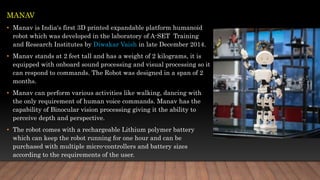
MANAV
• Manav is India's first 3D printed expandable platform humanoid
robot which was developed in the laboratory of A-SET Training
and Research Institutes by Diwakar Vaish in late December 2014.
• Manav stands at 2 feet tall and has a weight of 2 kilograms, it is
equipped with onboard sound processing and visual processing so it
can respond to commands. The Robot was designed in a span of 2
months.
• Manav can perform various activities like walking, dancing with
the only requirement of human voice commands. Manav has the
capability of Binocular vision processing giving it the ability to
perceive depth and perspective.
• The robot comes with a rechargeable Lithium polymer battery
which can keep the robot running for one hour and can be
purchased with multiple micro-controllers and battery sizes
according to the requirements of the user.
AI TAKEOVER
• An AI takeover is a hypothetical scenario in which
artificial intelligence (AI) becomes the dominant form of
intelligence on Earth, with computers or robots effectively
taking control of the planet away from the human race.
• Possible scenarios include replacement of the entire
human workforce, takeover by a super intelligent AI, and
the popular notion of a robot uprising.
• Some public figures, such as Stephen Hawking and Elon
Musk, have advocated research into precautionary
measures to ensure future super intelligent machines
remain under human control.
Presented By:
Madhav Khandelwal

Humanoids

  • 1.
    DISCLAIMER This presentation issimply a compilation of information gathered from various sources (internet, newspaper). I am not the author of any piece of information & due credit goes to all those who did research & made this information available for mankind The images and video used in this presentation are also downloaded from various sites on the internet & due credit goes to the respective creators of these images.
  • 2.
  • 3.
    INTRODUCTION • A humanoidrobot is a robot with its body shape built to resemble the human body. • The design may be for functional purposes, such as interacting with humans, tools and environments, for experimental purposes or for other purposes. • In general, humanoid robots have a torso, a head, two arms, and two legs, though some forms of humanoid robots may model only a part of the body, for example, from the waist up. Some humanoid robots also have heads designed to replicate human facial features such as eyes and mouths. • The first commercial, digital and programmable robot was built by George Devol in 1954 and was named the Unimate and sold to General Motors.
  • 4.
    PURPOSE • Work inDangerous environments. • Exhaustive and repetitive tasks • Division of labour with humans in cooperative tasks • Anthropomorphism • Embodiment • Interaction and Communication
  • 5.
    SOPHIA • Sophia isa social humanoid robot developed by Hong Kong-based company Hanson Robotics. Sophia was activated on April 19, 2015 and made her first public appearance at South by Southwest Festival (SXSW) in mid-March 2016 in Austin, Texas, United States. • In October 2017, the robot became a Saudi Arabian citizen, the first robot to receive citizenship of any country. • In November 2017, Sophia was named the United Nations Development Programme's first ever Innovation Champion, and the first non-human to be given any United Nations title. • She also made an appearance in IIT, Bombay during its cultural extravaganza TechFest.
  • 6.
    FEATURES • Sophia runson artificially intelligent software that is constantly being trained in the lab, so her conversations are likely to get faster, Sophia's expressions are likely to have fewer errors, and she should answer increasingly complex questions with more accuracy. • Cameras within her eyes combined with computer algorithms allow Sophia to see. She can follow faces, sustain eye contact, and recognize individuals. • Sophia also sometimes runs a dialogue system, where it can look at people, listen to what they say, and choose a pre-written response based on what the person said. She is able to process speech and have conversations using Alphabet’s Google Chrome voice recognition technology and other tools. • She uses actuators that perform like muscles and joints, though with a different structure. To achieve the same effect as human motion, humanoid robots use mainly rotary actuators.
  • 7.
  • 8.
    ASIMO (Advanced Stepin Innovative Mobility) • ASIMO is a humanoid robot created by Honda in 2000. It is currently displayed in Miraikan museum in the Japanese capital city of Tokyo. • ASIMO has the ability to recognize moving objects, postures, gestures, its surrounding environment, sounds and faces, which enables it to interact with humans. • The robot can detect the movements of multiple objects by using visual information captured by two camera "eyes" in its head and also determine distance and direction. This feature allows ASIMO to follow or face a person when approached. • The robot interprets voice commands and human gestures, enabling it to recognize when a handshake is offered or when a person waves or points, and then respond accordingly. ASIMO's ability to distinguish between voices and other sounds allows it to identify its companions.
  • 9.
    MANAV • Manav isIndia's first 3D printed expandable platform humanoid robot which was developed in the laboratory of A-SET Training and Research Institutes by Diwakar Vaish in late December 2014. • Manav stands at 2 feet tall and has a weight of 2 kilograms, it is equipped with onboard sound processing and visual processing so it can respond to commands. The Robot was designed in a span of 2 months. • Manav can perform various activities like walking, dancing with the only requirement of human voice commands. Manav has the capability of Binocular vision processing giving it the ability to perceive depth and perspective. • The robot comes with a rechargeable Lithium polymer battery which can keep the robot running for one hour and can be purchased with multiple micro-controllers and battery sizes according to the requirements of the user.
  • 10.
    AI TAKEOVER • AnAI takeover is a hypothetical scenario in which artificial intelligence (AI) becomes the dominant form of intelligence on Earth, with computers or robots effectively taking control of the planet away from the human race. • Possible scenarios include replacement of the entire human workforce, takeover by a super intelligent AI, and the popular notion of a robot uprising. • Some public figures, such as Stephen Hawking and Elon Musk, have advocated research into precautionary measures to ensure future super intelligent machines remain under human control.
  • 11.