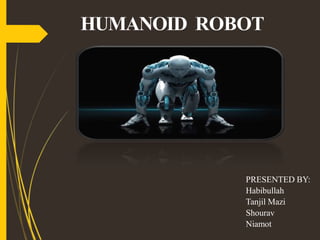
HUMANOID ROBOT
PRESENTED BY:
Habibullah
Tanjil Mazi
Shourav
Niamot
Humanoid Robotics
•Introduction of Humanoid Robot?
•Why isitso popular?
•What are Advantages?
Disadvantages?
•Where are we going withit?
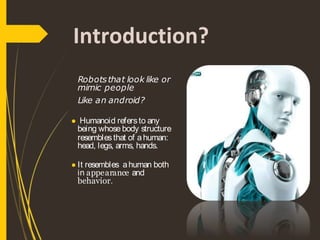
Introduction?
Robotsthat look like or
mimic people
Like an android?
● Humanoid refersto any
being whose body structure
resemblesthat of ahuman:
head, legs, arms, hands.
● It resembles ahuman both
in appearance and
behavior.
History ofthe Humanoid
Robot
Karel Capek coins the term
“Robot” –1921
1930’sto 70’s:theory of
humanoid shapes, electronics,
and movement.
Not until 1970’suntil a practical
autonomousRobot of thistype
Boom in development from
1980 to present
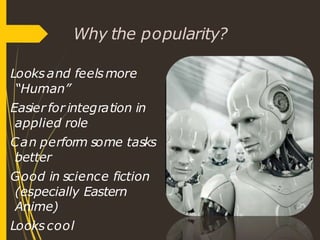
Why the popularity?
Looksand feelsmore
“Human”
Easier for integration in
applied role
Can perform some tasks
better
Good in science fiction
(especially Eastern
Anime)
Lookscool
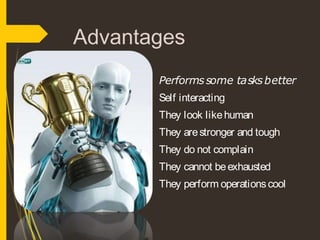
Advantages
Performssome tasksbetter
Self interacting
They look likehuman
They arestronger and tough
They do not complain
They cannot beexhausted
They perform operationscool
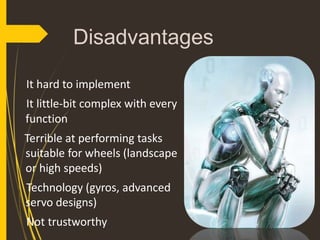
Disadvantages
It hard to implement
It little-bit complex with every
function
Terrible at performing tasks
suitable for wheels (landscape
or high speeds)
Technology (gyros, advanced
servo designs)
Not trustworthy
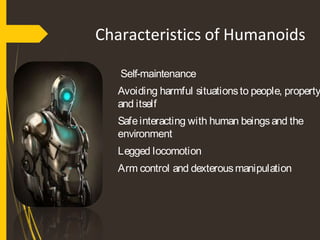
Characteristics of Humanoids
Self-maintenance
Avoiding harmful situationsto people, property
and itself
Safeinteracting with human beingsand the
environment
Legged locomotion
Arm control and dexterousmanipulation
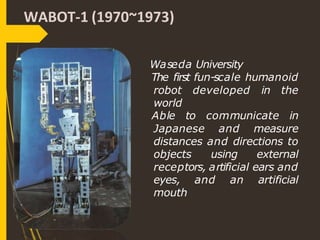
WABOT-1 (1970~1973)
Waseda University
The first fun-scale humanoid
robot developed in the
world
Able to communicate in
Japanese and measure
distances and directions to
objects using external
receptors, artificial ears and
eyes, and an artificial
mouth
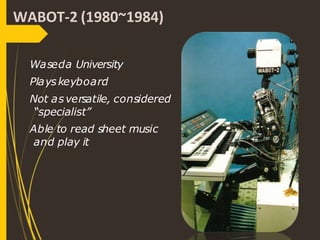
WABOT-2 (1980~1984)
Waseda University
Playskeyboard
Not asversatile, considered
“specialist”
Able to read sheet music
and play it
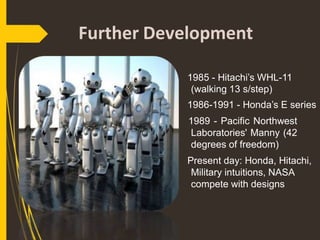
Further Development
1985 - Hitachi’s WHL-11
(walking 13 s/step)
1986-1991 - Honda’s E series
1989 - Pacific Northwest
Laboratories' Manny (42
degrees of freedom)
Present day: Honda, Hitachi,
Military intuitions, NASA
compete with designs
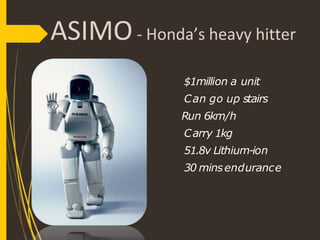
ASIMO- Honda’s heavy hitter
$1million a unit
Can go up stairs
Run 6km/h
Carry 1kg
51.8v Lithium-ion
30 minsendurance
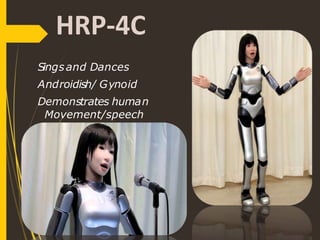
HRP-4C
Singsand Dances
Androidish/ Gynoid
Demonstrates human
Movement/speech
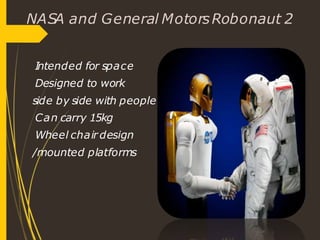
NASA and General MotorsRobonaut 2
Intended for space
Designed to work
side by side with people
Can carry 15kg
Wheel chair design
/mounted platforms
Where’sthe limit?
Large advancementsin both interest and
technology
Competitionsbetween large corporations
Can do many tasksthat were once near
impossible to implement (play soccer?)
Still a ways off from popular sci-fi films like
Terminator or IRobot
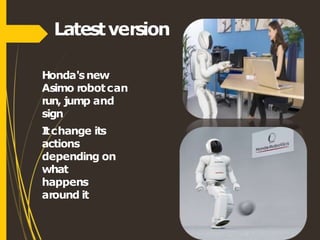
Latestversion
Honda'snew
Asimo robotcan
run, jump and
sign
I
tchange its
actions
depending on
what
happens
around it
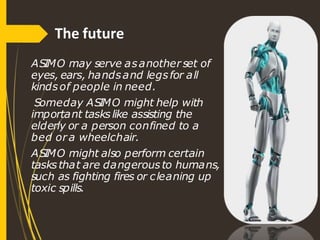
The future
ASIMO may serve asanother set of
eyes, ears, handsand legsfor all
kindsof people in need.
Someday ASIMO might help with
important taskslike assisting the
elderly or a person confined to a
bed or a wheelchair.
ASIMO might also perform certain
tasksthat are dangerousto humans,
such as fighting fires or cleaning up
toxic spills.
conclusion
Robotics and automation will offer great
benefitsto humanity In the future.
Robotics and automation enables great
advantage for people to do works in a
short period.
Defending the country, creating new
machines, operating with robots.
Therefore, the technology isdeveloping
rapidly and people should benefit from
technology’s opportunities.
Any queries ??????
Humanoid Robot.pptx

Humanoid Robot.pptx

  • 1.
  • 2.
    Humanoid Robotics •Introduction ofHumanoid Robot? •Why isitso popular? •What are Advantages? Disadvantages? •Where are we going withit?
  • 3.
    Introduction? Robotsthat look likeor mimic people Like an android? ● Humanoid refersto any being whose body structure resemblesthat of ahuman: head, legs, arms, hands. ● It resembles ahuman both in appearance and behavior.
  • 4.
    History ofthe Humanoid Robot KarelCapek coins the term “Robot” –1921 1930’sto 70’s:theory of humanoid shapes, electronics, and movement. Not until 1970’suntil a practical autonomousRobot of thistype Boom in development from 1980 to present
  • 5.
    Why the popularity? Looksandfeelsmore “Human” Easier for integration in applied role Can perform some tasks better Good in science fiction (especially Eastern Anime) Lookscool
  • 6.
    Advantages Performssome tasksbetter Self interacting Theylook likehuman They arestronger and tough They do not complain They cannot beexhausted They perform operationscool
  • 7.
    Disadvantages It hard toimplement It little-bit complex with every function Terrible at performing tasks suitable for wheels (landscape or high speeds) Technology (gyros, advanced servo designs) Not trustworthy
  • 8.
    Characteristics of Humanoids Self-maintenance Avoidingharmful situationsto people, property and itself Safeinteracting with human beingsand the environment Legged locomotion Arm control and dexterousmanipulation
  • 9.
    WABOT-1 (1970~1973) Waseda University Thefirst fun-scale humanoid robot developed in the world Able to communicate in Japanese and measure distances and directions to objects using external receptors, artificial ears and eyes, and an artificial mouth
  • 10.
    WABOT-2 (1980~1984) Waseda University Playskeyboard Notasversatile, considered “specialist” Able to read sheet music and play it
  • 11.
    Further Development 1985 -Hitachi’s WHL-11 (walking 13 s/step) 1986-1991 - Honda’s E series 1989 - Pacific Northwest Laboratories' Manny (42 degrees of freedom) Present day: Honda, Hitachi, Military intuitions, NASA compete with designs
  • 12.
    ASIMO- Honda’s heavyhitter $1million a unit Can go up stairs Run 6km/h Carry 1kg 51.8v Lithium-ion 30 minsendurance
  • 13.
  • 14.
    NASA and GeneralMotorsRobonaut 2 Intended for space Designed to work side by side with people Can carry 15kg Wheel chair design /mounted platforms
  • 15.
    Where’sthe limit? Large advancementsinboth interest and technology Competitionsbetween large corporations Can do many tasksthat were once near impossible to implement (play soccer?) Still a ways off from popular sci-fi films like Terminator or IRobot
  • 16.
    Latestversion Honda'snew Asimo robotcan run, jumpand sign I tchange its actions depending on what happens around it
  • 17.
    The future ASIMO mayserve asanother set of eyes, ears, handsand legsfor all kindsof people in need. Someday ASIMO might help with important taskslike assisting the elderly or a person confined to a bed or a wheelchair. ASIMO might also perform certain tasksthat are dangerousto humans, such as fighting fires or cleaning up toxic spills.
  • 18.
    conclusion Robotics and automationwill offer great benefitsto humanity In the future. Robotics and automation enables great advantage for people to do works in a short period. Defending the country, creating new machines, operating with robots. Therefore, the technology isdeveloping rapidly and people should benefit from technology’s opportunities.
  • 19.