1
OUR TPOIC IS
ANDROID (ROBOTS)
GROUP MEMBERS ARE
What is Android
(humanoid robot)?
 An android is a humanoid robot designed to be similar in
forms to humans.

 Some androids are built with the same basic physical
structure and kinetic capabilities as humans but are not
intended to really resemble people.
 Some definitions differentiate between the two types of
robots that only resemble people in basic form as humanoid
robots and those that look like people as androids.
Android (robot)
 An android is a robot or synthetic organism designed to look
and act like a human, especially one with a body having a
flesh like resemblance.
 Until recently, androids have largely remained within the
domain of science friction , frequently seen in movies and
televisions.
 Advancement in robot technology have allowed the design of
functional and realistic humanoid robots.
History
 The term android appears in US patents as early as 1863 in
reference to miniature human like toy automatons.
 The term android was used in a more modern sense by the
French author Augusta Villiers de lisle-Adam in his
work Tomorrow’s Eve (1886).
Projects
 Several projects aiming to create androids that look and to a
certain degree, speak or act like a human being have been
lunched or are underway.
6
Japan
 The intelligence robotics lab, directed by Hiroshi Ishiguro at
Osaka university and kokoro Co. ltd have demonstrated the
Android at Expo 2005 in Aichi prefecture, Japan and
released the telenoid R1 in 2010.
 Japanese Actroid
7
Korea
 KITECH researched and developed EveR1, an android
interpersonal communications model capable of emulating
human emotional expression via facial "musculature" and
capable of rudimentary conversation, having a vocabulary of
around 400 words. She is160 cm tall and weighs 50 kg,
matching the average figure of a Korean woman in her
twenties.
 EveR2 the first android that has the ability to sing
8
United States
 Walt Disney and a staff of imaginers created Great moments
with Mr.linclon that debuted at the 194 new York world’s
Fair.
 Hanson robotics Inc , of Texas and KAIST produced an
android portrait of Albert Einstein, using Hanson's facial
android technology mounted on KAIST's life-size walking
bipedal robot body. This Einstein android, also called “Albert
Hubo", thus represents the first full-body walking android in
history
9
United Kingdom
 In 2001, Steve Grand OBE, creator of the computer
game Creatures, created an android, or anthropoid; he
named it Lucy. The intention was that she would have to
learn everything, including how to use her mechanical vocal
chords to speak. Her systems were made to be similar to a
human's.
10
The difference between robots
and androids
 A robot can, but does not necessarily have to be in the form
of a human, but an android is always in the form of a human.
So, following this line of reasoning, SRI International’s
shakey was a robot, while ART intelligent robotics and
communication laboratories Geminoid F is an android.
11
10 Mind Blowing androids
and robots
12
ASIMO
 Built by Honda
 Was first unveiled in Oct. 2000
 Its stands just 1.3 meters tall and weights 54 kg
 Its capabilities that set it apart
 The robot was designed to be a personal assistant, helping
those who can’t help themselves.
 It can even distinguish one person from another for up to 10
people.
13
14
ATLAS
 On July 11 DARPA revealed one of the most technologically
advanced robots to date.
 It stands almost two meters tall and weighs about 150 kg
 It’s set to participate in DARPA’s robot challenge in
December as Boston Dynamics continues to make
improvements to the software.
 It can perform basic functions like walking, grabbing,
turning, and giving visual feedback, but it’s also capable of
doing things like climbing a ladder, starting and driving a
car, and connecting a fire hose to a valve.
15
16
MORPHEUS
 Being able to control a robot with gestures or a controller is
one thing, but imagine if you could control an android just
using your mind.
 In a key breakthrough, a robot known as Morpheus now has
the ability to follow commands given as thoughts.
 Built by Rajesh Rao at the University of Washington, it is
hoped that Morpheus will be able to provide companionship,
assistance, and rescue to many people.
17
18
ACTROID
 While the HRP-4C was fitted with an uncanny humanoid
face, the Actroid matches it with an equally realistic body
and even more human behaviors.
 It was first manufactured by Kokoro Company Ltd., who
have since created several new and improved versions.
 The Actroid can react accordingly to different kinds of tactile
data.
 She is also designed to express the subtle human-like
movements of the head and eyes and even looks like she’s
breathing.
19
20
FACE
 While most scientists stay away from creating robots that are
too like humans due to the Uncanny Valley theory, scientists
at the University of Pisa are actively trying to prove that
prediction wrong.
 They’ve created robot named FACE, considered
groundbreaking for its realistic human expressions.
 Most robots with the ability to mimic expressions are only
given a set of five to six emotions.
 FACE can mimic these same emotions (such as happiness,
sadness, disgust, amazement, indifference, and fear), but it
also has the ability to express the emotions between these
categories.
21
22
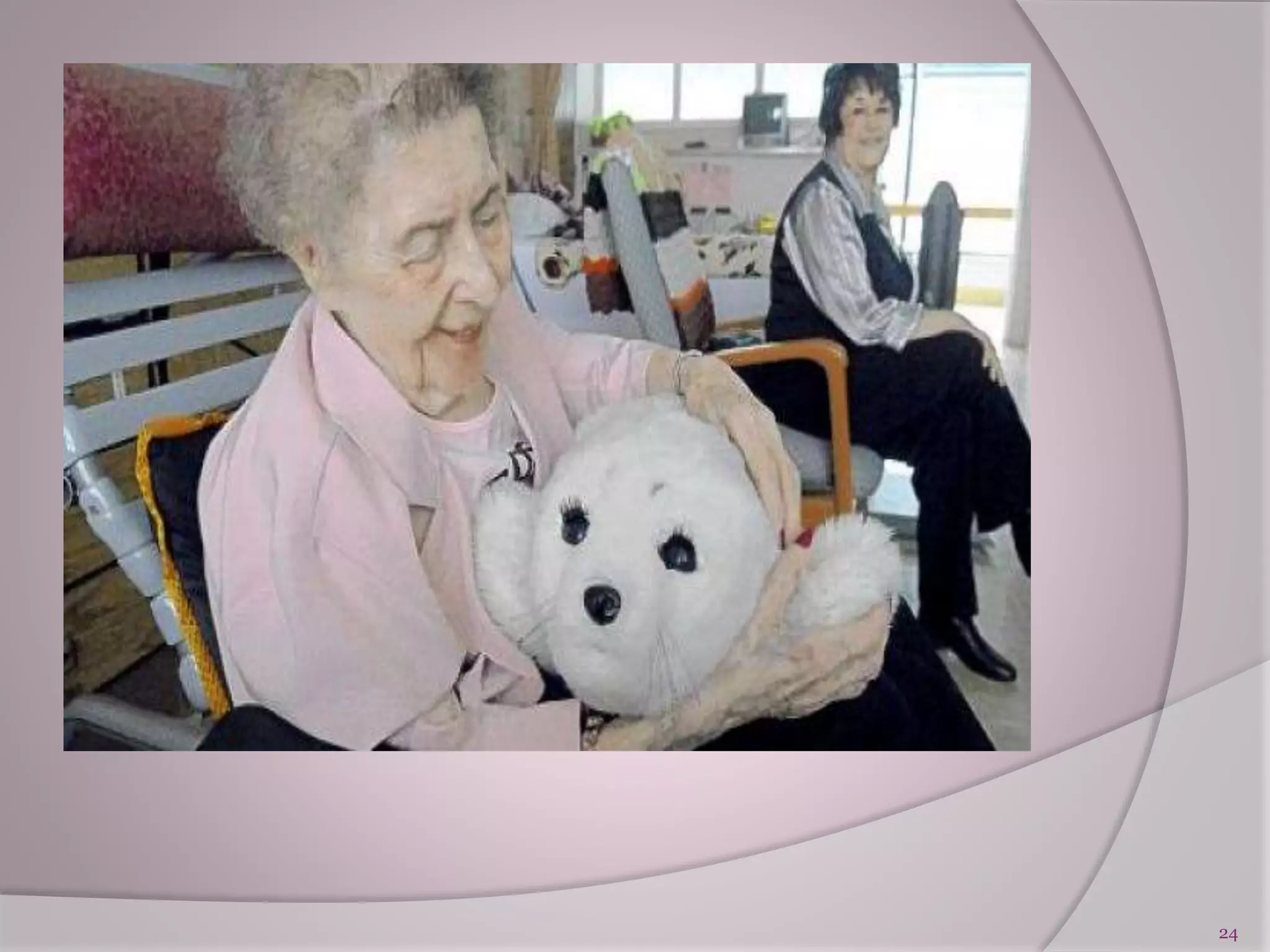
PARO
 Who doesn’t love cute little baby harp seals?
 Japanese company AIST certainly does:
 They’ve developed a strikingly realistic robotic seal named
PARO to be used for therapy.
 Paro interacts with people much in the ways a normal baby
seal would by moving its head and flippers and making
sounds, while using five sensors (audio, light, tactile,
posture, and temperature) to assess its environment.
23
24
HRP 4C
 So far, the androids on this list have been pretty clearly
robotic.
 But the HRP-4C (Miim) takes things to a whole new level
with its uncanny resemblance to a real human.
 Another piece of work from the Japanese company AIST,
Miim was fashioned after an average young Japanese female.
 She stands at 157 centimeters (5.2 ft) and 43 kilograms (95
lbs) with the ability to recognize faces, speech, and ambient
noise.
 She’s been called “super-realistic” and even has the ability to
dance.
25
26
NAO
 When you think of an android, emotional capacity probably
isn’t the first thing that springs to mind.
 However, the NAO robot boasts the ability to learn,
recognize, and interact with humans—and develop emotions
as well.
 NAO was developed by Aldebaran Robotics and stands a
mere 58 centimeters (23 in) tall.
27
28
BINA48
 The Breakthrough Intelligence via Neural Architecture, or
BINA48, has quickly achieved the title of the most
shockingly realistic android ever made.
 BINA48 was created and programmed by David Hanson of
Terasem Movement and modeled after the co-founder of
Terasem’s wife, Bina Rothblatt.
29
30
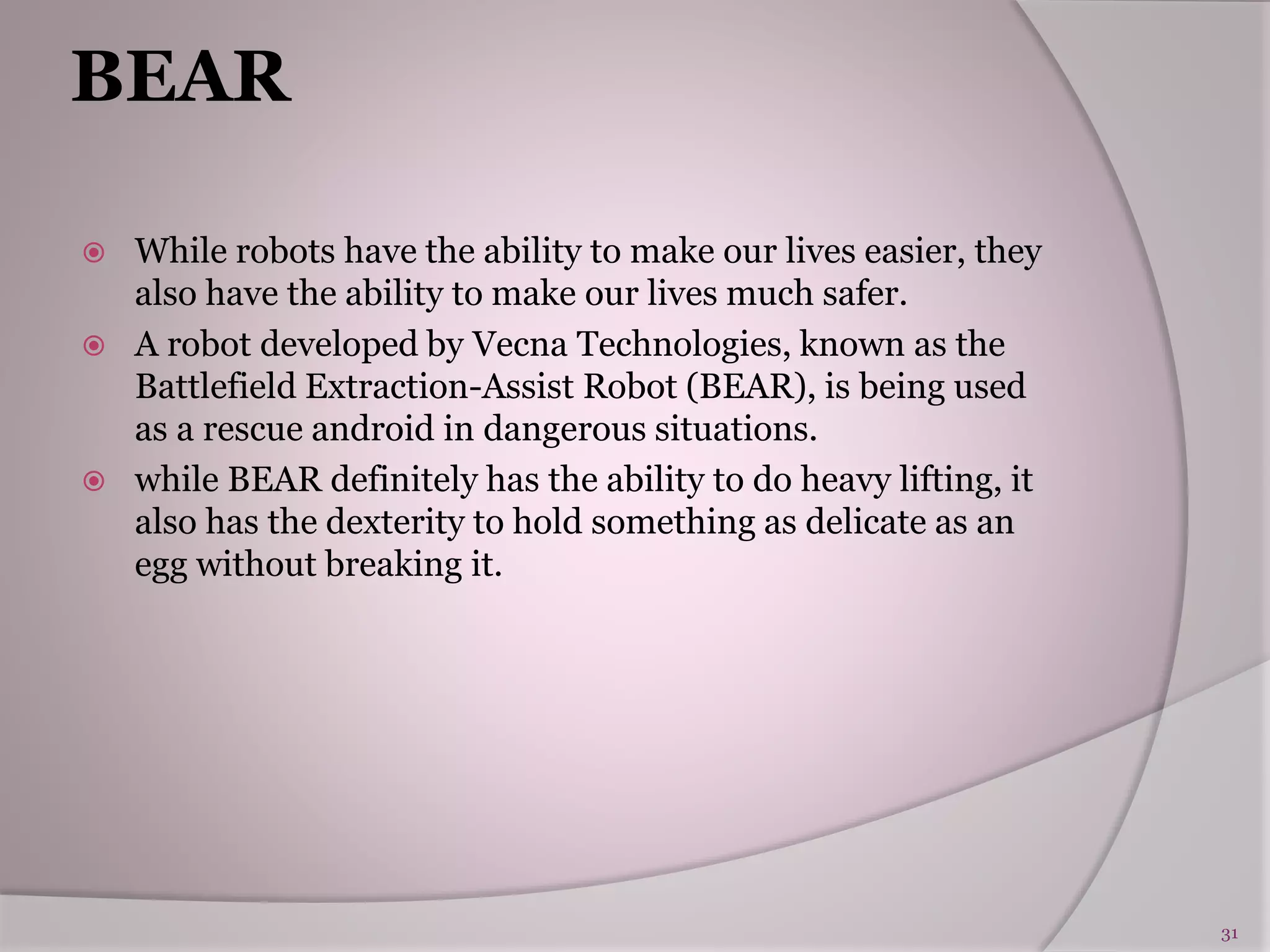
BEAR
 While robots have the ability to make our lives easier, they
also have the ability to make our lives much safer.
 A robot developed by Vecna Technologies, known as the
Battlefield Extraction-Assist Robot (BEAR), is being used
as a rescue android in dangerous situations.
 while BEAR definitely has the ability to do heavy lifting, it
also has the dexterity to hold something as delicate as an
egg without breaking it.
31
32
Human or Machine? Life-Like Android Robots
from Japan Show Glimpses of the Future
 A new exhibition entitled "Android: What is Human?"
showing at the National Museum of Emerging Science and
Innovation in Tokyo will showcase some of the most realistic
humanoid robots ever seen.
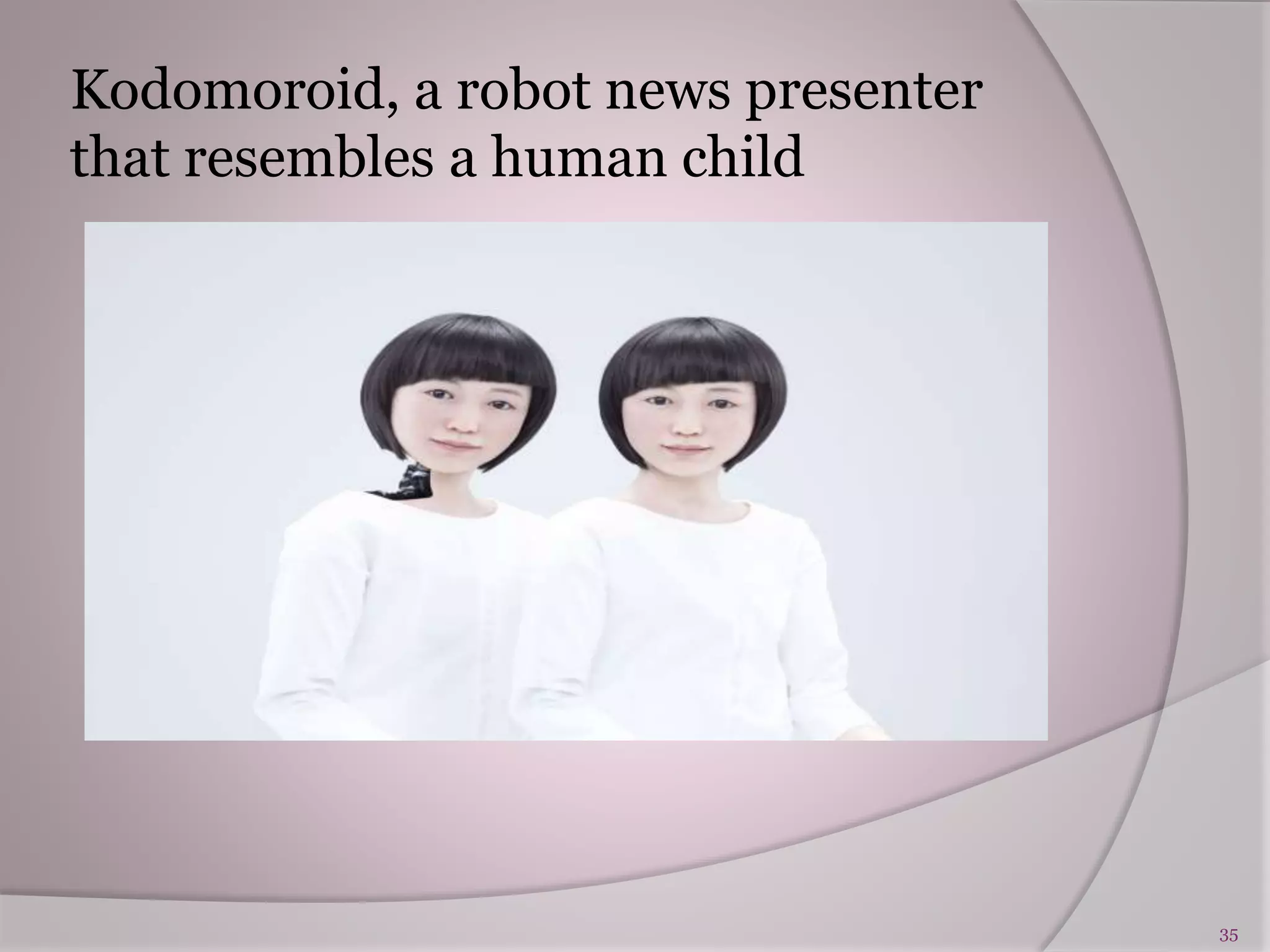
 The three android robots include Otonaroid, an adult female
android robot; Kodomorid, a human female child robot and
Telenoid, a minimally designed robot.
33
Otonaroid, the Miraikan's new
robot science communicator
34
Kodomoroid, a robot news presenter
that resembles a human child
35
Telenoid, a small android robot that
you can pick up and cuddle
36
37
38

Artificail intellegence

  • 1.
  • 2.
    OUR TPOIC IS ANDROID(ROBOTS) GROUP MEMBERS ARE
  • 3.
    What is Android (humanoidrobot)?  An android is a humanoid robot designed to be similar in forms to humans.  Some androids are built with the same basic physical structure and kinetic capabilities as humans but are not intended to really resemble people.  Some definitions differentiate between the two types of robots that only resemble people in basic form as humanoid robots and those that look like people as androids.
  • 4.
    Android (robot)  Anandroid is a robot or synthetic organism designed to look and act like a human, especially one with a body having a flesh like resemblance.  Until recently, androids have largely remained within the domain of science friction , frequently seen in movies and televisions.  Advancement in robot technology have allowed the design of functional and realistic humanoid robots.
  • 5.
    History  The termandroid appears in US patents as early as 1863 in reference to miniature human like toy automatons.  The term android was used in a more modern sense by the French author Augusta Villiers de lisle-Adam in his work Tomorrow’s Eve (1886).
  • 6.
    Projects  Several projectsaiming to create androids that look and to a certain degree, speak or act like a human being have been lunched or are underway. 6
  • 7.
    Japan  The intelligencerobotics lab, directed by Hiroshi Ishiguro at Osaka university and kokoro Co. ltd have demonstrated the Android at Expo 2005 in Aichi prefecture, Japan and released the telenoid R1 in 2010.  Japanese Actroid 7
  • 8.
    Korea  KITECH researchedand developed EveR1, an android interpersonal communications model capable of emulating human emotional expression via facial "musculature" and capable of rudimentary conversation, having a vocabulary of around 400 words. She is160 cm tall and weighs 50 kg, matching the average figure of a Korean woman in her twenties.  EveR2 the first android that has the ability to sing 8
  • 9.
    United States  WaltDisney and a staff of imaginers created Great moments with Mr.linclon that debuted at the 194 new York world’s Fair.  Hanson robotics Inc , of Texas and KAIST produced an android portrait of Albert Einstein, using Hanson's facial android technology mounted on KAIST's life-size walking bipedal robot body. This Einstein android, also called “Albert Hubo", thus represents the first full-body walking android in history 9
  • 10.
    United Kingdom  In2001, Steve Grand OBE, creator of the computer game Creatures, created an android, or anthropoid; he named it Lucy. The intention was that she would have to learn everything, including how to use her mechanical vocal chords to speak. Her systems were made to be similar to a human's. 10
  • 11.
    The difference betweenrobots and androids  A robot can, but does not necessarily have to be in the form of a human, but an android is always in the form of a human. So, following this line of reasoning, SRI International’s shakey was a robot, while ART intelligent robotics and communication laboratories Geminoid F is an android. 11
  • 12.
    10 Mind Blowingandroids and robots 12
  • 13.
    ASIMO  Built byHonda  Was first unveiled in Oct. 2000  Its stands just 1.3 meters tall and weights 54 kg  Its capabilities that set it apart  The robot was designed to be a personal assistant, helping those who can’t help themselves.  It can even distinguish one person from another for up to 10 people. 13
  • 14.
  • 15.
    ATLAS  On July11 DARPA revealed one of the most technologically advanced robots to date.  It stands almost two meters tall and weighs about 150 kg  It’s set to participate in DARPA’s robot challenge in December as Boston Dynamics continues to make improvements to the software.  It can perform basic functions like walking, grabbing, turning, and giving visual feedback, but it’s also capable of doing things like climbing a ladder, starting and driving a car, and connecting a fire hose to a valve. 15
  • 16.
  • 17.
    MORPHEUS  Being ableto control a robot with gestures or a controller is one thing, but imagine if you could control an android just using your mind.  In a key breakthrough, a robot known as Morpheus now has the ability to follow commands given as thoughts.  Built by Rajesh Rao at the University of Washington, it is hoped that Morpheus will be able to provide companionship, assistance, and rescue to many people. 17
  • 18.
  • 19.
    ACTROID  While theHRP-4C was fitted with an uncanny humanoid face, the Actroid matches it with an equally realistic body and even more human behaviors.  It was first manufactured by Kokoro Company Ltd., who have since created several new and improved versions.  The Actroid can react accordingly to different kinds of tactile data.  She is also designed to express the subtle human-like movements of the head and eyes and even looks like she’s breathing. 19
  • 20.
  • 21.
    FACE  While mostscientists stay away from creating robots that are too like humans due to the Uncanny Valley theory, scientists at the University of Pisa are actively trying to prove that prediction wrong.  They’ve created robot named FACE, considered groundbreaking for its realistic human expressions.  Most robots with the ability to mimic expressions are only given a set of five to six emotions.  FACE can mimic these same emotions (such as happiness, sadness, disgust, amazement, indifference, and fear), but it also has the ability to express the emotions between these categories. 21
  • 22.
  • 23.
    PARO  Who doesn’tlove cute little baby harp seals?  Japanese company AIST certainly does:  They’ve developed a strikingly realistic robotic seal named PARO to be used for therapy.  Paro interacts with people much in the ways a normal baby seal would by moving its head and flippers and making sounds, while using five sensors (audio, light, tactile, posture, and temperature) to assess its environment. 23
  • 24.
  • 25.
    HRP 4C  Sofar, the androids on this list have been pretty clearly robotic.  But the HRP-4C (Miim) takes things to a whole new level with its uncanny resemblance to a real human.  Another piece of work from the Japanese company AIST, Miim was fashioned after an average young Japanese female.  She stands at 157 centimeters (5.2 ft) and 43 kilograms (95 lbs) with the ability to recognize faces, speech, and ambient noise.  She’s been called “super-realistic” and even has the ability to dance. 25
  • 26.
  • 27.
    NAO  When youthink of an android, emotional capacity probably isn’t the first thing that springs to mind.  However, the NAO robot boasts the ability to learn, recognize, and interact with humans—and develop emotions as well.  NAO was developed by Aldebaran Robotics and stands a mere 58 centimeters (23 in) tall. 27
  • 28.
  • 29.
    BINA48  The BreakthroughIntelligence via Neural Architecture, or BINA48, has quickly achieved the title of the most shockingly realistic android ever made.  BINA48 was created and programmed by David Hanson of Terasem Movement and modeled after the co-founder of Terasem’s wife, Bina Rothblatt. 29
  • 30.
  • 31.
    BEAR  While robotshave the ability to make our lives easier, they also have the ability to make our lives much safer.  A robot developed by Vecna Technologies, known as the Battlefield Extraction-Assist Robot (BEAR), is being used as a rescue android in dangerous situations.  while BEAR definitely has the ability to do heavy lifting, it also has the dexterity to hold something as delicate as an egg without breaking it. 31
  • 32.
  • 33.
    Human or Machine?Life-Like Android Robots from Japan Show Glimpses of the Future  A new exhibition entitled "Android: What is Human?" showing at the National Museum of Emerging Science and Innovation in Tokyo will showcase some of the most realistic humanoid robots ever seen.  The three android robots include Otonaroid, an adult female android robot; Kodomorid, a human female child robot and Telenoid, a minimally designed robot. 33
  • 34.
    Otonaroid, the Miraikan'snew robot science communicator 34
  • 35.
    Kodomoroid, a robotnews presenter that resembles a human child 35
  • 36.
    Telenoid, a smallandroid robot that you can pick up and cuddle 36
  • 37.
  • 38.