

UNIT IIIPOOJA DEVIJA Assit. Prof PIMT source : Udaipurstudents.com
Introduction Need for organizations to build and sustain competencies that would provide them with competitive advantage.
Knowledge era, Human assets are valued highly.
Growth oriented organizations value training as a response to changing environment
Continues learning process in human development
Helps in development of one’s personality, sharpens skills and enhances effectiveness
It is an important and integral part of organizational renewal processPOOJA DEVIJA Assit. Prof PIMT source : Udaipurstudents.com
Training:-Training is the act of increasing the knowledge & skills of an employee for doing a particular job.To bring a change in behaviour, knowledge, skills and attitudes  of the workers.POOJA DEVIJA Assit. Prof PIMT source : Udaipurstudents.com
Training means teaching of specific skills	Need  and rationale for training:-Changing technology:- update employeesQuality conscious consumers:- quality improved through training of workersGreater productivity:- reduce cost of production, increase productivityStable workforce:-confidence in minds of workers, gives security and leads to stable workforceIncreased safety:- Handle machines more safelyBetter management:- Used as a planning & controlling tool, reduces cost and industrial accidentsPOOJA DEVIJA Assit. Prof PIMT source : Udaipurstudents.com
Significance of trainingQuick learningHigher productivityStandardization of proceduresLess supervisionEconomical operationsHigher moralePreparation of future managersBetter managementPOOJA DEVIJA Assit. Prof PIMT source : Udaipurstudents.com
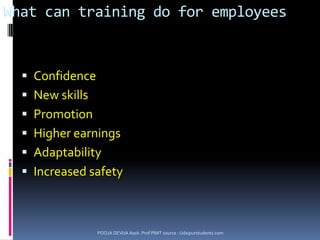
What can training do for employeesConfidenceNew skillsPromotionHigher earningsAdaptabilityIncreased safetyPOOJA DEVIJA Assit. Prof PIMT source : Udaipurstudents.com
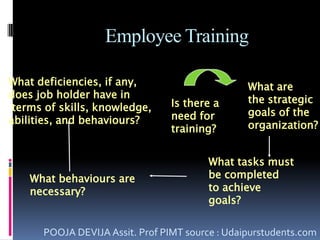
Employee TrainingWhat deficiencies, if any,does job holder have in terms of skills, knowledge, abilities, and behaviours?What arethe strategicgoals of theorganization?Is there a need fortraining?What tasks mustbe completedto achievegoals?What behaviours are necessary?POOJA DEVIJA Assit. Prof PIMT source : Udaipurstudents.com
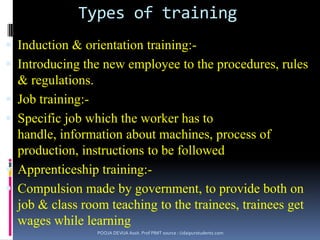
Types of trainingInduction & orientation training:-Introducing the new employee to the procedures, rules & regulations.Job training:-Specific job which the worker has to handle, information about machines, process of production, instructions to be followedApprenticeship training:-Compulsion made by government, to provide both on job & class room teaching to the trainees, trainees get wages while learningPOOJA DEVIJA Assit. Prof PIMT source : Udaipurstudents.com
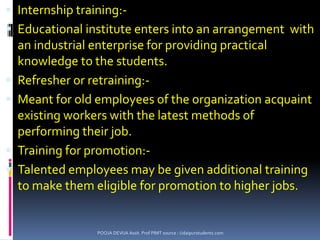
Internship training:-Educational institute enters into an arrangement  with an industrial enterprise for providing practical knowledge to the students.Refresher or retraining:-Meant for old employees of the organization acquaint existing workers with the latest methods of performing their job.Training for promotion:-Talented employees may be given additional training to make them eligible for promotion to higher jobs. POOJA DEVIJA Assit. Prof PIMT source : Udaipurstudents.com
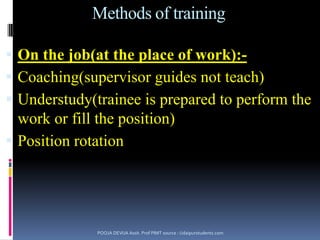
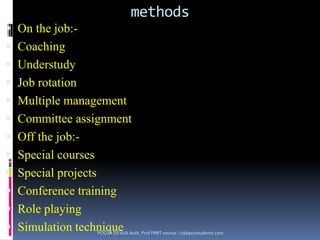
Methods of trainingOn the job(at the place of work):-Coaching(supervisor guides not teach)Understudy(trainee is prepared to perform the work or fill the position)Position rotation POOJA DEVIJA Assit. Prof PIMT source : Udaipurstudents.com
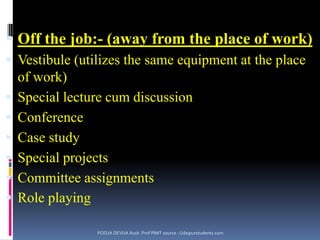
Off the job:- (away from the place of work)Vestibule (utilizes the same equipment at the place of work)Special lecture cum discussionConferenceCase studySpecial projectsCommittee assignmentsRole playingPOOJA DEVIJA Assit. Prof PIMT source : Udaipurstudents.com
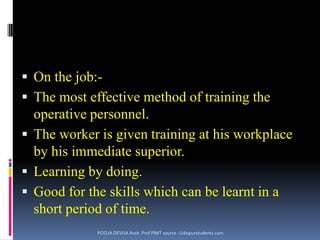
On the job:-The most effective method of training the operative personnel.The worker is given training at his workplace by his immediate superior.Learning by doing.Good for the skills which can be learnt in a short period of time.POOJA DEVIJA Assit. Prof PIMT source : Udaipurstudents.com
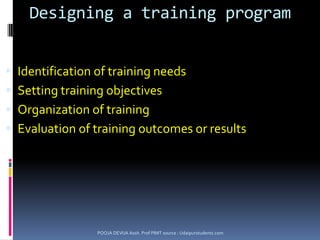
Designing a training programIdentification of training needsSetting training objectivesOrganization of trainingEvaluation of training outcomes or resultsPOOJA DEVIJA Assit. Prof PIMT source : Udaipurstudents.com
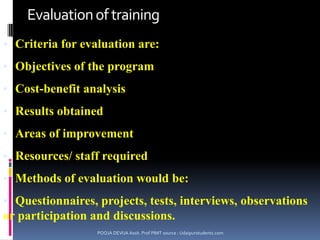
Evaluation of trainingCriteria for evaluation are:
Objectives of the program
Cost-benefit analysis
Results obtained
Areas of improvement
Resources/ staff required
Methods of evaluation would be:
Questionnaires, projects, tests, interviews, observations or participation and discussions.POOJA DEVIJA Assit. Prof PIMT source : Udaipurstudents.com

Human resource management unit iii

  • 1.
    UNIT IIIPOOJA DEVIJAAssit. Prof PIMT source : Udaipurstudents.com
  • 2.
    Introduction Need fororganizations to build and sustain competencies that would provide them with competitive advantage.
  • 3.
    Knowledge era, Humanassets are valued highly.
  • 4.
    Growth oriented organizationsvalue training as a response to changing environment
  • 5.
    Continues learning processin human development
  • 6.
    Helps in developmentof one’s personality, sharpens skills and enhances effectiveness
  • 7.
    It is animportant and integral part of organizational renewal processPOOJA DEVIJA Assit. Prof PIMT source : Udaipurstudents.com
  • 8.
    Training:-Training is theact of increasing the knowledge & skills of an employee for doing a particular job.To bring a change in behaviour, knowledge, skills and attitudes of the workers.POOJA DEVIJA Assit. Prof PIMT source : Udaipurstudents.com
  • 9.
    Training means teachingof specific skills Need and rationale for training:-Changing technology:- update employeesQuality conscious consumers:- quality improved through training of workersGreater productivity:- reduce cost of production, increase productivityStable workforce:-confidence in minds of workers, gives security and leads to stable workforceIncreased safety:- Handle machines more safelyBetter management:- Used as a planning & controlling tool, reduces cost and industrial accidentsPOOJA DEVIJA Assit. Prof PIMT source : Udaipurstudents.com
  • 10.
    Significance of trainingQuicklearningHigher productivityStandardization of proceduresLess supervisionEconomical operationsHigher moralePreparation of future managersBetter managementPOOJA DEVIJA Assit. Prof PIMT source : Udaipurstudents.com
  • 11.
    What can trainingdo for employeesConfidenceNew skillsPromotionHigher earningsAdaptabilityIncreased safetyPOOJA DEVIJA Assit. Prof PIMT source : Udaipurstudents.com
  • 12.
    Employee TrainingWhat deficiencies,if any,does job holder have in terms of skills, knowledge, abilities, and behaviours?What arethe strategicgoals of theorganization?Is there a need fortraining?What tasks mustbe completedto achievegoals?What behaviours are necessary?POOJA DEVIJA Assit. Prof PIMT source : Udaipurstudents.com
  • 13.
    Types of trainingInduction& orientation training:-Introducing the new employee to the procedures, rules & regulations.Job training:-Specific job which the worker has to handle, information about machines, process of production, instructions to be followedApprenticeship training:-Compulsion made by government, to provide both on job & class room teaching to the trainees, trainees get wages while learningPOOJA DEVIJA Assit. Prof PIMT source : Udaipurstudents.com
  • 14.
    Internship training:-Educational instituteenters into an arrangement with an industrial enterprise for providing practical knowledge to the students.Refresher or retraining:-Meant for old employees of the organization acquaint existing workers with the latest methods of performing their job.Training for promotion:-Talented employees may be given additional training to make them eligible for promotion to higher jobs. POOJA DEVIJA Assit. Prof PIMT source : Udaipurstudents.com
  • 15.
    Methods of trainingOnthe job(at the place of work):-Coaching(supervisor guides not teach)Understudy(trainee is prepared to perform the work or fill the position)Position rotation POOJA DEVIJA Assit. Prof PIMT source : Udaipurstudents.com
  • 16.
    Off the job:-(away from the place of work)Vestibule (utilizes the same equipment at the place of work)Special lecture cum discussionConferenceCase studySpecial projectsCommittee assignmentsRole playingPOOJA DEVIJA Assit. Prof PIMT source : Udaipurstudents.com
  • 17.
    On the job:-Themost effective method of training the operative personnel.The worker is given training at his workplace by his immediate superior.Learning by doing.Good for the skills which can be learnt in a short period of time.POOJA DEVIJA Assit. Prof PIMT source : Udaipurstudents.com
  • 18.
    Designing a trainingprogramIdentification of training needsSetting training objectivesOrganization of trainingEvaluation of training outcomes or resultsPOOJA DEVIJA Assit. Prof PIMT source : Udaipurstudents.com
  • 19.
  • 20.
  • 21.
  • 22.
  • 23.
  • 24.
  • 25.
  • 26.
    Questionnaires, projects, tests,interviews, observations or participation and discussions.POOJA DEVIJA Assit. Prof PIMT source : Udaipurstudents.com